Feb 062026
 

Giorgio de Chirico, “Portrait of Guillaume Apollinaire”,1914, Oil and charcoal on canvas

René Magritte, “The Secret Double”, 1927, Oil on Canvas

Dreamworld: Surrealism at 100 at the Philadelphia Museum of Art presents a large collection of works, in a variety of mediums, from the artistic movement. The show takes you through Surrealism’s history and is filled with many inventive and imaginative pieces- including several from lesser-known artists.

From the museum about the exhibition-

Surrealism burst onto the scene in Paris in 1924. French writer André Breton announced the aims of this revolutionary literary and artistic movement in his Manifesto of Surrealism. It started with a question: How, ideally, should we live? Breton observed that, at about twenty years of age, we make the error of trading our childlike imaginations for adult good sense and logic. Yet it’s the imagination that allows access to the innate state of freedom that we all possess. And maintaining freedom, Breton proposed, should always be the highest human aspiration.

Surrealism’s ambitions were broad and bold: its adherents wanted nothing less than a revolution in consciousness. To that end, they explored a method of experimental poetry called automatic writing, comparable to spoken free association, done spontaneously and, as far as possible, without conscious intent. Sigmund Freud’s theories about the role of the unconscious and the interpretation of dreams were an important inspiration. The Surrealists looked to access the unconscious mind to break free from the constraining rationality of the modern world.

Visual artists were part of the Surrealist movement from the start. They took up surprising and often challenging subject matter, imagery, and techniques across many mediums: painting, sculpture, drawing, printmaking, photography, book illustration and design, and film. In Dreamworld: Surrealism at 100, we explore how, from the movement’s 1920s beginnings through the 1950s, these trailblazing artists made good on Surrealism’s revolution in consciousness.

The exhibition is split into six categories- Waking Dream which features Surrealism’s beginnings in the 1920s, Natural History, focused on the influence of nature, Desire, Premonition of War, Exiles, and Magic Art, which focuses on the new type of esotericism that emerged within Surrealism in the aftermath of World War II.

Lee Miller’s photographs of natural rock formations

Salvador Dalí, “Aphrodisiac Telephone” 1938, Plastic, metal

From the museum about Aphrodisiac Telephone, one of the artworks in the Desire section–

Salvador Dalí likened the Surrealist object, which uses found items, as a symbolic creation with improbable juxtapositions, comparable to poetry and sexual perversion. He applied this idea in Aphrodisiac Telephone. Its basis is the substitution of a lobster— a real lobster in the sculpture’s first iteration for display in 1938, a factitious lobster in white plastic for the editioned version —for a similarly shaped telephone handset. The title alludes to the lobster’s reputation as an aphrodisiac when eaten.

Max Ernst, “The Fireside Angel (The Triumph of Surrealism)”, 1937, Oil on canvas

From the museum about the Max Ernst painting above, from the Premonition of War section-

Ernst painted The Fireside Angel (The Triumph of Surrealism) to protest the atrocities of the Spanish Civil War as well as the defeat of the Republican side. But this depiction of a rampaging bird-headed beast also served as an allegorical reflection on the nature of evil. Ernst exhibited this painting as The Triumph of Surrealism — a despairingly ironic title given the situation in Europe — at the 1938 International Surrealist Exhibition in Paris.

During World War II many European artists escaped to New York City and Mexico. The Exiles section features works by these artists, as well as Mexican (like Roberto Montenegro pictured below) and American artists whose work could also be seen as part of the Surrealist movement.

Roberto Montenegro, “The Double”, 1938, Oil on panel

The last section of the exhibition Magic Art, focuses on the increase in post-war interest in supernatural themes. There was also a room devoted to the work of artist friends Leonora Carrington and Remedios Varo, who had moved to Mexico during the war.

Leonora Carrington, “And Then We Saw the Daughter of the Minotaur”, 1953, Oil on canvas

Remedios Varo, “Creation of the Birds”, 1957, Oil on Masonite

This exhibition is on view until 2/16/25.

Aug 122024
 

After hearing the sad news of Shelley Duvall’s passing, I decided to watch a few films from her filmography and started with 3 Women, released in 1977. Based on a dream writer/director Robert Altman had, the film follows Duvall and Sissy Spacek as their lives and identities intertwine in the California desert. Later a third woman played by Janice Rule, becomes more important in the pair’s world.

Using reflections, water, mirrors, mirrored actions, and twins, Altman creates a mysterious space for these women to inhabit. Adding to the unsettling energy of the film are a series of murals created by artist Bodhi Wind (Charles Kuklis).

It’s definitely worth a watch, with an ambiguous ending that has been subject to many interpretations.


Apr 212023
 

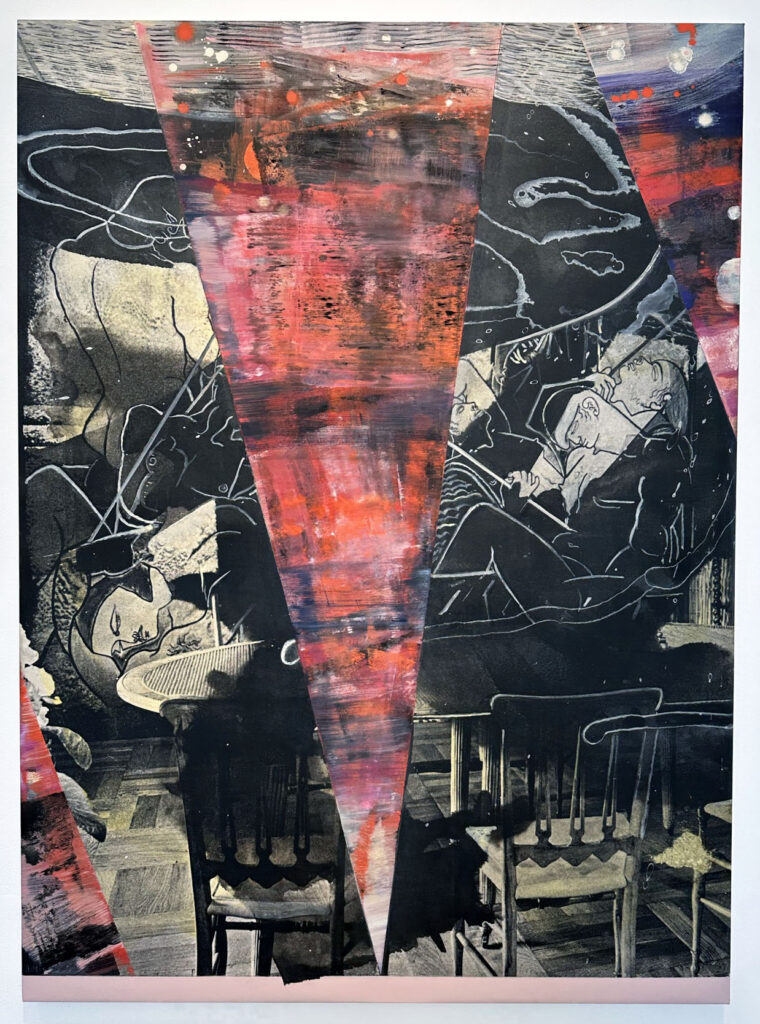
“Cocteau and Table”, 2023,oil on archival inkjet printed canvas

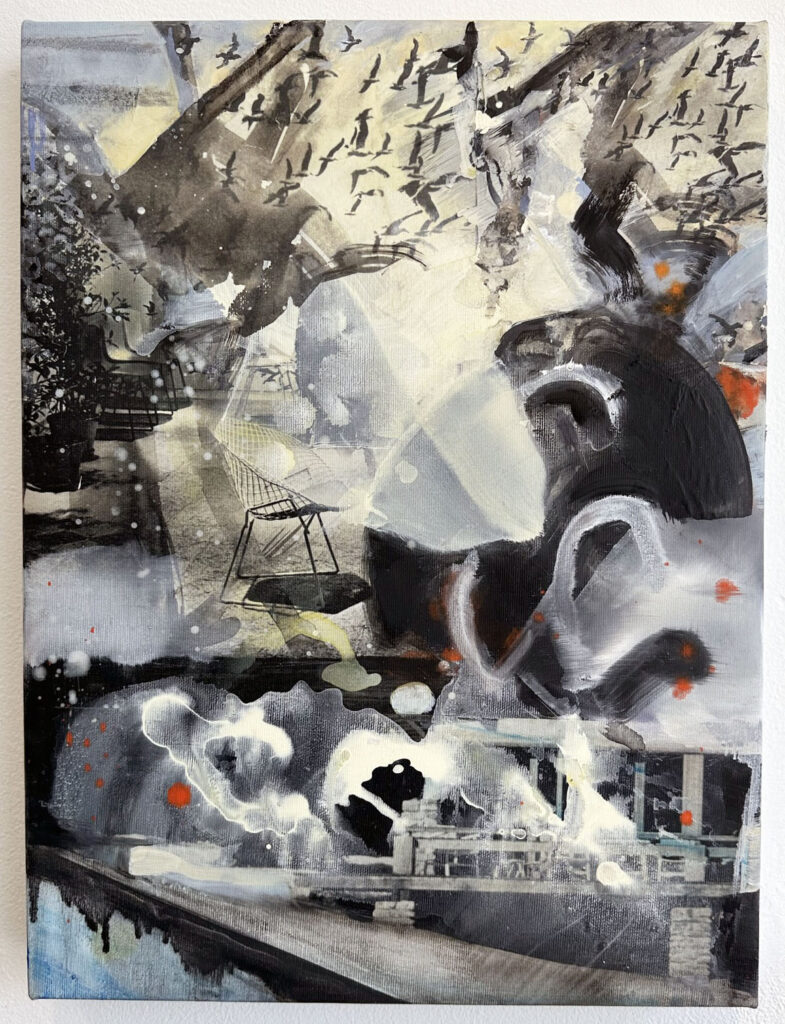
“The Seasons Between”, 2023, oil on archival inkjet printed canvas

High Noon Gallery is currently showing Les Problémes du Confort, an exhibition of work by Mary Jones.

From the press release-

Jones began this most recent body of work, collectively called simply, “Interior Design,” by painting Sumi ink over the black and white printed pages of a comprehensive French Interior Design publication from the 1960s. “[I chose the series’ title] not only to underscore the attributes of the original images, but to address their psychological component: the topos of dreams, so notably analyzed by Gaston Bachelard and James Hillman, spaces we conjure to discover the elements of our inner lives. Homes and interiors are not only spaces we remember, but also labyrinths of symbolism, familiar to all of us as emotionally charged experiences,” she explains.

The addition of her signature mark making started as an exercise to identify patterns in the tonal pages, separate from the context of the imagery. It seemed to act as a compositional barometer of sorts, deflecting the space in certain areas and illuminating it in others. The painted catalog images were then collaged, blown up, printed on canvas, and painted again, further conflating space and gesture, and inhabiting the vacant interiors with a visible energy. In doing so, Jones satisfies the principles of high design with the paintings’ harmonic beauty, and also the open systems of fine art by positioning the work as cultural critique that challenges the colonialist motifs that permeate the aesthetic sensibility of many of the spaces.

Jones’s work has long gnawed at the malleability of subject matter. She consistently uses legible imagery to anchor her abstractions, prodding at the fickle divide between the two modalities. Her sensitivity to painting’s illusionistic properties is connected to her experience as a faux painter, freelance work she’s done for 25 years. While the object of faux painting is to not let the artist’s hand show, Jones riffs on her craft by skillfully merging gesture and image in ways that are largely indistinguishable. She allows the marks to emulate form and object, playing on the viewer’s expectations of pictorial logic and slyly addressing the disparity between fine art and design, as for many decades— and especially during painting’s theoretical heyday in the second half of the 20th century— they shared a tenuous opposition. Design is associated with expense, and American society is perpetually transfixed by the Romantic notion of the artist as a working class hero.

Ionic Memories (2023), depicts a decadent room steeped in Roman busts and columns, the title a tongue-in-cheek reference to the science of memory and the unstable nature of artistic movements and empires alike. Jones echoes the velvety matte blacks of the printed image in her direct painting gestures, mixing a near perfect replica of the tone and texture for her to set up a meta tromp-l’oeil effect. In the foreground, a collaged brush stroke swipes away at the interior revealing a snowy landscape wherein a bush and modernist cabin are obscured by a swath of pink oil paint. In the context of the whole, the landscape reads as decorative forms within the room, such as fan coral and glass spheres. Other works such as Cocteau and Table (2023) make greater use of a fragmented effect wherein decisively multiversal looking forms cut through the composition like a glimpse into a parallel reality. Through a mix of painterly and faux elements, Jones takes care to merge her augmented realities just enough to allow the viewer to believe the image exists in one picture plane.

Perhaps to be comfortable is to momentarily resist time, to be temporarily impervious to the clamors for change. In Les Problémes du Confort, Jones reminds us that the arrangements we make with ourselves are transitory, constructed illusions to describe and reflect a sense of our place in the world we know, and that improvisational beauty can be found in transitions, in languages we don’t know, and in uncertainty.

This exhibition closes 4/23/23.