Jan 102020
 

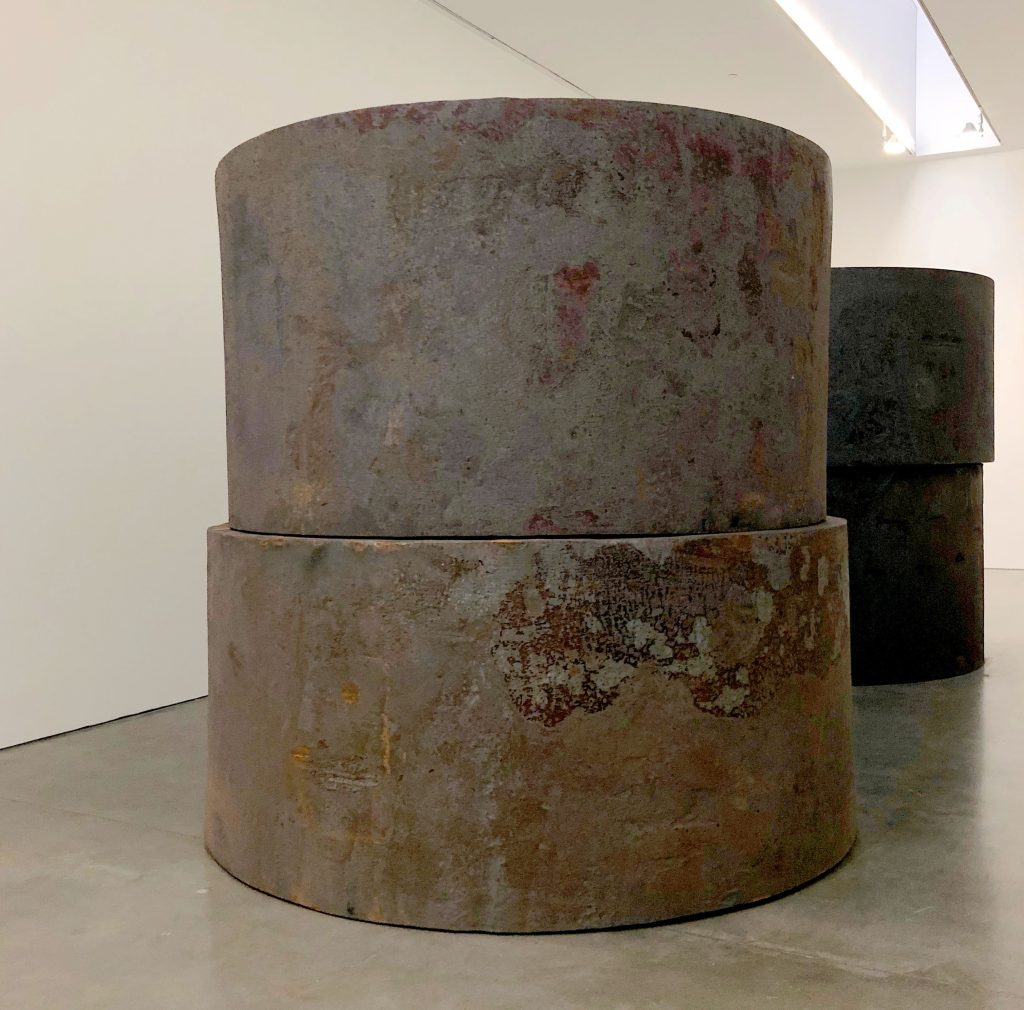
Gagosian is currently showing artist Richard Serra’s work at two of their locations. Above are works from Serra’s Rounds series and fill the entire West 24th Street location (closing 1/11/20), and in the 21st Street space is his Reverse Curve sculpture (closing 2/1/20).

Jan 032020
 

The Occult Enthusiast, 2019

The Occult Enthusiast, 2019 (detail)

Conspiracy Screen, 2019

Conspiracy Screen, 2019 (detail)

The GloFish Enthusiast, 2019

A Moment Eclipsed #1, 2019

The paintings in the Hernan Bas exhibition TIME LIFE at Lehmann Maupin’s 24th Street location tell stories. What those stories are, in some ways, ends up being up to the viewer. There is something really fun about that- paintings that your imagination can expand upon.

From the press release–

This exhibition will include seven large-scale paintings and one decorative room screen that feature a series of strange and seemingly obscure or forgotten moments that have influenced American culture. This body of work illustrates Bas’ innate ability to highlight cult phenomena from the past that offer insight into the political and social concerns of today. Rather than focusing on a singular subject matter, as Bas has done previously, this series spans time periods and themes, providing a unique perspective on American subculture and a contemporary version of History Painting.

Bas is best known for his narrative paintings that weave together adolescent adventures and the paranormal with classical poetry, religious stories, mythology, and literature. His subjects are often young men, typically in the transitional moment between boyhood and manhood. While the young male figure remains prominent in this body of work, each individual painting becomes an in-depth investigation into a singular critical subject, addressing topics such as LGBTQIA+ activism and desire, politics, news, conspiracy theories, and the occult. The title of the exhibition, TIME LIFE, is inspired by the Time-Life Book series Mysteries of the Unknown. Published between 1987 and 1991, each book focused on a different paranormal topic, such as ghosts, UFOs, psychic powers, and dreams. For TIME LIFE, Bas has similarly produced a series of paintings, each focused on a singular topic, that navigate the boundaries between pop culture and history, fiction and reality, and the artist’s personal interests and curiosities.

The Sip In, 2019

For The Sip In (pictured above) however, there is more of a specific story that Bas is telling.

From the press release-

For the large-scale painting, The Sip In (2019), Bas drew inspiration from a photograph that was recently featured in The New York Times for the 50th anniversary of Stonewall. The image depicts the 1966 “sip in” at Julius’ bar, where three young men, dressed in suits, were refused service for being openly gay. The bar still exists today and is now known as the oldest gay bar in New York City. Bas was intrigued by this irony and hidden piece of New York history, as well as by the compositional similarity to Leonardo da Vinci’s The Last Supper (1495). Bas’ interpretation highlights this formal similarity by removing the body of the bartender, leaving only his apparition in the form of a white glove hovering over a glass, making the young men the primary subjects of the painting. This representation of 1960s gay activism through the formal likeness to an iconic religious painting depicting Christ just prior to his death emphasizes the violence the LGBTQIA+ community continues to endure, especially as their rights are increasingly at risk due to the current presidential administration’s discriminatory language and policies.

This exhibition closes 1/4/20.


Dec 202019


Jack Shainman Gallery is currently showing two solo exhibitions of recent paintings by Meleko Mokgosi. The first, (a painting from which is pictured above) is titled The social revolution of our time cannot take its poetry from the past but only from the poetry of the future.

From the press release-

The title of Mokgosi’s 20th Street installation, The social revolution of our time cannot take its poetry from the past but only from the poetry of the future., is taken from Karl Marx’s The Eighteenth Brumaire of Louis Bonaparte. This text points to the limits of revolutionary discourses and proposes that it is only through disavowing the past that revolutionary action can occur. Similar to this argument, this body of work argues both for a disavowal of past grand narratives as well as the recuperation of non-Western forms of knowledge that were not privileged to coexist with conventional or established discursive frameworks. All twelve paintings are paired with a text that is taken from the writings of women either from Africa or the African Diaspora. The texts and paintings examine a wide range of issues, from African feminism and the struggle for liberation by African countries, to love, solidarity, and aesthetics. By pairing text and image, Mokgosi’s work aims to further questions around the politics of representation and strategies of resistance.

The second exhibition is Pan-African Pulp, pictured below.

From the press release-

…Mokgosi’s body of work at 24th Street, uses popular southern African pulp magazines or photo-novels to examine, broadly, the history of Pan-Africanism. These photo-novels, colloquially referred to as look-books, were first printed in the 1960s as an off-shoot of Drum Publications. Unlike Drum magazine, which addressed politics and issues of race in South Africa, photo-novels such as Lance Spearman avoided engaging with debates around politics, instead choosing to offer entertaining James Bond-like episodes of crime fighting. The photo novels—a less expensive alternative to filmmaking—are composed of staged photographs depicting action scenes, and follow a script conveyed with speech bubbles written in English, combining elements of comic books, films, and magazines.

Mokgosi has appropriated this trope and created new dialogue and plots within the existing imagery. By specifically focusing on Pan-Africanism, Mokgosi hopes to find meaningful ways of reconceptualizing the importance of a movement that sought to build alliances towards Black consciousness and foregrounding the rights and aspirations of Africans to self-determination and self-governance. Mokgosi reflects, “There is no doubt about the injustices, inhumanity, exploitation, violence, and racism caused by and associated with the Euro-American slave trade, European imperialism in Africa, and institutionalized racism in the Americas; the effects of these are ongoing and reflected not only in cultural and geopolitical contexts but also in the very reproduction and circulation of capital.” This work is the first of many stages through which Mokgosi intends to engage with and ask urgent questions around Pan-Africanism and solidarity.

Both of these exhibitions close 12/21/19.

Dec 202019
 

The paintings in Li Songsong’s One of My Ancestors, at Pace Gallery in Chelsea, are rich in both color and texture. Li creates his paintings from found photographs, adding another dimension to the work.

From the press release-

In the process of reinterpreting found imagery drawn from public sources such as everyday news items, Li adopts an impartial attitude. “I did not deliberately look for these images,” he explains, “It just happened. For example, a friend of mine went to an old book stall in Beijing to buy old magazines. I saw a good photo, and then I used it. I don’t seem to care about the content of the image itself. Of course, they are a starting point, but they will affect you more on a psychological level than in a narrative way.”

Li is interested in the ways in which images can trigger memories and emotions—a psychological impact magnified by his technique. The use of impasto and the dense materiality of his brushstrokes elicit a potent haptic response, while his palette of cool shades of gray, green, and beige create an estrangement from his chosen subject matter, as seen in Little Brother (2017), South (2017), and Civil Rather than Military (2018). Through his signature use of compact blocks of color, Li deconstructs and reassembles images, pushing his art towards abstraction.

This exhibition closes 12/21/19.

Dec 192019
 

Anish Kapoor’s exhibition at Lisson Gallery’s 24th Street location is a reflective wonderland where the sculptures twist your perception of your surroundings as you move around them. If his work looks familiar, he has created many public outdoor works including Cloud Gate, also known as “The Bean”, which is permanently installed in Millennium Park in Chicago.

The exhibition continues at Lisson Gallery’s smaller 10th Avenue space with several of Kapoor’s colorful wall-based circular sculptures in semi-reflective hues.

Both of these exhibitions close 12/20/19.


Dec 192019
 

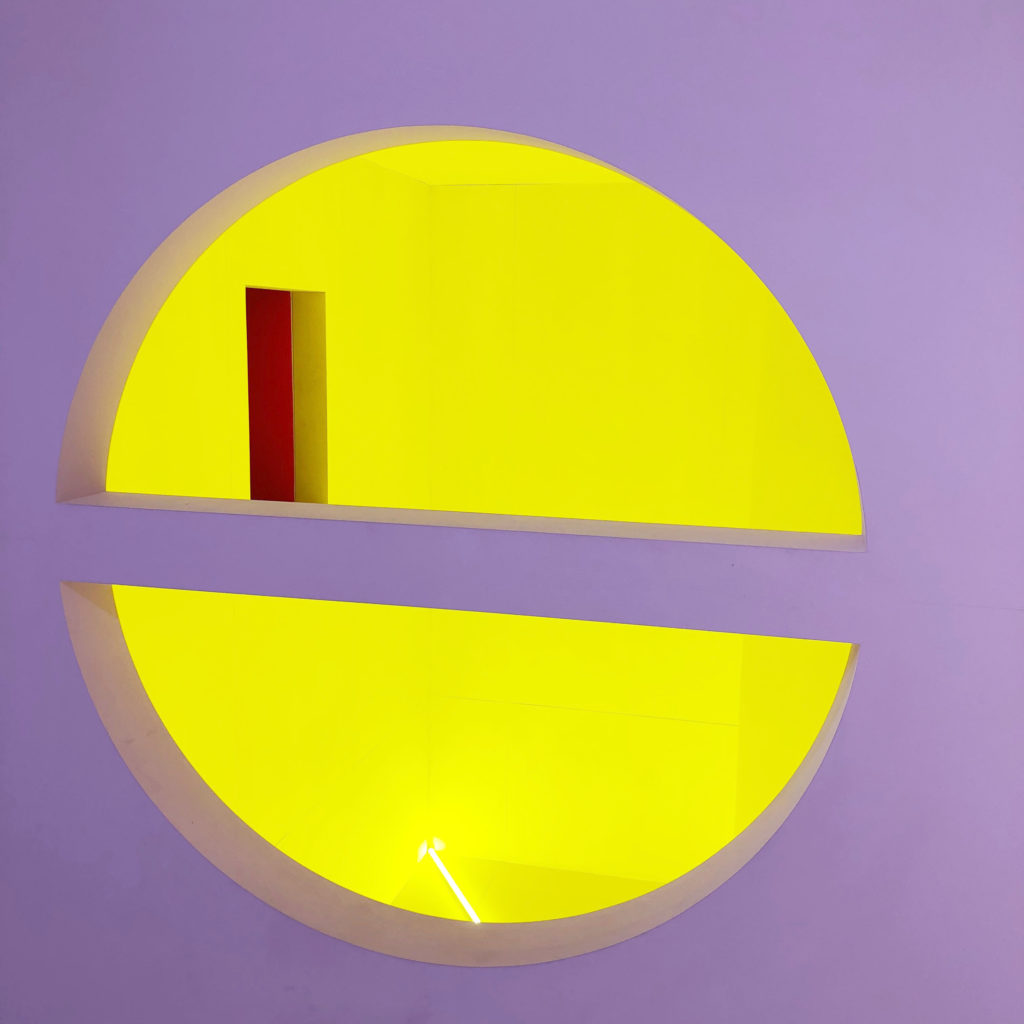
For Peter Halley’s Heterotopia II, at Greene Naftali’s ground floor gallery in Chelsea, he has created a delightful, brightly colored maze-like installation.

From the press release–

In Des Espaces Autres (1984), Michel Foucault defines heterotopia in opposition to utopia. While utopias are unrealized representations of a perfected society, heterotopias exist within all societies as realms differentiated from everyday life. Examples include ceremonial, sacred, and institutional spaces such as chapels, cemeteries, libraries, and prisons. They are spaces designated for special activities – creating their own sense of time and operating according to their own standards.

Through a range of media – painting, architectural installation, digital prints, and critical writing – Peter Halley’s work has illuminated the structures of social space and communication that shape our experience of contemporary life. For his second solo exhibition at Greene Naftali, Halley presents Heterotopia II, the latest in a series of large-scale installations exploring the relationship between painting and architectural space. Halley has created a multi-colored, labyrinthine structure in the ground floor gallery housing eight new shaped-canvas paintings, titled after imaginary planets from Isaac Asimov’s science-fictional universe.

The installation is enclosed by tall neon yellow walls coated in Roll-a-Tex, with only a narrow slot in the front wall offering the viewer a preemptive glimpse inside. The interior space is organized around a glowing yellow core – an inaccessible inner sanctum whose light is solely visible through three distinctive apertures. Around the core are arrayed eight interconnected rooms rendered in vivid colors, each defined by architectural elements, including staircases, keyhole windows, beams, and columns. The arrangement of these elements playfully nods to motifs in the work of architects Peter Eisenmann, Hans Hollein, Luis Barragán, and Louis Kahn, as well as to Halley’s own oeuvre. Halley’s installation, with its candy colored surfaces, is a postmodern reverie on neoplasticism and modernist geometry, founded on a tension between rationalist geometry and lyrical color.

Visitors circulating through the maze-like installation encounter Halley’s shaped-canvas paintings one-by-one, as the interactions between two-dimensional image and three-dimensional architecture unfolds. Composed of multiple interlocking prisons and cells, the paintings create ambiguous figure-ground relationships, while echoing the geometric plan of their three-dimensional setting.

This exhibition closes 12/20/19.

Oct 222019
 

Alex Prager’s exhibition at Lehmann Maupin’s 22nd Street location combines sculpture and still photography with her new film Play The Wind. The photographs in the show recreate scenes from the film, but are not from the film itself.  There are also photos of scenes that could have been from the film, but are not. These allow the viewer to consider alternate narratives to the story they have just seen. The photos also offer an opportunity to see many of the details from the film seen only briefly while watching.

Running for eight minutes, Play the Wind is a journey into a bizarre version of Los Angeles. It’s seen mainly through the window of a car, the way many Los Angeles residents often see it. Places seem familiar, as do many of the large cast of extras who inhabit this world, even if you are not personally familiar with the city.

The cab driver, played by Dimitri Chamblas (dean of the Sharon Disney Lund School of Dance at CalArts), drives through situations that seem both surreal and possible at the same time, like many things that happen in LA. At one point the cab driver, drives past an accident on the highway and sees a car vertical between two other cars with children in a school bus leaning out of the windows to observe. He passes alongside and moves on. It’s just another moment in a chaotic Los Angeles day. When he locks eyes with a woman played by actress Riley Keough, the film changes to her perspective and it all becomes even more dreamlike.

From the press release–

…She anchors her characteristically elaborate fictional scenes within the real Los Angeles, shooting for the first time in many years primarily on location rather than in the studio—a decision that harkens back to when Prager began her career over a decade ago. Though the images contain large constructed set pieces and are populated with carefully cast extras (numbering up to 300), the presence of the Los Angeles streets infuses an element of urban lifeblood that is palpable in the work. Prager’s perception of Los Angeles is one of the artifice and drama befitting Hollywood, with real world chaos that overflows into sci-fi dystopia and post-apocalyptic dread. She toys with these visions of the city disseminated on film, TV, and within the popular imagination, which inform our characterization of a place as much as our own memories.

Technically important to the making of this film was Prager’s collaboration with a team to produce set designs and props that would add a layer of artifice and duplicity to her real-world locations. The interference of these traditional illusionary effects upon the actual Los Angeles streets and locations Prager shot on creates an unnerving sensation, hinting at the reality that might exist just outside of our perception. All of these elements are recast in the series of photographs, which appear in different configurations or on various scales that further destabilize any linear narrative. Drawing on the concept of a distorted memory, Prager has found ways to incorporate objects seen in the photographs and film into the gallery as sculpture, with the intent to further dislodge our understanding of place and time and bring us deeper into her highly constructed world.

Connoisseurs of Prager’s work will likely spot the references to her past series, such as the noir themed Compulsion (2012), or the archetypical ingénue of The Big Valley (2008). This self-referencing becomes yet another layering device, mixing Prager’s career-spanning themes and the greater art historical genres from which they are drawn to create work both entirely new, yet seemingly familiar. Prager’s incorporation of her past into her present work serves as a reminder that while the past may not be returned to, it does remain with us, appearing in surprising, sometimes unsettling ways.

This exhibition closes 10/26/19.

Oct 222019
 

An assortment of beaded and marble creations have taken over Marianne Boesky Gallery in Chelsea, courtesy of The Haas Brothers’ exhibition Madonna.

From the press release-

As is now a signature of The Haas Brothers’ presentations, Madonna will transport viewers into an otherworldly realm, where fantastical animals and odd hybrids reside. Here, colorful sculptures and objects that resemble futuristic creatures will be positioned among seemingly rare tropical plants, and connected into a cohesive environment through undulating platforms. The featured works capture the Brothers’ wide-ranging artistic processes, from intricate beading techniques to monumental stonework to the incorporation of woven elements, and produce an incredibly tactile and evocative experience. The exhibition also highlights the Brothers’ diverse collaborations, including with workshops in California, South Africa, and Portugal, and encapsulates their deep engagement and support for those working in traditionally understood craft.

The Haas Brothers were first introduced to beading in 2015, when they met a group of women artisans selling beadworks in a craft market in Cape Town, South Africa. The Brothers’ were enamored with both the complexity of the technique and the incredible artistry in the women’s work. Seizing the serendipity of the moment, the Brothers’ established a collaboration with the artisans, which led to the development of the Afreaks series, a group of beaded creatures that were shown at the Cooper Hewitt’s Design Triennial in 2016. Since then, The Haas Brothers’ collaboration with the collective of women, who warmly go by The Haas Sisters, has grown and matured.

For Madonna, the collective will support the production of the featured beaded objects, guided by The Haas Brothers’ preparatory drawings and using a selection of Murano glass beads produced in Venice between 1880 and 1980, which The Haas Brothers purchased after the factory became defunct. In addition, Simon Haas has developed a complex system that captures the expansive creative opportunities that beading allows and that provides a guide to learning the craft. This system has been articulated in The Haas Brothers’ Bead Book, which has allowed Simon and Niki to teach the techniques to people local to the area of Lost Hills in Central California, establishing a workshop that offers work and pay in an area that lacks employment options. As part of their work with different communities and artisans, The Haas Brothers establish fair pay systems that include both economic support for the creation of works as well as in some instances profit sharing from sales.

“Part of the vision for our practice, and what we see as essential to the creation of art, is the establishment of communities. We are constantly asking how we can engage with others to achieve something new; something beautiful; something that excites or brings joy—that is really the importance and value of art and artmaking,” said The Haas Brothers. “At the same time, we recognize the platform and voice that we have been given, and think it is critical that we use both to uplift and support others, especially women who have traditionally not been recognized for their craftwork and skills. We feel so lucky to have developed this relationship with The Haas Sisters, and to have the opportunity to shed light on their dedication and tremendous work, while also paying a fair and right wage for their contributions.”

The beadwork in the exhibition will be augmented by several sculptures made with Portuguese Pele de Tigre marble. The Brothers first came to stone carving in their youth, learning from their father, artist Berthold Haas, and recently returned to the material, showing several large pieces at Marianne Boesky Gallery’s Aspen location in June 2018. The solid, smooth, and monumental nature of the stone works provides a powerful counterpoint to the more delicate and finely detailed beadworks and highlights the range of The Haas Brother’s practice. Here too, community proves an important element, as The Haas Brothers’ engagement has helped spur the development of stone-carving as an economic engine at the quarry that they use. The anchor figure, the Madonna, within the upcoming exhibition combines the efforts and visions of the various communities with which the Brothers are involved—each lending to an aspect of its creation and making it a true embodiment of their collaborative vision.

This exhibition closes 10/26/19.

Oct 182019
 

“Crescent (Timekeeper)”

“Crescent (Timekeeper)”

“Crescent (Timekeeper)” Detail

Sarah Sze’s exhibition at Tanya Bonakdar’s gallery in New York is stunning. There is so much to look at, to appreciate. There are so many pieces to all of the work, and yet it never feels overwhelming. It makes you want to keep looking.

It’s also immersive. The windows on the outside of the gallery are covered in her work, as is the staircase alcove. The video projections in the main room travel all around the room, surrounding you with visuals and sound. Upstairs the floors of the gallery have paint splattered on them, accompanying the works on the walls.

Detail of the above work

In a room on the first floor is a “studio space” where you can gain insight into Sze’s process and how she makes these elaborate works.

From the press release-

Sze’s latest body of work frays “the seam between the real and the image” (Smith). Through complex constellations of objects and a proliferation of images, Sze expands upon the never- ending stream of visual narratives that we negotiate daily, from magazines and newspapers, television and iPhones, to cyberspace and outer space. The works evoke the generative and recursive process of image-making in a world where consumption and production are more interdependent, where the beginning of one idea is the ending of another—and where sculpture gives rise to images, and images to sculpture.

In this new exhibition, Sze expands her work by embedding her nuanced sculptural language into the material surfaces of painting and into the digital realm through the interplay of cloth, ink, wood, paper, metal, paint, found objects, light, sound and structural supports—collapsing distinctions between two, three and four dimensions. This body of work fundamentally alters our sense of time, place, and memory by transforming our experiences of the physical world around us. Both objects and images, Sze says, are “ultimately reminders of our own ephemerality”.

This exhibition closes 10/19/19.


Oct 172019
 

From Ishiuchi Miyako’s “Scars” series (1991-)

Images from the “ひろしま/ hiroshima” series, 2007-present

Ishiuchi Miyako’s exhibition occupies both floors of Fergus McCaffrey’s Chelsea gallery space and includes over 70 photographs from five series made over four decades, including many early and never-before-seen works.

On the first floor are the artist’s somber black and white photos of the buildings of her hometown of Yokosuka. Yokosuka was also the home of a US Naval Base, established in 1945.  In another room is work from her Scars series, for which she photographed the damage left behind by injury, illness, and trauma. These portraits focus not on the people but on the imprints on their bodies. Despite that, they don’t feel impersonal or voyeuristic. There is a tenderness to these images.

Photographs of objects dominate the rest of the exhibition. There are a series of images of her mother’s possessions, taken before she passed away. She also photographed Frida Kahlo’s belongings, including a pair of her shoes that were different sizes- accommodating the physical issues Kahlo had after her bout with polio as a child.

The photos of items donated to the Hiroshima Peace Museum, for the ひろしま/ hiroshima series, are especially moving. The articles of clothing worn by residents of Hiroshima when the atomic bomb was dropped on the city are worn and damaged. It’s hard not to think of what happened to the people who owned them.

Each series of photographs is unique, but tying them together is the idea of capturing what gets left behind. It can be a city or a scar or a person’s possessions after they die, but they have an effect. Ishiuchi’s photos record that effect in an impressive and thought provoking way.

This exhibition closes 10/18/19.