Oct 292024
 

“Earth Lament”, 2023, Pigment and pencil on Aquacryl on canvas and aluminium

“Earth Lament”, 2023,Pigment and pencil on Aquacryl on canvas and aluminium (detail)

“So Far So Near”, 2024, Pigment and pencil on Aquacryl on canvas and aluminium

“So Far So Near”, 2024, Pigment and pencil on Aquacryl on canvas and aluminium (detail)

“Cicada”, 2023, Pigment and pencil on Aquacryl on canvas and aluminium

Currently at Lisson Gallery is Shirazeh Houshiary: The Sound of One Hand, an exhibition of the artist’s new and recent work. For the paintings she combined distinct color formations with intricate patterns drawn on the surface using pencil. The details are astounding when seen up close.

From the press release-

For her first solo show in Los Angeles for over a decade, the British artist Shirazeh Houshiary presents new and recent works, exploring the origins of life and the mysteries of the cosmos, from a microscopic cellular level, to the stratospheric phenomenon of the aurora borealis. The show’s title relates to a Zen Buddhist teaching that instructs the student to listen to the sound of one hand clapping, in order to open their mind to such a possibility and transcend the constraints of the physical body. Despite not being a Zen practitioner, Houshiary realised that her work revolves around the insistent sound made by one of her hands, making tiny, looping, scratched marks in pencil onto large aluminum surfaces, building up worlds through the silence of her inscribed words.

Houshiary’s abstract paintings emerge from an initial pour of liquid color that floods the surface in irregular pools, before she then covers these areas with her own calligraphic gestures in graphite, which are in fact tiny repetitions of the Arabic phrases: “I am” and “I am not”, which she also likens to the natural act of inhaling and exhaling. For one of the two largest works in the show, entitled Enchanter (2024), Houshiary applies red pigment and pencil to a black ground in five ring shapes, recalling structures of carbon particles linked in a chain. Matching this in scale but cooler in tone, is the painting Earth Lament (2023), with two silhouetted blue figures that somehow materialized from the sedimented pigment, one appearing to soar and the other seemingly being dragged down. This accidental figuration also occurs in the work Cicada (2023), which could just as easily be a depiction of the wings of this insect as it could be a representation of its rhythmic song. At the other end of the scale are the galactic indigo swirls of So Far So Near (2024) and the bands of ethereal light crisscrossing the work titled Aurora (2023), recalling those seen occasionally streaking across a night sky.

Occupying the floor is a sculptural installation in nine parts, made from an open latticework of aluminum bricks in blue and green hues, each with the same footprint, but all at different heights, growing at increments of one layer at a time (the shortest has five layers, the highest thirteen). Entitled Maelstrom (2022), these curved forms, both hard and supple at the same time, recall not only the molecular structures of the red painting Enchanter, or “that primeval storm within the spiral of creation where something grows,” as the artist puts it, but also the shape of the ouroboros snake eating its own tail.

A second sculpture, seemingly another form defying logic and gravity, bursts from the wall. Its two sinuous, entangled lines are the artist’s approximation of the movement of a solitary wave – lending it the name Soliton (2024) – which is a type of swelling or surging motion that is not dependent on previous pulses, or followed by other waves. From such unfathomable objects, to minute molecules and gigantic expanses of space, Houshiary’s artworks represent a journey through everything from the chaos and messiness of the Big Bang to the silent contemplation of the resulting energies that surround every one of us.

This exhibition closes 11/2/24.

Jul 312024
 

For Hugh Hayden’s current exhibition Hughmans at Lisson Gallery, his sculptures remain hidden behind bathroom stall doors. The well-crafted works vary in subject, size, and material, and cover a wide range of social issues. For more information on his thought process and some of the work, Hayden recently discussed the show with Art in America.

From the press release-

Following his solo exhibition in Los Angeles, Hugh Hayden continues his exploration of the prosthetics of power in a new series of works and site-specific installations created for the Lisson Gallery New York space. In Hughmans, Hayden reengages with the concept of the bathroom stall in order to investigate experiences of revelation, intimacy, desire, and sexuality – this time through the lens of the collective experience.

Known for his poignant metaphors and examinations of human existence, Hayden’s work transcends individual experience to probe the collective consciousness. Hughmans maintains his signature use of wood as a primary medium alongside bronze, resin, and silicone, amplifying the depth and texture of his narrative. At the heart of the exhibition lies an ambitious site-specific installation, unraveling the complexities of power dynamics in contemporary society. Hayden transforms mundane elements into profound symbols, inviting viewers to confront their own perceptions and assumptions of daily life.

In the gallery, visitors will find an arrangement of metal bathroom stalls, each concealing an artwork within. This unconventional setup challenges notions of privacy and intimacy, urging viewers to reconsider their relationship with public spaces. Two wooden sculptures embodying the fictional character Pinocchio will be exhibited. Ebanocchio (2024) and Nocecchio (2024) serve as contrasting counterparts, one crafted from ebony and the other from walnut. In the original fairytale, Pinocchio’s name was also derived from his physical, wooden origin, ‘Pino’ being the Italian term for pine. These works employ Hayden’s recurring conceptual gesture of wood and the intersection of materiality and identity. The artist recently unveiled another sculpture, Geppetto (2023), in his comprehensive exhibition, American Vernacular, at the Laumeier Sculpture Park. Named in reference to Pincocchio’s father, the work serves as an antecedent to the pieces showcased in New York. Like much of Hayden’s ouvre, the fantastical story of the marionette is often attributed as a metaphor for the human condition.

In another stall, the artist will present Harlem (2024), a new ensemble of cast iron melting pots and copper pans – works which serve as a metaphor for the creation of America through cultural diversity. These particular sculptures will depict both facial features and functional musical instruments. This iteration of melting pots, made using sand casting, synthesizes diasporic movement and the African origins of the US. Unlike past presentations of similar works which were hung from the wall and ceiling, these works will be suspended from a New York City subway-style handrail.

This exhibition closes 8/2/24.


Aug 112021
 

Rapunzel, 2021

Fruity, 2021

Fee-fi-fo-fum, 2021

Good Hair, 2021

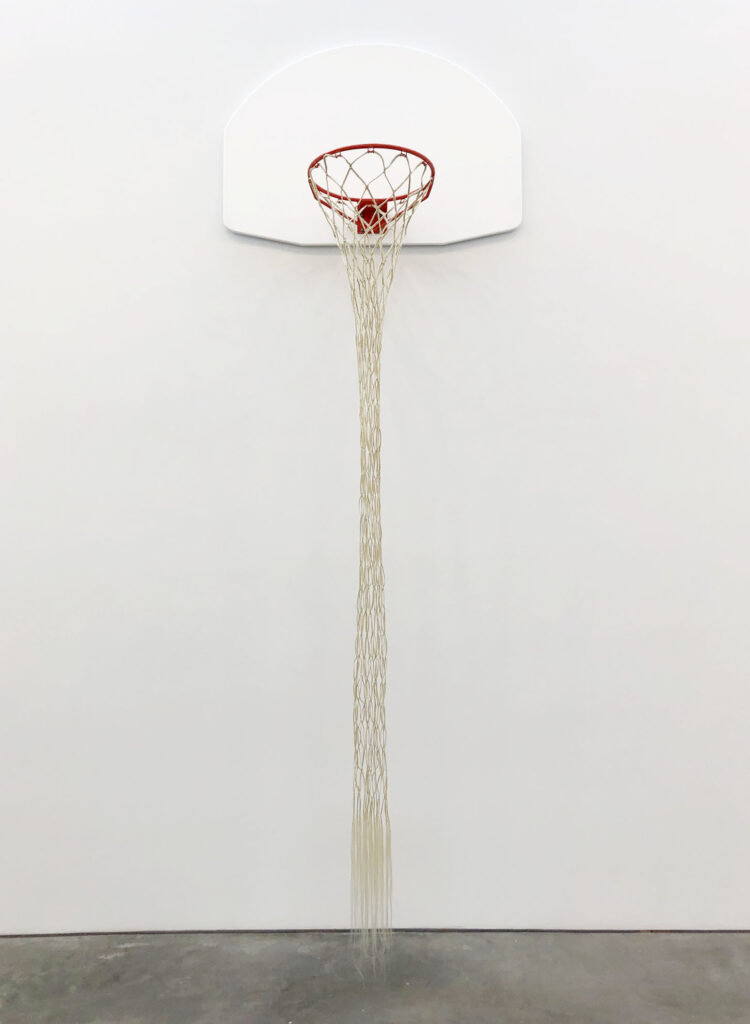
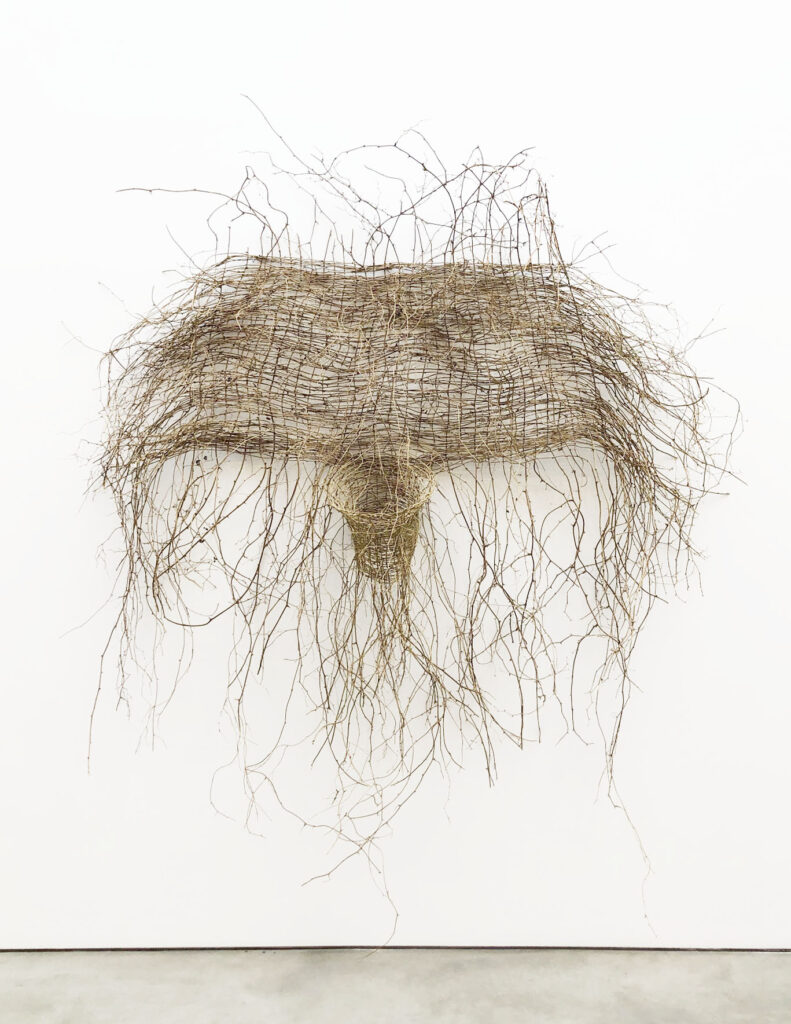
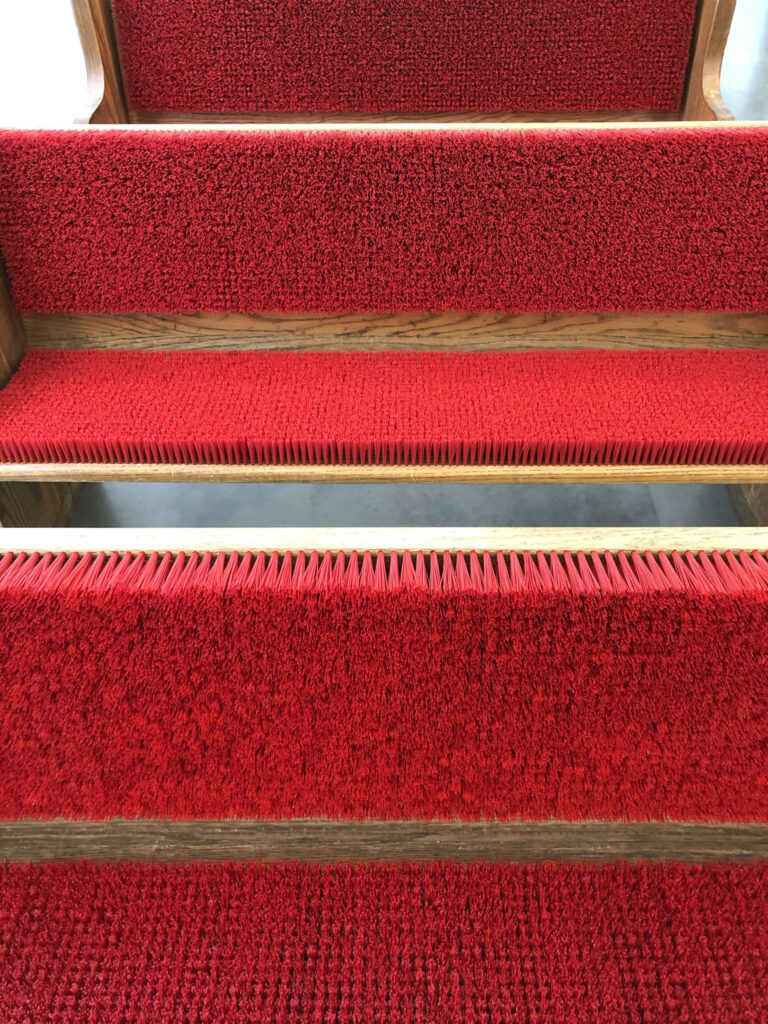
Lisson Gallery in New York is currently showing Hugh Hayden: Huey. This new body of work by Hayden “examines the American experience via agency, appearance, athletics and religion” and “interweaves symbols of the institutions that play key roles in an American upbringing with equally ever-present fairy tales to produce a new series of sculptures in wicker, vine, and ebony.”

More from the press release-

Hugh Hayden has previously examined the concept of the American Dream as well as the role historical foodways and dining traditions have played in shaping American identity. For Huey, the Texas-born artist chronicles and remixes his upbringing in the American South. Church, sport, school and hair are highlighted as Hayden probes the ingrained nature of cultural expectations. The exhibition is split into a trinity of rooms: a barber shop cum sanctuary, a basketball chapel and an ebony crypt, all of which harbor Hayden’s meticulously sculpted, sawed, sanded and woven objects.

The sanctuary features “Good Hair,” a new body of bristled wooden works that explore expectations of appearance and refinement in obligatory adolescent participation in athletics, education and religion. For Hayden the bristles render a subject simultaneously desirable yet uncomfortable, creating order via an abrasive action that, like the American Dream, is challenging and difficult to inhabit.

In the second chapel-like space hang woven basketball hoops out of hair, rattan and vine. The works are a childhood reimagination of the iconic peacock chairs the artist grew up with as well as an homage to the 1967 portrait of Black Panthers co-founder Huey P. Newton seated in one. The braided and woven works conflate tedious domestic handwork with hypermasculine athletics to materialize a queerness at odds with the fairy tale-like aspirations and reservations of becoming a professional athlete.

The final room of the exhibition is a meditation on agency, blackness and invisibility. Works sculpted from Gabon and Texas ebonies are presented in a daylight-lit, all-black room shifting in and out of visibility. Sculptures that reference the body, both moving fast as well as relaxing, offer an opportunity to reflect on the many hues of blackness.

This exhibition closes 8/13/21.

Dec 192019
 

Anish Kapoor’s exhibition at Lisson Gallery’s 24th Street location is a reflective wonderland where the sculptures twist your perception of your surroundings as you move around them. If his work looks familiar, he has created many public outdoor works including Cloud Gate, also known as “The Bean”, which is permanently installed in Millennium Park in Chicago.

The exhibition continues at Lisson Gallery’s smaller 10th Avenue space with several of Kapoor’s colorful wall-based circular sculptures in semi-reflective hues.

Both of these exhibitions close 12/20/19.


Dec 222016
 

terrywintersatmatthewmarks

terrywintersyellowmatthewmarks

To keep these posts a little shorter, I have split them up into two parts. The following continues the list of Chelsea exhibitions-

Terry Winters‘ vibrant paintings at Matthew Marks Gallery are made up of layers of marks in oil, resin, and wax.

From the press release-

“These recent paintings are a series of accumulations,” Winters says. “There’s a range of paint application in terms of both material and technique. Each color is a marker, a stage of development. I’m moving across the surface, modulating the material in different ways. That inflection produces an amplification of colors, both physical and chemical. But color is basically wild and full of surprises.”

padraigtimoneyatandrewkrepsgallery

Pádraig Timoney‘s work in The Deedle Eye, at Andrew Kreps Gallery, is a diverse combination of painting, photography, and installation.

From the press release-

Despite the visually distinct results, at the work’s core is a focused inquiry into the mechanics of images. Timoney conversely works in both directions – creating new images from abstractions (the captivating results of processes achieved in the studio), or rebuilding them part-by-part from photographs or observation. In each, he acknowledges the inherent flaws of these constructions, from the faultiness of recognition, the errors of translation, and further, the subjectivity of both viewers and the artist.

These in turn become generative openings in Timoney’s work as they are distanced from their original context. The images exist within thrilling, new visual constellations, allowing for the introduction of artifice and illusion, and the question of not only what they depict, but why? Each work records an index of decisions that determine its final state, materially and cognitively, displaying a history that is intentionally left open-ended. Figuration appears to hover only a hair away from abstraction, as if the movement of a line would cause one to collapse into the other. The narrowing of this gap suggests that the works’ initial disparate appearance may lead to an alternate understanding of their connections; a net that widens only to close anew, though what’s caught within it is left for the viewer to decide.

Also make sure to go to the space next door to see Klaus Weber’s sculpture Emergency Blanket.

klausweberatandrewkreps

Ai Weiwei has four shows up in NYC right now. Two of which are in Chelsea, at Mary Boone Gallery and Lisson Gallery, one is at the Mary Boone Gallery uptown, and one is at Deitch Projects in SoHo. Mary Boone Gallery and Lisson are both showing Weiwei’s Roots and Branches work, which includes large scale sections of dead trees, sometimes like the one seen below in cast iron at Lisson, and a 25 foot sculpture made up of tree parts bolted together. The uptown gallery includes a circle made up of 40,000 spouts broken off from Chinese teapots. Deitch Projects gallery has Laundromat, in which Weiwei has arranged items of clothing left behind by Syrian refugees (after they were forced to leave camps near the border of Greece) that he collected and laundered.

aiweiweilissongallery