Mar 022023
 

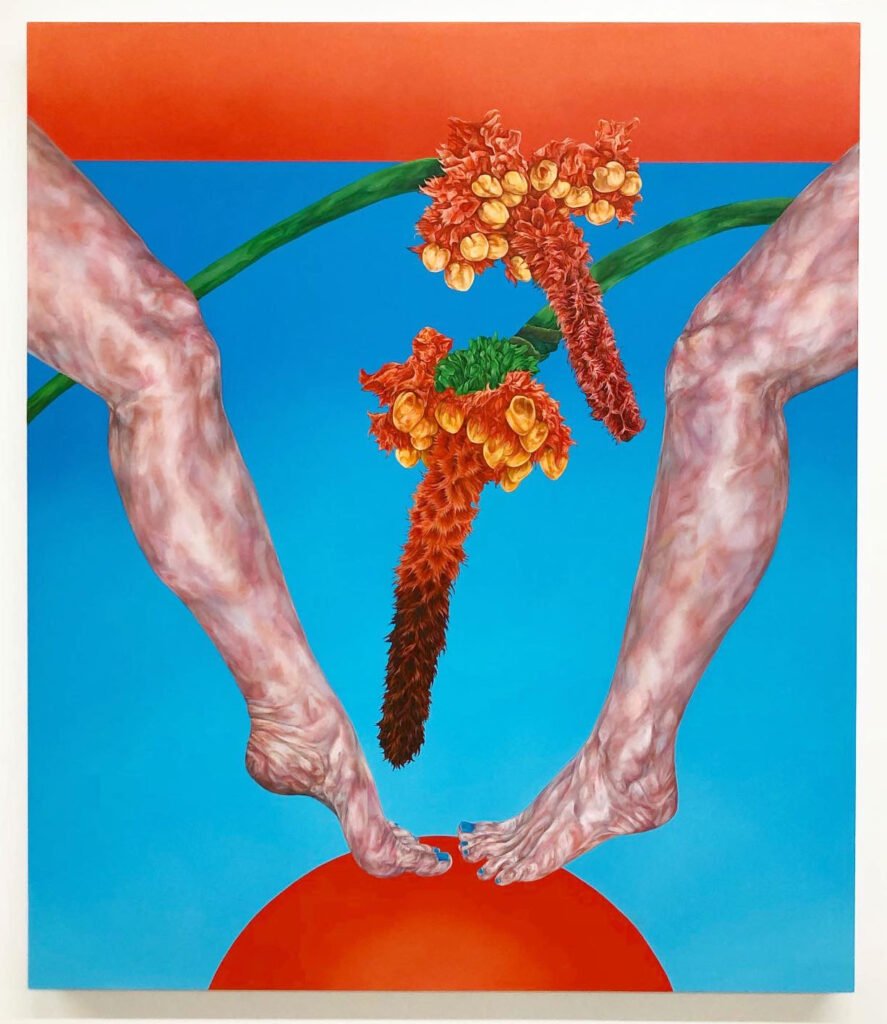
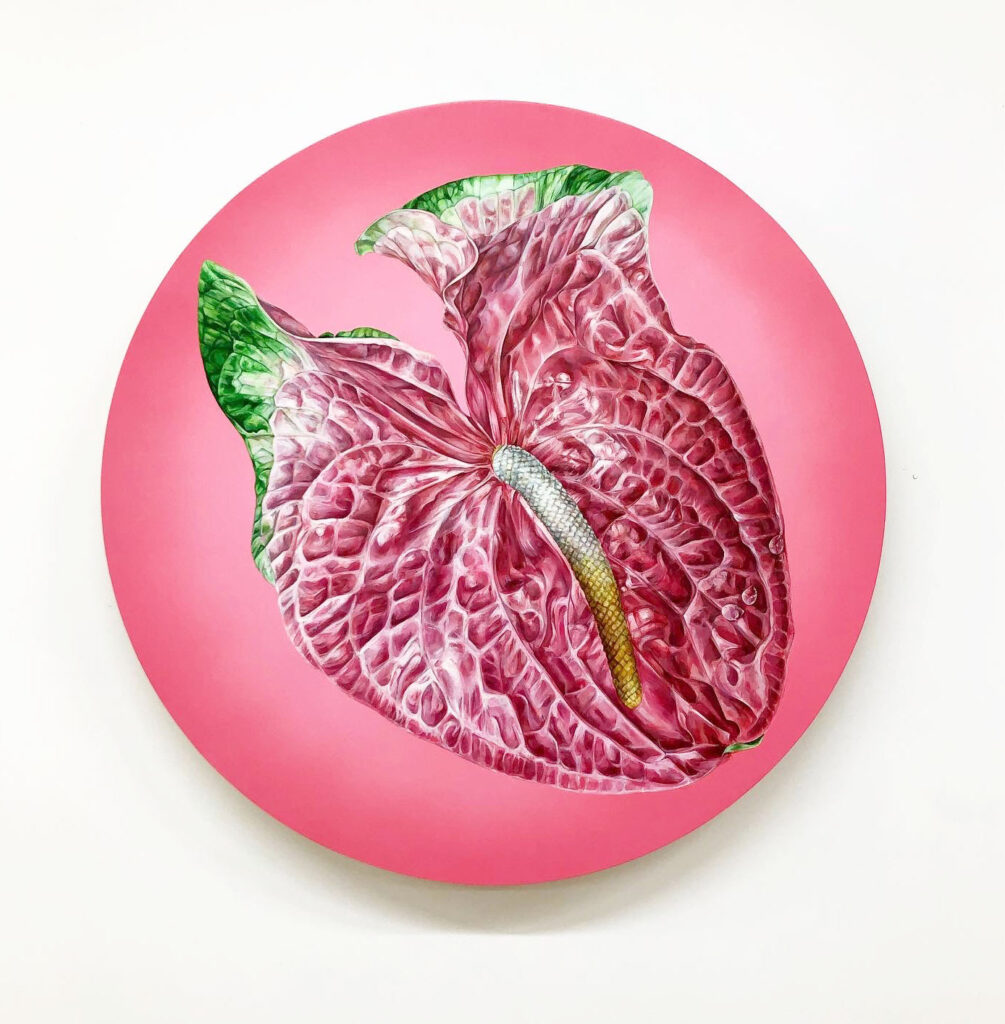
Iulia Nistor “Evidence L3 W2 P8”, 2022, oil on wood, 50 x 40 cm

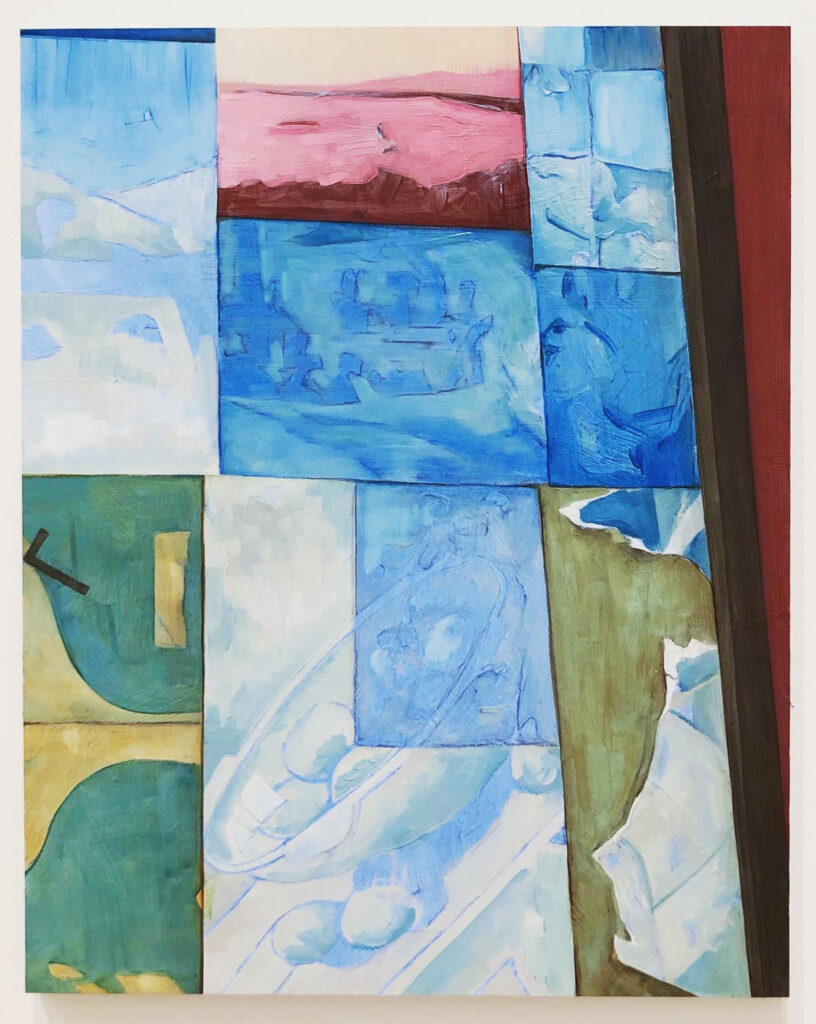
Iulia Nistor “Evidence L5 W8 P1”, 2022, oil on wood, 50 x 40 cm

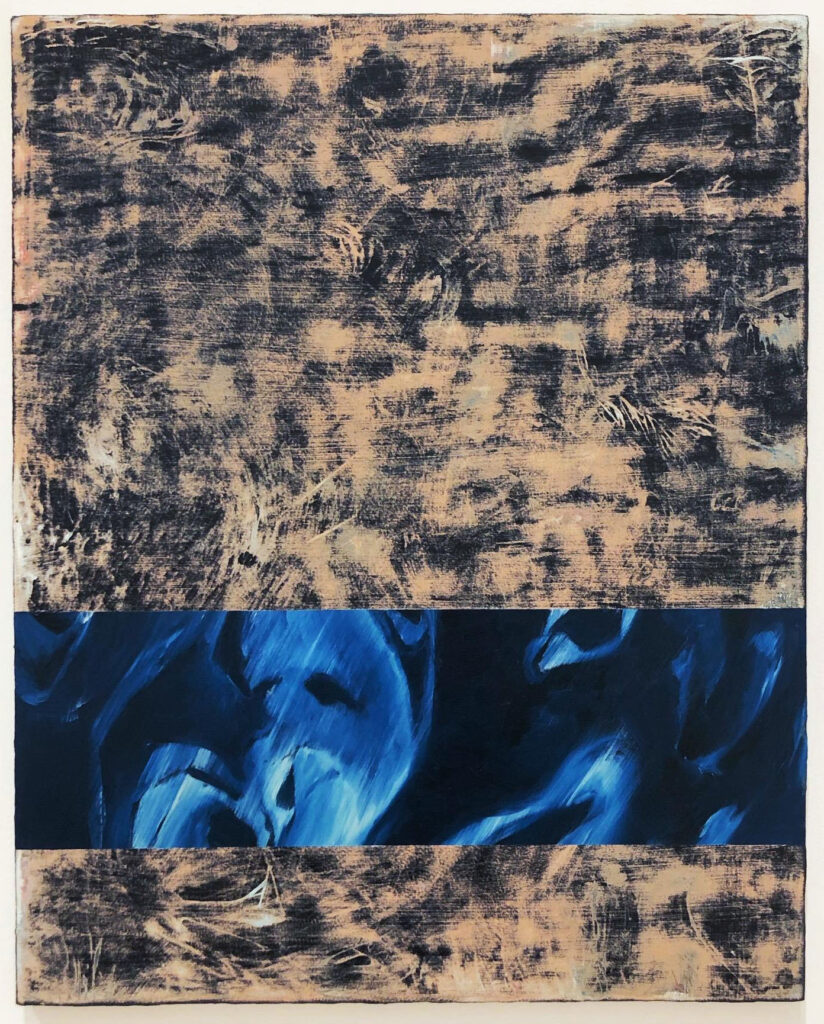
Iulia Nistor “Evidence L/E0 F4 A5”, 2022, oil on wood, 50 x 40 cm

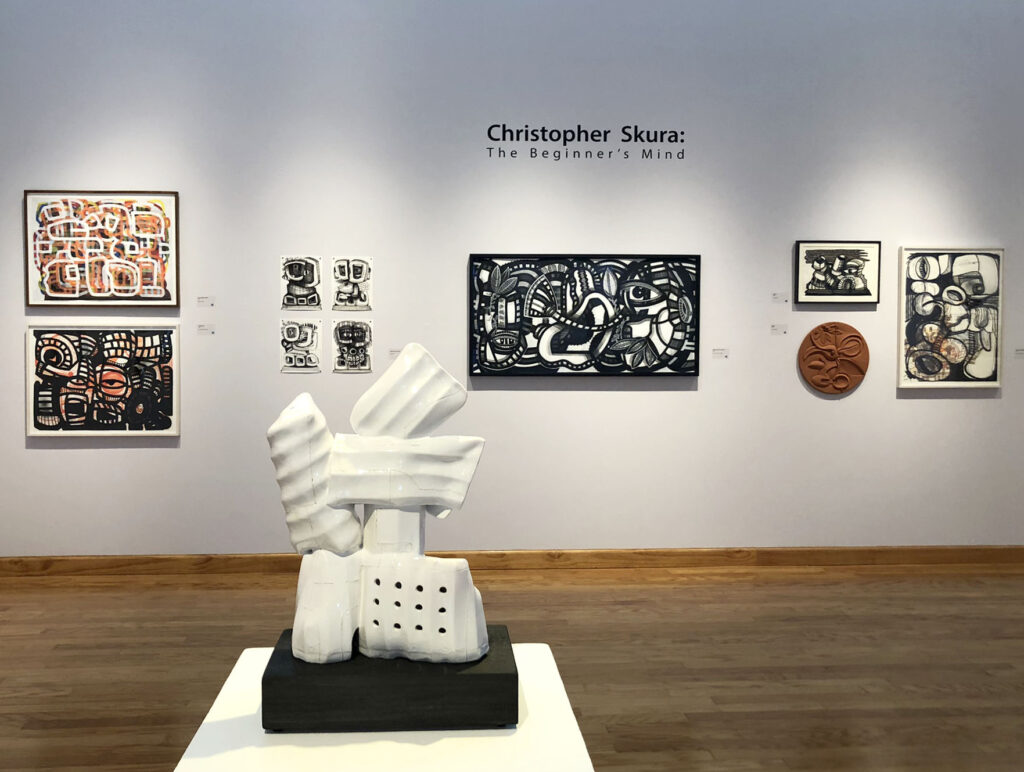
Iulia Nistor “Evidence L6 F2 A9”, 2023, oil on wood, 50 x 40 cm

Currently at Mendes Wood Gallery in NYC are Iulia Nistor’s paintings for her solo exhibition properties without object. The new works are part of her Evidence Paintings series. Each painting is the same size and titled with coordinates “suggesting not only the representational function, but also documentary specificity, of paintings which rarely picture anything we can automatically name”.

More from the gallery’s press release-

Paint is used with a diverse range of techniques, applied with a fine brush in painstaking detail or with broad gestures. Hard-edged forms cede to organic scumbling. Deep illusionistic spaces, evoked by geometric lines of perspective, contrast with marks which emphasize painting’s limitations to its surface. Trompe l’oeil plays sly games with our habitual perceptions. Dried paint is removed with a sanding device, subverting Nistor’s intentions, producing unforeseen configurations and textures, and reducing multiple layers of paint to ground.

Irreducible to any singular style, these expressive resources are positioned to represent the properties of certain things, perhaps an observed aspect of an object, a place, a person, or the space between them. Nistor’s purpose is not primarily to represent the things themselves but the qualities which they possess. This aim makes her paintings register less as representations than inquiries into the nature of representation itself, questioning the opaque relation between how something appears, how it is perceived, and how that duality can be pictorially rendered. How much of what we experience is a given of the environment, and how is it changed by the subjectivity which accompanies it? Does a painting, unlike a photograph, need to depart from the ostensible form of its subject to, paradoxically, achieve a true likeness of it?
Nistor often proceeds through gestures of subtraction, isolating a property of an object by eliminating aspects of it. The specificities of her practice correspond to the specificity of the phenomena they are used to capture.

Alongside her paintings, for the first time, Nistor exhibits a pair of photographs, each showing one side of an A4 sheet of paper, upon which a sequence of propositions is printed. These are attempts to define the relationship between objects and the properties which seem to adhere to them. The spare sentences, phrased in objective, philosophical language, have been edited by queries and remarks, written in pencil and ballpoint pen, in the artist’s hand. This process of revision and redefinition, preempting the demand for a categorical answer, reflects the artist’s process in painting.

In both photographs, the sheets appear on a black studio surface. One rests parallel to its frame, resembling an aperture, while the other lies tilted, negating this illusion. The abstractions of language qualify—or are qualified by—the materiality of the wooden surface, much like those upon which Nistor paints, stained with traces of the artist’s process. A window into Nistor’s conceptual method doubles as a formal metaphor for the axis, central to her practice, between the given and the made.

Iulia Nistor, “Untitled (properties without object)”, 2023, photo on cotton paper (image via Mendes Wood )

This exhibition closes 3/5/23.

Feb 262023
 

Y.Z. Kami “Woman in Dark Sweater, 2022

Y.Z. Kami “Woman in Dark Sweater, 2022 (detail)

Y.Z. Kami “Aïsha”, 2012-22

Y.Z. Kami “Messenger IV”, 2022

Y.Z. Kami “Night Painting XV”, 2022

For his exhibition Night and Day at Gagosian in NYC, Y.Z. Kami is presenting two distinct bodies of work, his portrait paintings and a newer series, Night Paintings, started in 2017.

From the press release-

Each of Kami’s large-scale painted portraits depicts a single face in muted colors on an opaque ground. Frontally composed and closely cropped, Kami’s self-absorbed subjects are removed from the specificity of context. From Aïsha (2021–22) and Lu (2022) to The Monk (2022) and Woman in Dark Sweater (2022), these paintings are titled by first names or descriptions, marking a continuum between individual identity and universality. Using layers of brushstrokes to blur his subjects’ features, Kami concentrates on the ineffability of individual presence. From longtime friends and acquaintances to strangers he has met in passing, his subjects form an ensemble of varied age, gender, and ethnicity. Kami’s introspective faces also recall the Fayum portraits of Roman-era Egypt—naturalistic likenesses of the deceased that were affixed to mummies. The works in Night and Day affirm—as do their ancient precedents—the common humanity in our observation of others.

Kami’s Night Paintings are made using a single shade of indigo—said to be the color of the night—which he blends with gradations of white to summon the sensorial dynamics of presence and absence. Each canvas is filled with apparitions that float just past the limits of materiality and concrete representation. Composed with hazy, tenebrous brushwork, these abstractions evoke a mental inner state. Their shifting outlines and hazy boundaries make manifest soft edges and shimmering biomorphic patterns, enticing the viewer to recognize elements from the human realm while ultimately confounding all attempts to do so. The Night Paintings thereby limn the boundaries between the earthly and the sublime.

Messenger IV (2022), a single painting that belongs to neither series, represents a cloaked figure seen from behind, painted in a soft-focus style. The anonymous subject appears in the foreground of a crossroads, a setting of passage and transition. Kami has positioned this figure using the classical compositional device of the Rückenfigur (back-figure), with which the viewer is encouraged to identify, thus implicating him or her in the space and narrative suggested.

Contrary to the instantaneity of a photograph, Kami composes his paintings over an extended period, his nuanced brushwork built up in many layers. Consequently, they reward sustained looking, revealing their character over time and bringing awareness both to perception as a process and to contemplation of the nature of being.


Feb 252023
 

TIDE- “SEA E”

TIDE- “DAYS” and “CALM”


Closing on 2/25 at Ross + Kramer in NYC is artist TIDE’s  (Tatsuhiro Ide) debut solo exhibition, HAPPYSADEMPTYFULL.

From the gallery’s website-

TIDE is a Tokyo-based artist renowned for his signature cat character, which he depicts in monochromatic, domestic settings. Beginning in 2019, TIDE has made grayscale paintings of this cat character, existing within various domestic environments, often punctuated with art historical references. In this newest body of work, the cat, perhaps an avatar for the artist himself, lounges in a cozy bed, swathed in blankets and layers of duvets.

The title of the exhibition comes from a painting, HAPPYSADEMPTYFULL, and reflects the cycles of feelings that one experiences throughout a day. The subject matter feels especially relevant given current events—a housecat, much like humans in a pandemic lockdown, has a somewhat narrowed spectrum of experience.

TIDE works in multiple layers, using airbrush and spray paint to express the illusion of depth in a delicate environment, and employs a variety of brush stroke techniques in order to create the appearance of texture and natural elements. TIDE’s work wonderfully demonstrates the value and richness of harmonious composition. His monochromatic palette, coupled with crisp yet gentle silhouettes, ignites a pronounced sense of nostalgia.

Feb 252023
 

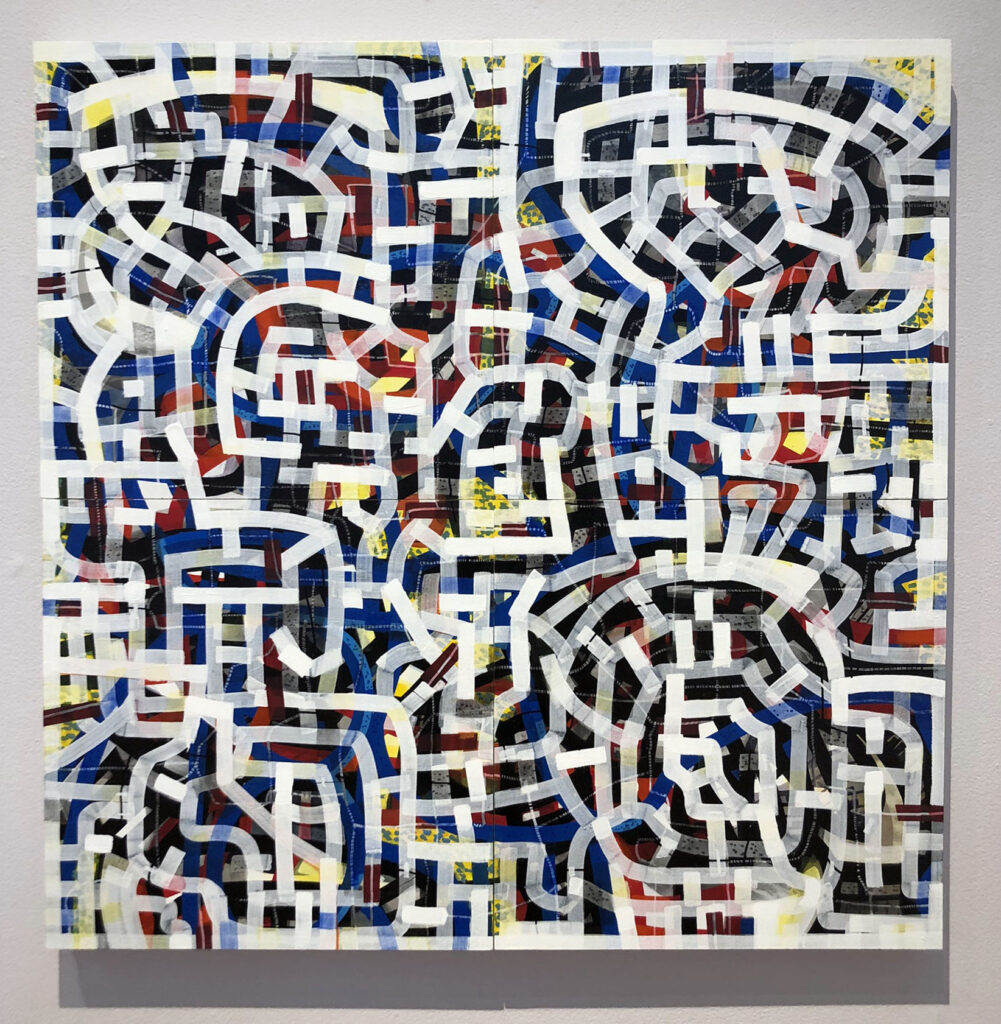
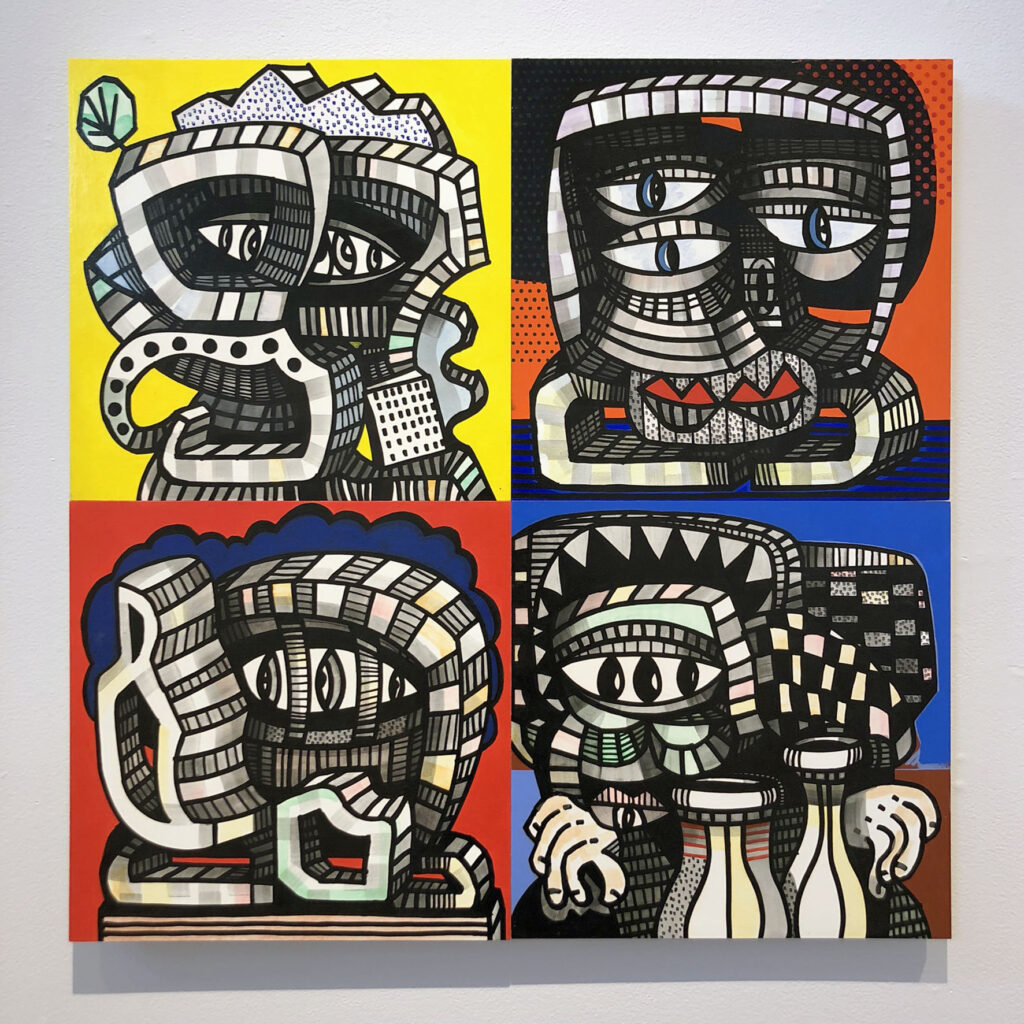
Christopher Skura, “Keep the Dream from Ending”, 2022

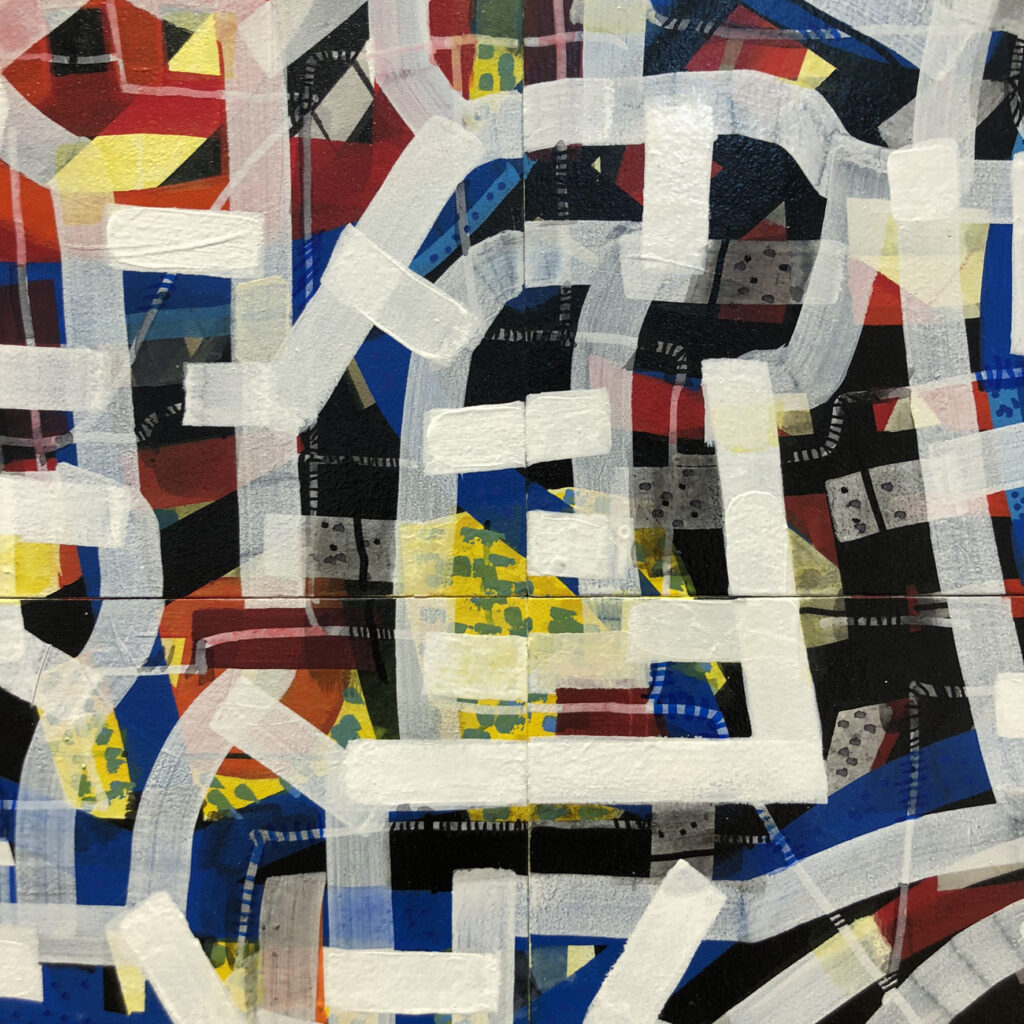
Christopher Skura, “Keep the Dream from Ending”, 2022 (detail)

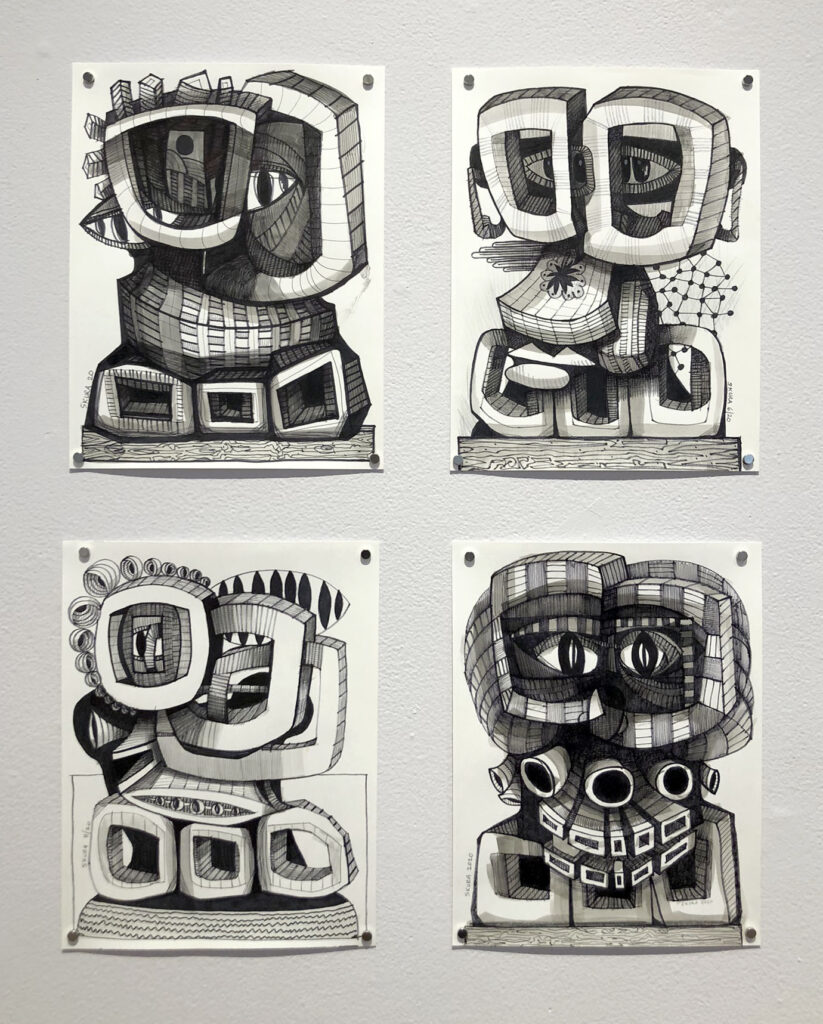
Christopher Skura “Sketchbook Drawings”

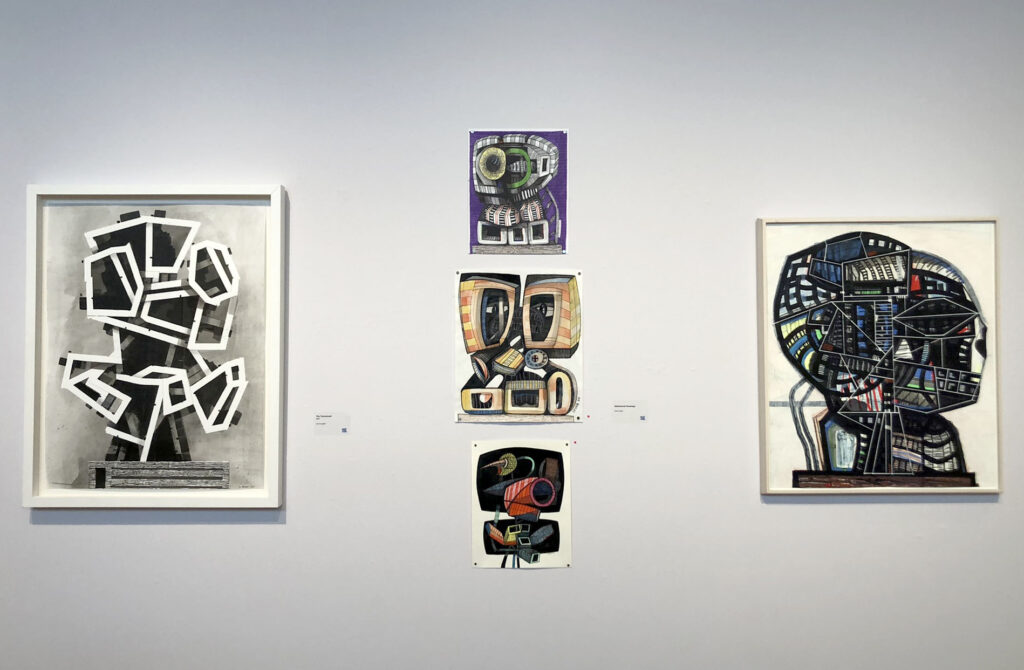
Christopher Skura, “The Turnaround”, 2021; “Sketchbook Drawings”; “Head Cult”, 2022


Christopher Skura, “Story Bored (Cast of Characters)”, 2021

Christopher Skura, “Gob Stopper”, 2018

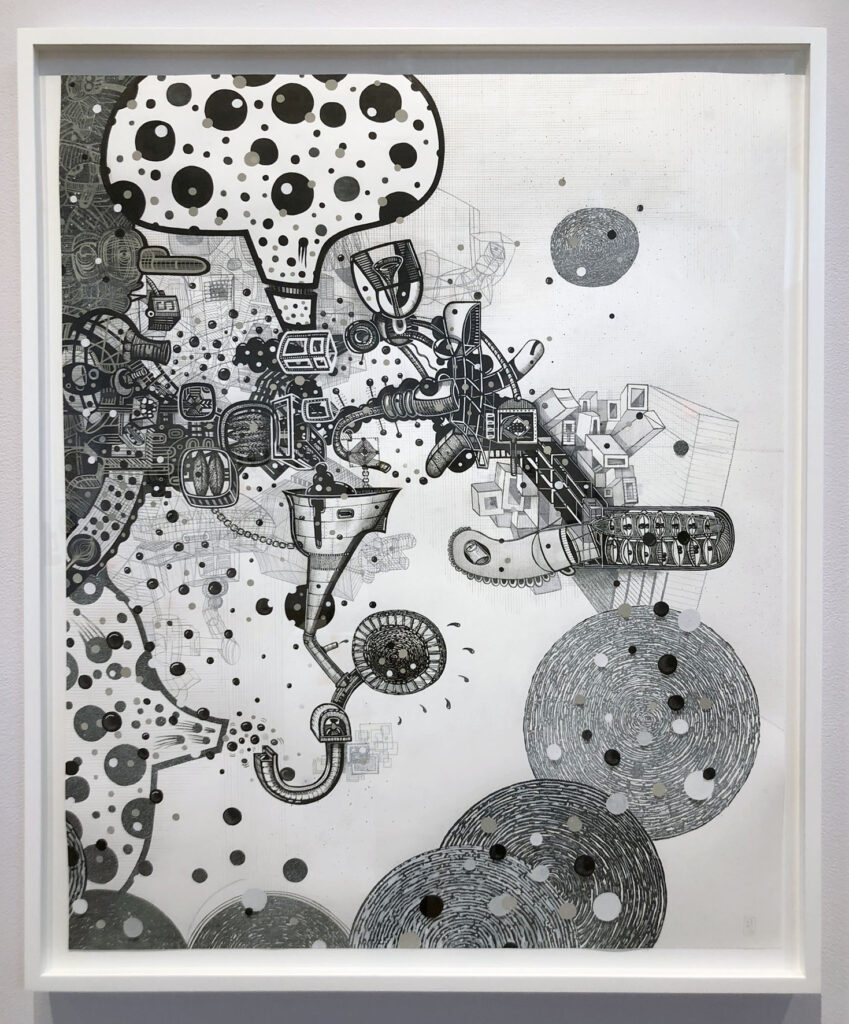
Christopher Skura’s exhibition The Beginner’s Mind (starting over after Covid) at Dunedin Fine Art Center is an interesting selection of his drawings, paintings and sculpture.

The artist’s statement on his work from the gallery wall-

Working in my Woodstock, NY studio during the 2020 Covid pandemic influenced my creative process by making my working method more direct and immediate. I have begun a routine of drawing everyday in sketchbooks. Out of these small drawings have come many sculptural ideas. Each imagined form serves as a kind of placeholder and represents someone we have lost. Drawing quickly with paint marker, my natural, hardwired shapes have become more pronounced. The goal is to work with a “beginner’s mind” and utilize the flow-state to achieve a direct expression.

All of my work comes out of extensive sketching and drawing. Very rarely do I recreate exact drawings as sculpture but I use them as a spring board to begin experimenting. Most of these drawings are small and done very quickly. By hesitating less, I have focused on completing an artwork in one or two sessions as opposed to laboring over it. The surfaces on the new works have become less concerned with refinement and I feel this has created a warmer and more active surface.

The style of my most recent artworks is influenced by the “street” art that blanketed my New York City neighborhood during lockdown. The images reference psychology, structural systems, emergence theory and the architecture of the human body. Improvisation and freehand drawing are emphasized for phenomenological effect and I try to capture the speed of living in Lower Manhattan. Some of my forms are organic and plant-like but others suggest the machinery of a man-made environment. This duality reflects my visual experiences growing up in the lush Florida landscape and my current life living in New York City.

The forms speak to the effects of time on the human body and the natural world. Each work imagined is a small psychological portrait of something struggling to survive or already gone.


Feb 242023
 

Danielle Roberts “The sky weighs heavy through the night”, 2023

Danielle Roberts “Picnic on the Roof (Moon Bath)”, 2022

Danielle Roberts “Adrift”, 2022

Danielle Roberts “Sunshine Market”, 2023

Currently at Fredericks and Freiser in NYC is Evening All Day, an exhibition of paintings by Danielle Roberts.

From the gallery’s press release-

In her moody and atmospheric paintings, Roberts explores the various psychological states brought on by her generation’s societal instability.  Roberts’ settings – strip mall parking lots, living room sofas, city rooftops, and outdoor parks – are familiar to wide audiences. Yet, when rendered with otherworldly color and dramatic chiaroscuro, they feel transitory and strange. Unstable emotions are communicated through uncanny lighting –both phenomenal and foreboding– and fragmented coloration that coalesces differently across canvases. Some figures are made up of geometric patches of hues that are visually delineated from each other. In contrast, other bodies are made up of a similar patchwork of coloration but by swaths that blur together slightly.

Solitude follows Roberts’ figures as they amble across an urban landscape populated by friends, lovers, and passersby.  These transitory moments, at once together yet disconnected, all seem to be anticipating something just out of reach.  A cinematic atmosphere bolstered by an artificial light imbues these scenes with Roberts’ signature radiant glow. The vivid and dark mood matches the internal, untethered state of the figures who seem oddly stuck. They wander as if they are perpetually spending their last $20 on another round of drinks.

Roberts does not shy away from discomfort and awkwardness in her worlds. She hones in on the pathos of her own experiences and those of her peers which are at once individual, unique to each of Roberts’ figures, and universal, instantly recognizable to audiences. The artist does not retreat into her painted worlds as an escape from the overwhelming anxiety and instability coursing through contemporary society; instead, she pushes right up against them, opening those spaces onto her audiences. There is an insistence on life and desire, even if those desires are complicated. The people of her scenes – withdrawn and ambivalent – wade through the mess, surviving on their own terms.

This show closes 2/25/23.


Feb 232023
 

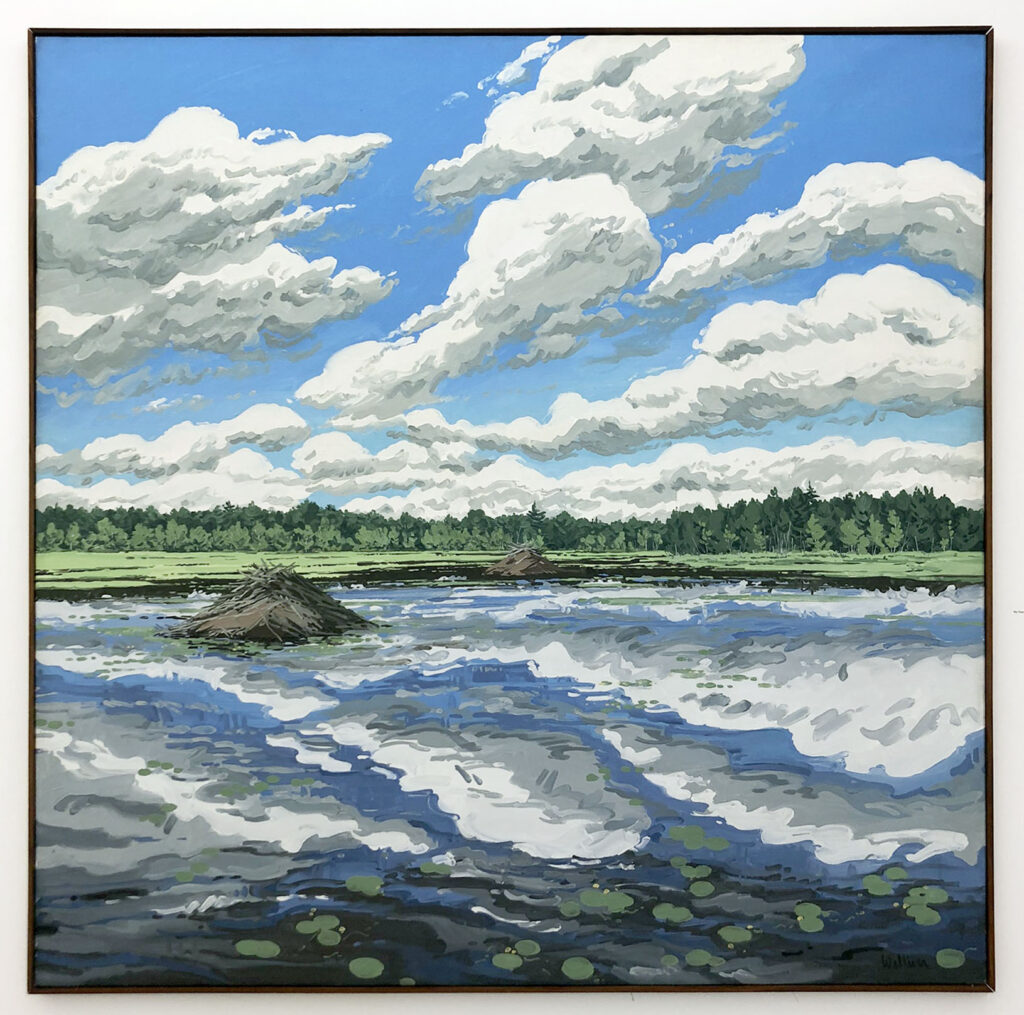
Neil Welliver, “Big Flowage”, 1979

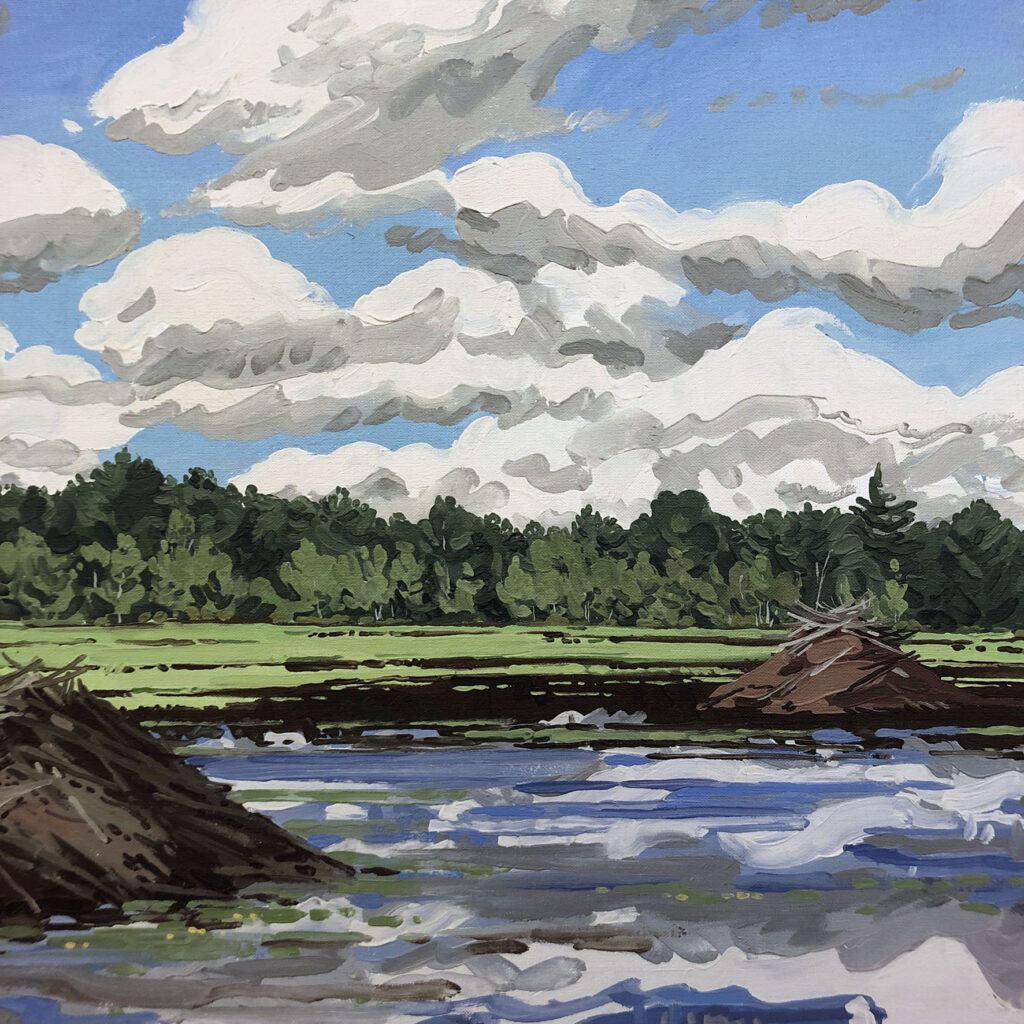
Neil Welliver, “Big Flowage”, 1979 (detail)

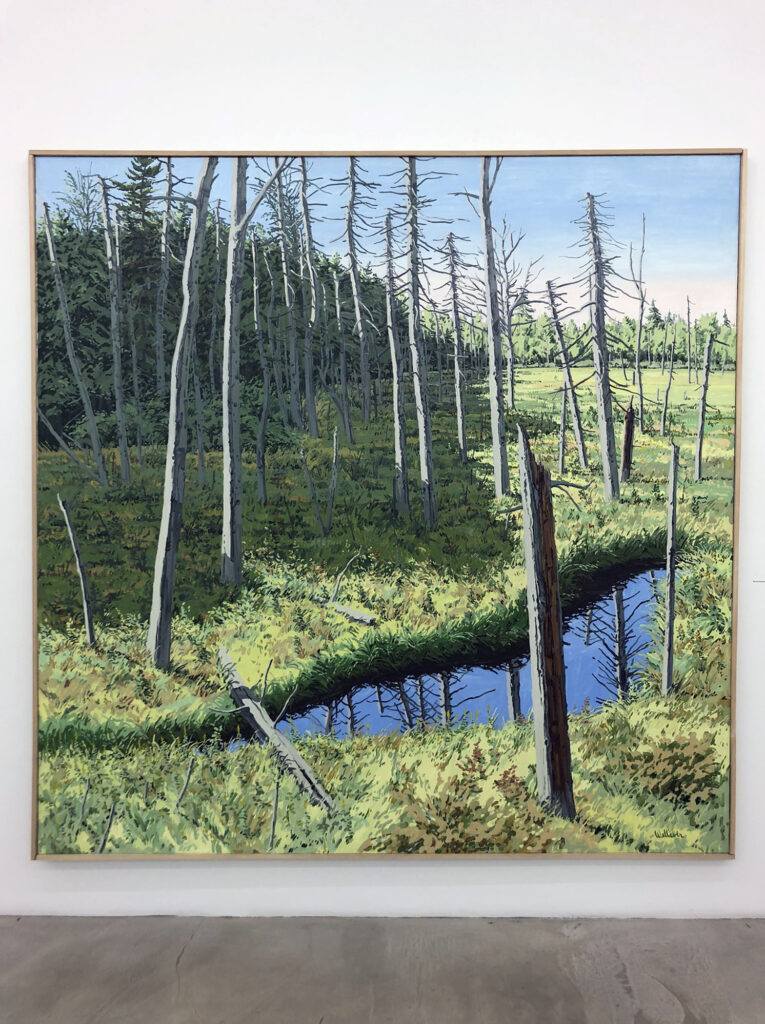
Neil Welliver, “Marsh Shadow”, 1984

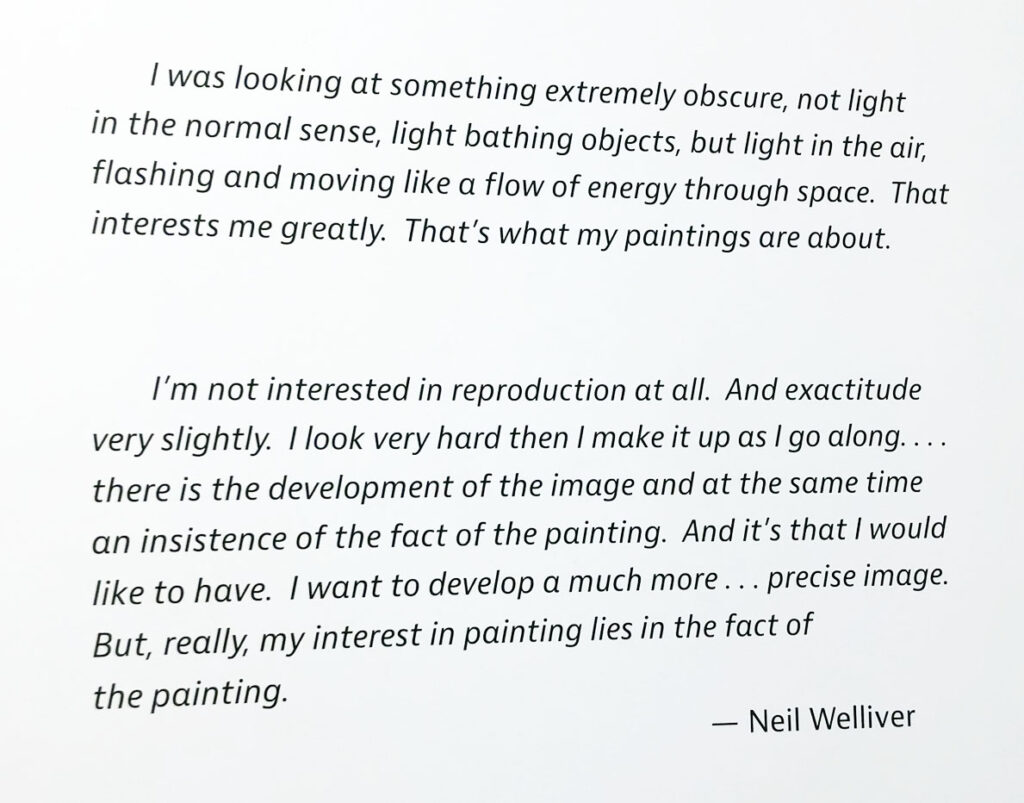
Neil Welliver quote on the gallery wall

Currently at Alexandre Gallery in NYC are Neil Welliver’s gorgeous paintings and works on paper, spanning his career from the late 1960s-2000, and including his last woodcut print, Stump.

From the gallery’s website

In his 2005 New York Times obituary, Ken Johnson wrote:

Mr. Welliver came of age as an artist in the late 1950’s and 60’s, at a time when nonrepresentational styles of painting like Abstract Expressionism and, later, Color Field and Minimalism were accorded the highest critical prestige. Along with artists like Larry Rivers, Alex Katz and Philip Pearlstein, Mr. Welliver strove to paint representational images without sacrificing the formal innovations that the Abstract Expressionists Jackson Pollock and Willem de Kooning had introduced to modern painting.

Welliver’s lifelong friend, the American poet Mark Strand, wrote of his process in 2001:

What sets Welliver’s woods apart from the woods of others is that they are, of course, his. We see them and know instantly who painted them. That stream plunging and swirling around those gray rocks is familiar, so are those clouds parading in ragged order across that sky spreading a midday blue over those hills. They are all part of Welliver’s woods. The unaffectedness, the ease with which they are simply there, without a hint of what went into their making, without an indication anywhere of the turmoil that prompted them, is what sets them apart. Of course, we can see the many brush strokes in a large Welliver and believe that they—in their tireless application—tell us what goes into a Welliver, but we would be wrong, for there is much in a Welliver that we cannot see. In the past of each one are the long hikes into the woods, which Welliver takes, loaded down with easel, canvas, brushes, oil, thinner, and tubes of color, to the spot where he will paint; then there are the hours he stands, in all kinds of weather, and paints what will be the small preparatory paintings on which he bases the large drawings that lead finally to the large paintings.

This exhibition closes 2/25/23.

Feb 232023
 

Cynthia Talmadge, “Goodbye to All This: Alan Smithee Off Broadway”, 2023 installation view

Cynthia Talmadge, “ACT 2: The Cabana”, 2022

Cynthia Talmadge, “Maserati (Dream Sequence)”, 2022

Cynthia Talmadge, “Maserati (The Strasberg Institute)”, 2022

Cynthia Talmadge, “Walk of Fame” 2023

Currently in Bortolami’s upstairs gallery is Cynthia Talmadge’s imaginative exhibition, Goodbye to All This: Alan Smithee Off Broadway.

From Bortolami’s press release-

“We find the narcissist in a reflective mood.” — stage directions penciled into a draft of act III, scene 1 of Alan Smithee’s Goodbye to All This

“Alan Smithee” is a pseudonym used by Hollywood directors to remove their names from movies over which they have lost creative control. In this exhibition Cynthia Talmadge animates Smithee, imagining him in the mid-1980s as a down-on-his-luck, middle-aged baby boomer, trying, elaborately but ineptly, to revive a career defined by burned bridges, bad behavior, and commercial failure. The show takes as its premise a fictitious play, an autobiographical avant-garde off-broadway Bildungsroman written and directed by Smithee in an effort to engineer his come back. The play–entitled Goodbye to All This is what Talmadge imagines as Smithee’s clumsy inversion of the title of Joan Didion’s essay about leaving New York for California – tells Smithee’s version of his rise and fall in Hollywood and his subsequent departure for New York, culminating in his redemption as a New York theater artist.

The only substance to the real-world “Smithee” is an extensive filmography of more than 80 credits. Talmadge takes this output at face value, envisioning for us the detailed biography and personality of a director whose career persists despite every job he’s done having gone badly awry amidst professional conflict. For Talmadge, this makes him a dubious American icon: an epitome of privilege and unwarranted confidence; a guy who – at least until recently – could only ever fail up.

Several Los Angeles and New York landmarks and former landmarks are included in the paintings along with Smithee’s Maserati- the Director’s Guild building, Chasen’s, the Friars Club, Scientology Celebrity Center, and the Beverly Hilton in Los Angeles and Elaine’s and The Lee Strasbourg Institute in New York. The Maserati’s final destination is 39 Walker in NYC, the address of the gallery.

The Playbill paintings have an incredible amount of detail within them and highlight the three acts of Smithee’s journey. The room includes a fallen column, a box of headshots, and Smithee’s set design model for Goodbye to All This, his autobiographical play.

Both Bortolami and Talmadge’s Instagram pages expand on the Smithee story in a few of their posts and are worth taking a look at as well.

This exhibition closes 2/25/23.

Feb 222023
 

Robert Yasuda, “Boundary” 2010-2020

Robert Yasuda, “Boundary” 2010-2020 (detail)

Robert Yasuda, “Pele”, 2022

Robert Yasuda, “Pele”, 2022 (side view)

Robert Yasuda, “Maluhia”, 2022

Robert Yasuda, “Pipeline”, 2022

Currently at Sundaram Tagore gallery in New York are Robert Yasuda’s sculptural paintings for his exhibition Transparent and Translucent.

From the gallery’s press release-

The artist’s latest body of work is a culmination of his decades-long exploration of perception, light and space. On view will be a series of atmospheric paintings rooted in his early encounters with nature in Hawaii where he was born and raised.

Yasuda’s iridescent paintings are composed of translucent veil-like fields of color layered on slabs of wood that protrude from the wall or nestle into corners. Several works are constructed to cast a reflected glow of colored light into the surrounding space. Depending on where you stand, the surfaces of the paintings shift in color and temperature.

“For many people, looking at a painting for 20 seconds can be extremely long but these are pieces that reveal themselves over time,” says Yasuda, who invites viewers to pause and immerse themselves in the work in order to perceive these subtle transformations.

Yasuda begins by shaping wooden panels, which are up to two inches thick, with chisels and grinders. Softening harsh vertical lines, he introduces bowed and gently sloping edges as well as sharply upturned corners. After painting a base layer onto the wood, he wraps the wood in diaphanous cotton. Adding as many as 40 layers of pearlescent acrylic paint, he suspends the fabric amid layers of luminous color. Most of his works are multi-paneled, with intricately wrought and detailed seams, and mounted on cradle-like structures that push them away from the wall.

Several of the works on view feature aqueous expanses of rich blues and lush greens evoking the ocean. In other pieces, sensuous swathes of paint evoke sunsets or the iridescent lining of seashells. “My entire childhood I saw myriad greens in the countryside of Hawaii and I spent a great deal of time diving…These works are connected with that point of view and the process of meditating on nature,” says Yasuda.

This exhibition closes 2/25/23.

Feb 222023
 

Currently at Carter G. Woodson Museum is Touch in the Spirit of Love, an exhibition of work by professor and artist Dr. Gary L. Lemons.

From the artist about his work (via the museum’s website)-

“I am a Black abstract painter. Conceptually, my paintings are rooted in Africentric colors and patterns. I believe art should inspire all people to connect to the liberating power of communal love. Touch in the Spirit of Love is a series of paintings that graphically illustrate the value of love for all humanity. In an imaginary, spiritually enriched context—this series calls all people together to see each other reaching out to one another through the touching of their hands. The hands in my paintings connect people together to express hope for the life-saving power of love committed to community-building. As envisioned by Dr. Martin Luther King, Jr., hope for a “beloved community” can be realized when people actively join together to show love for social justice. Overall, the paintings in this series visually challenge people to see the need for loving wholeness in mind, body, heart, and soul. Hands of different colors touching each other in this painting series artistically demonstrate the power of love rooted in freedom for all people who have been historically oppressed.”


Feb 212023
 

Ted Gahl “Purgatory (2)”, 2022

Ted Gahl “Woman Putting on Jacket”, 2022

Ted Gahl’s paintings for Le Goon at Harkawik Gallery draw you in the more you look at them, revealing layers of imagery.

From the gallery’s press release-

Building on imagery he developed in “Stories from the City, Stories from the Sea,” here he delves further into an ocean of muted memories and historical associations that are legible only as hazy apparitions. Gahl charts a course through an emotionally charged landscape: a trench where isolation and connection embrace, where melancholic figures strain to make contact with an ineffability beyond the border of the canvas. Through a dialogue between small, mid-size, and large-scale paintings on unstretched canvas, Gahl implores us to look under the surface, offering attentive viewers the gift of conjuring new meanings over time.

The frames on Gahl’s smaller paintings are composed of chopped paint stirrers, a nod to the artist’s youth spent painting houses and lattice framing techniques of the past, as well as an interest in blending high and low culture. He juxtaposes smaller figurative works with gargantuan 8-feet tall paintings that cascade down unstretched canvas, rooted in abstraction inspired by landscape. These large paintings are intuitive, with one movement or color influencing the next, allowing the artist the physical space to deepen his investigation of consciousness. He calls these works “tarps,” a nod to the cloths thrown down to catch errant paint drips. Here, he deepens his ethical engagement with the many modalities of paint and creative labor.

The artist employs figuration as a vehicle to explore abstraction, seamlessly gliding between the two methods. Figures are adorned in coats that serve as portals into another dimension, brimming with thin layers of muddy greens, sky blues, and merigold oranges that feel plucked out of a Post-Impressionist painting. Within Gahl’s controlled confines of abstraction, the world enlarges, revealing traces of the night sky, throngs of people, fish in a stream.

Gahl’s work is intensely cinematic, as if projected onto a screen or trapped inside an unraveled roll of film. Several scenes unfold within a single painting, allowing a multitude of emotion to erupt. Fleeting moments of tension abound. Two nude women emerge from a body of water reminiscent of a Georges Seurat or Milton Avery landscape, but their togetherness is fractured by a hulking tower of darkly-hued abstraction. A translucent trio bathing in a deep Rothko red exudes a biblical aura; an outline of an angelic body reaches towards the top of the canvas. Gahl’s airy yet deft brushstrokes feel like wading into a pond, while a ghostlike figure dissolves into the landscape, as if imprisoned in the sparse solitude of a Norbert Schwontkowski painting. The artist plays with the horizon, causing us to question if the shadowy form is sinking into water or simply lying in the grass. Are we above or below ground? Is this death or relaxation? Are they the same thing?

At the heart of Le Goon lives a yearning for connection. Mortality cannot help but leak through the canvases and become personified. Gahl’s work invites us towards intimacy, towards deeper questioning. The answers emerge from the water and evaporate towards the heavens before we can touch them, leaving us only with the feeling of the mist kissing our skin.

—Lauren Gagnon


Also at Harkawik are Eli Hill’s recent paintings for Some Days I Taste The World, a series of works that use the natural world to approach topics of identity.

Eli Hill “Wineberry Sight”, 2022

Eli Hill “Decidousness”, 2022

From the gallery’s press release-

Comprised of nine mid-size works, Some Days evidences Hill’s fascination with the way in which humans order and classify the natural world. His paintings speak to the problematics of anthropology, the subversion of the naturalist’s impulse to categorize, and the painter’s age-old communion with nature. Hill proposes a fascinating configuration of personal, political, and scientific concerns and draws parallels between the transgender body and planet Earth. Hill’s canvases merge figurative and landscape traditions, calling attention to the ways in which bodies—celestial, earthly or otherwise—are routinely subject to binaries, alienation, hierarchy and the struggle for survival and self-actualization.

The majority of the exhibition’s paintings are derived from the artist’s long distance runs and environmental work in the leafy Queens oasis of Forest Park. Here, we bid farewell to the gray grit of the city and emerge into a landscape that is simultaneously natural and hallucinogenic. Verdant greens and earthy browns mingle with pale lavenders and silvery blues. The umber shadows of trees streak the soil, basking in the blood orange glow of an artificial sunset. Fluid brushstrokes waterfall down the canvases. Hill’s paintings of the natural world are borderline devotional; he is imploring us to worship the beauty and drama of nature in its fullness. Not unlike the still-lifes of Rachel Ruysch, insects creep out and leaves decay and decompose back into the earth. Split depicts a tree the artist passes by, an image so striking you can almost hear the sound of bark cracking. The branches are split in half and upheld by the flora around it. Community, mortality, and the life cycle are omnipresent.

While some of Hill’s paintings engage traditional modes of depiction, others shift between recognizable and unrecognizable subjects. In Wineberry Sight, the invasive wineberry shrub masquerades itself as a raspberry bush to ensure survival. But are we peering through an eye of vines or veins? By creating images that refuse us easy associations, he provides an opportunity to find pleasure in images we cannot name or categorize. Under every branch we find trickery, performance, preservation. The notion of the “invasive species” itself calls attention to the ideological structures at play in our understanding of what’s “original,” “natural;” what has a right to proliferate and thrive.

The exhibition title is a line from a CA Conrad poem, as well as an homage to the influence of the poet’s writing and spiritual practice in Hill’s work. Revolutionary care permeates Hill’s depiction of the figure; whether his own body, a tree, or a friend, he actively opposes mining, objectifying, or exploiting his subjects. In The Artist as a Naturalist, a self-portrait is accompanied by two paintings within a painting of colorful moths. The work demands time and effort, as awkward cropping abstracts the body, consequently resisting commodification and denying easy consumption of the work from a historically cisgender gaze. Like German-Swedish figurative painter Lotte Laserstein’s Portrait With a Cat, Hill consolidates naturalistic observation with a figure that gazes back at the audience. The painting itself possesses a sort of agency, as multiple pairs of eyes appear, aware we are observing them, and throwing into uncertainty the subject of the examination; them, us, something else?

Some Days I Taste the World is like walking through a Ralph Waldo Emerson essay, where beauty takes on a cosmic quality that transcends the experience of individuals. Hill offers us a fascinating configuration of previously known quantities, suggesting a natural place for things like radical queer joy. Through a dense canopy sunlight streams through, lighting up our faces.