“1958 Championship Game ( Colts/NY Giants )” by artist Jack Howard-Potter
“Formation of the American Football League (1959)” by artist Katherine Stanek
The sculptures above are two of The ELEVEN, a public art project created by The Pro Football Hall of Fame and Arts in Stark, located in downtown Canton, Ohio. The commissioned art works each represent one of the eleven greatest moments in professional football.
The first sculpture pictured, Colts/NY Giants Championship Game (1958) is by Jack Howard Potter. The 30-foot tall steel sculpture celebrates Baltimore Colts player Raymond Berry.
The second, Formation of the American Football League (1959) is by artist Katherine Stanek. The concrete sculpture represents the founders of the league and the use of television as part of its growth. On a nearby information plaque the artist states that she “wanted to celebrate the AFL founders by putting eight giant heads on top of 1960’s TV sets, as if they were ancient heroes in some Roman ruins”. Stanek also runs her own gallery in Philadelphia.
In 1985, they purchased the beige house on Third Street in Safety Harbor, Florida. They traveled everywhere, actively seeking out inspirational and unusual places. Inspired by these travels, they began transforming their house. One of the earliest additions were the wooden triangles to the eaves of their house. The beige house became bold in color, too.
One day, they went to a flea market and saw a sign that said that anybody could take 10 free bowling balls. They took the bowling balls and began painting and placing them around the property. This is how they became known as the bowling ball house of Safety Harbor.
Todd and Kiaralinda even branched out of decorating their home, creating two different art cars, designed a restaurant, and making public sculptures, among other things. They began calling themselves the Whimzey Twinz because they work together on all of their projects.
Their travels soon included visits to folk artists and artists that they met at their shows. These friends visited them, too. Todd and Kiaralinda’s bowling balls inspired many of them. They would create bowling balls for Todd and Kiaralinda, who got so many of these works from artist friends that they started a gallery in their home. They created a “Call for Balls” which made a lot more of these art works roll into their home. Today, they have over 80 bowling balls from various artists around the world and people still bring them bowling balls as gifts.
If you are in the area, make sure to also stop by Safety Harbor Art and Music Center (SHAMc), a nonprofit they opened in 2017. It has an art gallery and shop, and hosts music events and art classes as well.
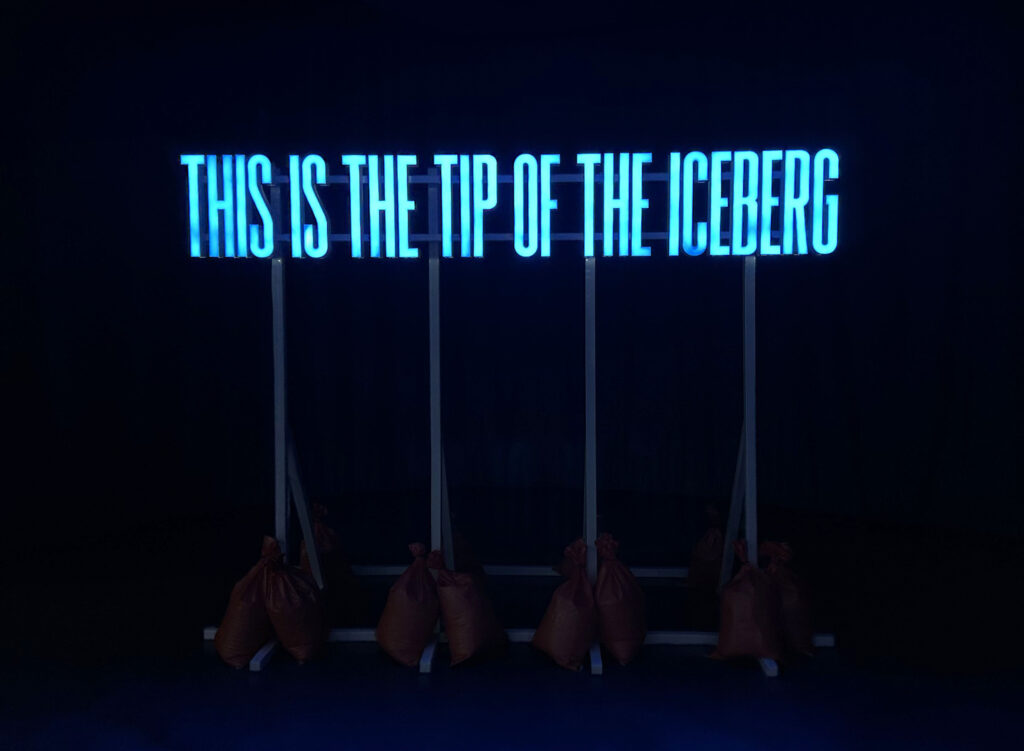
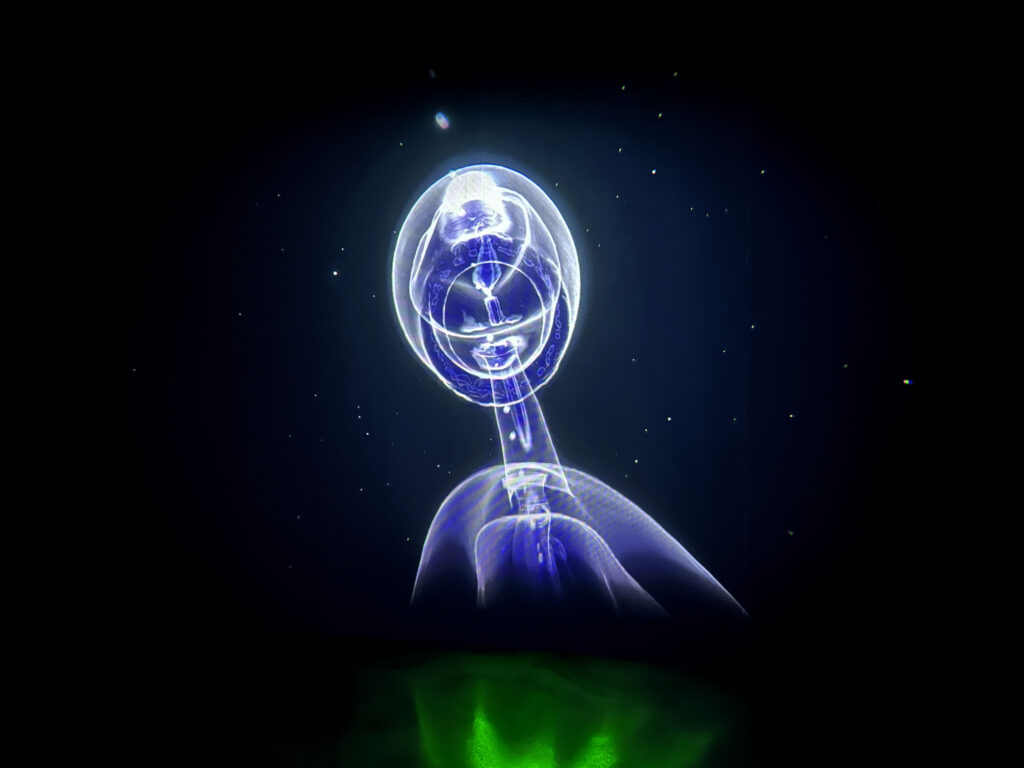
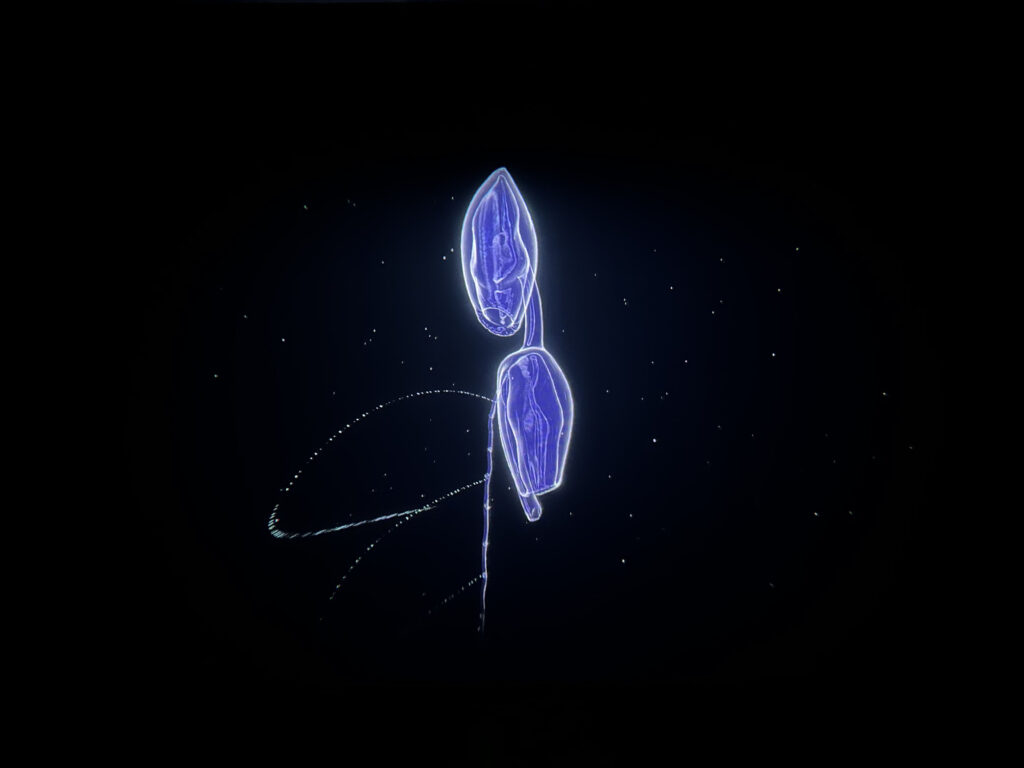
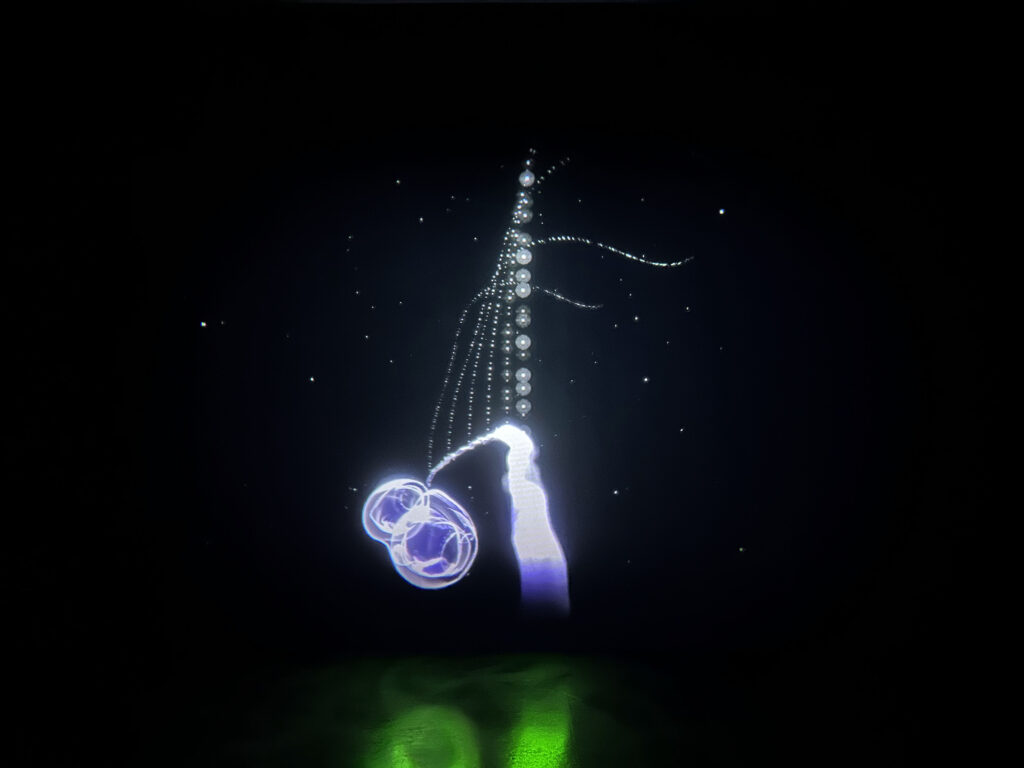
The images above are from SUPERFLEX: This Is The Tip Of The Iceberg,GENERATOR: USF Contemporary Art Museum’s inaugural exhibition. The two part exhibition includes a sculptural installation and the mesmerizing interactive animation Vertical Migration, in which viewers encounter a siphonophore that reacts to their movements.
From the gallery about the exhibition-
This Is The Tip Of The Iceberg emerges from SUPERFLEX’s in-depth research into the deep sea, biodiversity, and the climate. The exhibition immerses viewers in two parallel and interconnected realms, separated by a curtain which acts as an imaginary filter between land and sea. Passing through the curtain brings visitors from a terrestrial space unsettled by rising water to the ocean’s dark depths, to meet one of the most important cleaners of the ocean, the siphonophore. Relatives of the jellyfish, siphonophores bring between two and six billion tons of carbon a year from the surface down to the seabed, where it is stored. This Is The Tip Of The Iceberg offers an opportunity to encounter this unfamiliar species, prompting reflection on the impacts and consequences of climate change, especially relevant to Florida and its coastal communities, and encouraging humans to imagine a future defined by interspecies living and ecological coexistence.
For a more detailed discussion of the work, the gallery has created an exhibition catalogue that can be viewed online or downloaded as a pdf.
Vertical Migration was originally created in 2021 by SUPERFLEX for ART 2030 and was projected on the United Nations Secretariat Building in NYC during the 76th United Nations General Assembly.
The sea is not an abyss. It teems with an almost unimaginable array of life. Every night, the largest biological migration on Earth takes place, as trillions of creatures travel closer to the surface to feed. Some of these animals, like shrimp, are well-known. Others, like siphonophores—relatives of jellyfish—are unfamiliar: varying wildly in size, from the slightness of a fingernail to the length of a whale, they look like nothing that we find on land.
How does it feel to be one of these creatures? To explore this question, SUPERFLEX designed a computer-generated siphonophore and created an animated film, Vertical Migration, depicting its ascent. At first, the film mechanically circles the creature, getting closer and closer while giving the audience a view of it from all angles. But eventually the perspective shifts, the camera’s movements become more fluid, and the viewer sees the world from the perspective of the siphonophore.
Unsettling our perceptions of scale and otherness, Vertical Migration is an intimate encounter with a life form that bears no resemblance to human beings, though we share a planet, an ecosystem, and a future. Because of sea-level rise, humans will also be migrating vertically in the coming centuries, to higher elevations and raised buildings. The siphonophore’s story is our story. Though we can never experience its journey through the pitch-black ocean depths, we can shift our perspective to recognize that we’re connected, that our actions affect each other, and that we share a common fate.
For a look at the work in motion, below is the trailer from ART 2030.
About SUPERFLEX from their website-
SUPERFLEX was founded in 1993 by Jakob Fenger, Bjørnstjerne Christiansen, and Rasmus Rosengren Nielsen. Conceived as an expanded collective, SUPERFLEX has consistently worked with a wide variety of collaborators, from gardeners to engineers to audience members. Engaging with alternative models for the creation of social and economic organisation, works have taken the form of energy systems, beverages, sculptures, copies, hypnosis sessions, infrastructure, paintings, plant nurseries, contracts, and public spaces.
Working in and outside the physical location of the exhibition space, SUPERFLEX has been engaged in major public space projects since their award-winning Superkilen opened in 2011. These projects often involve participation, involving the input of local communities, specialists, and children. Taking the idea of collaboration even further, recent works have involved soliciting the participation of other species. SUPERFLEX has been developing a new kind of urbanism that includes the perspectives of plants and animals, aiming to move society towards interspecies living. For SUPERFLEX, the best idea might come from a fish.