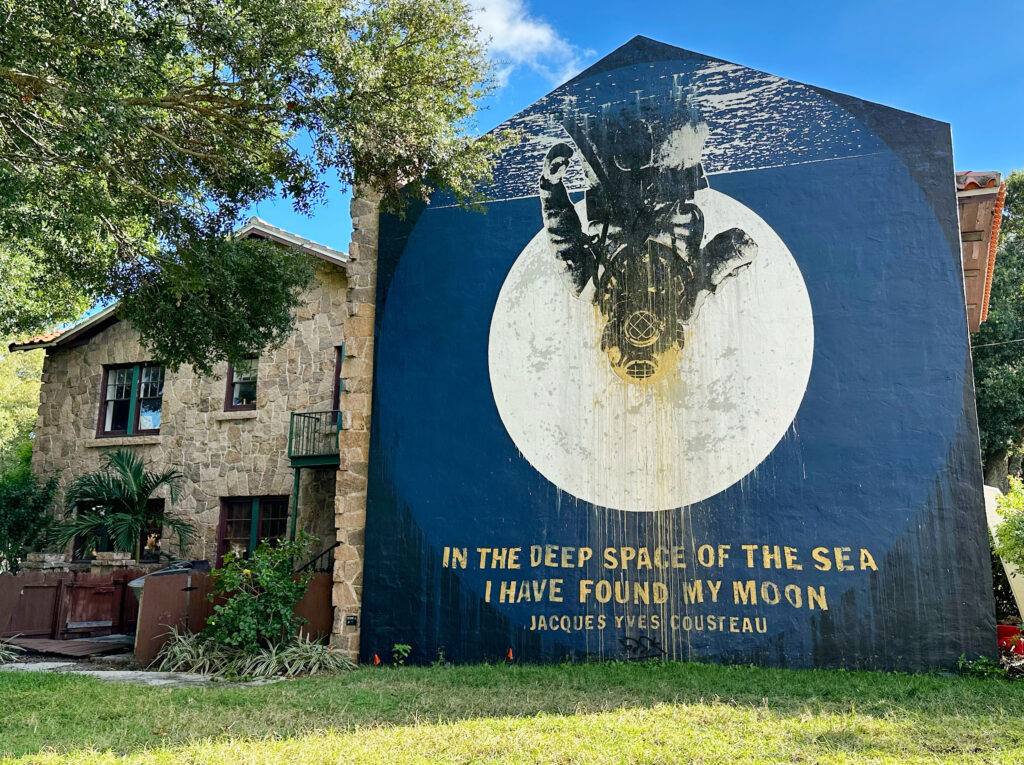
Painting by Kelly Irvine

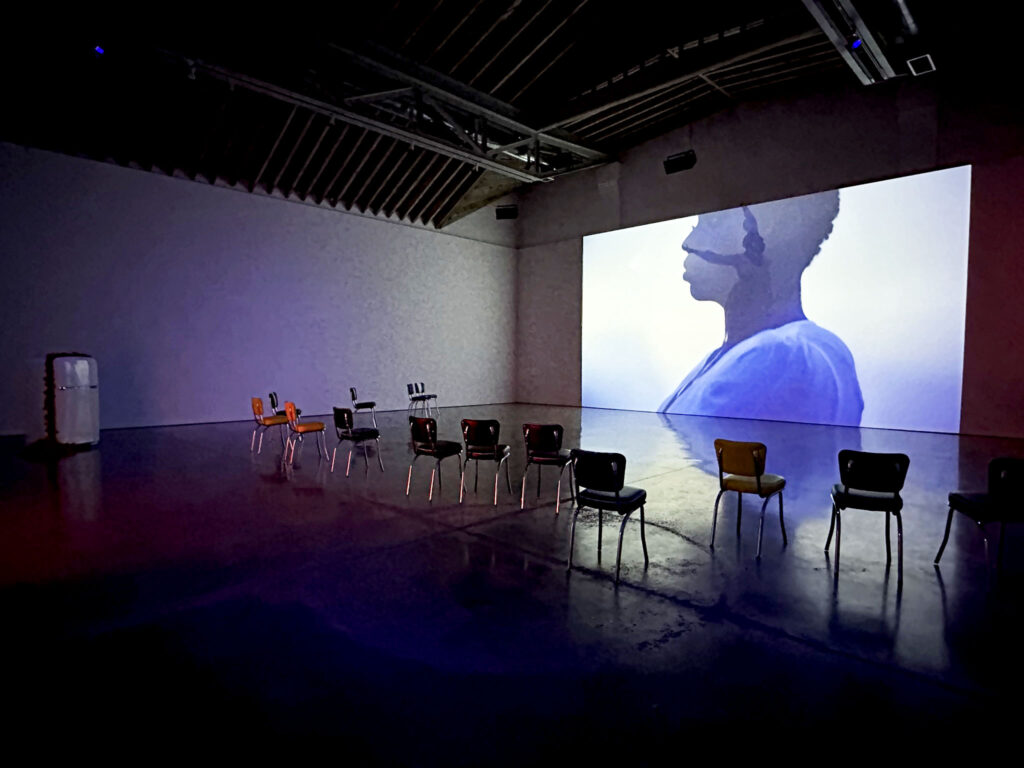
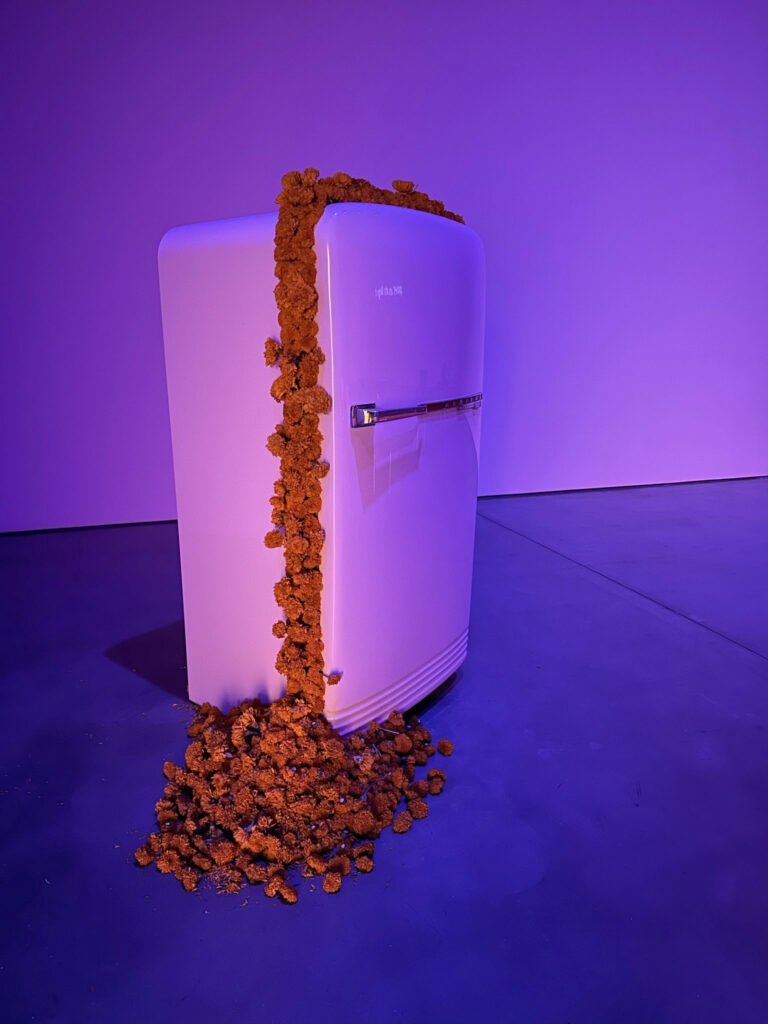
Installation of sculptures by Allison Hudson

Work by Anna Guarneri

Each of the five artists in Bricolage: Artists and Accumulation, currently on view at The Delaware Contemporary, use their materials to express meaning through a layering process.
From the curators, Kasia J. Bunofsky and Leah Triplett-
“I have a very simple theory. I have always pretended that objects themselves formed a self-composition. My composition consisted of allowing them to compose themselves.” – Armand Pierre Fernandez (Arman) (November 17, 1928 – October 22, 2005)
When ‘assemblage’ first circulated as an art-historical term in the early twentieth century, it referred to the primarily formalist practice of joining tangible, often discarded or found, materials. Like a three-dimensional collage, assemblages made novel juxtapositions of individual components to create a whole artwork with its own impact. As the topography of the art world shifted mid-century, assemblage was often used to critique the post-war era’s burgeoning consumerism. Similarly, “accumulation” refers to a kind of assemblage that emphasizes materiality through the mass repetition of similar objects or forms. Accumulations lent themselves particularly well to expressing discontent with consumerism. They underscored the commodity’s necessity as a medium while maintaining the artist’s agency to reclaim meaning through the processes of recontextualization and repetition. As time persisted, assemblage continued to inspire and lend credibility to avant-garde contemporary movements. Even the new wave of ‘conceptual art’–a blatant rejection of materiality–was seen as an assemblage that forwent concrete objects to assemble ideas, language, or concepts. From installation art, to performance, to ‘relational aesthetics’, assemblage and accumulation helped pave the way for today’s contemporary art world and its many innovations.
Assemblage and accumulation emphasize the importance of each material element to the message of the completed work of art. This idea evokes a sense of collectivism; a metaphorical microcosm of material cooperation that might inspire a yearning to change our individualistic society, as art reminds us the whole cannot exist without the contributions of every one of its parts.
The artists and works featured in Bricolage: Artists and Accumulation reference the tradition of assemblage, accumulation, and their many corollaries; either through the performance held within their artistic process, their compilation of abstract concepts, or their passion to speak through material. They build, assemble, accumulate, gather, and collect. Using assemblage as both a method and technique, these artists engage assemblage as an action that is always in perpetual evolution of form. Be their medium drawing or sculpting, painting or installation-their material glass or found objects, acrylic or graphite- Anna Guarneri, Allison Hudson, Brynn Hurlstone, Kelly Irvine, and Emilio Maldonado, apply an iterative, intuitive approach to making, resulting in a bricolage.
This aesthetic- in which the whole is a sum of parts-demonstrates a depth of material knowledge. The works presented here require long looks to unfold and reveal their discrete components. Layering, stacking, blending, and amalgamating are processes and aesthetic devices that enable the viewer to experience the work in an instinctual way. Throughout these artists’ individual practices, an emphasis on transformation through collecting and comingling materials, media, and forms is paramount, with bricolage being a means for metamorphosis.
Below are additional works by the artists and information from the museum-


“My work explores the nature of cycles and the emergence of growth from decay. It’s tactile and fragile- a combination of unfired clay, wool, fabric, resin, and wax. Driven to manipulate raw materials into something new and unrecognizable, I enjoy the physicality of building, tearing apart, and mending together – striving to create work that is at once ethereal and visceral.”

“My abstract color field paintings invite the viewer to step into a lush, translucent world of color. Drawn to the beauty of layered transparent hues from an early age, I use sheer color, overlapping forms, gestural brush work, organic forms, and repeating motifs that flow and intersect, resulting in delicious new hues and increased tonal depth. Contrast is important in my work as well; hard edges are in conversation with areas of soft gradation, while vibrant, neon hues pop against muted tints and natural, raw canvas.
I’m especially inspired by the canvas staining techniques and paintings of Helen Frankenthaler and Washington Color School artists Morris Louis and Kenneth Victor Young. I pair that inspiration with constant experimentation and manipulation of materials, developing new processes as a natural outcome.”

Anna Guarneri‘s work explores the possibilities of suggestive imagery and the devotional connotations of stained glass. She uses crude marks and associations to tap into early human experience, pulling from a range of sources – ancient art, architecture, dance history, and her own body. Colors in her work conjure poignant memories, turning drawn forms and glass structures into celebrations, memorials, or premonitions.
Guarneri’s latest body of work pulls from the visual world of postpartum life, incorporating imagery of bodily landscapes and interiors, and the various devices, accessories, and toys encountered during pregnancy, birth, and early motherhood.


“In Time explores the process of healing from trauma, and the permanent transformation left behind once that process begins. Layers of broken safety glass are frozen within ice and slowly melt over a steel platform. The thaw allows for the release of contained breakage onto the foundation, where it rests in a slowly evaporating pool of water. Over time the water evaporates and the shattered glass may be swept away, but the foundational steel upon which the process took place will forever carry its traces.”

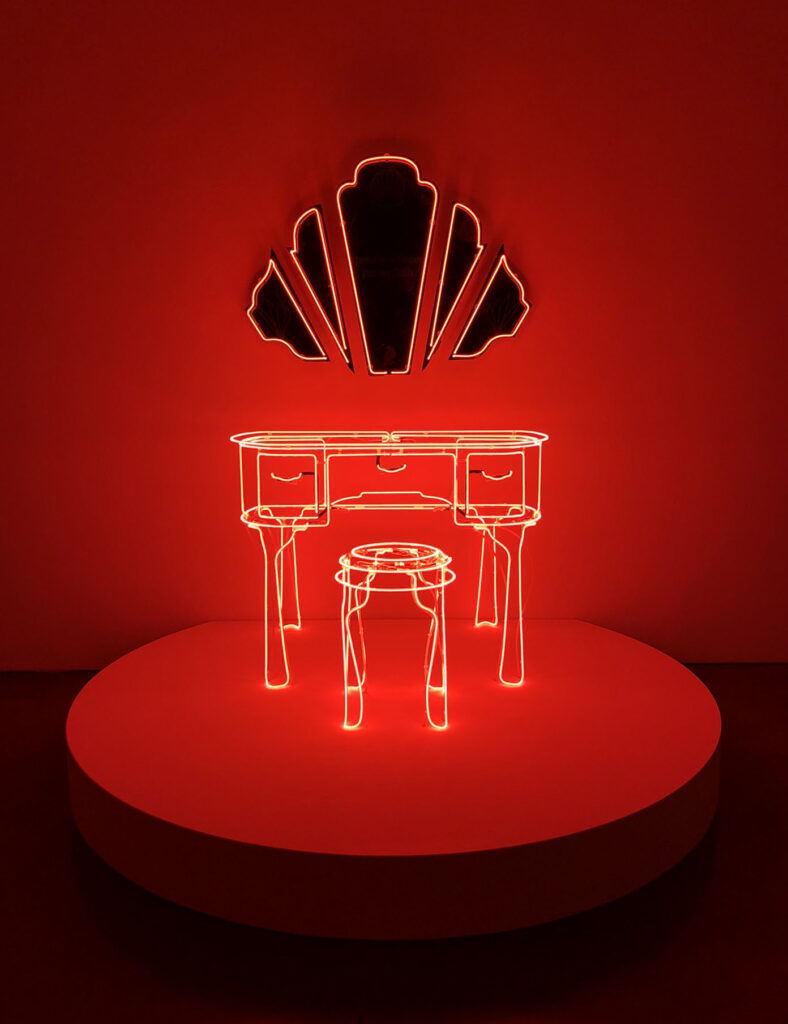
“I create art to explore personal narratives and navigate life through the material culture of capitalist America.
My work raises questions about social constructs, structural inequalities, and the dynamics of race and class. Through a multidisciplinary approach, I repurpose discarded objects as a means to reflect on memory, identity, and social conventions.”
This exhibition is on view until 8/24/25.