
In The Recap this month- big sculptures, murals, portraits, music, and more art. Check it out here and subscribe!

In The Recap this month- big sculptures, murals, portraits, music, and more art. Check it out here and subscribe!

Jean-Michel Basquiat was born today, December 22nd, in 1960. The painting above, Untitled (1981) is currently on view at The Broad in Los Angeles.
From the museum about this work-
Many of Jean-Michel Basquiat’s paintings are in some way autobiographical, and Untitled may be considered a form of self-portraiture. The skull here exists somewhere between life and death. The eyes are listless, the face is sunken in, and the head looks lobotomized and subdued. Yet there are wild colors and spirited marks that suggest a surfeit of internal activity. Developing his own personal iconography, in this early work Basquiat both alludes to modernist appropriation of African masks and employs the mask as a means of exploring identity. Basquiat labored over this painting for months — evident in the worked surface and imagery — while most of his pieces were completed with bursts of energy over just a few days. The intensity of the painting, which was presented at his debut solo gallery exhibition in New York City, may also represent Basquiat’s anxieties surrounding the pressures of becoming a commercially successful artist.
In the video below (also from The Broad) LeVar Burton discusses the work and its possible connection to Basquiat’s childhood and family.


While reading through the recently released list of artists selected for next year’s Whitney Biennial, I was very happy to see Kimowan Metchewais on the list. I discovered his work when it was part of USF Contemporary Art Museum‘s 2023 exhibition, Native America: In Translation.
The exhibition included a slide show of Metchewais’s polaroids that was particularly captivating. The images in this post are just a few favorites. For more on the artist, this Aperture article from 2023 is very informative.
Below are a few more selections-


Work by Mel Rosen (sculpture) and Stass Shpanin (mural, video, and paintings)

Detail from Stass Shpanin’s “Dance of Birth” animated video

Ceramic sculptures by Mel Rosen

Paintings by Stass Shpanin
The Delaware Contemporary is currently showing three exhibitions as part of its 2025 Biennial Art + AI programming. This post covers two of them, the third is here.
Construct | Disrupt: Artificial Intelligence as Tool and Material features work by artists Mel Rosen, Stass Shpanin, Sol Kim, and Mark Burchick.
From the museum about the exhibition-
In an age when reality itself feels unstable—filtered through algorithms, fragmented by digital archives, and refracted through competing narratives—artists are increasingly turning to the tools of fiction and speculation not to obscure the truth, but to question how we construct it. Construct | Disrupt brings together the work of Mel Rosen, Sol Kim, Stass Shpanin, and Mark Burchick, four artists who use artificial intelligence, language, and archival material to explore the porous boundaries between perception, memory, and belief.
Across diverse practices—from ceramics, drawing, and painting to video, installation, and text—these artists engage with AI not as a replacement for the hand, but as a provocateur, a co-conspirator, and a mirror to the human imagination. Rather than seeking resolution or certainty, their works open up space for doubt, complexity, and contradiction.
Together, the artists in Construct | Disrupt invite us to consider how we construct meaning in a world where the archive is no longer fixed and where the image can be endlessly generated. The work of these artists does not offer answers, but rather asks: What do we trust? What do we remember? And how do we decide what is worth believing?
About the two artists pictured above, from the museum-
Stass Shpanin engages history as a space of imaginative reconstruction. Working with visual fragments from American folk traditions and immigrant archives, he uses AI to distort and reconfigure the past, generating speculative images that blend glitch, myth, and memory. His paintings and drawings present broken, layered timelines where visual language is both preserved and interrupted. Rather than restoring a singular truth, Shpanin’s work embraces the possibility of many coexisting histories—ones shaped as much by fantasy as by fact, as much by the digital as the ancestral.
Mel Rosen’s practice draws from archaeology, natural history, and personal memory to create objects and images that feel both ancient and otherworldly. Her use of AI image generation allows her to iterate quickly, mutating prompts based on her own drawings and a mental library of organic and cultural references—from Pompeian frescoes and fossils to barnacles and talismans. The resulting images feed back into her ceramics and drawings, where mythic forms and geometric distortions coexist in a suspended cosmology. Rosen’s work suggests that artifacts—whether material or digital—are always evolving, reshaped by time, environment, and interpretation.

Still from the video “Person Enough” by Sol Kim
Sol Kim (video still above) approaches language as a material form, using words to subtly disrupt social and technological systems. Her works often begin with a textual prompt—an instruction, label, or survey—that gives rise to absurd, humorous, or quietly unsettling performances. In The Cookiest Cookie, cookies are judged and destroyed by AI based on their perceived “cookie-ness,” while in Person Enough?, performers attempt to become more legibly “human” to computer vision systems. Through these gestures, Kim reveals the tensions between human nuance and machine classification, exposing the strange logic that governs our interactions with technology—and with one another.

Mark Burchick Installation

Images from Mark Burchick’s “Felt Presence”
Mark Burchick’s Felt Presence explores the intersection of faith, media, and artificial intelligence through the lens of Catholic mysticism. Drawing on archival photographs from the 1917 “Miracle of the Sun” in Fatima, Portugal, Burchick trains AI models to generate photorealistic images of miracles that were never captured on film. Presented alongside historical documentation and witness testimony, these fabricated scenes invite viewers to question the boundaries between belief, evidence, and visual truth—highlighting the unseen technological, institutional, and spiritual forces that shape our perception of reality.
In NOO Icons, Burchick expands this inquiry through an immersive video installation framed like a reliquary. A five-minute rear-projected loop, trained on over 100 images of stained glass Rose Windows, morphs into abstract color fields via AI animation. At its center is a 3D-printed altar piece generated using DreamFusion, a text-to-3D tool prompted to create a “solar monstrance.” The resulting object—gold-finished, internally lit, and housing Lithium batteries—evokes both the Communion host and a technological relic. As Kate Crawford notes in Atlas of AI, Lithium is a sacred yet finite resource driving modern AI. By encasing it in plastic and low-res form, Burchick critiques the planned obsolescence and ecological cost of our AI-powered age, reframing divine presence through the lens of material decay.
In another of the museum’s galleries is- Reimagine | Reveal: Challenging the Algorithmic Gaze featuring work by Danielle Glovin, Stephanie Dinkins, and Leah Modigliani.
About the show from the museum-
The works covering this exhibition theme approach AI not as a neutral instrument, but as a complex cultural system—one that reflects, amplifies, and at times distorts the values of its makers. Through the intersecting strategies of critique, reimagination, and bias exposure, Danielle Glovin, Stephanie Dinkins, and Leah Modigliani probe the systems—algorithmic, archival, social—that dictate what is preserved, who is recognized, and how knowledge circulates.
Together, these artists ask urgent questions: Who trains the algorithm? Whose histories are encoded, and whose are left out? What does it mean to build an intelligence—and who is it built for? In doing so, they model a critical engagement with AI, one that challenges default narratives, centers marginalized perspectives, and opens up space for new possibilities. Their practices call us to reconsider what it means to know, to remember, and to be recognized in a world increasingly shaped by invisible systems of intelligence.

Stephanie Dinkins’ interactive sculpture “Not The Only One (N’TOO)“

Stephanie Dinkins’ “Conversations with Bina48” (back wall) and Leah Modigliani’s AI generated letters for “Cultural Capital”

From Danielle Glovin’s series “Future Generations”
About the artists’ work pictured above-
Stephanie Dinkins’ Not The Only One (N’TOO) and Conversations with Bina48 extend this inquiry into the realm of relational AI, specifically that of minority groups in the tech sector. In N’TOO, an interactive sculpture gives voice to the oral histories of three generations of Black women, creating an AI entity intentionally designed, trained, and aligned with their values and lived experiences. It is a poignant reversal: instead of AI extracting meaning from biased data sets, Dinkins encodes her AI, reorienting the goals of intelligence design toward inclusivity and equal representation.
In Conversations with Bina48, Dinkins engages in an evolving dialogue with one of the world’s most advanced humanoid robots- probing the limits of kinship, consciousness, and identity. The recorded exchanges navigate tensions between human and machine, emotion and algorithm, intimacy and abstraction—underscoring the urgency of developing AI systems coded to reflect the full richness and diversity of human stories, cultures, and embodied experiences.
Leah Modigliani’s Cultural Capital offers a satirical yet incisive intervention into the circuits of artistic legitimacy. Through a fictional archive of AI-generated letters of recommendation and rejection—authored in the mimicked voices of historical critics and curators—Modigliani reveals how the rhetoric of value and genius in the art world is both constructed and recursively reinforced. The project uses generative tools to lay bare the biases embedded in cultural gatekeeping, drawing attention to the ways AI might amplify inherited hierarchies under the guise of neutrality.
Danielle Glovin’s Future Generations presents AI-generated reinterpretations of inherited family photographs, exposing the mechanics of machine vision and the flattening effects of automated classification. By transposing Midjourney text outputs onto her photographs, Glovin literalizes the collision between personal history and digital taxonomy. The result is a visual language at once familiar and estranged—where nostalgia meets simulation, and memory is rewritten through the aesthetics of machine learning.
These exhibitions will close on 12/28/25.

Portraits by Carrie Ann Baade


Reclaim | Reframe: Datasets and Cultural Visibility, is one of three exhibitions that make up The Delaware Contemporary’s 2025 Biennial- Art + AI. The timely show features work by Carrie Ann Baade, Tyanna Buie, Blažo Kovačević, and Tara Youngborg.
From the museum–
Through AI and computational technologies, artists Carrie Ann Baade, Tyanna Buie, Blažo Kovačević, and Tara Youngborg construct layered narratives that reclaim overlooked and marginalized histories. In doing so, these artists unsettle dominant cultural and media frameworks that have long erased, distorted, or commodified lived experience. Exploring themes of identity, ancestry, and displacement, they use generative tools as critical instruments to question, expose, and reconfigure the archival and institutional biases embedded in history, culture, and the environment. From ancestral reclamation and speculative futures to immersive storytelling and data-driven environmental translations, their work advances a reimagining of social justice through the lens of artificial intelligence.
Together, these artists offer a complex portrait of making in the age of AI, revealing how tools shaped by those in power can both perpetuate bias and enable resistance. Their work asks: Who shapes the cultural record? When an AI model “remembers,” whose truth is it repeating? How can we reclaim agency within these systems (built on our collective labor)?
The images at the beginning of this post are from Carrie Anne Baade’s series, Birthplace. Her mixed media portraits of her ancestors, created with the help of AI, present a fascinating look at the stories of several women from early in American history.
From Baade’s statement about the work-
Birthplace is a visual exploration of personal ancestry, delving into the lives of women from colonial Louisiana between 1690 and 1750. Through oil painting, collage, and Al-generated imagery, I reconstruct the presence of these women-figures shaped by French colonial rule, Indigenous displacement, and Romani migration-whose stories have been largely absent from recorded history. Employing a methodology that blends archival research with imaginative storytelling, I create portraits that serve as visual hypotheses-acts of artistic and ancestral repair. The compositions incorporate antique lace, colonial maps, domestic fabrics, and found objects, mirroring the intertwined textures of lineage, migration, and identity. Al-generated image blending aids in synthesizing historically plausible references, speculating on the appearance and presence of women who were never visually recorded.
This project is not about one family, but a shared American inheritance. It reveals the complexity of identity in a land shaped by colonization, migration, and erasure. In rematriating these women to history, Birthplace offers viewers a visual counter-history-one rooted in survival, interconnection, and the enduring power of maternal lineage.
Pictured below are works from the other artists in the exhibition along with information provided by the museum.
Tara Youngborg examines how institutional data and machine learning shape our understanding of land and environment. Using field research, environmental archives, and US Geological Survey datasets, her datastream translates waterflow data and topographic maps into immersive video installations that highlight the limitations of digital representation. By transforming statistics into layered, shifting media, Youngborg portrays landscapes as dynamic terrains of knowledge. Glitches and ruptures in the work expose gaps between digital abstraction and lived experience, prompting questions about algorithmic authority and what is lost when place is reduced to data.

Tara Youngborg’s installation

Tara Youngborg’s installation (detail)
In AR (Argumentative Reality) and Truck for Three Illegal Passengers, Blažo Kovačević uses augmented reality, 3D modeling, and game engine software to confront invasive state surveillance and the dehumanization of migrants. Using digitally enhanced X-ray images from European Border Patrol inspections, he reconstructs a 2015 tragedy in Serbia where 54 undocumented passengers died in a van crash. His works shift between detached aerial views and intimate interior scans, altering typical media frames into ethical engagement. Kovačević warns how AI-driven technologies can perpetuate oppression through automated surveillance, data collection, and erasure, urging reflection on the politics of visibility and mediated violence.

A still from Blažo Kovačević’s video
Tyanna Buie reconstructs erased family histories and reimagines Black identity through speculative Afro-Futurist frameworks. Using ChatGPT and DeepFake technology, she remixes images, sound, and text to create narratives where absence becomes presence. In The Guardians of Nyala, Buie overlays her own likeness onto eighteenth-century Dutch dignitary portraits, then collaborates with AI to imagine a family history untouched by colonization. Rooted in personal narrative and Black popular culture, her counter-archive elevates erased lives and transforms AI from a tool of replication into one of radical self-authorship.

Two of the portraits from Tyanna Buie’s “The Guardians of Nyala”
This exhibition closes 12/28/25.

“Allegory of Winter”, 1948, Goache and paper

“The Juggler (The Magician)”, 1956, Oil and inlaid mother of pearl on board
Surrealist artist Remedios Varo was born on December 16th, 1908, in Spain. Throughout her life, she was a part of avant-garde circles— first in her homeland, and later in Paris and Mexico. She and several other intellectuals and artists fled to Mexico during World War II, where they were given asylum and citizenship. It was there that she would create the majority of her best-known works.
Varo’s paintings are filled with symbolism and mystical imagery. They also often reference her own experiences creating art. While Allegory of Winter (first image) is currently in a private collection, The Juggler (The Magician) can be seen at the Museum of Modern Art.
From MoMa about the work-
This painting’s titular juggler (or magician) stands on the platform of a carnivalesque cart filled with fantastical objects and animals. He performs before seemingly identical figures robed in a single gray cloak. To produce this composition, Varo worked in the manner of early Renaissance masters: she transposed preparatory drawings onto a gesso-primed panel, which had been scratched to give the surface variation. She also deployed decalcomania, a technique favored by the Surrealists in which materials such as paper or aluminum foil are pressed onto wet paint to transfer a pattern that may then be embellished. This textured effect can be seen in the magician’s garments and in the background trees.

Cleveland artist Jake Kelly‘s 2010 mural was inspired by the artwork and concepts of ArtsCollinwood‘s portfolio project students. Along with his numerous murals band posters, and fliers, he has also made several comics detailing darker moments from Cleveland’s history.
He also created the fictional series, The Lake Erie Monster, with fellow artist John G. A few issues are currently available online for free.
More about the series from their website-
The flagship story is an “adaptation” of a fake movie that J. Kelly developed for a series of Ten Imaginary Movie Posters. Set in the 1970s, we follow a cast of eclectic characters as they have to navigate the choppy waters stirred up by a Monster born out of the pollution from a city gone to seed. Along with the main title, each issue will feature at least one short back up story.
The Aither‘s 2023 interview with Kelly is also worth a read for more information on the artist.


Alex Da Corte‘s Soft Power was on view from the High Line until June of last year.
His latest exhibition, Parade, is currently on view at Matthew Marks in NYC, on view until 12/20/25. The Pink Panther appears in this show as well- Da Corte depicts himself as the character painting the gallery pink.
From the High Line website about the billboard-
Known for his immersive installations, sculptures, and films, Alex Da Corte’s work explores themes of identity, consumerism, and taste, challenging societal norms and reimagining the familiar in unexpected ways. The artist draws from myriad sources, including popular and consumer culture, art history, classical literature, and modern design, seamlessly weaving together disparate elements into cohesive narratives. His adept use of vibrant color and surreal imagery lends a dreamlike quality to his work that captivates viewers and blurs the lines between fantasy and reality.
Da Corte presents a new artwork for the High Line’s 18th Street Billboard, inspired by the Pink Panther, a Friz Freleng creation designed for the animated opening sequence of a 1963 Hollywood comedy that came to embody the film and has evolved, through 60 years of spin-offs and reinventions, into cultural ubiquity. Pink’s durability across many generations has allowed it to sell countless products, from fiberglass insulation foam to artificial sweetener, yet the creature’s essence remains out of reach. With neither master nor peer—and seemingly eternally unbound by the rules of others—Pink represents a certain queer freedom. Da Corte revives Pink as an icon of resistance, supine but poised, wielding a sign of universal protest, brandishing a clear pink purpose. “There is a difference between falling down and laying down,” Da Corte explains. “I call that soft power.” This billboard is an advertisement for the value of such power.


Sasha Gordon‘s two billboards- My Love of Upholstery (2024) and Untitled (2024), are currently on view from the High Line in NYC.
From the High Line website about the work-
Sasha Gordon creates surreal paintings and drawings that explore themes of sexuality, gender, race, and the body. Often depicting herself as subject, Gordon is keenly attuned to art historical themes of portraiture and self-portraiture, and of the politics of representation. She approaches these categories with inventiveness and humor, using the uncanny to communicate very real concerns around self-image and identity.
For the High Line – Moynihan Connector Billboard, Gordon presents two works, My Love of Upholstery (2024) and Untitled (2024). Both hail from the artist’s most recent body of work, in which she examines challenging taboos and standards of representation. Her images present a wide range of emotional states, frequently considered through the lens of her identity as a queer Asian American woman. Through endless avatars, she portrays the othering of unconventional human bodies and her own experiences of alienation. Towering over 30th Street and Dyer Avenue, the artist’s fluctuating visage appears at massive scale, marked by a distinct unnaturalness—in My Love of Upholstery, where she depicts herself with a Pinocchio-like wood-grain body, and in Untitled, in which her face and pupils are marked with five-pointed stars. These visions are simultaneously anxious and intimate, teetering somewhere between tender fantasy and nightmare. Her avatars, looming large within their frames, offer both artist and audience an outlet for exploring contradictory emotions and complex personal experiences.
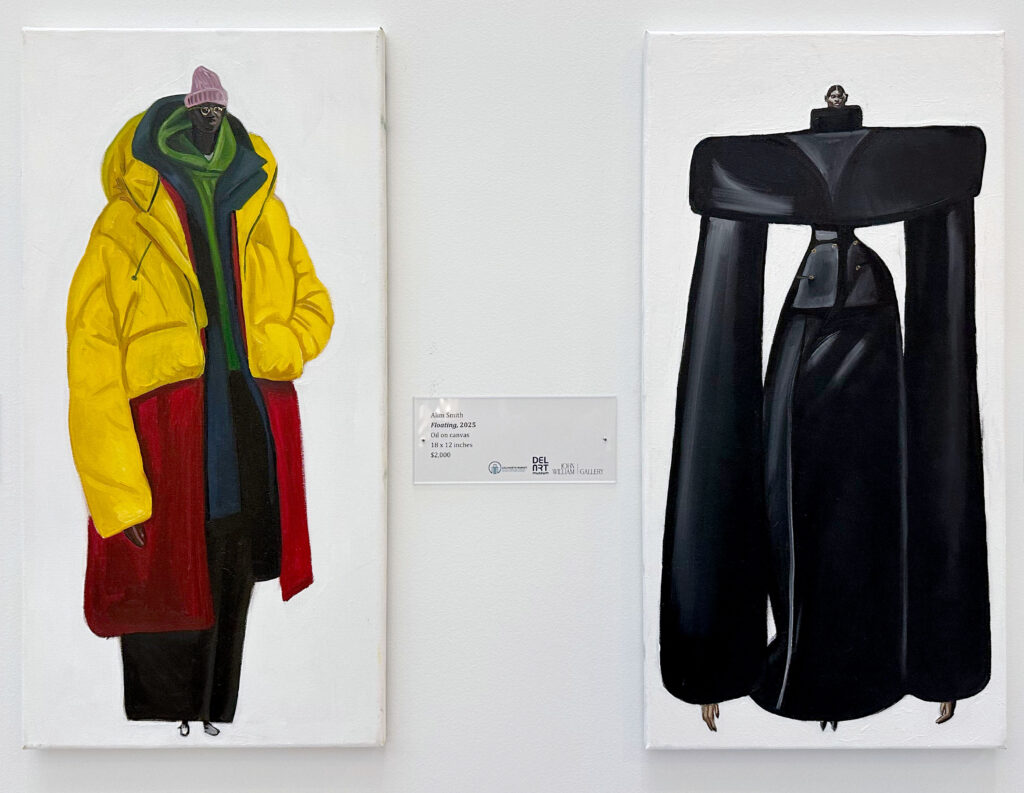
Alim Smith, “Floating” and “Thought A New Dress Would Make it Better”, 2025, Oil on canvas
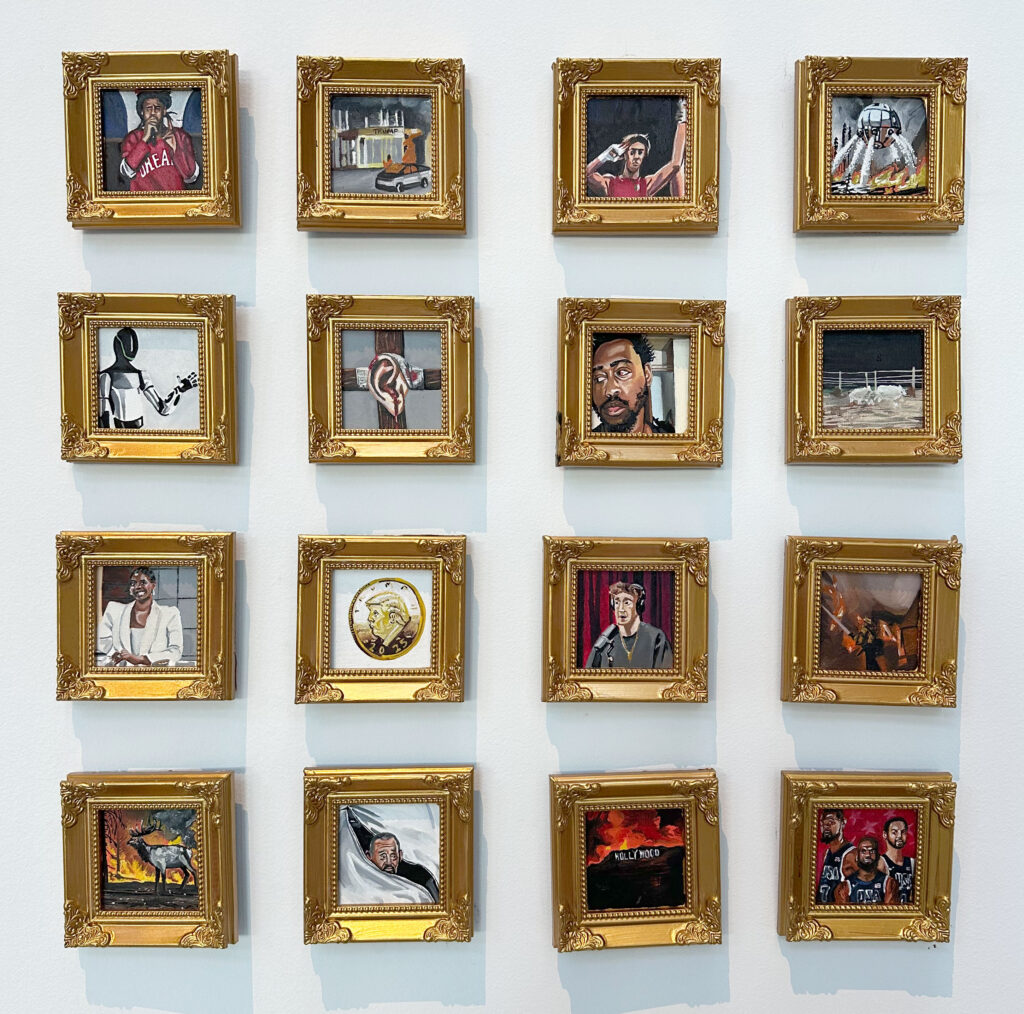
Paintings by Alim Smith
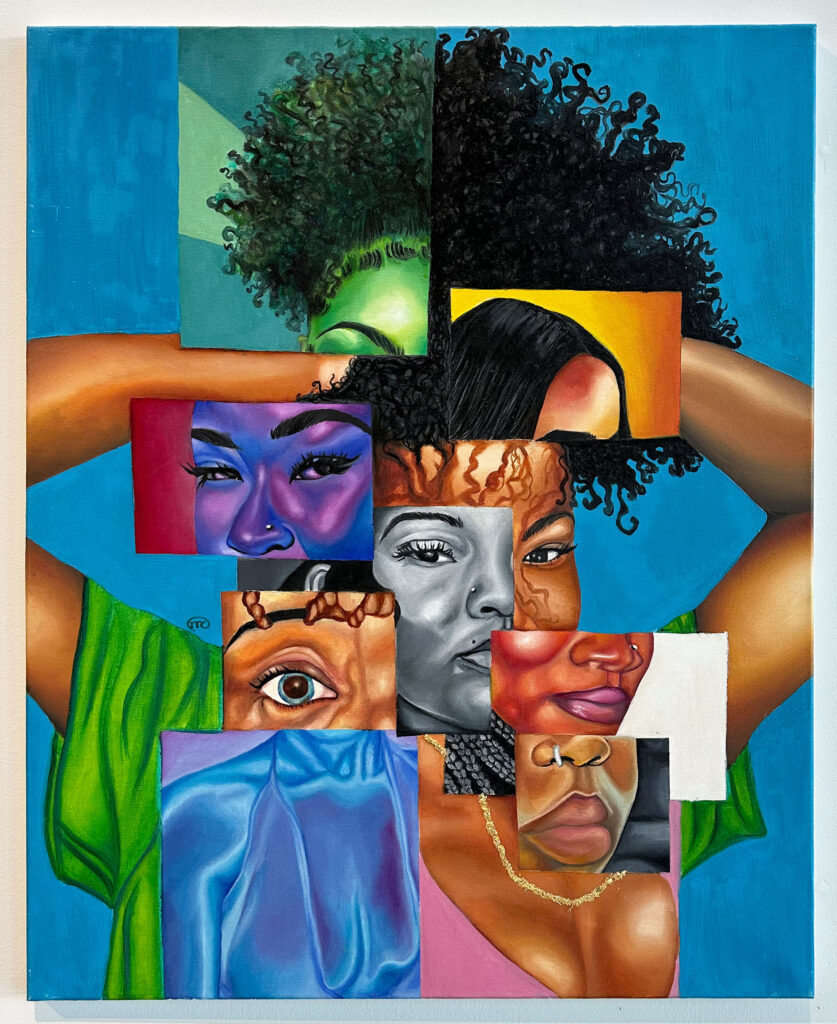
Taylor Gordon, “To Be A Black Woman”, 2023, Oil on canvas
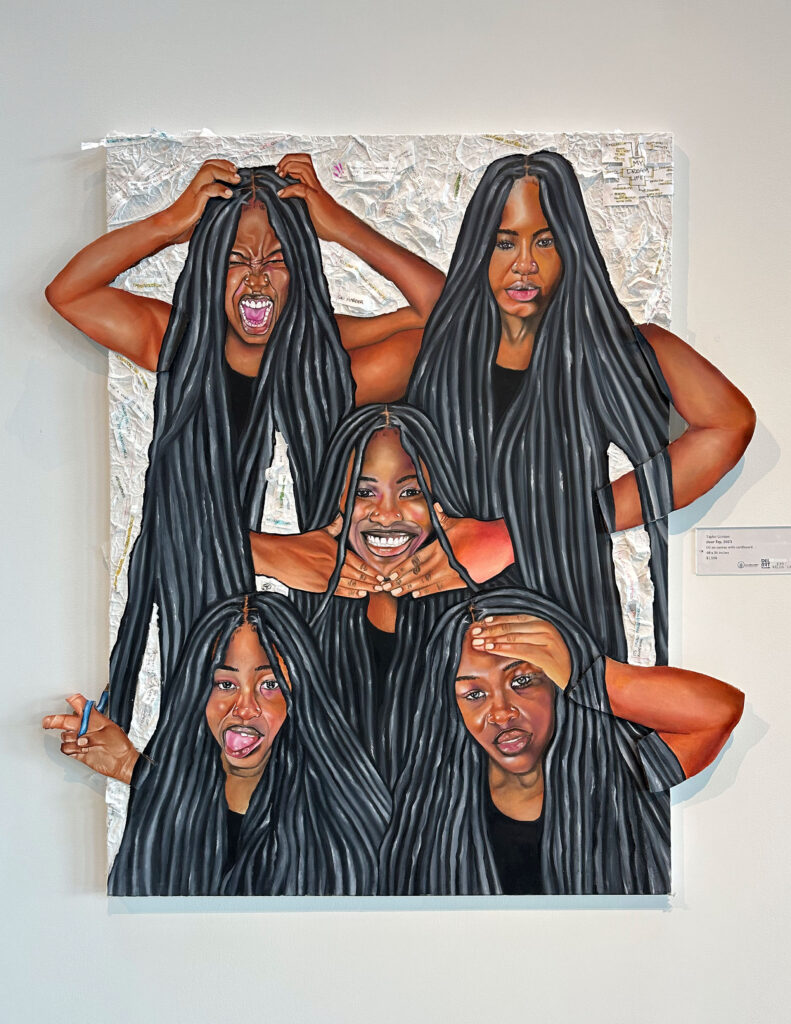
Taylor Gordon, “Dear Tay”, 2023, Oil on canvas with cardboard
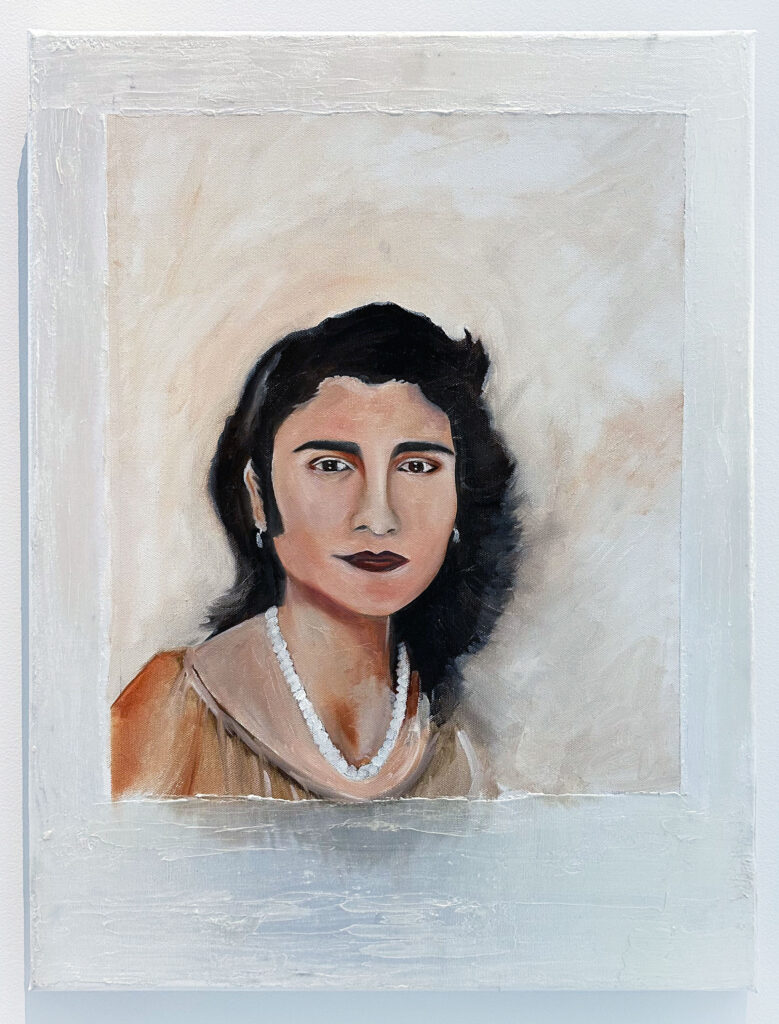
Manuel Ramos, “Abuela Gorin”, 2025, Oil on canvas
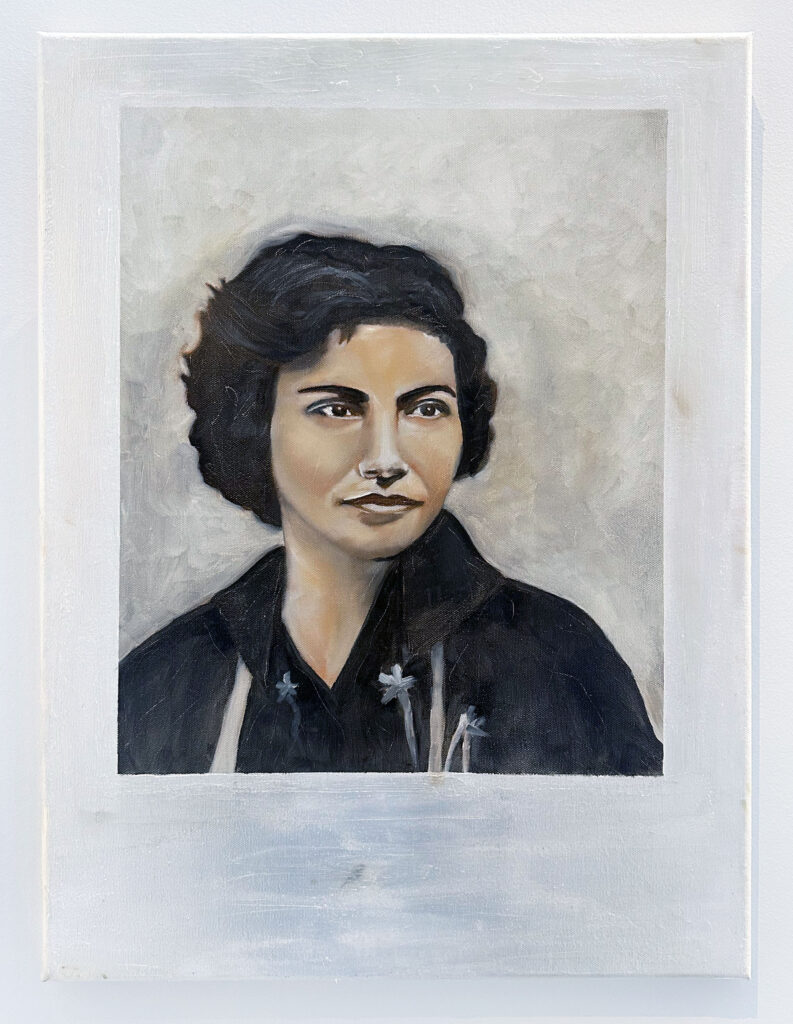
Manuel Ramos, “Abuela Olga”, 2025, Oil on canvas
Currently on view at John William Gallery in Wilmington is Colorful Voices: Taylor Gordon, Alim Smith, Manuel Ramos, featuring unique paintings by the three Delaware artists.
From the gallery about the exhibition-
Colorful Voices: Taylor Gordon, Alim Smith, Manuel Ramos brings together three distinctive practices that articulate the richness of contemporary community life through color, portraiture, and cultural reference. The exhibition seeks to foreground the vitality of local voices while offering a space in which viewers might consider how identity, humor, and heritage are translated into visual form.
Taylor Gordon’s paintings situate themselves within the lineage of Black contemporary art, yet remain deeply personal. Her chromatic sensibility infuses each figure with layered emotional resonance, encouraging conversations around beauty, resilience, and the multiplicity of Black experience beyond reductive narratives. Manuel Ramos, or “RAmos ART,” approaches portraiture with a keen attentiveness to light and surface, imbuing his sitters with an understated dignity that resonates quietly yet powerfully. Emerging from a self-taught practice shaped during the pandemic, his canvases record moments of presence that hover between the intimate and universal. Alim Smith, or “Yesterday Nite,” works in a spontaneous visual language, fusing surrealism, popular culture, and sly humor. His rhythmic compositions and vivid palette translate music, memory, and cultural archetypes into forms at once playful and incisive.
Together these artists propose color as more than visual pleasure: it becomes a conduit for empathy, critique, and joy. Colorful Voices invites us to engage with works that are celebratory yet searching, attuned to both the textures of daily life and the broader currents shaping our communities. In gathering their practices, the exhibition hopes to affirm art’s capacity to nurture dialogue and to render visible the stories that animate shared experience.
This exhibition is on view until 12/18/25.
Alim Smith’s work may look familiar- he created work for the television series Atlanta and the cover art for Mac Miller‘s second posthumous album, Balloonerism, released earlier this year. Miller reached out to him in 2018, after finding his work on Instagram. Smith was recently nominated for a Grammy award for “Best Recording Package” for this album.
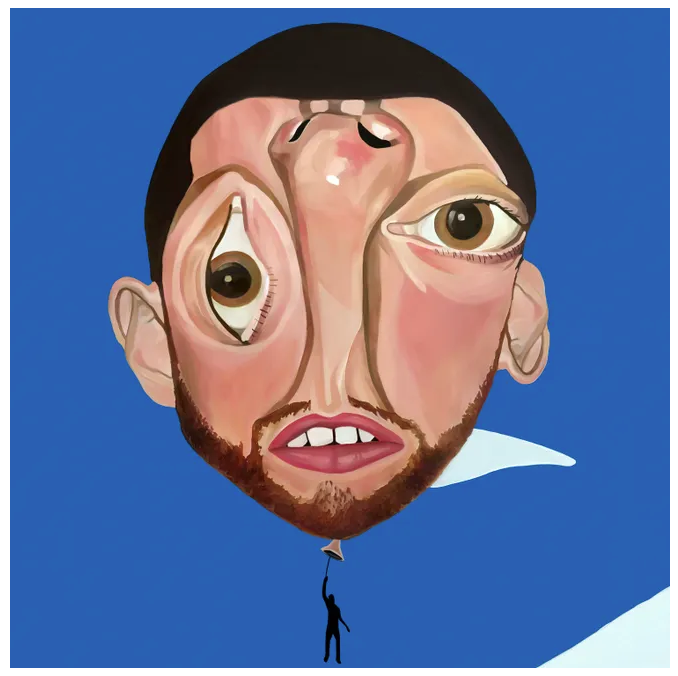
Mac Miller’s “Balloonerism” cover art by Alim Smith