Oct 222019
 

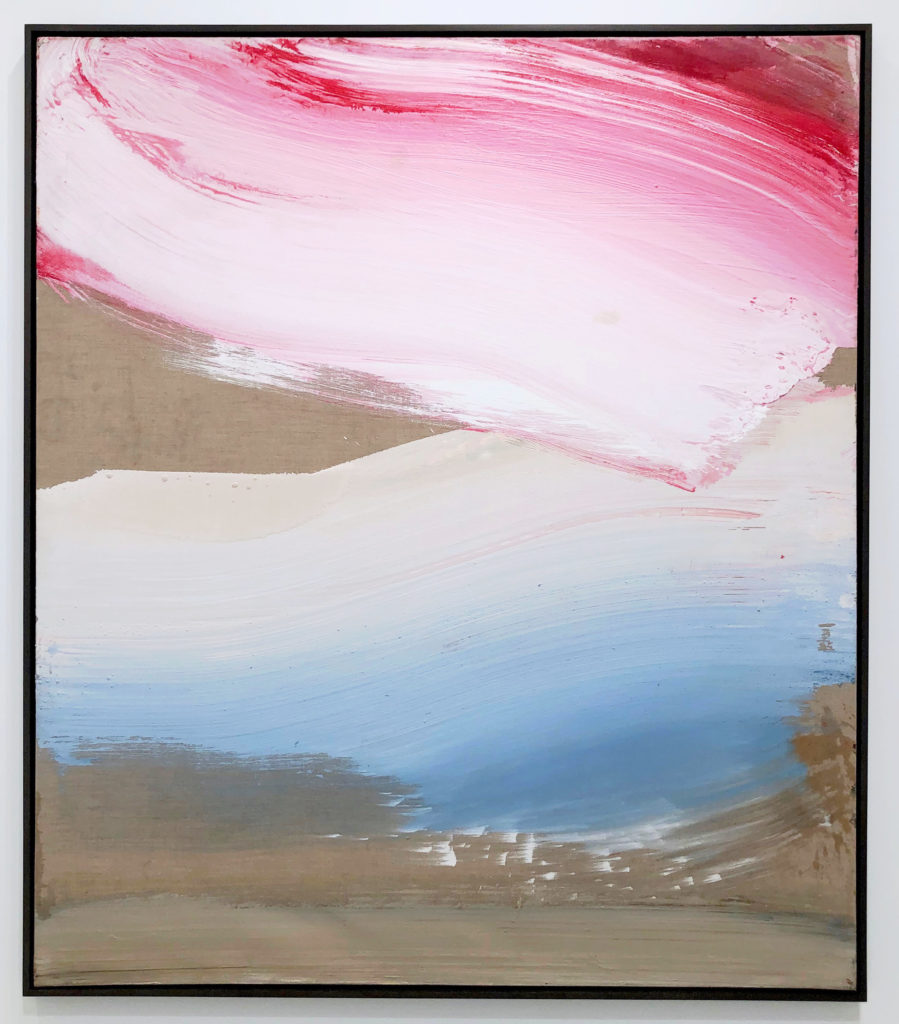
Hauser & Wirth is currently showing two painting exhibitions. On the ground floor of their 22nd Street location are Ed Clark’s gorgeous abstract works, some of which are pictured above. The paintings on view are recent, made between 2000 and 2013. Created on the floor using a push broom, there is a high energy in the motion and blend of color in these canvases.

Sadly, Clark passed away on Friday, October 18th at the age of 93. He was an innovative abstract painter who worked for more than 60 years. This is a wonderful opportunity to see his work in person.

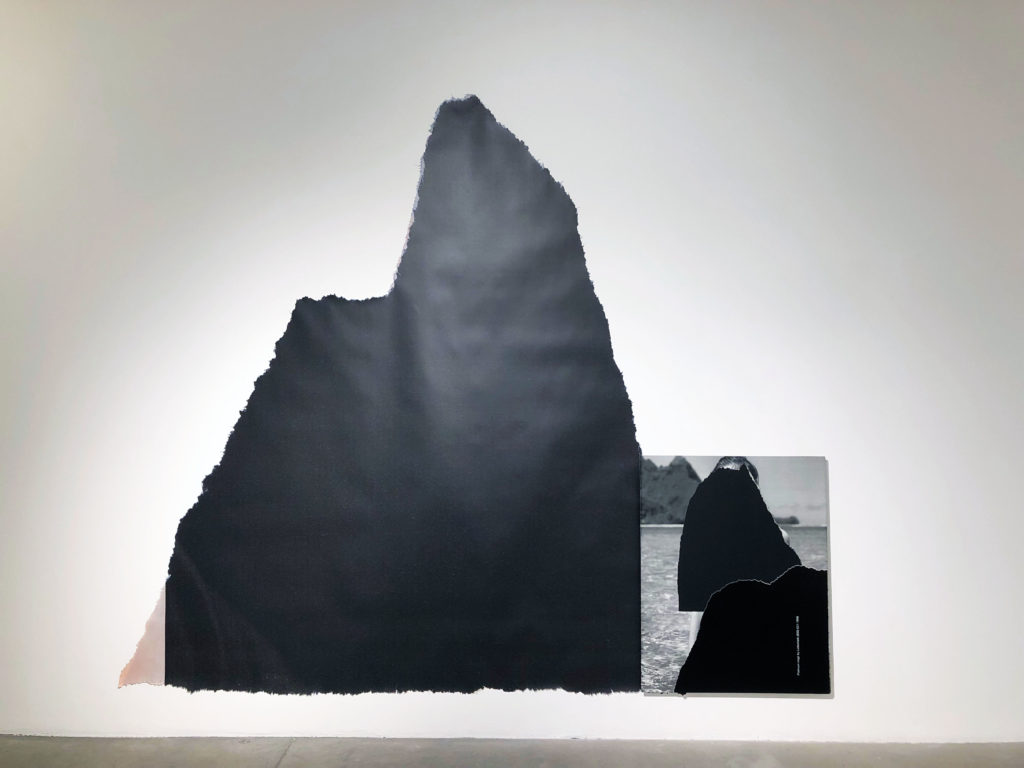
On the second floor of the gallery is Amy Sherald’s the heart of the matter… , (pictured below) her inaugural exhibition with the gallery. If her style looks familiar, it may be because she gained a lot of attention with her portrait of Michelle Obama for the Smithsonian’s National Portrait Gallery.

“If you surrendered to the air you could ride it” (2019)

“Precious jewels by the sea” (2019)

From the press release-

Informed by the artist’s reading of key texts that explore tensions between interior and public realms, the heart of the matter… draws its title from the first chapter of bell hooks’ seminal book ‘Salvation,’ and builds on themes of silence and stillness explored in Kevin Quashie’s ‘Sovereignty of Quiet’ and U.S. Poet Laureate Elizabeth Alexander’s ‘Black Interior.’ In her new paintings, Sherald considers how these relate to the conceptualization of blackness as it is represented publicly, questioning representation of black identity, which often negates the complex reality of an interior life. She envisions black American identity beyond the conceits to which it has largely been restricted, attempting to restore a broader, fuller picture of humanity.

Sherald’s portraits are vivid, large in scale but intimate in effect, capturing both the ordinary likeness and extraordinary essence of her subjects while simultaneously detaching them from everyday reality. Varying in expressiveness, gesture, clothing, and emotional auras, the individuals portrayed maintain a persistent sense of privacy and mystery, requiring viewers to ponder the sitters’ thoughts and dreams. Drawn to each of her subjects instinctively and spontaneously, these ‘Americans doing everyday American things,’ as Sherald has described them, are part of an informal network of people who populate our universe.

Once Sherald commences painting, a transformational moment ensues as the artist begins to view her sitter as an archetype in the history of representation and therefore a vehicle for challenging assumptions. Working from carefully composed and dramatically staged photographs, Sherald situates her subjects in brightly colored, ambiguous environments, then meticulously tweaks expressions and patterns to emphasize a sense of universality and connection. While her subjects are always African-American, Sherald renders their skin-tone exclusively in grisaille – an absence of color that directly challenges perceptions of black identity.

the heart of the matter… debuts two paintings that reach a new, monumental scale for the artist. In these works, Sherald’s monochromatic backgrounds evolve into fully realized scenes that reference quintessential Americana: friends posed at the beach and a man atop a metal construction beam. For the latter, Sherald draws inspiration from Charles C. Ebbet’s iconic photography of 30 Rockefeller Plaza in New York City. Sherald often looks to vintage photography for source material, drawn to what she describes as its capacity ‘to narrate a truer history that counters a dominant historical narrative… Photography was the first medium I saw that made what was absent, visible.’ Sherald continues, ‘It gave people who once had no control over the proliferation of their own image the ability to become authors of their narratives.’ By mining and positioning images associated with archetypal or nostalgic American moments – burgeoning industry, sunny beachside locales – Sherald is able to firmly situate and make fully visible black Americans within the canon of American iconography. In this way, her portraits reclaim space and author a narrative for people that official art history omitted, speaking to the human condition and holding up a mirror to American life.

Lastly,  take a trip to the top floor for the group show Personal Private Public, a group exhibition “exploring the idea of the inner life in three main themes: introspection, intimacy, and voyeurism”.  The exhibition includes work by Jonathan Lyndon Chase, Ivy Haldeman, Celia Hempton, Tala Madani, Paul McCarthy, B. Ingrid Olson, Paul Mpagi Sepuya, Emily Mae Smith, Mira Schor, and Kohei Yoshiyuki.

All three of these exhibitions close 10/26/19.


Oct 172019
 

From Ishiuchi Miyako’s “Scars” series (1991-)

Images from the “ひろしま/ hiroshima” series, 2007-present

Ishiuchi Miyako’s exhibition occupies both floors of Fergus McCaffrey’s Chelsea gallery space and includes over 70 photographs from five series made over four decades, including many early and never-before-seen works.

On the first floor are the artist’s somber black and white photos of the buildings of her hometown of Yokosuka. Yokosuka was also the home of a US Naval Base, established in 1945.  In another room is work from her Scars series, for which she photographed the damage left behind by injury, illness, and trauma. These portraits focus not on the people but on the imprints on their bodies. Despite that, they don’t feel impersonal or voyeuristic. There is a tenderness to these images.

Photographs of objects dominate the rest of the exhibition. There are a series of images of her mother’s possessions, taken before she passed away. She also photographed Frida Kahlo’s belongings, including a pair of her shoes that were different sizes- accommodating the physical issues Kahlo had after her bout with polio as a child.

The photos of items donated to the Hiroshima Peace Museum, for the ひろしま/ hiroshima series, are especially moving. The articles of clothing worn by residents of Hiroshima when the atomic bomb was dropped on the city are worn and damaged. It’s hard not to think of what happened to the people who owned them.

Each series of photographs is unique, but tying them together is the idea of capturing what gets left behind. It can be a city or a scar or a person’s possessions after they die, but they have an effect. Ishiuchi’s photos record that effect in an impressive and thought provoking way.

This exhibition closes 10/18/19.


Oct 112019
 

Francisco Rodriguez “Aridity”, 2019

Francisco Rodriguez “In the Garden”, 2019

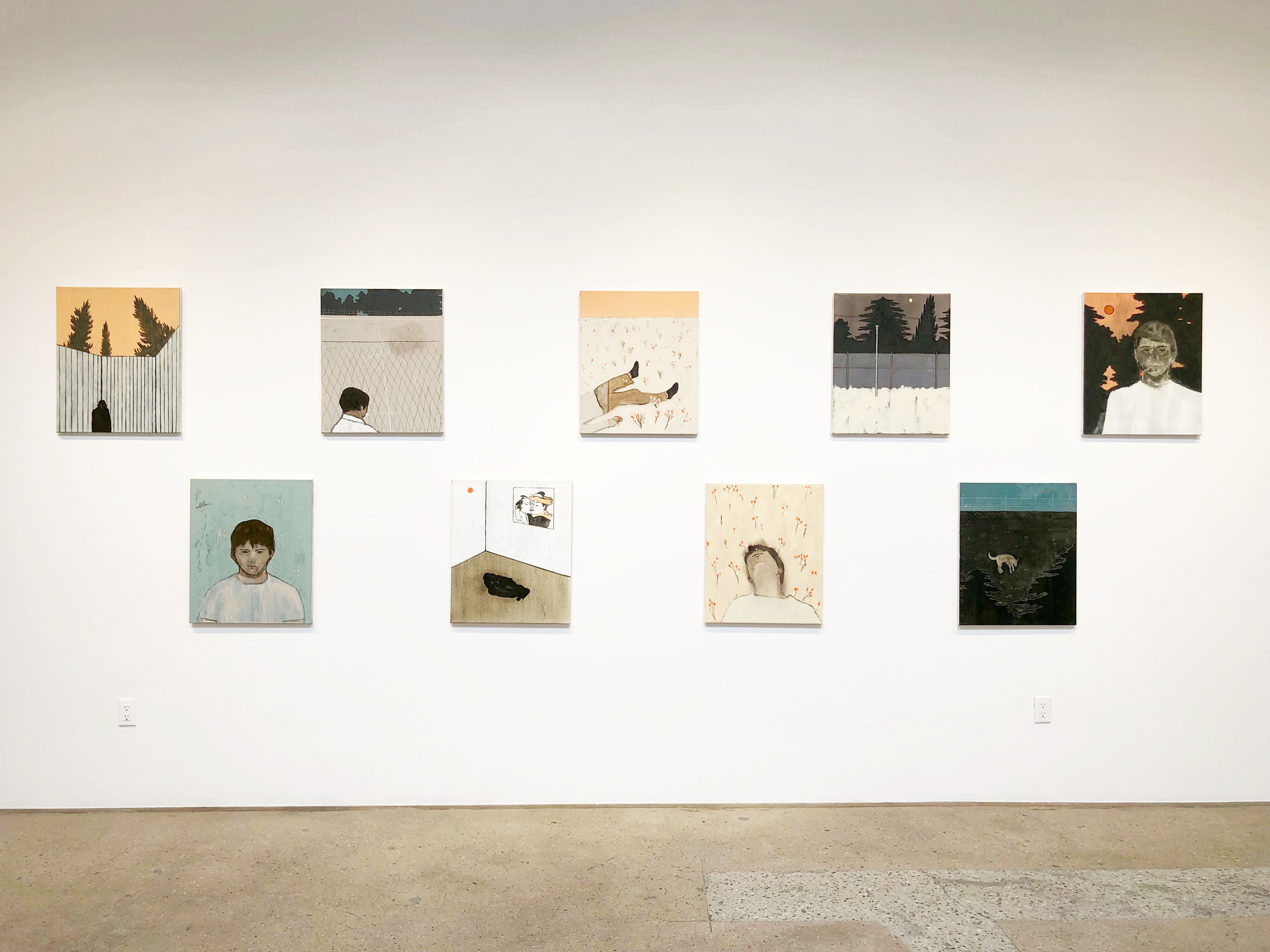
Currently at Steve Turner gallery in Hollywood are three excellent painting exhibitions. The first, pictured above, is Francisco Rodriguez’s Midday Demon.

From the press release–

Steve Turner is pleased to present Midday Demon, a solo exhibition of new paintings by London-based Francisco Rodriguez, most of which feature an isolated male figure within a desolate urban landscape. In some, the figure is upright and smoking a cigarette. In others, he appears to have passed out. The artist describes the bleak setting as one that fosters exhaustion, listlessness, sadness, dejection, restlessness, anxiety and depression. Rodriguez observed the phenomena of the “midday demon” while growing up in Santiago, one of the largest cities in South America; again in London where he has lived for the last five years; and also during a recent residencies in Poland and Ukraine. He ponders the effects of the oppressive midday sun and wonders if such “spirits” actually do appear at that hour. Are his figures victims of some  “midday demon”; or are they the demons themselves?

In the second gallery are Rebecca Shippee’s paintings for The Creators, featuring four portraits that are scaled to life and painted from observation.

From the press release–

Her subjects are queer, their bodies altered medically or through wardrobe choices. One figure bears top-surgery scars and whimsical tattoos, while another wears emerald green silk pajamas and a nameplate reading Boyland. The show’s title refers to self-fashioning, the art of inventing oneself, a pursuit particularly vital to queer life as well as to the fact that all the sitters are cultural creators–artists, writers and activists. In choosing to portray individuals with whom she has close personal relationships, Shippee rejects the traditional notions of “active artist” and “passive muse.” Instead, she portrays the sitters as creators of their own images.

Rebecca Shippee “Noah”, 2019.


In the third gallery are Jon Key’s paintings for Violet Alabama, a solo exhibition “inspired by the artist’s personal history and memories of growing up in rural Seale, Alabama”.

From the press release–

Through self-portraiture, Key explores the lineage and history of his identity through four themes–southern-ness, blackness, queerness, and family–each of which he represents chromatically with green, black, violet and red. He will also exhibit portraits of his father and grandfather to highlight the friction between the generations and the challenges of being a queer Black man in the Deep South.

Jon Key “The Man (No. 4)” and “The Man (No. 3)”, 2019

Jon Key “Family Portrait (No. 1)”, 2019 (front) and “Man in Red Room 1”, 2019

All three of these exhibitions close 10/12/19.
Oct 032019
 

“Lake Annecy”, 2019 and “Sailboat”, 2019

Lake Annecy, 2019 detail

Currently at Miles McEnery’s gallery locations in Chelsea are two engaging painting exhibitions.

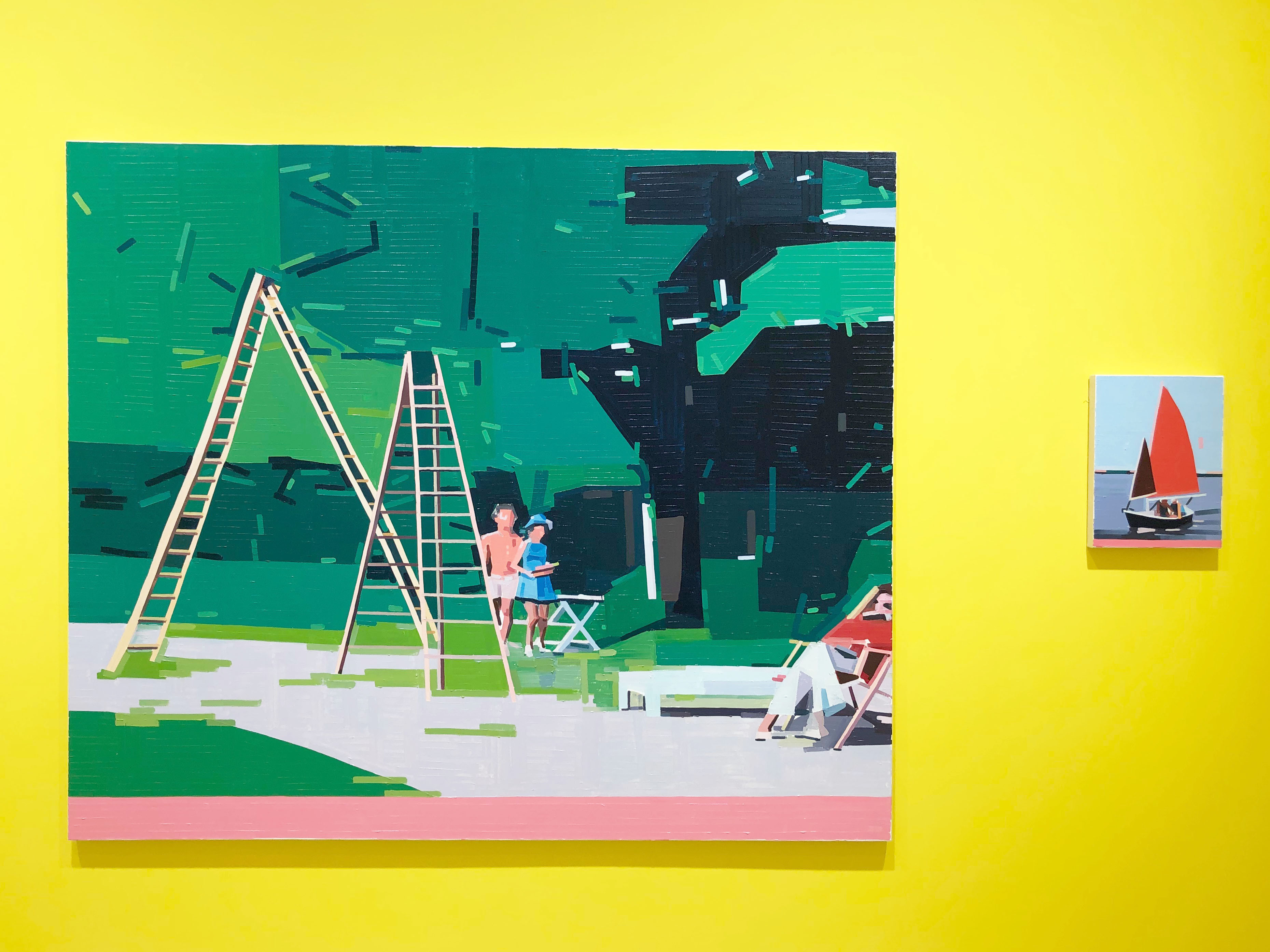
Guy Yanai’s paintings, at the 21st Street location, are created with strips of oil paint and are fascinating to walk up close to, observing the details, and then to pull back from to see as a whole. He also chose a bright yellow for the walls of the gallery to be painted, which brings out the colors of the paintings even further.

From the press release–

Guy Yanai strips his subjects down to geometric necessity and builds them back up again in oil paint, establishing a tension on his canvases between the spatially flat and the physically multidimensional. A combination of diagrammatic delineation of form and vivid color, Yanai’s paintings are an optical delight.

Yanai accomplishes this willful distillation of his subjects by painting obsessively in tight chromatic strips. While from afar the individual brushstrokes fade into the larger landscape, up close one can notice the stops and starts of each metered stroke. This synthesis speaks to Yanai’s desire for his works “to have such tension that if you take out one brushstroke, the painting will collapse.” The smoothness and uniformity of his taut oil bands offer a linear precision that can only be accomplished by the most disciplined draftsman.

While Yanai harkens back to modernist masters such as Matisse and Cézanne, his compositions are pixelated in a manner that is fundamentally contemporary. The collection of short and disconnected brushstrokes merge in the viewer’s eye to create a fully realized image. Yanai’s paintings experiment with the digital in contemporary art. “As beholden to the virtual imagery of the internet as to the history of modernism,” Ara H. Merjian writes in his essay, Élan Vital, “Yanai’s work proves beguilingly complex despite – or rather, precisely in – its congenial simplicity.”

Often revisiting the same subject, he paints from memory – of a place, of a moment, of a feeling. Just as recollections brighten and fade in the mind over time, Yanai recalls his own inspirations and recreates them in different ways as they evolve. What results is a proliferation of works that demonstrate Yanai’s rich meditation on his experiences. Whether an open window or an ocean view, Yanai’s nostalgic passion has a lasting impact on its viewer.

At their 22nd Street location are Brian Alfred’s colorful graphic paintings of places in New York City.

“W. 4th St.”, 2018-2019

“Central Park at Dusk”, 2019

From the press release-

Alfred navigates these complex themes using an approach characterized by sharp lines and blocked colors. Tightly-cropped compositions manipulate the viewer’s perception of space, conflating overlapping buildings, signage, and other urban elements. These vibrant, city-shaped configurations capture ephemeral moments: the view through the gap between two skyscrapers, the contour of a passing storefront from a car window, and a downward glance into a subway entrance. While they might not last long, these unique fields of vision are fundamental parts of the experience of the city.

Both of these exhibitions close 10/5/19.

Oct 032019
 

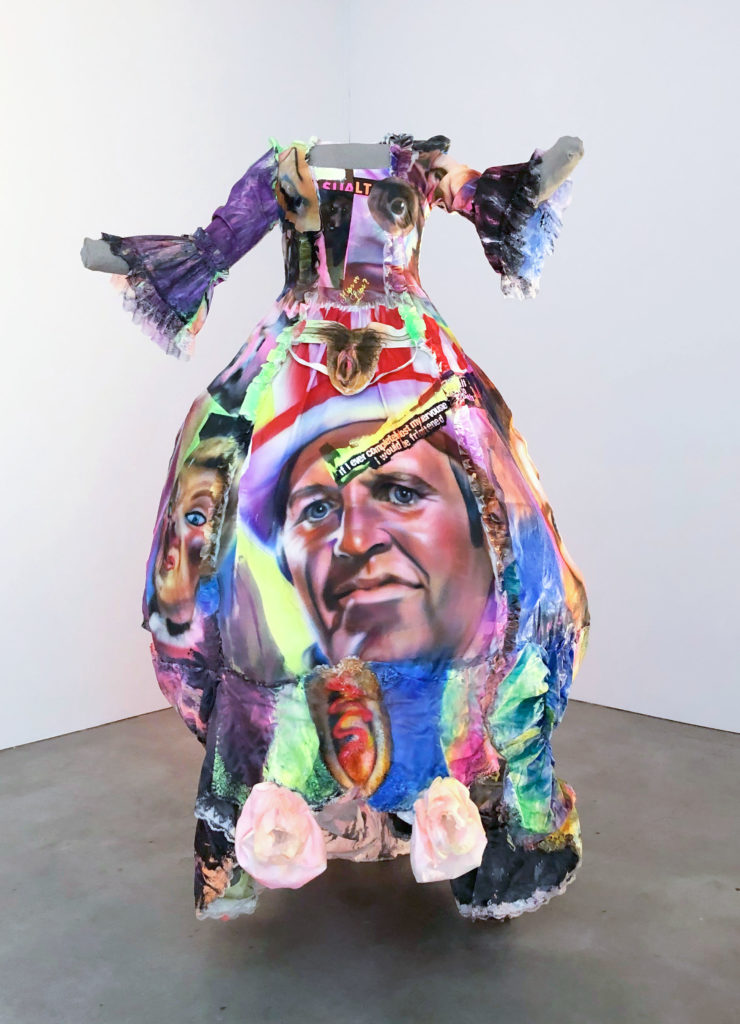
Jim Krewson’s “tribute to a vanishing subculture”, A Requiem for Paul Lynde, currently in the Viewing Room in the back of Marlborough Gallery’s downtown location, “questions the loss and amnesia of marginal identity in a new age of equality, instant access, Instagram influencers and celebrity, from homosexuality to homogenization in 20 short years.”

The airbrushed wedding dress spins with images that include Lynde himself, as well as Lady Elaine Fairchild from Mister Rogers’ Neighborhood, and the Madame puppet, a Wayland Flowers creation. Flowers’ puppet had her own sitcom in 1982 and also took over Paul Lynde’s center square on Hollywood Squares. Sadly Flowers, an openly gay entertainer, passed away in 1988 at the age of 48 from AIDS related Kaposi’s sarcoma.

If you love of a certain time period of pop culture and Paul Lynde than it will be hard not to embrace this project. But it’s also interesting as a meditation on the state of gay pop culture in the past, the place it is in today, and the question of where it may go in the future now that it is has such a strong, but less subversive place, within mainstream media.

In the main viewing space of Marlborough Gallery is Joe Zucker’s multi-panel 100-Foot-Long-Piece created from 1968 to 1969.

From the press release–

This masterwork, exhibited here with a large body of related archival material, comprises a blueprint for Zucker’s long and diverse practice. It plants a flag for the artist’s ongoing inventiveness, irony, and eclecticism.

With the creation of this work, Zucker presents the viewer with a puzzle-like, encyclopedic visual vocabulary, anticipating subsequent pictorial and conceptual approaches such as New Image, Neo-Expressionism, Appropriation, Neo Geo, as well as more recent process- based abstraction, with a self-referential, wry regard for the embedded, associative meaning of his imagery and materials.

100-Foot-Long Piece is a linear aggregate in which gestural abstraction rubs elbows with hard edged grids, silk-screened passages, sculptural reliefs, and a host of other styles and forms. One is mindful of both physical and critical tropes of progressive art history from the physicality of the frieze to a qualitative timeline tracing the contributions of Modernism.

Both shows close 10/5/19.

Sep 202019
 

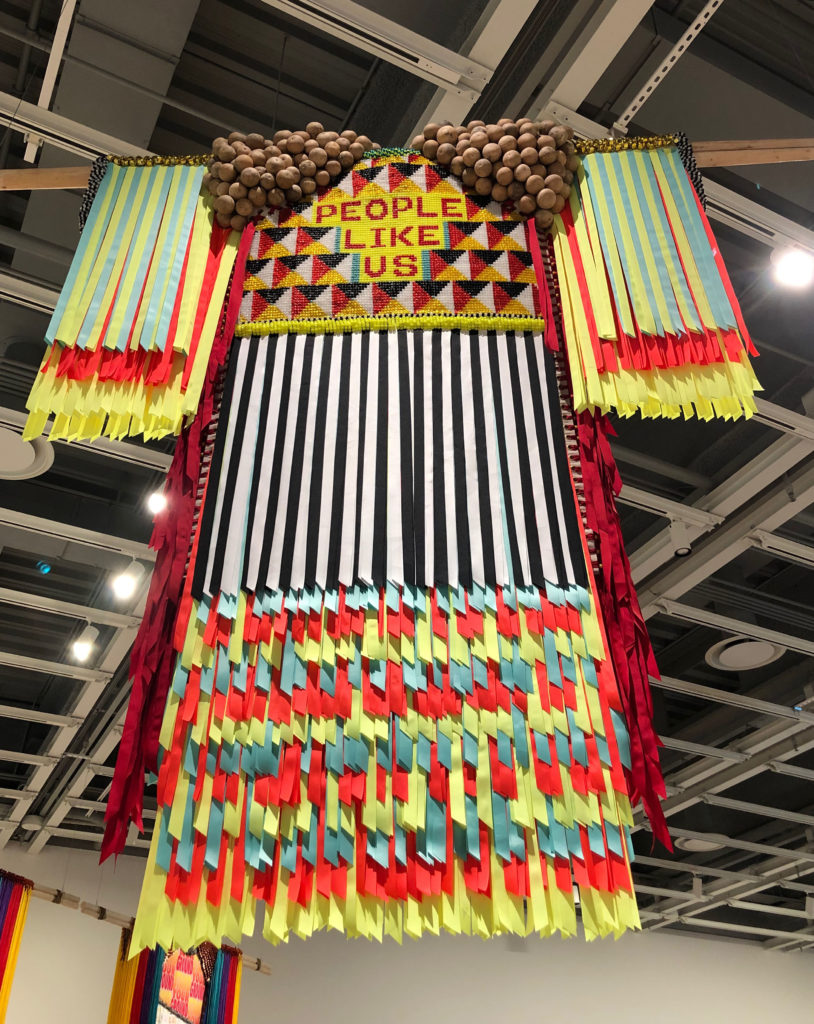
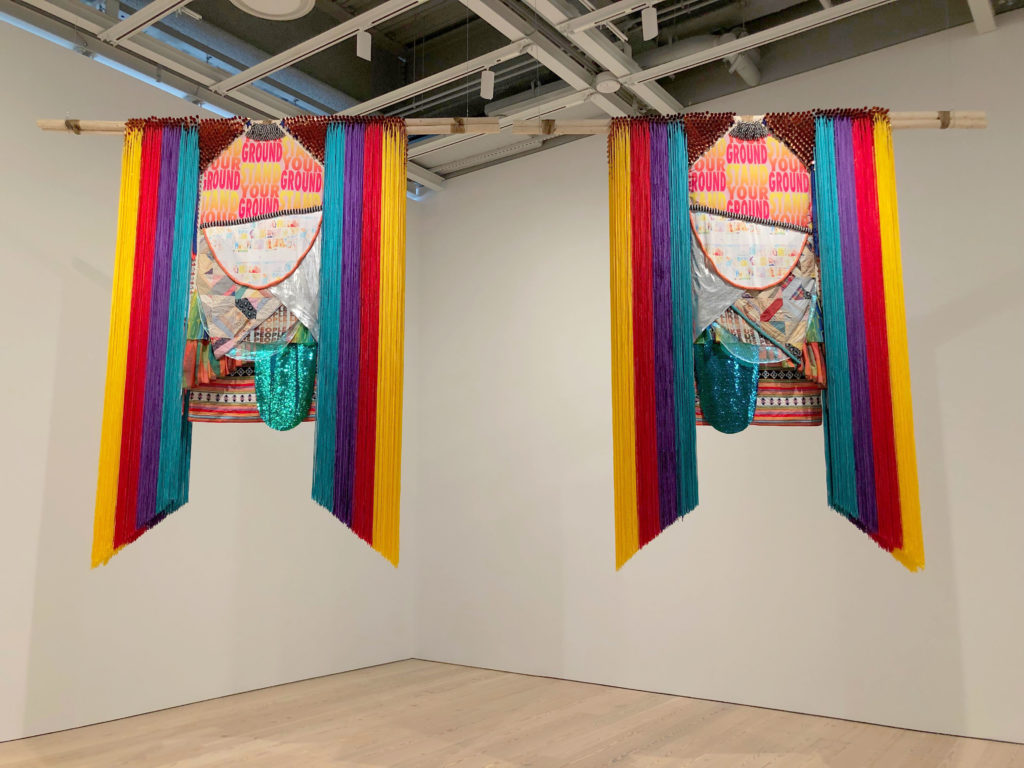
Jeffrey Gibson, “PEOPLE LIKE US”, 2019

Jeffrey Gibson

2019’s Whitney Biennial presents an interesting selection of work, by a mostly young and diverse group of artists. The works included in the show are consistently good, and often intriguing, but this time around nothing is particularly outrageous or polarizing- a contrast to many of the previous iterations.

Not that there wasn’t any drama surrounding the show. This time around, however, the controversy was not with an artwork but with former Whitney executive board member Warren B. Kanders and his ownership of Safariland, a tear-gas canister maker. He has since resigned after protests and threats of withdrawal from several of the artists included in the show. Artist collective Forensic Architecture’s film, Triple Chaser, on view in the exhibition, investigates Safariland and Kanders.

Below are a few highlights from the exhibition.

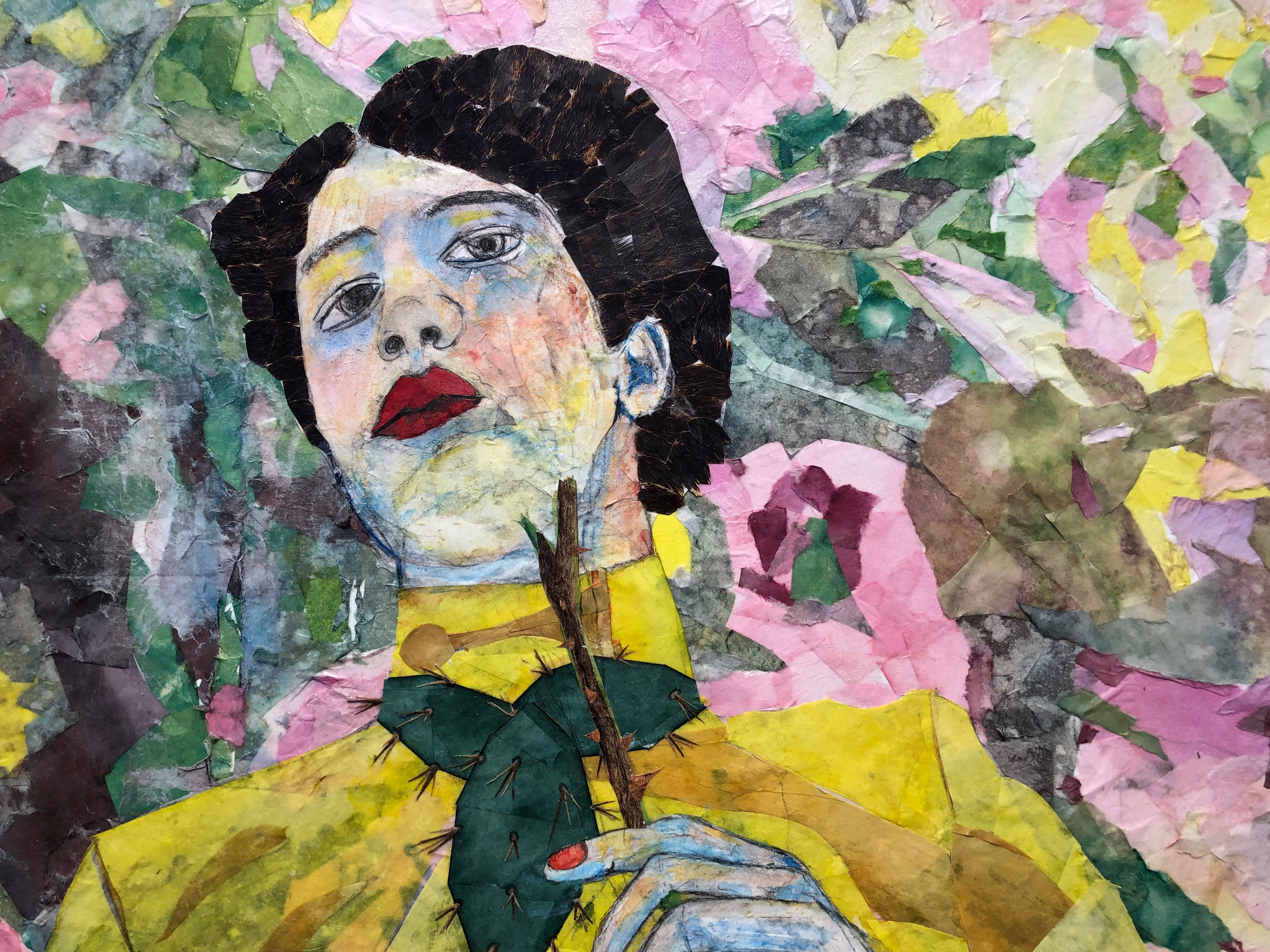
Janiva Ellis ” Uh Oh, Look Who Got Wet”, 2019

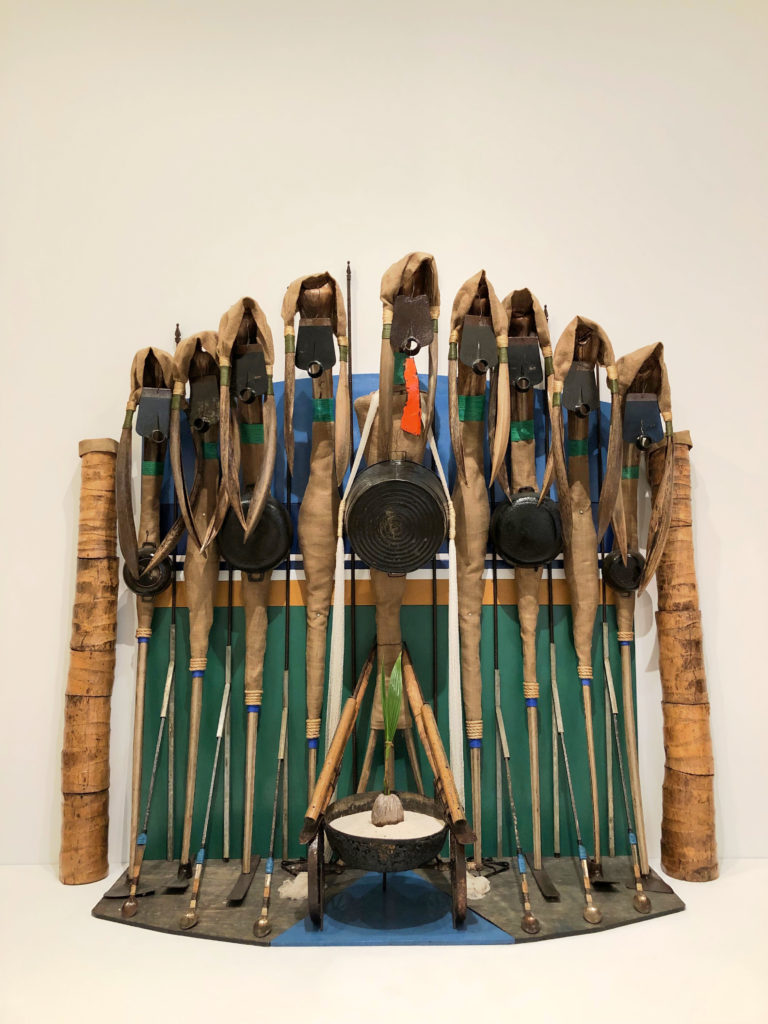
Daniel Lind-Ramos, “Centinelas (Sentinels)”, 2013

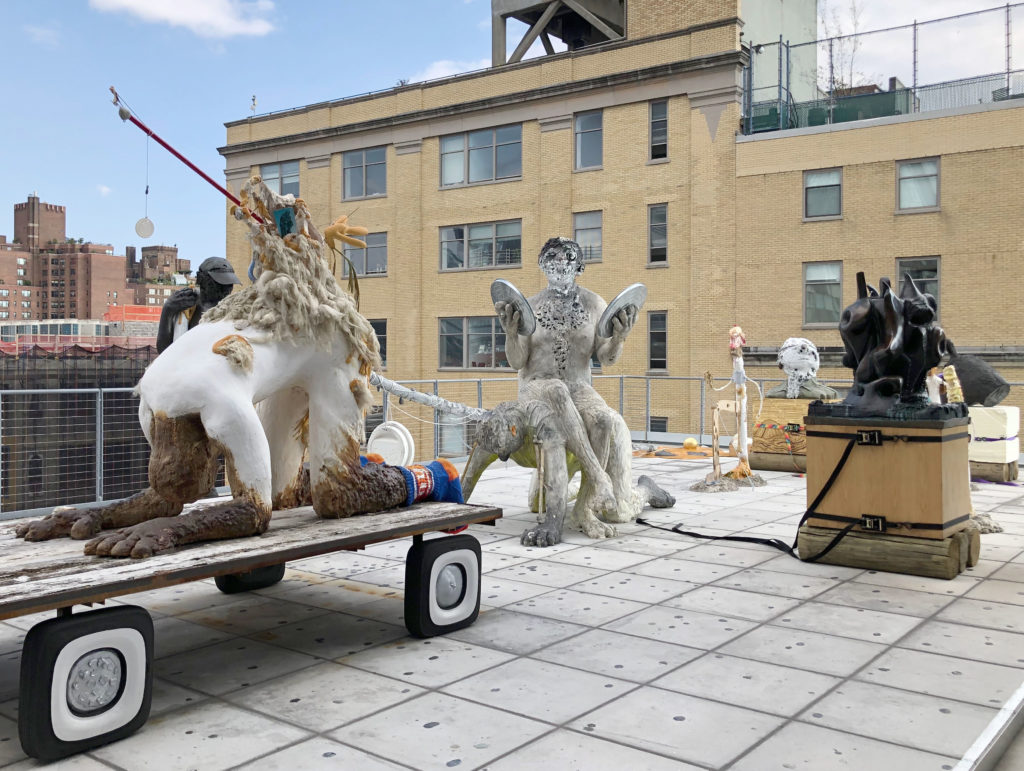
Section of Nicole Eisenman’s, “Procession”, 2019

This exhibition closes 9/22/19.


Aug 232019
 

CONTACT HIGH: A Visual History of Hip-Hop, Annenberg Space for Photography‘s latest exhibition, includes an excellent selection of photos from the beginning of hip-hop until now. Over 75 original and unedited contact sheets are also being shown. These are a great addition to the exhibition and give the viewer added insight into the thought process that went into the final work.

In the center of the gallery, there is an exclusive new documentary short film featuring several of the photographers from the show at work and in conversation. There is also a pop-up record shop featuring rare hip-hop on vinyl.

This exhibition closes 8/25/19.

Aug 222019
 

A Universe of One, 2018

A Universe of One, 2018 (detail)

The Dream of Flight, 2019

The Dream of Flight, 2019 (detail)

Currently at Kohn Gallery is New York-based artist María Berrío’s first solo exhibition in Los Angeles.

From the press release-

Inspired by her youth in the countryside of Bogotá, Colombia, Berrío’s paintings explore the experience of immigrant identity, intercultural connectivity and the beauty that is found in the diversity of cultures and countries. Berrío depicts her figures with richly detailed and patterned backgrounds of exteriors and interiors. The large, detailed mixed media canvases employ lush, carefully crafted, multilayered Japanese papers and paint, resulting in scenes replete with pensive yet confident figures amid a scene of visual exuberance.

Berrío’s work often places female figures at the center of her intricately woven landscapes. Painted with watercolor details, her figures stare out of the composition determined to confront the viewer from their own surreal surroundings. Her work is evocative of predecessors such as Gustav Klimt and Egon Schiele, both known for their exceptional degree of emotional directness and figural distortion in the place of conventional beauty. Berrío’s works float seamlessly between historical and contemporary artistic styles as they employ a wide visual vernacular ranging from expressionism to graphic, abstract marks.

The variety of media and techniques found in María Berrío’s practice emphasizes the interwoven cultural breadth of the world in which we live, where globalization and injustice touch the lives of everyone. Each character Berrío paints is a symbol of this new reality and the strength that can issue from it. For the artist, a female soldier on the front lines is as brave and mighty as the mother who protects her children from the perils of war. These depictions of women are seen as guiding spirits who are strong, vulnerable, compassionate, courageous and in harmony with Nature and themselves. With these combinations of human traits and emotions, Berrío fortifies her belief that with womanhood every action is considered beautiful and strong, no matter how small or large.

For her current show, A Cloud’s Roots, Berrío focuses especially on place and migration. The individuals are seen in preparation for their travels, in moments of transition, and in various states of uncertainty. Berrío states, “the ambiguity is intentional; although I may have a specific idea in mind when making the work, the actual piece lacks cultural specificity to allow for all symbolic possibilities.” Berrío therefore gravitates towards symbols with global cultural significance, such as braids, birds, and flowers, with the hope that they allow diverse audiences to bring their own understanding to the work.

In her recent work, A Cloud’s Roots (2018), Berrío creates a fictional species of tree based on the dragon’s blood tree, found exclusively on an island off the coast of Yemen. The dragon’s blood tree has adapted perfectly to the island’s desert-like climate and rocky soil, inhospitable to most other plant life. It is a powerful symbol of survival and resilience, able to thrive even in the most unlikely conditions. The figures in the piece are compelled to leave their home but they carry with them the knowledge that they too have the power to put down roots wherever they go.

By reflecting on the beauty of our immigrant nation, Berrío’s new body of work aims to rewrite the narrative of American history to include the stories of people who have long been excluded. It makes space for those who were not born in this country, but come here full of hope and desire to make it their home. As the art canon expands its scope and redefines its boundaries, Berrío imagines a future in which people with diverse perspectives can walk into an institution and see themselves reflected back. Berrío states, “so many immigrants, myself included, are stuck in the inbetween, not quite from here, and no longer from there. I create work that bears witness to this liminal state of being and acknowledges it as an essential part of being American. I wish to convey that which can never be conveyed: the sheer joy of being, of creation, and the undiscoverable mystery of being alive.”

This exhibition closes 8/24/19.

Also, if you are in New York City, she recently created several glass and ceramic mosaics that can be seen in the Fort Hamilton Pkwy Station.


Jul 192019
 

Woven Stories, at the Museum of Art and History (MOAH) in Lancaster, is a collection of narrative fiber artworks as well as five solo exhibitions and five site specific installations. There are so many great pieces in the show it was hard to narrow down which artists to include, but below are a few that stood out.

Victor Wilde, Momma Bears, 2019

Vojislav Radovanovic, TWO SIDES OF A LUCID DREAM, 2018

Vojislav Radovanovic, TWO SIDES OF A LUCID DREAM, 2018

Orly Cogan, Confections

Orly Cogan, Sugar ‘n Spice ‘n Everything Nice

Upstairs, the solo exhibitions are equally impressive. Several of these artists utilize nontraditional materials to create their unique work.

Nicola Vruwink uses the film from cassette tapes instead of traditional yarn to create her pieces.

For her large sculptures, Elisabeth Higgins O’Connor, uses materials from second hand shops. The pieces of broken furniture and scraps of fabric form animal figures caught in awkward poses.

Elisabeth Higgins O’Connor, Blamethirst

Peter Hiers’ sculptures are made from found scraps of tires. Using this discarded material, he gives new life to what would ordinarily be littering the sides of highways.

Peter Hiers, Circular Logic, 2010

This exhibition closes 7/21/19.

While in Lancaster, make sure to also check out MOAH Cedar nearby, which is showing Collateral Damage, an immersive installation by Snezana Saraswati Petrovic.


Jul 122019
 

Juan Capistrán, Psychogeography of Rage (sending up searchlights in the form of flames) Western, 2019

Kim Fisher- Los Angeles Hedge, 2019

Kim Fisher, Woman Behind Rocks, 2019

Sabrina Gschwandtner, Cinema Sanctuary, 2019

Sabrina Gschwandtner, Cinema Sanctuary (close-up)

Enrique Castrejon, You, me, and all of us are in this together/Reach out to those that don’t know their status, 2019

Enrique Castrejon, You, me, and all of us are in this together/Reach out to those that don’t know their status, 2019 close-up

Every year The City of Los Angeles Department of Cultural Affairs (DCA) awards grants to the city’s best mid-career artists. The work created with these grants is then shown in the Los Angeles Municipal Art Gallery (LAMAG) in Barnsdall Park for the C.O.L.A.(City of Los Angeles) exhibitions.

COLA 2019 is made up of 11 artists working in various mediums. Two of the artists, Juan Capistrán and Kim Fisher were also shown together as part of Hammer Museum’s biennial exhibition, Made in L.A. 2014. For this show, Capistrán created large brick sculptures that he placed in sites in South Los Angeles that haven’t been rebuilt since the 1992 LA Riots. In his section of work in the gallery, he includes photos of these temporary site specific installations as well as some of the brick sculptures- two of which have balloons tied to them spelling GRATIS. The bricks can be seen as objects of destruction or building blocks, and the dual meanings work well in the context of the work.

Kim Fisher’s large collages capture another side of Los Angeles. From the hedge she used for the largest piece, to the ocean, swimming pools, and car culture, included in her others, the graphics and color come together in a way that feels very much like the traditional ideas associated with the city.  The different sections, created to look as if they were torn or cut from magazines, form collages that feel like scattered memories that have somehow arranged themselves cohesively.

Sabrina Gschwandtner took forgotten films made by female directors and stitched them together to form patterns drawn from the history of quilt-making. The use of a craft that is traditionally associated with women and tying it an artistic pursuit that women are only more recently being acknowledged for is an interesting juxtaposition. The resulting work is stunning graphically and reminiscent of Agnés Varda’s colorful house of film reels created for LACMA’s Agnés Varda in Californialand from 2014.

Enrique Castrejon created sculptures that stem from his work in an LGBTQ center in Los Angeles. His sculptures of fragmented bodies are surrounded by strips of paper with HIV infection rates. The humanity of the figures contrasts with the overwhelming strips of typed documentation that swarms all around them.

All of the work created for this exhibition is incredibly strong and these annual exhibitions are a great way to see some of the best work being created by Los Angeles artists today. If you can’t make it to the exhibition there is a video on the site that takes you on a walk through with one of the curators. Also make sure to catch Stephanie Taylor’s Municipal Art Song, which plays at the entrance to the exhibition. She created song lyrics based on text from LAMAG and DCA’s websites and catalogs, and used them to create sheet music using Schoolhouse Rock! as an inspiration. The result is really funny, especially if you read a lot of press releases.

This exhibition closes 7/14/19.