Oct 292019
 

Closing this week on 11/1/19 is Enrique Martínez Celaya’s exhibition The Tears of Things, at Kohn Gallery.

From the press release-

This new body of work consists of a series of paintings and one sculpture that revolve around three dualities: our alienation from and interconnectedness with all that there is, the absurdity and redeeming possibility of embarking, and the tension between promise and risk. The imagery brings together skaters, ice-covered lakes, black apple trees, golden landscapes, bullfighting, moonlit butterflies, and whale bones. The work featured in The Tears of Things continues Martínez Celaya’s concern with displacement and exile in its psychological sense, while deepening his ongoing exploration of the limitations and possibilities of art’s capacity to reveal or create meaning.

Martínez Celaya is widely celebrated for a practice that arises from sustained engagement with literature, poetry, philosophy, and science, as well as his own writing practice. An artist, author and former physicist, he works in a variety of mediums and materials that include oil, wax, tar, mirrors, dirt, steel, silk and bronze, which he weaves together with physical, emotional and conceptual qualities into a multi-layered exploration of the human condition evoking both immediacy and timelessness. His practice is laden with a depth of textures and philosophical touchstones, often incorporating elements of mysticism and fairy tales, yet he creates works that resist narrative interpretations. His paintings, sculptures, photographs and environments address universal questions about life and the individual experience, loss, memory, failure and one’s place in an emotionally radiant yet chaotic world.


Oct 252019
 

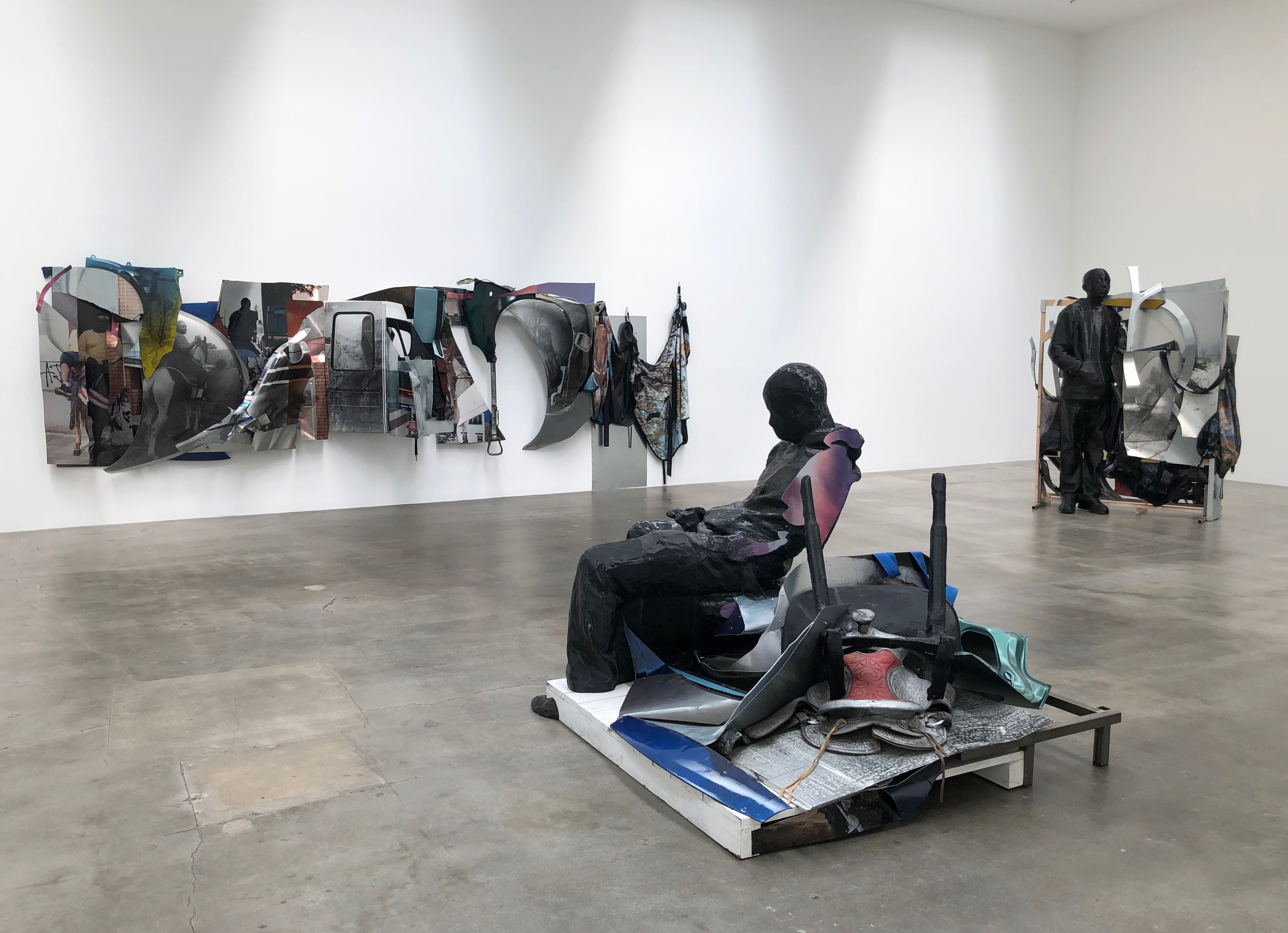
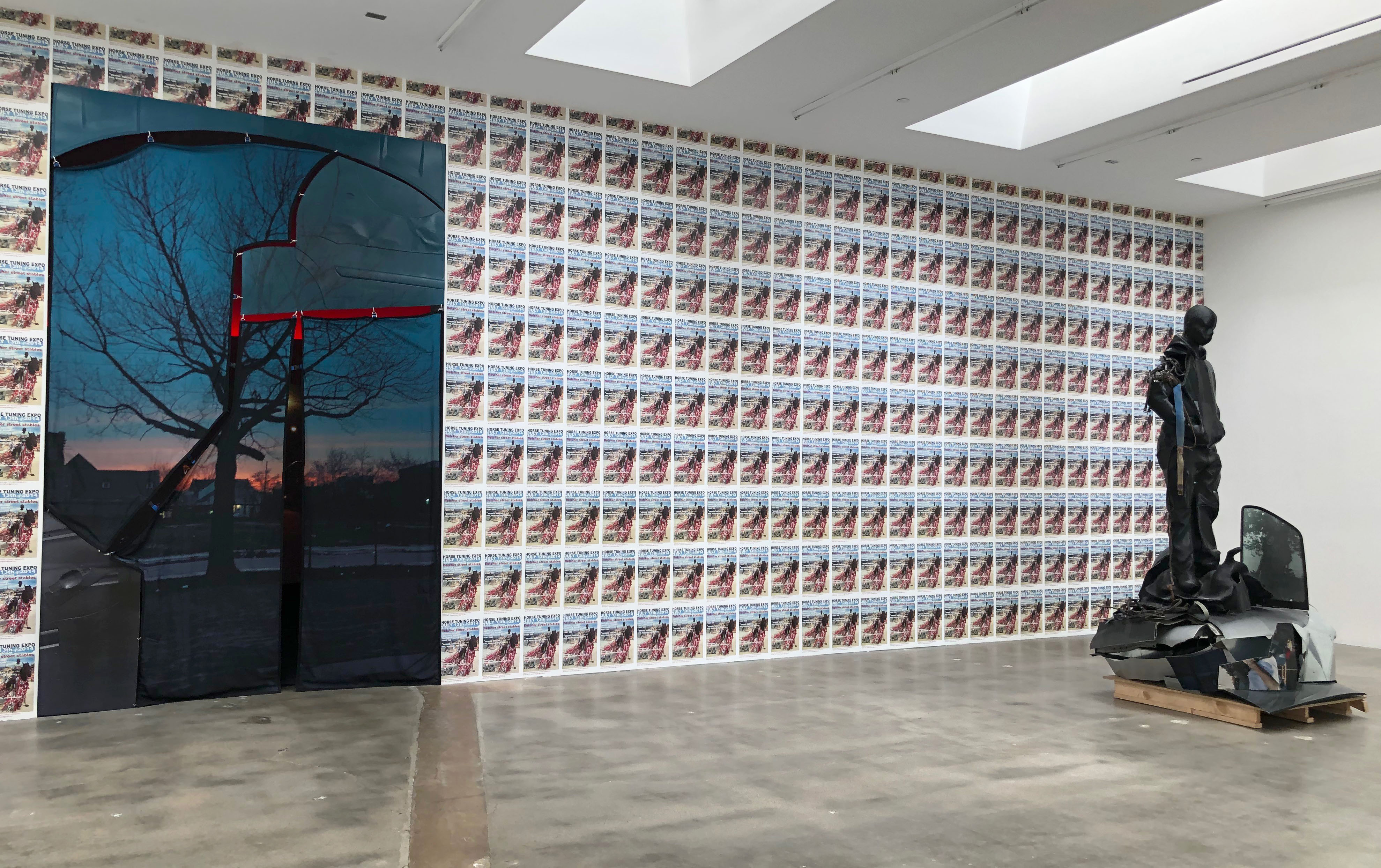
Paris-based Algerian artist Mohamed Bourouissa’s first solo exhibition in Los Angeles, Pour une poignée de Dollars (For A Fistful of Dollars), at Blum & Poe, combines film, sculpture, drawing and photography to expand on his project Horse Day, also on view at the gallery.

From the press release-

Initially driven to capture his own community and generation of immigrant youth living in the outskirts of Paris, in recent years Bourouissa’s focus has expanded to the US, the UAE, and beyond. In 2014 the artist spent nearly a year in North Philadelphia, PA living among the young men of the Fletcher Street Urban Riding Club, a non-profit established over 100 years ago by African American cowboys. This area increasingly struggles with unemployment and drug abuse, economic and social conditions from which the center attempts to provide a refuge—rescuing horses and mentoring boys who may otherwise find support hard to come by. Bourouissa instigated a collaboration with the community of riders and local artists—a riding competition and pageant called “Horse Day” in which equestrian participants arrived clad in decadent regalia, costumes including linked blank CDs, streamers, fake flowers, or fabric Pegasus wings. Using the cowboy as an emblem of a narrative of domination, the critical documents Bourouissa and the Fletcher Street community produced—sculptures, costumes, drawings, photography, and a video mixing tropes of westerns, documentaries and hip-hop—explore social injustice as it relates to geographical space, spotlight contemporary America’s culture of segregation, and intend to forge a new creative space for marginalized groups. Within a new body of sculptural work, the artist integrates images of riders and/or horses into the body parts of automobiles, as curator Okwui Enwezor once put it: “Bringing together two myths, the cowboy and the urban lowrider with his customized car, a sort of collision of the frontier and Compton.” This 3-D montage connects representations of domination and power, as well as industries and communities facing crisis.

Bourouissa’s work focuses on rituals of friendship, an exploration of alterity and the role images play in channels of distribution, investigations into the politics of representation and subjectivity. Seeking to humanize his community as social subjects, Bourouissa engages all sorts of imagery, initiating agency where is it often deprived. Bourouissa’s work is a hybrid of documentation and formal composition, collaborative choreographed representations of reality on the margins, channeling a wide range of historical precedents from Caravaggio and Delacroix to Fanon, rap music, and the Harlem Renaissance.

In a separate space behind the main gallery is Anya Gallaccio’s Stroke (pictured below), a room where the walls are painted with dark chocolate.  The work was originally created in September of 1994, for Blum & Poe’s inaugural exhibition at their original location in Santa Monica. Twenty-five years later, it has been recreated in an exhibition space the exact dimensions of the original gallery.

It’s worth checking out for the smell alone. It’s overpowering.

From the press release-

Stroke plays with perceptions of desire and their disconnection from reality. In this chocolate-covered room, an idea pulled from a childlike fantasy comes to life and goads the viewer’s appetite for pleasure. The whimsical notion of an edible room is contrasted with the strikingly rich, dark color of the walls and their heavy, sometimes putrid, smell. Of this disconnect, Gallaccio states, “the idea of a chocolate room is one thing, and the reality of a chocolate room is very much something else.” Created by thousands of small, repeated brush strokes for which the installation is named, prolonged looking is rewarded when one sees new colors, textures, and patterns appearing out of the darkness.

Rooted in the formal language of Minimalism, Gallaccio’s practice uses organic materials to subvert and reframe that male-dominated moment in art history. Trees, flowers, fruit, and ice are investigated for their fluidity and impermanence, and decay becomes a part of the installation to be embraced. The unpredictability of these ephemeral materials yields a freeing inability to control the final product, from which unexpected results emerge. These materials, pulled from a feminine, domestic space, challenge a masculine past and reclaim a place in history. As noted in the original press release from 1994: “Feminist in material, natural in its decay, subversively Freudian, Stroke is an enigmatic and challenging work.”


Both of these exhibitions close 10/26/19.

Oct 242019


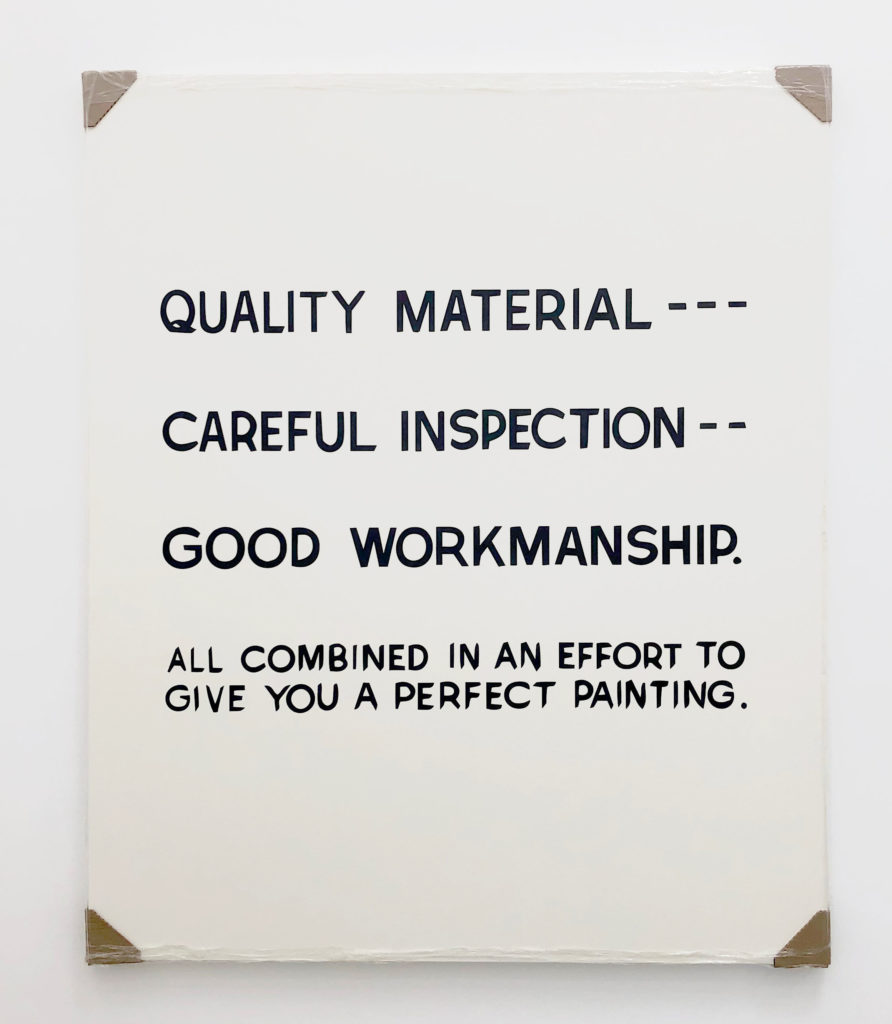
Tammi Campbell’s exhibition Boring Art at Anat Ebgi in Culver City takes on the male dominated art world canon in a fun way. She’s recreated iconic works and then covered them with bubble wrap, packaging tape, and cardboard corners. But yet those materials are an illusion. They have been made with acrylic painting medium.

From the press release-

The gesture of covering these works emphasizes the preciousness of the goods they contain, while simultaneously highlighting the frequently invisible network of art world laborers, art handlers, shippers, registrars, studio assistants, etc. who support and care for them as they circulate. The coverings also obscure the originals and draw our attention to their fixed state of transition.

…Campbell is concerned with memorializing art history, while also making a break from it. Her work literally envelopes, secures, and mummifies historical paintings; it asks viewers to ponder what is valued and allows us to imagine making room for something new. Full of contradictions, Campbell’s work pays homage to the past, while simultaneously taking it hostage.

The title, Boring Art, is a reference to John Baldessari’s I Will Not Make Anymore Boring Art, but this exhibition is anything but dull. See it before it closes on 10/26/19.


Oct 232019
 

Luis De Jesus Los Angeles is currently showing Laura Krifka: The Game of Patience.

From the press release

The Game of Patience features new figurative paintings by artist Laura Krifka that depict female and male subjects in intimate moments within carefully constructed interiors. Krifka deftly paints her bare-skinned protagonists reading, drawing, daydreaming, watching, and waiting. The peep of a phallus and the highlight of a thigh gap allude to the pleasure of stillness, supplemented by the visual tension meticulously sculpted throughout the domestic spaces. A notable development in Krifka’s content is the genesis of idiosyncratic wallpapers that appear to direct the viewer’s gaze rather than lay flat. These imagined patterns create parallel planes of space, shift color and shape inexplicably, and build psychological tension, functioning like maps for the dream logic of each painting.

At the heart of Krifka’s practice are post-modern and contemporary critiques of canonical Painting. Krifka treats the false dichotomies of subject and object, male and female, observer and observed as comedic jumping off points before bending or breaking the rules and moving on to more nuanced and poetic concerns. Sensually charged in the pinks, purples, pea-greens, and ochers of afternoon reveries, all the protagonists are depicted in vulnerable situations, and Krifka wanders through paintings with surprising detail and care, in search of consent and a deeper understanding of the nature of desire.

This exhibition closes 10/26/19.


Oct 232019
 

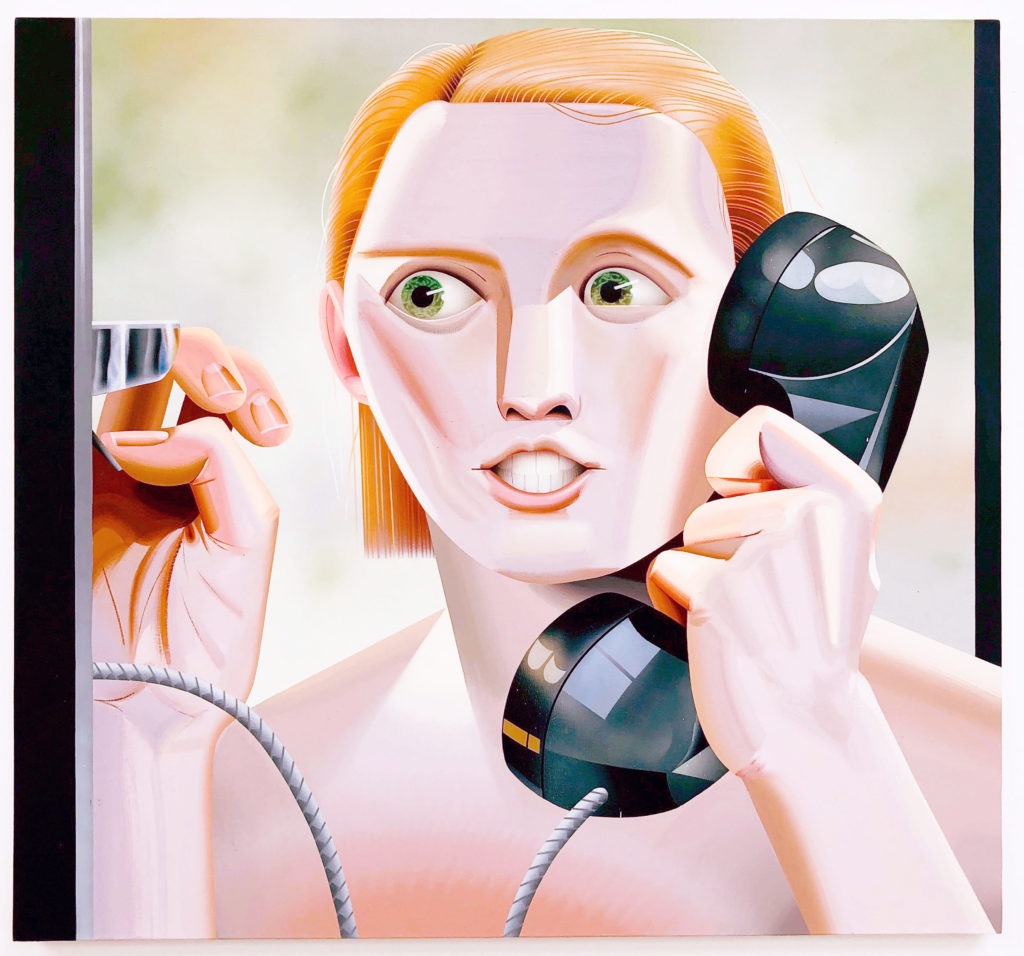
Currently at Various Small Fires gallery in Los Angeles is Robin F. Williams’ painting exhibition, With Pleasure.

From the press release-

In a series of new paintings that re-imagine the coded narratives of American media, Williams isolates and derails the sexual suggestiveness, pandering strategies, and gendered objectifications utilized in representations of women.

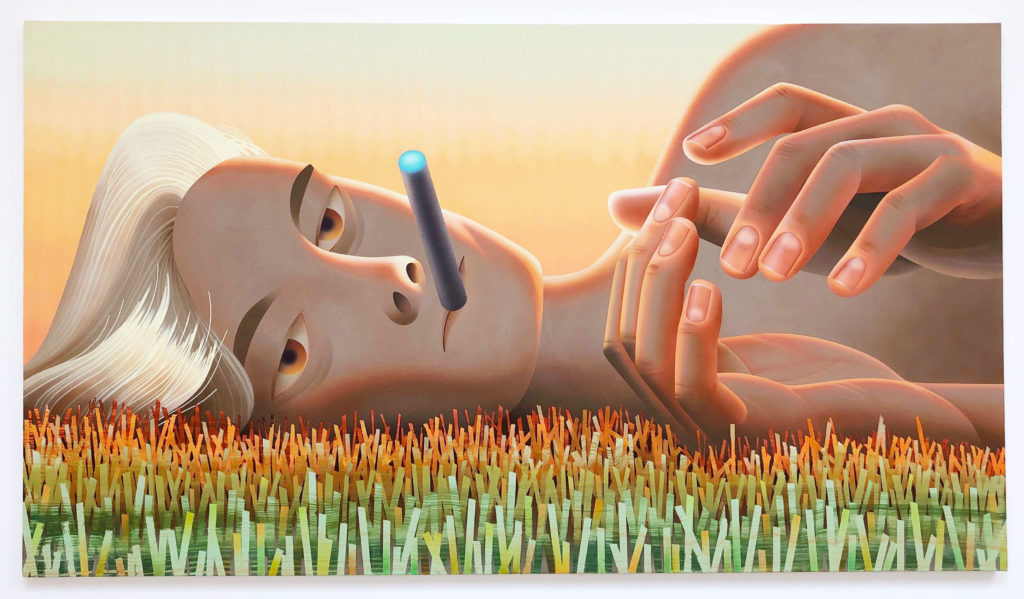
Embodiments of feminine AIs (Siri and Alexa) as nude figures lend Williams’ paintings an air of consciousness, as if aware of the viewer and their own status as female simulacrum. Appropriated from cigarette ad campaigns, paintings such as Alive With Pleasure, Alexa Plays Ball, and Slow Clap subvert their cast of sexually compliant “cool girls” who catch footballs, play around the ankles of men, and smoke seductively. By contrast, Williams’ subjects are stone-faced and defiant, unwilling to embody the latent desires of the viewer.

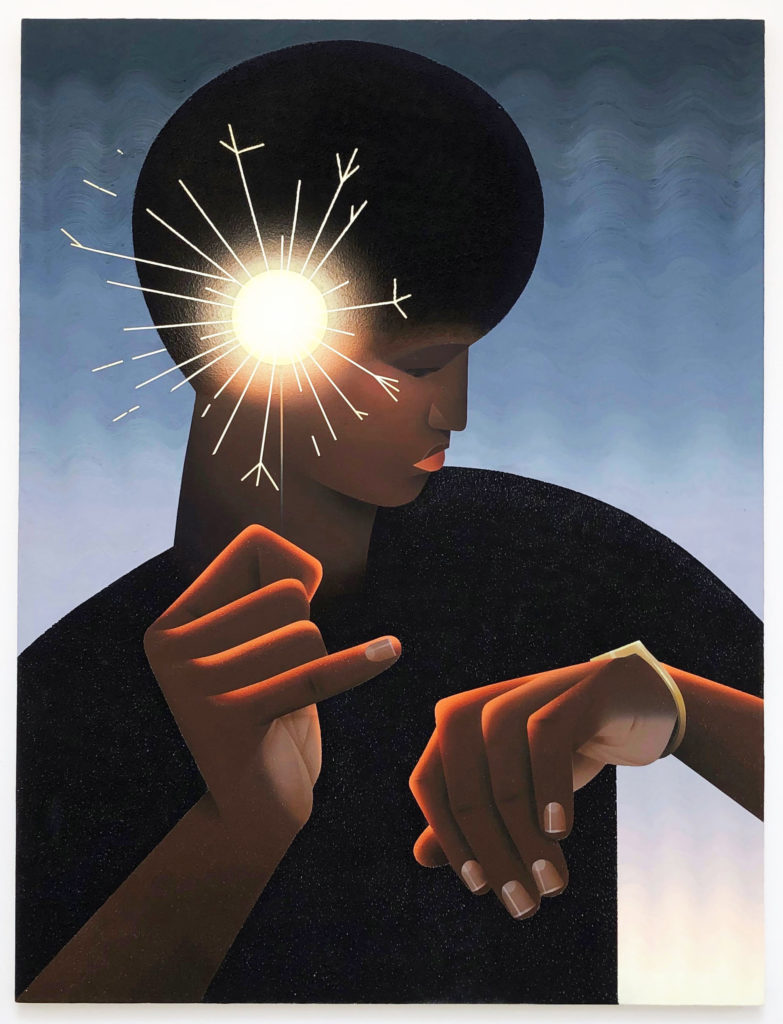
Williams’ paintings play with chronology both through distinctive painting techniques such as stain painting and airbrushing, and through visual markers recreated and reimagined for the present day. In Slow Clap, a cigarette is replaced by the newer, yet equally ominous vape; a languid repose is substituted for a derisive “slow clap”, the gap between the subject’s hands leaving her gesture permanently unresolved. Eye on the Time depicts a black woman with tightly coiffed 1960s afro who impatiently turns her gaze away from the burning 4th of July sparkler in one hand to the wristwatch on her other arm, counting down the seconds for its patriotic light to extinguish. In Weathervane, a gymnast appropriated from a 1972 Life Magazine cover poses precariously on a rooftop amidst an approaching storm; she gazes out coldly toward the viewer, the purveyor of her ornamental function.

In each painting, Williams’ female figures wait, caught in a perpetual state of questioning, forever burning, and locking eyes as if to challenge their embodied roles: woman as technology, tool, or paragon. These figures, aware of their identity as paintings, must answer the call to remain frozen in time. They refuse, however, to do it with pleasure.

This show closes 10/26/19.

Oct 222019
 

Alex Prager’s exhibition at Lehmann Maupin’s 22nd Street location combines sculpture and still photography with her new film Play The Wind. The photographs in the show recreate scenes from the film, but are not from the film itself.  There are also photos of scenes that could have been from the film, but are not. These allow the viewer to consider alternate narratives to the story they have just seen. The photos also offer an opportunity to see many of the details from the film seen only briefly while watching.

Running for eight minutes, Play the Wind is a journey into a bizarre version of Los Angeles. It’s seen mainly through the window of a car, the way many Los Angeles residents often see it. Places seem familiar, as do many of the large cast of extras who inhabit this world, even if you are not personally familiar with the city.

The cab driver, played by Dimitri Chamblas (dean of the Sharon Disney Lund School of Dance at CalArts), drives through situations that seem both surreal and possible at the same time, like many things that happen in LA. At one point the cab driver, drives past an accident on the highway and sees a car vertical between two other cars with children in a school bus leaning out of the windows to observe. He passes alongside and moves on. It’s just another moment in a chaotic Los Angeles day. When he locks eyes with a woman played by actress Riley Keough, the film changes to her perspective and it all becomes even more dreamlike.

From the press release

…She anchors her characteristically elaborate fictional scenes within the real Los Angeles, shooting for the first time in many years primarily on location rather than in the studio—a decision that harkens back to when Prager began her career over a decade ago. Though the images contain large constructed set pieces and are populated with carefully cast extras (numbering up to 300), the presence of the Los Angeles streets infuses an element of urban lifeblood that is palpable in the work. Prager’s perception of Los Angeles is one of the artifice and drama befitting Hollywood, with real world chaos that overflows into sci-fi dystopia and post-apocalyptic dread. She toys with these visions of the city disseminated on film, TV, and within the popular imagination, which inform our characterization of a place as much as our own memories.

Technically important to the making of this film was Prager’s collaboration with a team to produce set designs and props that would add a layer of artifice and duplicity to her real-world locations. The interference of these traditional illusionary effects upon the actual Los Angeles streets and locations Prager shot on creates an unnerving sensation, hinting at the reality that might exist just outside of our perception. All of these elements are recast in the series of photographs, which appear in different configurations or on various scales that further destabilize any linear narrative. Drawing on the concept of a distorted memory, Prager has found ways to incorporate objects seen in the photographs and film into the gallery as sculpture, with the intent to further dislodge our understanding of place and time and bring us deeper into her highly constructed world.

Connoisseurs of Prager’s work will likely spot the references to her past series, such as the noir themed Compulsion (2012), or the archetypical ingénue of The Big Valley (2008). This self-referencing becomes yet another layering device, mixing Prager’s career-spanning themes and the greater art historical genres from which they are drawn to create work both entirely new, yet seemingly familiar. Prager’s incorporation of her past into her present work serves as a reminder that while the past may not be returned to, it does remain with us, appearing in surprising, sometimes unsettling ways.

This exhibition closes 10/26/19.

Oct 222019
 

An assortment of beaded and marble creations have taken over Marianne Boesky Gallery in Chelsea, courtesy of The Haas Brothers’ exhibition Madonna.

From the press release-

As is now a signature of The Haas Brothers’ presentations, Madonna will transport viewers into an otherworldly realm, where fantastical animals and odd hybrids reside. Here, colorful sculptures and objects that resemble futuristic creatures will be positioned among seemingly rare tropical plants, and connected into a cohesive environment through undulating platforms. The featured works capture the Brothers’ wide-ranging artistic processes, from intricate beading techniques to monumental stonework to the incorporation of woven elements, and produce an incredibly tactile and evocative experience. The exhibition also highlights the Brothers’ diverse collaborations, including with workshops in California, South Africa, and Portugal, and encapsulates their deep engagement and support for those working in traditionally understood craft.

The Haas Brothers were first introduced to beading in 2015, when they met a group of women artisans selling beadworks in a craft market in Cape Town, South Africa. The Brothers’ were enamored with both the complexity of the technique and the incredible artistry in the women’s work. Seizing the serendipity of the moment, the Brothers’ established a collaboration with the artisans, which led to the development of the Afreaks series, a group of beaded creatures that were shown at the Cooper Hewitt’s Design Triennial in 2016. Since then, The Haas Brothers’ collaboration with the collective of women, who warmly go by The Haas Sisters, has grown and matured.

For Madonna, the collective will support the production of the featured beaded objects, guided by The Haas Brothers’ preparatory drawings and using a selection of Murano glass beads produced in Venice between 1880 and 1980, which The Haas Brothers purchased after the factory became defunct. In addition, Simon Haas has developed a complex system that captures the expansive creative opportunities that beading allows and that provides a guide to learning the craft. This system has been articulated in The Haas Brothers’ Bead Book, which has allowed Simon and Niki to teach the techniques to people local to the area of Lost Hills in Central California, establishing a workshop that offers work and pay in an area that lacks employment options. As part of their work with different communities and artisans, The Haas Brothers establish fair pay systems that include both economic support for the creation of works as well as in some instances profit sharing from sales.

“Part of the vision for our practice, and what we see as essential to the creation of art, is the establishment of communities. We are constantly asking how we can engage with others to achieve something new; something beautiful; something that excites or brings joy—that is really the importance and value of art and artmaking,” said The Haas Brothers. “At the same time, we recognize the platform and voice that we have been given, and think it is critical that we use both to uplift and support others, especially women who have traditionally not been recognized for their craftwork and skills. We feel so lucky to have developed this relationship with The Haas Sisters, and to have the opportunity to shed light on their dedication and tremendous work, while also paying a fair and right wage for their contributions.”

The beadwork in the exhibition will be augmented by several sculptures made with Portuguese Pele de Tigre marble. The Brothers first came to stone carving in their youth, learning from their father, artist Berthold Haas, and recently returned to the material, showing several large pieces at Marianne Boesky Gallery’s Aspen location in June 2018. The solid, smooth, and monumental nature of the stone works provides a powerful counterpoint to the more delicate and finely detailed beadworks and highlights the range of The Haas Brother’s practice. Here too, community proves an important element, as The Haas Brothers’ engagement has helped spur the development of stone-carving as an economic engine at the quarry that they use. The anchor figure, the Madonna, within the upcoming exhibition combines the efforts and visions of the various communities with which the Brothers are involved—each lending to an aspect of its creation and making it a true embodiment of their collaborative vision.

This exhibition closes 10/26/19.

Oct 222019
 

Hauser & Wirth is currently showing two painting exhibitions. On the ground floor of their 22nd Street location are Ed Clark’s gorgeous abstract works, some of which are pictured above. The paintings on view are recent, made between 2000 and 2013. Created on the floor using a push broom, there is a high energy in the motion and blend of color in these canvases.

Sadly, Clark passed away on Friday, October 18th at the age of 93. He was an innovative abstract painter who worked for more than 60 years. This is a wonderful opportunity to see his work in person.

On the second floor of the gallery is Amy Sherald’s the heart of the matter… , (pictured below) her inaugural exhibition with the gallery. If her style looks familiar, it may be because she gained a lot of attention with her portrait of Michelle Obama for the Smithsonian’s National Portrait Gallery.

“If you surrendered to the air you could ride it” (2019)

“Precious jewels by the sea” (2019)

From the press release-

Informed by the artist’s reading of key texts that explore tensions between interior and public realms, the heart of the matter… draws its title from the first chapter of bell hooks’ seminal book ‘Salvation,’ and builds on themes of silence and stillness explored in Kevin Quashie’s ‘Sovereignty of Quiet’ and U.S. Poet Laureate Elizabeth Alexander’s ‘Black Interior.’ In her new paintings, Sherald considers how these relate to the conceptualization of blackness as it is represented publicly, questioning representation of black identity, which often negates the complex reality of an interior life. She envisions black American identity beyond the conceits to which it has largely been restricted, attempting to restore a broader, fuller picture of humanity.

Sherald’s portraits are vivid, large in scale but intimate in effect, capturing both the ordinary likeness and extraordinary essence of her subjects while simultaneously detaching them from everyday reality. Varying in expressiveness, gesture, clothing, and emotional auras, the individuals portrayed maintain a persistent sense of privacy and mystery, requiring viewers to ponder the sitters’ thoughts and dreams. Drawn to each of her subjects instinctively and spontaneously, these ‘Americans doing everyday American things,’ as Sherald has described them, are part of an informal network of people who populate our universe.

Once Sherald commences painting, a transformational moment ensues as the artist begins to view her sitter as an archetype in the history of representation and therefore a vehicle for challenging assumptions. Working from carefully composed and dramatically staged photographs, Sherald situates her subjects in brightly colored, ambiguous environments, then meticulously tweaks expressions and patterns to emphasize a sense of universality and connection. While her subjects are always African-American, Sherald renders their skin-tone exclusively in grisaille – an absence of color that directly challenges perceptions of black identity.

the heart of the matter… debuts two paintings that reach a new, monumental scale for the artist. In these works, Sherald’s monochromatic backgrounds evolve into fully realized scenes that reference quintessential Americana: friends posed at the beach and a man atop a metal construction beam. For the latter, Sherald draws inspiration from Charles C. Ebbet’s iconic photography of 30 Rockefeller Plaza in New York City. Sherald often looks to vintage photography for source material, drawn to what she describes as its capacity ‘to narrate a truer history that counters a dominant historical narrative… Photography was the first medium I saw that made what was absent, visible.’ Sherald continues, ‘It gave people who once had no control over the proliferation of their own image the ability to become authors of their narratives.’ By mining and positioning images associated with archetypal or nostalgic American moments – burgeoning industry, sunny beachside locales – Sherald is able to firmly situate and make fully visible black Americans within the canon of American iconography. In this way, her portraits reclaim space and author a narrative for people that official art history omitted, speaking to the human condition and holding up a mirror to American life.

Lastly,  take a trip to the top floor for the group show Personal Private Public, a group exhibition “exploring the idea of the inner life in three main themes: introspection, intimacy, and voyeurism”.  The exhibition includes work by Jonathan Lyndon Chase, Ivy Haldeman, Celia Hempton, Tala Madani, Paul McCarthy, B. Ingrid Olson, Paul Mpagi Sepuya, Emily Mae Smith, Mira Schor, and Kohei Yoshiyuki.

All three of these exhibitions close 10/26/19.


Oct 172019
 

From Ishiuchi Miyako’s “Scars” series (1991-)

Images from the “ひろしま/ hiroshima” series, 2007-present

Ishiuchi Miyako’s exhibition occupies both floors of Fergus McCaffrey’s Chelsea gallery space and includes over 70 photographs from five series made over four decades, including many early and never-before-seen works.

On the first floor are the artist’s somber black and white photos of the buildings of her hometown of Yokosuka. Yokosuka was also the home of a US Naval Base, established in 1945.  In another room is work from her Scars series, for which she photographed the damage left behind by injury, illness, and trauma. These portraits focus not on the people but on the imprints on their bodies. Despite that, they don’t feel impersonal or voyeuristic. There is a tenderness to these images.

Photographs of objects dominate the rest of the exhibition. There are a series of images of her mother’s possessions, taken before she passed away. She also photographed Frida Kahlo’s belongings, including a pair of her shoes that were different sizes- accommodating the physical issues Kahlo had after her bout with polio as a child.

The photos of items donated to the Hiroshima Peace Museum, for the ひろしま/ hiroshima series, are especially moving. The articles of clothing worn by residents of Hiroshima when the atomic bomb was dropped on the city are worn and damaged. It’s hard not to think of what happened to the people who owned them.

Each series of photographs is unique, but tying them together is the idea of capturing what gets left behind. It can be a city or a scar or a person’s possessions after they die, but they have an effect. Ishiuchi’s photos record that effect in an impressive and thought provoking way.

This exhibition closes 10/18/19.


Oct 112019
 

Francisco Rodriguez “Aridity”, 2019

Francisco Rodriguez “In the Garden”, 2019

Currently at Steve Turner gallery in Hollywood are three excellent painting exhibitions. The first, pictured above, is Francisco Rodriguez’s Midday Demon.

From the press release

Steve Turner is pleased to present Midday Demon, a solo exhibition of new paintings by London-based Francisco Rodriguez, most of which feature an isolated male figure within a desolate urban landscape. In some, the figure is upright and smoking a cigarette. In others, he appears to have passed out. The artist describes the bleak setting as one that fosters exhaustion, listlessness, sadness, dejection, restlessness, anxiety and depression. Rodriguez observed the phenomena of the “midday demon” while growing up in Santiago, one of the largest cities in South America; again in London where he has lived for the last five years; and also during a recent residencies in Poland and Ukraine. He ponders the effects of the oppressive midday sun and wonders if such “spirits” actually do appear at that hour. Are his figures victims of some  “midday demon”; or are they the demons themselves?

In the second gallery are Rebecca Shippee’s paintings for The Creators, featuring four portraits that are scaled to life and painted from observation.

From the press release

Her subjects are queer, their bodies altered medically or through wardrobe choices. One figure bears top-surgery scars and whimsical tattoos, while another wears emerald green silk pajamas and a nameplate reading Boyland. The show’s title refers to self-fashioning, the art of inventing oneself, a pursuit particularly vital to queer life as well as to the fact that all the sitters are cultural creators–artists, writers and activists. In choosing to portray individuals with whom she has close personal relationships, Shippee rejects the traditional notions of “active artist” and “passive muse.” Instead, she portrays the sitters as creators of their own images.

Rebecca Shippee “Noah”, 2019.


In the third gallery are Jon Key’s paintings for Violet Alabama, a solo exhibition “inspired by the artist’s personal history and memories of growing up in rural Seale, Alabama”.

From the press release

Through self-portraiture, Key explores the lineage and history of his identity through four themes–southern-ness, blackness, queerness, and family–each of which he represents chromatically with green, black, violet and red. He will also exhibit portraits of his father and grandfather to highlight the friction between the generations and the challenges of being a queer Black man in the Deep South.

Jon Key “The Man (No. 4)” and “The Man (No. 3)”, 2019

Jon Key “Family Portrait (No. 1)”, 2019 (front) and “Man in Red Room 1”, 2019

All three of these exhibitions close 10/12/19.