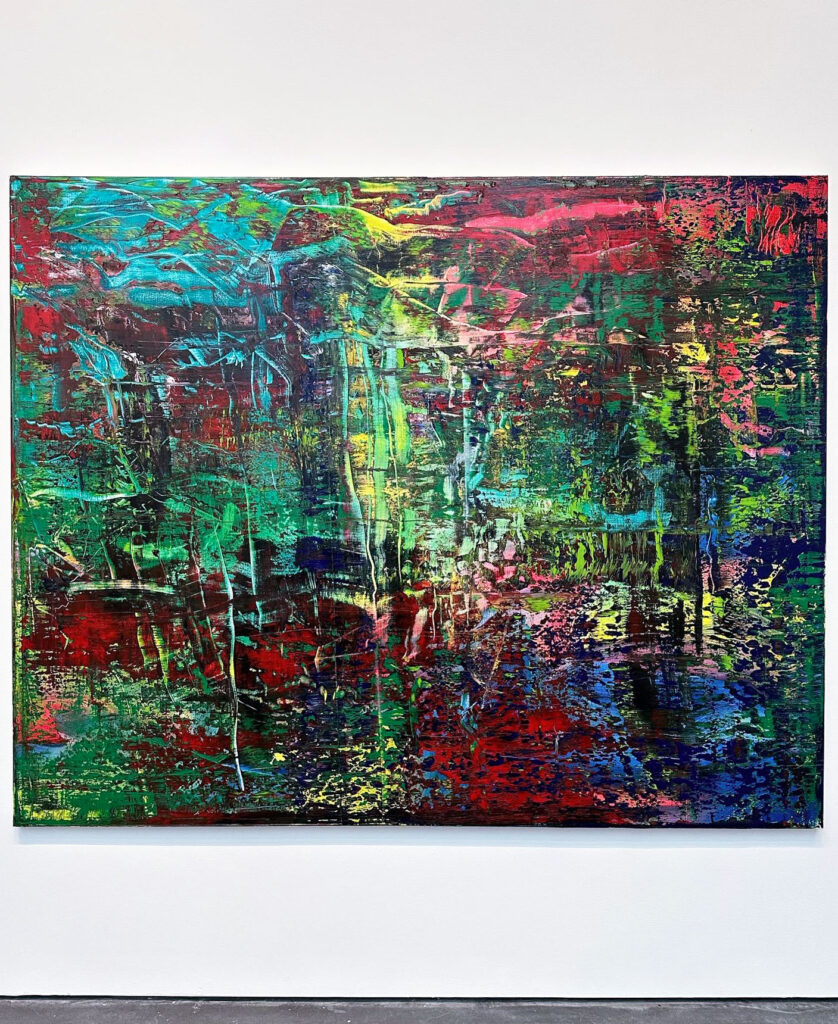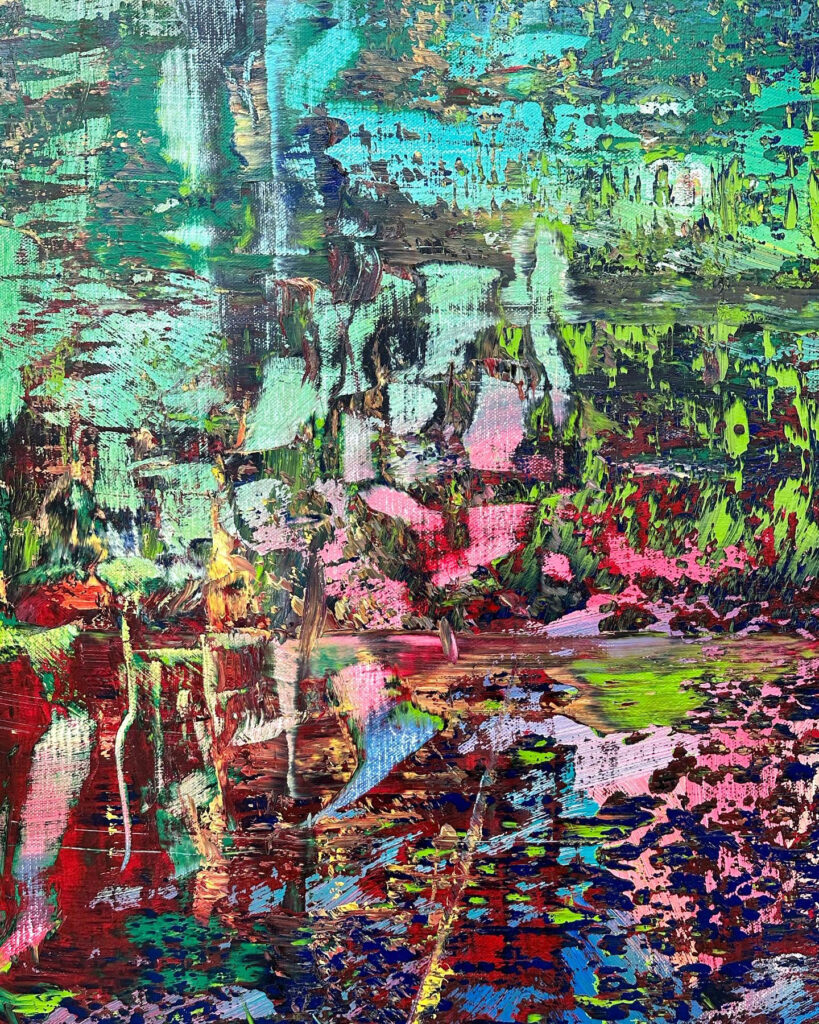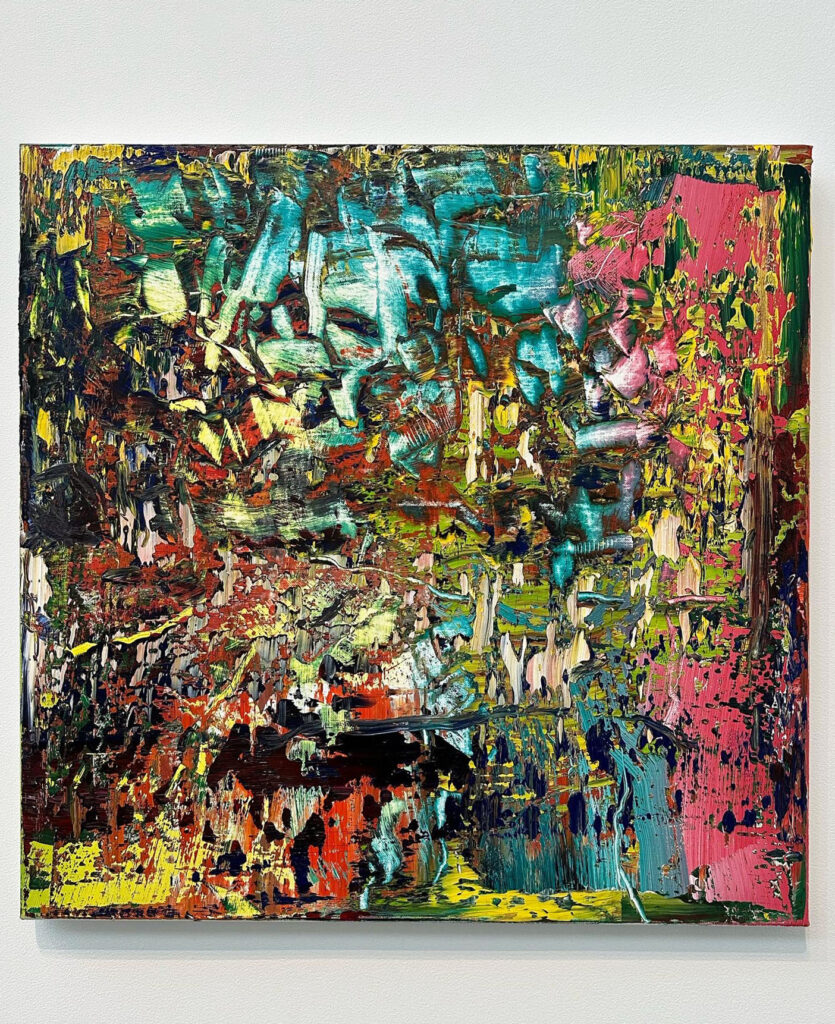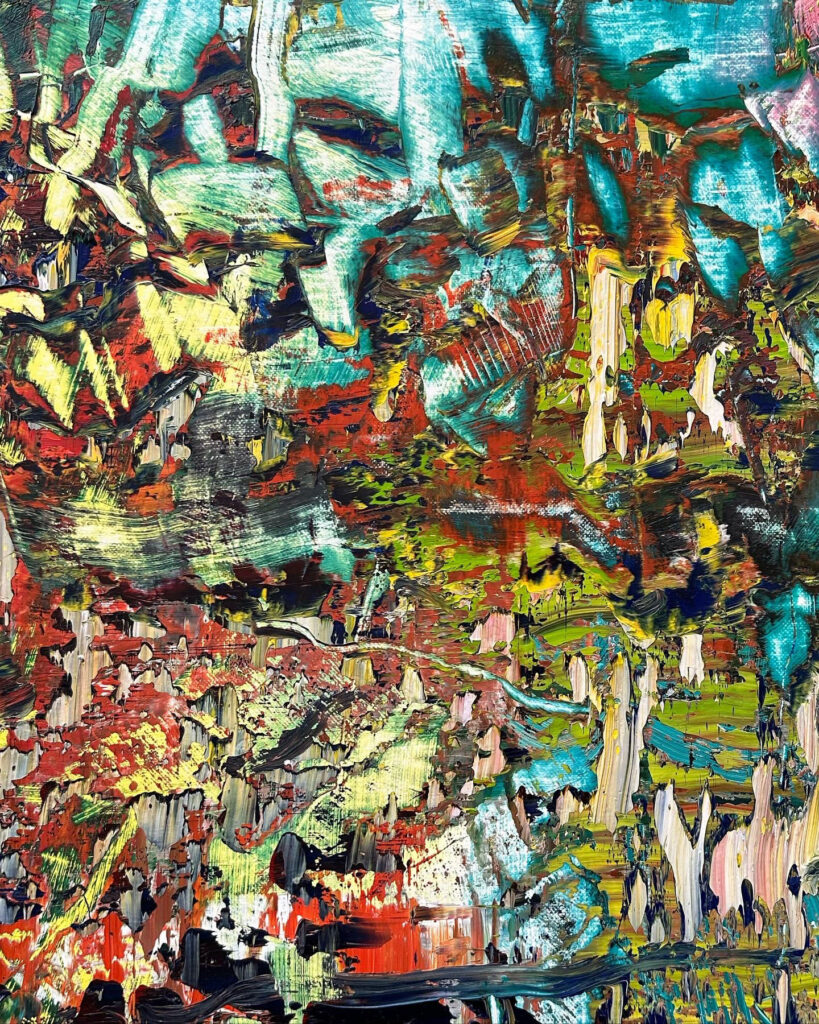
Apr 212023
 

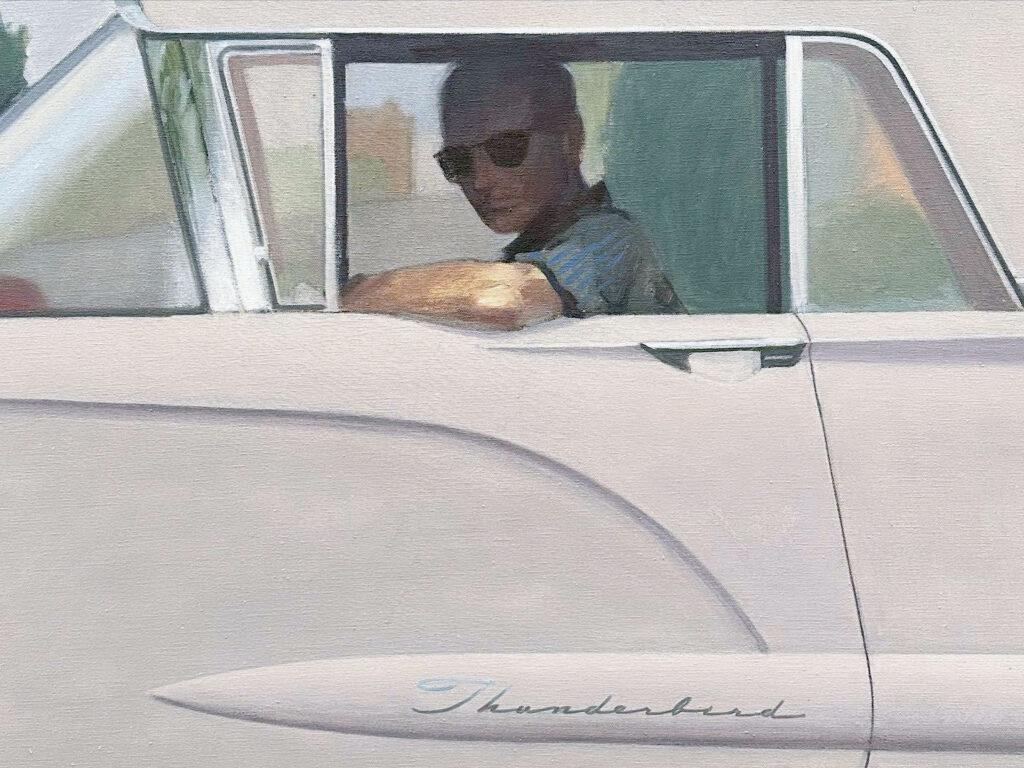
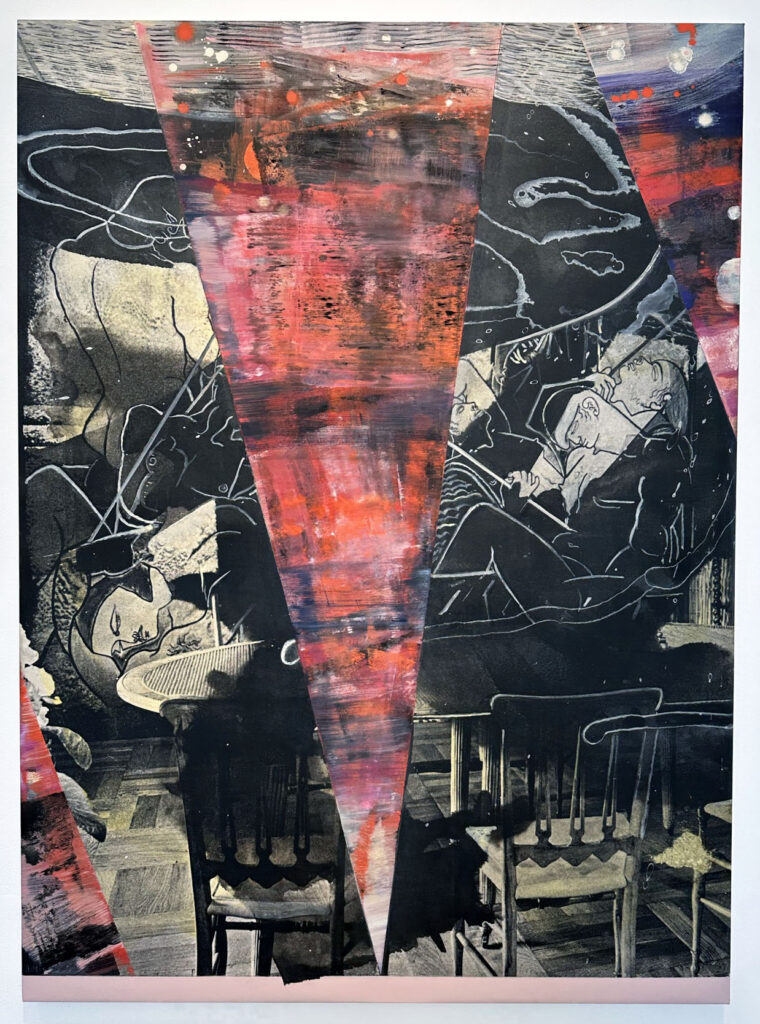
“Cocteau and Table”, 2023,oil on archival inkjet printed canvas

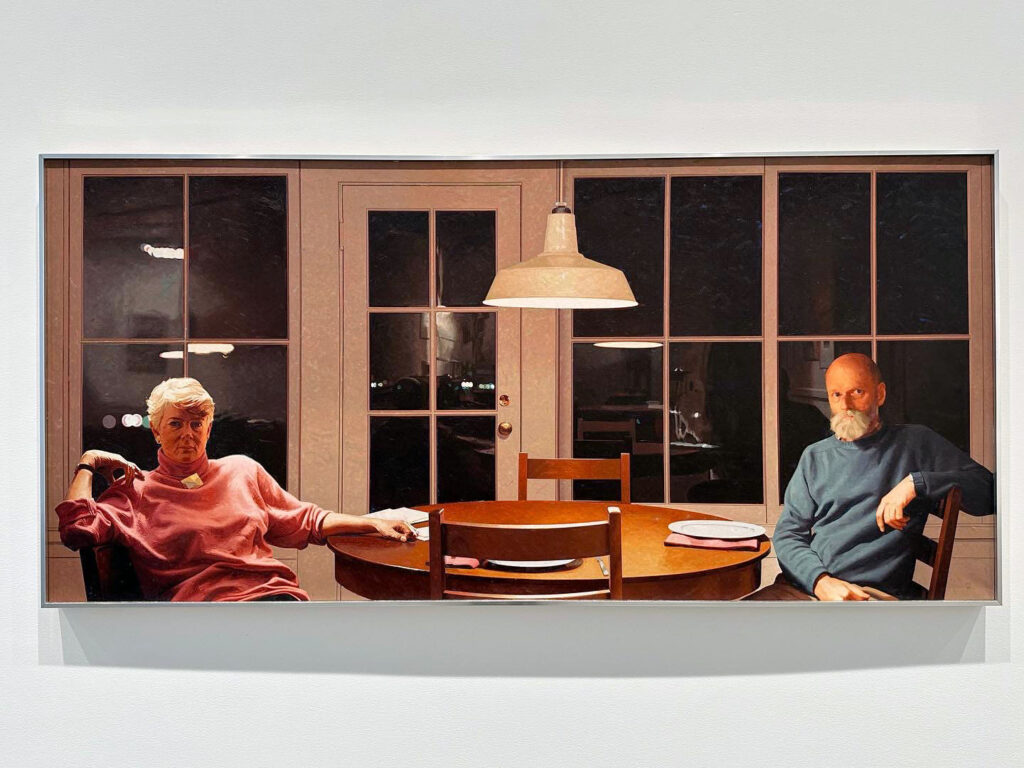
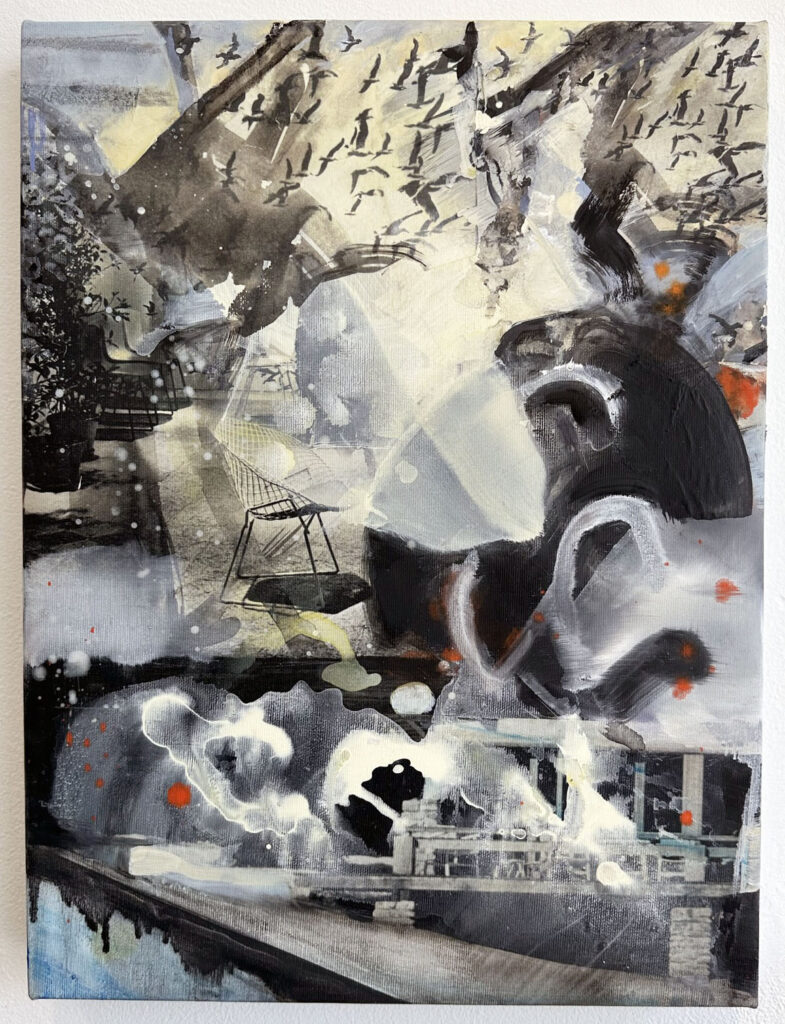
“The Seasons Between”, 2023, oil on archival inkjet printed canvas

High Noon Gallery is currently showing Les Problémes du Confort, an exhibition of work by Mary Jones.

From the press release-

Jones began this most recent body of work, collectively called simply, “Interior Design,” by painting Sumi ink over the black and white printed pages of a comprehensive French Interior Design publication from the 1960s. “[I chose the series’ title] not only to underscore the attributes of the original images, but to address their psychological component: the topos of dreams, so notably analyzed by Gaston Bachelard and James Hillman, spaces we conjure to discover the elements of our inner lives. Homes and interiors are not only spaces we remember, but also labyrinths of symbolism, familiar to all of us as emotionally charged experiences,” she explains.

The addition of her signature mark making started as an exercise to identify patterns in the tonal pages, separate from the context of the imagery. It seemed to act as a compositional barometer of sorts, deflecting the space in certain areas and illuminating it in others. The painted catalog images were then collaged, blown up, printed on canvas, and painted again, further conflating space and gesture, and inhabiting the vacant interiors with a visible energy. In doing so, Jones satisfies the principles of high design with the paintings’ harmonic beauty, and also the open systems of fine art by positioning the work as cultural critique that challenges the colonialist motifs that permeate the aesthetic sensibility of many of the spaces.

Jones’s work has long gnawed at the malleability of subject matter. She consistently uses legible imagery to anchor her abstractions, prodding at the fickle divide between the two modalities. Her sensitivity to painting’s illusionistic properties is connected to her experience as a faux painter, freelance work she’s done for 25 years. While the object of faux painting is to not let the artist’s hand show, Jones riffs on her craft by skillfully merging gesture and image in ways that are largely indistinguishable. She allows the marks to emulate form and object, playing on the viewer’s expectations of pictorial logic and slyly addressing the disparity between fine art and design, as for many decades— and especially during painting’s theoretical heyday in the second half of the 20th century— they shared a tenuous opposition. Design is associated with expense, and American society is perpetually transfixed by the Romantic notion of the artist as a working class hero.

Ionic Memories (2023), depicts a decadent room steeped in Roman busts and columns, the title a tongue-in-cheek reference to the science of memory and the unstable nature of artistic movements and empires alike. Jones echoes the velvety matte blacks of the printed image in her direct painting gestures, mixing a near perfect replica of the tone and texture for her to set up a meta tromp-l’oeil effect. In the foreground, a collaged brush stroke swipes away at the interior revealing a snowy landscape wherein a bush and modernist cabin are obscured by a swath of pink oil paint. In the context of the whole, the landscape reads as decorative forms within the room, such as fan coral and glass spheres. Other works such as Cocteau and Table (2023) make greater use of a fragmented effect wherein decisively multiversal looking forms cut through the composition like a glimpse into a parallel reality. Through a mix of painterly and faux elements, Jones takes care to merge her augmented realities just enough to allow the viewer to believe the image exists in one picture plane.

Perhaps to be comfortable is to momentarily resist time, to be temporarily impervious to the clamors for change. In Les Problémes du Confort, Jones reminds us that the arrangements we make with ourselves are transitory, constructed illusions to describe and reflect a sense of our place in the world we know, and that improvisational beauty can be found in transitions, in languages we don’t know, and in uncertainty.

This exhibition closes 4/23/23.

Apr 212023
 

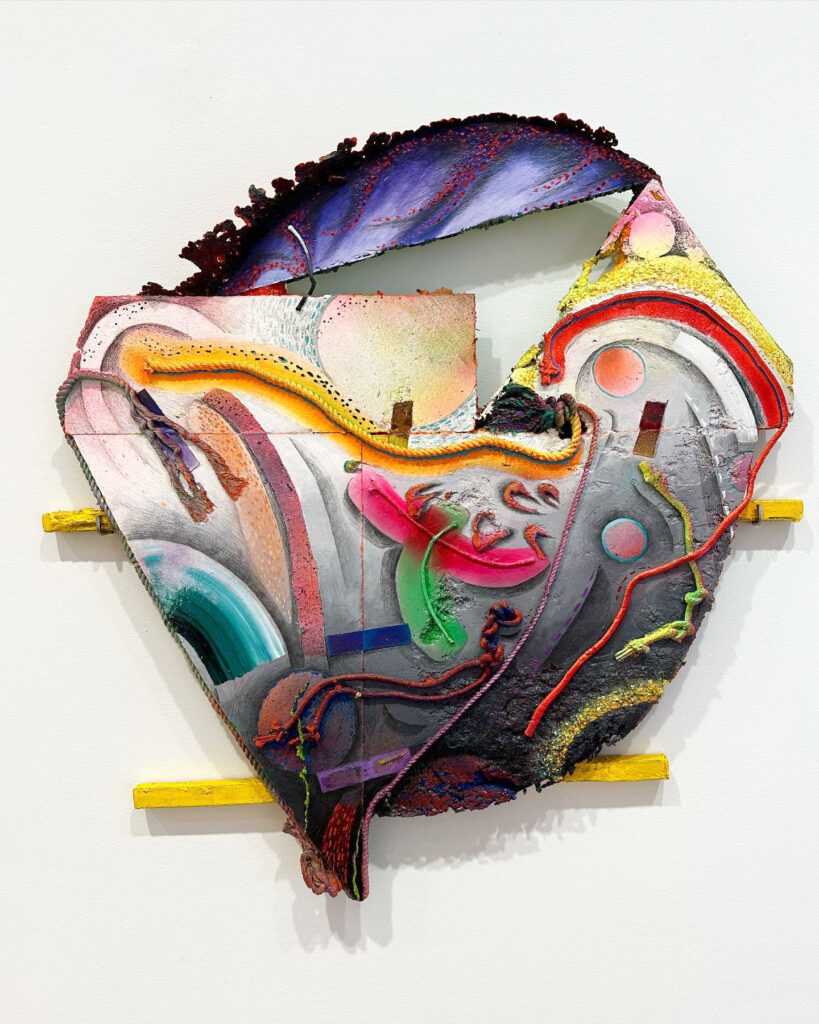
“when stone entwines”, 2023, Oil and enamel paint, graphite on cast aluminum, in two parts

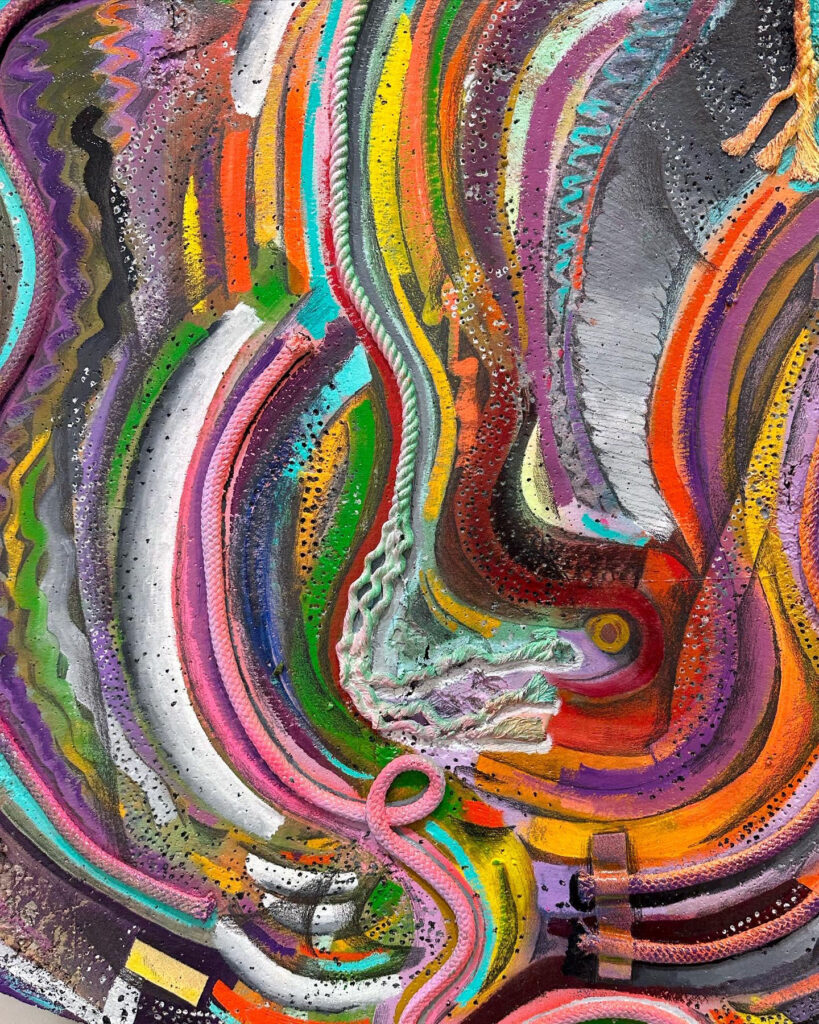
“when stone entwines”, 2023, (detail)

“if only, if yet”, 2023, Oil and enamel paint, graphite on cast aluminum/painted wood

“if only, if yet”, 2023, detail

Miles McEnery Gallery is currently showing Katy Cowan’s colorful and intricate sculptures for her exhibition gods on a bridge.

From the press release-

gods on a bridge is Katy Cowan’s first exhibition of metalworks since relocating her artistic practice from California to Berlin. The resulting body of work is a culmination of her current experiences, coupled with engrained references to the historical presence of sculpture in the city.

Each work starts in a foundry where the artist casts solid aluminum forms, which are then adorned with a variety of mediums and methods: acrylic and enamel paints, sprayed and brushed. Cowan elects to retain the fractured casting bars, signaling a parallel to the remnants of the Berlin Wall. As personally described, a guiding principle in her process is to “combine a multitude of experiences onto one surface and find a way to seize that depiction.”

This overarching aim is realized when Cowan draws from natural and urban environment alike—the blooming trees, reflecting ponds, and embracing bodies. The most prominent of these influences are the stone sculptures that appear throughout the city, acting as constant fixtures in the landscape, changing with age, taking on the textures of time and layers of graffiti. In her essay, Stephanie Cristello cements their influence by the figurative turn in Cowan’s compositions, expressing that they “have manifested as sculptural abstractions and fragmented, embodied landscapes.”

Cowan translates this amalgamation of inspiration to her aluminum surfaces, contouring reflections with cast rope, painted lines and flowing points. “Each work constitutes at once a fleshing out of figures as much as a mapping of movements—whether bodies in a park or city street or marks that dance across the capacious plane of representation itself,” writes Stephanie Bailey. “[gods on a bridge is] where line, ground, and figure collapse into a vortex of intuitive becoming.”

This exhibition closes 4/22/23.

Apr 202023
 

“Last Words”, 2022

“Butterfly”, 2022

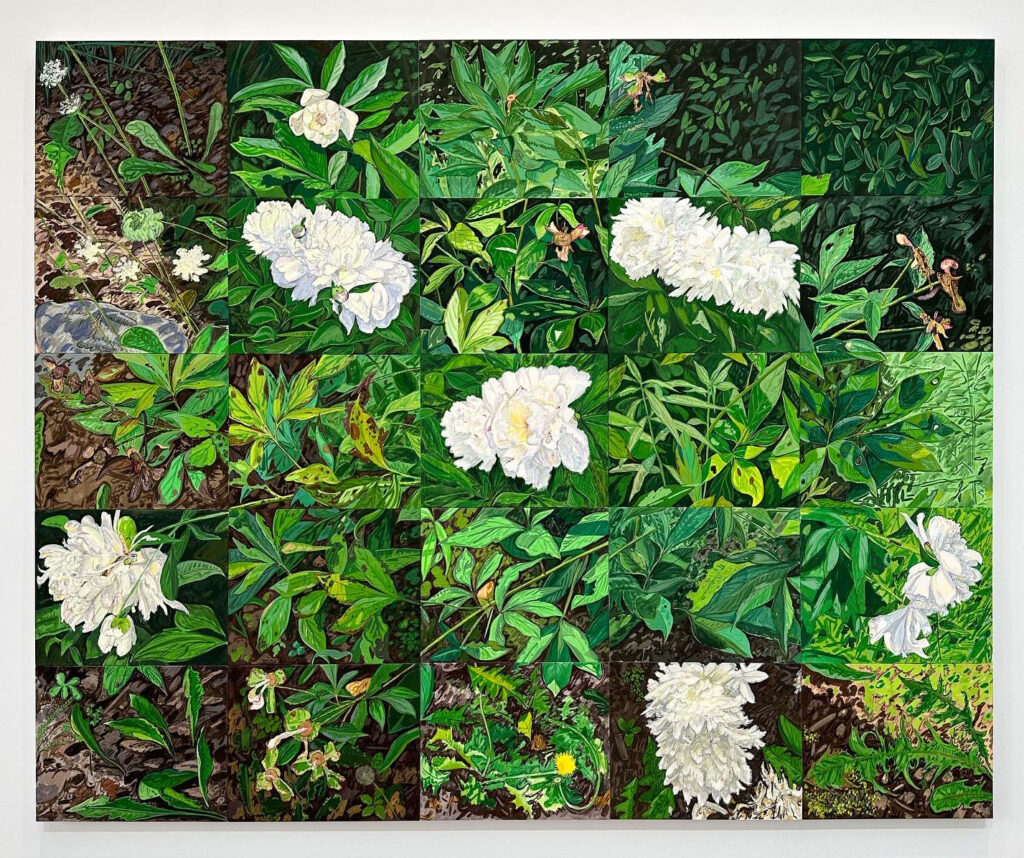
“Peony”, 2022

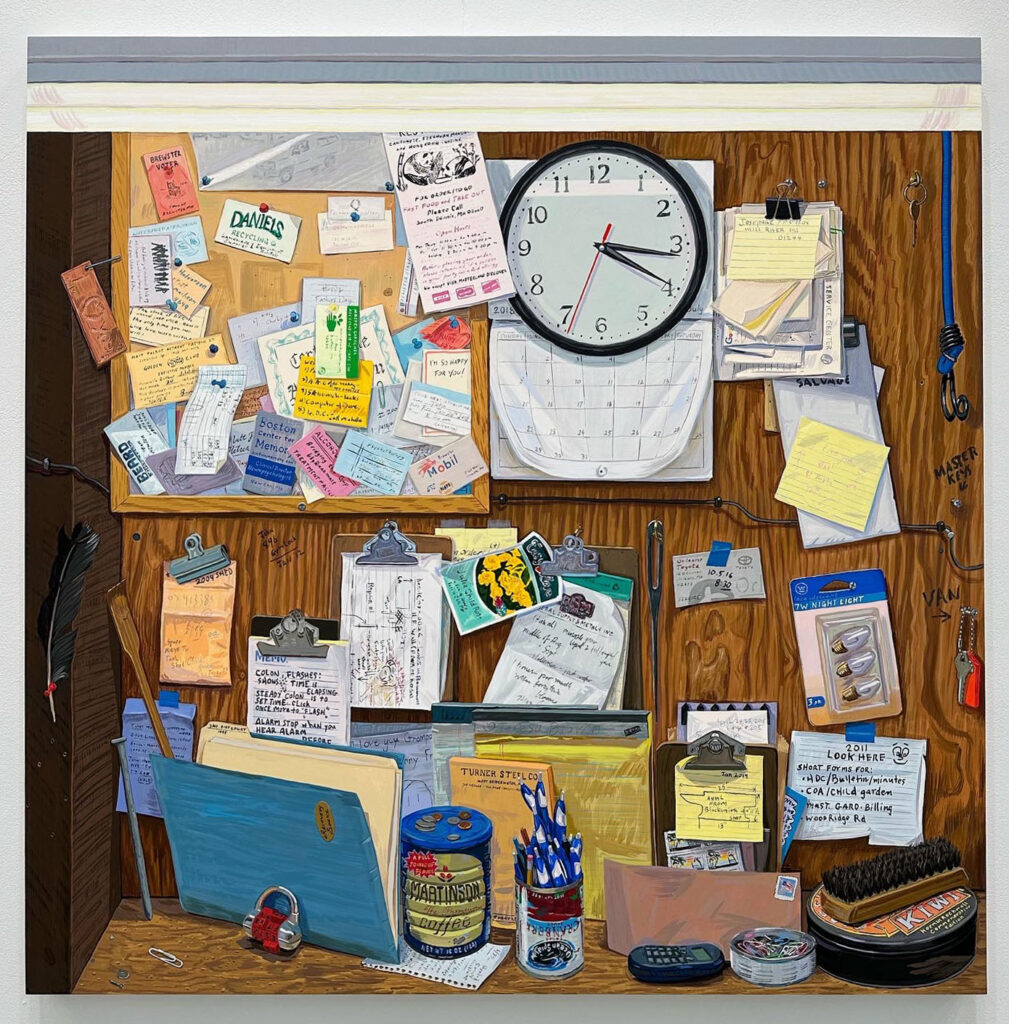
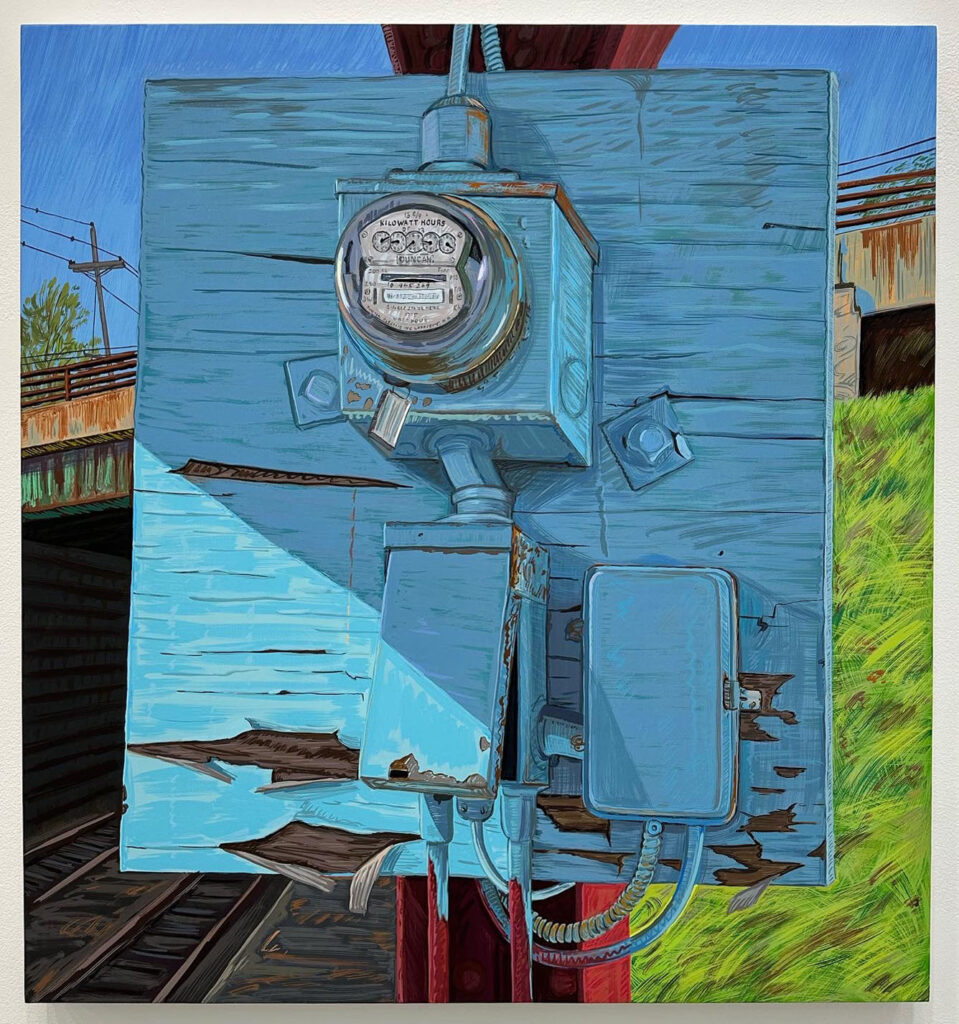
“Station Meter”, 2023


“Peony”, 2022 (detail)

Josephine Halvorson’s paintings for Unforgotten at Sikkema Jenkins, contain an amazing amount of detail and encourage the viewer to take in the little details of things they might ordinarily not pay much mind to.

From the press release-

Josephine Halvorson’s paintings emerge from chance or repeated encounters with objects the artist comes across while wandering and traveling. Her practice often takes place outdoors, naturally relating to daylight, geography, and season. The works in this show center on still life and memento mori, artistic genres that, for Halvorson, “hover between liveliness and decay.” She is drawn to things which have little apparent value—objects and spaces that have been, or may be, forgotten. Sharing the same air and hours with a subject, Halvorson finds within them latent expressions and buried meanings.

Since 2018, Halvorson has been painting with acrylic gouache on absorbent grounds. Inspired by fresco painting’s ability to indelibly hold color and mark, the artist has sought to make a sensitive surface that preserves her observations in real time. Painting in longhand, Halvorson works in a verité style, documenting the subtle shifts of shadow and thought. As she says, “I want to make a painting that remembers better than I can.”

This exhibition closes 4/22/23.


Apr 202023
 

Closing on 4/22/23 is Amoako Boafo’s exhibition, what could possibly go wrong, if we tell it like it is, at Gagosian gallery’s Madison Avenue location.

From the press release-

When I’m making paintings, I want the characters to be strong, I want them to be free, I want them to be independent, I want them to be unapologetic.
—Amoako Boafo

Boafo’s large-scale portraits portray his friends and those he admires with candor, joy, and individuality. Focused on Black identity, his monumental paintings have already become key works in the representation of contemporary Africa and the African diaspora.

Boafo paints the faces and bodies of his subjects with his fingertips rather than a brush, the directness of his touch enhancing their expressive qualities. The works’ surfaces feature a gestural facture which the artist uses to model the figures’ anatomy. Making eye contact, Boafo’s subjects return the gaze of the viewer in an assertion of presence and identity, reflecting the artist’s interest in conveying charisma and individuality. The characters occupy domestic interiors, their casual grace reinforced by the familiarity of these settings.


Apr 202023
 

“Double Double”, 2023

“Creep”, 2023

“The Switch”, 2023

“Under The Sea”, 2023

“Under The Sea”, 2023 (detail)

“Hour Glass”, 2023

Currently at The Hole gallery’s Tribeca location are Jeremy Shockley’s imaginative paintings for his exhibition, Well, Look At That.

From the press release-

Across eleven large canvasses, Shockley depicts the intersection of painting as a window into landscape and painting as a cloth stretched over some wood slats.

Shockley, who has a background in art conservation, was helping to restore a Lucio Fontana painting when he decided to incorporate the renowned Spatialist’s slashed-canvas imagery into his own practice. After experimenting with actual cuts he arrived at his signature trompe l’oeil technique, beginning each canvas in big exuberant strokes with four- or five-inch housepainting brushes then progressing to eyelash-thin ones to simulate frayed threads along fake slits in the canvas.

He describes his first large series—painted flaps suggesting two eyes and a smiling mouth—as a response to the renaissance in portraiture that coincided with COVID lockdown. “I put faces on the beautiful landscapes as a way of saying that in the future people may want to go back to looking at them instead of people. We might be all right,” he says, “but perhaps the landscapes won’t be.”

The works in this show push the theme further: the natural world becomes a curtain to be tugged, a veneer to be peeled back, or a series of ever-darkening portals that nonetheless contain a dose of optimism. We are invited to think about alternate dimensions, about the structural materiality of the painted canvas, and about our kitten-like propensity to just “hang in there.”

This exhibition closes 4/22/23.


Apr 192023
 

“…from dawn to dusk, (January)”, 2022

“…from dawn to dusk, (May)”, 2022

“…from dawn to dusk, (December)”, 2022

“white blind (bright red) (02.13)”, 2002

“white blind/bright red (02.6)”, 2002

“Untitled (98.5)”, 1998

From “nowhere near” Untitled (NW 18), 1999

“… and to draw a bright white line with light (Untitled 11.10)”, 2011

Uta Barth’s two part exhibition at Tanya Bonakdar Gallery is a fascinating look at the artist’s work.  It includes the New York debut of her most recent piece, …from dawn to dusk, a nearly 360-degree installation of images commissioned by the J. Paul Getty Trust.

From the press release-

Barth’s expansive 2022 series … from dawn to dusk focuses on the intersection of Southern California light with the architecture of the Getty Center. It traces the changing light at one location of the Richard Meier built campus, for the period of one year. The location was photographed every five minutes, from dawn to dusk, on two days each month, for the entirety of the year. Made with a GigaPan, over 64,000 images were captured and a Timelapse video sequence now shows the progression of this movement of light. As the view repeats from panel to panel, there are subtle changes in light as well as more dramatic blurring and color shifts, which invoke inverted optical afterimages and other visual phenomena that occur when staring at a fixed point for a prolonged period of time. Presented as twelve consecutive single views, the video is embedded among the still images of the installation, and it comes as a surprise to discover what one first assumes to be a still photograph to actually be the moving summation of the show.

In the upstairs galleries, Elizabeth Smith’s selection of work reveals the foundations of the artist’s renowned and influential practice, as well as the trajectory that led to the explorations found in …from dawn to dusk. Elizabeth Smith shared her thoughts on Barth’s practice as she approached this exhibition:

It’s been almost thirty years since I worked with Uta Barth to present her first solo museum show at MOCA in 1995. In relation to her newest project, the gallery’s invitation to select some key examples from both her early series and subsequent ones has offered a welcome opportunity to reengage with and consider the full trajectory of her work. From her earliest to her most recent photographs, Barth’s practice has centered on a nuanced investigation of visual experience, free from narrative. Light, color, the passage of time, and the shifting nature of the process of vision through bodily experience are the ongoing subjects of her resonant images, probed in various ways over decades.

Throughout her career, Uta Barth has made visual perception the subject of her work. Regarded for her “empty” images that reference painterly abstraction, the artist carefully renders blurred backgrounds, cropped frames and the natural qualities of light to capture incidental and fleeting moments, those which exist almost exclusively within our periphery. With a deliberate disregard for both the conventional photographic subject and the point-and-shoot role of the camera, Barth’s work delicately deconstructs conventions of visual representation by calling our attention to the limits of the human eye.

As Leah Ollman writes in her recent Los Angeles Times profile of the artist,

From her earliest years as an artist, Barth’s attention has been drawn to the eye’s behavior: what attracts it, what makes it stay, what causes it to double back, what generates after-images and optical fatigue. Learning to photograph was, for her, a way of learning to see.

This exhibition closes 4/22/23.


Apr 182023
 

“Untitled (Thicket)”, 2022, Steel, wood and paint

“Untitled”, 2020-22, Bronze and paint (two parts)

“Untitled (Fence I)”, 2020, Papier mache

Rachel Whiteread’s sculptures at Luhring Augustine’s Tribeca location draw the eye in with their textures, colors, and in some the unique combinations of items. They are even more intriguing when you discover they are often not what they first appear to be.

From the press release-

As is typical in Whiteread’s work, the sculptures in this exhibition communicate a high-low dialogue: discarded, seemingly inconsequential items are rendered in often precious, high-art materials, which transforms and elevates them from their original context and reading. The eye is tricked, and careful observation is required of the viewer. What appears to be spray-painted cardboard is in reality patinated bronze or silver, or shimmering metallic papier-mache, and assemblages of found materials are in reality amalgams of both found objects and hand-crafted simulacra. Cartons, boxes, branches, crates, cardboard, packing materials, and pipes overlap and interchange, creating an installation that becomes a pleasing visual puzzle. Whiteread created the works for this exhibition specifically with the light-filled, high-ceilinged Tribeca gallery in mind, so a beautiful optical play with colors and materials punctuates the space and draws the viewer into close examination of these human-scaled pieces. Silver and bronze casts of empty, anonymous boxes have a weighty presence, in contrast to the disposable nature of their form. The floor pieces are ghostly white assemblages of both found and cast objects, mostly debris; sitting wraithlike on the floor, each beckons the viewer to circle them and decode their elements.

This exhibition closes 4/22/23.


Apr 142023
 

“The Rake’s Progress”, 1991

“The Rake’s Progress”, 1991 (detail)

“Magnet”, 1992

“Magnet”, 1992 (detail)

“Stella Polaris”, 1990

Currently at Gagosian in NYC is Helen Frankenthaler’s Drawing within Nature: Paintings from the 1990s. The exhibition includes twelve paintings and two large scale works on paper.

From the press release-

My pictures are full of climates, abstract climates, and not nature per se. But a feeling. And the feeling of an order that is associated more with nature. Nature in seasons, maybe; but nature in, well, an order. And I think art itself is order out of chaos.
—Helen Frankenthaler

Frankenthaler’s celebrated 1952 composition, Mountains and Sea, was the first of her soak-stained canvases and was highly influential in the development of 1960s Color Field painting. By the 1970s, though, she had amplified her methods to include the expressive possibilities of surface inflection and density. Over the course of the 1980s, highly painterly canvases became her principal pictorial means, soon resulting in, during what would be her final decade, canvases of the greatest dramatic impact of her entire career, some of an unexpectedly large size.

Drawing within Nature features works dating from 1990 through 1995, made following Frankenthaler’s paintings retrospective which opened in 1989 at the Museum of Modern Art, New York. Composed in her studios in New York; Stamford, Connecticut; and Santa Fe, New Mexico—where she held a summer teaching residency at the Santa Fe Institute of Art in 1990 and 1991—these abstractions are inspired by the artist’s experience of landscapes.

Works in the exhibition include Poseidon (1990), more than eight feet wide, which calls on qualities of Frankenthaler’s earlier soak-stained canvases to evoke ocean currents, with its wet-on-wet passages of aqua, white, and green. The even larger Stella Polaris (1990) sets streams and patches of dense cloudlike white paint beneath the starlight of its title. Western Roadmap (1991) transforms the desert rock and glowing sunsets of the American Southwest into a stratified abstraction that hangs within an almost nine-foot-wide panorama. Reef and Spellbound (both 1991) lay out washes of rich, glowing color of varying density across dark grounds. The verdant hues of The Rake’s Progress (1991) suggest a garden in bloom, and show how Frankenthaler began to use gel to thicken her paint as well as combing and raking tools to create tracks bearing the imprint of the energy passing over the surface.

Painted a few years later, in acrylic on large sheets of paper, Flirt and Aerie (both 1995) are less grounded in memories of landscape vistas. Rather, their open, cursive forms invoke vividly colored and magnified details of drawing within nature.

This exhibition closes 4/22/23.

Apr 142023
 

“As the Crow Flies”, 2022

“As the Crow Flies”, 2022 (detail)

“As the Crow Flies”, 2022 (detail)

“As the Crow Flies”, 2022 (detail)

“Skunk Hour”, 2022

“Dogwood”, 2022

“Dogwood”, 2022 (detail)

There’s more to Nikki Maloof’s paintings than meets the eye in her exhibition Skunk Hour at Perrotin. The more you look, the more details- often dark- begin to emerge.

From the press release-

For Nikki Maloof, painting is a way to convey the experience of existing in the world—the light, the dark, and all the shadows in between. Her language is figuration: she started out with portraits of individual animals, progressing onto still lifes and, most recently, domestic interiors and landscapes populated with a mix of creatures—human and non-human; alive, dead, and inanimate. These subjects, on one level, have an everyday familiarity. Indeed, they are in many instances collected from Maloof’s immediate environment: for the past few years, her house and studio in rural Massachusetts. But the resulting depictions, however vivid, never feel quite real. The colors are bright, the shapes cartoonish, the compositions often implausible. Everything is emotionally charged. The eyes of dead fish seem to brim with sadness, the oversized blade of a knife glints with menace. A woman who shares Maloof’s physical features stands at a window with a glum expression, her face only just visible behind a tree dense with apples. Looking at these canvases is like looking at a series of dreams, governed by a mysterious logic, their characters and events freighted with ambiguous symbolism.

Of course, unlike in a dream, Maloof chooses what to paint: hers is a conscious artistry. We see evidence of this in her equally accomplished graphite works on paper, in which images are carefully worked out before she embarks on the larger oils on linen. (It’s fun to play spot the difference between the versions in pencil and paint: notice how a glass of wine materializes on a countertop; how a cat relocates from the landing to the stairs.) Perhaps her work is more akin to confessional poetry, intensely personal yet meticulously crafted. The title of this exhibition, “Skunk Hour,” is borrowed from a well-known poem by Robert Lowell, published in 1959, which begins as a light-hearted description of a seaside town in Maine and culminates in a self-portrait of a mind in turmoil. “I myself am hell,” wrote Lowell, “nobody’s here— / only skunks, that search / in the moonlight for a bite to eat.” Similarly, Maloof describes the scenes she constructs as “vessels,” giving tangible form to psychological states or particular thoughts and feelings.

The idea for this new series of paintings hatched last spring, when one morning the artist stumbled upon the birth of a fawn near her home, and later that day witnessed the body of a recently deceased neighbor being removed from his home. She decided that she wanted to capture the weight of being made simultaneously aware of the beginning and the end of life, as well as the tension between the mundane and extraordinary. There are no laboring deer or body bags here: instead, we get paintings like Life Cycles (2022), in which five plates are arranged in a circle, showing the progression of fishes’ lives from small orange roe on crackers to clean-picked bones. Or Burning Bush (2022), in which an empty bird’s nest rests inches away from a hawk dismembering its prey on a branch of the same tree. Whether taking the form of conventional still lifes or more expansive house-and-garden scenes, Maloof’s coded pictures make clear reference to the conventions of Western religious vanitas painting, with its representations of physical objects—flowers, food, skulls—to symbolize the transience of earthly pleasures.

If this sounds unremittingly heavy, it’s not. Maloof’s paintings also offer up many of their own pleasures, both intellectual and sensuous. It would be remiss, for instance, to ignore the slapstick wit in the detail of a rolled joint on a kitchen shelf in the work entitled Skunk Hour (2022): skunk here signifying not the foul-odored mammal but the just-as-pungent strain of cannabis. Life, as Maloof understands, is nearly always funny, even when things are pretty bad. And if you’re not in the mood to laugh, well, just try to resist the delights of the paintings themselves—their profusions of color, pattern, and texture. Extending the culinary theme, we might describe her work as a feast for the eyes. See how the coiling smoke from the lit joint rhymes with the squiggles of steam rising above a pair of artichokes in a colander; notice the thick scraped impasto of the howling cat’s bristling fur. Maloof is unabashedly maximalist in her approach to her canvases, layering both imagery and brushstrokes, at times threatening to overwhelm her subjects through an abundance of painterly gesture. This makes perfect sense. In such moments it becomes clear that, despite the universality of their themes, Maloof’s paintings are a vision of the world as seen through the eyes of a singular artist.

This exhibition will close 4/15/23.

Apr 142023
 

Thornton Dial, “Memory of the Ladies That Gave Us the Good Life”, 2004, Tin, carpet, wood, glove, washbasin, scrub brush, yard ornament, motor-oil bottle, paint brush, clothing, wire, enamel, and spray paint on wood

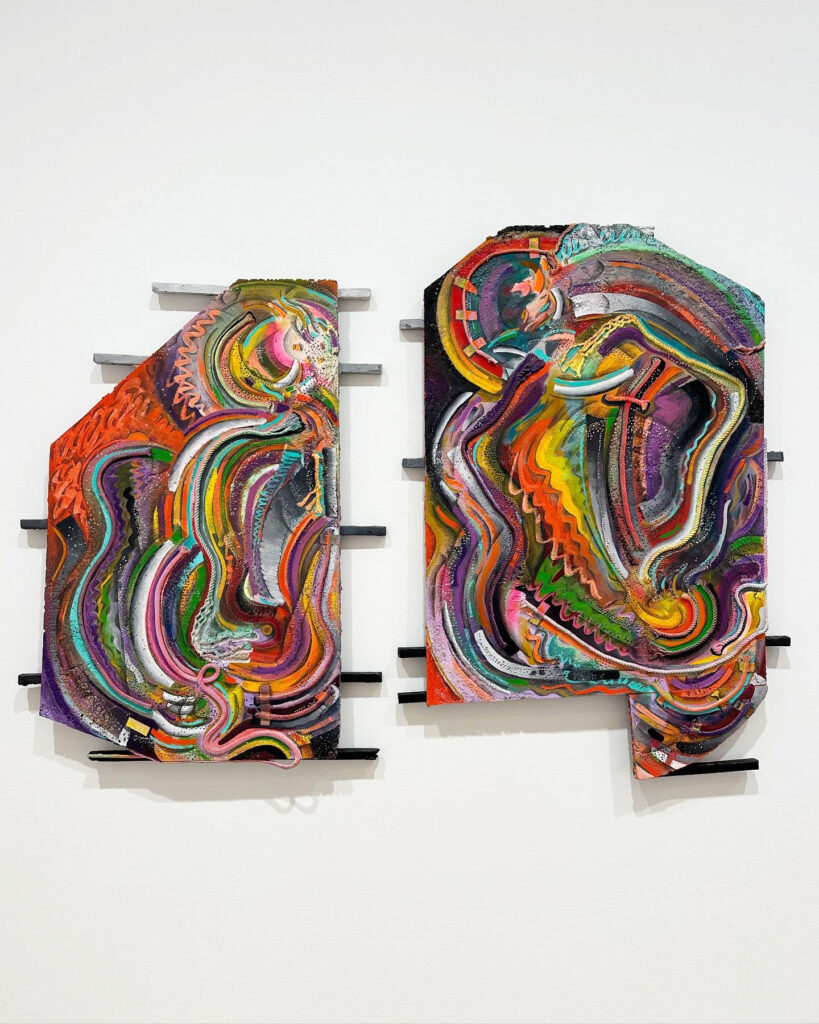
David Hammons, “Untitled”, 1976-77, Wire, rope, pipe cleaner, hair, rubber ball, mesh, aluminum, sand paper, thumb tack

Robert Rauschenberg, “Matt’s Defense (Scenarios)”, 2005, Pigment transfer on polylaminate

Dial / Hammons / Rauschenberg at David Lewis presents several works by the three artists that, although different in many ways, work together well.
From the press release-

This is the first-ever exhibition to solely bring together these three great American artists, each of whose conceptual ingenuity is expressed by way of material transformation and possibility. In particular, Dial / Hammons / Rauschenberg seeks to articulate the intersection between the American Duchampian legacy, as expressed in the material invention and possibilities of postwar Neo-Dada, and African-American traditions of redemptive, alchemical, and visionary practices based in found and discarded objects.
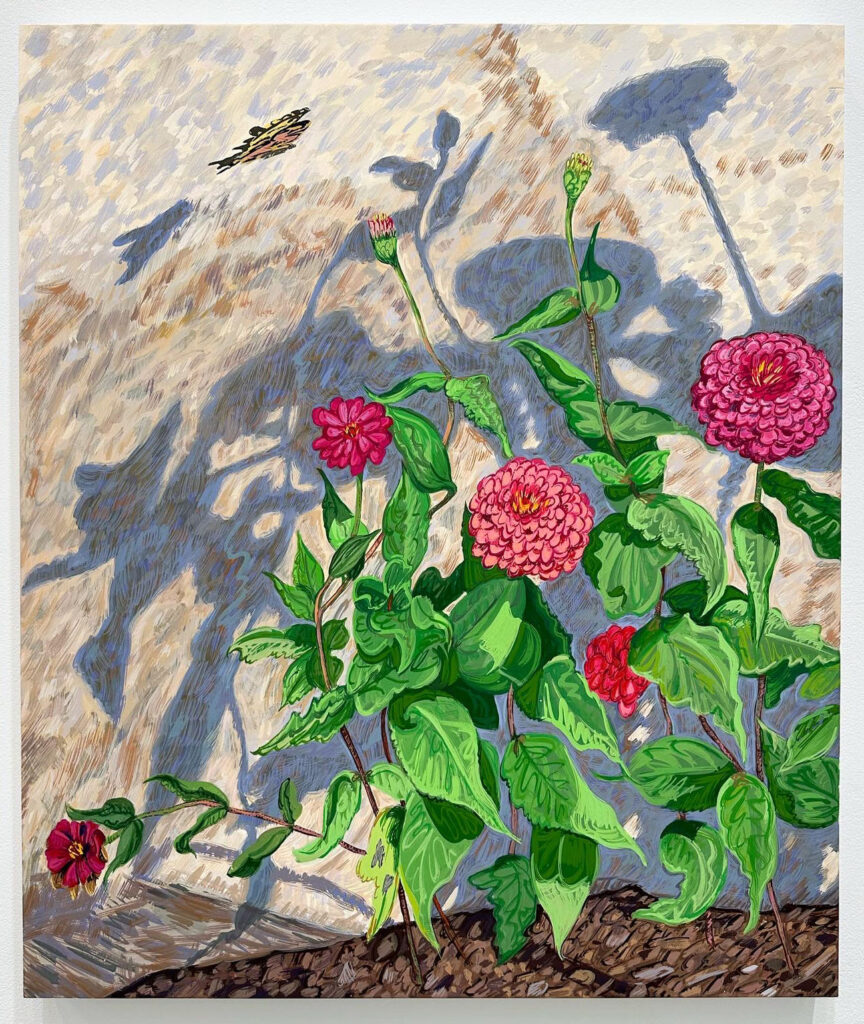
The exhibition ranges over more than 50 years; the earliest work presented is in Rauschenberg’s iconic 1962 assemblage Cartoon, then includes an early Duchampian wire, rope, pipe cleaner, hair, ball, and tack construction by David Hammons (Untitled, 1976-77), and then focuses on the 90s and 2000s, featuring four magisterial assemblages from Thornton Dial’s ‘high,’ most modernist phase of work, as well as an example of each of Hammons Kool-Aid and Tarp series from 2006 and 2007 and additional later Rauschenberg works. The exhibition also features two important sculptures: Dial’s Top of the World (1998), and Rauschenberg’s extraordinary The Lurid Attack of the Monsters from the Postal News, August, 1875 (Kabal American Zephyr) (1981). The largest work in the exhibition, Dial’s astonishing Master of Space (2004), conjures and critiques the iconography of American imperialism, military and corporate both (the eagle is made of neckties), while simultaneously calling upon and vengefully subverting the most classical of all modernist devices: the grid.

Every piece in the exhibition deploys, invents, and reflects upon the logic of assemblage: the Duchampian act of appropriation, transmuted in postwar America, into the language of assemblage, the Rauschenbergian combine. Dial / Hammons / Rauschenberg highlights these acts of American alchemy, and asks us to imagine their power and possibilities in ways which revise, expand, and complicate the history of modern and contemporary art, and weave a broader tapestry.

This exhibition closes 4/15/23.