Apr 102025
 

For Camille Henrot’s imaginative installation for A Number of Things at Hauser & Wirth, a variety of sculptures, including several from her Abacus series, are surrounded by paintings from her Dos and Don’ts series. There’s a playfulness to both, but something a bit darker too. Walking on the soft floor among the sculptures there is a feeling of childlike wonder, while at the same time, in combination with the paintings, you are reminded of the rules and restrictions that are imposed on us, starting when we are very young, and how they become more oppressive with age.

From the gallery’s press release-

Evoking children’s developmental tools, shoes, distorted graphs and counting devices, new large-scale bronze sculptures from the artist’s ‘Abacus’ series (2024)—presented alongside recent smaller-scaled works—address the friction between a nascent sense of imagination and society’s systems of signs. The exhibition will also feature vibrant new paintings from Henrot’s ongoing ‘Dos and Don’ts’ series.

Initiated in 2021, the ‘Dos and Don’ts’ series combines printing, painting and collage techniques where etiquette books become the palimpsest for play with color, gesture, texture and trompe l’oeil. The artworks will emerge from a flooring intervention—conceived and designed with Charlap Hyman & Herrero—that transforms the gallery into a site of sensory experimentation. Henrot’s exhibition vivaciously sets the stage for the arbitrary nature of human behavior to circulate freely between rule and exception.

As viewers enter the gallery, they will be greeted by a pack of dog sculptures tied to a pole, as if left unattended by their walker. Shaped from steel wool, aluminum sheets, carved wood, wax, chain and other unexpected materials, Henrot’s creatures speak to the ever-unfolding effects of human design and domestication. As an extension of Henrot’s ongoing interest in relationships of dependency, the dogs stand in as the ultimate image of attachment.

Henrot’s latest ‘Abacus’ sculptures unite the utilitarianism of the ancient calculating tool with the arches and spirals of a children’s bead maze—a toy popularized in the 1980s as a heuristic diversion in pediatric waiting rooms and nursery schools. Through these formal associations, an instinctive sense of play collides with the learned impulse to search out patterns and impose order. With their biomorphic contours, opaline patinas and quadruped or biped anatomies, these works seem charged with a lifeforce of their own. Hovering between pure abstraction and their multivalent referents, Henrot’s bronzes invite our unfettered, sensuous engagement, even as they allude to the symbolic systems that tyrannize our imaginations.

Behavioral conditioning is a central concern of Henrot’s ‘Dos and Don’ts’ series. These richly layered paintings consider the idea of ‘etiquette’ as it relates to society at large: its codes of conduct, laws and notions of authority, civility and conformity. The works feature collaged fragments of invoices from an embryology lab; a note conjugating the German verb ‘to be;’ dental X-rays; digital error messages; children’s school homework; and to-do lists, among other things. Together, they build on Henrot’s interest in making sense of the urge to organize and categorize information—a theme that has been prevalent in her practice since her groundbreaking film ‘Grosse Fatigue’ (2013). The ‘Dos and Don’ts’ series distorts its source material to reveal the constructed, performative nature of any social identity, while acknowledging the emotional security that behavioral mimicry and groupthink can provide.

As the exhibition’s almost childlike title suggests, ‘A Number of Things’ brings together a disparate but related group of works that collectively address the enormously difficult task that is living, learning and growing in society. With tenderness for the most banal traces of our existences, Henrot offers a meditation on the competing impulses to both integrate and resist the unquestioned structures of society in our everyday lives.

‘There’s a reason why, in English, the word ‘politics,’ ‘polite’ and ‘police’ all sound the same—they are all derived from the Greek word polis or city, the Latin equivalent is civitas, which also gives us ‘civility,’ ‘civic’ and a certain modern understanding of ‘civilization.’

—David Graeber, ‘The Dawn of Everything’ (2021)

In the video walkthrough with Henrot (below) she discusses many of the inspirations for the work.

This exhibition closes 4/12/25.
Feb 162019
 

This month there are a lot of excellent exhibitions on view in Chelsea.

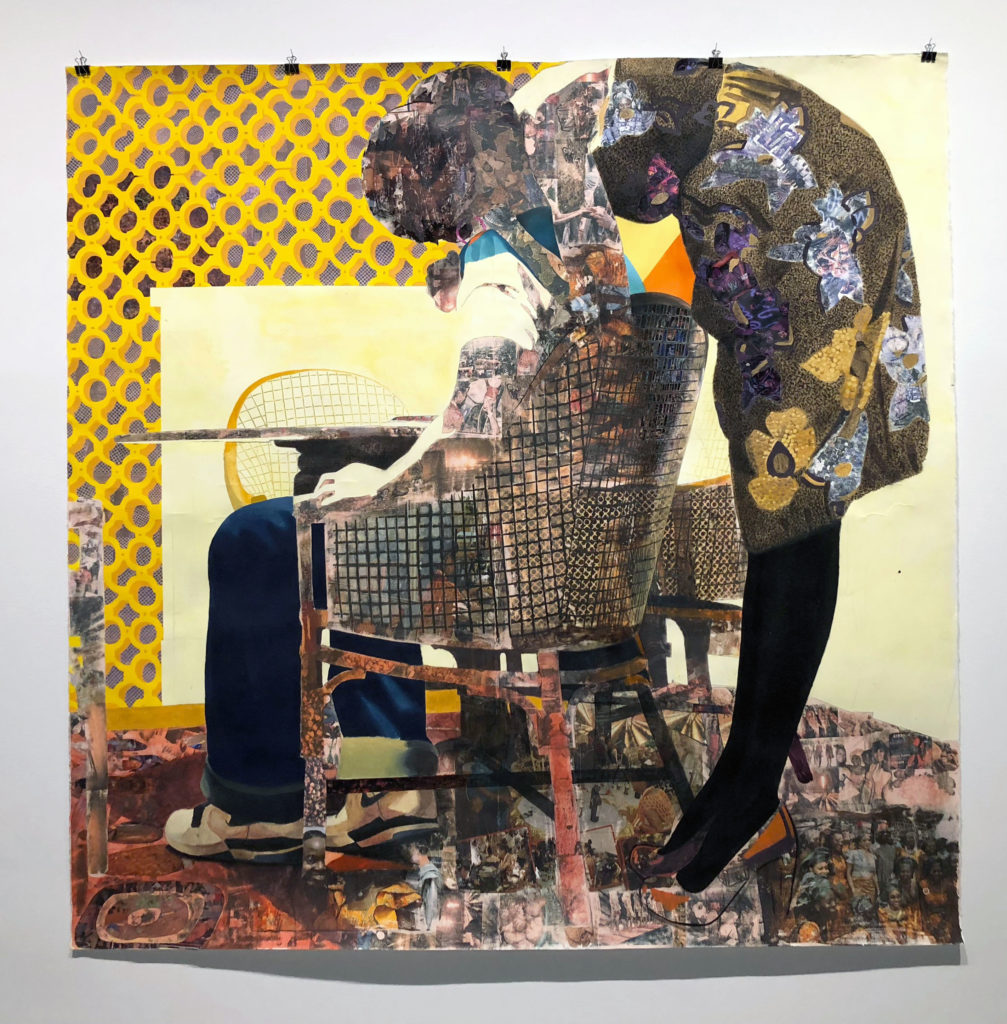
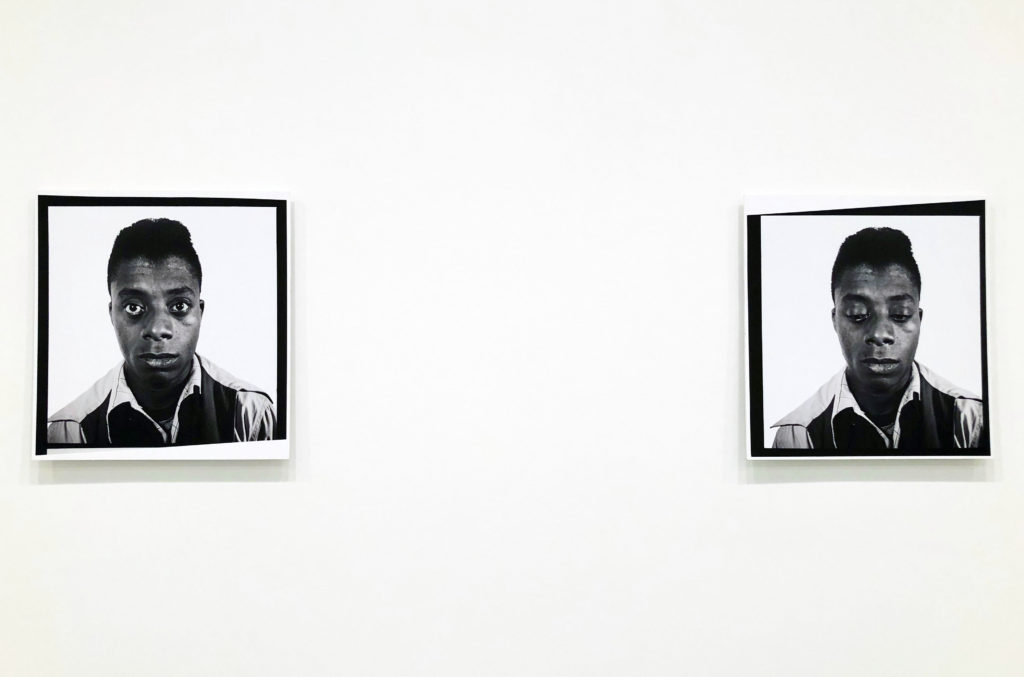
At David Zwirner is God Made My Face: A Collective Portrait of James Baldwin, a group show curated by writer Hilton Als. The works are varied and include portraits by Richard Avedon (shown above), a friend of Baldwin’s who also attended De Witt Clinton High School with him, as well work by Njideka Akunyili Crosby (seen below), Kara Walker, James Welling, Beuford Delaney, Glenn Ligon and many more.

Nyado: The Thing Around Her Neck, 2011 by Njideka Akunyili Crosby

At Marianne Boesky Gallery is Pure, Very, New, Paul Stephen Benjamin’s first solo exhibition in New York. The exhibition includes paintings, photographs, sculpture, and single and multi-channel video installations, as well as a new site-specific black light installation in the internal passageway between the two spaces.

From the press release

Benjamin’s practice is rooted in a vigorous meditation on blackness, considering: “What is the color black?” “What does black sound like?” “Is it an adjective, a verb, an essence, or all of these components mixed to create a nuanced whole?” For his large-scale monochromatic paintings, Benjamin thickly coats the canvas in varying shades of black, producing a sensation of boundless depth. This is further accentuated by Benjamin’s application of the particular tonality’s name within the field of color—the words appearing to float and dissipate within the richness of the paint itself. The development of these paintings followed an ordinary visit to a hardware store, where Benjamin was confronted with the many permutations of commercial black paint. Shades of black came with emotive titles like “Totally Black,” “New Black,” and “Pure Black,” among numerous others. For Benjamin, this sparked a multi-layered investigation of the color and whether it could be distilled or understood differently within the context of a painting or the color itself.

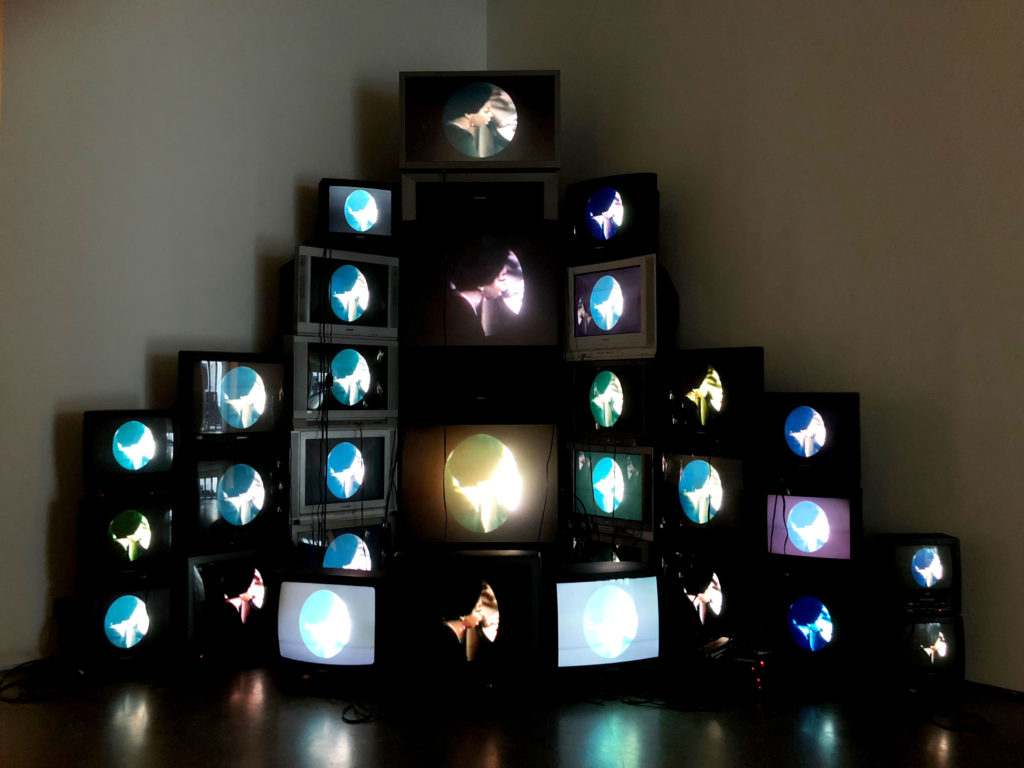
 … Benjamin’s practice also extends into a conceptual investigation of sound, and how “black” can be conveyed and experienced aurally. In these works, he often uses single and multi-channel video installations to loop portions of particular historic and cultural footage to isolate fragments of collective memories or internalized narratives. With Black is the Color (2015), which will be included in the exhibition, Benjamin arranges a towering cluster of antiquated televisions, forming a glowing grid that endlessly repeats a segment of Nina Simone’s 1959 performance of “Black is the Color of My True Love’s Hair.” Here, Benjamin appropriates only the words “Black is the Color,” creating an abstraction of the song that reveals the contradictions and parallels between the notion of black being the color and it being a color. Moving fluidly from sound installation to painting to photography and sculpture, Benjamin’s practice is driven by the idea that blackness, whether explored as a matter of conceptual inquiry or identity, cannot be captured in a single action, emotion, or language.

Black Is The Color 2015 by Paul Stephen Benjamin

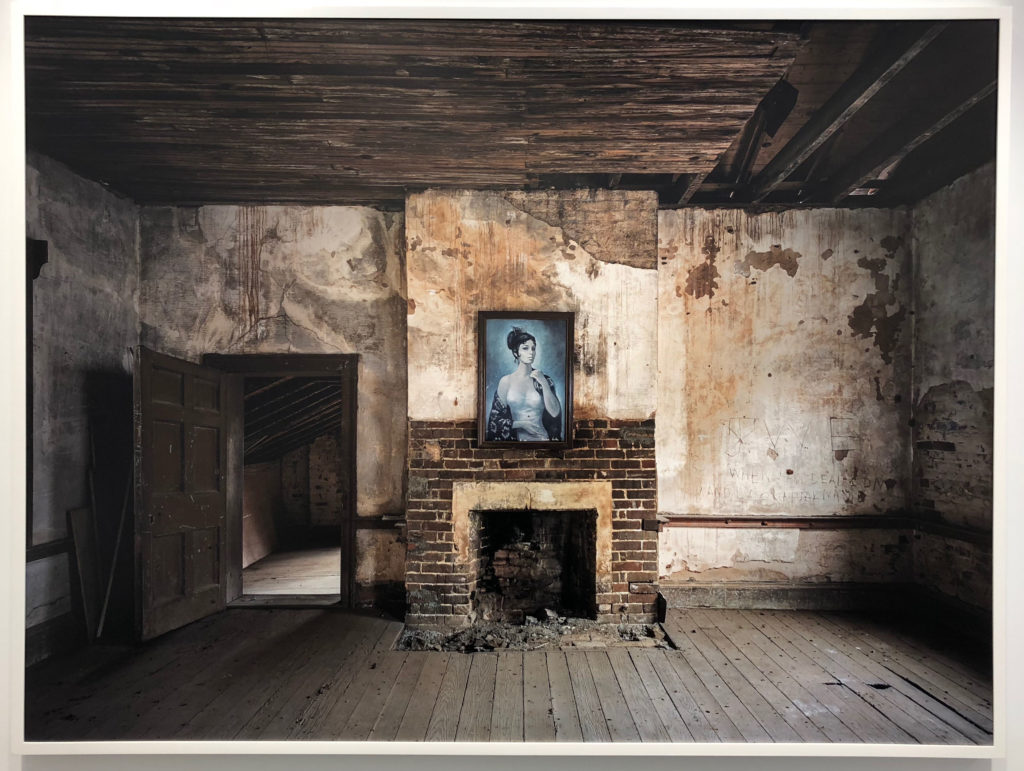
At Yancey Richardson is Blue Sweep, an exhibition of Andrew Moore’s beautiful photographs, taken in Alabama and Mississippi over the course of three years.

Carmen, Saunders Hall, AL 2015 by Andrew Moore

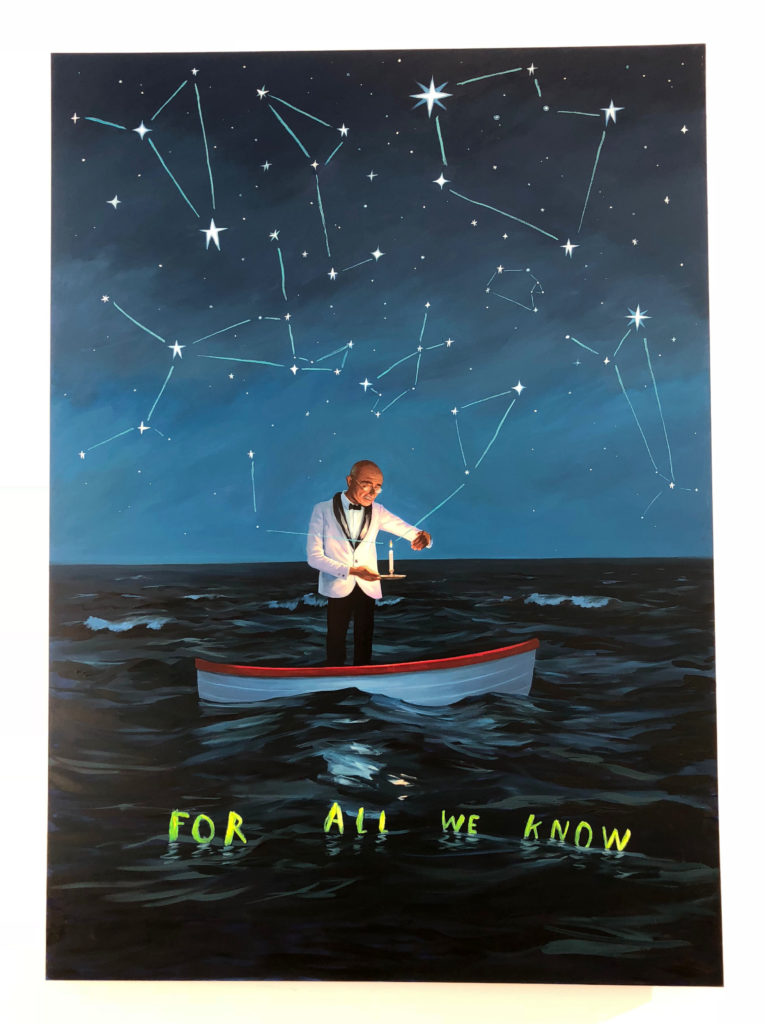
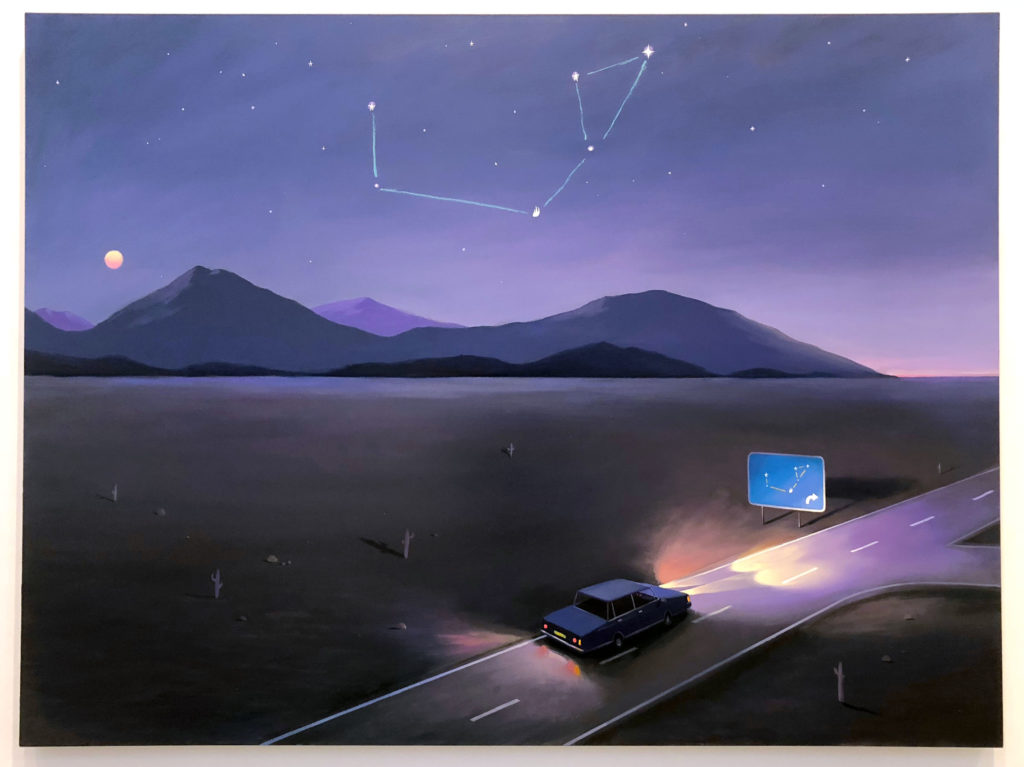
At Bryce Wolkowitz Gallery is Oliver Jeffers’ charming painting exhibition For All We Know. If his work looks familiar it may be because Jeffers is also the author of several critically acclaimed picture books.

From the press release

This series of paintings illuminate a dream-like nocturnal world populated by astronauts, deep-sea divers, sinking ships, floating pianos, and burning matches. Omnipresent throughout are the night sky and the ocean – the two great and unknown frontiers – glittered with the imaginary lines that create constellations, serving in this case as a mysterious key to unlock our world.

Expanding on years of observation, from the history of his upbringing in Belfast, to contemporary New York City, Jeffers’ evokes the precarious state of our home and its inhabitants. Inspired by Buckminster Fuller’s seminal book Operating Manual for Spaceship Earth, he presents pianos as dubious flotation devices and our planet presented as a cumbersome motor vehicle, overheating as we argue over what to play on the radio. From researching astronaut’s descriptions of looking at Earth from the distance of the Moon, Jeffers noticed certain recognizable patterns to the way in which he discussed the politics of his hometown from a vantage point of across the Atlantic Ocean. In finding that few people outside of Northern Ireland knew or cared of the intricate conflict there, a great waste of time was revealed: a divided population identical to each other in every way save for the flags they flew and the stories they told. Tragically, each side’s identity are still firmly rooted to the existence of the other, and therefore locked into a spiral of repeated patterns.


At both of Jack Shainman’s locations are a series of impressive paintings by Lynette Yiadom-Boakye.

Black Allegiance to the Cunning, 2018 by Lynette Yiadom-Boakye


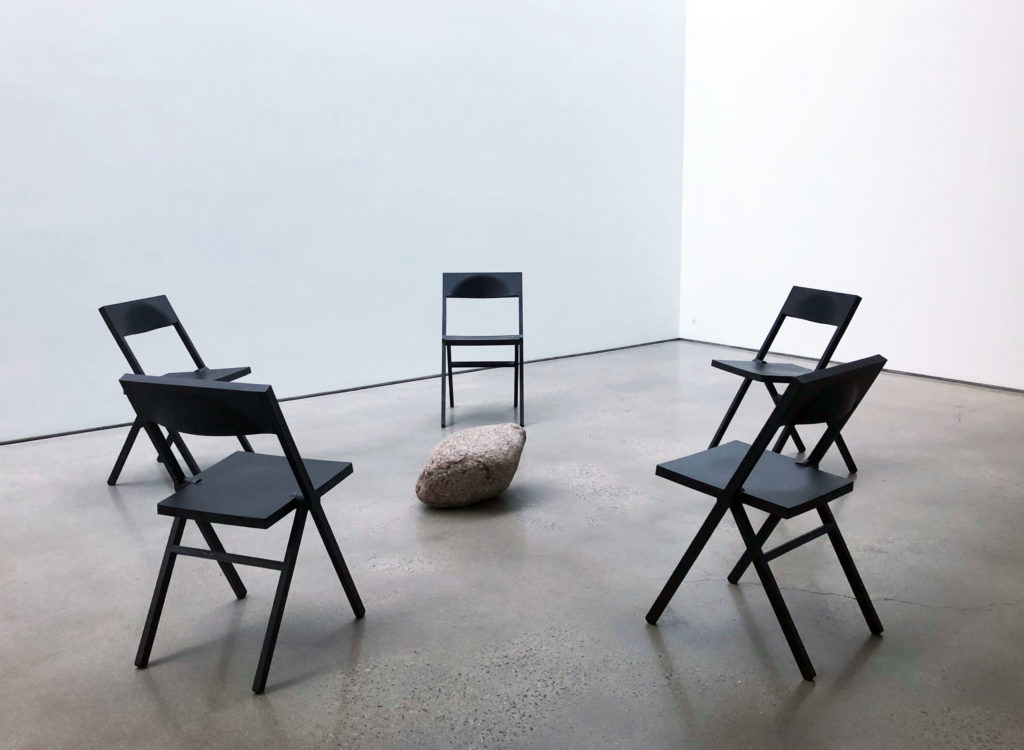
For a new kind of exhibition experience, Asad Raza has organized the group show Life to Come, at Metro Pictures which “brings together works that meditate on the creation of new worlds and new models for living.” There are no labels or listings for the works included in the show. Instead there is a guided tour by hosts who take you around the various works to help you draw connections between the objects. Adding to the uniqueness of the experience, at one point the host pauses while talking and partially in motion, recreating a work by artist Tino Sehgal, and at another they show you that they have changed their eye color, a work by Rirkrit Tiravanija.

From the press release

Experiencing these works together incites intellectual, physical, and spiritual understandings of what it means to make an entirely new world, one in which reality is made from fiction. Raza asserts that “by re-immersing ourselves in the strangeness and fecundity of attempts to create worlds that have gone before, our imagination of a world beyond the present may be renewed.” The uncertainty about what new paradigm awaits us is unsettling in the wake of the modernist 20th century, but it links us to previous generations who experienced radical reinventions of biological and social life.

Philippe Parreno, La pierre qui parle (The Speaking Stone), 2018.


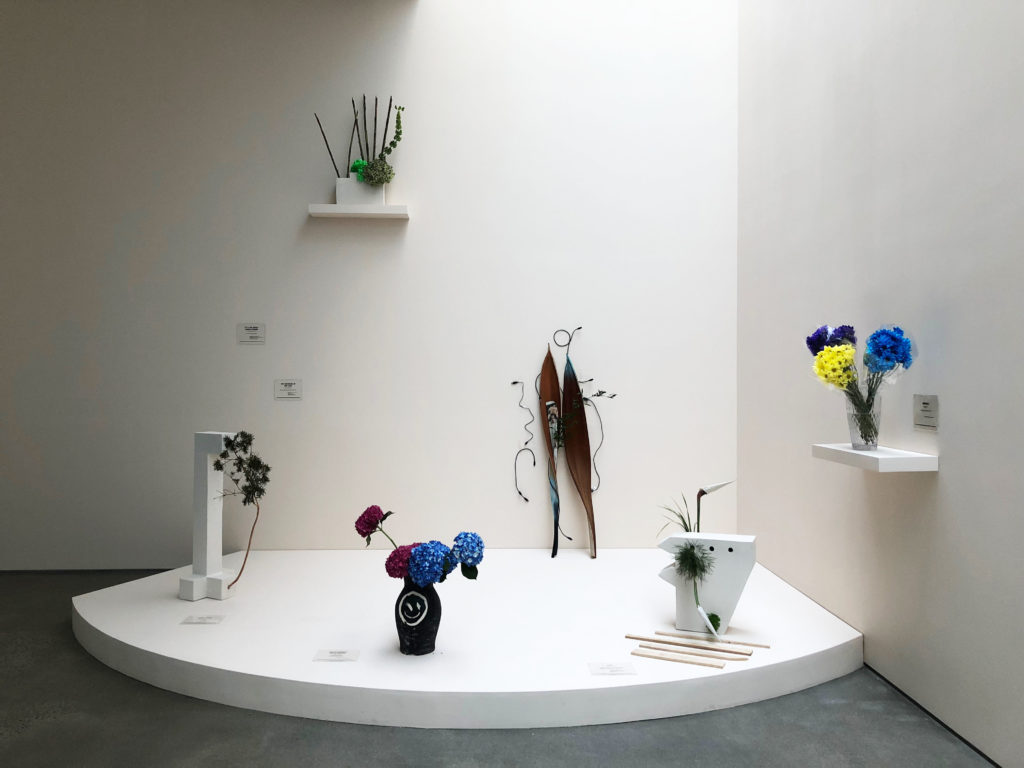
Selection of work by Camille Henrot (floral arrangements inspired by books)

All of these exhibitions close 2/16/19.