Jun 222023
 

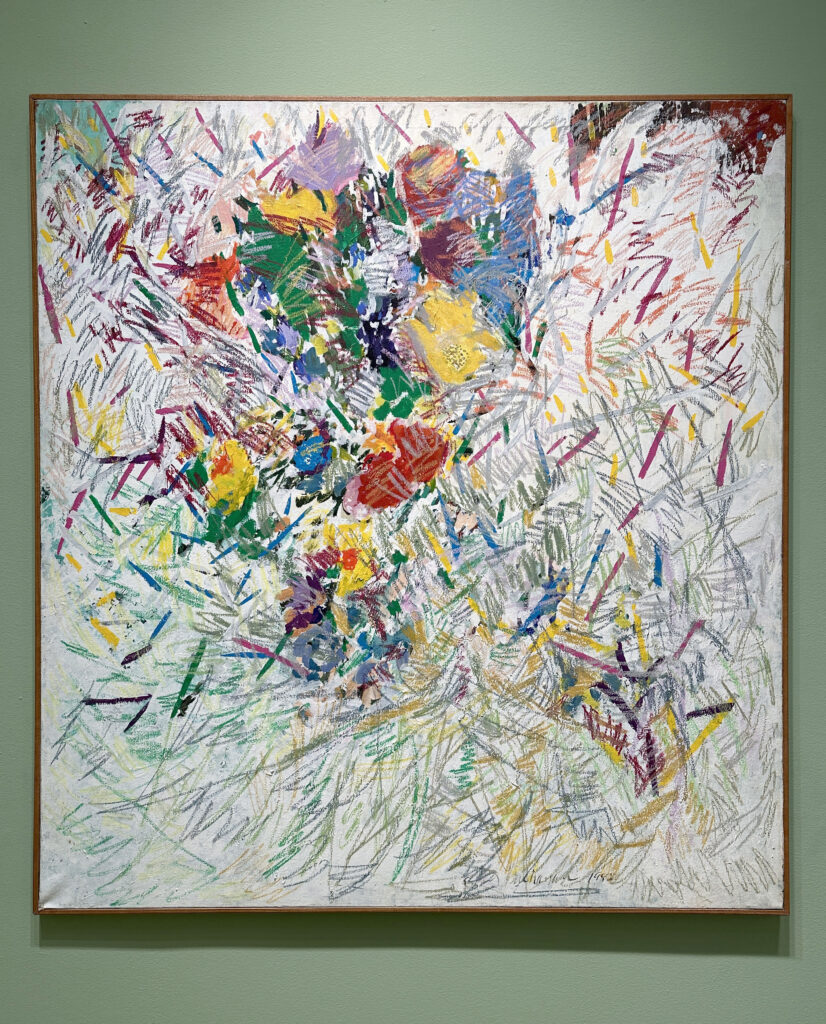
“North Tower”, 2021, mixed media on canvas

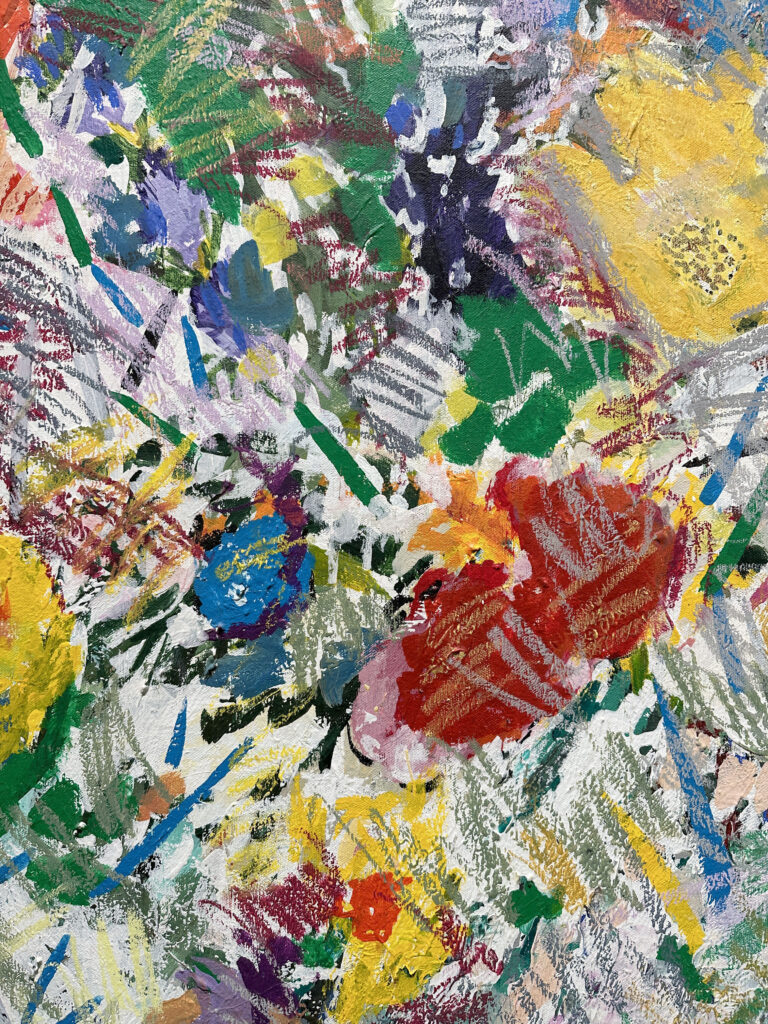
“North Tower” detail

“South Tower”, 2023 mixed media on canvas

Paintings created from zoomed-in sections of the underpaintings of the larger works

“Memories”, 2023, digital photographs

“Memories”, 2023, digital photographs (closer look)

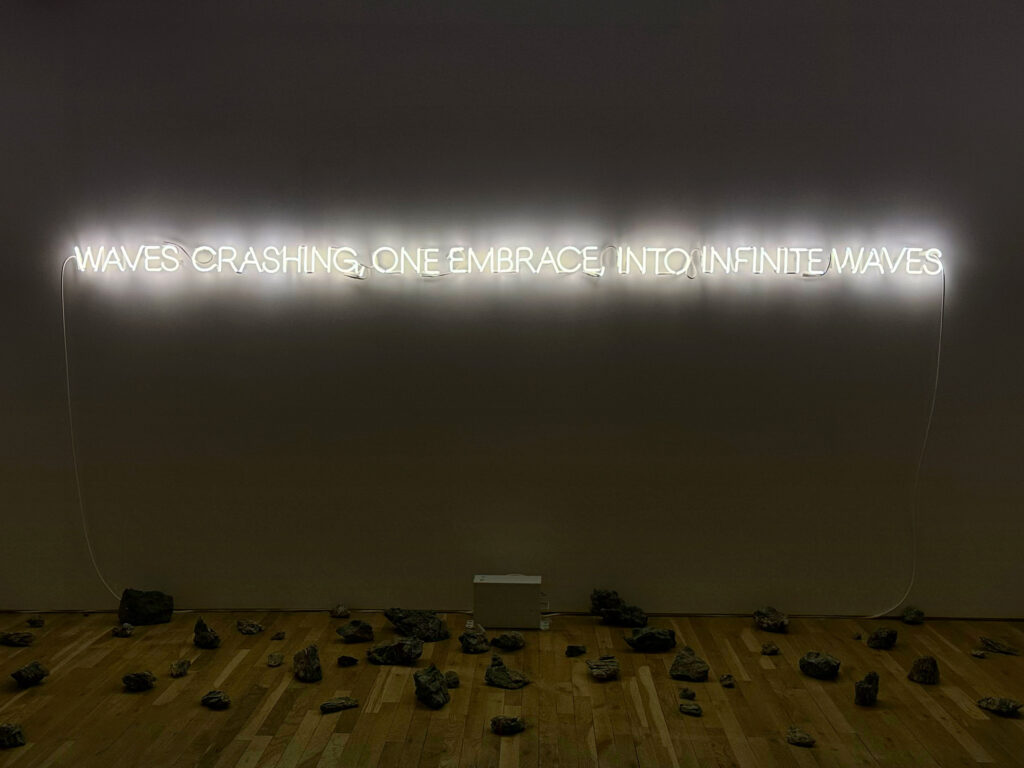
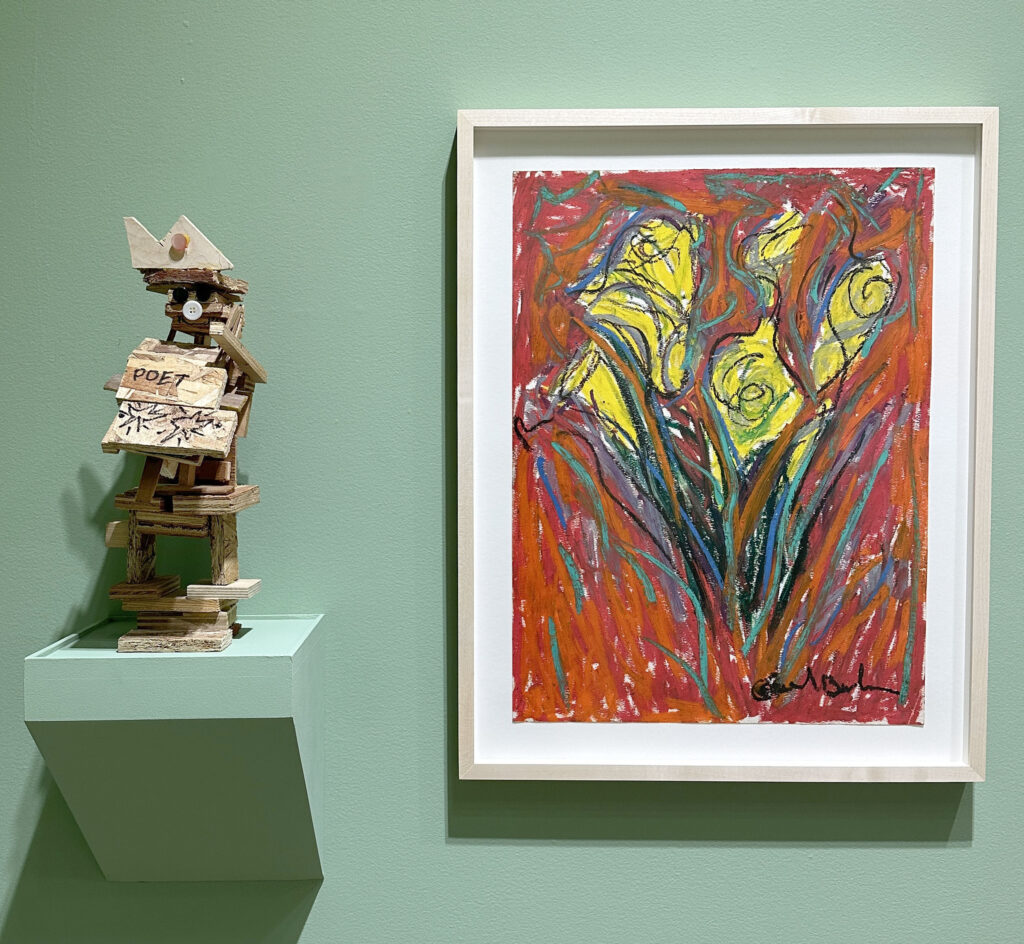
Gallery 221, at Hillsborough Community College’s Dale Mabry Campus, is currently showing Snow in September, an exhibition of work by Kirk Ke Wang. The layered mixed media works are really pretty but there is a deeper meaning within the details.

From the gallery about the exhibition-

Kirk Ke Wang (b. Shanghai, China) is a multimedia artist whose work focuses on critiquing modern stereotypes as a diaspora. Throughout his career, Wang has used painting, installation, mixed media, video and photography to present his vision of the world, led by a consistent thread: the fear of inexorable cataclysm.

Wang’s solo exhibition in Gallery221@HCC draws inspiration from a 13th century Chinese play called The Injustice to Dou E, also known as Snow in Midsummer. In the story, the tragic and unjust death of Lady Dou E causes the heavens to snow during a hot midsummer day, thereby proving her innocence.

Today, the story symbolizes injustice and tragedy, and in Wang’s exhibition Snow in September, the artist parallels the Chinese fable with abstracted images of more recent tragedies such as 9/11, calling to mind the moment when the twin towers collapsed, and debris rained down like falling snow.

Through retelling tragedies, Wang tries to find a spiritual solace and the meaningfulness of being human.

This exhibition closes 6/22/23.

Jun 212023
 

These days it’s hard not to think sometimes about the end of the world. But have you started putting together a plan? Thought about who would be good in a crisis? Put together a pros and cons list of your friends, family and acquaintances?  Wondered if things would actually be better?

Finn Schult’s current exhibition Everything You’ve Ever Wanted at Gallery 114 at Hillsborough Community College’s Ybor City location, presents an interesting take on the current state of things for those with the end on their minds.  It includes paintings, animal traps, an ipod and walkie talkie, as well as a book containing photos, prepper information, journal entries, drawings, and some pros and cons for the people in his life, including his mom. The paintings are titled “L’appel Du Vide” a French phrase meaning “the call of the void” or the urge to jump when you are standing in a high place.

From the gallery’s website-

Everything You’ve Ever Wanted is a solo exhibition of new work by Finn Schult (b. 1993, Naples, FL) reflecting on the inevitability of the end of the world and the fantasy of apocalypse as catalyst for utopia. Schult’s multimedia series exists as fragments, sketches and interludes distilled from an otherwise deranged web of theories. At times, the artworks presented in Gallery114@HCC feel terroristic, violent and unbearably bleak–at other times, they remind us of the beauty inherent in loss, longing and love. Schult’s work yearns for a world that doesn’t yet exist and mourns for a world that isn’t yet gone, answering the cry, “How will I ever get out of this labyrinth?” with “The only way out is through.”

There is also a video in the exhibition, Where r u rn? which mixes a variety of imagery with a bit of author and mystic Terence McKenna’s 1999 final interview where he discusses “the fire in the madhouse at the end of time”- the possibility of the craziness in the world being a sign of the dying of our species.

This exhibition closes on 6/22/23.

Jun 212023
 

Center work by Laura De Valencia

Morean Arts Center in St. Pete, Florida, is currently showing Fresh Squeezed 7, their annual exhibition of emerging artists in Florida. It’s a great opportunity to see some of the best artwork being done by local artists. The exhibition closes 6/22/23.

From the the Morean Arts Center’s press release-

As always, our selection panel culled over 120 applications from across the state, narrowing the exhibition down to the six artists featured here. It’s always a joyful and heartbreaking process, seeing so much inspiring good work and only having a limited amount of space in which to show it all.We were looking for diversity in medium, in ideas, and in geographical location, all of which somehow comes together to form a delightful, cohesive whole.

While we don’t necessarily plan it that way, themes and commonalities do emerge among the artists selected for the exhibition. We’re happy to announce this is the first year that we have an ALL FEMALE line up. And due to the inclusive interpretation we use to define an emerging artist (no previous solo shows in Florida), you’ll find artists here who are still pursuing their MFAs (KJ Skidmore and Leeann Rae) AND artists who are returning to their first love of art after finding fulfillment in decades of other related careers (Latonya Hicks and Deborah W. Perlman).

Other themes you may notice as you peruse the galleries are the inventive (and exuberant!) use of materials. Denise Treizman and Latonya Hicks both incorporate cast off, recycled and vintage materials in their dimensional wall work. While Denise’s process is more spontaneous and Latonya’s is deliberate and measured, they both create joyful works of art that invite contemplation and perhaps a spark of recognition from the viewer.

KJ Skidmore and Laura De Valencia both deal with contemporary issues and pop culture in their work, though to wildly different effect. KJ’s humorous mixed media paintings address the notion of the male gaze, and the women who must endure it. Laura’s installations use fashion culture as a jumping off point to raise questions about international stereotypes and the borders (both visible and not) that immigrants have to experience on a daily basis.

Both Leeann Rae and Deborah W. Perlman create work that challenge the viewer to look longer, and to think deeper. With their disparate materials (Leeann with soft pastel and Deborah with cut paper), they raise notions of space, whether physical or mental, real or imagined, in the present or a memory from the past.

KJ Skidmore “Squeeze ‘n’ Block”, Acrylic and coffee

KJ Skidmore

KJ Skidmore “Angel’s Bar”, Acrylic, fabric, trim, paste and wood paper

The work above is by Tampa based artist KJ Skidmore.

Morean Arts Center’s information about the artist-

KJ’s current work is based in painting/drawing that extends into3-D space through multimedia installation. Her immersive spaces are chaotic and aggressive, but at the same time alluring. She works within her own bizarre and disjointed narratives and themes containing warped textual elements, strange cartoon characters, and color palettes that are both grimy and fluorescent. Her material use is variable and may include masses of hair clumped together with canned beets, pink stained carpet, fabrics, wood, plaster, teeth, rain jackets, and Smurf-themed objects.

KJ’s painted series Burger Time caricatures leering male clientele as flat, monster-like cartoons that interact with a staring waitress to explore gendered tropes and forms of voyeurism. This series reconstructs reality in relation to being female by presenting experiences like getting stared at or groped within a hokey themed attraction called “Burger Time” restaurant. Her series is meant to revolt the viewer through acknowledging the male gaze, while also celebrating its trashiness and the culture surrounding it. She uses humor to poke fun at this harmful and uneven power dynamic. The series presents this sickening concept through more palatable presentation such as expressive cartoon figures and bright colors.

KJ is from Gainesville, FL, but was living on the West Coast until recently. She is back in Florida pursuing an MFA at USF in Tampa.

For more of the artists in the show, continue to the next page.

Jun 192023
 

Robert Pruitt, “A Song for Travelers”

Brooklyn Museum’s exhibition, A Movement in Every Direction: Legacies of the Great Migration, is an opportunity to learn about an important period of American history, and see it interpreted through the eyes of twelve contemporary artists.

From the museum’s website-

Between 1915 and 1970, in the wake of racial terror during the post-Reconstruction period, millions of Black Americans fled from their homes to other areas within the South and to other parts of the country. This remarkable movement of people, known as the Great Migration, caused a radical shift in the demographic, economic, and sociopolitical makeup of the United States. A Movement in Every Direction: Legacies of the Great Migration brings together twelve contemporary artists to consider the complex impact of this period on their lives, as well as on social and cultural life, with newly commissioned works ranging from large-scale installation, immersive film, and tapestry to photography, painting, and mixed media. Featured artists are Akea Brionne, Mark Bradford, Zoë Charlton, Larry W. Cook, Torkwase Dyson, Theaster Gates Jr., Allison Janae Hamilton, Leslie Hewitt, Steffani Jemison, Robert Pruitt, Jamea Richmond-Edwards, and Carrie Mae Weems.

A Movement in Every Direction presents a departure from traditional accounts of the Great Migration, which are often understood through a lens of trauma, and reconceptualizes them through stories of self-possession, self-determination, and self-examination. While the South did lose generations of courageous, creative, and productive Black Americans due to racial and social inequities, the exhibition expands the narrative by introducing people who stayed in, or returned to, the region during this time. Additionally, the Brooklyn Museum’s presentation centers Brooklyn as another important site in the Great Migration, highlighting historical and contemporary census data about the borough’s migration patterns. Visitors are encouraged to share their own personal and familial stories of migration through an oral history “pod” available in the exhibition galleries.

About Robert Pruitt’s work, pictured above, from the museum’s wall information plaque-

“A Song for Travelers” celebrates the individual and Black collective experiences that have shaped the histories of rural East Texas and Houston’s Third, Fourth, and Fifth Wards. In this drawing-based on an early 1970’s photograph of a reunion of the artist’s family in Dobbin, Texas -sixteen people gather around a seated central figure about to embark on a journey. During the creation of this work, the masked traveler became a stand-in for Pruitt, who had recently left his hometown of Houston.

Pruitt often draws inspiration from his and others’ family photographs while examining historical events that have impacted Houston’s Black communities. Wearing costumes and adorned with items that reference various aspects of Black culture found in schools, social clubs, and religious spaces, the figures in the work reflect the numerous networks that remained and flourished in the South. Merging the Great Migration period with the present, Pruitt centers the Black neighborhoods across the southern region that served as safe havens and rich sites of cultural expression for migrants during the twentieth century. This link extends to today as many Black Americans leave the northern and western cities that once attracted their elders and return to the South.

Allison Janae Hamilton’s A House Called Florida, below, takes the viewer on a journey through part of northern Florida’s natural beauty.

From the museum’s information plaque about the video installation-

Allison Janae Hamilton produced the three-channel film installation A House Called Florida in her hometown region of northern Florida. The breathtaking landscapes of Apalachicola Bay and the swampy Blackwater Lakes of Florida’s Big Bend frame musicians, dancers, motorists, a Victorian house, and a slow resounding rhythm.

The artist references French Argentinian writer Julio Cortázar’s 1946 short story “Casa Tomada.” (“House Taken Over”) about ghosts that slowly take over a home and eventually push out its owners, room by room. Hamilton echoes the story’s theme of displacement with two regally dressed, spirit-like protagonists who move about the house engaging in mark-making and ritual performances. Hamilton’s film pays tribute to the Black Floridians who remained in the Red Hills and the Forgotten Coast regions, despite the racial violence and environmental precariousness they faced throughout the nineteenth and twentieth centuries.

Carrie Mae Weems‘ personal and moving contribution is in two parts- a series of photographs and a unique digital video installation.

The museum’s description of the work-

Carrie Mae Weems explores a painful family story: the disappearance of her grandfather Frank Weems, a tenant farmer and union activist who was attacked by a white mob in Earle Arkansas, in 1936. Presumed dead, he narrowly escaped and made his way to Chicago on foot, never again reuniting with his family. Frank Weems may have followed the North Star to Chicago. Weems’s series of seven prints, The North Star, makes an apt metaphor for Frank’s life. In Leave! Leave Now! Weems conjures the figure of her grandfather with a Pepper’s Ghost, a late nineteenth-century form of illusion first used in theater. By weaving historical events with fragmented family stories, photographs, poetry, music, and interviews, the artist reveals the tragedy of her grandfather’s disappearance and the aftermath.

This exhibition will close on Sunday, June 25th, 2023.

Jun 102023
 

Ketsy Ruiz, “El Yunque in my Corazón I and II”, acrylic on canvas

Work by (L to R)- Chloe Lewis, Kyra Connolly, Ketsy Ruiz. and Joerod Collier

Photos by Joerod Collier, Ceramics by Babette Herschberger

Currently on view at Parachute Gallery in Ybor City, Tampa, is the group exhibition Buy Me Flowers & Call Me Pretty. The show celebrates the beauty of nature and features seven artists with Florida roots.

The artists included are-

This show is on view until 6/25/23.


May 112023


Andrew Edlin Gallery is currently showing a collection of rarely seen works by artist Beverly Buchanan. It covers her years as an abstract expressionist painter in NYC and her later work inspired by the rural South.

The gallery’s press release gives a really good history of this wonderful artist-

The first section of the show features the artist’s abstract paintings and works on paper from the 1970s, alongside post-minimalist sculpture from the late 1970s and early 1980s. The second section introduces a later, more personal side of Buchanan’s oeuvre, her colorful depictions of flowers and small folk-inspired assemblages created during the same period as her well-known “shacks.” A number of the works in the show, many of which were part of the artist’s private collection, have never been shown.

Though Buchanan wrote about her love of “making things” from an early age, it wasn’t until 1971, when she began taking evening classes taught by African-American painter Norman Lewis (1909-1979) at the Art Students League in New York, that her career as an artist took off. Abstract still-lifes that she made in Lewis’s class in 1972 are displayed here for the first time. That same year, her paintings were included in a group show at Cinque Gallery, a nonprofit space co-founded by Lewis and Romare Bearden (1911-1988), which showcased the art of emerging minority artists.

Having witnessed demolition sites in Harlem and SoHo, Buchanan evoked the visual erosion of architectural facades through what she dubbed her “Wall” paintings. In 1976 she presented a selection that she called “Torn Walls” in a two-person show titled City Walls at the Montclair Art Museum in New Jersey. In his New York Times review, David Shirey described the show as “indisputably a tinderbox of a display that will cause sparks to fly” and “the kind …one sees more regularly at the Whitney Museum and at some of New York’s avantgarde galleries.” Three of these paintings are being shown for the first time since that exhibition, forty-seven years ago. The show also includes a monotype, small studies, and a large painting from a series she titled “Black Walls.” The latter was originally featured in Shackworks, a seminal exhibition that opened at the Montclair Art Museum in 1994 and traveled to nine other institutions from 1994-1996.

By the late 1970s, Buchanan was further exploring the aesthetics of architectural decay through sculpture, i.e., cast concrete assemblages, made from pieces of stone, brick debris, clay, and cement mixtures. She arranged these works in clusters on the floor, documenting them with photographs, and exhibited them, notably at Truman Gallery in New York in 1978, and at the feminist artist cooperative A.I.R. Gallery in 1980 in its groundbreaking show Dialectics of Isolation, curated by Ana Mendieta. Some of the small black terracotta works on display may be considered as studies for these larger assemblages.

After moving to Georgia in 1977, Buchanan became increasingly interested in making what she referred to as “environmental sculpture,” artworks that mimicked exterior surfaces and were also site-specific installations that were allowed to decay over time and become part of the surroundings. Most notably, in 1979 she completed Ruins and Rituals (also the title of the Brooklyn Museum retrospective from 2016-2017), and in 1980 Marsh Ruins, with funding from a Guggenheim Fellowship. To construct the three mounds that comprise Marsh Ruins, Buchanan produced her own tabby cement. Composed of the lime from burned oyster shells mixed with sand, water, ash, and other shells, tabby is what colonial settlers used to build structures in coastal Georgia, the location of Marsh Ruins. In her zine “Making Tabby for Brick Sculptures,” Buchanan documented the labor-intensive process of making tabby, a task that in the eighteenth century was typically delegated to enslaved workers. Two smaller iterations of these structures, with bits of oyster shell showing in the concrete, are laid out in the show alongside four other examples of her cast concrete assemblages. Though little is known about their exhibition history, we do know that the artist placed these cast concrete works in her garden in Athens, Georgia. They retain stripes of the green, blue, black and earth-toned paint with which Buchanan initially covered them. The faint outline of her signature “B.B.” is also visible.

Buchanan’s later work is intimately linked to her natural surroundings and folk art. As a native Southerner, she drew on memories from her childhood as well as the lush Georgian landscape and yard art of local self-taught artists. A passionate gardener, Buchanan produced vivid oil pastel flower drawings and small assemblage works. She loved to rummage through thrift stores collecting marbles, wedding toppers, and beads, to create what she referred to as her “Christmas trees,” and “spirit jars,” her take on memory jugs, a prized Southern Folk Art form. Buchanan was particularly moved by a visit to folk artist Nellie Mae Rowe’s home in Fayette County, Georgia, and reminisced: “Being at Nellie Mae Rowe’s home was like being engulfed in a magic forest of her work because every surface had a mark from her hand and the simple chewing gum works made you never take gum as just chewing gum again.” A distinctive chewing gum jug and pin are also included in the show.

This exhibition closes 5/13/23.

May 092023
 

“Curtains”, 1972, Acrylic and fabric on canvas

“Curtains”, 1972 (detail)

“Voyage”, 1973, Acrylic and collage on canvas

“Shrine: Homage to M.L.”, 1963, Oil on canvas

“Big Ox”, 1967, acrylic on canvas

There’s only a few days left to see Miriam Schapiro: The André Emmerich Years, Paintings from 1957–76 at Eric Firestone Gallery.

From the press release-

Miriam Schapiro (1923–2015) is now well-known as a pioneer of the Women’s Art Movement, and for her contribution to the Pattern and Decoration Movement. She fused craft work, traditionally made by women, with modern painting in collages termed “femmage.” However, this exhibition will additionally shed light on her early Abstract Expressionist canvases, and her pioneering approach utilizing computer technology to create Hard Edge geometric painting in the 1960s. Spotlighting the legacy of this feminist artist, the exhibition will explore three stylistic phases, with significant examples from these two decades of Schapiro’s career.

This exhibition closes 5/13/23.

May 042023
 

“Day 11: Flight Simulator”, 2023 Oil, inkjet transfer, enamel, and paper on canvas

“Carousel”, 2023 Oil, inkjet transfer, enamel, and paper on canvas

“Day 5: In Praise of Shadows”, 2023 Oil, inkjet transfer, enamel, and paper on canvas

“Day 3: Janitor”, 2022 Oil, inkjet transfer, enamel, and paper on canvas

Above are some of Ho Jae Kim’s enchanting mixed media works from his exhibition, Carousel at Harper’s gallery.

From the press release written by the artist-

The centerpiece of this exhibition, its namesake painting, depicts a carousel with 31 horses signifying the days of the month. For each of these “days,” I built a unique narrative in honor of liminal spaces, the mundane, and the quotidian. Just as life continues regardless of our psychology, the carousel will turn whether or not there is a rider. While I prepared for this exhibition, I thought of the displacement I’ve experienced by tragic events out of my control. One summer night in 2022, my stepfather committed suicide. He left a brief note for my mother before driving to a nearby railroad where he waited for a train to take his life. Since then, I have been plagued with a vision of the train’s headlights—a magnificent bright light that dissolves the contours of everything in its path. I became a prisoner to this light that exists within my dark fantasy.

We rely on fleeting moments of significance to define life, but the majority of our lives are shaped by non-moments of transition, endurance, and dormancy. For this reason, I chose to create representations of less significant moments in order to build a body of work that can paint a better picture of reality. Luxurious portrayals of life as depicted in movies and pop culture cultivate dreams of becoming a character in a fantasy, but these dreams are quickly shattered by the constraints and circumstances of daily life. We become psychologically displaced and rejected by the fantasies that once served as our vitality. We begin to live in a state of purgatory, caught between reality and our dreams.

In The Divine Comedy, during the transition from the Inferno to Purgatory, Dante turns right to see the light from the east on Easter Sunday, a day of resurrection. With this new orientation, Dante’s purgatory becomes a place of hope, where lost souls can choose to repent or find redemption. The horses on my carousel face to the left, in the direction of the spiraling Inferno, but if the audience chooses to imagine the mechanism rotating, the horses will eventually turn right as they continue their clockwise journey. Similarly, as the halos, arches, circles, and light in my paintings become juxtaposed with the mundanity of the subjects, they transform those quiet non-moments into divinity, and the prisoners of my narratives are granted redemption.

This body of work began as a tragedy, but it has the potential to become a comedy. And just as I wish for my loved ones to see the beauty that is within their souls, I hope that my divine scenes of nothingness can become a vehicle for others to redeem themselves in purgatory and indulge in the beauty that is inherent in every life.

This exhibition closes 5/6/23.


May 022023


Currently on view at Bortolami is Tom Burr’s excellent multimedia exhibition. With new discoveries around every corner, the show keeps you engaged, at times even on an emotional level.

From the press release-

Once more Burr has assumed his dual role as artist and exhibition maker, relocating the act of making from the traditional studio space into the gallery. An architectural intervention of four walls defines the show, a deconstructed box whose contents have been scattered both in view and out of sight yet remain connected on levels of materiality, memory, biography, and history. Moving through the gallery, the viewer is directly confronted by Burr’s work, activating the artworks and the physical space created for them. As the interconnectivity of the different facets of the exhibition comes into view, not only here and now but in its connection to the entirety of Burr’s career, we begin to understand this as not merely an assortment of objects as artworks, but on a larger scale as a total artwork.

Four new wooden panels populate each makeshift wall, continuing the signature plywood sculptural series begun in the 1990s. Each painted a different color, the artist loosely utilizes the shipping crate motif, a point of interest for Burr. Adhering stainless steel and brass plates to each panel, the images portray the artist himself as well as his own simulation of stereotypical “faggy gestures,” as he refers to them, creating an intersection of public expectations of artistic sensibility, identity performance and exposure.

Also on view in the main gallery are a series of furniture-based sculptures. Set behind the walls, each work draws the viewer into the constructed architectural space as they grapple with themes of legacy, memory, and biography. Pulse utilizes various items once belonging to the “lounge” at Burr’s project space in Torrington, Connecticut—a disco ball, a couch, a lamp, a wool blanket — the disco ball being a relic from American Fine Arts, the legendary SoHo gallery run by Colin de Land where Burr exhibited throughout the 1990s and early 2000s. Accompanying the work is a wall text listing the various academic definitions of the word “pulse,” while the last line, a new addition by the artist, is a reference to the infamous shooting at the gay nightclub in Orlando, Florida, a signal to both the individual and communal meanings associated with the word. Similarly, the artist has gathered various items belonging to his father to create Johns (my father’s chest)—a chest of drawers, long johns, a metal storage box, and a handkerchief— evoking the same ideas of legacy and biography.

A new photo series entitled Capricornus I, II, III, and IV lines the outer walls of the main gallery. Depicting Burr in the three public bathrooms of his Torrington space, he is in the midst of various movements—lounging, laying down, reading. In a string of associations from Bruce Nauman to Francesca Woodman, as well as nods to his own past work, here the studio becomes a stage as Burr equates the everyday banal and artmaking.

Occupying the small gallery space, Floor Model (adolescent), is the most recent continuation of the artist’s series His Personal Effects, while in the office Burr has installed a series of new collages made in homage to Stefania Bortolami. The Visit, I, II, III depicts images of a visit by Bortolami to Burr’s space in Torrington, CT, as well as images of plant foliage from Burr’s seminal work, Construction of An American Garden, currently installed in the Torrington space. In the words of scholar and curator Blake Oetting “the body of the dealer emphasizes the commercial system that supports Burr’s work and translates it into exchange-value, a framework, he reveals, that often moves beyond the physical boundaries of the gallery.”

This exhibition closes 5/4/23.