Dec 192019
 

Anish Kapoor’s exhibition at Lisson Gallery’s 24th Street location is a reflective wonderland where the sculptures twist your perception of your surroundings as you move around them. If his work looks familiar, he has created many public outdoor works including Cloud Gate, also known as “The Bean”, which is permanently installed in Millennium Park in Chicago.

The exhibition continues at Lisson Gallery’s smaller 10th Avenue space with several of Kapoor’s colorful wall-based circular sculptures in semi-reflective hues.

Both of these exhibitions close 12/20/19.


Dec 122019
 

Petzel Gallery is currently showing Walead Beshty’s solo show “Abstract of A Partial Disassembling of an Invention Without a Future: Helter-Skelter and Random Notes in Which the Pulleys and Cogwheels Are Lying Around at Random All Over the Workbench”. The sheer volume of work covering the walls is overwhelming and impressive in its assembly.

From the press release-

The work A Partial Disassembling of an Invention Without a Future: Helter-Skelter and Random Notes in Which the Pulleys and Cogwheels Are Lying Around at Random All Over the Workbench, was originally commissioned by the Barbican Centre, London. The London-born, Los Angeles-based artist first exhibited the work there in 2014, covering the 273 ft long Curve gallery from floor to ceiling in cyanotype prints. The prints were produced over the duration of a year (October 9, 2013–October 8, 2014) and are chronologically installed in proportion to the exhibition space. For its New York première at Petzel, approximately 5,120 cyanotypes (38% of the total 15,616 sq. ft work) will be presented.

In A Partial Disassembling of an Invention … , each cyanotype (a 19th Century photographic process using ferric ammonium citrate and potassium ferro-cyanide) was produced by placing tools and other objects used in the production process of the studio on cellulose waste material generated by that same process (such as wood, cardboard, or paper) that was coated with UV-sensitive cyanotype material. After being exposed to sunlight and washed in water, the object’s silhouette appears in reverse against a cyan-blue background.

In using everyday objects, such as receipts, prescriptions, invoices, financial statements, legal documents, letters, gallery invitations, etc. from the working life of the studio, an inherent transparency is embedded in the work, demystifying the artwork and exposing its process of coming to be. Representative of the lives of those who made it, the cyanotypes expose both aspects of identity and circumstance, situating the work within political, social, and economic exchange without being representational or depictive in the conventional sense. While both the Barbican and Petzel iterations deal with debris, this new display has a more overtly American immediacy to it. Considering the resurgent discourse on the politics of representation, there is a new urgency to exhibiting the work for the questions it evokes about the modes and uses of representation, such as how art can accurately display real world conditions of labor, production and power, and whether a truly accurate and transparent form of representation is possible.

Beshty will also show Prologue to A Partial Disassembling of an Invention Without a Future: Helter-Skelter and Random Notes in Which the Pulleys and Cogwheels Are Lying Around at Random All Over the Workbench, which are the cyanotypes that were produced in anticipation of the Barbican work from August 1, 2013–October 8, 2013, along with seven volumes of the 59-volume archive of the work. The books—in their Prologue and Opus volumes—comprise bound pages printed recto and verso of the entire work reproduced at 1:2 scale. The volumes create both an archival record of Beshty’s workspace as well as an index of all the tools and artefacts used for the work’s own making.

The title of the project is a reference to Hollis Frampton’s hypothetical lecture he muses about in a talk delivered at the Whitney Museum of American Art, but never actually gives. The title of this phantom lecture alludes to the origins of the medium, and its inevitable obsolescence. It also calls forward the question of the role objects play when they have ceased being useful. Wrenched by time from their intended use, the objects become purely aesthetic, becoming the focus of contemplation in both historical and poetic terms.

This exhibition closes 12/14/19.

Dec 062019
 

Currently at Brooklyn Museum is Garry Winogrand: Color, the first exhibition dedicated to Winogrand’s color photographs.

From Brooklyn Museum’s website-

While almost exclusively known for his black-and-white images that pioneered a “snapshot aesthetic” in contemporary art, Winogrand produced more than 45,000 color slides between the early 1950s and late 1960s.

Coming from a working-class background in the Bronx and practicing at the time when photographs had little market value, Winogrand did not have the resources to produce costly and time consuming prints of his color slides during his lifetime. Yet, he remained dedicated to the medium for nearly twenty years.

The exhibition presents an enveloping installation of large-scale projections comprising more than 400 rarely or never-before seen color photographs that capture the social and physical landscape of New York City and the United States. On his numerous journeys through Midtown Manhattan and across the country, Winogrand explored the raw visual poetics of public life—on streets and highways, in suburbs, at motels, theaters, fairgrounds, and amusement parks. For him, the industrially manufactured color film, which was used by commercial and amateur photographers, perfectly reproduced the industrially manufactured colors of consumer goods in postwar America. By presenting this group of largely unknown color work, Garry Winogrand: Color sheds new light on the career of this pivotal artist as well as the development of color photography before 1970.

Winogrand’s photos are always captivating, both in his style and subject matter, and now there is the addition of time, which adds nostalgia to their allure.

The exhibition begins with a slide projector showing single slides, most of which aren’t on view in the main room (shown below).

The main room (shown below) has slides rotating on the walls along both sides of the large room with seats in the center for viewing. The pairings often accentuate each others colors, with the smaller slide of each pair staying up longer. It is definitely worth making the time to see them all.

Also included in the exhibition are a room of Winogrand’s black and white photographs and a video of him discussing his work.

This exhibition closes 12/8/19.

Oct 222019
 

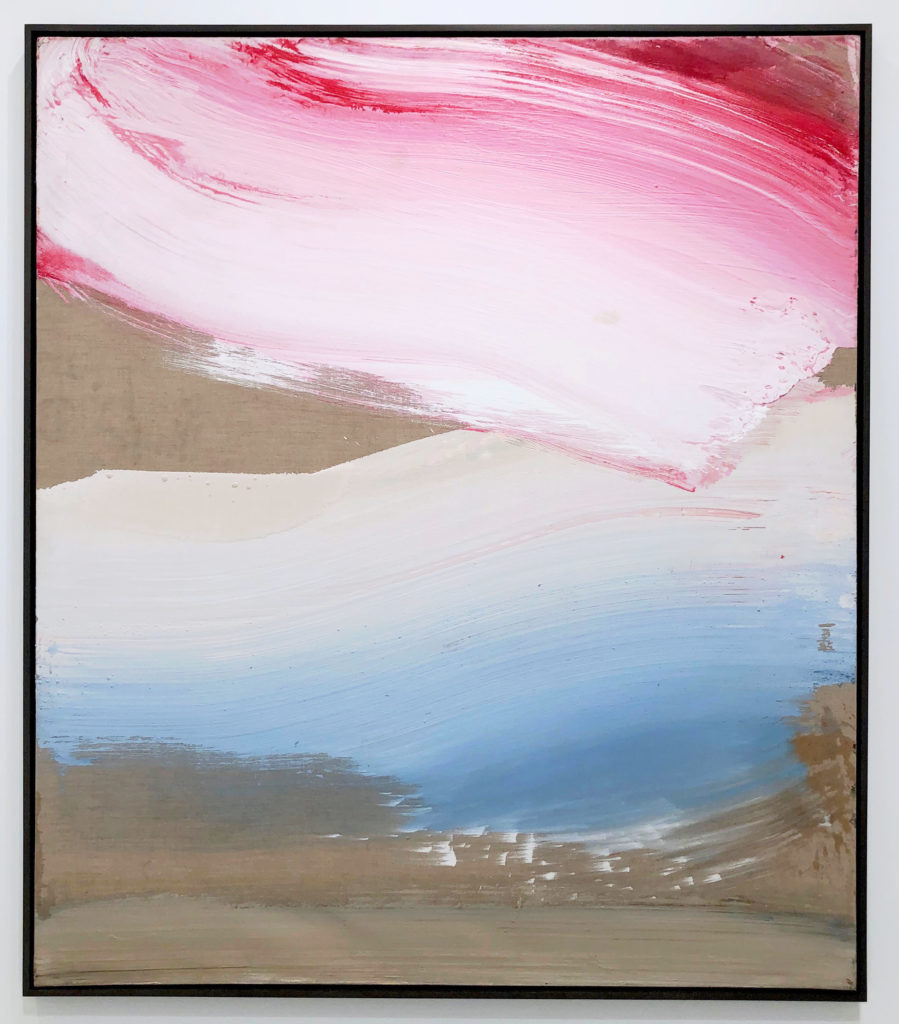
Hauser & Wirth is currently showing two painting exhibitions. On the ground floor of their 22nd Street location are Ed Clark’s gorgeous abstract works, some of which are pictured above. The paintings on view are recent, made between 2000 and 2013. Created on the floor using a push broom, there is a high energy in the motion and blend of color in these canvases.

Sadly, Clark passed away on Friday, October 18th at the age of 93. He was an innovative abstract painter who worked for more than 60 years. This is a wonderful opportunity to see his work in person.

On the second floor of the gallery is Amy Sherald’s the heart of the matter… , (pictured below) her inaugural exhibition with the gallery. If her style looks familiar, it may be because she gained a lot of attention with her portrait of Michelle Obama for the Smithsonian’s National Portrait Gallery.

“If you surrendered to the air you could ride it” (2019)

“Precious jewels by the sea” (2019)

From the press release-

Informed by the artist’s reading of key texts that explore tensions between interior and public realms, the heart of the matter… draws its title from the first chapter of bell hooks’ seminal book ‘Salvation,’ and builds on themes of silence and stillness explored in Kevin Quashie’s ‘Sovereignty of Quiet’ and U.S. Poet Laureate Elizabeth Alexander’s ‘Black Interior.’ In her new paintings, Sherald considers how these relate to the conceptualization of blackness as it is represented publicly, questioning representation of black identity, which often negates the complex reality of an interior life. She envisions black American identity beyond the conceits to which it has largely been restricted, attempting to restore a broader, fuller picture of humanity.

Sherald’s portraits are vivid, large in scale but intimate in effect, capturing both the ordinary likeness and extraordinary essence of her subjects while simultaneously detaching them from everyday reality. Varying in expressiveness, gesture, clothing, and emotional auras, the individuals portrayed maintain a persistent sense of privacy and mystery, requiring viewers to ponder the sitters’ thoughts and dreams. Drawn to each of her subjects instinctively and spontaneously, these ‘Americans doing everyday American things,’ as Sherald has described them, are part of an informal network of people who populate our universe.

Once Sherald commences painting, a transformational moment ensues as the artist begins to view her sitter as an archetype in the history of representation and therefore a vehicle for challenging assumptions. Working from carefully composed and dramatically staged photographs, Sherald situates her subjects in brightly colored, ambiguous environments, then meticulously tweaks expressions and patterns to emphasize a sense of universality and connection. While her subjects are always African-American, Sherald renders their skin-tone exclusively in grisaille – an absence of color that directly challenges perceptions of black identity.

the heart of the matter… debuts two paintings that reach a new, monumental scale for the artist. In these works, Sherald’s monochromatic backgrounds evolve into fully realized scenes that reference quintessential Americana: friends posed at the beach and a man atop a metal construction beam. For the latter, Sherald draws inspiration from Charles C. Ebbet’s iconic photography of 30 Rockefeller Plaza in New York City. Sherald often looks to vintage photography for source material, drawn to what she describes as its capacity ‘to narrate a truer history that counters a dominant historical narrative… Photography was the first medium I saw that made what was absent, visible.’ Sherald continues, ‘It gave people who once had no control over the proliferation of their own image the ability to become authors of their narratives.’ By mining and positioning images associated with archetypal or nostalgic American moments – burgeoning industry, sunny beachside locales – Sherald is able to firmly situate and make fully visible black Americans within the canon of American iconography. In this way, her portraits reclaim space and author a narrative for people that official art history omitted, speaking to the human condition and holding up a mirror to American life.

Lastly,  take a trip to the top floor for the group show Personal Private Public, a group exhibition “exploring the idea of the inner life in three main themes: introspection, intimacy, and voyeurism”.  The exhibition includes work by Jonathan Lyndon Chase, Ivy Haldeman, Celia Hempton, Tala Madani, Paul McCarthy, B. Ingrid Olson, Paul Mpagi Sepuya, Emily Mae Smith, Mira Schor, and Kohei Yoshiyuki.

All three of these exhibitions close 10/26/19.


Oct 182019
 

“Crescent (Timekeeper)”

“Crescent (Timekeeper)”

“Crescent (Timekeeper)” Detail

Sarah Sze’s exhibition at Tanya Bonakdar’s gallery in New York is stunning. There is so much to look at, to appreciate. There are so many pieces to all of the work, and yet it never feels overwhelming. It makes you want to keep looking.

It’s also immersive. The windows on the outside of the gallery are covered in her work, as is the staircase alcove. The video projections in the main room travel all around the room, surrounding you with visuals and sound. Upstairs the floors of the gallery have paint splattered on them, accompanying the works on the walls.

Detail of the above work

In a room on the first floor is a “studio space” where you can gain insight into Sze’s process and how she makes these elaborate works.

From the press release-

Sze’s latest body of work frays “the seam between the real and the image” (Smith). Through complex constellations of objects and a proliferation of images, Sze expands upon the never- ending stream of visual narratives that we negotiate daily, from magazines and newspapers, television and iPhones, to cyberspace and outer space. The works evoke the generative and recursive process of image-making in a world where consumption and production are more interdependent, where the beginning of one idea is the ending of another—and where sculpture gives rise to images, and images to sculpture.

In this new exhibition, Sze expands her work by embedding her nuanced sculptural language into the material surfaces of painting and into the digital realm through the interplay of cloth, ink, wood, paper, metal, paint, found objects, light, sound and structural supports—collapsing distinctions between two, three and four dimensions. This body of work fundamentally alters our sense of time, place, and memory by transforming our experiences of the physical world around us. Both objects and images, Sze says, are “ultimately reminders of our own ephemerality”.

This exhibition closes 10/19/19.


Oct 172019
 

From Ishiuchi Miyako’s “Scars” series (1991-)

Images from the “ひろしま/ hiroshima” series, 2007-present

Ishiuchi Miyako’s exhibition occupies both floors of Fergus McCaffrey’s Chelsea gallery space and includes over 70 photographs from five series made over four decades, including many early and never-before-seen works.

On the first floor are the artist’s somber black and white photos of the buildings of her hometown of Yokosuka. Yokosuka was also the home of a US Naval Base, established in 1945.  In another room is work from her Scars series, for which she photographed the damage left behind by injury, illness, and trauma. These portraits focus not on the people but on the imprints on their bodies. Despite that, they don’t feel impersonal or voyeuristic. There is a tenderness to these images.

Photographs of objects dominate the rest of the exhibition. There are a series of images of her mother’s possessions, taken before she passed away. She also photographed Frida Kahlo’s belongings, including a pair of her shoes that were different sizes- accommodating the physical issues Kahlo had after her bout with polio as a child.

The photos of items donated to the Hiroshima Peace Museum, for the ひろしま/ hiroshima series, are especially moving. The articles of clothing worn by residents of Hiroshima when the atomic bomb was dropped on the city are worn and damaged. It’s hard not to think of what happened to the people who owned them.

Each series of photographs is unique, but tying them together is the idea of capturing what gets left behind. It can be a city or a scar or a person’s possessions after they die, but they have an effect. Ishiuchi’s photos record that effect in an impressive and thought provoking way.

This exhibition closes 10/18/19.