Jul 292026
 

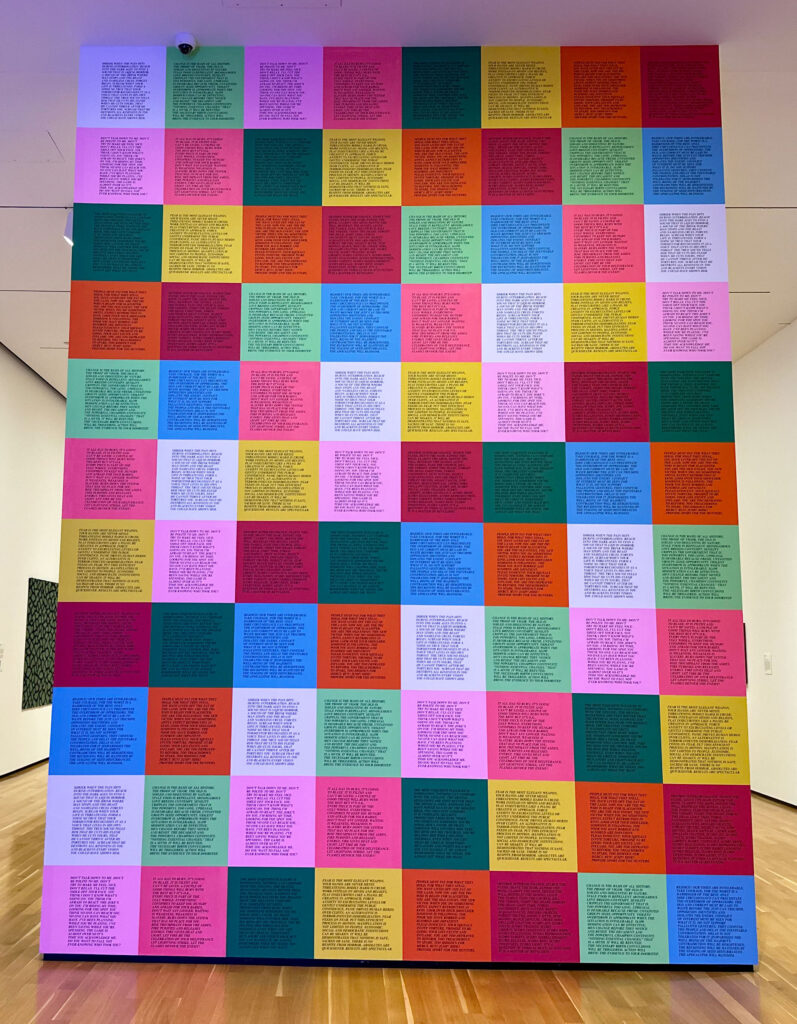
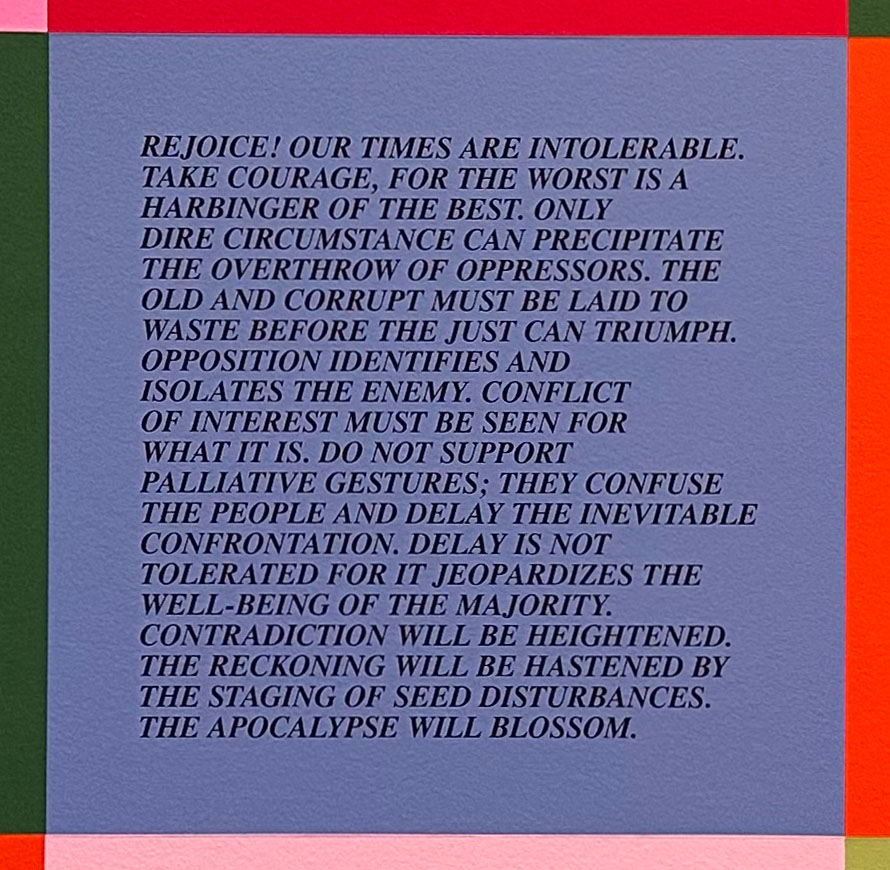
Jenny Holzer was born today, July 29th, in 1950. Pictured in this post are some of her famous Truisms, when they were on view at Akron Art Museum.

Her latest exhibition, Wrong Answers, is currently at the Serralves Museum in Portugal, closing November 1st.


Feb 142026
 

Nicola Vruwink‘s The Best That You Can Do, 2009-10, is currently on view as part of Palm Springs Art Museum‘s permanent collection. The artist crocheted cassette tape to create the sculpture.

The phrase “the best that you can do is fall in love” is a lyric from the 1981 song Arthur’s Theme (Best That You Can Do) by Christopher Cross for the soundtrack to the 1981 film Arthur.

Feb 282025
 

“Oh Well”, 2013, acrylic on canvas

The above paintings are from Mel Bochner‘s 2024 exhibition ALL SALES FINAL! at TOTAH, in NYC. Sadly, the artist passed away this month at the age of 84.

Bochner was a conceptual artist with a career filled with works that challenged expectations. His work incorporated photography, installation pieces, and later the text-based paintings for which he became well known.

Border Crossings Magazine has an excellent interview with the artist from 2018 where he discusses his work and process, his early days writing about art, his famous Working Drawings and Other Visible Things on Paper Not Necessarily Meant To Be Viewed As Art from 1966, and more.

Below are a few excerpts-

On the text paintings and the viewer-

The “Thesaurus” paintings are a lot about voice, about who’s speaking and the tone of one’s voice. I don’t think it is anything that painting has dealt with very well. It’s one of the places where colour comes in because colour sets a tone, in an aural as well as visual sense. The viewer becomes a reader, a very different sense of involvement. The words grab the viewer. Once they see there is something to read, they’re liable to stop and read it. They engage with the painting in a different way, because seeing and reading take place in separate parts of the brain.

On where the words come from-

So is the process one in which you’ll get a word in your head from reading or overhearing something, and that will be the ignition for that particular painting?

I like that “point of ignition,” but you never know when it’s going to happen. Many years ago when both my kids were living at home, one was in high school and one was in grade school, listening to them talk was like living in a language factory. I would hear stuff and say, “Wow, that is a really interesting word, I can use that.” Sometimes I would overhear a conversation on the subway or read something in the newspaper and that would get me thinking. The words could come from anywhere. What I was trying to understand is how we talk now.

And here he discusses his use of color in the text works, specifically in Oh Well (2010)-

Is all language necessarily a palimpsest, so that when you enter its terrain, you’re always entering previously occupied spaces?

Yes. The thing with synonyms, which Roget himself first said, is that no two words ever mean the same thing. You’re moving through different shades and approximations of meaning. That was something I was thinking about in regards to the colour in the “Thesaurus” paintings. I never used the same colour twice in the same painting. They all had to shade off somehow, like synonyms. I would make a drawing recording every colour that went into every letter, and there are a couple of hundred letters in each painting. For example, Oh Well (2010). “Oh” was in Old Holland yellow green, “well” was in Williamsburg brilliant yellow, plus pale grey and cadmium yellow medium. “That’s” was in Gamblin quinacridone violet with a touch of Holbein grey and white. “Goes” was Williamsburg persian rose pure. Some of them got really complicated. “To” was Holbein light red earth and Old Holland yellow ochre deep and Williams cadmium orange and Gamblin Portland grey medium and Old Holland warm grey light plus white, plus Williams quinacridone maroon. This was my shopping list.

He also discusses his interest in philosophy and in this section he discusses Edmund Husserl‘s idea of brackets and applies it to creating art-

…When you can’t figure something out in math, you set it aside by putting it in brackets. You haven’t eliminated it; you haven’t discarded it; it’s just there waiting for you. So as I started reducing my work more and more, I put all those things aside: “Right now I can’t deal with colour; I can’t deal with shape; I can’t deal with surface. So what can I deal with; what can I do that feels authentic to me?” In the beginning it was just drawing numbers or writing words. Then as time went on I wanted to add things back in to increase the range and depth of the work.

To take them out of the brackets?

To move them into the equation. As you get older you build up a body of work and gradually give yourself more permission. I always thought that if Mondrian in his most classical year—1923 or 1924—if somebody had shown him Victory Boogie Woogie (1944), unfinished with all that masking tape, and said, “You’re going to paint this in 20 years,” he would have said, “You’re out of your mind, there’s no way I’m going to do that. It’ll never happen.” Or he would have had a heart attack and dropped dead on the spot. So if you’re fortunate to work for a certain length of time, there’s a trajectory but it’s not direct. If you want to continue making things that surprise you, you have to go against your own sensibility and see where the contradictions will take you.

The deferral that is contained within the brackets is a lovely notion. Does it mean that the act of being an artist is an engagement with contingency?

Yes, but there are always limits to contingency. Look, if you come into your studio, day after day, year after year, you want to have the feeling by the end of that day that you might have done something you’ve never seen before, something unexpected. If it’s the same old thing, then what are you doing? The place to be is where you don’t know where your work is going. If it doesn’t go anywhere today, that’s okay, too, because maybe it will tomorrow.

 

Dec 192024
 

Lillian Bayley Hoover, “a planet swayed by breath”, 2024, oil on Dibond panel

Lillian Bayley Hoover, “a planet swayed by breath”, 2024, oil on Dibond panel (detail)

Marion Fink, “A mountain top full of achievements-a woman thinking of the sea.”, 2022, monotype, oil color and wax pastel on paper (left) and Lillian Bayley Hoover “here, witnessing now”, 2021, oil and pastel pencil on Dibond panel (right)

Marion Fink, “Night Sky Dreamer”, 2022, monotype, oil color and wax pastel on paper

Lillian Bayley Hoover, “the grass still sings”, 2019, acrylic and oil on Dibond panel, and “no ruined stones”, 2020, oil on Dibond panel

Teresa Shields, “Trending Threads”, 2016-17, embroidered felt and wool letter blocks, wood

Part of The Delaware Contemporary’s series of exhibitions exploring the intersection of art and design, Fissures in the Frame presents work from three artists- Marion Fink, Lillian Bayley Hoover, and Teresa Shields.

From the museum-

Although technology has increased the ease and availability of interaction, human connection has arguably become more difficult. Our daily lives have become reliant on those systems that enable, and even promote, us to interact. Modes of interchange have become more mediated; physical spaces and resources are afforded to those with access, while digital realms are accessible, but commandeer attention away to fabricated unrealities. The undercurrents of which reveal cracks; and fractured existences due to disconnect. Marion Fink, Lillian Bayley Hoover, and Teresa Shields probe these fissures, unveiling their nuance and paradox.

Marion Fink creates layered, large-scale monotype portraits that are rich with narrative elements in surrealistic settings. Raised in the early years of the digital age, Fink’s portraits allude to moments of fragmented realities; the paradox of actual, lived experiences conflated with their existence through the internet. Figures are isolated within fabricated spaces, revealing the parallels between emotion and circumstance. Fink beautifully captures these moments through competing perspectives and complex feelings.

Lillian Bayley Hoover paints landscapes that reveal features realistically while omitting others. These visual fissures that bar the viewer from accessing the remaining painting reflect the perceived separation between nature and the “human world”; one that frequently feels disconnected even though we are all of one world. Hoover investigates how nature is a witness to human life; the designed spaces that shape our world, but also those that we have inherited and how nature acts as a historical record of us.

Multimedia artist, Teresa Shields, presents an interactive installation consisting of 140 individual wooden panels that represent the maximum characters of a post on X (formerly a Tweet on Twitter) and are meant to be moved to form a message. Shields explores our relationship with language; the contradiction between the immediacy of a digital post versus that of a physically crafted message. The activity is simple but offers the opportunity to slow down, collaborate with others, and make new meanings entirely.

This exhibition closes 12/29/24.

Oct 162024
 

Lita Albuquerque’s exhibition of new work for Earth Skin, on view at Michael Kohn Gallery, includes several dramatic blue paintings and a huge installation piece on the floor of the gallery that grabs your attention the moment you enter the gallery.

From the gallery-

Beginning her career in the 1970s with works that intimately connected her to the earth, Albuquerque’s artistic evolution envelops the cosmos and the space between it and us. Her work emanates from years of practicing the exact science of Kundalini breath technique as well as automatic writing; both drive a deep investigation and scientific inquiry of who we are as individual beings on this planet. Albuquerque further connects to the exactness of physics by a meditation she, and astronomers, call the cosmic address. These daily practices are at the root of her art, precisely positioning self to cosmos. It is those discoveries she embeds in works of art that permit us, the viewer, to experience the connections she has made between these internal and external worlds.

Thinking about the exhibition, Albuquerque writes:
Feet dancing above the earth, dancing with fervor, drumming, the increasing drumming of the feet not fragile on the fragile earth.

The wisps of bodies, like skins falling off their frames leaving the planet, the planet strong and our forms ethereal, the strength of us, our feet, on the fragile earth, the wispy lightness of us, detached from the earth, transforming into space.

The earth strong behind us, propelling us upward, giving us her strength, throwing us in the air, while we fly, never falling, the fierce intensity of our rhythm while alive, and the freedom of release from the earth.

Experiments of intensities of emotions and colors, whirling dervishes’ cyclones, Earth Skin is whispered, “Earth Skin” she whispered.

For PST’s Art and Science Collide, Albuquerque transforms the gallery with a titular installation, Earth Skin. A membrane of decomposed granite fills the space creating the illusory sensation of the earth being revealed below the gallery, as if the concrete floor has been meticulously removed. Accompanying this installation is a new series of paintings revolving around the gestures of the body and ancient marks, like a hieroglyphic code only the artist has a key for. With each gesture, Albuquerque embraces the tactile intimacy of painting, reminding us of the power of capturing and transforming the elusive into the material. This installation invites viewers to explore the shared fragility of humanity and earth.

Two of the paintings, picutred below, include poems referencing fellow artist Ana Mendieta, who was known in part for her “earth-body” work and who passed away tragically in 1985.

“Propelling Us Upwards, She, The Earth, Throwing Us In The Air While We Fly, Never Falling, A Poem for A.M.”, 2024, Pigment on Canvas

“Desire and Memory, A Poem for A.M.”, 2024, Pigment on canvas

This exhibition is part of The Getty’s Pacific Standard Time: Art and Science Collide an arts event taking place in various venues around Southern California.

For more information on Lita Albuquerque and her work Red Canary Magazine recently published an excellent article that is worth a read as well.

Aug 162024
 

What does a wall of color make you feel? Does that change if it exists in a gallery? What about the specific color? And if you add text?

These are some of the questions that arise when viewing Haim Steinbach’s mypoemisfinishedandIhaven’tmentionedorangeyet, 2019. The work was part of his 2019 exhibition Appear to Use at Tanya Bonakdar Gallery in Los Angeles.

From the press release-

Holding a wall of the back gallery is an expansive wall painting consisting of the color orange along with the line—mypoemisfinishedandIhaven’tmentionedorangeyet—from the poem “Why I Am Not a Painter” by Frank O’Hara. Here, Steinbach challenges our perception of architecture in the relationship between language, color and cultural structures, encompassing the core themes of the exhibition.

Here is the Frank O’Hara poem being referenced-

I am not a painter, I am a poet.
Why? I think I would rather be
a painter, but I am not. Well,

for instance, Mike Goldberg
is starting a painting. I drop in.
“Sit down and have a drink” he
says. I drink; we drink. I look
up. “You have SARDINES in it.”
“Yes, it needed something there.”
“Oh.” I go and the days go by
and I drop in again. The painting
is going on, and I go, and the days
go by. I drop in. The painting is
finished. “Where’s SARDINES?”
All that’s left is just
letters, “It was too much,” Mike says.

But me? One day I am thinking of
a color: orange. I write a line
about orange. Pretty soon it is a
whole page of words, not lines.
Then another page. There should be
so much more, not of orange, of
words, of how terrible orange is
and life. Days go by. It is even in
prose, I am a real poet. My poem
is finished and I haven’t mentioned
orange yet. It’s twelve poems, I call
it ORANGES. And one day in a gallery
I see Mike’s painting, called SARDINES.

And below is Michael Goldberg’s Sardines.

Michael Goldberg, “Sardines”, 1955, oil and adhesive tape on canvas, image via Smithsonian American Art Museum

Aug 042022
 

“THERE IS A PERIOD WHEN IT IS CLEAR THAT YOU HAVE GONE WRONG BUT YOU CONTINUE. SOMETIMES THERE IS A LUXURIOUS AMOUNT OF TIME BEFORE ANYTHING BAD HAPPENS.”

This 1989 sculpture by Jenny Holzer is part of the permanent collection at Santa Barbara Museum of Art.