May 262023
 

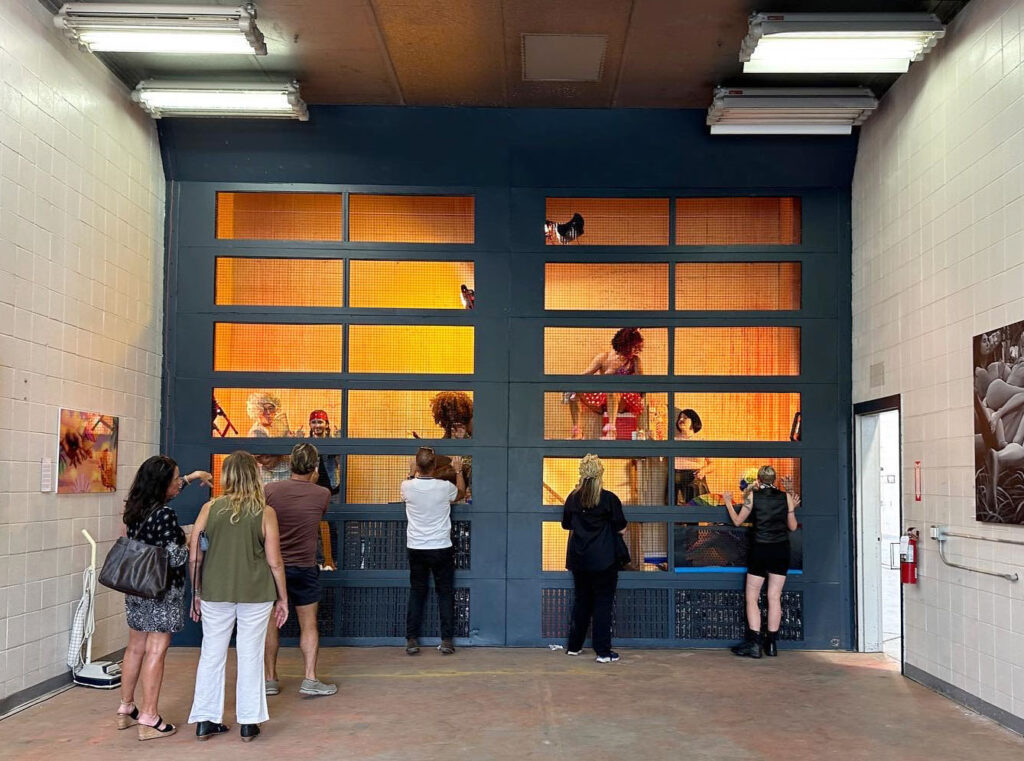
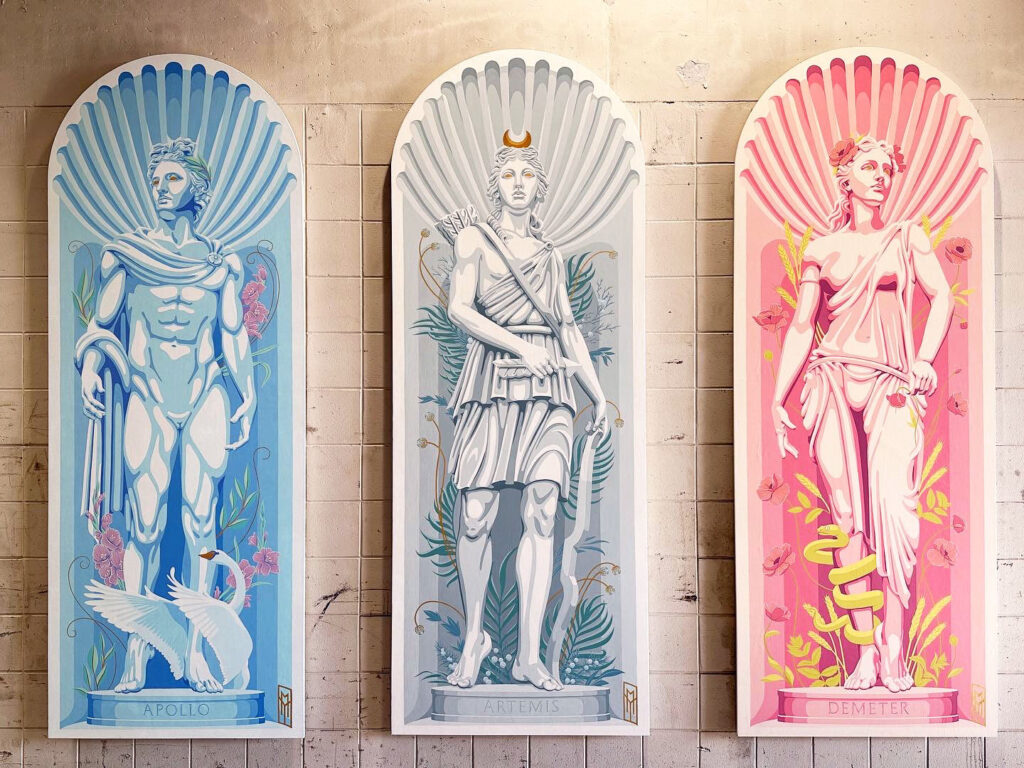
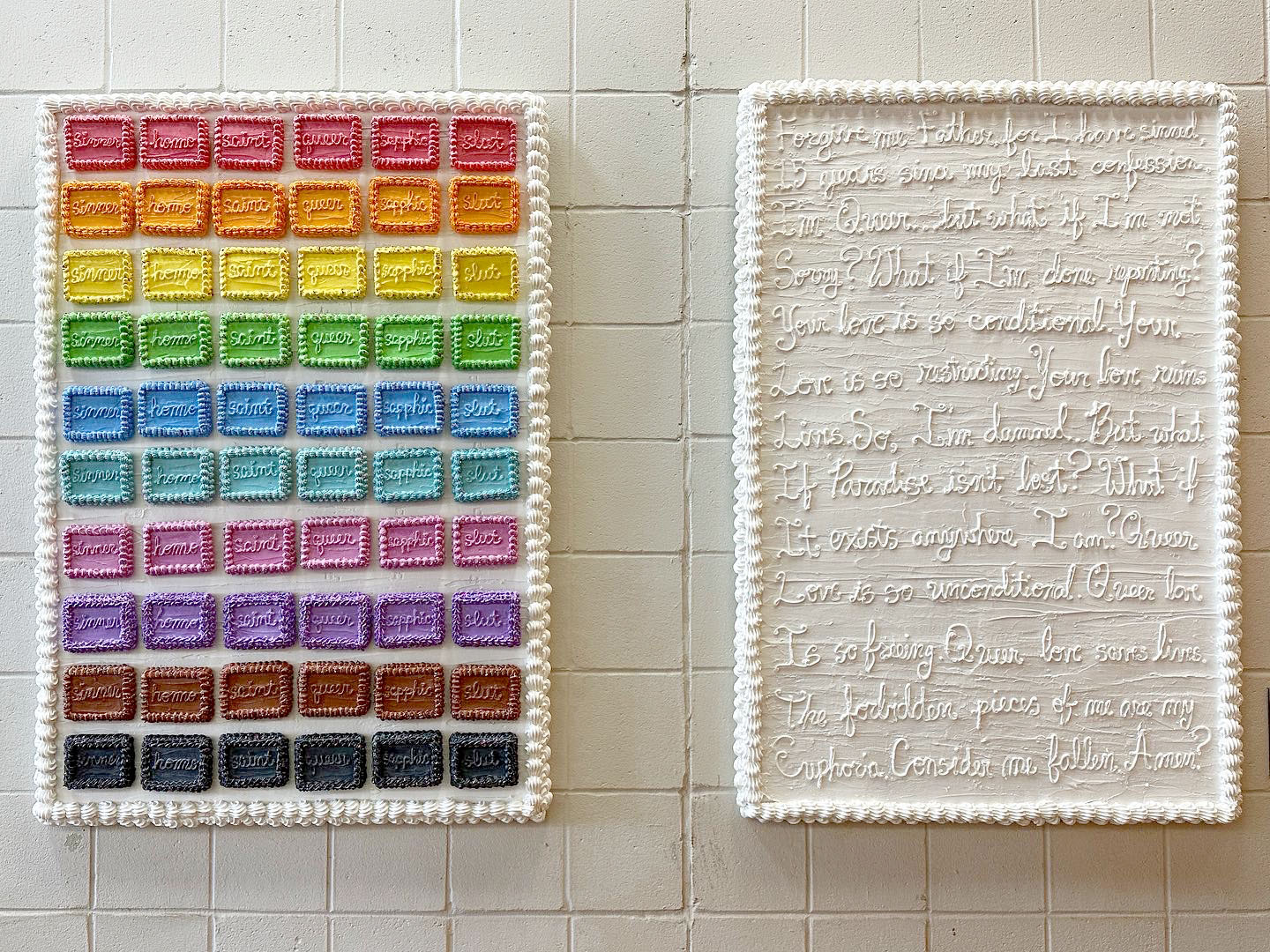
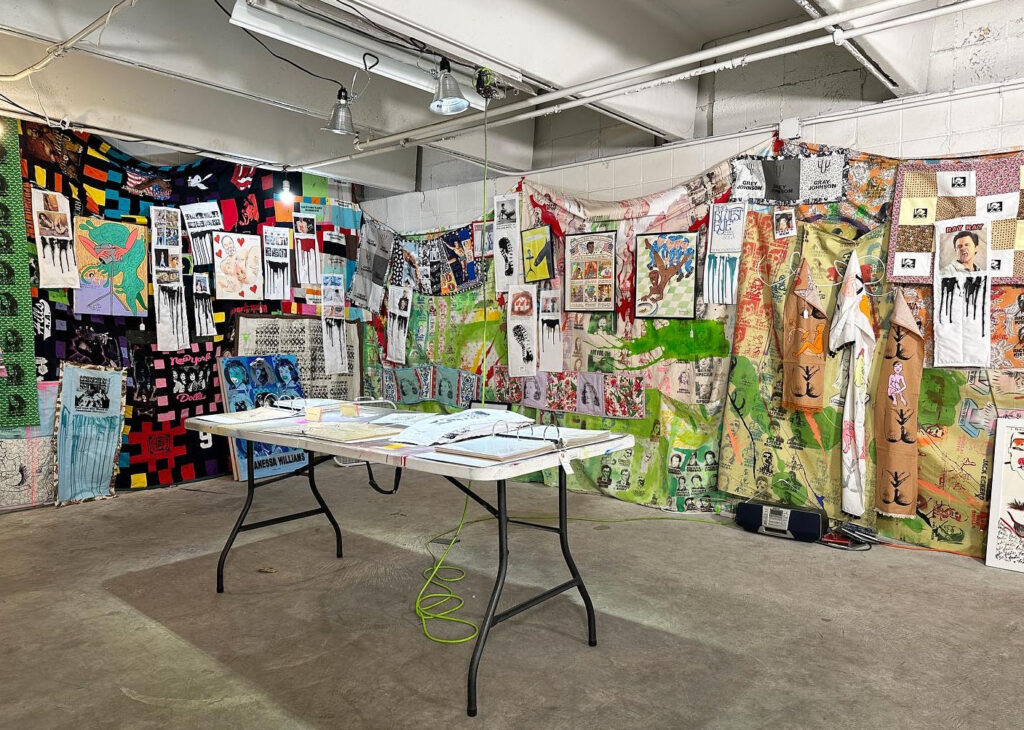
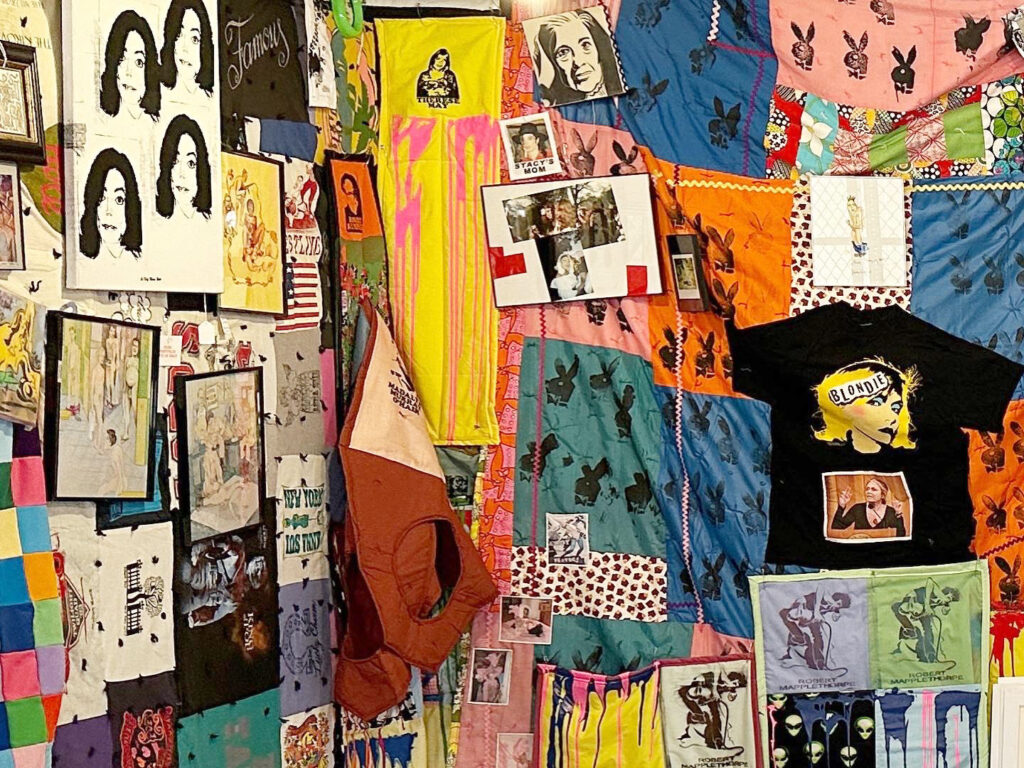
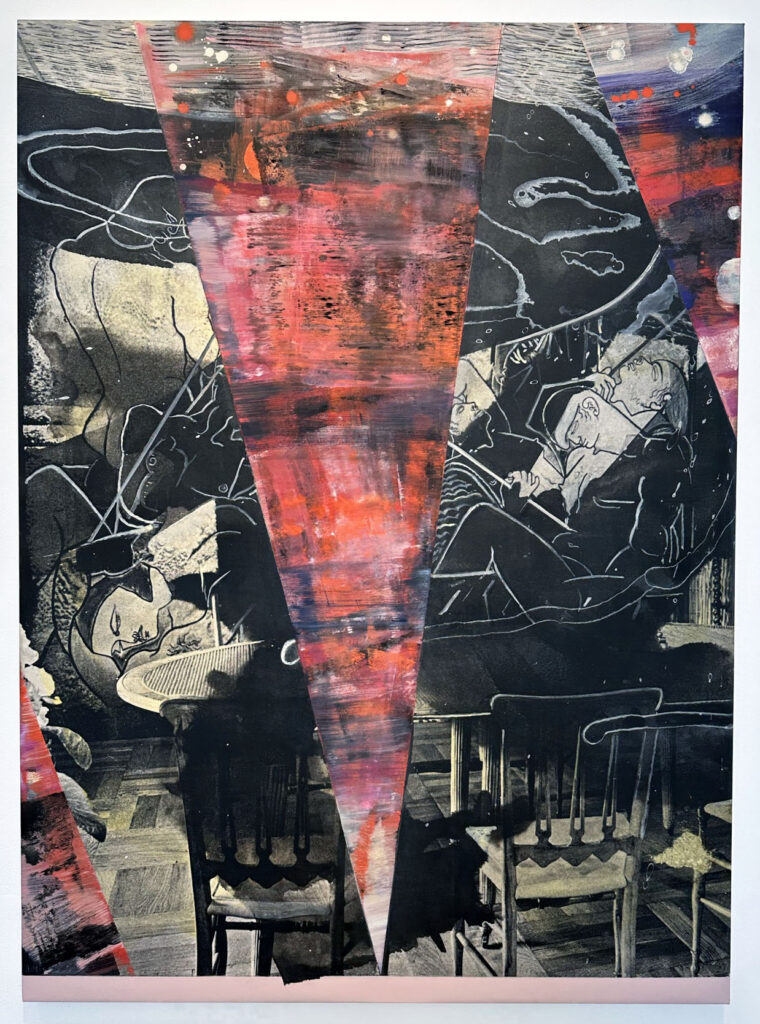
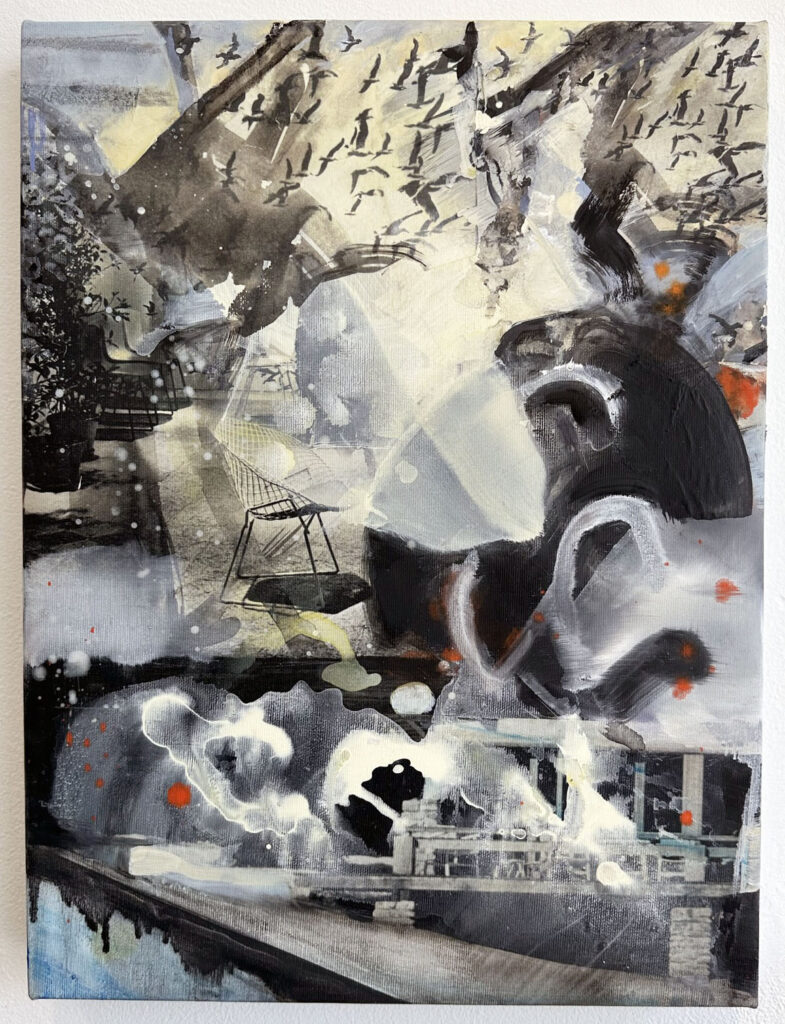
Dave DiMarchi’s Somatic Pause, located in Princeton, New Jersey during Winter/Spring of 2023.

From the Arts Council of Princeton about the mural and artist-

Fashioned after both the artist’s workspace and print editions he created during his Arts Council of Princeton’s Anne Reeves Artist-in-Residency, Somatic Pause invites Princeton to contemplate the transformational power of rest, and how time changes each of us.

Somatic Pause – a wheat-pasted, painted, and collaged installation – is an ephemeral one.  Meant to change over time, the mural will be exposed to harsh winter weather, early spring rains, and glaring sun, each doing its own work to fade, soften, tear, and mar its surface.

Change is the constant.

And about the artist-

Dave DiMarchi is a queer, multi-disciplinary artist working in printmaking, papermaking and sculptural book forms. He engages in a relentless material practice, nurturing ideas into singular and editioned works. As a multi-disciplinary artist, he has exhibited works on paper, installations and books in the US and internationally. He maintains a small collaborative studio and art space in New Hope, Pennsylvania and teaches printmaking, papermaking and book forms extensively throughout the New York, New Jersey and Pennsylvania area. In Fall of 2022, he was announced as the ACP Artist-in-Residence which will allow him to continue to explore collage-based multi-media and print works.

Since 2012, he has created his own work, curated exhibitions, provided print exchange opportunities, and published fine art prints as 9INHANDPRESS, a fine art printmaking and education studio located in New Hope, Pennsylvania.

May 242023
 

Rachel Ratcliff, “Roll of the Kaleidoscope”, 2021, acrylic on canvas

Richard Logan “Sea Oats”, 2022, photographic transfer on metal with etched glass

Steven Spathelf, “Orange Blossom”, 2022, acrylic on canvas

This past Friday the city of Dunedin, Florida, celebrated the opening of its new City Hall. As part of the celebration, the building and all of its offices were open to the public. It was the first opportunity to see all the wonderful art by Florida artists- selected and commissioned by Elizabeth Brincklow.

Pictured above are works by Rachel Ratcliff (wave painting) and Richard Logan (photography). The third work is by Steven Spathelf whose oranges can be seen adorning buildings and homes all around town.

Scroll through the pages below to see the other works on view.

May 122023
 

Currently at Marc Straus is Marie Watt’s impressive exhibition, Singing Everything.

From the press release-

A member of the Seneca Nation, Watt also has German-Scott ancestry. Her layered and complex influences include Indigenous knowledge and Iroquois proto-feminism, the matriarchal structures of certain Native American nations, the rise of social activism throughout the 20th century, and the anti-war and anti-hate content of the 1960s and 1970s music scene.

Central to the exhibition are three Sewing Circle pieces that were initiated at communal gatherings at the Whitney Museum of American Art in 2022. Watt’s sewing circles are cross generational, multicultural gatherings that she has been organizing for over a decade. Inspired by poet laurate Joy Harjo’s (Mvskoke/Creek) poem Singing Everything, Watt collects words from the participants of her sewing circles with the prompt, “what do you want to sing a song for in this moment?” The submitted words are then embroidered or sewn onto patches of fabric during the sewing circle. For the Whitney Sewing Circle, with over 300 participants, Watt, for the first time, used all the submitted words. Each panel is patterned in a way that stays true to the original hand. She thinks of ones handwriting as an extension of the cadence of one’s voice and in this project, it becomes part of a larger chorus. By composing large-scale wall works from these pieces of fabric, Watt creates collaborative artworks that interweave many individual handwritings, touches, and the stories that were exchanged in a shared space.

When entering the gallery, the visitor is greeted by a sweeping, 24-foot-long neon sign spelling out the words “deer, skywalker, heron, bass, great lake, woodland, beaver, turtle, wolf, lowly, muskrat, rat” in various hues that evoke the sky on the horizon during sunset and sunrise. While the piece represents a new direction in Watt’s work, she views neon as an extension of beadwork. The glass itself is at once thread and bead, and both neon and beads have a relationship to trade. They both envelop light, color, and sound, embodying sunrises and sunsets on the horizon.

Two blanket towers, her signature sculptural works, appear in the show but now with tin bells or jingles added to the reclaimed wool blankets. This choice of added material felt like a natural extension to Watt. She writes: “Blankets are danced and so are jingles, there is something healing about them both. They are objects of comfort” – by way of touch or sound. Jingles acknowledge the Jingle Dress Dance which began as a healing ritual in the Ojibwe tribe in the 1910s during the influenza pandemic. The Jingle Dress Dance was also a radical act. In 1883, the United States banned Indigenous ceremonial gatherings. Though the ban was repealed in 1978 with the American Indian Religious Freedom Act, during its century-long prohibition the Jingle Dress Dance was shared with other tribal communities. Today it is a pow-wow dance and continues to be associated with healing. The relevance of this dance extends beyond pandemics.” By including jingles Watt brings the potential of sound into her work, adding to their visual and tactile aspects.

While drawing from long craft traditions such as textile or glass work, Watt is expanding her work by including contemporary stories and both individual and collective experiences. Her primary interest is to think about art as more experiential, rather than only visual, a direction she plans to explore further.

This exhibition closes 5/20/23.

May 092023
 

“Curtains”, 1972, Acrylic and fabric on canvas

“Curtains”, 1972 (detail)

“Voyage”, 1973, Acrylic and collage on canvas

“Shrine: Homage to M.L.”, 1963, Oil on canvas

“Big Ox”, 1967, acrylic on canvas

There’s only a few days left to see Miriam Schapiro: The André Emmerich Years, Paintings from 1957–76 at Eric Firestone Gallery.

From the press release-

Miriam Schapiro (1923–2015) is now well-known as a pioneer of the Women’s Art Movement, and for her contribution to the Pattern and Decoration Movement. She fused craft work, traditionally made by women, with modern painting in collages termed “femmage.” However, this exhibition will additionally shed light on her early Abstract Expressionist canvases, and her pioneering approach utilizing computer technology to create Hard Edge geometric painting in the 1960s. Spotlighting the legacy of this feminist artist, the exhibition will explore three stylistic phases, with significant examples from these two decades of Schapiro’s career.

This exhibition closes 5/13/23.

May 042023
 

“Day 11: Flight Simulator”, 2023 Oil, inkjet transfer, enamel, and paper on canvas

“Carousel”, 2023 Oil, inkjet transfer, enamel, and paper on canvas

“Day 5: In Praise of Shadows”, 2023 Oil, inkjet transfer, enamel, and paper on canvas

“Day 3: Janitor”, 2022 Oil, inkjet transfer, enamel, and paper on canvas

Above are some of Ho Jae Kim’s enchanting mixed media works from his exhibition, Carousel at Harper’s gallery.

From the press release written by the artist-

The centerpiece of this exhibition, its namesake painting, depicts a carousel with 31 horses signifying the days of the month. For each of these “days,” I built a unique narrative in honor of liminal spaces, the mundane, and the quotidian. Just as life continues regardless of our psychology, the carousel will turn whether or not there is a rider. While I prepared for this exhibition, I thought of the displacement I’ve experienced by tragic events out of my control. One summer night in 2022, my stepfather committed suicide. He left a brief note for my mother before driving to a nearby railroad where he waited for a train to take his life. Since then, I have been plagued with a vision of the train’s headlights—a magnificent bright light that dissolves the contours of everything in its path. I became a prisoner to this light that exists within my dark fantasy.

We rely on fleeting moments of significance to define life, but the majority of our lives are shaped by non-moments of transition, endurance, and dormancy. For this reason, I chose to create representations of less significant moments in order to build a body of work that can paint a better picture of reality. Luxurious portrayals of life as depicted in movies and pop culture cultivate dreams of becoming a character in a fantasy, but these dreams are quickly shattered by the constraints and circumstances of daily life. We become psychologically displaced and rejected by the fantasies that once served as our vitality. We begin to live in a state of purgatory, caught between reality and our dreams.

In The Divine Comedy, during the transition from the Inferno to Purgatory, Dante turns right to see the light from the east on Easter Sunday, a day of resurrection. With this new orientation, Dante’s purgatory becomes a place of hope, where lost souls can choose to repent or find redemption. The horses on my carousel face to the left, in the direction of the spiraling Inferno, but if the audience chooses to imagine the mechanism rotating, the horses will eventually turn right as they continue their clockwise journey. Similarly, as the halos, arches, circles, and light in my paintings become juxtaposed with the mundanity of the subjects, they transform those quiet non-moments into divinity, and the prisoners of my narratives are granted redemption.

This body of work began as a tragedy, but it has the potential to become a comedy. And just as I wish for my loved ones to see the beauty that is within their souls, I hope that my divine scenes of nothingness can become a vehicle for others to redeem themselves in purgatory and indulge in the beauty that is inherent in every life.

This exhibition closes 5/6/23.


Apr 282023
 

Installation by Molly A. Duff

Work by Trinity Oribio (left) and Manon VanScoder (videos on right)

Currently on view at The USF Contemporary Art Museum is SOMEDAY YOU’LL HAVE TO SAY IT OUT LOUD, an exhibition of eight students graduating with MFA degrees from the USF School of Art and Art History.

The artists included are Molly Duff, Kai Holyoke, Caitlin Nobilé, Trinity Oribio, Rachel Treide, Manon VanScoder, Alicia Watkinson, and Willow Wells.

For the artists’ statements about their work, as well as more information on the exhibition, the museum has produced this PDF.

The show will be on view until 5/6/2023.

Installation by Molly A. Duff, another view

Alicia Watkinson, “Notations in Passing II”, 2023, plywood, lightbulbs, ceramic bases, timers. Duration of light set daily according to the previous day’s activities and observations

Alicia Watkinson, “Notations in Passing II”, 2023 (detail)

Photo transfer on glass by Rachel Treide

Still from video by Rachel Treide

Caitlin Nobilé, “The gap in the door”, 2023 triptych, acrylic on wood

Willow Wells, “Whispers”, 2023, oil painting on panel

Trinidad Oribio “Untitled”, 2023 oil on canvas

Trinidad Oribio, “La Trinidad”, 2023, archival pigment print

Video installation by Manon VanScoder

Manon VanScoder, “each day is an endless scroll”, 2023

Kai Holyoke “Paradise Lakes”, 2023

Kai Holyoke “Paradise Lakes”, 2023


Apr 212023
 

“Cocteau and Table”, 2023,oil on archival inkjet printed canvas

“The Seasons Between”, 2023, oil on archival inkjet printed canvas

High Noon Gallery is currently showing Les Problémes du Confort, an exhibition of work by Mary Jones.

From the press release-

Jones began this most recent body of work, collectively called simply, “Interior Design,” by painting Sumi ink over the black and white printed pages of a comprehensive French Interior Design publication from the 1960s. “[I chose the series’ title] not only to underscore the attributes of the original images, but to address their psychological component: the topos of dreams, so notably analyzed by Gaston Bachelard and James Hillman, spaces we conjure to discover the elements of our inner lives. Homes and interiors are not only spaces we remember, but also labyrinths of symbolism, familiar to all of us as emotionally charged experiences,” she explains.

The addition of her signature mark making started as an exercise to identify patterns in the tonal pages, separate from the context of the imagery. It seemed to act as a compositional barometer of sorts, deflecting the space in certain areas and illuminating it in others. The painted catalog images were then collaged, blown up, printed on canvas, and painted again, further conflating space and gesture, and inhabiting the vacant interiors with a visible energy. In doing so, Jones satisfies the principles of high design with the paintings’ harmonic beauty, and also the open systems of fine art by positioning the work as cultural critique that challenges the colonialist motifs that permeate the aesthetic sensibility of many of the spaces.

Jones’s work has long gnawed at the malleability of subject matter. She consistently uses legible imagery to anchor her abstractions, prodding at the fickle divide between the two modalities. Her sensitivity to painting’s illusionistic properties is connected to her experience as a faux painter, freelance work she’s done for 25 years. While the object of faux painting is to not let the artist’s hand show, Jones riffs on her craft by skillfully merging gesture and image in ways that are largely indistinguishable. She allows the marks to emulate form and object, playing on the viewer’s expectations of pictorial logic and slyly addressing the disparity between fine art and design, as for many decades— and especially during painting’s theoretical heyday in the second half of the 20th century— they shared a tenuous opposition. Design is associated with expense, and American society is perpetually transfixed by the Romantic notion of the artist as a working class hero.

Ionic Memories (2023), depicts a decadent room steeped in Roman busts and columns, the title a tongue-in-cheek reference to the science of memory and the unstable nature of artistic movements and empires alike. Jones echoes the velvety matte blacks of the printed image in her direct painting gestures, mixing a near perfect replica of the tone and texture for her to set up a meta tromp-l’oeil effect. In the foreground, a collaged brush stroke swipes away at the interior revealing a snowy landscape wherein a bush and modernist cabin are obscured by a swath of pink oil paint. In the context of the whole, the landscape reads as decorative forms within the room, such as fan coral and glass spheres. Other works such as Cocteau and Table (2023) make greater use of a fragmented effect wherein decisively multiversal looking forms cut through the composition like a glimpse into a parallel reality. Through a mix of painterly and faux elements, Jones takes care to merge her augmented realities just enough to allow the viewer to believe the image exists in one picture plane.

Perhaps to be comfortable is to momentarily resist time, to be temporarily impervious to the clamors for change. In Les Problémes du Confort, Jones reminds us that the arrangements we make with ourselves are transitory, constructed illusions to describe and reflect a sense of our place in the world we know, and that improvisational beauty can be found in transitions, in languages we don’t know, and in uncertainty.

This exhibition closes 4/23/23.

Apr 142023
 

Thornton Dial, “Memory of the Ladies That Gave Us the Good Life”, 2004, Tin, carpet, wood, glove, washbasin, scrub brush, yard ornament, motor-oil bottle, paint brush, clothing, wire, enamel, and spray paint on wood

David Hammons, “Untitled”, 1976-77, Wire, rope, pipe cleaner, hair, rubber ball, mesh, aluminum, sand paper, thumb tack

Robert Rauschenberg, “Matt’s Defense (Scenarios)”, 2005, Pigment transfer on polylaminate

Dial / Hammons / Rauschenberg at David Lewis presents several works by the three artists that, although different in many ways, work together well.

From the press release-

This is the first-ever exhibition to solely bring together these three great American artists, each of whose conceptual ingenuity is expressed by way of material transformation and possibility. In particular, Dial / Hammons / Rauschenberg seeks to articulate the intersection between the American Duchampian legacy, as expressed in the material invention and possibilities of postwar Neo-Dada, and African-American traditions of redemptive, alchemical, and visionary practices based in found and discarded objects.

The exhibition ranges over more than 50 years; the earliest work presented is in Rauschenberg’s iconic 1962 assemblage Cartoon, then includes an early Duchampian wire, rope, pipe cleaner, hair, ball, and tack construction by David Hammons (Untitled, 1976-77), and then focuses on the 90s and 2000s, featuring four magisterial assemblages from Thornton Dial’s ‘high,’ most modernist phase of work, as well as an example of each of Hammons Kool-Aid and Tarp series from 2006 and 2007 and additional later Rauschenberg works. The exhibition also features two important sculptures: Dial’s Top of the World (1998), and Rauschenberg’s extraordinary The Lurid Attack of the Monsters from the Postal News, August, 1875 (Kabal American Zephyr) (1981). The largest work in the exhibition, Dial’s astonishing Master of Space (2004), conjures and critiques the iconography of American imperialism, military and corporate both (the eagle is made of neckties), while simultaneously calling upon and vengefully subverting the most classical of all modernist devices: the grid.

Every piece in the exhibition deploys, invents, and reflects upon the logic of assemblage: the Duchampian act of appropriation, transmuted in postwar America, into the language of assemblage, the Rauschenbergian combine. Dial / Hammons / Rauschenberg highlights these acts of American alchemy, and asks us to imagine their power and possibilities in ways which revise, expand, and complicate the history of modern and contemporary art, and weave a broader tapestry.

This exhibition closes 4/15/23.

Mar 292023
 

Hew Locke, “Listening to the Land” room view

“The Relic”, 2022

“The Relic” 2022 (another side)

“Raw Materials 3”, 2022

“Raw Materials 3”, 2022 (detail)

“Raw Materials 3”, 2022 (detail)

“Jumbie House 2”, 2022

“Jumbie House 2”, 2022

For Hew Locke’s exhibition, Listening to the Land, at P.P.O.W. he has created intricate sculptures and paintings that are fascinating in person.

From the press release-

Locke is known for exploring the languages of colonial and post-colonial power, and the symbols through which different cultures assume and assert identity. Furthering the themes explored in his celebrated commission The Procession at Tate Britain, and his concurrent installation Gilt on the façade of The Metropolitan Museum of Art, this exhibit engages with contemporary and historical inequities while reflecting on the landscape and history of the Caribbean. The exhibition draws its title from a poem by Guyanese political activist and poet Martin Carter which situates itself between two opposing forces of the landscape – sea and forest. Locke’s show features new sculptures and wall works with recurring motifs of stilt-houses, boats, memento mori, and share certificates referencing tensions between the land, the sea, and economic power. Reflecting on these links, Locke notes, “The land was created to generate money for colonial power, now the sea wants it back.”

Translating to ‘land of many waters,’ Guyana and its physical, economic, and political landscape serve as one of the primary sources for Locke’s work. Having spent his childhood in this newly independent nation, the artist witnessed first-hand an era of radical transformation. Now, the country teeters on the precipice of an oil boom and is one of the world’s fastest growing economies. Juxtaposing personal meditations on the climate crisis with political commentary on the history of a globalized world, Locke contemplates the ways in which colonies were exploited to accumulate capital, and observes how Guyana’s economic future lies in the exploitation of its waters. Locke’s new boat sculptures The Relic and The Survivor embody this broad worldview as the two battered wrecks drift through time and history. Evoking the fragmented and diverse legacies of the global diaspora, the boats’ patchwork sails are interspersed with photo transfers of 19th Century cane cutters and banana boat loaders, while their decks are loaded with cargo that could allude to colonial plunder, trade goods or personal belongings.

Based on an abandoned plantation house, Locke’s newest sculpture Jumbie House 2 features layered images that unveil the spirits that haunt this colonial vestige. Presented alongside are a series of painted photographs of dilapidated vernacular architecture across Georgetown and rural Guyana. Constantly under threat of being washed away by storms or rising sea levels, these crumbling structures echo anxieties surrounding climate change and historical erasure. A new series of mixed media wall works, Raw Materials, is derived from antique share certificates and bonds. Locke richly decorates the appliques with acrylic, beads, and patchwork to draw attention to the complex ways in which the past shapes the present. The image of an 1898 Chinese Imperial Gold Loan behind painted Congolese figures connects the global economy at the height of Empire to current Sino-African trade networks. In another work, a painted representation of a Nigerian Ife mask, alongside an image of David Livingstone, is layered on a French-African Mortgage Bond from 1923, connecting exploration and exploitation of African land, to current conversations surrounding the repatriation of artifacts. Taken together, the works in Locke’s Listening to the Land echo William Faulkner’s adage “The past is never dead. It’s not even past.”

This exhibition closes 4/1/23.

The Procession, mentioned above, can now be seen at Baltic Centre for Contemporary Art, in Gateshead, England until June 11th, 2023.

Gilt, also mentioned above, is on view at The Metropolitan Museum of Art until May 30th, 2023.


Mar 262023
 

Kirsty Wither “Tumbling Crowd”

Yelena Lezhen “Clockwork Bird Song”

Esther Rosa “Goes around, comes around III”

This weekend is the Affordable Art Fair in NYC. It’s a chance to check out and buy art at reasonable prices.The fair goes to Hampstead, London next, and will return to New York in September of 2023.

For more on the artists pictured above and their galleries-

Kirsty Wither runs the London gallery Cameron Contemporary with her husband, Robin Cameron.

Yelena Lezhen’s work was shown by Barcelona gallery Manifest Destiny Art. Check out her Instagram for current work.

Esther Rosa’s sculpture was part of InSight Artspace’s booth. Her Instagram is also a good place to see her work.