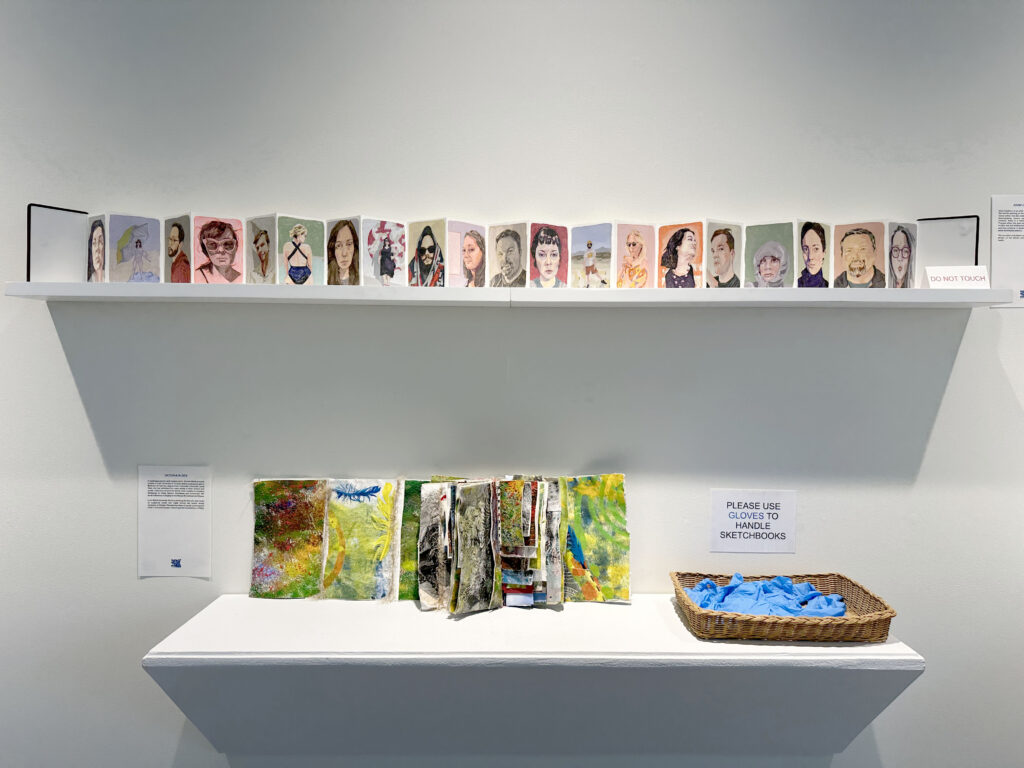
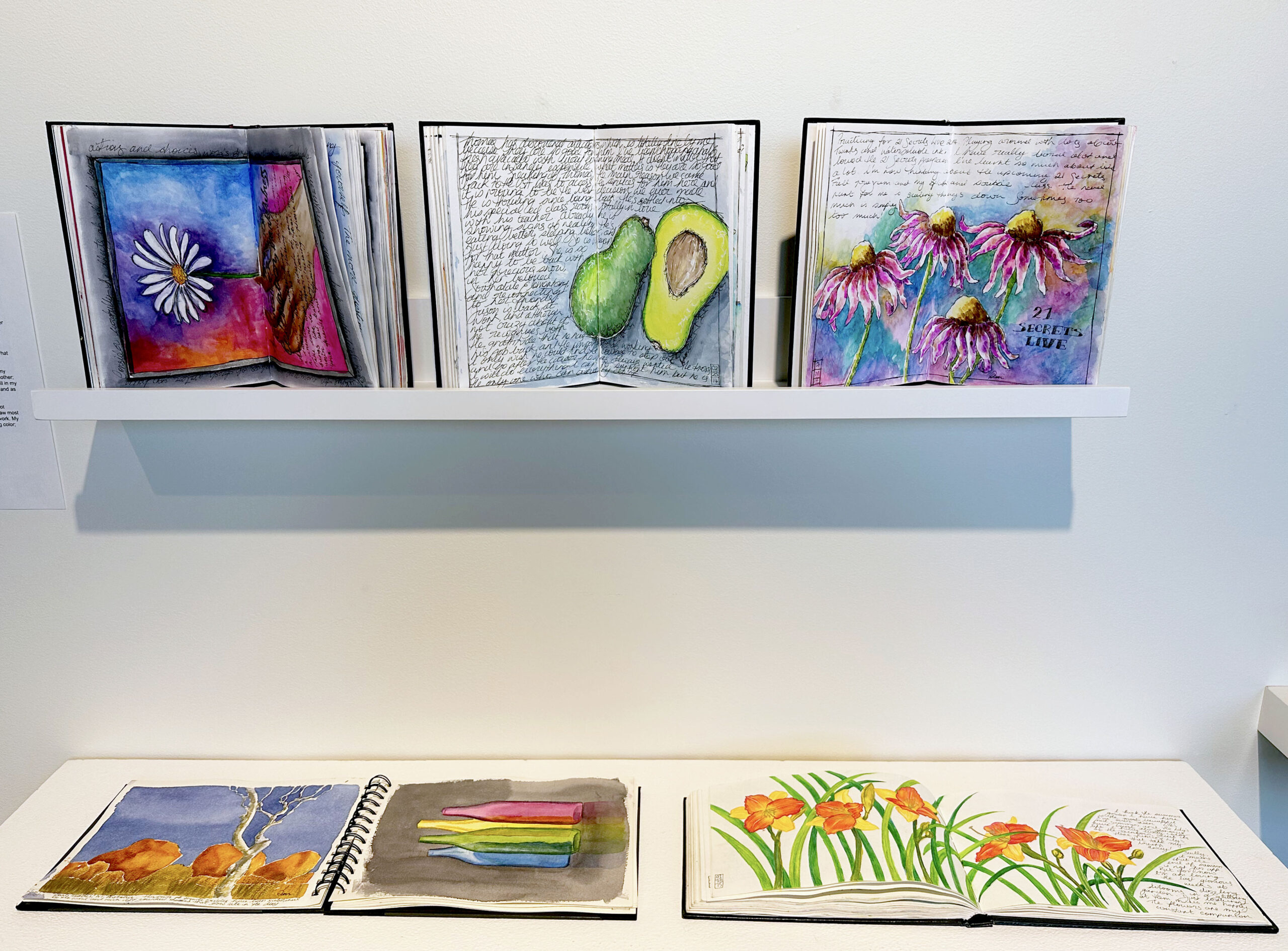
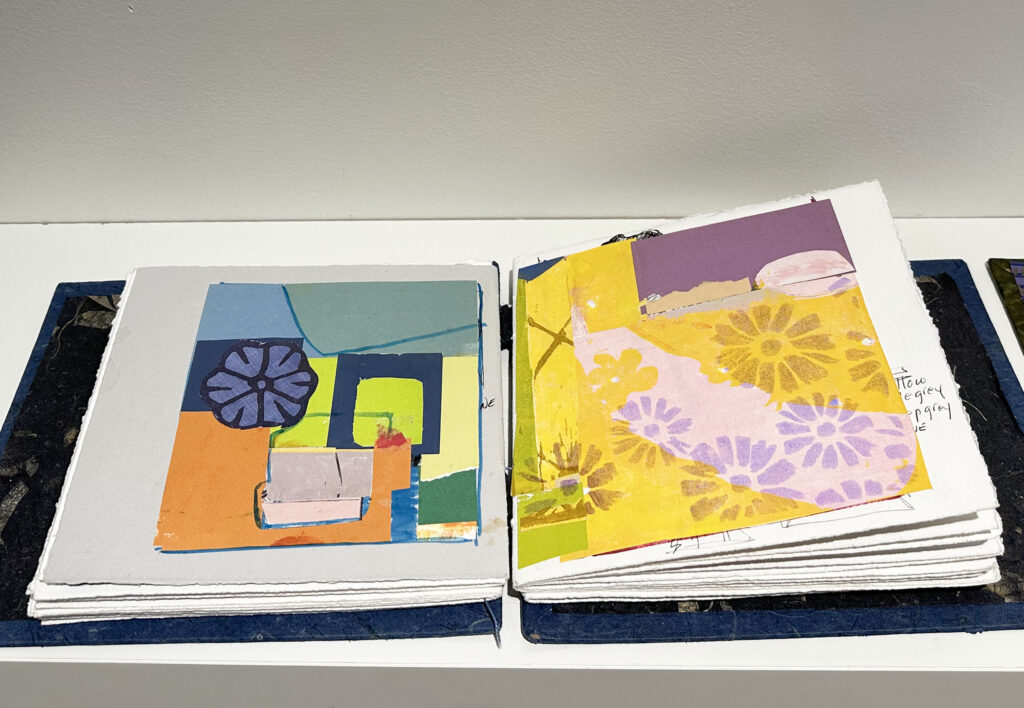
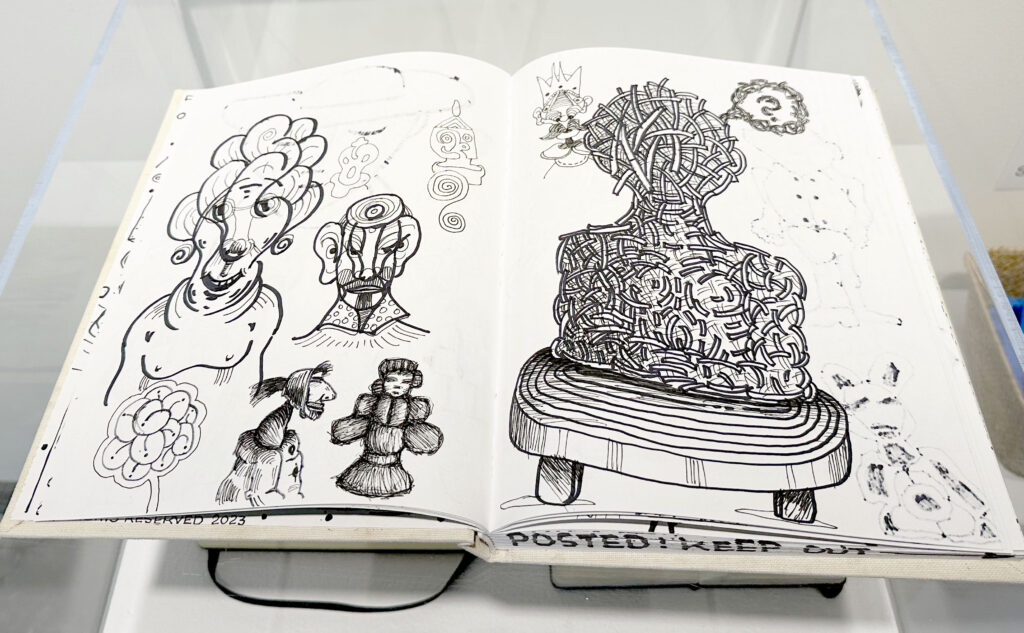
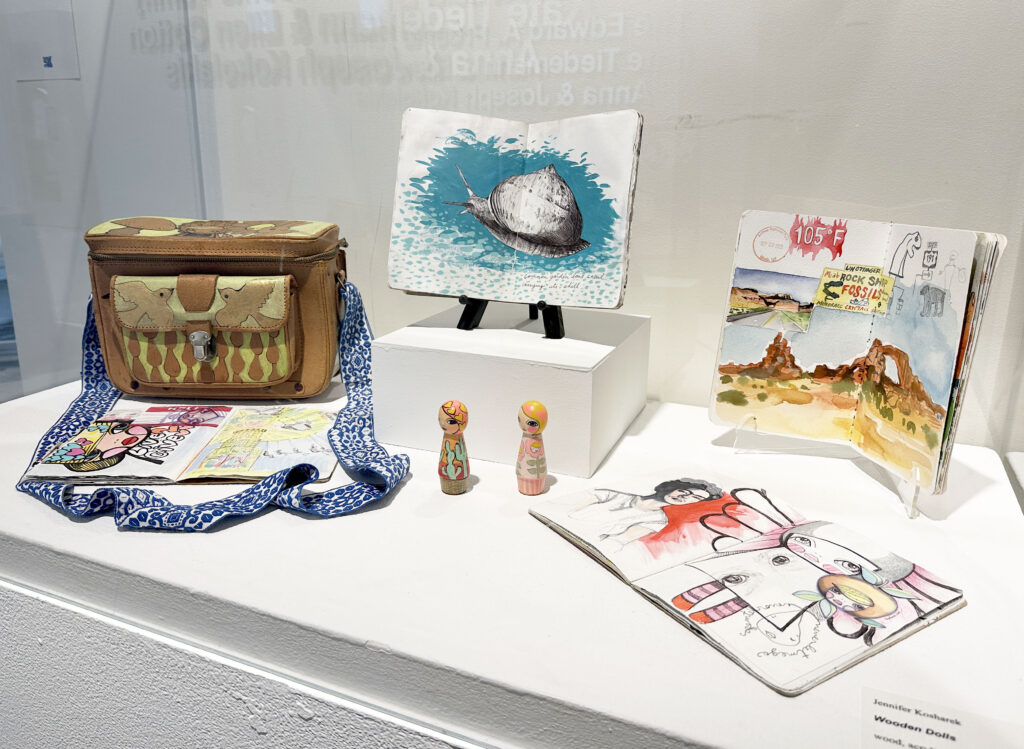
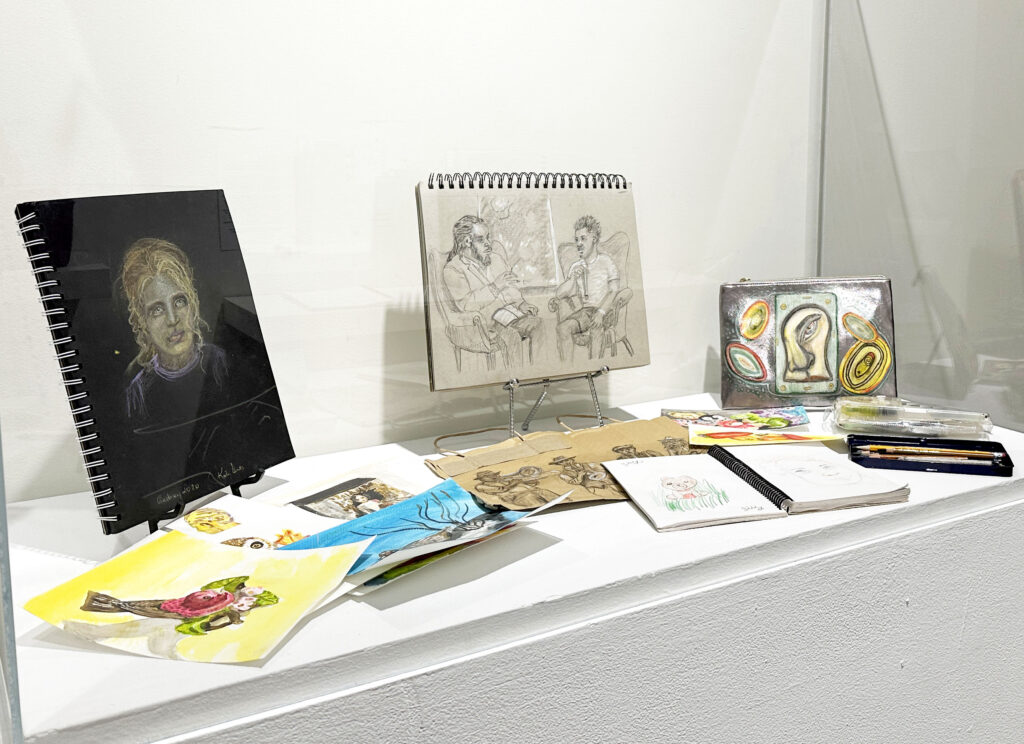
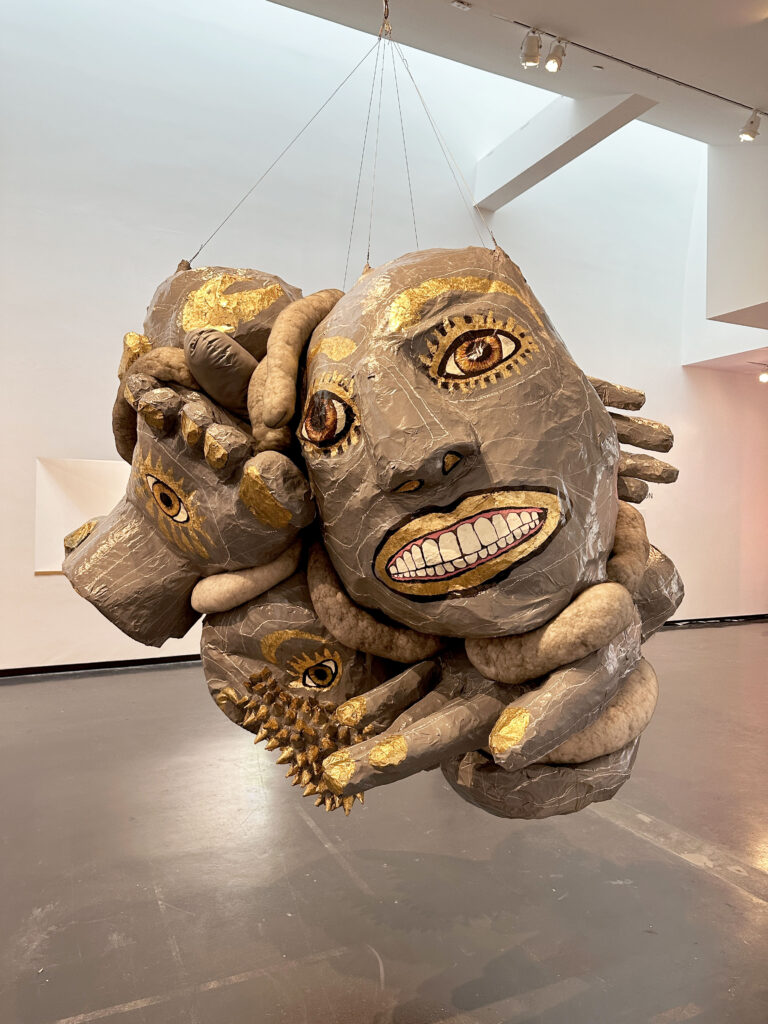
Work by Jenny Granberry (top) and Victoria Block (bottom)
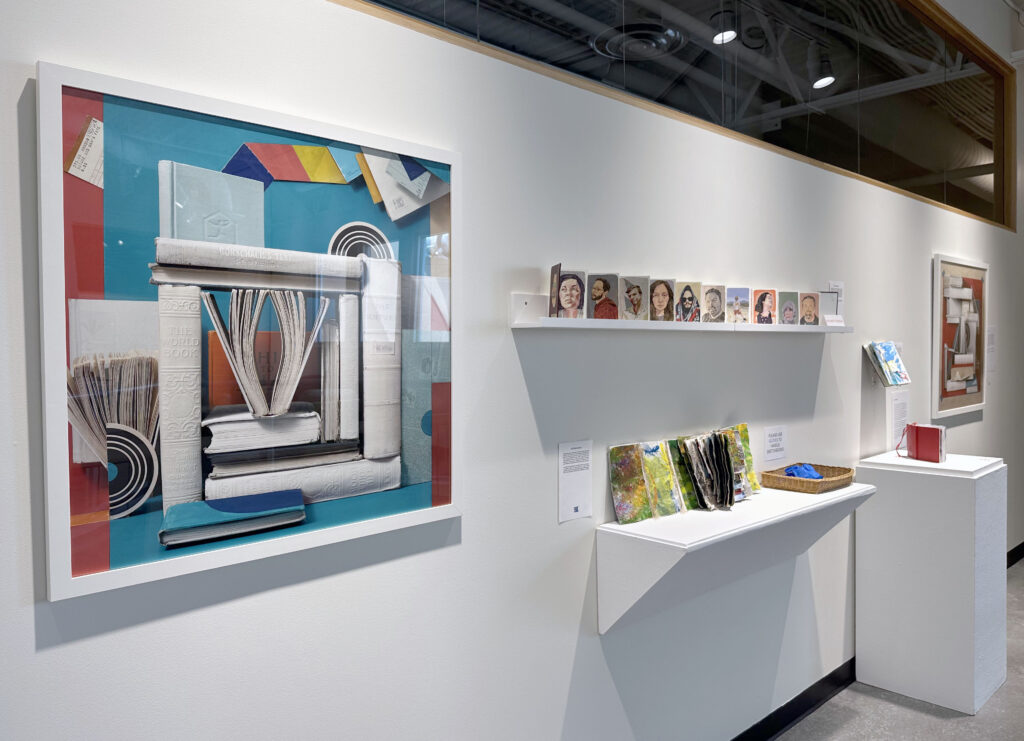
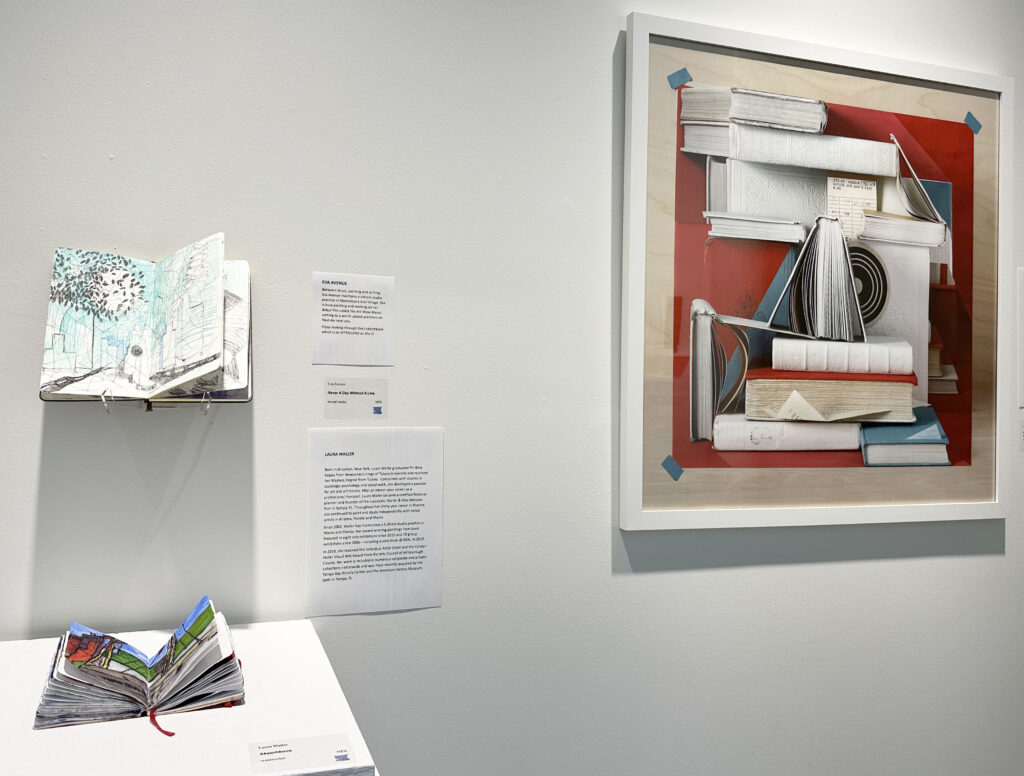
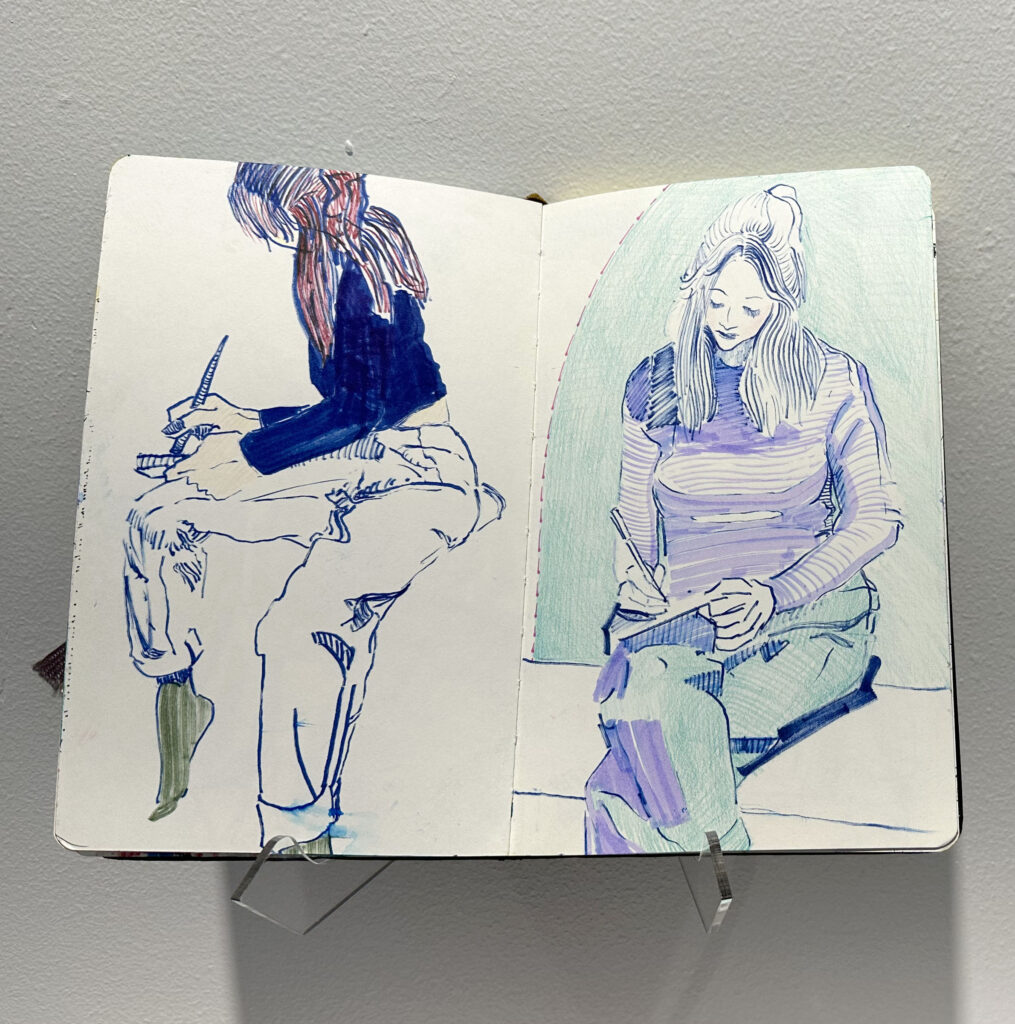
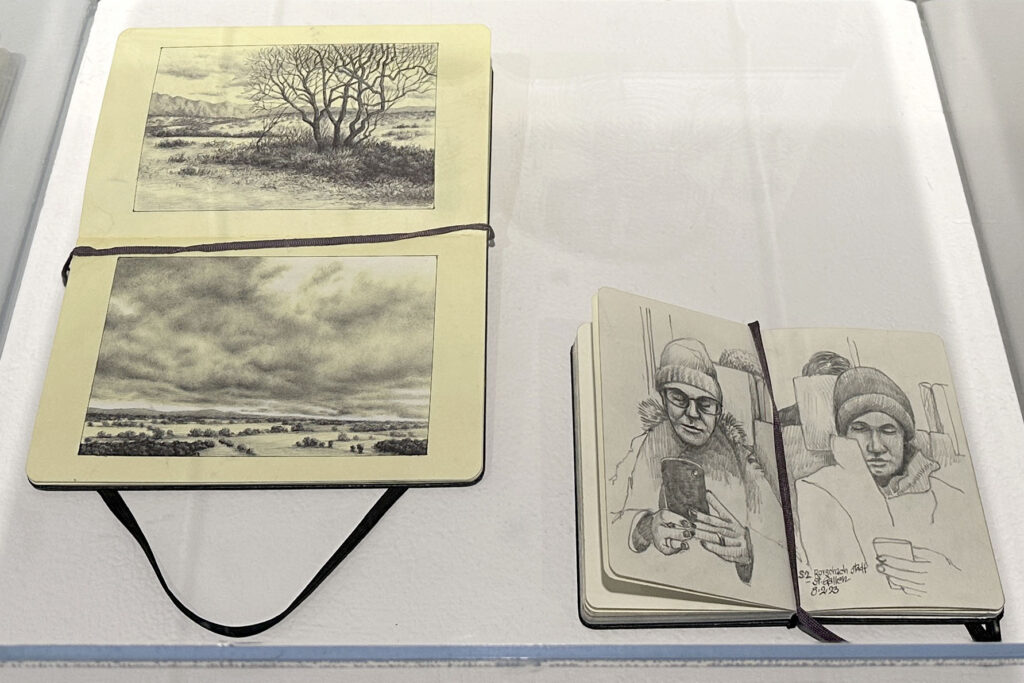
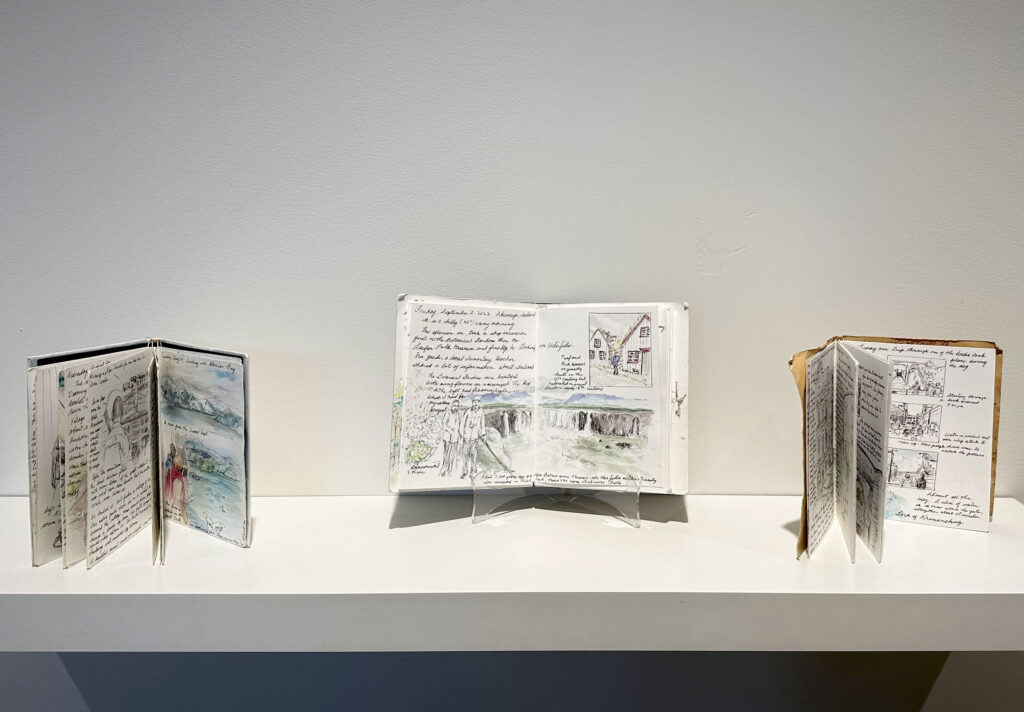
Journals by Eva Avenue (top left) and Laura Waller (bottom left) and photography by Andrew Sovjani
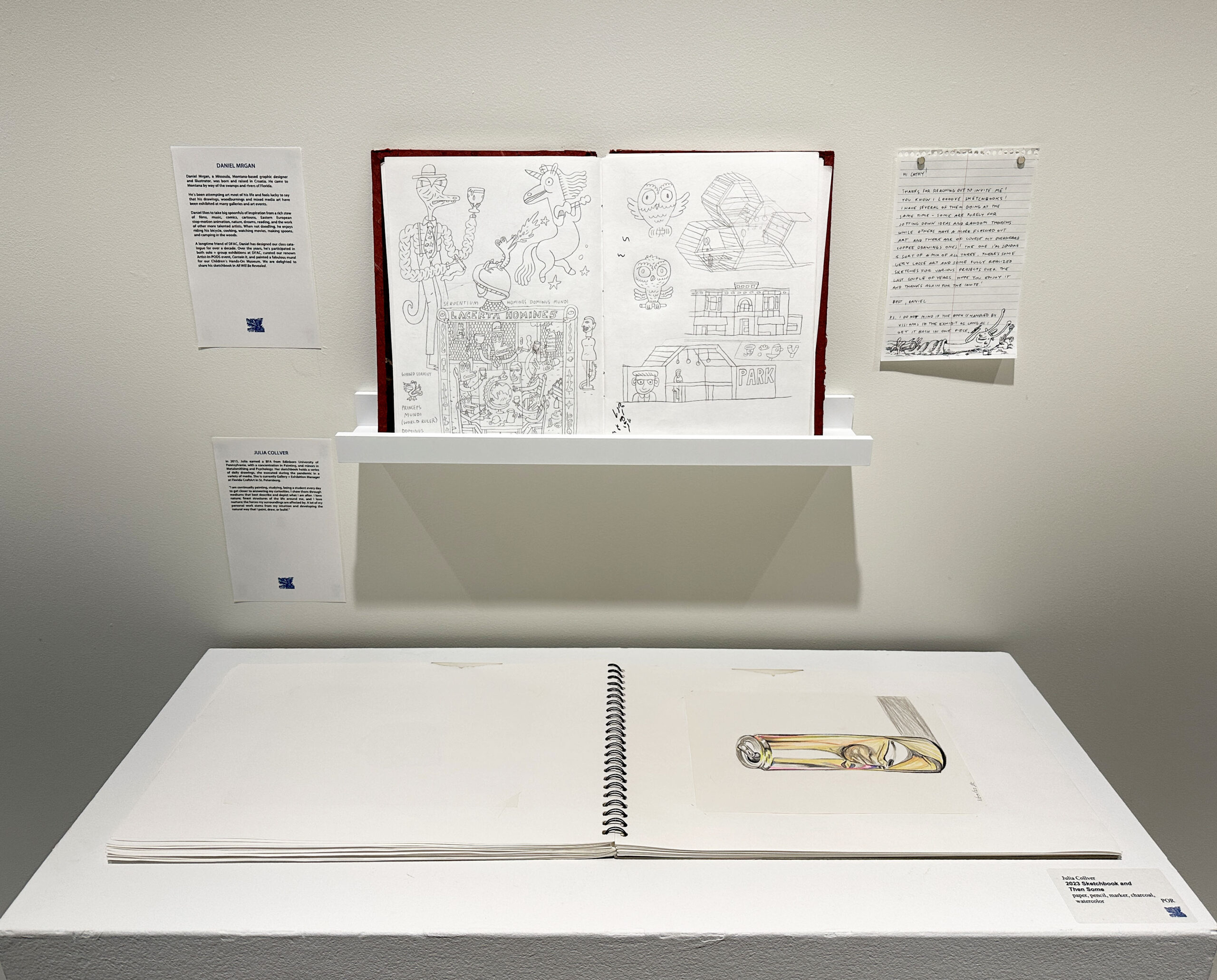
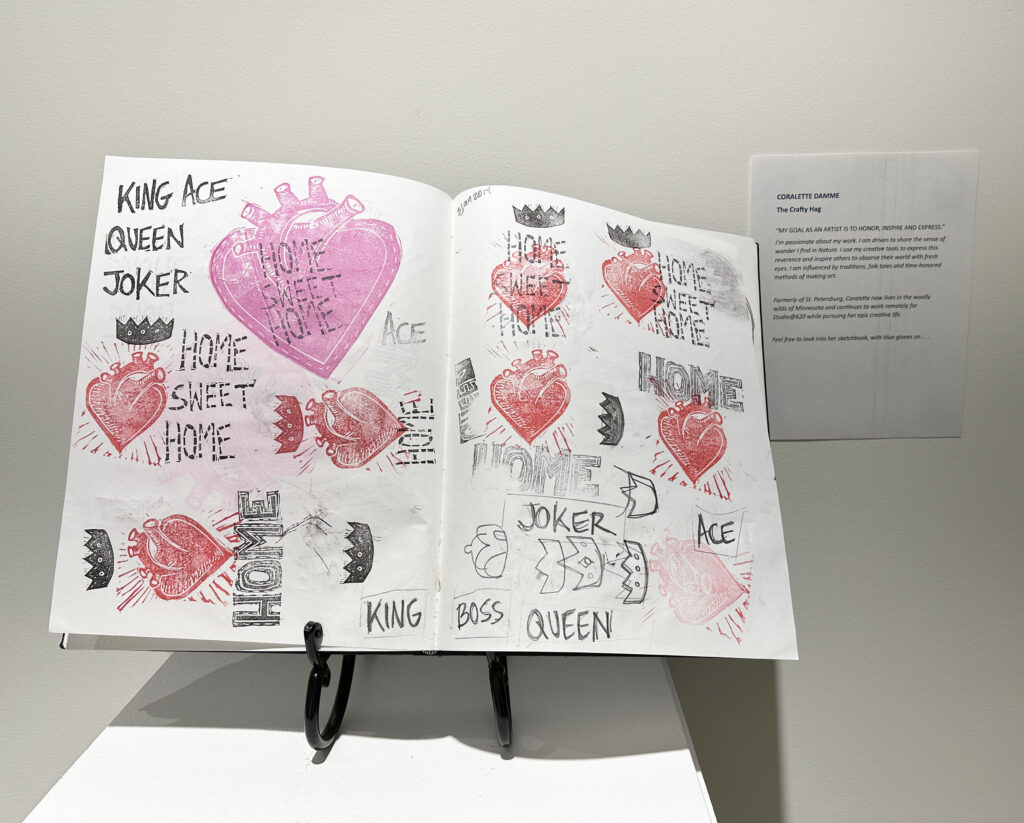
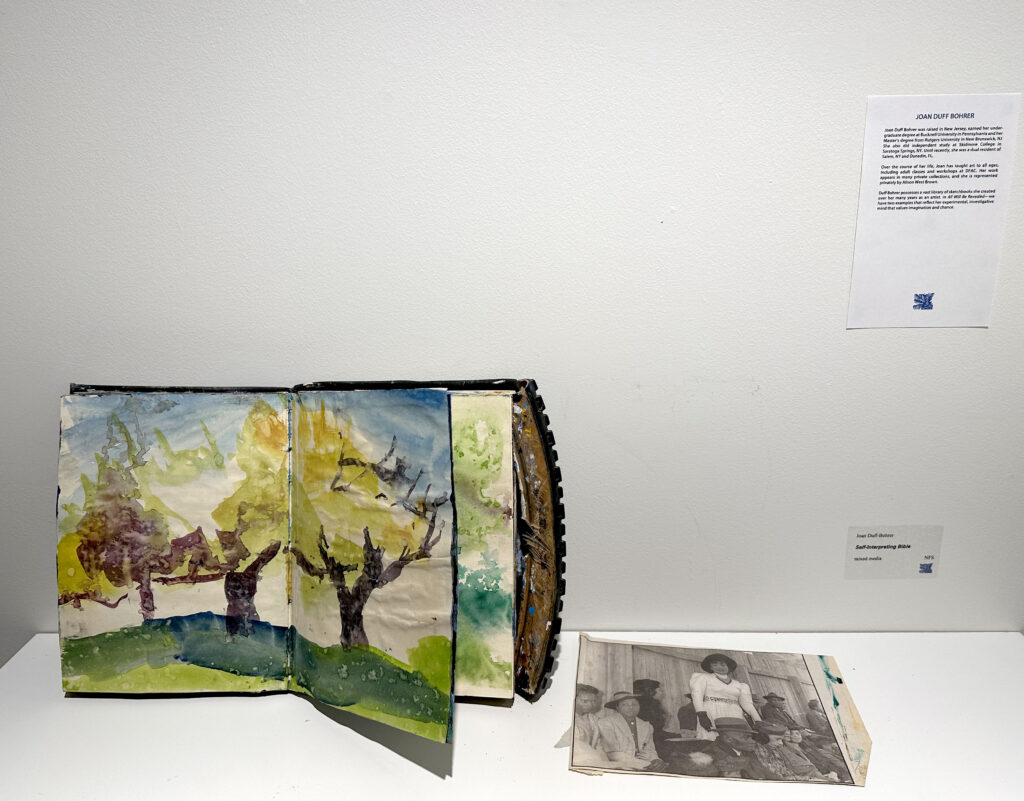
On the second floor of the Dunedin Fine Art Center are photographs by Andrew Sovjani and a collection of sketchbooks from a variety of artists, many of which you can look through- with gloves of course. It’s easy to spend lots of time with all the inspiring books these artists have created.
The exhibition closes 8/13/23.
About Andrew Sovjani, from the gallery-
Andrew Sovjani is a visual artist recognized for blurring the boundaries between photography, printmaking and painting. Raised in a family of working studio artists, art making is in his blood. Andrew has drawn from his life experiences in the scientific world and living in Asia to create transcendent bodies of work that are often extremely peaceful. His award-winning photographs have been shown in exhibitions throughout the U.S., Europe and Japan and are held in many public and private collections. He has won awards of distinction at many of the top fine arts festivals in the nation and was a finalist for the Critical Mass book awards in 2008 and 2016.
“From the moment we are born until we die, we are almost constantly in contact with cloth as we move through our lives. Without thinking about it, we are familiar with its varied qualities–the simplicity of white cotton, the luxury of silk velvet, the flexibility of knitting, the structure of weaving. We can see the impact of time in a piece of fabric: how it wrinkles, stains, takes repairs, unravels. Handmade paper is a kind of non-woven cloth and is in fact often made of recycled cotton or linen. It can be dyed, stitched, wrinkled, torn, and repaired much in the same way as fabric.
My work explores the expressive possibilities of these materials, which I use to deal with my fascination with time altered urban and rural landscapes. A piece of land in the Oregon outback, the brick wall of buildings in Madison, a leafy Minneapolis neighborhood, etc. are all impacted by the passing of time, actions of human beings, weather. These occurrences can be incremental or sudden, and the change they bring almost imperceptible or very radical, each change layering on top of what came before. I use that observation to inspire my work. Fabric surfaces are worked over with layers and layers of pigments, embellished with embroidery, dunked into dye, cut and torn. Paper pulp is poured, dipped, mixed with sawdust, painted, crumpled and smoothed out again. In this small human way, I am channeling the world into the objects I create.”
For more than two decades, Brooklyn-based artist Rico Gatson has been celebrated for his vibrant, colorful, and layered artworks. Inspired by significant moments in African American history, identity politics and spirituality, his oeuvre includes images of protests and longstanding injustices—touching on subjects like the murder of Emmett Till, the Watts Riots, and the formation of the Black Panthers—as well as dynamic abstract geometries that celebrate Pan-Africanist aesthetics and Black cultural and political figures.
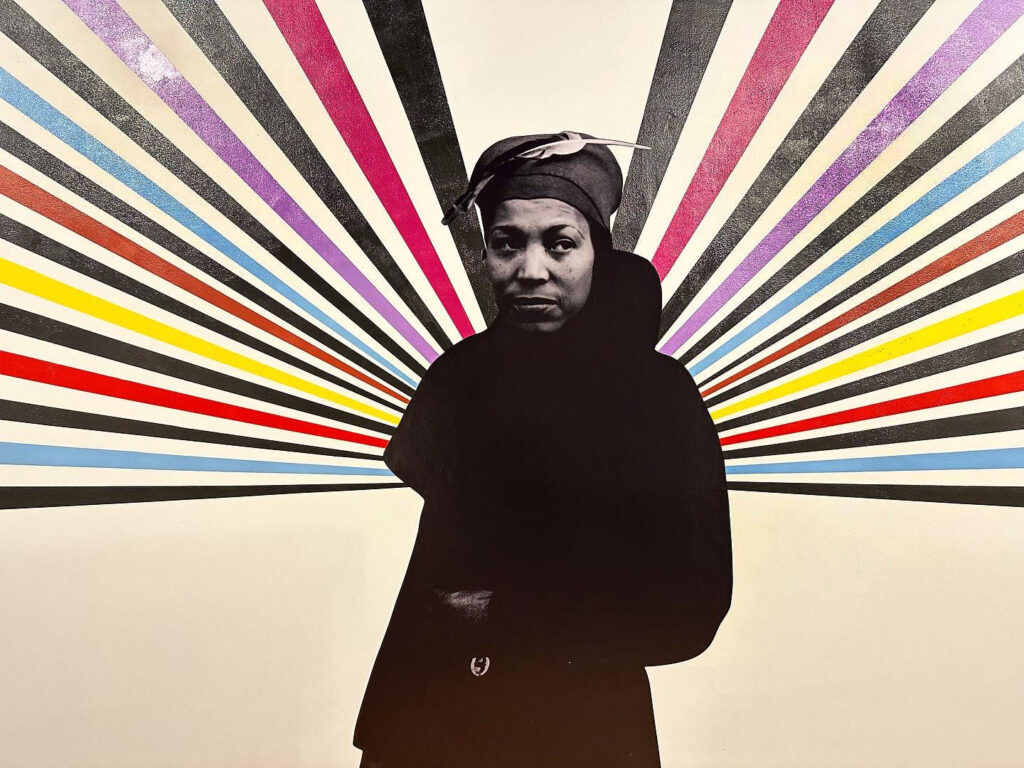
About the mural, Zora III, commissioned by the museum (pictured above)-
Zora Neale Hurston was an American author, anthropologist, and filmmaker. She portrayed racial struggles in the early-1900s American South and published research on hoodoo (a set of spiritual practices, traditions, and beliefs created by enslaved Africans in the Southern U.S.). The most popular of her four novels is Their Eyes Were Watching God, published in 1937. Born in Notasulga, Alabama, Hurston grew up near Orlando, in Eatonville, Florida, incorporated in 1887 as one of the first self-governing all-black municipalities in the country. Despite her landmark achievements, Hurston died penniless and in obscurity in 1960-her novels and other writings largely unknown, until they were single-handedly rescued by novelist Alice Walker in 1975. Through his wall painting Rico Gatson extends the monumental impact of Hurston’s legacy-and Walker’s- into a visual arena reminiscent of the Mexican Muralists and hand-painted cinema signs.
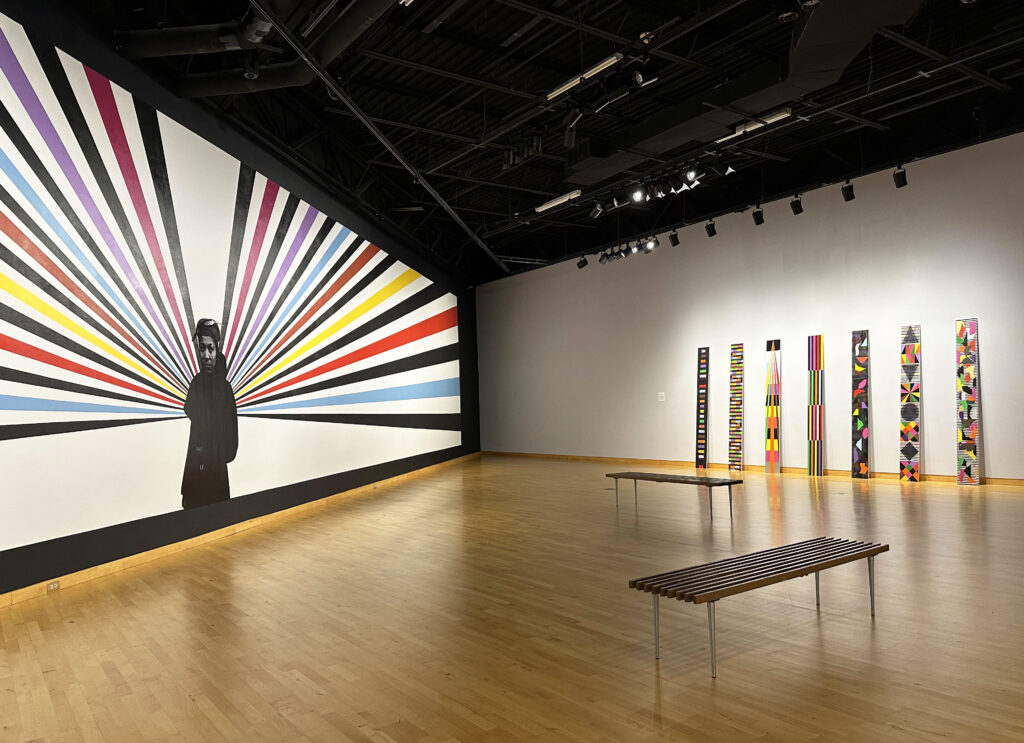
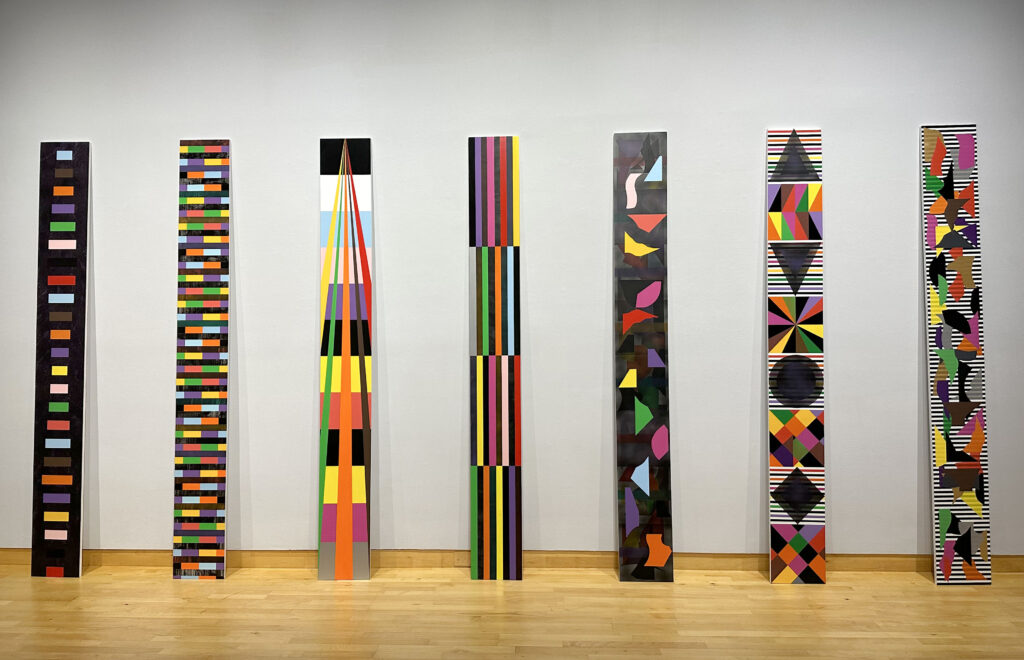
“Untitled (Seven Panels)”, 2022 acrylic paint on wood, in seven parts
From the museum’s wall plaque about the above paintings-
According to catalog contributor Mark Fredricks, Rico Gatson’s “panel paintings” resemble “a musical framework.” Arranged together along a single wall, the “rhythm” animating their colorful compositions and their “uniformity of structure” suggest, anthropomorphically speaking, musicians in a jazz combo. One of the many ways in which Gatson draws on music as a lasting influence in his art, his seven panels approximate what legendary jazz player Albert Ayler described as “the healing force of the universe,” but in three dimensions.
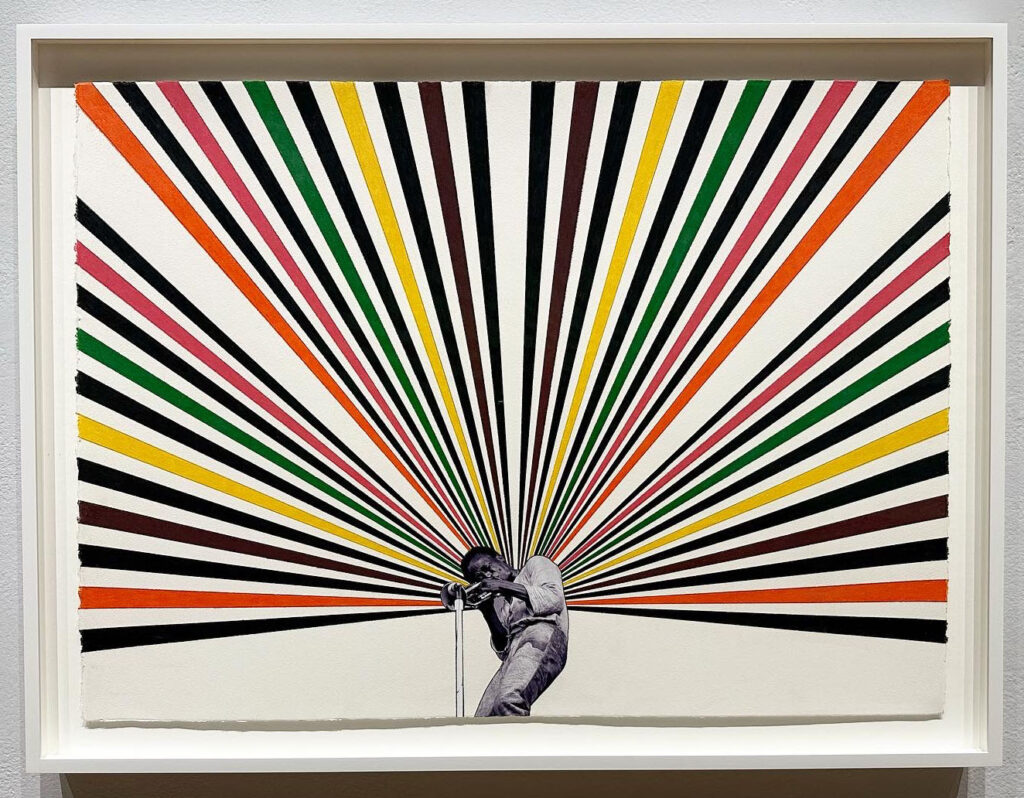
“Don” 2022, Color pencil and photo-collage on paper
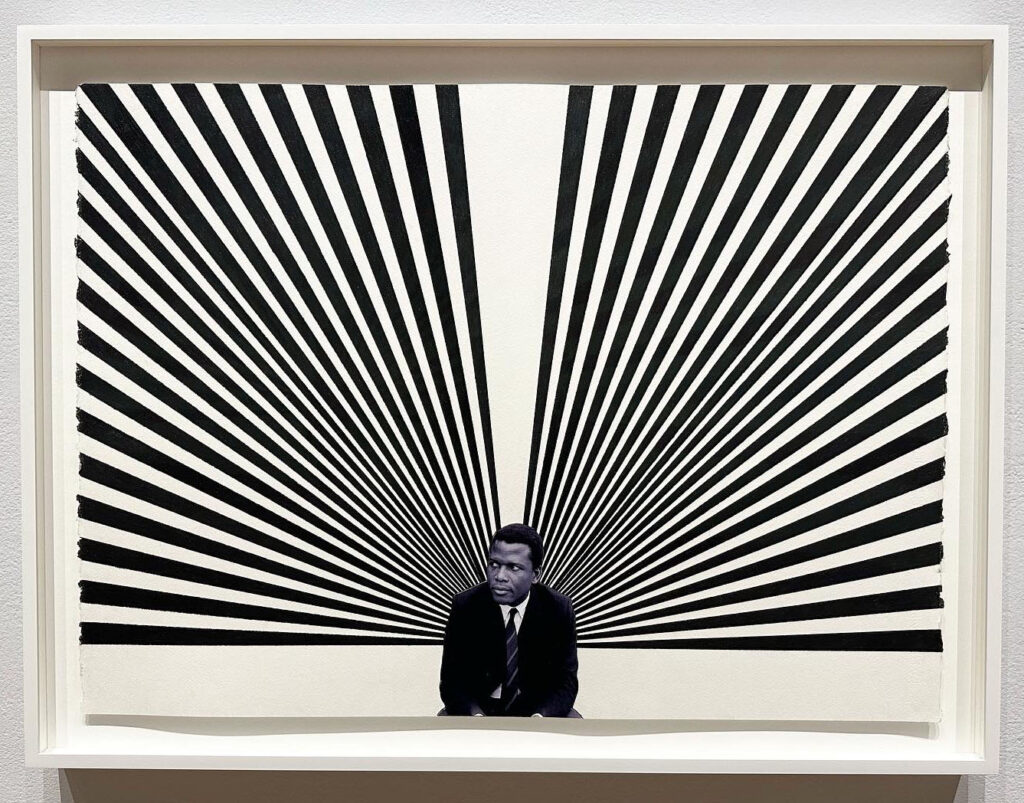
“Sidney” 2022, Color pencil and photo-collage on paper
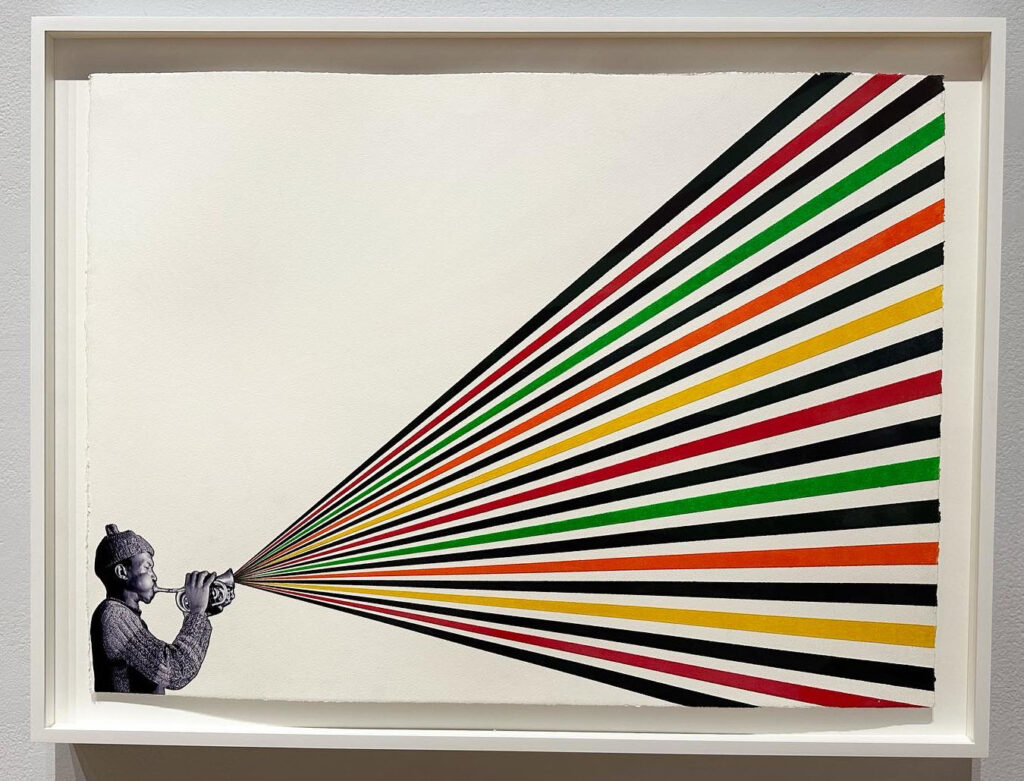
“Miles #2″ 2022, Color pencil and photo-collage on paper
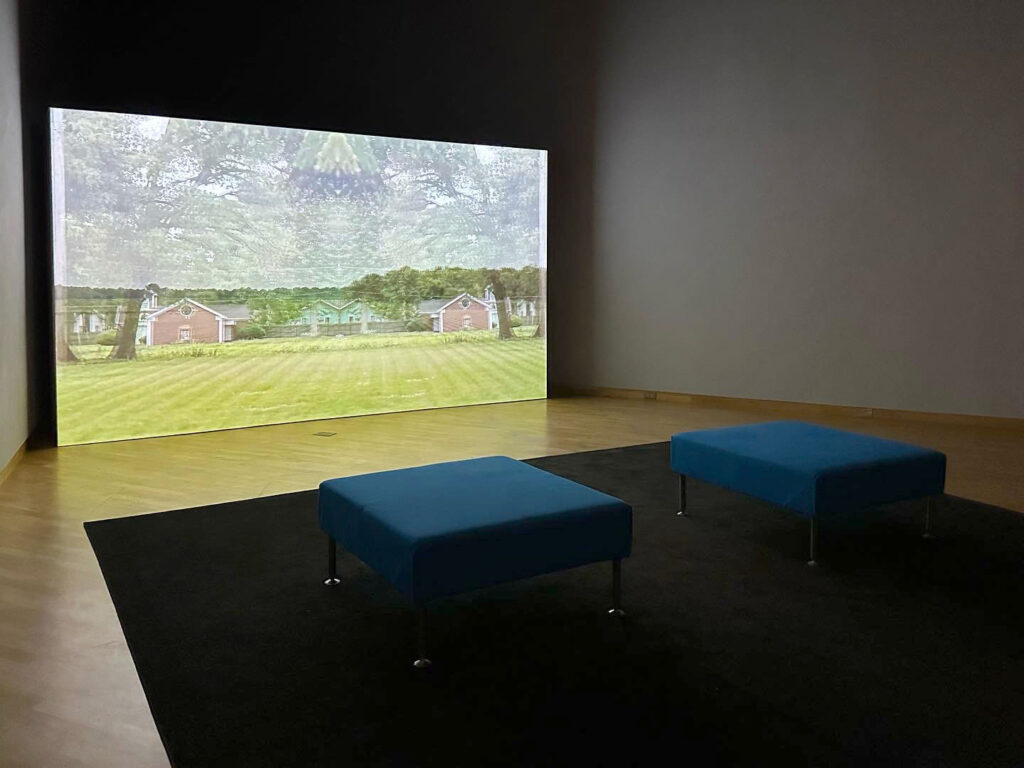
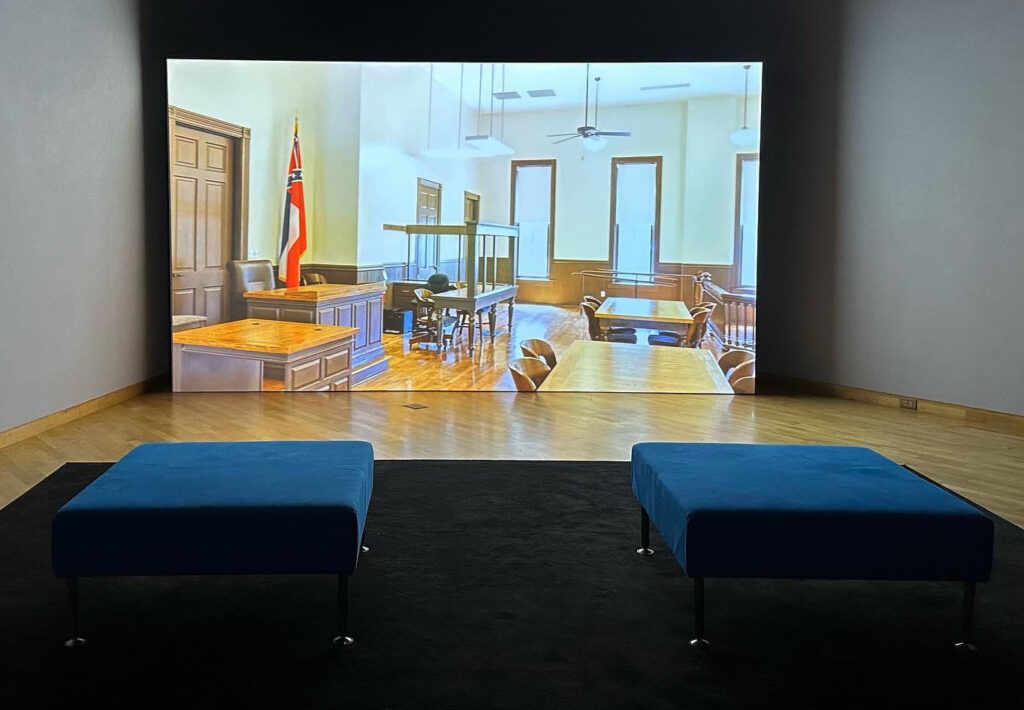
Below are images are from Four Stations, one of the five moving image works in the exhibition. For this work, Gatson traveled to Money, Mississippi and took handheld footage along the trail of places and events that led to the lynching of 14-year-old Emmett Till.
“Four Stations” 2017
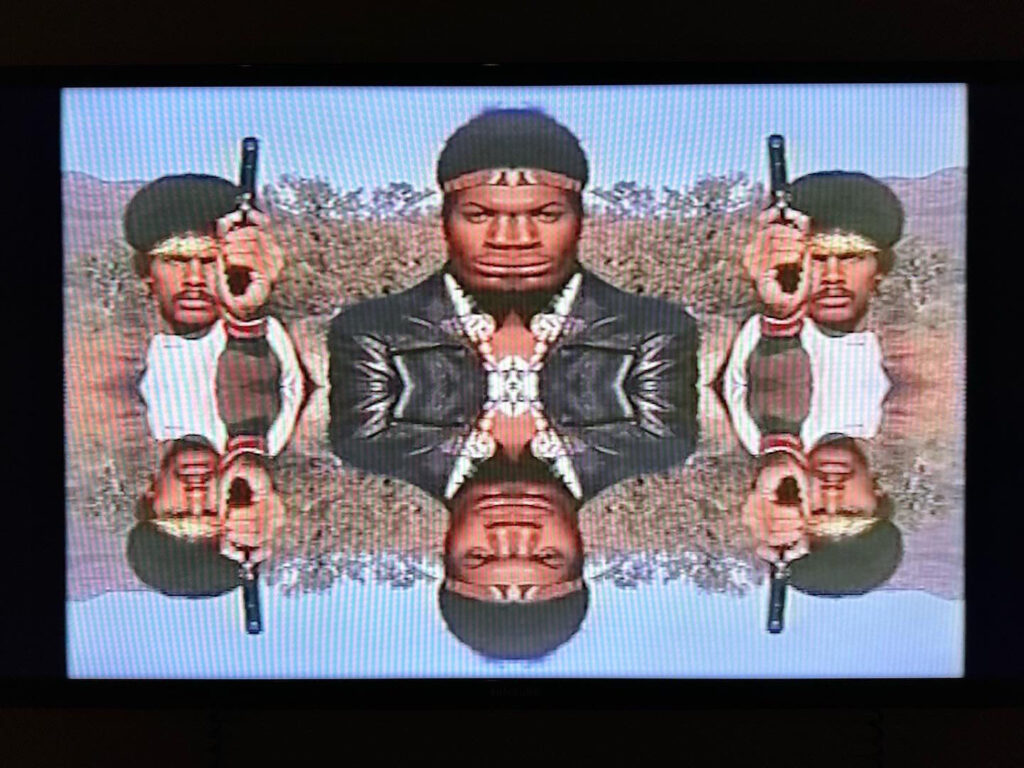
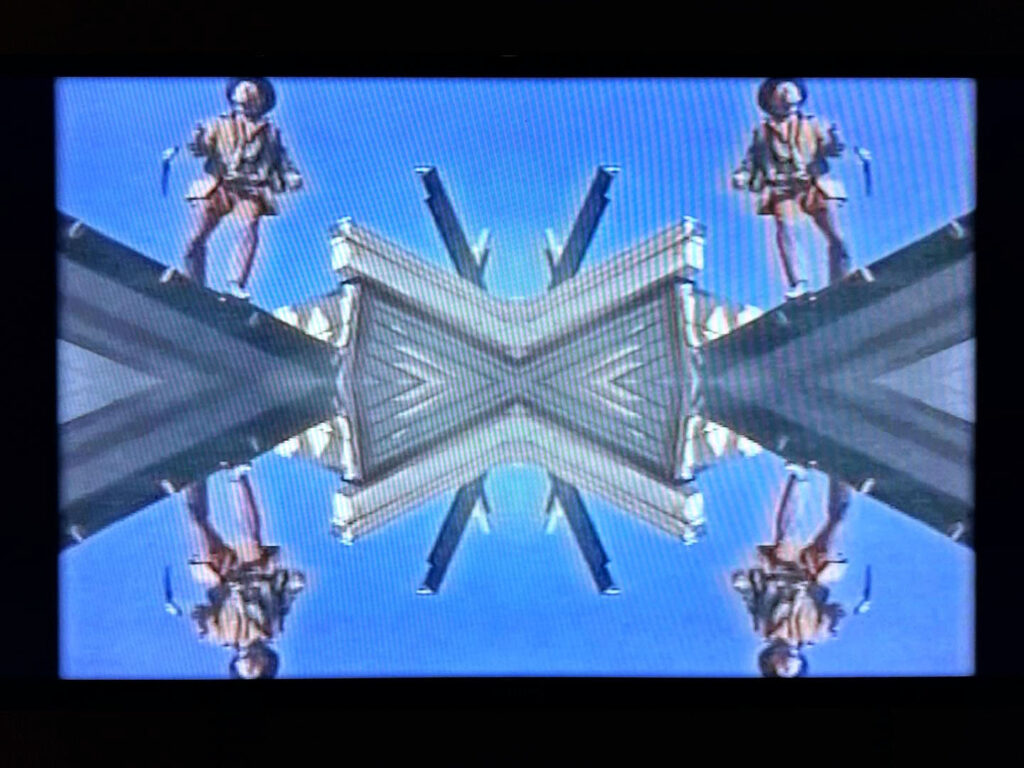
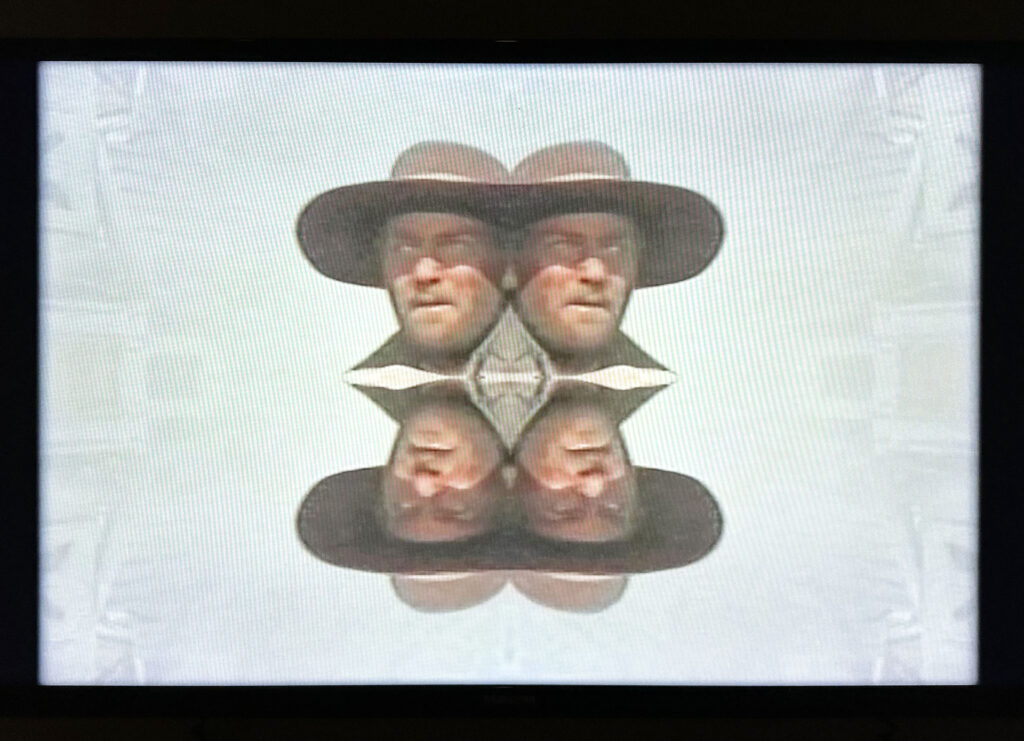
On one of the smaller screens is Gun Play, 2001, a film collage that mixes sequences from Foxy Brown and The Good, the Band and the Ugly, combining them together with kaleidoscopic effects.
This Thursday 7/27/23, the museum will be showing Spike Lee’s Do the Right Thing, the last of the three films chosen by Gatson to accompany the exhibition.
Polly E. Perkins, “Woodstork Portrait”, 2022 from Ferman Center for the Arts
24 Hands is a printmaking collective of Florida Gulf Coast printmakers founded by Marjorie Greene Graff. The group has regular exhibitions throughout the year at various locations in the area.
Recently a group of their artists were showing work at The Ferman Center for the Arts, on the University of Tampa’s campus. Below are a few selections from that exhibition.
For more information on Polly E. Perkins, whose work is in the first image, check out her Instagram.
Linda Dee Guy, “Botanical Shroud”, 2021, acrylic, Inkjet print, Goldleaf on canvas
Linda Dee Guy, “Nucleus”, 2021
Linda Dee Guy, “Seascape”, 2021
For more work by Linda Dee Guy, check out her website and Instagram.
The 2023 Emerging Artist Exhibition in Creative Pinellas’ gallery space highlights work from the ten Pinellas County artists chosen by the organization for this year’s Emerging Artist Grant.
Above are sculptures by Amy Wolf. She has written several articles for the Creative Pinellas website which give some insight into her work and are worth a read.
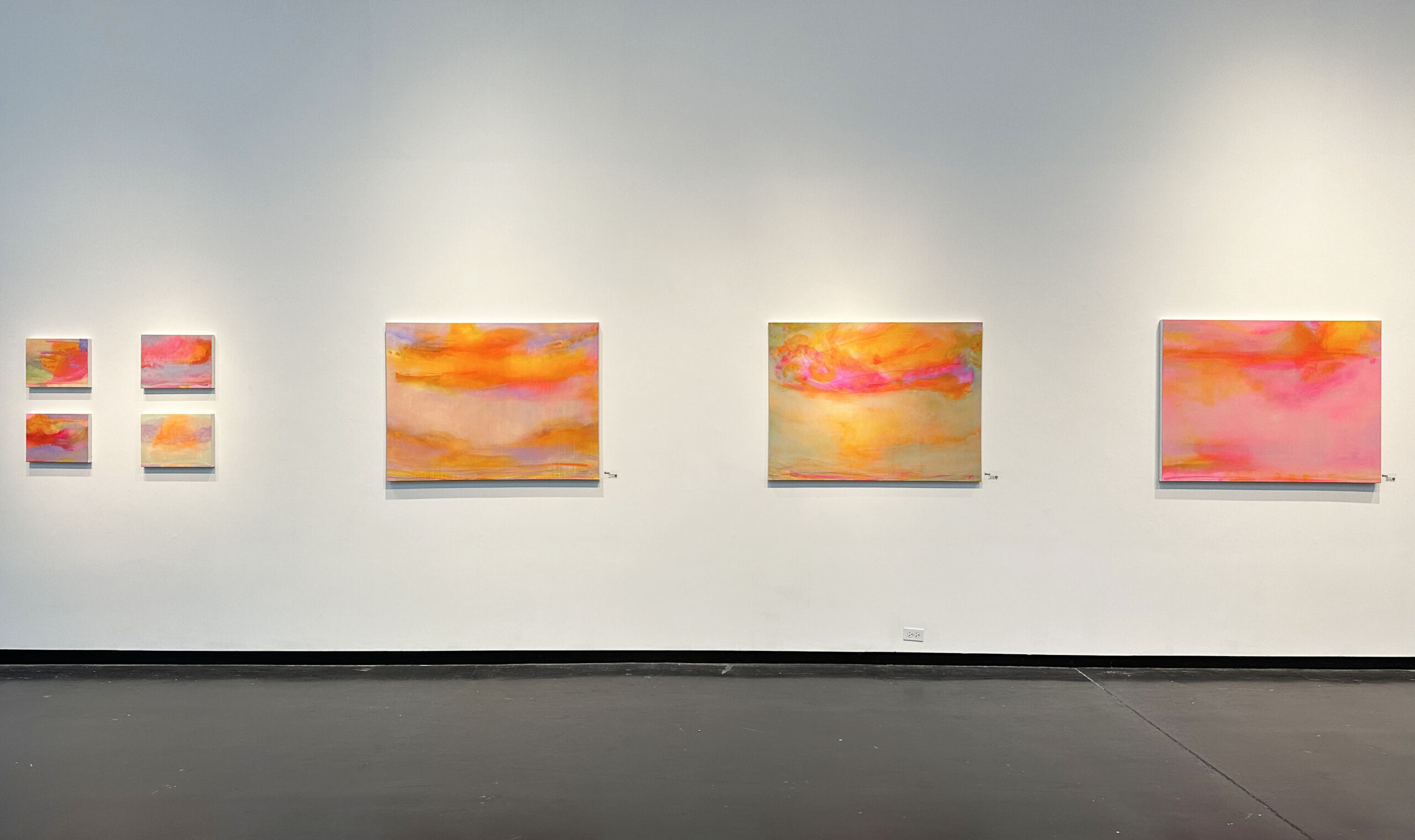
According to artist Kimberly Engel, the paintings above “explore vibrant color interaction while inviting viewers to meditate on an illusive horizon line where sky meets water.”
From the Creative Pinellas website-
Kimberly Engel is a contemporary abstract painter who lives and works in Clearwater, Florida. Her distinct gestural style combines a love for color interaction with spontaneous mark making. Engel’s paintings explore levels of transparency, evoking depth and light. She is inspired by the constant presence and changing states of large bodies of water. She has lived on the shore of Lake Erie in Euclid, Ohio prior to moving to the Gulf Coast.
Engel describes her process as an exploration of herself and ultimately the dissolving of herself mirrored in the process of making and deconstructing works. Her gestural marks have been described as both compulsive and somewhat calligraphic. They undulate and disappear under thin veils of color.
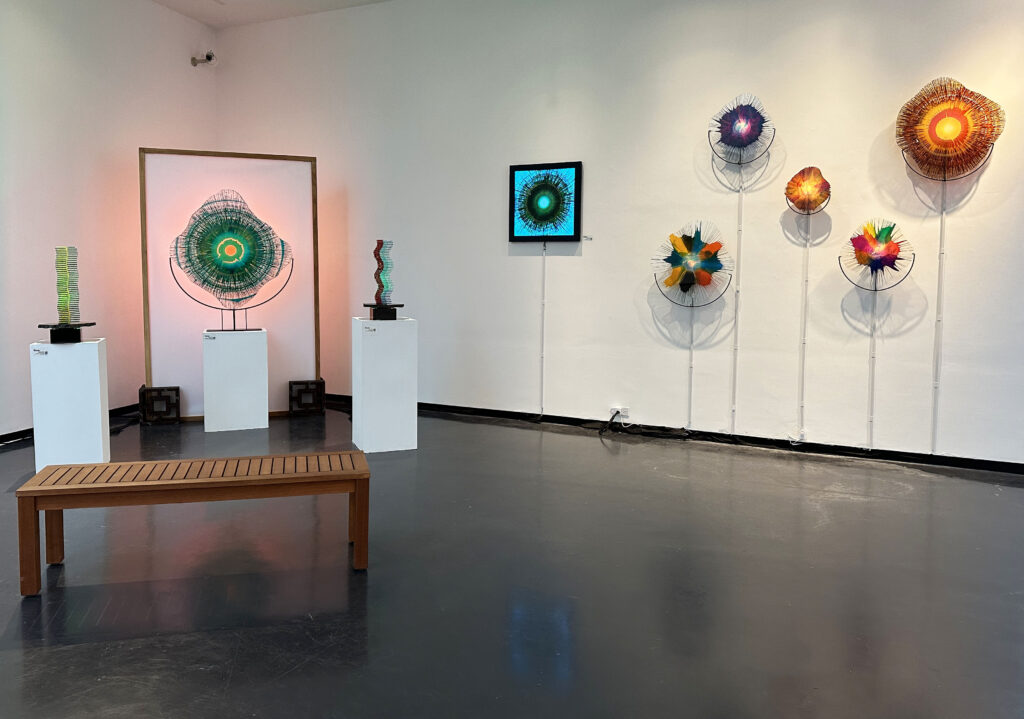
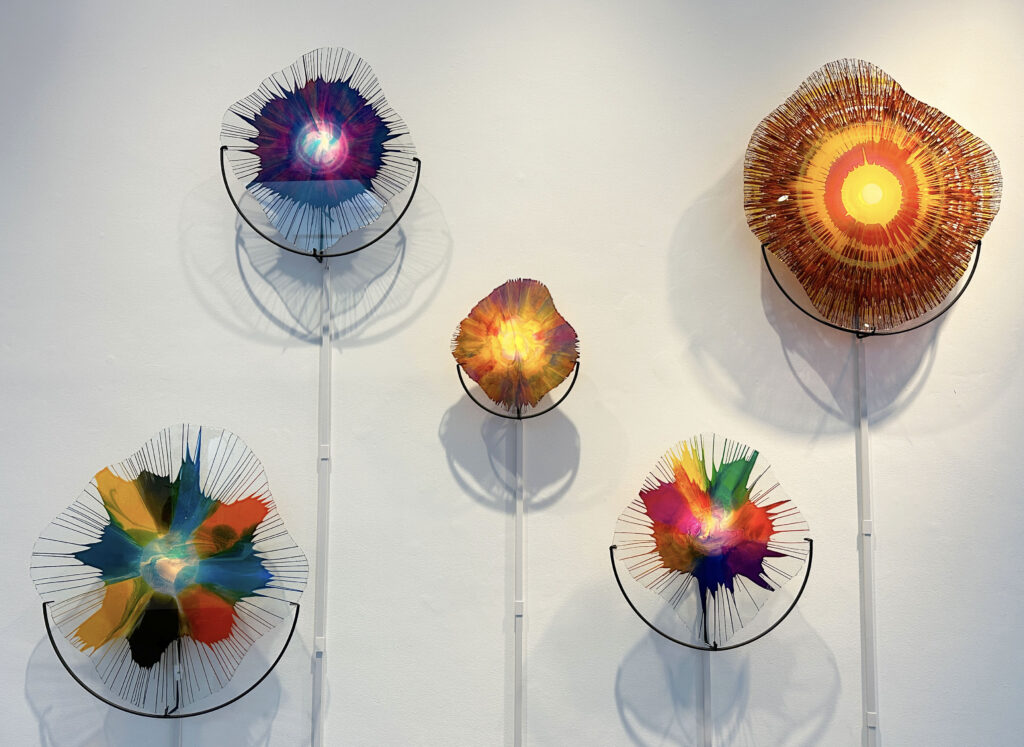
Denis DeBon created the unique glass works seen above.
His biography from the gallery website-
Dennis DeBon is the creator of EnergyWebs, which are one-of-a-kind works of modern glass art. He is often been compared to artist Jackson Pollock. Like Pollack, Dennis uses simple artistic techniques and has combined reverse painting on glass with spin art and taken both to a whole new level.
Each EnergyWeb is cut from a large sheet of plate glass, then free-style hand-cut into shape, scalloped, polished then spun. Dennis uses a multitude of application techniques and color combinations when creating each piece before firing and hand-signing them.
Every EnergyWeb is a unique, one-of-a-kind work of modern glass art and he is the only artist in the world creating them.
In addition to selling his artwork at fine art festivals across the country, Dennis was commissioned as the artist to create the Richard Dawkins Awards. In addition, his past creations have been presented to James “The Amazing” Randi, Carl Sagan’s widow, Ann Druyan, and the Zora Neale Hurston and the Koi Society of America award winners.
Dennis was born and raised in Buffalo, New York and attended the Rochester Institute of Technology in Rochester, New York, where he studied photography and graphic design.
He now lives in Saint Petersburg, Florida and when he isn’t creating art, you might find him writing screenplays or in the boxing ring . . . working as a professional boxing referee.
For more of the artists in the exhibition, head to the pages below.
Raised in Highland Park and East Los Angeles, Terrill was part of a small group of Chicano artists who in the 1970s and 80s created works that diverged from traditional Chicano-based imagery and subject matter to include visual representations reflecting his queer lived experiences. Utilizing the existing image culture that surrounded him, Terrill combines personal photographs, found pop cultural imagery, and reproductions of artworks by queer predecessors, including Diane Arbus, Robert Mapplethorpe and Wilhelm von Gloeden, to conjure utopic spaces. Spanning from his earliest explorations to substantial new works, Cut and Paste reveals collage as a foundational element to Terrill’s expanded artistic practice.
Beginning with abstract collages and silkscreens made while Terrill was an undergraduate at Immaculate Heart College—an art department still heavily influenced by the graphic artist and activist Sister Corita Kent—the exhibition draws out the interconnectivity of illustration, collage, and printmaking in Terrill’s work and their influence upon the characteristically flat style of his early paintings. Like many artists who came of age in the wake of Pop, he found refuge within the fantasies of American image culture–his earliest artworks covering his bedroom walls, which he transformed with a mix of drawings, photographs, and clippings of comic books, film starlets, and music icons. His silkscreens from the mid-1970s–a medium central to the larger Chicano art movement–find him applying a graphic sensibility to not only representations of brown bodies, but queer desire, an impulse he would continue to explore in his episodic Homeboy Beautiful proto-zines from the end of the decade.
Paintings created from zoomed-in sections of the underpaintings of the larger works
“Memories”, 2023, digital photographs
“Memories”, 2023, digital photographs (closer look)
Gallery 221, at Hillsborough Community College’s Dale Mabry Campus, is currently showing Snow in September, an exhibition of work by Kirk Ke Wang. The layered mixed media works are really pretty but there is a deeper meaning within the details.
From the gallery about the exhibition-
Kirk Ke Wang (b. Shanghai, China) is a multimedia artist whose work focuses on critiquing modern stereotypes as a diaspora. Throughout his career, Wang has used painting, installation, mixed media, video and photography to present his vision of the world, led by a consistent thread: the fear of inexorable cataclysm.
Wang’s solo exhibition in Gallery221@HCC draws inspiration from a 13th century Chinese play called The Injustice to Dou E, also known as Snow in Midsummer. In the story, the tragic and unjust death of Lady Dou E causes the heavens to snow during a hot midsummer day, thereby proving her innocence.
Today, the story symbolizes injustice and tragedy, and in Wang’s exhibition Snow in September, the artist parallels the Chinese fable with abstracted images of more recent tragedies such as 9/11, calling to mind the moment when the twin towers collapsed, and debris rained down like falling snow.
Through retelling tragedies, Wang tries to find a spiritual solace and the meaningfulness of being human.
These days it’s hard not to think sometimes about the end of the world. But have you started putting together a plan? Thought about who would be good in a crisis? Put together a pros and cons list of your friends, family and acquaintances? Wondered if things would actually be better?
Finn Schult’s current exhibition Everything You’ve Ever Wanted at Gallery 114 at Hillsborough Community College’s Ybor City location, presents an interesting take on the current state of things for those with the end on their minds. It includes paintings, animal traps, an ipod and walkie talkie, as well as a book containing photos, prepper information, journal entries, drawings, and some pros and cons for the people in his life, including his mom. The paintings are titled “L’appel Du Vide” a French phrase meaning “the call of the void” or the urge to jump when you are standing in a high place.
From the gallery’s website-
Everything You’ve Ever Wanted is a solo exhibition of new work by Finn Schult (b. 1993, Naples, FL) reflecting on the inevitability of the end of the world and the fantasy of apocalypse as catalyst for utopia. Schult’s multimedia series exists as fragments, sketches and interludes distilled from an otherwise deranged web of theories. At times, the artworks presented in Gallery114@HCC feel terroristic, violent and unbearably bleak–at other times, they remind us of the beauty inherent in loss, longing and love. Schult’s work yearns for a world that doesn’t yet exist and mourns for a world that isn’t yet gone, answering the cry, “How will I ever get out of this labyrinth?” with “The only way out is through.”
There is also a video in the exhibition, Where r u rn? which mixes a variety of imagery with a bit of author and mystic Terence McKenna’s 1999 final interview where he discusses “the fire in the madhouse at the end of time”- the possibility of the craziness in the world being a sign of the dying of our species.
Morean Arts Center in St. Pete, Florida, is currently showing Fresh Squeezed 7, their annual exhibition of emerging artists in Florida. It’s a great opportunity to see some of the best artwork being done by local artists. The exhibition closes 6/22/23.
From the the Morean Arts Center’s press release-
As always, our selection panel culled over 120 applications from across the state, narrowing the exhibition down to the six artists featured here. It’s always a joyful and heartbreaking process, seeing so much inspiring good work and only having a limited amount of space in which to show it all.We were looking for diversity in medium, in ideas, and in geographical location, all of which somehow comes together to form a delightful, cohesive whole.
While we don’t necessarily plan it that way, themes and commonalities do emerge among the artists selected for the exhibition. We’re happy to announce this is the first year that we have an ALL FEMALE line up. And due to the inclusive interpretation we use to define an emerging artist (no previous solo shows in Florida), you’ll find artists here who are still pursuing their MFAs (KJ Skidmore and Leeann Rae) AND artists who are returning to their first love of art after finding fulfillment in decades of other related careers (Latonya Hicks and Deborah W. Perlman).
Other themes you may notice as you peruse the galleries are the inventive (and exuberant!) use of materials. Denise Treizman and Latonya Hicks both incorporate cast off, recycled and vintage materials in their dimensional wall work. While Denise’s process is more spontaneous and Latonya’s is deliberate and measured, they both create joyful works of art that invite contemplation and perhaps a spark of recognition from the viewer.
KJ Skidmore and Laura De Valencia both deal with contemporary issues and pop culture in their work, though to wildly different effect. KJ’s humorous mixed media paintings address the notion of the male gaze, and the women who must endure it. Laura’s installations use fashion culture as a jumping off point to raise questions about international stereotypes and the borders (both visible and not) that immigrants have to experience on a daily basis.
Both Leeann Rae and Deborah W. Perlman create work that challenge the viewer to look longer, and to think deeper. With their disparate materials (Leeann with soft pastel and Deborah with cut paper), they raise notions of space, whether physical or mental, real or imagined, in the present or a memory from the past.
KJ Skidmore “Squeeze ‘n’ Block”, Acrylic and coffee
KJ Skidmore
KJ Skidmore “Angel’s Bar”, Acrylic, fabric, trim, paste and wood paper
The work above is by Tampa based artist KJ Skidmore.
Morean Arts Center’s information about the artist-
KJ’s current work is based in painting/drawing that extends into3-D space through multimedia installation. Her immersive spaces are chaotic and aggressive, but at the same time alluring. She works within her own bizarre and disjointed narratives and themes containing warped textual elements, strange cartoon characters, and color palettes that are both grimy and fluorescent. Her material use is variable and may include masses of hair clumped together with canned beets, pink stained carpet, fabrics, wood, plaster, teeth, rain jackets, and Smurf-themed objects.
KJ’s painted series Burger Time caricatures leering male clientele as flat, monster-like cartoons that interact with a staring waitress to explore gendered tropes and forms of voyeurism. This series reconstructs reality in relation to being female by presenting experiences like getting stared at or groped within a hokey themed attraction called “Burger Time” restaurant. Her series is meant to revolt the viewer through acknowledging the male gaze, while also celebrating its trashiness and the culture surrounding it. She uses humor to poke fun at this harmful and uneven power dynamic. The series presents this sickening concept through more palatable presentation such as expressive cartoon figures and bright colors.
KJ is from Gainesville, FL, but was living on the West Coast until recently. She is back in Florida pursuing an MFA at USF in Tampa.
For more of the artists in the show, continue to the next page.
Between 1915 and 1970, in the wake of racial terror during the post-Reconstruction period, millions of Black Americans fled from their homes to other areas within the South and to other parts of the country. This remarkable movement of people, known as the Great Migration, caused a radical shift in the demographic, economic, and sociopolitical makeup of the United States. A Movement in Every Direction: Legacies of the Great Migration brings together twelve contemporary artists to consider the complex impact of this period on their lives, as well as on social and cultural life, with newly commissioned works ranging from large-scale installation, immersive film, and tapestry to photography, painting, and mixed media. Featured artists are Akea Brionne, Mark Bradford, Zoë Charlton, Larry W. Cook, Torkwase Dyson, Theaster Gates Jr., Allison Janae Hamilton, Leslie Hewitt, Steffani Jemison, Robert Pruitt, Jamea Richmond-Edwards, and Carrie Mae Weems.
A Movement in Every Direction presents a departure from traditional accounts of the Great Migration, which are often understood through a lens of trauma, and reconceptualizes them through stories of self-possession, self-determination, and self-examination. While the South did lose generations of courageous, creative, and productive Black Americans due to racial and social inequities, the exhibition expands the narrative by introducing people who stayed in, or returned to, the region during this time. Additionally, the Brooklyn Museum’s presentation centers Brooklyn as another important site in the Great Migration, highlighting historical and contemporary census data about the borough’s migration patterns. Visitors are encouraged to share their own personal and familial stories of migration through an oral history “pod” available in the exhibition galleries.
About Robert Pruitt’s work, pictured above, from the museum’s wall information plaque-
“A Song for Travelers” celebrates the individual and Black collective experiences that have shaped the histories of rural East Texas and Houston’s Third, Fourth, and Fifth Wards. In this drawing-based on an early 1970’s photograph of a reunion of the artist’s family in Dobbin, Texas -sixteen people gather around a seated central figure about to embark on a journey. During the creation of this work, the masked traveler became a stand-in for Pruitt, who had recently left his hometown of Houston.
Pruitt often draws inspiration from his and others’ family photographs while examining historical events that have impacted Houston’s Black communities. Wearing costumes and adorned with items that reference various aspects of Black culture found in schools, social clubs, and religious spaces, the figures in the work reflect the numerous networks that remained and flourished in the South. Merging the Great Migration period with the present, Pruitt centers the Black neighborhoods across the southern region that served as safe havens and rich sites of cultural expression for migrants during the twentieth century. This link extends to today as many Black Americans leave the northern and western cities that once attracted their elders and return to the South.
Allison Janae Hamilton’sA House Called Florida, below, takes the viewer on a journey through part of northern Florida’s natural beauty.
From the museum’s information plaque about the video installation-
Allison Janae Hamilton produced the three-channel film installation A House Called Florida in her hometown region of northern Florida. The breathtaking landscapes of Apalachicola Bay and the swampy Blackwater Lakes of Florida’s Big Bend frame musicians, dancers, motorists, a Victorian house, and a slow resounding rhythm.
The artist references French Argentinian writer Julio Cortázar’s 1946 short story “Casa Tomada.” (“House Taken Over”) about ghosts that slowly take over a home and eventually push out its owners, room by room. Hamilton echoes the story’s theme of displacement with two regally dressed, spirit-like protagonists who move about the house engaging in mark-making and ritual performances. Hamilton’s film pays tribute to the Black Floridians who remained in the Red Hills and the Forgotten Coast regions, despite the racial violence and environmental precariousness they faced throughout the nineteenth and twentieth centuries.
Carrie Mae Weems‘ personal and moving contribution is in two parts- a series of photographs and a unique digital video installation.
The museum’s description of the work-
Carrie Mae Weems explores a painful family story: the disappearance of her grandfather Frank Weems, a tenant farmer and union activist who was attacked by a white mob in Earle Arkansas, in 1936. Presumed dead, he narrowly escaped and made his way to Chicago on foot, never again reuniting with his family. Frank Weems may have followed the North Star to Chicago. Weems’s series of seven prints, The North Star, makes an apt metaphor for Frank’s life. In Leave! Leave Now! Weems conjures the figure of her grandfather with a Pepper’s Ghost, a late nineteenth-century form of illusion first used in theater. By weaving historical events with fragmented family stories, photographs, poetry, music, and interviews, the artist reveals the tragedy of her grandfather’s disappearance and the aftermath.
This exhibition will close on Sunday, June 25th, 2023.