Jul 192019
 

Woven Stories, at the Museum of Art and History (MOAH) in Lancaster, is a collection of narrative fiber artworks as well as five solo exhibitions and five site specific installations. There are so many great pieces in the show it was hard to narrow down which artists to include, but below are a few that stood out.

Victor Wilde, Momma Bears, 2019

Vojislav Radovanovic, TWO SIDES OF A LUCID DREAM, 2018

Vojislav Radovanovic, TWO SIDES OF A LUCID DREAM, 2018

Orly Cogan, Confections

Orly Cogan, Sugar ‘n Spice ‘n Everything Nice

Upstairs, the solo exhibitions are equally impressive. Several of these artists utilize nontraditional materials to create their unique work.

Nicola Vruwink uses the film from cassette tapes instead of traditional yarn to create her pieces.

For her large sculptures, Elisabeth Higgins O’Connor, uses materials from second hand shops. The pieces of broken furniture and scraps of fabric form animal figures caught in awkward poses.

Elisabeth Higgins O’Connor, Blamethirst

Peter Hiers’ sculptures are made from found scraps of tires. Using this discarded material, he gives new life to what would ordinarily be littering the sides of highways.

Peter Hiers, Circular Logic, 2010

This exhibition closes 7/21/19.

While in Lancaster, make sure to also check out MOAH Cedar nearby, which is showing Collateral Damage, an immersive installation by Snezana Saraswati Petrovic.


Jul 122019
 

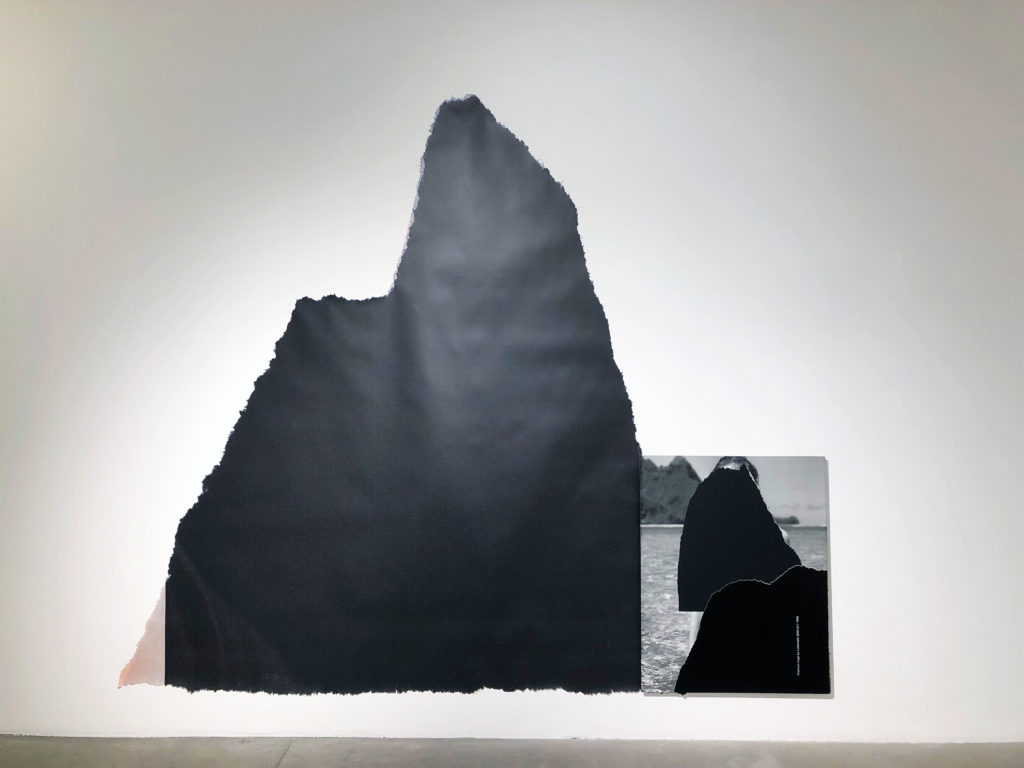
Juan Capistrán, Psychogeography of Rage (sending up searchlights in the form of flames) Western, 2019

Kim Fisher- Los Angeles Hedge, 2019

Kim Fisher, Woman Behind Rocks, 2019

Sabrina Gschwandtner, Cinema Sanctuary, 2019

Sabrina Gschwandtner, Cinema Sanctuary (close-up)

Enrique Castrejon, You, me, and all of us are in this together/Reach out to those that don’t know their status, 2019

Enrique Castrejon, You, me, and all of us are in this together/Reach out to those that don’t know their status, 2019 close-up

Every year The City of Los Angeles Department of Cultural Affairs (DCA) awards grants to the city’s best mid-career artists. The work created with these grants is then shown in the Los Angeles Municipal Art Gallery (LAMAG) in Barnsdall Park for the C.O.L.A.(City of Los Angeles) exhibitions.

COLA 2019 is made up of 11 artists working in various mediums. Two of the artists, Juan Capistrán and Kim Fisher were also shown together as part of Hammer Museum’s biennial exhibition, Made in L.A. 2014. For this show, Capistrán created large brick sculptures that he placed in sites in South Los Angeles that haven’t been rebuilt since the 1992 LA Riots. In his section of work in the gallery, he includes photos of these temporary site specific installations as well as some of the brick sculptures- two of which have balloons tied to them spelling GRATIS. The bricks can be seen as objects of destruction or building blocks, and the dual meanings work well in the context of the work.

Kim Fisher’s large collages capture another side of Los Angeles. From the hedge she used for the largest piece, to the ocean, swimming pools, and car culture, included in her others, the graphics and color come together in a way that feels very much like the traditional ideas associated with the city.  The different sections, created to look as if they were torn or cut from magazines, form collages that feel like scattered memories that have somehow arranged themselves cohesively.

Sabrina Gschwandtner took forgotten films made by female directors and stitched them together to form patterns drawn from the history of quilt-making. The use of a craft that is traditionally associated with women and tying it an artistic pursuit that women are only more recently being acknowledged for is an interesting juxtaposition. The resulting work is stunning graphically and reminiscent of Agnés Varda’s colorful house of film reels created for LACMA’s Agnés Varda in Californialand from 2014.

Enrique Castrejon created sculptures that stem from his work in an LGBTQ center in Los Angeles. His sculptures of fragmented bodies are surrounded by strips of paper with HIV infection rates. The humanity of the figures contrasts with the overwhelming strips of typed documentation that swarms all around them.

All of the work created for this exhibition is incredibly strong and these annual exhibitions are a great way to see some of the best work being created by Los Angeles artists today. If you can’t make it to the exhibition there is a video on the site that takes you on a walk through with one of the curators. Also make sure to catch Stephanie Taylor’s Municipal Art Song, which plays at the entrance to the exhibition. She created song lyrics based on text from LAMAG and DCA’s websites and catalogs, and used them to create sheet music using Schoolhouse Rock! as an inspiration. The result is really funny, especially if you read a lot of press releases.

This exhibition closes 7/14/19.


Jun 202019
 

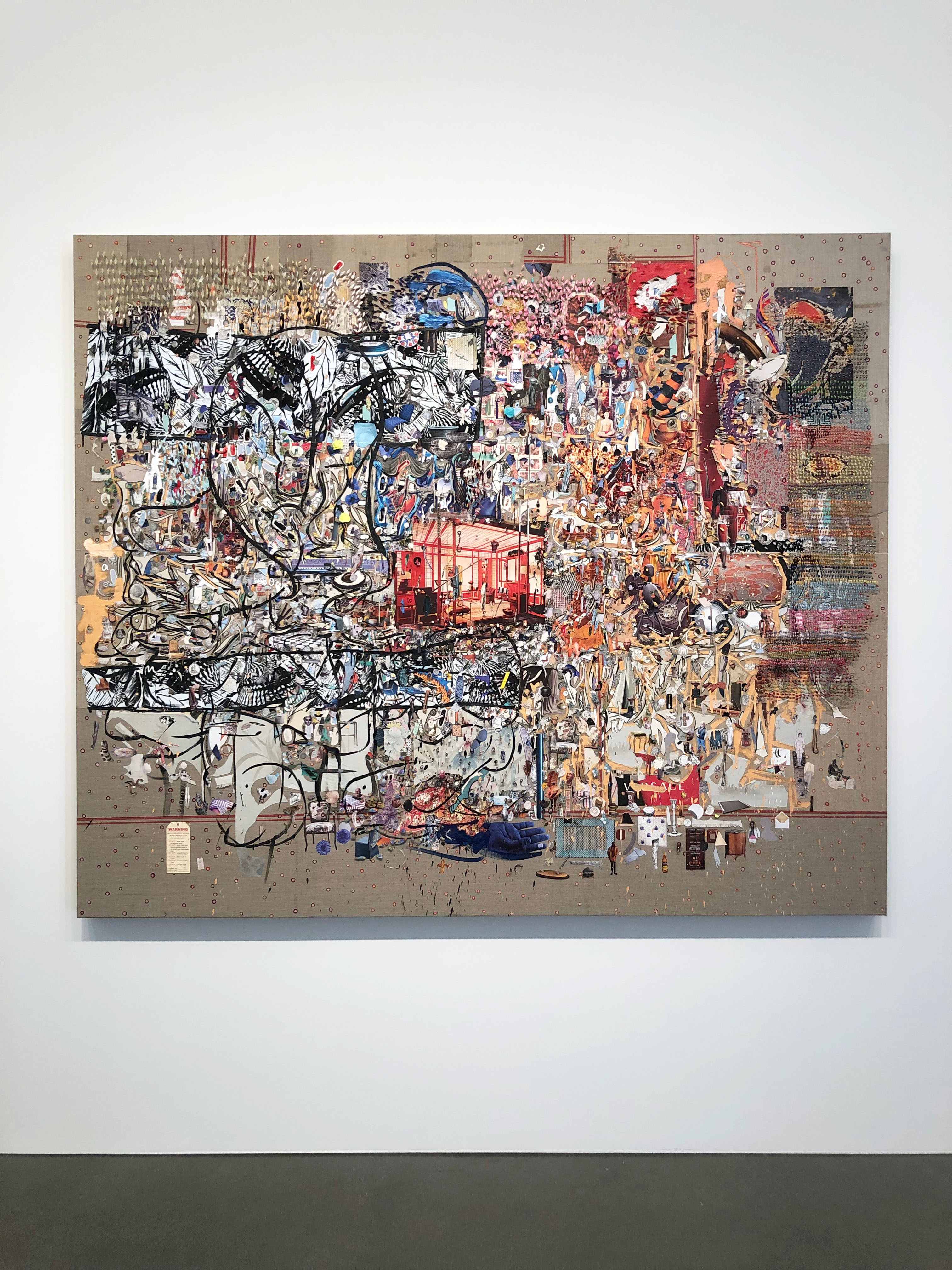
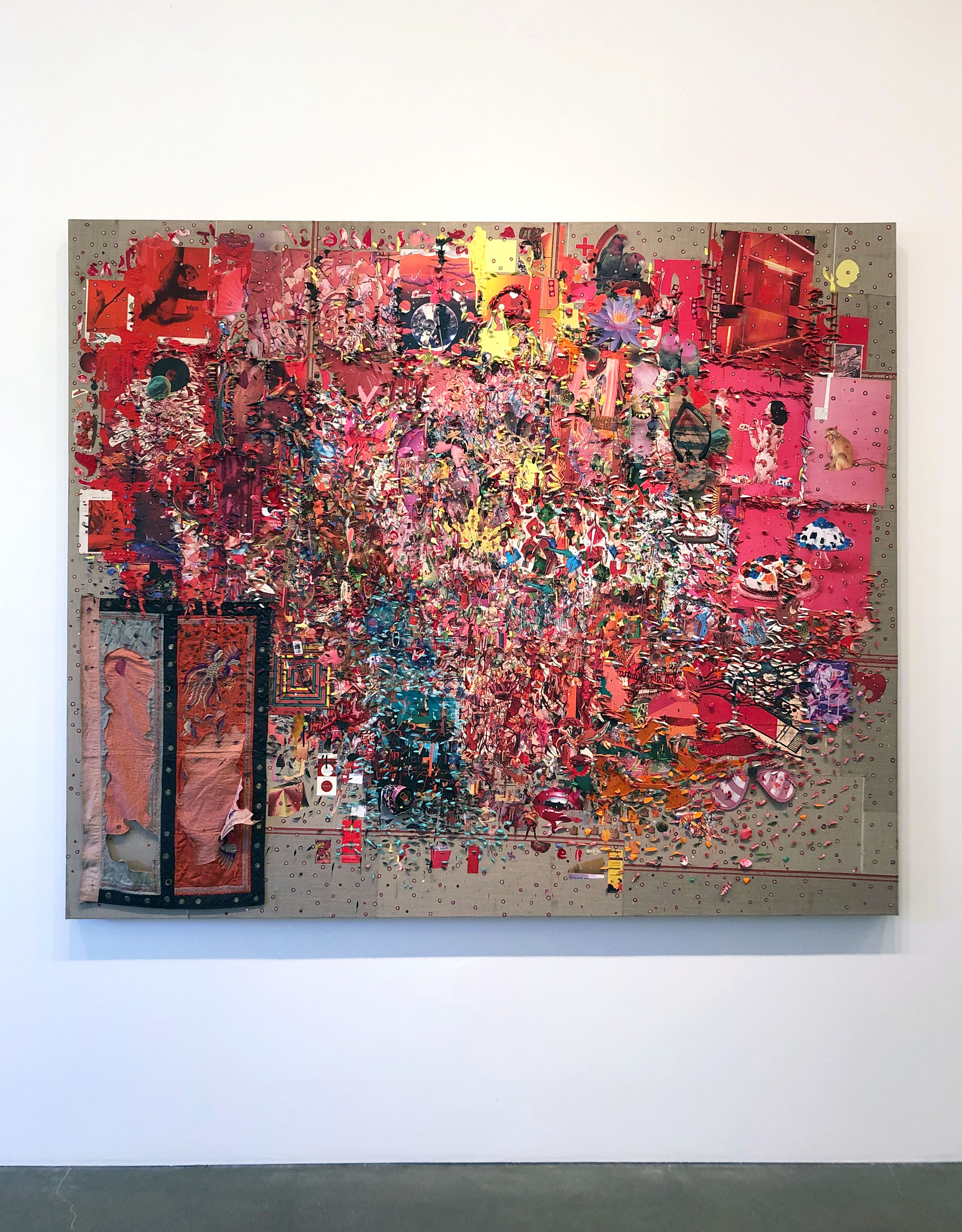
Regen Projects is currently showing Elliot Hundley’s Clearing (pictured above) and Liz Larner’s As Below, So Above (shown below). Hundley’s exhibition includes five panel works as well as three benches with accompanying sculptures. The panel works are incredible, with dizzying amounts of detail and texture. Tiny images, pieces of fabric, tags, and even one flip flop, mix with paint and ink to form the final works. The best way to appreciate the work is by moving close to look at small sections at a time and then pulling back to see it as a whole.

In the video below, that was made for the exhibition at MOCA that Hundley recently curated, he talks a bit about his process. Especially interesting is when he says he tries to leave his creations “in an open ended form so that people who look at them can also imagine making them or interacting with them or destroying them or rearranging them”.

For Liz Larner’s exhibition she has created several new works that “demonstrate her ongoing examination into sculpture, painting, drawing, and ceramics. The environment – the personal and the entrenched – are set together in these artworks that reach for an understanding of vulnerability through what is and has been considered low and directed, made capital of, and endangered.”

Both of these exhibition will close on 6/22/19.

Jun 072019
 

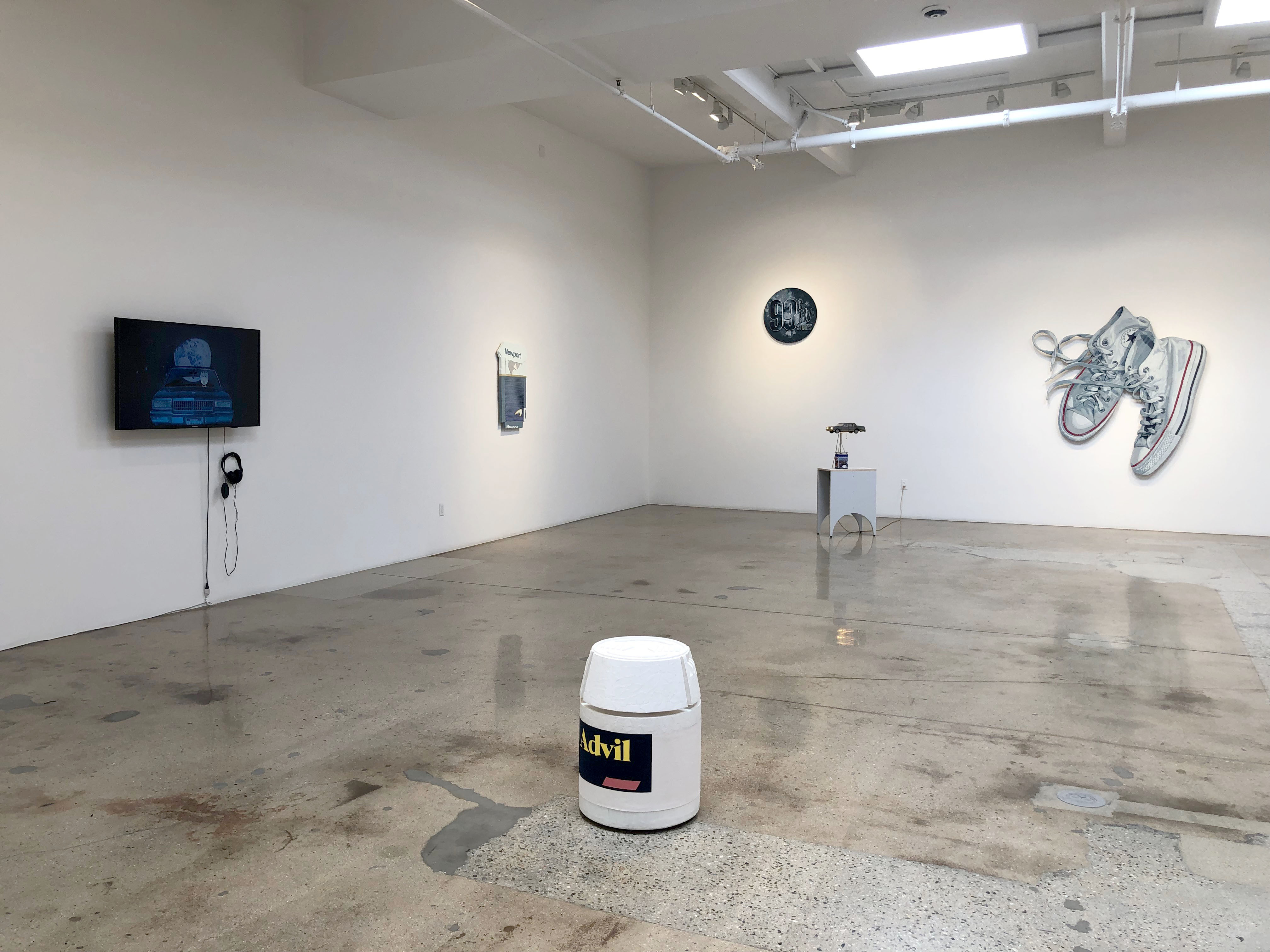
This is the last weekend to see Nick Doyle’s show The Great Escape at Steve Turner in Hollywood.

From the press release–

Steve Turner is pleased to present The Great Escape, a solo exhibition by New York-based Nick Doyle, that features sculptural works depicting everyday objects including an oversized bottle of Advil; losing lottery tickets; a pressed dress shirt; a pair of Converse shoes; a miniature Chevron sign; a crushed Newport cigarette box; and two air fresheners. Inspired by the idea of the American road trip, Doyle meticulously assembled these works from a multitude of materials–steel, plywood, brass, paper, sandpaper, canvas, chain, tin foil, light bulbs, electrical wire, concrete, and most importantly, denim. Worn by miners, cowboys, hippies, bikers, punks and bad boys, denim represents westward expansion, rugged individualism and a kind of masculinity that Doyle questions with these works. Doyle also created three small kinetic “Executive Toys” in which he examines the underlying pressure and violence of corporate culture. Finally, there is a three-minute music video that combines puppetry and found footage. The main character is a spork dressed in a suit and tie who is on the road singing a song of lament. It ends with some Saguaro cacti singing Amazing Grace against a desert backdrop.

There is also the group show Power of Ten, in the smaller galleries, which has some great pieces by Maccabee Shelley, Hannah Epstein, Paige Jiyoung Moon and others.

Jun 062019
 

Taking up an entire level of the BCAM Building at LACMA, Robert Rauschenberg: The 1/4 Mile or 2 Furlong Piece, is a wonderful testament to the artist’s work and creativity. It is also the first time it has ever been shown in its entirety.

There is so much variety in the materials, subjects, colors, and styles, that as you wander from section to section, it’s easy to notice new things the longer you look. Despite the differences among the different sections, they are bound together by a creative exuberance. LACMA recommends an hour to wander the 1/4 mile of work, but you may want to spend longer.

This exhibition will close on 6/9/19.

May 242019
 

Wendy White’s exhibition Racetrack Playa, at Shulamit Nazarian, is a very American show. Her collages of old car ads ,and their often blatant sexism, combined with the use of denim as a sculptural medium, play with the iconography of America’s past to force us to think about America today. How do you reconcile a love of the open road and exploring natural landscapes with the environmental destruction caused by using cars fueled with oil to get there? How much of the past perception of women as objects still informs thinking today? Will America get out of its wood paneled basement to move into a better place- or will its longing for the past continue to slow its progress?

From the press release-

Shulamit Nazarian is pleased to announce representation of New York-based artist Wendy White. The artist’s first solo exhibition in Los Angeles, Racetrack Playa, will feature new paintings, sculptures, pigment prints, and a site-specific installation.

The exhibition takes its name from a three-mile dry lakebed in Death Valley National Park where sliding rocks or “sailing stones” have inscribed mysterious linear imprints on the landscape. Using this scarred landscape as a metaphor for our current times, the works in Racetrack Playa explore power, entitlement, and imperialism via the aesthetics and evolution of American car culture.

In pieces that function as both homage and critique, White collapses signs of racing and car culture with references to 20th-century American painting. Multiple-canvas works such as Posi Track and Burnout (both 2019) take cues from James Rosenquist’s famous Vietnam War-era painting F-111 (1964–65). In White’s versions, images of mangled engines, worn tire treads, and damaged landscapes suggest a trampling of both philosophical ideals and the natural environment. In addition, the works make reference to Andy Warhol’s Death and Disasters series and Jackson Pollock’s drip paintings.

The exhibition also includes new works from the artist’s ongoing Jeans series. These pieces make use of worn denim, a quintessentially American fabric associated with labor and a sense of rugged individualism. Co-opting the material and its cultural connotations as a substrate for painting, White makes marks with dripped and splattered bleach before garnishing each piece with flat cut-out rainbows, beer bottles, and energy drinks.

A site-specific installation complete with wood paneled walls, carpet, and one of White’s signature denim sofas creates a quasi-automotive shop backdrop for a new suite of unique pigment prints. Carving directly into the paneling, White references the DIY aesthetic of the 70s muscle car era by way of hand-drawn symbols, slogans and logos.

Taken together, the works in Racetrack Playa riff on the visual cues of car culture, the resilient materiality of denim, and the sexiness of commercial graphics to examine a society long drawn to speed and dominance. Reexamining this typically male-dominated arena, White pushes back on advertising’s false promise that perhaps all of your desires are for the taking, if you just smoke the right cigarettes and drive the right car.

This exhibition closes 5/25/19.

May 232019
 

This is the last weekend (5/25/19) to see Vanessa German’s excellent sculpture exhibition, $LANG: Short Language in Soul, at Gavlak Los Angeles.

From the press release-

$LANG is German’s first solo exhibition in Los Angeles, the artist’s native city, and her first with Gavlak. The exhibition features a body of work created by German during her recent month long residency at Aguacate in Puerto Vallarta, Mexico. Though assembled in Mexico, many of the found objects incorporated in the sculptures were sourced from the artist’s current neighborhood of Homewood in Pittsburgh, Pennsylvania – the historic black neighborhood whose residents are often faced with systemic, institutionalized racism, and violence in their daily lives.

A self-trained “citizen artist,” German explores the power of art and love as a transformative force in the dynamic cultural ecosystem of communities and neighborhoods. As the founder of the ARThouse, a community arts initiative in her own neighborhood ravaged by gun violence, German’s art extends to helping local children heal through art  making. Recently recognized as the 2018 recipient of the Don Tyson Prize, the majority of German’s $200,000 grant is going toward opening a Museum of Resilience to honor the neighborhood’s large population of black single mothers. Her spoken-word performance art, influenced heavily by hip-hop, opera and the long tradition of Negro spirituals, calls attention to the epidemic of racially charged violence and advocates for compassion and empathy in daily  life. Similarly, German’s sculptural work blends spirituality, beauty, and femininity to focus  on empowering black women and girls. In a transformative way, the artist hopes that her work gives a space for positive and inclusive manifestations of love and awareness.

Born in Wisconsin, German moved to Mid-City Los Angeles at seven months old along with her five siblings and mother, Sandra German, a fiber artist and quilter. “We were makers as a way of life. We were raised by making something,” German explains about her formative years. The multi-media works assembled for $LANG explore her lived experience growing up black in Los  Angeles and how the power of art kept her alive. German writes:

As a strange, dirty, round, nappy black girl in Los Angeles, never really smelling good, or looking hair-combed & pressed, i was always inventing things that i deeply, profoundly believed had power. People made fun of me for this. i wrote poems to cure cancer. i drew and drew and drew and drew and refused to pick my pencil up from the paper until i’d driven any thought of disbelief from my mind. i was furious with these thoughts of creativity and power; that i was alive and could make *things that had the power to do *something. i believed this like a deep, deep fire. It kept me alive.

On view in the gallery are a series of 15 mixed-media assemblage sculptures using vintage tennis rackets, titled from the specific branding text on each. German’s use of rackets stems from Intermediate axis theorem, or tennis racket theorem, an effect in classical mechanics defining the  movement of a rigid body with three distinct principal moments of inertia. German explains: “Here in this work is the rigid body (black femaleness) reckoning with three distinct principal moments of inertia: Americanness; the aesthetics  of femininity (body and sex and identity), Blackness and the value in the striations of the known and unknown, and Love & Creative Power.” German utilizes historically black found objects such as hair weave and cowrie shells to adorn her hand painted portraits of black women, creating majestic and empowered presentations of a community so commonly subjected to violence and oppression in American society.

Also on view are five of German’s signature sculptures of which she refers to as “power figures,” or “tar babies.” Created by sculpting and hand painting large figures, adding a wide range of materials from feathers, glitter, seashells, plastic toys, bottle caps, vintage products, and fabric found from both Homewood and her travels. These female figures are based on traditional Congolese Nkisi Power Figure sculptures, which create protection, fend off evil spirits, and punish wrongdoers. German’s rococo meets folk power figures confront the violence of white supremacy and racism. German describes her process of assembling these sculptures as wholly spiritual.

May 162019
 

Blum & Poe is currently showing  Parergon: Japanese Art of the 1980s and 1990s Part II, the gallery’s second installment of their survey.

From the press release-

Part II of Parergon expands on the thematic territories explored in Part I, with seminal installations and sculptures from the era and performances by renowned figures of noise, sound, and electro-acoustic music genres. Kenji Yanobe’s Tanking Machine (Rebirth) (2019) is a darkly humorous, interactive, sci-fi sculpture first presented in 1989 that addresses the ever-present reality of nuclear crisis through a retro-futurist narrative. Influential multimedia artist, Kodai Nakahara’s bizarre installations of figurine-like marble stones and brightly, suspended spheres reflect a humorous take on sculpture’s “post-medium” condition.  As an intellectual and artist, Kenjiro Okazaki’s practice engages with theories of perception through interdisciplinary genres spanning architecture, literary theory, painting, reliefs, sculpture, robotics, and dance. Trained in both Japan and the U.S., Yukinori Yanagi’s large-scale and site-specific installations interrogate the politics of institutional borders and boundaries often drawing from semiotic systems of symbolic imagery. Psychedelic ’60s graphic designer Tadanori Yokoo revisits strategies of historical pastiche with his figurative noir paintings that hang alongside his cut-canvas portraits of Dada figures, as well as ceramic depictions of spiritual mediums. Finally, a dedicated Japanese noise archive of photography, journals, and vinyl records from Tokyo’s experimental underground will also be featured on the second floor giving historical context to the live performances.

The exhibition title makes reference to the gallery in Tokyo (Gallery Parergon, 1981-1987) that introduced many artists associated with the New Wave phenomenon, its name attributed to Jacques Derrida’s essay from 1978 which questioned the “framework” of art, influential to artists and critics during the period. Parergon brings together some of the most enigmatic works that were first generated during a rich two-decade period that are pivotal to the way we perceive and understand contemporary Japanese art today.

This exhibition closes 5/18/19.


May 112019


Ry Rocklen’s show Food Group: Genesis at Honor Fraser presents typical American foods and those that consume them from a new perspective. People in food costumes appear in small sculptures on paper plates, while in another room the food items appear large, reminiscent of the food sculptures of Claes Oldenburg.

From the press release–

Ry Rocklen’s sculptural practice is dedicated to the forms of the hyper familiar, an investigation of human subjectivity through the archetypal objects of our existence. Working with objects so familiar that they are committed to muscle memory and woven into our DNA, his artwork often aims to reclaim and exalt the individuality of the serialized object. For his exhibition with Honor Fraser, Rocklen will present Food Group: Genesis, an exploration of some of America’s favorite handheld foods through costume, 3D-printed sculpture, and video.

The iconic forms of tacos, burgers, pizza, and other fast foods served as inspiration for elaborate costumes that Rocklen rented from a Hollywood studio or fabricated himself. The artist and his collaborators were then scanned in the round wearing the costumes to create the source images, which were then 3D printed at the natural size of the foods they were wearing. The resulting collection of figurines form the core of Food Group: Genesis, an exhibition built around the simple concept of enlarging a familiar object with the purpose of shrinking it back to its natural size, a multiyear investigation by the artist.

In 2016, Ry Rocklen began production on Scale Model for the World’s Biggest T- Shirt, a T-shirt over 16 feet tall that was intended to be shrunken down to its normal size through a process similar to that used in the production of Food Group. After further consideration, the artist decided to also create a giant figure to wear the massive garment. He was then left with Mr. Pillowman, a giant made of pillows, after it had served its original purpose. As Rocklen continued his exploration of scale through Food Group, he came to think of Mr. Pillowman as the precursor to the Food Group endeavor and so it is included in the exhibition literally as the man behind the curtain.

At no point in the process of making the figurines are both the foodstuffs and the wearer their actual size, one is always enlarged while the other shrunken. They are simultaneously in and out of scale. The figurines are at once generic and intensely specific as they couple actual individuals with popular foods. They are devotional forms meant for devouring. They are both predator and prey, with an abundance of softening power.

Food Group can be a lens through which to view the world. The works are vehicles to explore issues of scale, media, form, desire, subjectivity, politics, and our environment. They are loci of delight, connection, guilt, and destruction. In the guise of ubiquitous foods, the costumes evoke an immediate relationship to the human body as it is affected by everything put into and on it, making food a means for sculpting oneself from within.

This exhibition closes 5/18/19.

May 102019
 

Hammer Museum’s current exhibition Allen Ruppersberg: Intellectual Property 1968-2018 is a fascinating and fun look at the work of the Conceptual artist. Walking through the show, the variety of the work and the artist’s sense of humor keep the exhibition engaging from start to finish.

Much of Ruppersberg’s work created in Los Angeles is specific to the city, especially how it was during the late 1960s and early 1970s.  The contrast between the urban city life and the natural surroundings of mountains, desert and beach can be seen in several of his pieces including the “Location Pieces”. For “Al’s Cafe”, he created a restaurant in downtown LA where everything from the menus, receipts, and tongue-in-cheek dishes, was a work of art. Examples of the “meals” include “Rock Varieties Smothered in Pine Needles” and the “Patti Melt”, a studio photo covered in toasted marshmallows. He later went on to create “Al’s Grand Hotel” which consisted of several rooms of various themes, run by the artist. For a little over a month of weekends, guests came to stay overnight. Like his restaurant, the hotel became a meeting place for the Los Angeles arts community.

Language and the printed word play a very important in Rupperberg’s work. He rewrote Oscar Wilde’s novel The Picture of Dorian Gray on several large canvases that take up an entire room in the show. For a series of paintings he recreated newspaper articles of strange crimes and then wrote comments on the canvas “translating” them.

Driving around Los Angeles he noticed the ubiquitous DayGlo posters made by Colby Printing and used them to print The Singing Posters: Allen Ginsberg’s Howl by Allen Ruppersberg (Parts I-III). For this work the poem is recreated phonetically in a series of these posters, along with some commercial advertising posters, and placed together to form a large mural.

Ruppersberg is still creating, collecting, and exploring the world around him. This show celebrates his unique perspective while also presenting a glimpse of what it was like to be an artist in Los Angeles at the time he was making this work.

This exhibition closes 5/12/19.