Oct 232019
 

Luis De Jesus Los Angeles is currently showing Laura Krifka: The Game of Patience.

From the press release–

The Game of Patience features new figurative paintings by artist Laura Krifka that depict female and male subjects in intimate moments within carefully constructed interiors. Krifka deftly paints her bare-skinned protagonists reading, drawing, daydreaming, watching, and waiting. The peep of a phallus and the highlight of a thigh gap allude to the pleasure of stillness, supplemented by the visual tension meticulously sculpted throughout the domestic spaces. A notable development in Krifka’s content is the genesis of idiosyncratic wallpapers that appear to direct the viewer’s gaze rather than lay flat. These imagined patterns create parallel planes of space, shift color and shape inexplicably, and build psychological tension, functioning like maps for the dream logic of each painting.

At the heart of Krifka’s practice are post-modern and contemporary critiques of canonical Painting. Krifka treats the false dichotomies of subject and object, male and female, observer and observed as comedic jumping off points before bending or breaking the rules and moving on to more nuanced and poetic concerns. Sensually charged in the pinks, purples, pea-greens, and ochers of afternoon reveries, all the protagonists are depicted in vulnerable situations, and Krifka wanders through paintings with surprising detail and care, in search of consent and a deeper understanding of the nature of desire.

This exhibition closes 10/26/19.


Oct 222019
 

Alex Prager’s exhibition at Lehmann Maupin’s 22nd Street location combines sculpture and still photography with her new film Play The Wind. The photographs in the show recreate scenes from the film, but are not from the film itself.  There are also photos of scenes that could have been from the film, but are not. These allow the viewer to consider alternate narratives to the story they have just seen. The photos also offer an opportunity to see many of the details from the film seen only briefly while watching.

Running for eight minutes, Play the Wind is a journey into a bizarre version of Los Angeles. It’s seen mainly through the window of a car, the way many Los Angeles residents often see it. Places seem familiar, as do many of the large cast of extras who inhabit this world, even if you are not personally familiar with the city.

The cab driver, played by Dimitri Chamblas (dean of the Sharon Disney Lund School of Dance at CalArts), drives through situations that seem both surreal and possible at the same time, like many things that happen in LA. At one point the cab driver, drives past an accident on the highway and sees a car vertical between two other cars with children in a school bus leaning out of the windows to observe. He passes alongside and moves on. It’s just another moment in a chaotic Los Angeles day. When he locks eyes with a woman played by actress Riley Keough, the film changes to her perspective and it all becomes even more dreamlike.

From the press release–

…She anchors her characteristically elaborate fictional scenes within the real Los Angeles, shooting for the first time in many years primarily on location rather than in the studio—a decision that harkens back to when Prager began her career over a decade ago. Though the images contain large constructed set pieces and are populated with carefully cast extras (numbering up to 300), the presence of the Los Angeles streets infuses an element of urban lifeblood that is palpable in the work. Prager’s perception of Los Angeles is one of the artifice and drama befitting Hollywood, with real world chaos that overflows into sci-fi dystopia and post-apocalyptic dread. She toys with these visions of the city disseminated on film, TV, and within the popular imagination, which inform our characterization of a place as much as our own memories.

Technically important to the making of this film was Prager’s collaboration with a team to produce set designs and props that would add a layer of artifice and duplicity to her real-world locations. The interference of these traditional illusionary effects upon the actual Los Angeles streets and locations Prager shot on creates an unnerving sensation, hinting at the reality that might exist just outside of our perception. All of these elements are recast in the series of photographs, which appear in different configurations or on various scales that further destabilize any linear narrative. Drawing on the concept of a distorted memory, Prager has found ways to incorporate objects seen in the photographs and film into the gallery as sculpture, with the intent to further dislodge our understanding of place and time and bring us deeper into her highly constructed world.

Connoisseurs of Prager’s work will likely spot the references to her past series, such as the noir themed Compulsion (2012), or the archetypical ingénue of The Big Valley (2008). This self-referencing becomes yet another layering device, mixing Prager’s career-spanning themes and the greater art historical genres from which they are drawn to create work both entirely new, yet seemingly familiar. Prager’s incorporation of her past into her present work serves as a reminder that while the past may not be returned to, it does remain with us, appearing in surprising, sometimes unsettling ways.

This exhibition closes 10/26/19.

Oct 222019
 

An assortment of beaded and marble creations have taken over Marianne Boesky Gallery in Chelsea, courtesy of The Haas Brothers’ exhibition Madonna.

From the press release-

As is now a signature of The Haas Brothers’ presentations, Madonna will transport viewers into an otherworldly realm, where fantastical animals and odd hybrids reside. Here, colorful sculptures and objects that resemble futuristic creatures will be positioned among seemingly rare tropical plants, and connected into a cohesive environment through undulating platforms. The featured works capture the Brothers’ wide-ranging artistic processes, from intricate beading techniques to monumental stonework to the incorporation of woven elements, and produce an incredibly tactile and evocative experience. The exhibition also highlights the Brothers’ diverse collaborations, including with workshops in California, South Africa, and Portugal, and encapsulates their deep engagement and support for those working in traditionally understood craft.

The Haas Brothers were first introduced to beading in 2015, when they met a group of women artisans selling beadworks in a craft market in Cape Town, South Africa. The Brothers’ were enamored with both the complexity of the technique and the incredible artistry in the women’s work. Seizing the serendipity of the moment, the Brothers’ established a collaboration with the artisans, which led to the development of the Afreaks series, a group of beaded creatures that were shown at the Cooper Hewitt’s Design Triennial in 2016. Since then, The Haas Brothers’ collaboration with the collective of women, who warmly go by The Haas Sisters, has grown and matured.

For Madonna, the collective will support the production of the featured beaded objects, guided by The Haas Brothers’ preparatory drawings and using a selection of Murano glass beads produced in Venice between 1880 and 1980, which The Haas Brothers purchased after the factory became defunct. In addition, Simon Haas has developed a complex system that captures the expansive creative opportunities that beading allows and that provides a guide to learning the craft. This system has been articulated in The Haas Brothers’ Bead Book, which has allowed Simon and Niki to teach the techniques to people local to the area of Lost Hills in Central California, establishing a workshop that offers work and pay in an area that lacks employment options. As part of their work with different communities and artisans, The Haas Brothers establish fair pay systems that include both economic support for the creation of works as well as in some instances profit sharing from sales.

“Part of the vision for our practice, and what we see as essential to the creation of art, is the establishment of communities. We are constantly asking how we can engage with others to achieve something new; something beautiful; something that excites or brings joy—that is really the importance and value of art and artmaking,” said The Haas Brothers. “At the same time, we recognize the platform and voice that we have been given, and think it is critical that we use both to uplift and support others, especially women who have traditionally not been recognized for their craftwork and skills. We feel so lucky to have developed this relationship with The Haas Sisters, and to have the opportunity to shed light on their dedication and tremendous work, while also paying a fair and right wage for their contributions.”

The beadwork in the exhibition will be augmented by several sculptures made with Portuguese Pele de Tigre marble. The Brothers first came to stone carving in their youth, learning from their father, artist Berthold Haas, and recently returned to the material, showing several large pieces at Marianne Boesky Gallery’s Aspen location in June 2018. The solid, smooth, and monumental nature of the stone works provides a powerful counterpoint to the more delicate and finely detailed beadworks and highlights the range of The Haas Brother’s practice. Here too, community proves an important element, as The Haas Brothers’ engagement has helped spur the development of stone-carving as an economic engine at the quarry that they use. The anchor figure, the Madonna, within the upcoming exhibition combines the efforts and visions of the various communities with which the Brothers are involved—each lending to an aspect of its creation and making it a true embodiment of their collaborative vision.

This exhibition closes 10/26/19.

Oct 172019
 

From Ishiuchi Miyako’s “Scars” series (1991-)

Images from the “ひろしま/ hiroshima” series, 2007-present

Ishiuchi Miyako’s exhibition occupies both floors of Fergus McCaffrey’s Chelsea gallery space and includes over 70 photographs from five series made over four decades, including many early and never-before-seen works.

On the first floor are the artist’s somber black and white photos of the buildings of her hometown of Yokosuka. Yokosuka was also the home of a US Naval Base, established in 1945.  In another room is work from her Scars series, for which she photographed the damage left behind by injury, illness, and trauma. These portraits focus not on the people but on the imprints on their bodies. Despite that, they don’t feel impersonal or voyeuristic. There is a tenderness to these images.

Photographs of objects dominate the rest of the exhibition. There are a series of images of her mother’s possessions, taken before she passed away. She also photographed Frida Kahlo’s belongings, including a pair of her shoes that were different sizes- accommodating the physical issues Kahlo had after her bout with polio as a child.

The photos of items donated to the Hiroshima Peace Museum, for the ひろしま/ hiroshima series, are especially moving. The articles of clothing worn by residents of Hiroshima when the atomic bomb was dropped on the city are worn and damaged. It’s hard not to think of what happened to the people who owned them.

Each series of photographs is unique, but tying them together is the idea of capturing what gets left behind. It can be a city or a scar or a person’s possessions after they die, but they have an effect. Ishiuchi’s photos record that effect in an impressive and thought provoking way.

This exhibition closes 10/18/19.


Oct 082019
 

The Museum of Broken Windows is a free pop-up experience in New York City, a project by the NYCLU currently located Cooper Union.

From the Museum of Broken Windows/ NYCLU websites-

The broken windows theory is an academic theory proposed by social scientists James Q. Wilson and George Kelling in 1982. The academic theory, which first appeared in The Atlantic Monthly, states that signs of disorder in a neighborhood, like a broken window, encourages petty crimes and leads to more serious crimes. This postulation was adopted by the New York City Police Department and has led to the criminalization of poverty and the over-policing of Black and Brown communities at disproportionate rates. The theory has never been proven to be effective at reducing crime.

The Museum showcases the ineffectiveness of broken windows policing, which criminalizes our most vulnerable communities. The strategy of broken windows policing is outdated and has never been proven to be effective at reducing crime. For decades, communities of color have been disproportionately impacted by broken windows policing.

It is time for a change. New Yorkers are coming together for important conversations on policing and what it means to feel and be safe. Using art and creativity, the Museum of Broken Windows will provide a powerful and emotional experience that critically looks at the system of policing in New York.


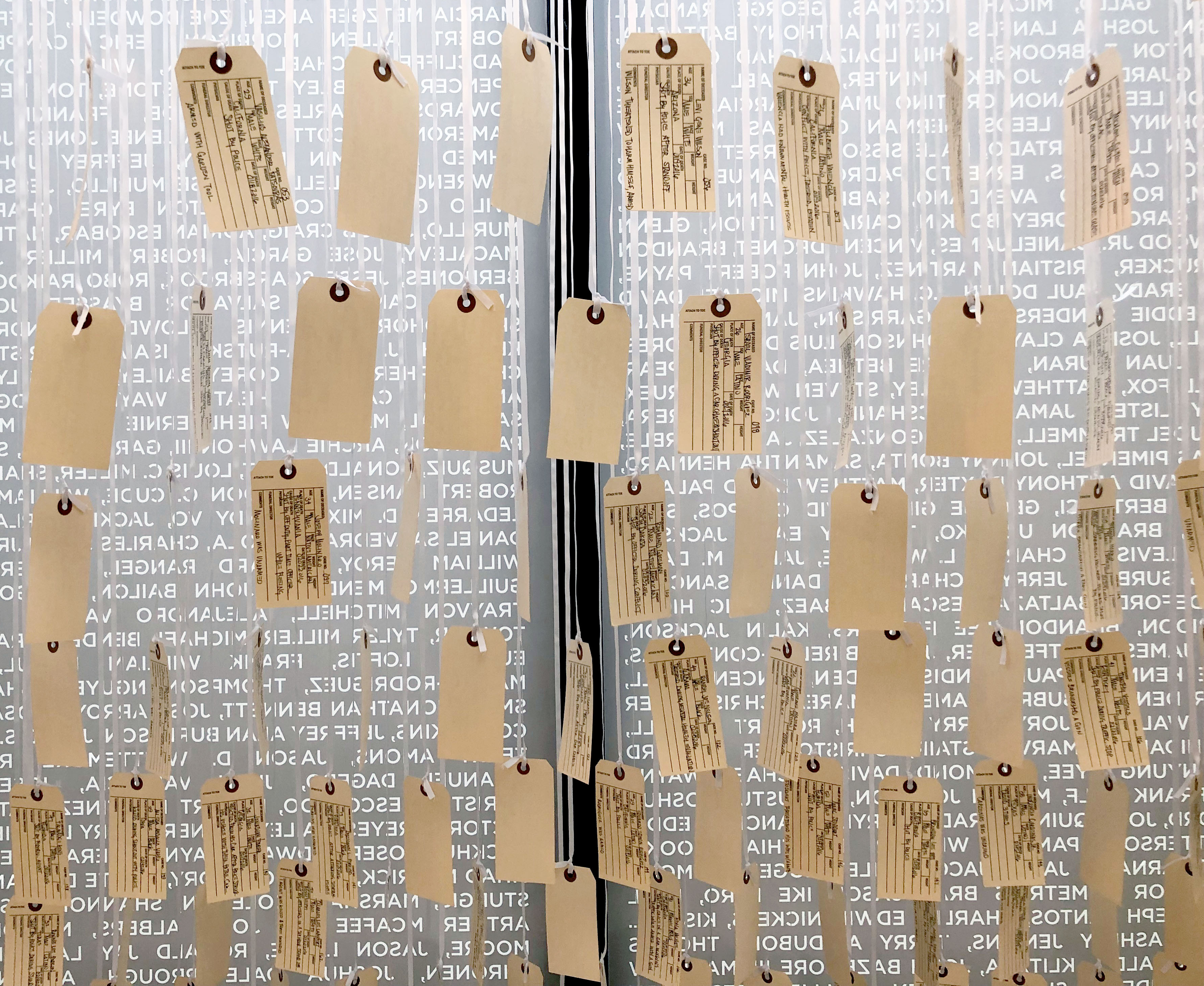
Pictured above are “…and counting” by Ann Lewis (each tag is filled out with the name of a person killed by police) and one of the group of portraits by Tracy Hetzel of women who have lost loved ones because of broken window policing. The one pictured is of Gwen Carr who is holding a picture of her son Eric Garner.

This show ends on 10/8/19.

Oct 032019
 

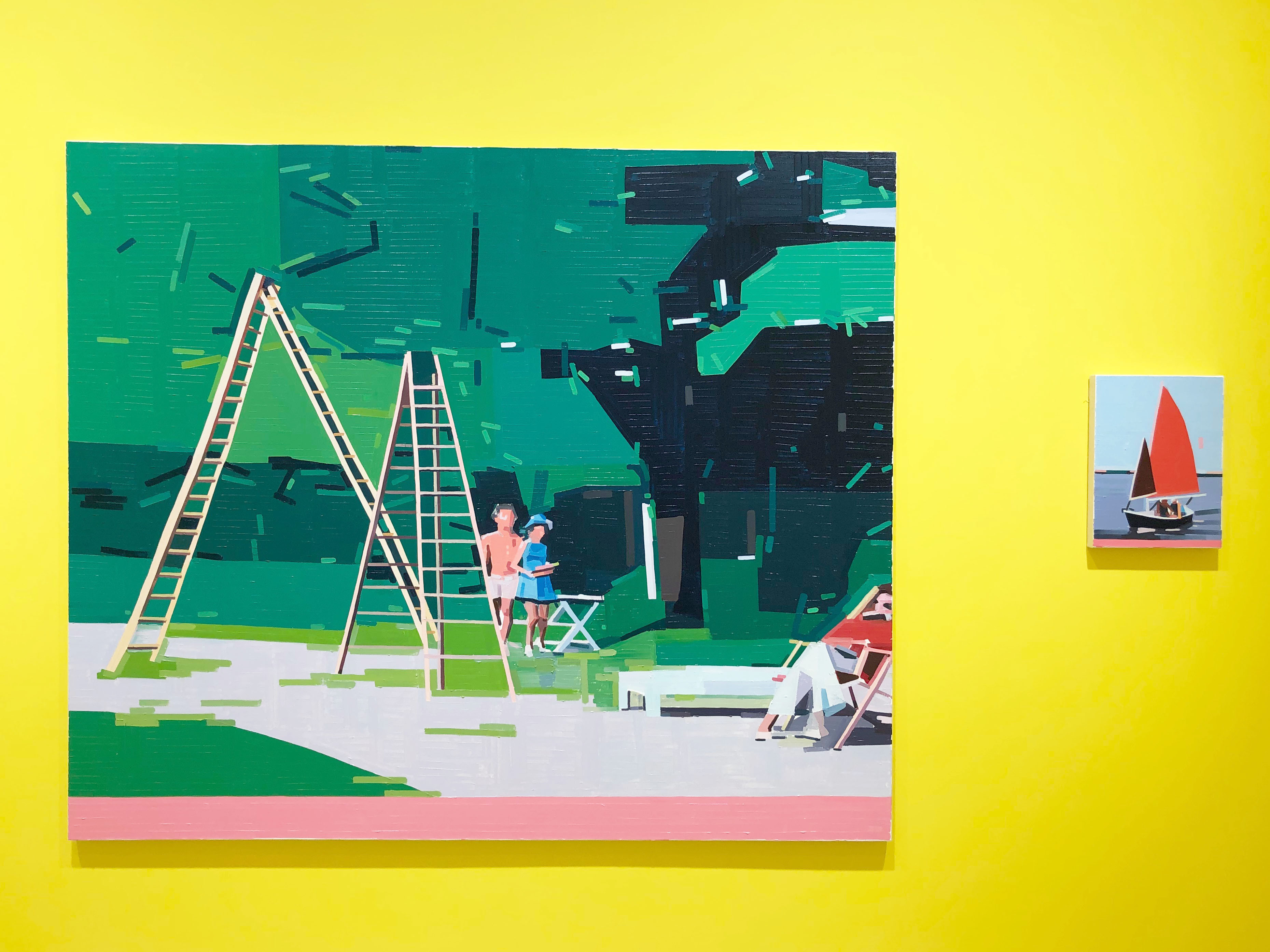
“Lake Annecy”, 2019 and “Sailboat”, 2019

Lake Annecy, 2019 detail

Currently at Miles McEnery’s gallery locations in Chelsea are two engaging painting exhibitions.

Guy Yanai’s paintings, at the 21st Street location, are created with strips of oil paint and are fascinating to walk up close to, observing the details, and then to pull back from to see as a whole. He also chose a bright yellow for the walls of the gallery to be painted, which brings out the colors of the paintings even further.

From the press release–

Guy Yanai strips his subjects down to geometric necessity and builds them back up again in oil paint, establishing a tension on his canvases between the spatially flat and the physically multidimensional. A combination of diagrammatic delineation of form and vivid color, Yanai’s paintings are an optical delight.

Yanai accomplishes this willful distillation of his subjects by painting obsessively in tight chromatic strips. While from afar the individual brushstrokes fade into the larger landscape, up close one can notice the stops and starts of each metered stroke. This synthesis speaks to Yanai’s desire for his works “to have such tension that if you take out one brushstroke, the painting will collapse.” The smoothness and uniformity of his taut oil bands offer a linear precision that can only be accomplished by the most disciplined draftsman.

While Yanai harkens back to modernist masters such as Matisse and Cézanne, his compositions are pixelated in a manner that is fundamentally contemporary. The collection of short and disconnected brushstrokes merge in the viewer’s eye to create a fully realized image. Yanai’s paintings experiment with the digital in contemporary art. “As beholden to the virtual imagery of the internet as to the history of modernism,” Ara H. Merjian writes in his essay, Élan Vital, “Yanai’s work proves beguilingly complex despite – or rather, precisely in – its congenial simplicity.”

Often revisiting the same subject, he paints from memory – of a place, of a moment, of a feeling. Just as recollections brighten and fade in the mind over time, Yanai recalls his own inspirations and recreates them in different ways as they evolve. What results is a proliferation of works that demonstrate Yanai’s rich meditation on his experiences. Whether an open window or an ocean view, Yanai’s nostalgic passion has a lasting impact on its viewer.

At their 22nd Street location are Brian Alfred’s colorful graphic paintings of places in New York City.

“W. 4th St.”, 2018-2019

“Central Park at Dusk”, 2019

From the press release-

Alfred navigates these complex themes using an approach characterized by sharp lines and blocked colors. Tightly-cropped compositions manipulate the viewer’s perception of space, conflating overlapping buildings, signage, and other urban elements. These vibrant, city-shaped configurations capture ephemeral moments: the view through the gap between two skyscrapers, the contour of a passing storefront from a car window, and a downward glance into a subway entrance. While they might not last long, these unique fields of vision are fundamental parts of the experience of the city.

Both of these exhibitions close 10/5/19.

Sep 202019
 

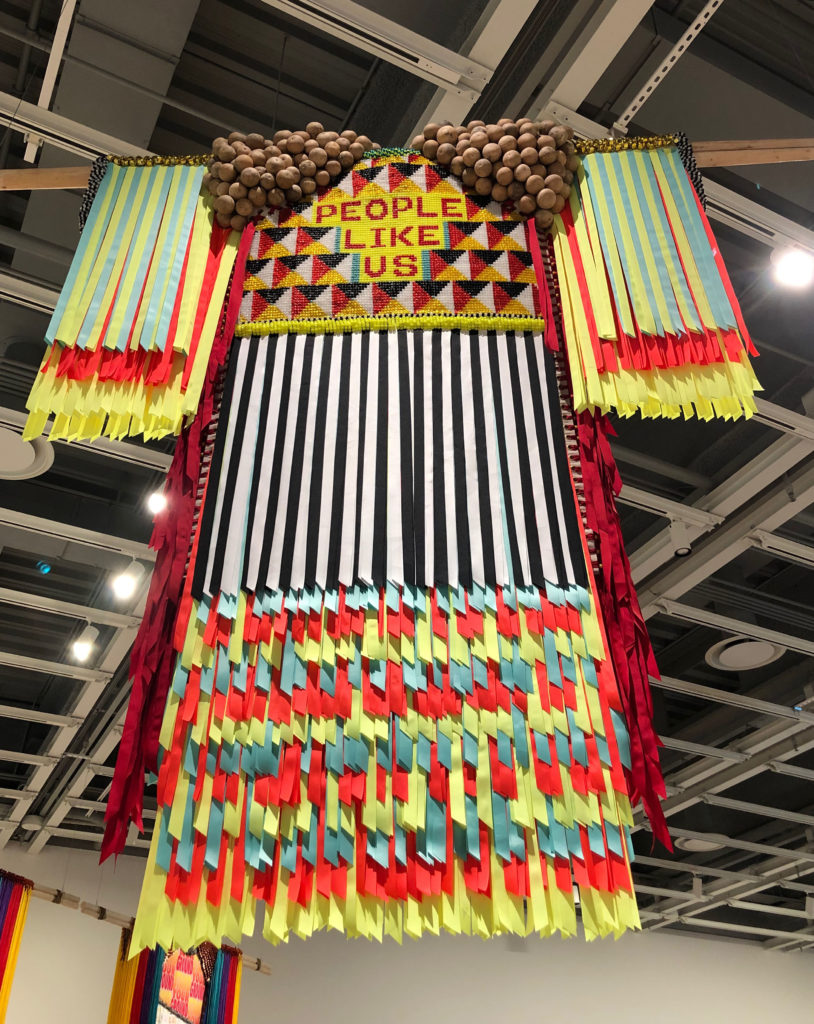
Jeffrey Gibson, “PEOPLE LIKE US”, 2019

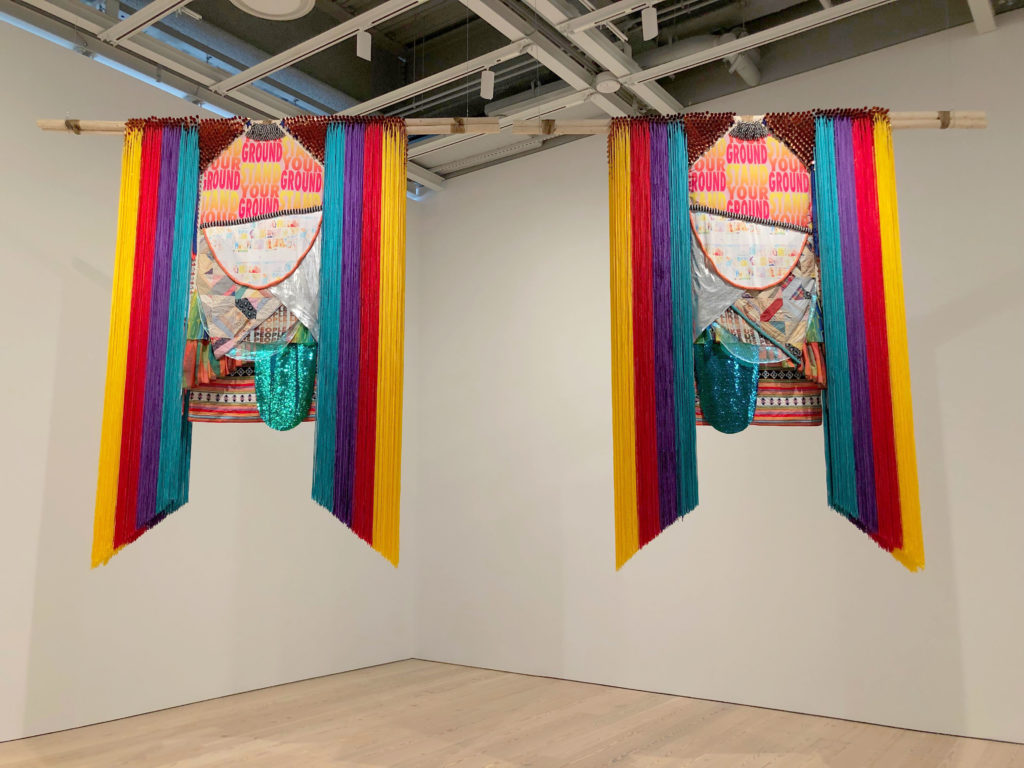
Jeffrey Gibson

2019’s Whitney Biennial presents an interesting selection of work, by a mostly young and diverse group of artists. The works included in the show are consistently good, and often intriguing, but this time around nothing is particularly outrageous or polarizing- a contrast to many of the previous iterations.

Not that there wasn’t any drama surrounding the show. This time around, however, the controversy was not with an artwork but with former Whitney executive board member Warren B. Kanders and his ownership of Safariland, a tear-gas canister maker. He has since resigned after protests and threats of withdrawal from several of the artists included in the show. Artist collective Forensic Architecture’s film, Triple Chaser, on view in the exhibition, investigates Safariland and Kanders.

Below are a few highlights from the exhibition.

Janiva Ellis ” Uh Oh, Look Who Got Wet”, 2019

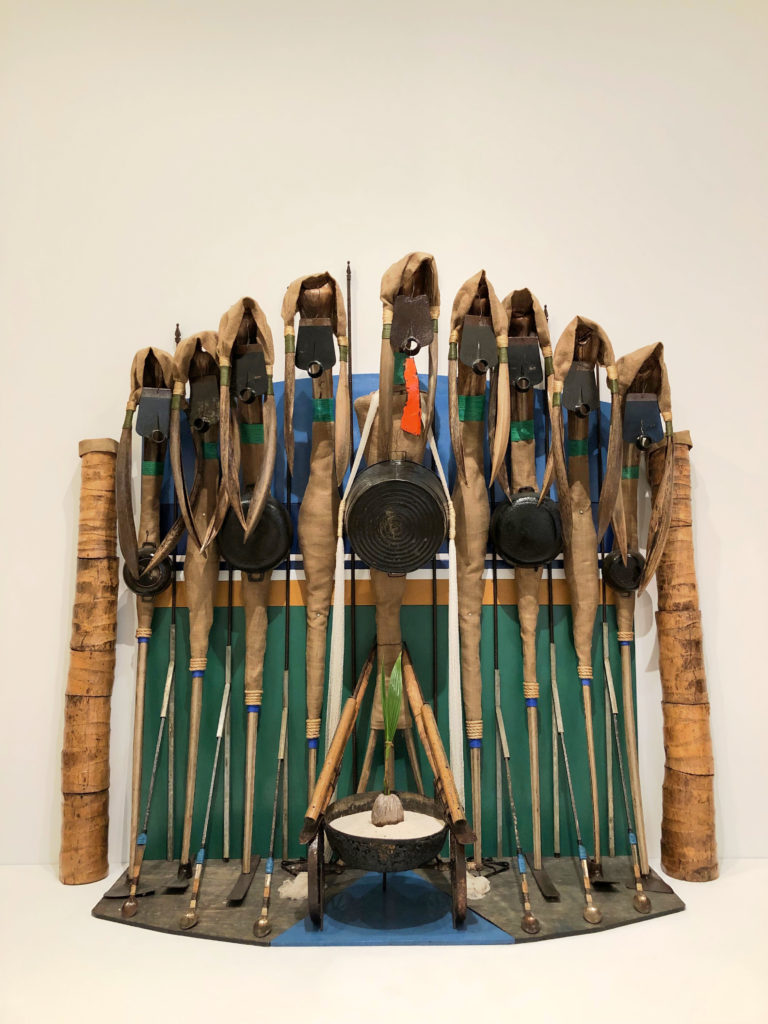
Daniel Lind-Ramos, “Centinelas (Sentinels)”, 2013

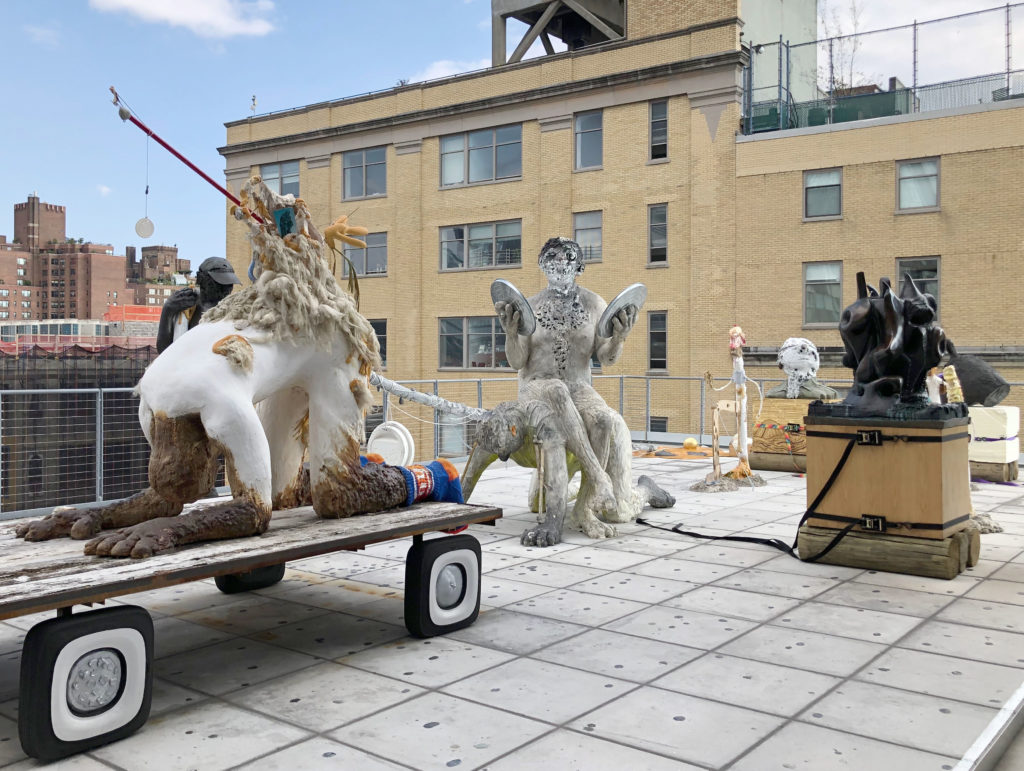
Section of Nicole Eisenman’s, “Procession”, 2019

This exhibition closes 9/22/19.


Jul 202019
 

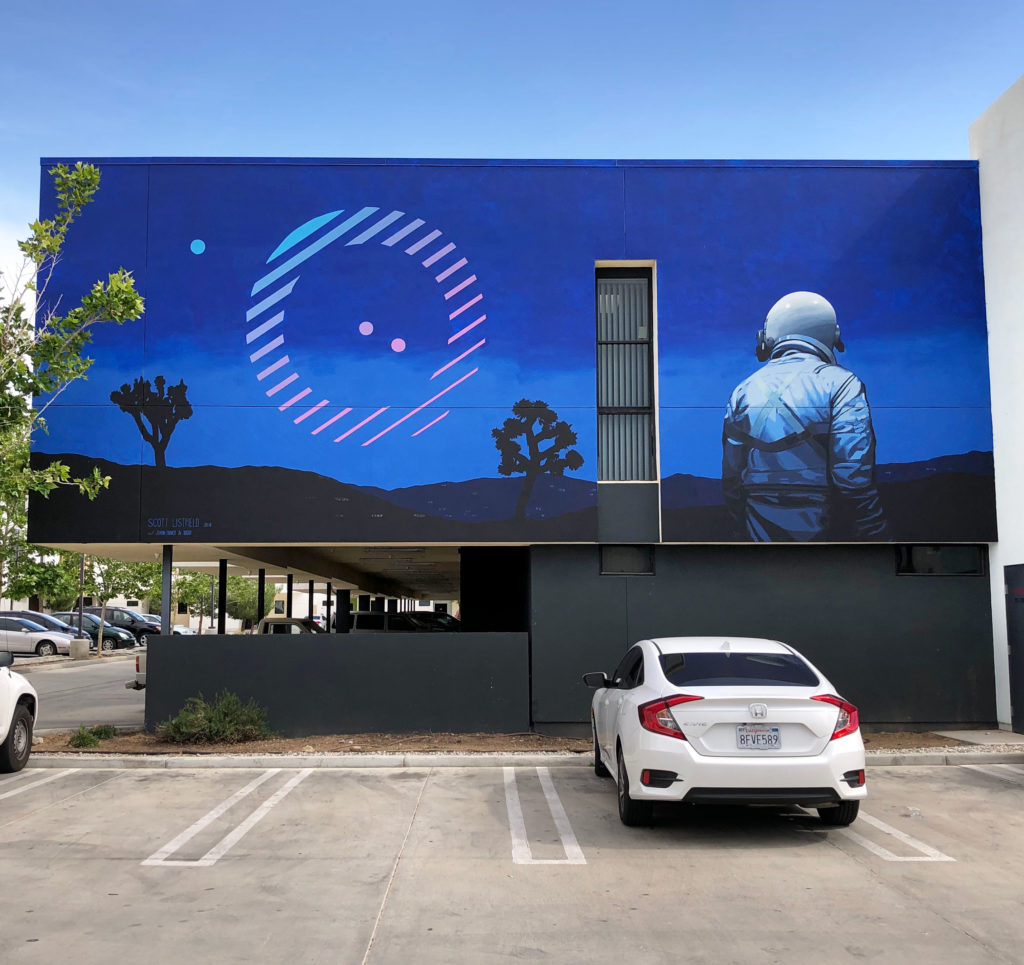
The image above one of the many murals created for POW! WOW! Antelope Valley 2018. POW! WOW! creates mural festivals in different locations around the world.

The work shown above is by artist Scott Listfield. To see more of his work check out his website and Instagram.

Tomorrow (7/21/19) begins a week of programming for POW! WOW! Long Beach. Events include panel discussions, a movie screening, a photography show and more.
Jul 192019
 

Woven Stories, at the Museum of Art and History (MOAH) in Lancaster, is a collection of narrative fiber artworks as well as five solo exhibitions and five site specific installations. There are so many great pieces in the show it was hard to narrow down which artists to include, but below are a few that stood out.

Victor Wilde, Momma Bears, 2019

Vojislav Radovanovic, TWO SIDES OF A LUCID DREAM, 2018

Vojislav Radovanovic, TWO SIDES OF A LUCID DREAM, 2018

Orly Cogan, Confections

Orly Cogan, Sugar ‘n Spice ‘n Everything Nice

Upstairs, the solo exhibitions are equally impressive. Several of these artists utilize nontraditional materials to create their unique work.

Nicola Vruwink uses the film from cassette tapes instead of traditional yarn to create her pieces.

For her large sculptures, Elisabeth Higgins O’Connor, uses materials from second hand shops. The pieces of broken furniture and scraps of fabric form animal figures caught in awkward poses.

Elisabeth Higgins O’Connor, Blamethirst

Peter Hiers’ sculptures are made from found scraps of tires. Using this discarded material, he gives new life to what would ordinarily be littering the sides of highways.

Peter Hiers, Circular Logic, 2010

This exhibition closes 7/21/19.

While in Lancaster, make sure to also check out MOAH Cedar nearby, which is showing Collateral Damage, an immersive installation by Snezana Saraswati Petrovic.


Jun 272019
 

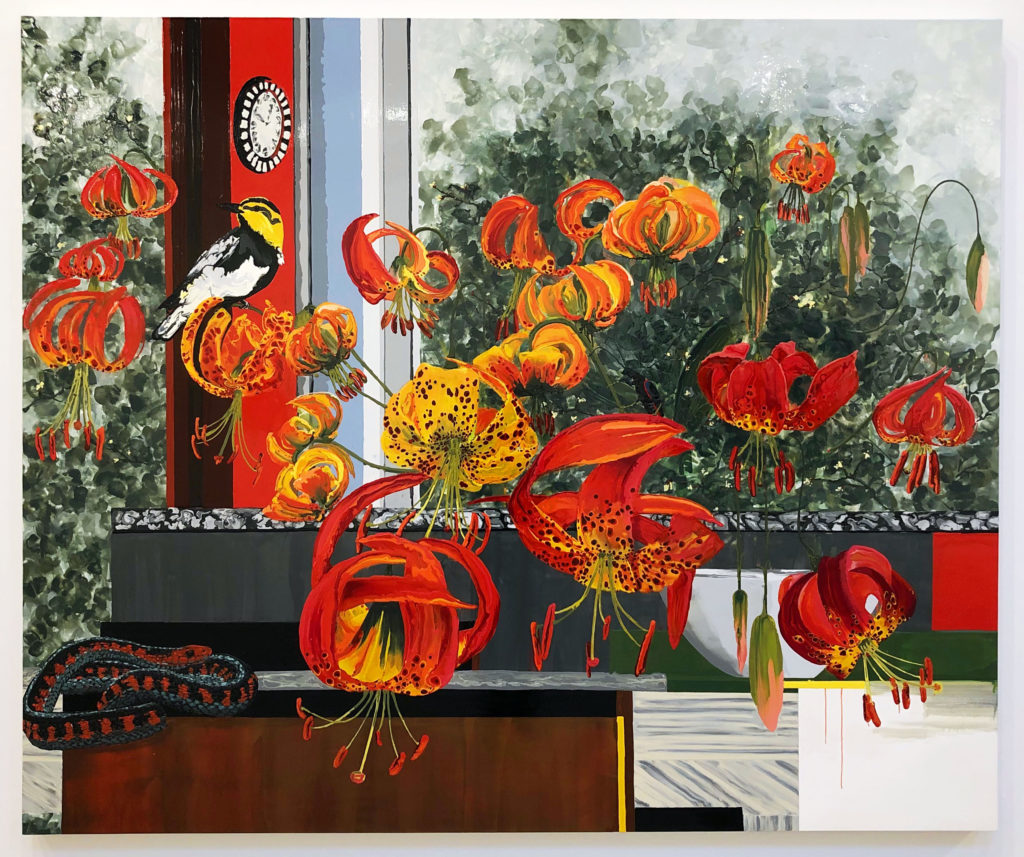
This is the last week to see Kirsten Everberg’s painting exhibition, Life Still, at 1301PE before it closes on 6/29/19.

From the press release–

With a new body of work that is based primarily on the genre and history of Dutch Golden Age still life paintings Everberg replaces the traditional elements with plant and animal species simultaneously listed as extinct or endangered, native and non-native. Symbolic not just as demonstrations but for their ability to transcend deceptively “earthy splendors”, these paintings have the capacity to create meaning in the larger moment we find ourselves in while being contained primarily in architectural settings. Everberg’s attention to detail is highlighted by the shifting perspective that is at the same time unstable and precise, and the scale is amplified, elevating the objects and creatures to sometimes imposing monumentality, refusing to be unseen or marginalized.

Using a unique combination of oil and enamel paint, Everberg’s works hover between representation and pure paint. There is always a tension here between the convincing depiction of space and the abstract skeins of color that dance across the canvas. What appears to be the exterior of a house or a dense jungle from far away is reconfigured into glossy pools of paint close-up. Everberg’s mastery of her medium is demonstrated by how deftly she walks this line. Narrative and image; truth and fiction; surface and what lies beneath – are all woven together in her captivating works.