Murals of La Jolla is a project started in 2010 by The Athenaeum and the La Jolla Community Foundation. It commissions artists to create work to be displayed on buildings around La Jolla. The works are on view for a minimum of two years (a map of current work here)
The above work is Favorite Color (2010) by Roy McMakin.
From the Murals of La Jolla website regarding this work-
…“The idea was very simple. I have always, since a child, been intrigued at both my own emotions around color preference, and also others. It has been important, and part of my identity to know what my favorite color is. I often recall times that I discussed color with my friends as a child and the talk always centered around preference. And I have found as an adult that most people still enjoy sharing what their favorite color is.”
“My proposal for the wall in La Jolla was to create a visual document of what a somewhat arbitrary group of people, of various ages, etc., choose as their favorite color. I began the process by asking people their favorite color, and then I presented them with a selection of 4 to 6 colors, of which they choose the one that was closest to the color they liked best. For example, if someone said “blue”, then I showed them blue swatches and they chose one. One square was painted that color. I like the idea that this takes place at a certain time, and that the ultimate form of the mural was dictated by the number of folks that showed up.”
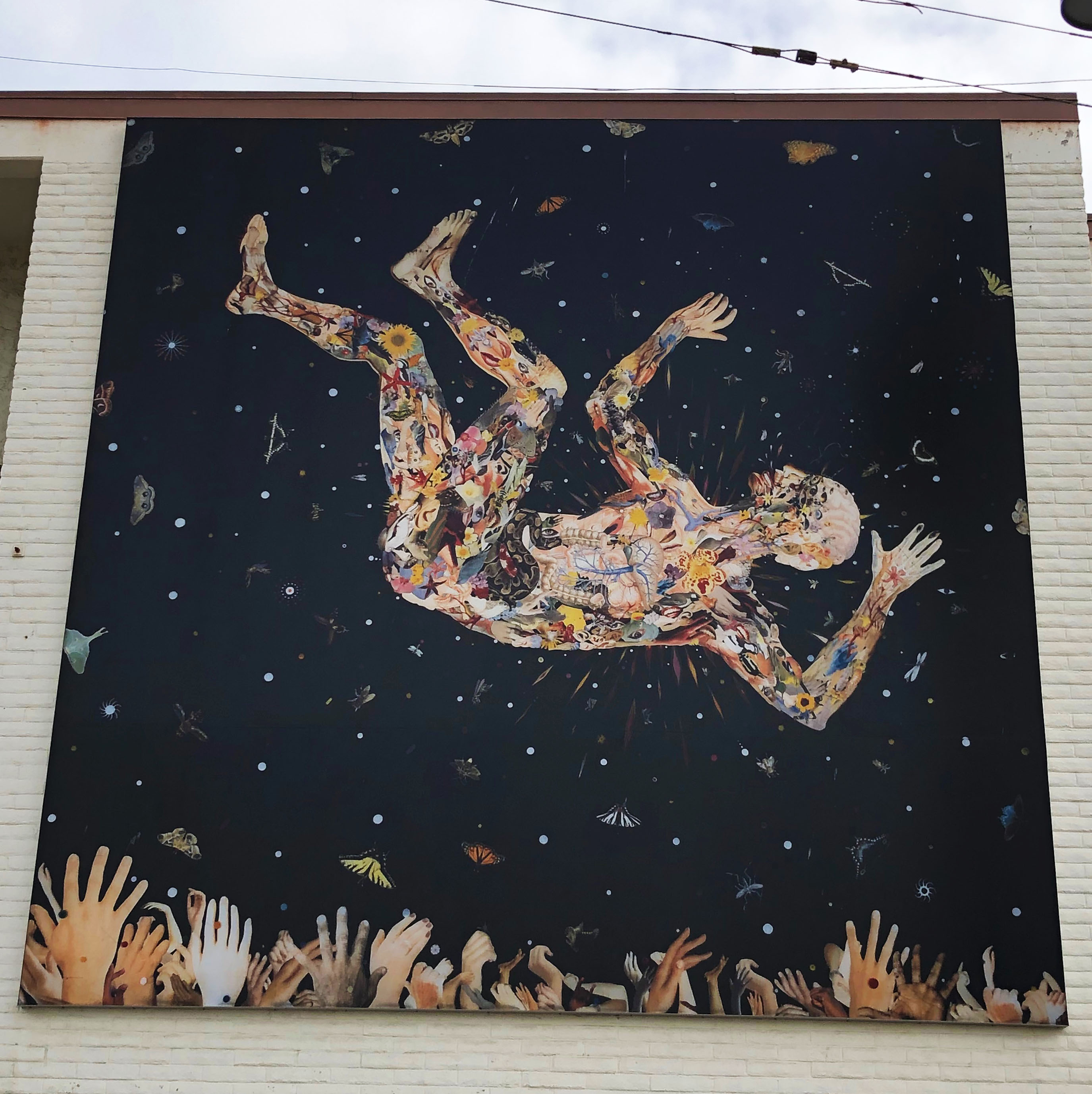
Murals of La Jolla is a project started in 2010 by The Athenaeum and the La Jolla Community Foundation. It commissions artists to create work to be displayed on buildings around La Jolla. The works are on view for a minimum of two years (a map of current work here)
The above work, Expecting to Fly (for the Zeros), 2013, is by Fred Tomaselli and honors Chula Vista based Chicano punk band, The Zeros.
From the Murals of La Jolla website about the work-
It combines cutout images of insects, animals, plants, butterflies, birds, and body parts to create a visionary image of a man falling through space. The title of this work, Expecting to Fly, is the title of a song written by Neil Young and performed by Buffalo Springfield in the late ’60’s. The man falling through space can be read as a crowd surfer, an image that comes out of the Punk Rock movement. One traditional idea of the “sublime” deals with losing oneself to the vastness of the universe. In this case, the crowd-surfer is losing himself to the vast, collectivist “organism” of the crowd. “In this piece I try to find commonalities in the pursuit of a modern sublime that stretch through time and past ideologies”.
The Second Home Serpentine Pavilion, designed by Spanish architects Lucia Cano and Jose Selgas of SelgasCano, is a bright and colorful addition to the park that houses the La Brea Tarpits and LACMA.
The installation will be up and accessible to the public until 11/24/19 (although tickets are available for Monday 11/25 and Friday 11/29). Get free tickets here.
Murals of La Jolla is a project started in 2010 by The Athenaeum and the La Jolla Community Foundation. It commissions artists to create work to be displayed on buildings around La Jolla. The works are on view for a minimum of two years (a map of current work here)
The above work, Tear Stains Be Gone, was created by Jean Lowe in 2015 and is still on view as of this writing in 2019 at 7661 Girard Avenue.
Line Drawing for Shirt and Cloak presents a complex reflection on desire, consumption and surrender using contemporary activations of the storefront as a vehicle for expressing both emotional and aesthetic intent. With a highly honed metal strategy and the artist’s entire wardrobe, this multi-faceted installation represents a conscious movement toward the freedom found when one’s appetite and the world’s insistence asks for everything, and a moment of clearing when emotive freedom is found.
Referencing the exhibition’s title, the gallery will be transformed by a series of free-standing and wall-mounted metal structures that demarcate the interior of the space, forming a series of line drawings onto which varying sculptural and quotidian works will hang. Additional sculptural forms supported by large stone pillars and large metal and wood platforms form the basis of an extant atelier. In preparation for the exhibition, Gates will transform his entire wardrobe into many smaller symbolic works, which will be placed en masse as a large sculptural work. This body of work, while a departure in material motif, underscores Gates’ ongoing interest in both the transcendental acts of reclusion and denouncement, and his inability to totally reconcile his appetite for spiritual truth with his competing desire for the things of this world. Through painting, sculpture, sound, and up-cycling, Gates continues to find truth in the unseen and evidence growth in ways unexpected.
A new vocal score conceived of and performed by Gates punctuates the exhibition space. The lyrics of the piece playfully riff on the biblical verse from which the exhibition’s title is inspired, and offer an explication for the artist’s metamorphosis.
“I’ve always been a lover of material things; fashion, antiques, adornment. A believer in the beautiful. But in this moment, I’ve never felt more need to question my own contempt and appetite. This process is not a spiritual attempt; it’s actually quite worldly. I can’t feel growth because I’m weighted by the things around me and people can’t see my growth. The accumulations are a distraction. But the title has much to do with what happens when the world charges you – the outside forces that judge and gnaw and hate. If the world wants to pursue me for this shirt, well, they can have it all.
The sculptural intent of the show is to introduce an unexpected spatial strategy at Regen that gives me permission to be free of conventional gallery tropes and form a set of new sculptural dictates that consider more of the everyday world of fashion and street activity. The project is a minor response to the growth of interest that the fashion world has in art and perhaps my own reckoning with the power of the hyper-public, hyper-everyday considerations that fashion affords. I’m in dialogue with Willie Wear, Girbaud, the Prada concern, retail projects in China, the historic fashions that Chicago House Music produced, and my mama’s church hats. While none of these things need to be immediately perceived, they are no-less present.” –Theaster Gates, 2019
Closing 11/2 at Tanya Bonakdar’s Los Angeles location is Ernesto Neto’s interactive exhibition Children of the Earth.
From the press release-
In Children of the Earth, Neto creates an alluring environment of color, materials, fragrances and sound, transforming the gallery into a living organism, where visitors are encouraged to wander, touch, feel, interact and connect.
Upon entering the gallery, a curtain in green and brown patterns invites the viewer to walk through a tunnel-like path which leads to the main gallery space. Entitled Children of the Earth, a large-scale installation of crochet, spices and leaves hangs from the ceiling to the floor. The large biomorphic shape—hand knitted in vibrant colors of yellows, greens, purples and reds—is flanged by drop-shaped crochet vines that serve as counterbalance and establish the delicate equilibrium of the piece. Here, references to nature interconnect with formal questions of tension, gravity and weight. On the floor, tracing the outline of the structure above, a soft surface of handmade textile is installed. Ceramic vases sprout from the ground, representing the diversity of peoples inhabiting the planet, and that ultimately, we are all the children of the earth. Musical instruments, spices, and crystals comprise an integral part of this malleable, highly tactile sculpture, which engages the five senses, and invites viewers to connect with one another in new and meaningful ways. In expanding the boundaries of physical space and calling for a new type of interaction, Neto creates an experience that is physical, sensorial, intellectual and social all at once.
Surrounding the piece, as another layer of skin, hand-sewn fabric hangs. The organic pattern and color pallet further recall the natural world, as they invoke the forest, wood grain, or the circulatory system of a plant. The path the visitor follows throughout the space, and from within the piece—like an organic line in nature—is analogues to Neto’s conception of life where there is “no separation between humans and nature, nor between art making and art experience”, highlighting that in the exhibition, as in life, everything is connected.
In the back gallery a hanging platform with a crochet canopy and crochet tendrils is installed. Designed for direct interaction, this is a healing bed that offers a moment of rest and respite, where people can connect to themselves, as to one another. The tendrils function as ‘connectors’, as they amplify the pulse of life while connecting us to the environment and to our own physicality. Embracing the participant in its serenity, the healing bed investigates the meeting point of art, sensation, personal connection and the human body.
The exhibition as a whole connects mind, body and nature through a sensory experience that is unmediated. It is an invitation to connect to ourselves and to our planet at a time when connectivity is most needed. For Neto, sculpture is an extension of the body, and the body is ultimately an extension of earth.
Located in LACMA’s B. Gerald Cantor Sculpture Garden among the sculptures by Rodin is Zak Ové’s sculptural installation, The Invisible Man and the Masque of Blackness.
From the LACMA’s website-
The title’s references—Ben Jonson’s 1605 play, The Masque of Blackness, and Ralph Ellison’s 1952 novel, Invisible Man—mark two milestones in black history: the first stage production to utilize blackface makeup, and the first novel by an African American to win the National Book Award. In addition to literary references, the artist draws inspiration from Caribbean Carnival, a festival that originated from the Mardi Gras celebrations of the region’s French colonists, and Canboulay, a parallel celebration in which enslaved people expressed themselves through music and costume and paid homage to their African traditions. The installation’s 40 graphite figures stand tall and dignified to represent the strength and resilience of the African diaspora.
In the the video below, Ové provides some interesting insight and information on the work.
This exhibition closes 11/3/19. LACMA is free for residents with ID from 3pm and is open late on Fridays until 8pm.
The exhibition revisits the Surrealist encounter with the anti-colonial movement in the Caribbean to consider present forms of coloniality and its relation to climate justice. The artists have taken inspiration from the radical and transformative collection of poems by Martinican poet and politician Aimé Césaire under the same name. The term “cadastre” refers to the means by which the territorial limits of private property are publicly registered. Taking cue from the powerful mechanics of Césaire’s writing, Allora & Calzadilla’s exhibition Cadastre brings together three works all informed by a poetics of mark making, traces, and survival.
In April 1941, the anti-colonial Martinican poets and theoreticians Susanne and Aimé Césaire, founders of the literary journal Tropiques, met with a group of artists and intellectuals fleeing Nazi-occupied France, whose boat had temporarily docked at the West Indian port of Fort-de-France. The refugees included Helena Benitez, André Breton, Wifredo Lam, Jacqueline Lamba, Claude Lévi-Strauss, André Masson, and Victor Serge, among others. Penumbra takes as its point of departure the now mythic hikes the group took in the gouffre d’Absalom valley in Martinique, which served in part as inspiration for Lam’s masterpiece, The Jungle. Penumbra is a soundscape of “shadow tones,” a psycho-acoustic phenomenon perceived when two real tones create the semblance of a third. The original musical composition by David Lang uses nonlinear distortion of violin sounds to evoke the sensation of walking through that tropical forest.
In Graft, thousands of cast blossoms of the Tabebuia chrysantha tree, a common native species in the Caribbean, appear as though a wind had swept them across the gallery floor. Graft alludes to environmental changes set in motion through the interlocking effects of colonial exploitation and global climatic transformation. Systemic deforestation and depletion of the Caribbean’s original flora and fauna is one of the primary legacies of colonialism. Nevertheless, the Caribbean remains a biodiversity hotspot and, along with thirty-five other hotspots worldwide (which amount to just 2.4% of the earth’s land surface), supports nearly 60% of the world’s plant, bird, mammal, reptile, and amphibian species. As rising global temperatures result in more frequent and violently destructive weather, adding even more pressure to the Caribbean, the uncanny presence of tropical tree blossoms in Graft stands as a potent harbinger for the immeasurable losses that continue unabated after centuries of colonial plunder.
Measuring 6 feet in height and 70 feet in length, and covering the east and south walls, the exhibition’s eponymous work, Cadastre takes electromagnetism as its subject and medium. To make the work, Allora & Calzadilla dropped iron filings on top of a canvas and placed it above an array of copper cables connected to an electrical breaker in the artists’ studio in San Juan, which gets its power from the Puerto Rico Electric Power Authority. When the breaker is turned on, the electrical current causes the iron particles to self-organize into a composition of lines and shapes governed by the electromagnetic field. As the Latin title and full subtitle (Meter Number 18257262, Consumption Charge 36.9kWh x $0.02564, Rider FCA-Fuel Charge Adjusted 36.9 kWh x $0.053323, Rider PPCA-Purchase Power Charge Adjusted 36.9kWh x $0.016752, Rider CILTA-Municipalities Adjusted 36.9kWh x $0.002376, Rider SUBA Subsidies $1.084) suggest, the work probes the propriety politics of electricity and the power grid. Cadastre is part of a continuum of multiple sites and actors that the artists are probing through their artistic process working with electricity, from the oil futures market, to the transnational holders of PREPA bond debt, to the local consumers who are forced to pay for the recently privatized power company’s fiscal mismanagement.
This exhibition closes 11/2/19.
Recently, their film, The Great Silence, was shown at Marciano Art Foundation in Los Angeles. It is subtitled with thoughts from the perspective of an endangered Puerto Rican parrot who lives in the same area as the Arecibo Observatory, which was created to capture and transmit radio waves from and into outer space. The parrot questions why humans look to communicate and make a connection with extraterrestrial life, when there are parrots who can potentially use human language nearby.
It’s a thought provoking and moving piece, well worth a watch.
This new body of work consists of a series of paintings and one sculpture that revolve around three dualities: our alienation from and interconnectedness with all that there is, the absurdity and redeeming possibility of embarking, and the tension between promise and risk. The imagery brings together skaters, ice-covered lakes, black apple trees, golden landscapes, bullfighting, moonlit butterflies, and whale bones. The work featured in The Tears of Things continues Martínez Celaya’s concern with displacement and exile in its psychological sense, while deepening his ongoing exploration of the limitations and possibilities of art’s capacity to reveal or create meaning.
Martínez Celaya is widely celebrated for a practice that arises from sustained engagement with literature, poetry, philosophy, and science, as well as his own writing practice. An artist, author and former physicist, he works in a variety of mediums and materials that include oil, wax, tar, mirrors, dirt, steel, silk and bronze, which he weaves together with physical, emotional and conceptual qualities into a multi-layered exploration of the human condition evoking both immediacy and timelessness. His practice is laden with a depth of textures and philosophical touchstones, often incorporating elements of mysticism and fairy tales, yet he creates works that resist narrative interpretations. His paintings, sculptures, photographs and environments address universal questions about life and the individual experience, loss, memory, failure and one’s place in an emotionally radiant yet chaotic world.
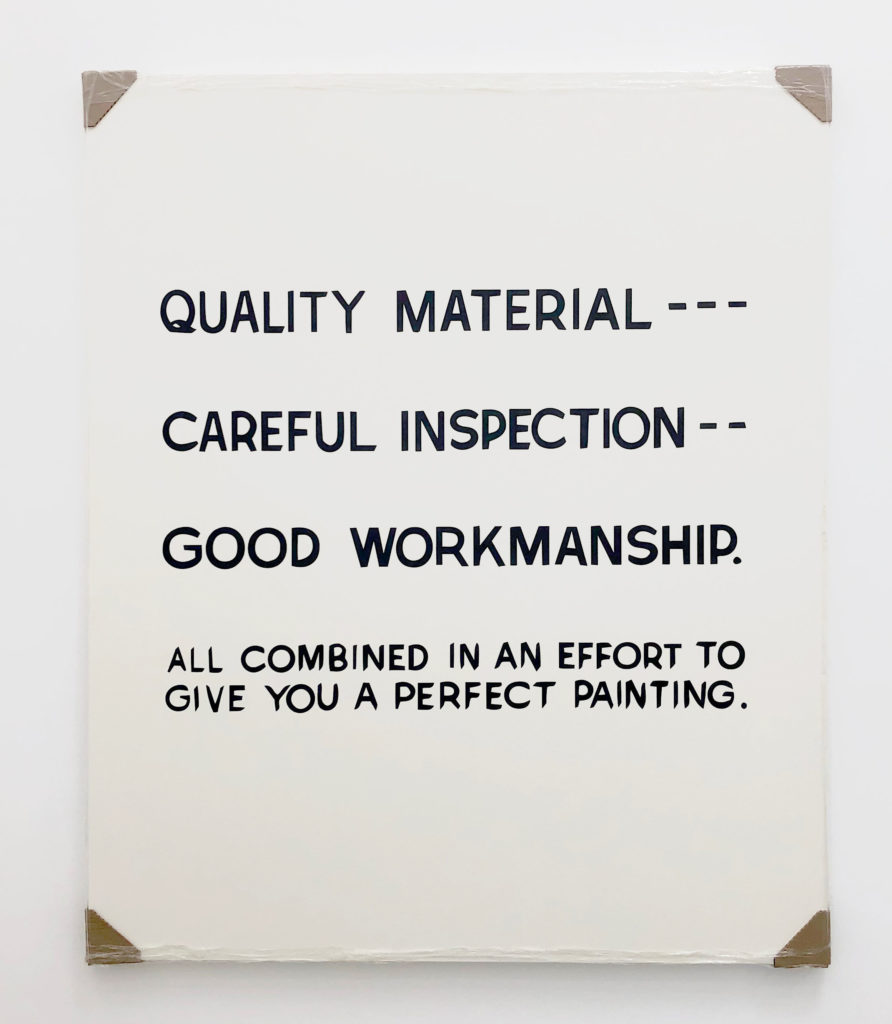
Tammi Campbell’s exhibition Boring Art at Anat Ebgi in Culver City takes on the male dominated art world canon in a fun way. She’s recreated iconic works and then covered them with bubble wrap, packaging tape, and cardboard corners. But yet those materials are an illusion. They have been made with acrylic painting medium.
From the press release-
The gesture of covering these works emphasizes the preciousness of the goods they contain, while simultaneously highlighting the frequently invisible network of art world laborers, art handlers, shippers, registrars, studio assistants, etc. who support and care for them as they circulate. The coverings also obscure the originals and draw our attention to their fixed state of transition.
…Campbell is concerned with memorializing art history, while also making a break from it. Her work literally envelopes, secures, and mummifies historical paintings; it asks viewers to ponder what is valued and allows us to imagine making room for something new. Full of contradictions, Campbell’s work pays homage to the past, while simultaneously taking it hostage.
The title, Boring Art, is a reference to John Baldessari’s I Will Not Make Anymore Boring Art, but this exhibition is anything but dull. See it before it closes on 10/26/19.