Oct 142024
 

The Agua Caliente Cultural Museum opened in 2023 in its new location in Palm Springs as part of the Agua Caliente Cultural Plaza. It consists of several exhibition areas that tell the story of the Agua Caliente Band of Cahuilla Indians. These include an immersive digitally animated film in a theater at the entrance, scale replicas of the Indian Canyons, and videos, historical photographs and documents. The museum also includes several artifacts including those found during excavations for the plaza that are over 7,000 years old.

The museum also has a gallery for rotating exhibitions focused on traditional and contemporary Native American art. Currently on view is For a Love of His People, the black and white photography of Horace Poolaw.

From the museum

Horace Poolaw (Kiowa, 1906-1984) was born during a time of great change for his people—one year before Oklahoma statehood and six years after the U.S. government approved an allotment policy that ended the reservation period. A rare American Indian photographer who documented Indian subjects, he began making a visual history in the mid-1920s and continued for the next 50 years.

Poolaw photographed his friends and family, and events important to them—weddings, funerals, parades, fishing, driving cars, going on dates, going to war, playing baseball. When he sold his photos at fairs and community events, he often stamped the reverse: “A Poolaw Photo, Pictures by an Indian, Horace M. Poolaw, Anadarko, Okla.” Not simply by “an Indian,” but by a Kiowa man strongly rooted in his multi-tribal community, Poolaw’s work celebrates his subjects’ place in American life and preserves an insider’s perspective on a world few outsiders are familiar with—the Native America of the Southern Plains during the mid-20th century.

Organized around the central theme of Poolaw as a man of his community and time, For a Love of His People is based on the Poolaw Photography Project, a research initiative established by Poolaw’s daughter, Linda, in 1989 at Stanford University and carried on by Native scholars Nancy Marie Mithlo (Chiricahua Apache) and Tom Jones (Ho-Chunk) of the University of Wisconsin-Madison.

For a Love of His People: The Photography of Horace Poolaw is organized by the Smithsonian National Museum of the American Indian. The exhibition was curated by Tom Jones (Ho-chunk) and Nancy Marie Mithlo (Chiricahua Apache).

Below are a few selections from the show-

Aug 142024
 

Frey House I (1940) as pictured in House & Garden magazine, January 1948

More images of Frey House I

Palm Springs is famous for its mid-century modern architecture and architect Albert Frey played a large part in creating that legacy. Palm Springs Art Museum’s Architecture and Design Center’s Albert Frey: Inventive Modernist celebrates his career with a creatively curated show filled with an extensive collection of historical photographs.

From the museum-

Albert Frey (American, born Switzerland, 1903-1998) helped to establish Palm Springs as a world-recognized center for modern architecture and design. He was the first architect to design a modern International Style structure for Palm Springs and paved the way for modern architecture and the architects that followed.

Steeped in early European modernism, Frey’s adroit handling of low-cost and low-maintenance industrial materials, sublime desert color combinations, and appealing geometric compositions give him a unique and permanent place in the idiom of “desert modernism” and succinctly expressed his two greatest loves—nature and architecture.

His mark on Palm Springs is indelible and includes such recognized icons as the Palm Springs City Hall, Fire Station #1, The Palm Springs Visitors Center, The Palm Springs Aerial Tramway Valley Station, The Loewy House, and his final home, known as Frey House II, as well as hundreds of other notable projects.

“….the sun, the pure air and the simple forms of the desert create perfect conditions for architecture.”

Albert Frey in a letter to Le Corbusier, 1935 about Palm Springs

More selections from the exhibition below-

In 1937, Frey left California to join the staff of Philip Goodwin who was commissioned to design the new Museum of Modern Art in New York. The museum has included documentation, photos and a model of the building- pictured above.

Above are stills taken from North Shore Yacht Club (1958), a promotional video for the structure that Frey built when the Salton Sea was a thriving resort destination. The refurbished building is now used for community events in Mecca, California.

The Tramway Gas Station, pictured above, is now the location of the Official Palm Springs Visitor Information Center.

From the museum-

At the same location where some 23 years earlier Clark & Frey had designed the graceful stone entry gates to Palm Springs, Frey created another welcoming structure-the Tramway Gas Station, a bold and assertive monument. Architecturally speaking, its roof offers a hyperbolic paraboloid design. Its cantilever suggests a spectacular soaring bird and indicates that visitors were entering a decidedly mid-century modern, forward-thinking city. About its genesis Frey said, “When you think about what nature produces in fantastic forms, in birds and animals-that’s where creativity comes in.”

In 1996 the building was approved by the city for demolition, sparking the beginning of the mid-century preservation movement in Palm Springs. The building was saved by those who bravely stood up for and championed its daring artistry, its physical representation of a moment in time and place, and the legacy of Albert Frey.

This exhibition closes 8/18/24.

If you are a modernism fan, every year Palm Springs celebrates Modernism Week- this year with a four day event in October and next year a week long event in February.


Aug 012024
 

Sandra Cinto created the mural above in 2018 for Murals of La Jolla, in San Diego. The Murals of La Jolla project commissions various artists to create murals around La Jolla with 16 currently on view and 48 created in total.  A map of current work can be found here.

From the Murals of La Jolla website about this work

In Sandra Cinto’s mural, Untitled, we get lost in a vortex of lines that push and pull in every direction. Inspired by the immersive relationship of the ocean as a part of La Jolla’s Landscape, Cinto “decided to create another kind of landscape and make it by drawing without colors”. The artist intends for each viewer to have a different experience with the work as it is meant to be an open landscape. For Cinto, her work reinforces a kind of philosophy that each little mark is important, since “little details, little actions can change everything.” The viewer can be absorbed in the lines and details found in her work or step back and behold an undulating and pulsating landscape.


Feb 042023
 

This mural, Shesha Sand Storm, by Fin Dac and Starfightera (Christina Angelina), is on the side of the Desert Shores market near Salton Sea in California.

Jan 202023
 

Artist Alex Katz created this mural, Bill 2, a portrait of modern dancer and choreographer Bill T. Jones, in 2019 for Murals of La Jolla in San Diego. Murals of La Jolla is a project started in 2010 by The Athenaeum and the La Jolla Community Foundation. It commissions artists to create work to be displayed on buildings around La Jolla. A map of all the murals currently on view can be found here.

From the Murals of La Jolla website about the work-

Alex Katz’s mural, Bill 2, celebrates Bill T. Jones, one of the most noted and recognized modern-dance choreographers of our time. Executed in Katz’s bold and simplified signature style, Bill 2 depicts Jones’ visage, through a series of distinct expressions. The repetition of his face has a cinematic and lyrical quality, reinforcing his place in the world of dance, music and film. Portions of the face are dramatically cropped, giving the viewer only quick and gestural glimpses of Jones. Bill 2, is a striking homage to two artists, Katz and Jones, both renowned in their respective fields of visual and performing arts. The mural’s proximity to the new Conrad Prebys Performing Arts Center gives a nod to the interconnected worlds of art, music, and dance.

The Guggenheim museum in NYC is currently showing Alex Katz: Gathering, a retrospective of the artist’s work from the late 1940’s until the present. The exhibition will be up until February 20, 2023.

From their website about the exhibition-

Emerging as an artist in the mid-20th century, Katz forged a mode of figurative painting that fused the energy of Abstract Expressionist canvases with the American vernaculars of the magazine, billboard, and movie screen. Throughout his practice, he has turned to his surroundings in downtown New York City and coastal Maine as his primary subject matter, documenting an evolving community of poets, artists, critics, dancers, and filmmakers who have animated the cultural avant-garde from the postwar period to the present.

Staged in the city where Katz has lived and worked his entire life, and prepared with the close collaboration of the artist, this retrospective will fill the museum’s Frank Lloyd Wright rotunda. Encompassing paintings, oil sketches, collages, drawings, prints, and freestanding “cutout” works, the exhibition will begin with the artist’s intimate sketches of riders on the New York City subway from the late 1940s and will culminate in the rapturous, immersive landscapes that have dominated his output in recent years.

Bill T. Jones/Arnie Zane Company has numerous performances every year. Conceived and directed by Bill T. Jones, and choreographed by Jones with Janet Wong and the Bill T. Jones/Arnie Zane Company, the latest work, Curriculum II, will be performed at on March 10, 11, and 12, at the Institute of Contemporary Art Boston.

Jones also hosts the series Bill Chats at NYC’s The New School. On January 30th, he will be in conversation with Bessie Award-winning theater director and performance artist, Niegel Smith and curator, producer, and director, Kamilah Forbes. For more events check out the New York Live Arts calendar.


May 122022
 

Marcos Ramirez ERRE’s  Is All That it Proves, 2015, was created for Murals of La Jolla, in San Diego. Murals of La Jolla is a project started in 2010 by The Athenaeum and the La Jolla Community Foundation. It commissions artists to create work to be displayed on buildings around La Jolla. Information on his current mural for the project can be found here and a map of all the murals can be found here.

From the Murals of La Jolla website about the work-

Marcos Ramirez ERRE’s mural, All That it Proves, is a strongly stated, critical stance on what we perceive as the truth. He employs Thomas Paine’s famous quote as both a linguistic and visual exploration of the human condition and a challenge against long standing rhetoric. Paine’s quote is about understanding that our opinion is only that, our opinion. And our opinion is not necessarily the “truth”, while at the same time it may be. The piece deviates from its most obvious reference towards eyesight and becomes about another kind of vision, the kind of vision you perceive through common sense. True to his form as humanitarian artist, Is All That It Proves, exemplifies the notion that now, more than ever, we need to embrace tolerance and learn to respect individuals who chose to think in a way different than we do.

Marcos Ramirez ERRE has come to be defined by his clever visual arguments and masterfully crafted work that maintains a poetic sensibility, even when leveling biting political commentary. He was born in 1961 in Tijuana, Mexico. ERRE received his Law Degree from La Universidad Autónoma de Baja California. In 1983, he immigrated to the United States where he worked for seventeen years in the construction industry. His multi-disciplinary background has shaped his practice. He came to prominence in the 1990s with large public installations that dealt with migrants, immigration, and border control, specifically focusing on the Mexican-American border crossing. Much of ERRE’s work grapples with these issues.

Dec 112020
 

Kota Ezawa’s Once Upon A Time in the West, 2017, for Murals of La Jolla, in San Diego. Murals of La Jolla is a project started in 2010 by The Athenaeum and the La Jolla Community Foundation. It commissions artists to create work to be displayed on buildings around La Jolla. A map of current work can be found here.

From the Murals of La Jolla website

Kota Ezawa’s mural, Once Upon a Time in the West, pays homage to La Jolla’s landmark contribution to science and architecture. The mural image overlays a stylized portrait of architect Louis Kahn in profile onto a perspectival view of the Salk Institute’s courtyard and the Pacific Ocean beyond. The Salk Institute, located in La Jolla, has been a hub for groundbreaking scientific research since its inception by Jonas Salk in 1960. Kahn was handpicked by Salk to design a flexible laboratory space that would be conducive to the constantly evolving needs of science. Ezawa portrays Kahn deep in thought as the modern, bold architecture of the Salk is depicted behind him. The use of contrasting opaque and transparent forms seamlessly blends Kahn with his creation, suggesting the endless possibilities of science and art.

Kota Ezawa uses graphic stylization reminiscent of Pop Art to create bold, flattened imagery rich with subtle, critical commentary. Ezawa was born in 1969 in Cologne, Germany. He attended the Kunstakademie Düsseldorf in the early 1990s. He later went on to receive a BFA from the San Francisco Art Institute and an MFA from Stanford University. He is an associate professor in film and fine art at the California College of the Arts in Oakland. Ezawa is known for his labor-intensive, stylized computer animations that re-contextualize history to highlight the biased lens through which pop-culture media is consumed. He seeks to reduce information to its most basic elements to question validity and truth of news and media. He also uses slide projection, light box images, and collage to explore similar themes.


Sep 292020
 

One of the many art works in East Jesus, an art museum near the Salton Sea in California. This sculpture by Flip Cassidy is made entirely from found and collected TV sets and computer monitors, with more added as time goes on. The version pictured is from 2018.

Dec 062019
 

Murals of La Jolla is a project started in 2010 by The Athenaeum and the La Jolla Community Foundation. It commissions artists to create work to be displayed on buildings around La Jolla. The works are on view for a minimum of two years (a map of current work here)

The above work is Favorite Color (2010) by Roy McMakin.

From the Murals of La Jolla website regarding this work-

…“The idea was very simple. I have always, since a child, been intrigued at both my own emotions around color preference, and also others. It has been important, and part of my identity to know what my favorite color is. I often recall times that I discussed color with my friends as a child and the talk always centered around preference. And I have found as an adult that most people still enjoy sharing what their favorite color is.”

“My proposal for the wall in La Jolla was to create a visual document of what a somewhat arbitrary group of people, of various ages, etc., choose as their favorite color. I began the process by asking people their favorite color, and then I presented them with a selection of 4 to 6 colors, of which they choose the one that was closest to the color they liked best. For example, if someone said “blue”, then I showed them blue swatches and they chose one. One square was painted that color. I like the idea that this takes place at a certain time, and that the ultimate form of the mural was dictated by the number of folks that showed up.”

This mural is located at 7596 Eads Avenue.


Dec 052019
 

Murals of La Jolla is a project started in 2010 by The Athenaeum and the La Jolla Community Foundation. It commissions artists to create work to be displayed on buildings around La Jolla. The works are on view for a minimum of two years (a map of current work here)

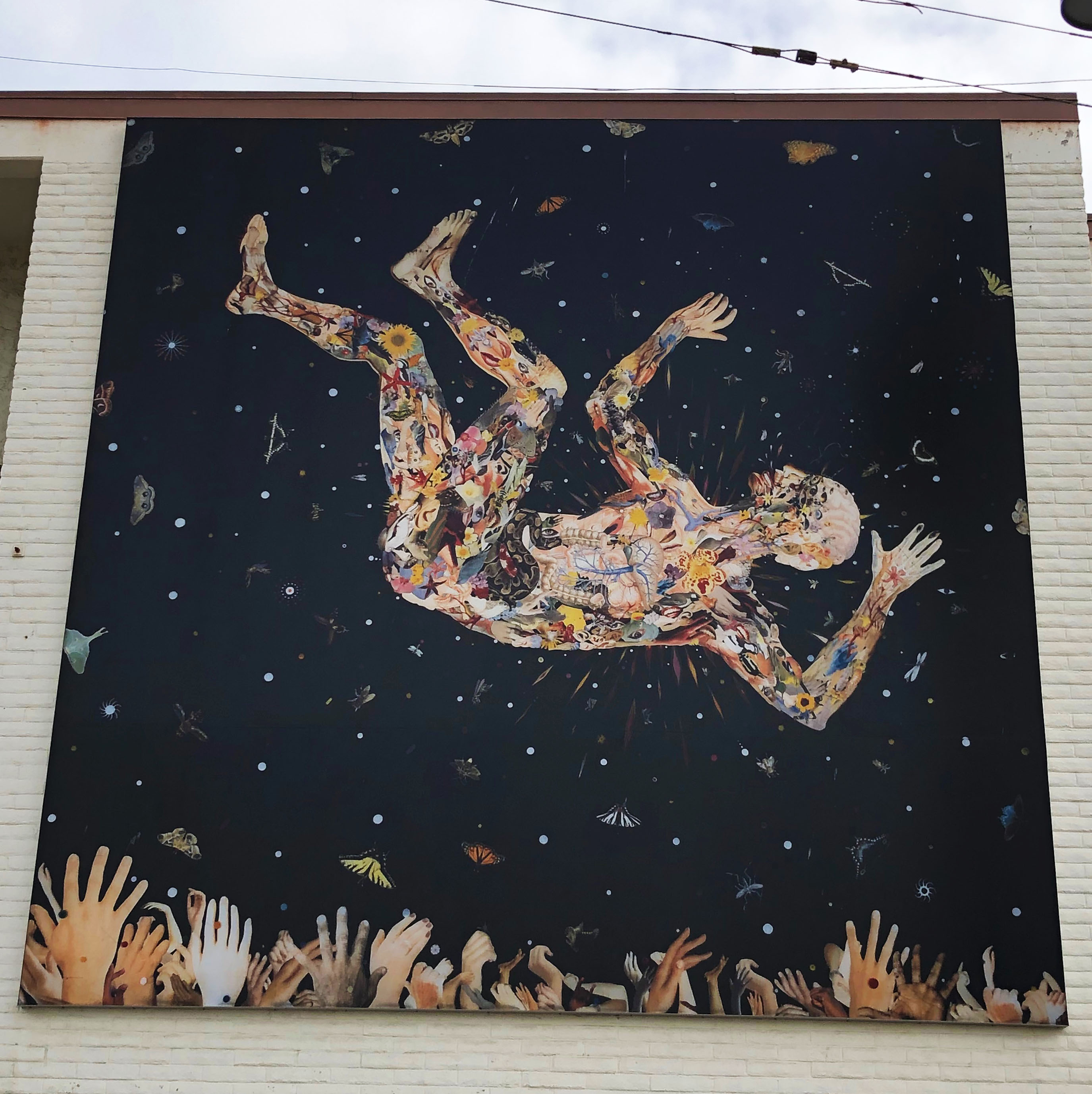
The above work, Expecting to Fly (for the Zeros), 2013, is by Fred Tomaselli and honors Chula Vista based Chicano punk band, The Zeros.

From the Murals of La Jolla website about the work-

It combines cutout images of insects, animals, plants, butterflies, birds, and body parts to create a visionary image of a man falling through space. The title of this work, Expecting to Fly, is the title of a song written by Neil Young and performed by Buffalo Springfield in the late ’60’s.  The man falling through space can be read as a crowd surfer, an image that comes out of the Punk Rock movement. One traditional idea of the “sublime” deals with losing oneself to the vastness of the universe. In this case, the crowd-surfer is losing himself to the vast, collectivist  “organism” of the crowd.  “In this piece I try to find commonalities in the pursuit of a modern sublime that stretch through time and past ideologies”.

This mural is located at 7569 Girard Avenue.