May 232019
 

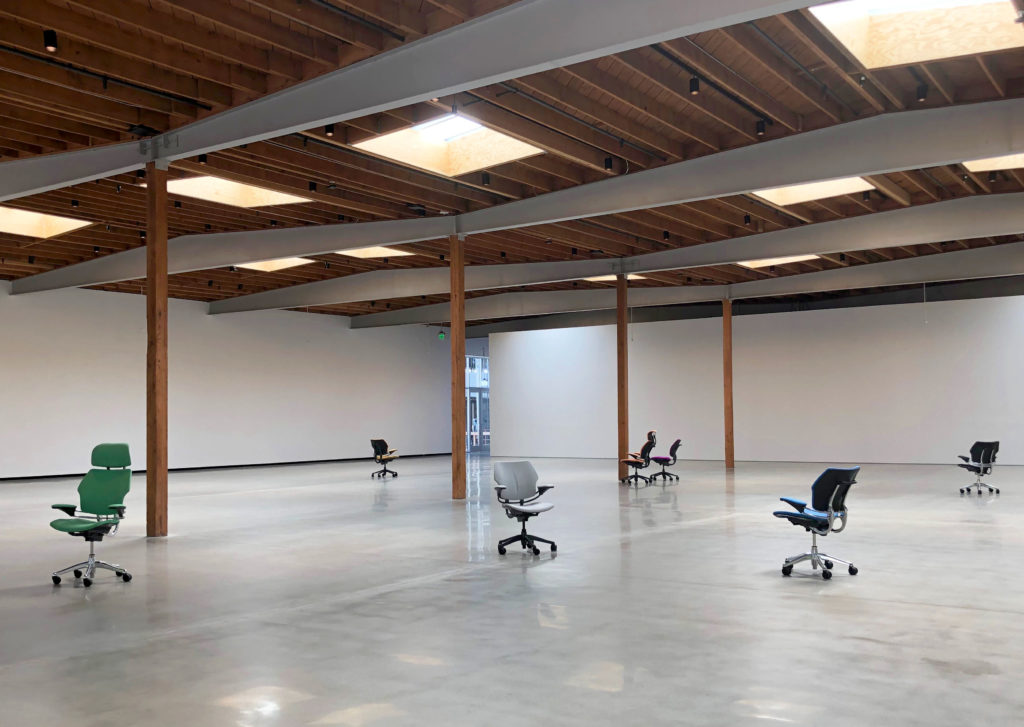
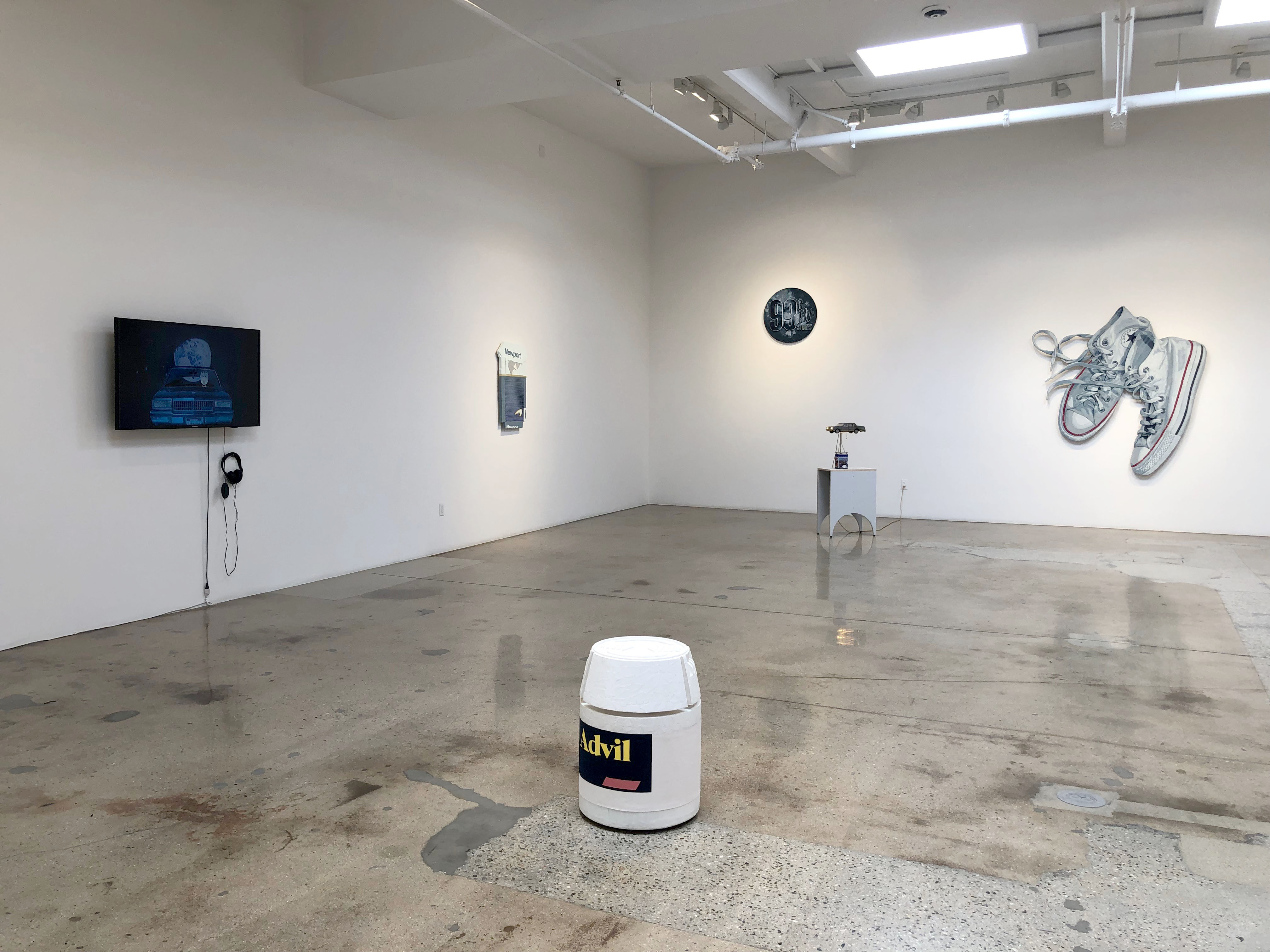
This is the last weekend (5/25/19) to see Vanessa German’s excellent sculpture exhibition, $LANG: Short Language in Soul, at Gavlak Los Angeles.

From the press release-

$LANG is German’s first solo exhibition in Los Angeles, the artist’s native city, and her first with Gavlak. The exhibition features a body of work created by German during her recent month long residency at Aguacate in Puerto Vallarta, Mexico. Though assembled in Mexico, many of the found objects incorporated in the sculptures were sourced from the artist’s current neighborhood of Homewood in Pittsburgh, Pennsylvania – the historic black neighborhood whose residents are often faced with systemic, institutionalized racism, and violence in their daily lives.

A self-trained “citizen artist,” German explores the power of art and love as a transformative force in the dynamic cultural ecosystem of communities and neighborhoods. As the founder of the ARThouse, a community arts initiative in her own neighborhood ravaged by gun violence, German’s art extends to helping local children heal through art  making. Recently recognized as the 2018 recipient of the Don Tyson Prize, the majority of German’s $200,000 grant is going toward opening a Museum of Resilience to honor the neighborhood’s large population of black single mothers. Her spoken-word performance art, influenced heavily by hip-hop, opera and the long tradition of Negro spirituals, calls attention to the epidemic of racially charged violence and advocates for compassion and empathy in daily  life. Similarly, German’s sculptural work blends spirituality, beauty, and femininity to focus  on empowering black women and girls. In a transformative way, the artist hopes that her work gives a space for positive and inclusive manifestations of love and awareness.

Born in Wisconsin, German moved to Mid-City Los Angeles at seven months old along with her five siblings and mother, Sandra German, a fiber artist and quilter. “We were makers as a way of life. We were raised by making something,” German explains about her formative years. The multi-media works assembled for $LANG explore her lived experience growing up black in Los  Angeles and how the power of art kept her alive. German writes:

As a strange, dirty, round, nappy black girl in Los Angeles, never really smelling good, or looking hair-combed & pressed, i was always inventing things that i deeply, profoundly believed had power. People made fun of me for this. i wrote poems to cure cancer. i drew and drew and drew and drew and refused to pick my pencil up from the paper until i’d driven any thought of disbelief from my mind. i was furious with these thoughts of creativity and power; that i was alive and could make *things that had the power to do *something. i believed this like a deep, deep fire. It kept me alive.

On view in the gallery are a series of 15 mixed-media assemblage sculptures using vintage tennis rackets, titled from the specific branding text on each. German’s use of rackets stems from Intermediate axis theorem, or tennis racket theorem, an effect in classical mechanics defining the  movement of a rigid body with three distinct principal moments of inertia. German explains: “Here in this work is the rigid body (black femaleness) reckoning with three distinct principal moments of inertia: Americanness; the aesthetics  of femininity (body and sex and identity), Blackness and the value in the striations of the known and unknown, and Love & Creative Power.” German utilizes historically black found objects such as hair weave and cowrie shells to adorn her hand painted portraits of black women, creating majestic and empowered presentations of a community so commonly subjected to violence and oppression in American society.

Also on view are five of German’s signature sculptures of which she refers to as “power figures,” or “tar babies.” Created by sculpting and hand painting large figures, adding a wide range of materials from feathers, glitter, seashells, plastic toys, bottle caps, vintage products, and fabric found from both Homewood and her travels. These female figures are based on traditional Congolese Nkisi Power Figure sculptures, which create protection, fend off evil spirits, and punish wrongdoers. German’s rococo meets folk power figures confront the violence of white supremacy and racism. German describes her process of assembling these sculptures as wholly spiritual.

May 162019
 

Blum & Poe is currently showing  Parergon: Japanese Art of the 1980s and 1990s Part II, the gallery’s second installment of their survey.

From the press release-

Part II of Parergon expands on the thematic territories explored in Part I, with seminal installations and sculptures from the era and performances by renowned figures of noise, sound, and electro-acoustic music genres. Kenji Yanobe’s Tanking Machine (Rebirth) (2019) is a darkly humorous, interactive, sci-fi sculpture first presented in 1989 that addresses the ever-present reality of nuclear crisis through a retro-futurist narrative. Influential multimedia artist, Kodai Nakahara’s bizarre installations of figurine-like marble stones and brightly, suspended spheres reflect a humorous take on sculpture’s “post-medium” condition.  As an intellectual and artist, Kenjiro Okazaki’s practice engages with theories of perception through interdisciplinary genres spanning architecture, literary theory, painting, reliefs, sculpture, robotics, and dance. Trained in both Japan and the U.S., Yukinori Yanagi’s large-scale and site-specific installations interrogate the politics of institutional borders and boundaries often drawing from semiotic systems of symbolic imagery. Psychedelic ’60s graphic designer Tadanori Yokoo revisits strategies of historical pastiche with his figurative noir paintings that hang alongside his cut-canvas portraits of Dada figures, as well as ceramic depictions of spiritual mediums. Finally, a dedicated Japanese noise archive of photography, journals, and vinyl records from Tokyo’s experimental underground will also be featured on the second floor giving historical context to the live performances.

The exhibition title makes reference to the gallery in Tokyo (Gallery Parergon, 1981-1987) that introduced many artists associated with the New Wave phenomenon, its name attributed to Jacques Derrida’s essay from 1978 which questioned the “framework” of art, influential to artists and critics during the period. Parergon brings together some of the most enigmatic works that were first generated during a rich two-decade period that are pivotal to the way we perceive and understand contemporary Japanese art today.

This exhibition closes 5/18/19.


May 132019
 

ONE Gallery in West Hollywood is currently showing The Gutter Art of Stephen Varble: Genderqueer Performance Art in the 1970s photographs by Greg Day. The artist died in his late 30s and would have remained virtually unknown if not for curator David Getsy researching, collecting, and documenting everything he could find on Varble.

His performance pieces were often both audacious and humorous and the exhibition details several of them. Varble popped open blood filled condom breasts in protest at a bank (proceeding to use the blood to sign a check for “zero million dollars”), crashed the Met Gala and the premiere of Tommy, and gave “costume tours” of big name art galleries in Soho, challenging the status quo. In our current world of corporate bailouts, rampant capitalism, and celebration of the rich, its fun to imagine what kind of work Varble might have created today in response.

From the press release-

In costumes made from street trash, food waste, and stolen objects, Stephen Varble (1946–1984) took to the streets of 1970s New York City to perform his “Gutter Art.” With disruption as his aim, he led uninvited costumed tours through the galleries of SoHo, occupied Fifth Avenue gutters, and burst into banks and boutiques in his gender-confounding ensembles. Varble made the recombination of signs for gender a central theme in his increasingly outrageous costumes and performances. While maintaining he/him as his pronouns, Varble performed gender as an open question in both his life and his work, sometimes identifying as a female persona, Marie Debris, and sometimes playing up his appearance as a gay man. Only later would the term “genderqueer” emerge to describe the kind of self-made, non-binary gender options that Varble adopted throughout his life and in his disruptions of the 1970s art world.

At the pinnacle moment of Varble’s public performances, the photographer Greg Day (b. 1944) captured the inventiveness and energy of his genderqueer costume confrontations. Trained as an artist and anthropologist and with a keen eye for documenting ephemeral culture as it flourished, Day took hundreds of photographs of Varble’s trash couture, public performances, and events in 1975 and 1976. Varble understood the importance of photographers, and Day was his most important photographic collaborator. This exhibition brings together a selection of Day’s photographs of Varble performing his costume works and also includes Day’s photographs of Varble’s friends and collaborators such as Peter Hujar, Jimmy DeSana, Shibata Atsuko, Agosto Machado, and Warhol stars Jackie Curtis, Taylor Mead, and Mario Montez.

Varble sought to make a place for himself outside of art’s institutions and mainstream cultures all the while critiquing them both. The story of Varble told through Day’s photographs is both about their synergistic artistic friendship and about the queer networks and communities that made such an anti-institutional and genderqueer practice imaginable. Together, Varble and Day worked to preserve the radical potential of Gutter Art for the future.

The Gutter Art of Stephen Varble builds upon the 2018 retrospective exhibition of Stephen Varble’s work at the Leslie-Lohman Museum of Gay and Lesbian Art, New York, titled Rubbish and Dreams: The Genderqueer Performance Art of Stephen Varble, as featured in the New York Times on January 11, 2019.  The new ONE Gallery exhibition, with its focus on the collaboration of Varble with the photographer Greg Day, will explore the ways in which Varble’s disruptive guerilla performance art has lived on primarily through vibrant photographs that captured his inventive costumes, transformed trash, and public confrontations.

This exhibition closes 5/17/19.

*For an additional perspective on the artist- Stephen Varble was friends with a 14-year old girl in NYC named Fernanda Eberstadt who kept diaries detailing her time with him. She wrote an interesting piece for Granta about him, reproduced here.

Apr 122019
 

Annie Leibovitz. The Early Years, 1970 – 1983: Archive Project No. 1 at Hauser and Wirth Los Angeles, is an engrossing look into the beginnings of a photographer who is now one of the most famous in the world. The exhibition, curated by Leibovitz herself, features more than 4,000 photographs. Despite that large number, the layout keeps it from feeling overwhelming. Photographs are put together on the walls by theme and time period. As you wander from room to room looking at the often recognizable faces, Leibovitz’s distinct style emerges.

The early sections of the show give the viewer a chance to see Annie Leibovitz as a young artist just starting out and developing her way of looking at the world through a camera. On one wall is a collage of photos creating a panorama of the Pont Neuf bridge in Paris. She took it when she realized she was standing where Henri Cartier-Bresson, one of the photographers she most admired, had once stood to photograph that same bridge. The sense of excitement she felt at that moment informs the image she would later take of Cartier-Bresson himself. That portrait is included on another wall with images of other photographers and artists she admired.

Walking from room to room, the famous faces blend together with the history of the time period. Political protests, music festivals and tours, presidential campaigns, Nixon’s resignation, Warhol’s factory- she was there documenting what was happening, often in unique ways. Her ability to observe and capture moments without intruding in her subject’s personal space remains present whether it is a rock star, politician, or a member of her own family.

As the show moves through Leibovitz’s timeline, her increased focus on the portraiture that would make her famous emerges. Her staged photographs from the 1980s of celebrities including Keith Haring, Whoopi Goldberg, and Meryl Streep appear. The transition makes logistical sense as this progression of her career is made clear by all the work that came before. Her portraits are the works that stand out the most, even at the beginning.

The exhibition captures an incredible period of time in both the artist’s work and the history of America. Make sure to leave a lot of time to see it before it closes on 4/14/19.


Apr 042019
 

People, the current sculpture exhibition at Jeffrey Deitch’s Hollywood gallery, fills the large room with work in a variety of media but all representing human beings in some way.

From the press release-

More than fifty standing, sitting and hanging figurative sculptures will fill Jeffrey Deitch’s new Los Angeles gallery. The artists in the show span several generations from the 1980s to the present, with an emphasis on emerging talent.

All of the works in the exhibition reflect a contemporary approach to sculpture inspired by the innovations of Dada, Surrealism, Assemblage and by the influence of non- or meta- art sources like department store mannequins.

Only one work in the show is carved or modeled in the traditional way. Some are made from body casts, others are constructed with found objects and only a few use conventional sculptural materials like bronze.

The works in the exhibition reflect the diversity of the artists who created them and the diversity of the people who the sculptures represent. The styles range from hyperrealism to allegory. The subjects range from ordinary individuals to creatures of fantasy. The works explore the uncanny confrontation of the artificial and the real while simultaneously responding to the multiple approaches to human identity in the contemporary world.

One of the sculptures, Totem, by Narcissister even incorporates live women. This adds to the unsettling feeling that some of the other sculptures, like Nobody, by Karon Davis (who founded The Underground Museum with her late husband Noah Davis), might have included real people as well (they don’t).

Karon Davis, “Nobody”, 2019

One of the strongest pieces in the exhibition is David Altmejd’s Pyramid in which a human/dog hybrid figure sits smoking while its back opens to expose insides composed of quartz, a hand, and several ears protrude from its sides. The little details are fascinating. He’s even painted one of the figure’s fingers purple, perhaps a reference to Human, the Ibizan hound with one purple leg that was included in Pierre Huyghe’s exhibition at LACMA.

People was inspired by Mike Kelley’s exhibition and book project The Uncanny, from 1993, and that’s definitely an accurate description of how it feels to wander around in this particular room of sculptures.

This exhibition closes 4/6/19.


Mar 062019
 

Currently at The Rendon Gallery, at a pop-up space on Palmetto Street, is Los Angeles based South African artist Ralph Ziman’s exhibition, The Casspir Project. The Casspir is a massive military vehicle that was used to terrorize the civilian population in South Africa during the apartheid-era. Sadly, they are still used by police forces in certain parts of the world, including in the United States. Ziman, with a team of artists from Zimbabwe and the Mpumalanga province of South Africa, have covered the Casspir in brightly colored beads in traditional patterns, making something beautiful out of what was once a symbol of horror.

Although the vehicle is the centerpiece, the exhibition also focuses on the arms trade and includes photos, a video, and additional beaded work. From the press release-

For this iteration of The Casspir Project, Ziman has designed the massive gallery space with a “macro and micro” experience in mind. Each room within the gallery space brings context to the next, informing the project as whole. The exhibition starts with an installation of brightly colored AK-47s leading into a room with large photographs taken in Soweto. For the photos, Ziman recreated scenes from newspapers during the apartheid, incorporating many of the elements found within the exhibition such as the beaded guns and SPOEK 1. A screening room shows a 20 minute documentary by Ziman which tells the history of the Casspir, from its design and conception to people’s personal experiences with it in the ‘70s and ‘80s. It chronicles Ziman’s reclaiming of the Casspir, detailing how he transformed and Africanized it. The exhibition culminates with the dramatic presentation of SPOEK 1, lit only by a spotlight in a dark room.

Opening a dialogue between those who remember and those too young to know, The Casspir Project is a profound attempt to reconcile history. Ziman has reclaimed the savagely violent brute—embellished and bedazzled, the Casspir has been made less threatening, its power and authority subverted.

This exhibition has been extended through 3/10/19 and this weekend Ziman will be live painting at the gallery with artist Keya Tama.


Mar 022019
 

What are the webs within our own lives? How are we connected to others? What is seen and not seen in our world? How do we function within our environment? What is created without our even noticing?

Tomás Saraceno’s current exhibition at Tanya Bonakdar Gallery in Hollywood, his first ever solo exhibition in Los Angeles, explores these ideas through the intersection of science and art. In one room, balloons drag pens to create drawings from the air and movements of those who wander through. Spider webs (displayed without the spiders) play an important part in weaving together the themes of the exhibition. Made by different species of spider and dyed with carbon ink, they are in frames against the wall. Presented in another part of the gallery, in a dark room, they are spot lit creating beautiful three dimensional sculptures. In another room, in full darkness, they are lit by a slowly moving laser which highlights in red various sections of the webs as others fade away.

In the front room of the gallery is a sculpture that continues the artist’s Cloud Cities body of work (pictured below). Cloud Cities was shown on the rooftop of the Metropolitan Museum of Art in New York in 2012.


From the press release-

… Conceived and inspired by the geometries of soap bubbles, the cluster-like artworks are composed of a number of interconnected modules, some with web-like structures set within them, which form geometric constellations inspired by the Weaire-Phelan structure. The Cloud Cities project is intimately tied to and embodied in the Aerocene Foundation, a community that proposes an epoch free from fossil fuel emissions, which challenges socio-political atmospheres by trespassing and weaving new, much needed, aerographies.

Cloud Cities are fictional urban and socioscapes in such imagined post-Anthropocenic future. These sculptural assemblages whose interplay between being tethered to the Earth whilst inviting our gaze to the sky, are devoted to reimagining life in tune and in collaboration with the atmosphere. Indeed, with 102,465 planes and about 8.3 million people traversing the atmosphere every day, swarms of particulate matter crossing borders and billions of pounds of carbon dioxide produced by fossil fuel aerial transportation, there is an entire metropolis up in the air already, coming with a huge cost and carbon print. The elemental imaginaries of Cloud Cities and Aerocene epoch call to open up the boundaries of the Earth toward a new interplanetary ecology of practice. We can reconnect with elemental sources of energy and form a new set of values that would overcome the extractive economies of the fossil fuel regime – a new stratigraphy of the future.

This exhibition closes 3/2/19.


Mar 022019
 

Derek Fordjour, Two Party System, 2019


JRRNNYS, Derek Fordjour’s solo exhibition at Night Gallery, includes new paintings and sculptures that “advance explorations of earlier works, returning to the subjects of crowds and athletic competitions to illustrate the entrenchment of power relations, capital flows, and racial inequality within the economic and social systems of the United States”. The paintings are made of multiple layers of painted cardboard and newspaper that are then scored and sections are removed.

This interview with the artist from artnet goes into more detail on his fascinating process and the reasons behind it.

Signing Day, 2019

Signing Day detail


The centerpiece of the exhibition is the installation STOCKROOM Ezekiel.

From the press release

…The work takes its name from the 1884 letters of Ezekiel Archey, an 25-year-old unjustly held as a prisoner sent to labor at the Pratt Coal Mines in Birmingham. Archey’s letters, sent to the Alabama inspector of prisons, are among the most prominent primary-source documentation of the ravages of the convict leasing system, acknowledging the stark preponderance of black prisoners and the gruesome treatment of the laborers by their supervisors. Fordjour’s installation responds to Archey’s letters by creating a walled-in structure comprised of over 1,000 individually constructed compartments – cells, as the artist calls them – painstakingly organized with a variety of found and handmade objects, though by a logic that is never explicated to the viewer. Lights in individual cells blink on and off variously, while small speakers let forth bursts of music by the dictates of a rigid but similarly inscrutable pattern, luring the viewer in the eye-popping manner of the carnival game or game board. The intermittent sounds of music range from the early field recordings of 20th century ethnomusicologist Alan Lomax to 80s- and 90s-era drug dealer anthems to modern day Trap music, a largely Southern genre of hip-hop inspired by the illegal drug trade. The viewer has entered a gamelike arena whose rules remain obscure. With time, the objects that populate the shelves come into focus. Some cells contain familiar items – balls extracted from various sporting contests, the lottery and billiards, cameras, hood ornaments from luxury sports cars, decommissioned prison uniforms, and hundreds of hand blown glass balloons, among others. Others are closed off with metal grating, while still more are lined with the ubiquitous fabrics of luxury designers, invoking the aspirational quests of poverty-stricken urban communities. Finally, many cells contain small busts of the same expressionless figure, molded from resin, copper, metal, plaster, dirt, and salt – materials which stand in for the most prominent products from the era of convict leasing, including the coal mines and steel plants of of Alabama and the molasses distilleries of Florida. Taken individually, the contents of these cells suggest luxury and labor, surveillance and displacement, strategy and competition; as a whole, the work suggests the laws of chance taking place within the confines of a framework that is as unknowable as it is oppressive. From the era of Pig Laws to our current three-strikes mandatory sentencing, educational lotteries to modern day sporting empires, Fordjour’s installation points to the tragic persistence of unjust structures that define American life, employing contemporary commodities while invoking history. At once mournful and flickering with possibility, the installation conjures notions of personal loss and gain within the macro-scale context of the inscrutable systems that have determined the fates of black and brown people through the nation’s history.

Derek Fordjour, STOCKROOM Ezekiel, 2019 image via Night Gallery

This exhibition closes 3/2/19.

If you are in NYC you can see one of Fordjour’s new works, Half Mast, as a public art installation for the Whitney Museum. The large vinyl reproduction of his painting can be seen at the intersection of Gansevoort and Washington Streets, directly across from the Whitney and the High Line.

Derek Fordjour, Half Mast. Image via Whitney Museum

Mar 012019
 

Matvey Levenstein, LY, 2018

Currently at Kasmin Gallery are Matvey Levenstein’s paintings depicting scenes from his life in North Fork, Long Island. There’s a quiet, peaceful quality to the works, which begin with snapshots before they are turned into paintings. This exhibition closes Saturday 3/2/19.

Across the street at another of Kasmin Gallery’s Chelsea locations, and worth a visit, is an exhibition of some of Andy Warhol’s polaroid portraits.

Matvey Levenstein, Pink Moon, 2018

Susan Inglett Gallery is showing Slim… you don’t got the juice, an exhibition of work by Wilmer Wilson IV. His work with staples may seem familiar from its inclusion in the New Museum’s 2018 Triennial: Songs for Sabotage.

From the press release-

Slim… you don’t got the juice presents multidisciplinary departures from familiar modes of figurative representation, as they have evolved in the realm of photographic discourse. Wilmer Wilson IV has developed strategies of redaction and annotation in his work that begin to destabilize the norms of making and viewing portraiture through visual, material, and technical manipulation. An exploration into the complex renderings of individual subject-hood versus object-hood in portraiture, the artist has conceived of a stapled-surface-as-viewing-device that mediates image with material. The device is manifest in a series of staple works that almost fully shroud the photographic subjects beneath dense fields of metal fasteners. The austere, randomized application of the staples onto the surface of each portrait results in a resistance of visual penetration from many angles, complicating access to the underlying figures and deconstructing the voyeuristic inclinations of the viewer.

This exhibition closes 3/16/19.

Wilmer Wilson IV, Host, 2018


At Lehmann Maupin’s 24th Street location is McArthur Binion, Hand:Work, an exhibition of the artist’s grid paintings created with oil paint stick and paper on board. The patterns created in the work are overwhelming at first glance but then when seen up close, the personal details add a new dimension to the paintings.

From the press release

…For Binion, his personal documents represent the sum total of one’s social life: relationships, citizenship, vocation, and family life. The revealing and obscuring of these aspects of his life also addresses the larger sociopolitical reality of African-American identity—often obscured or erased from common knowledge, yet always present in tandem with major movements in American culture. In his newest Hand:Work paintings, Binion takes an introspective approach that is more closely aligned with the artist’s own self-perception—effectively, his first self-portraits. Using copies of a photo of the home where he was born, along with a photograph of his hand as the ground layer of the paintings, Binion pares down his identity to its most essential elements. These images are tiled in repeated succession, layered under his repetitious line work in oil stick. These gestures themselves relate to memories Binion has of his early childhood farm life, a disciplined approach to the cyclical, sustained effort he maintains in his work today. Through the insertion of his hand, literally in the photographs, and figuratively in his intricate, overlapping mark-making, the artist relates to his earliest introduction to artistry in his mother’s quilting, a tradition he modified and carried into his practice.

This exhibition closes 3/2/19.

McArthur Binion at Lehmann Maupin

McArthur Binion at Lehmann Maupin, detail of above painting

Robert Mann Gallery is showing the newly discovered work of photographer Ed Sievers. The exhibition of black and white photos also includes his later work from the 1970s in Venice Beach. The gallery also has an exhibition of Michael Kenna’s series of black and white female nudes made in Japan (not shown). Both shows close 3/2/19.

Ed Sievers, Untitled (woman in the shadows), c. 1960s, courtesy of the artist, image via Robert Mann Gallery

Damn! The Defiant, a group show curated by Damon Brandt and Andrew Freiser at Fredericks & Freiser Gallery, brings together “images of rebellion and dissent in contemporary portraiture” and includes a wide variety of work in different mediums from an incredible selection of artists that includes Mary Ellen Mark, Gordon Parks, Dana Schutz, Bruce Davidson, Whitfield Lovell and many more. It’s a show that’s very appropriate for a time period that is going to require more and more defiance.

From the press release-

Nothing creates projected personal territory more than the emotional push back generated from the recalcitrant expression of a defiant subject. Yet ironically, it is the very nature of this engagement that makes it difficult for the viewer to quickly detach or withdraw from what in fact amounts to an extended glare or moment of social tension. In a time of undeniable anxiety, finding both the common and contrasting ground in the portrayal of defiance speaks directly to the angst and pre-occupation for self-determination that has been and continues to be a pervasive human concern.

This exhibition closes 3/2/19.


Installation view of Damn! The Defiant, image via Fredericks & Freiser


Feb 252019


Currently outside of LACMA’s Ahmanson Building is one of artist Sam Durant’s “electric signs”. It takes its text from a photo taken at the 1963 March on Washington for Jobs and Freedom where Martin Luther King, Jr. delivered his “I Have A Dream” speech.