Giant Fagends, 1967, one of Claes Oldenburg‘s soft sculptures, is currently on view at the Whitney Museum.

Giant Fagends, 1967, one of Claes Oldenburg‘s soft sculptures, is currently on view at the Whitney Museum.
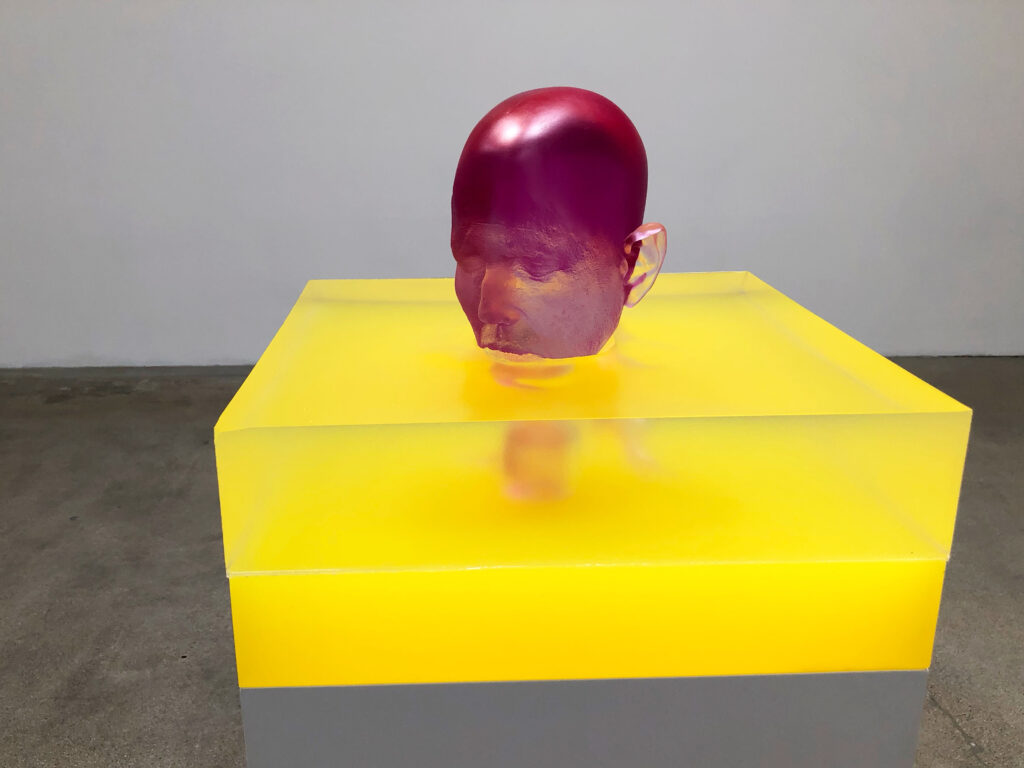
Magenta Swimming in Yellow, 2015-7, by Rona Pondick from her solo exhibition at Zevitas Marcus. The sculpture was created using pigmented resin and acrylic.
From the Zevitas Marcus press release–
In 2013, Pondick began an intensive period of experimentation with materials that were new to her practice: resins and acrylics. Over a period of five years, she developed complex methods of working with these materials and came to understand their sculptural potential. This exhibition is the first time this body of work has been seen on the West Coast.
Since her career began in 1984, Rona’s work has consistently referenced the body, in both a metaphorical and literal sense. Her sculptural practice has been no less defined by her ceaseless exploration of new materials and methods. Stainless-steel was Rona’s primary medium for the better part of a decade beginning in 1998. Her newest works are made from resins, acrylics and modeling compound.While thematically related to Rona’s earlier work, these new sculptures are notable for their extraordinary use of color and the way in which the artist’s hand is ever present, elements which heighten the sense of fragility and humanity that have always been achingly present in her work.
Also worth checking out- this ODDA magazine interview with the Pondrick from this year (2022) and her Instagram.

Florida Roadside- Gatorland, 2020

Dusk Pines, 2020 (left) and Pinelands, 2020
Artists Sam McCoy (works above) and Sheherazade Thenard (work below) were both part of the recent exhibition Fresh Squeezed 6: Emerging Artists in Florida at Morean Arts Center in St. Petersburg, Florida.
Information on Sam McCoy from her website–
Sam McCoy was born and raised in Orlando, Florida in the 90s. She is a contemporary painter who focuses on the boundaries between natural and hyperreal landscapes of Florida. She pulls her inspirations from a place where spectacles and roadside attractions dominate America’s tourism capital. Between eco-tourism destinations and constructed gardens, McCoy explores the contradictions of her experiences in these places. By pulling back the metaphorical curtain on a carefully crafted image of Florida, McCoy’s ideas of disenchantment and re-enchantment are enacted in each painting. The viewer can still find meaning in the shadier discordant corners of the State.

Magnolia, 2020
From Sheherazade Thenard’s information page–
For me, a landscape painting is not merely a visual representation of the world. It is a metaphor for the human condition. I paint to try to make sense of the fragility of our world, the passing of time, and our shared experiences of light, color, and space. The incorporation of figures within my paintings are often swallowed or hidden by their constructed lush surroundings. Painting the land and its inhabitants continues to be a way of engaging with the strangeness of being here.
The undercurrent themes of mysticism, escapism and fantasy are reoccurring within my pieces. Through these works, I aim to create psychological spaces paired with hidden symbolism integral to the understanding of each painting.
Check out both of their websites to see more of their excellent work.
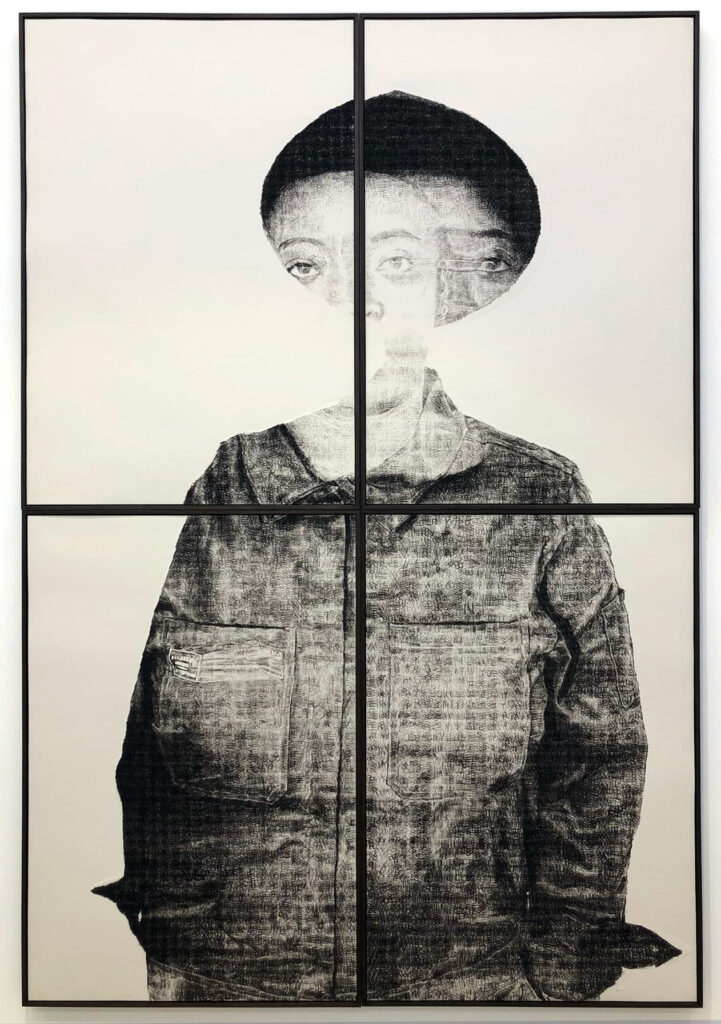
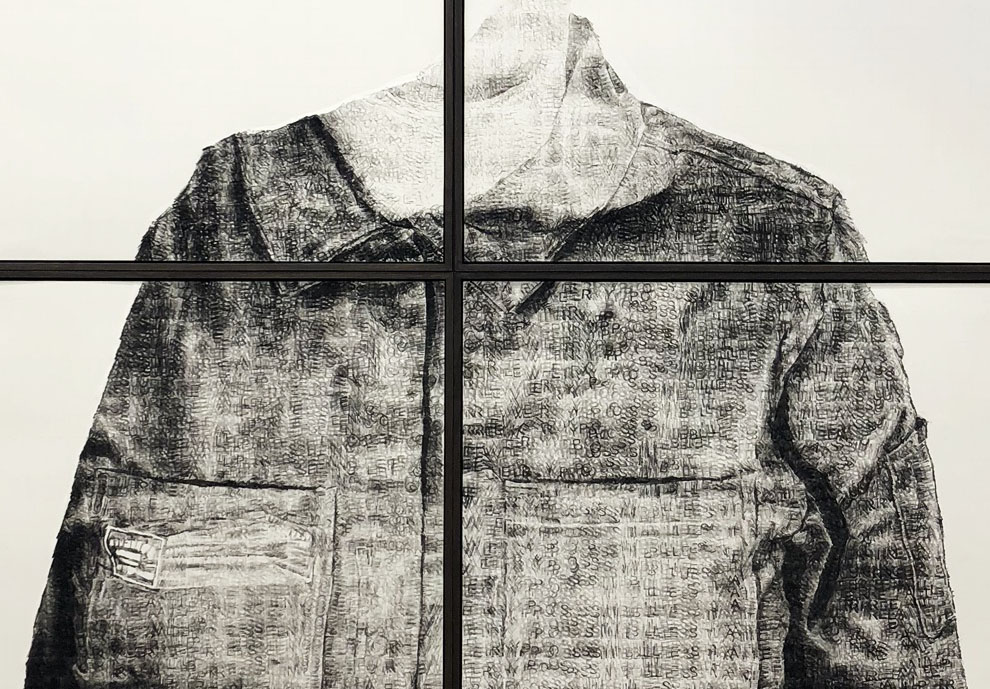
A Surreal Presence for Every Possible State, 2018 by Kenturah Davis from her 2019 exhibition, Blur in the Interest of Precision at Matthew Brown Los Angeles. The four panel work was created using oil paint applied with rubber stamp letters and graphite grid on embossed Mohachi paper.
From the press release-
Blur in the Interest of Precision is a search for parallel conditions between the poetics of our visual experience and the strangeness of our relationship to language. We often use language to carve out distinctions between one thing and another. Davis’ objective—to complicate ideas about meaning, representation and perception—have found refuge in blur and doubling. The new drawings are rendered with arrangements of text, but the words are virtually illegible. Many of the portraits pursue ideas the artist is working through via the writings of Fred Moten and Toni Morrison’s essay, Sites of Memory.
Davis’ work oscillates between various facets of portraiture and design. Using text as a point of departure, the artist explores the fundamental role that language has in shaping how we understand ourselves and the world around us. This manifests in a variety of forms including drawings, photographs and performances.
Recently Davis was commissioned by LA Metro to create work for the future Inglewood Station, slated to open in November of 2022. The work, Sonder, depicts community members photographed at gatherings at the artist’s Inglewood art studio and made into large porcelain enamel steel panels.
From Metro’s site–
The photographs were hand painted with stamps incorporating letters that form the words defining the term “sonder.”
Davis was drawn to the term which alludes to the realization that every person has a unique and significant story. She hopes that the portraits inspire connections between strangers, even if only for a passing moment while waiting for the train.
(images below via LA Metro’s site)


For more images, information about the station, and a video of the artist discussing the work, check out Metro’s website.

Happy Birthday to Betye Saar who turned 94 today! This work Still Ticking, (2005), was part of LACMA’s exhibition Betye Saar: Call and Response which opened at the museum in September of 2019.
From the wall description of the work-
Made shortly before Saar’s seventy-eighth birthday, the assemblage includes years and astrological glyphs on the inner left side that correlate to various important dates in her life. The work’s title wittily refers both to the timepieces in the sculpture- which, of course, are not ticking; indeed they are either frozen in time or missing their hands- and to the artist herself, who is alive and well, still ticking, now at age ninety-three.


Today, July 6th, is the four year anniversary of the fatal shooting of Philando Castile by a police officer during a traffic stop in Minnesota. Castile was shot five times while his girlfriend and her four year old daughter were in the car.
Mark Bradford’s 150 Portrait Tone, 2017, currently at LACMA, is a devastating large scale work that uses excerpts from Philando Castile’s girlfriend Diamond Reynolds’s dialogue from the video she live streamed on Facebook from the incident.
From LACMA’s wall description of the work-
Bradford notes that he was moved by the multiple subjects Reynolds simultaneously addressed and the different spaces they occupied: her boyfriend, Castile, next to her (“stay with me”); the officer outside the car (“please, officer, don’t tell me that you just did this”); God (“Lord, please Jesus, don’t tell me that he’s gone”); as well as the unknown receiver on the other side of her lifestream (“please don’t tell me he just went like that”).
Like many of Bradford’s works, the mural-size composition contains elements of both abstraction and realism. In places, layers of manipulated paint render the text almost illegible. The dark form in the background, however, evokes all-too-real associations with the horrific shooting, such as Castile’s twisted arm and the dark-red bloodstain spread across his white shirt, both visible in the live stream feed.
The title, “150 Portrait Tone”, refers to the name and color code of the pink acrylic used throughout the painting (most conspicuous in a large patch at the work’s bottom edge). Like the now-obsolete “flesh” crayon in the Crayola 64 box (the color was renamed “peach” in 1962), the color “portrait tone” carries inherent assumptions about who, exactly, is being depicted. In the context of Bradford’s painting, the title presents a sobering commentary on power and representation.

This mural, Untitled (Questions) (1990/2018), by artist Barbara Kruger, is on the wall of The Geffen Contemporary at MOCA in Los Angeles until November 2020. The work was originally commissioned by MOCA in 1989 for the exhibition A Forest of Signs: Art in the Crisis of Representation, and was last installed in 1990 on the south wall of MOCA’s building (now The Geffen Contemporary at MOCA).

Murals of La Jolla is a project started in 2010 by The Athenaeum and the La Jolla Community Foundation. It commissions artists to create work to be displayed on buildings around La Jolla. The works are on view for a minimum of two years (a map of current work here)
The above work, Tear Stains Be Gone, was created by Jean Lowe in 2015 and is still on view as of this writing in 2019 at 7661 Girard Avenue.

ONE Gallery in West Hollywood is currently showing The Gutter Art of Stephen Varble: Genderqueer Performance Art in the 1970s photographs by Greg Day. The artist died in his late 30s and would have remained virtually unknown if not for curator David Getsy researching, collecting, and documenting everything he could find on Varble.
His performance pieces were often both audacious and humorous and the exhibition details several of them. Varble popped open blood filled condom breasts in protest at a bank (proceeding to use the blood to sign a check for “zero million dollars”), crashed the Met Gala and the premiere of Tommy, and gave “costume tours” of big name art galleries in Soho, challenging the status quo. In our current world of corporate bailouts, rampant capitalism, and celebration of the rich, its fun to imagine what kind of work Varble might have created today in response.
From the press release-
In costumes made from street trash, food waste, and stolen objects, Stephen Varble (1946–1984) took to the streets of 1970s New York City to perform his “Gutter Art.” With disruption as his aim, he led uninvited costumed tours through the galleries of SoHo, occupied Fifth Avenue gutters, and burst into banks and boutiques in his gender-confounding ensembles. Varble made the recombination of signs for gender a central theme in his increasingly outrageous costumes and performances. While maintaining he/him as his pronouns, Varble performed gender as an open question in both his life and his work, sometimes identifying as a female persona, Marie Debris, and sometimes playing up his appearance as a gay man. Only later would the term “genderqueer” emerge to describe the kind of self-made, non-binary gender options that Varble adopted throughout his life and in his disruptions of the 1970s art world.
At the pinnacle moment of Varble’s public performances, the photographer Greg Day (b. 1944) captured the inventiveness and energy of his genderqueer costume confrontations. Trained as an artist and anthropologist and with a keen eye for documenting ephemeral culture as it flourished, Day took hundreds of photographs of Varble’s trash couture, public performances, and events in 1975 and 1976. Varble understood the importance of photographers, and Day was his most important photographic collaborator. This exhibition brings together a selection of Day’s photographs of Varble performing his costume works and also includes Day’s photographs of Varble’s friends and collaborators such as Peter Hujar, Jimmy DeSana, Shibata Atsuko, Agosto Machado, and Warhol stars Jackie Curtis, Taylor Mead, and Mario Montez.
Varble sought to make a place for himself outside of art’s institutions and mainstream cultures all the while critiquing them both. The story of Varble told through Day’s photographs is both about their synergistic artistic friendship and about the queer networks and communities that made such an anti-institutional and genderqueer practice imaginable. Together, Varble and Day worked to preserve the radical potential of Gutter Art for the future.
The Gutter Art of Stephen Varble builds upon the 2018 retrospective exhibition of Stephen Varble’s work at the Leslie-Lohman Museum of Gay and Lesbian Art, New York, titled Rubbish and Dreams: The Genderqueer Performance Art of Stephen Varble, as featured in the New York Times on January 11, 2019. The new ONE Gallery exhibition, with its focus on the collaboration of Varble with the photographer Greg Day, will explore the ways in which Varble’s disruptive guerilla performance art has lived on primarily through vibrant photographs that captured his inventive costumes, transformed trash, and public confrontations.
This exhibition closes 5/17/19.
*For an additional perspective on the artist- Stephen Varble was friends with a 14-year old girl in NYC named Fernanda Eberstadt who kept diaries detailing her time with him. She wrote an interesting piece for Granta about him, reproduced here.