Sep 032026
 

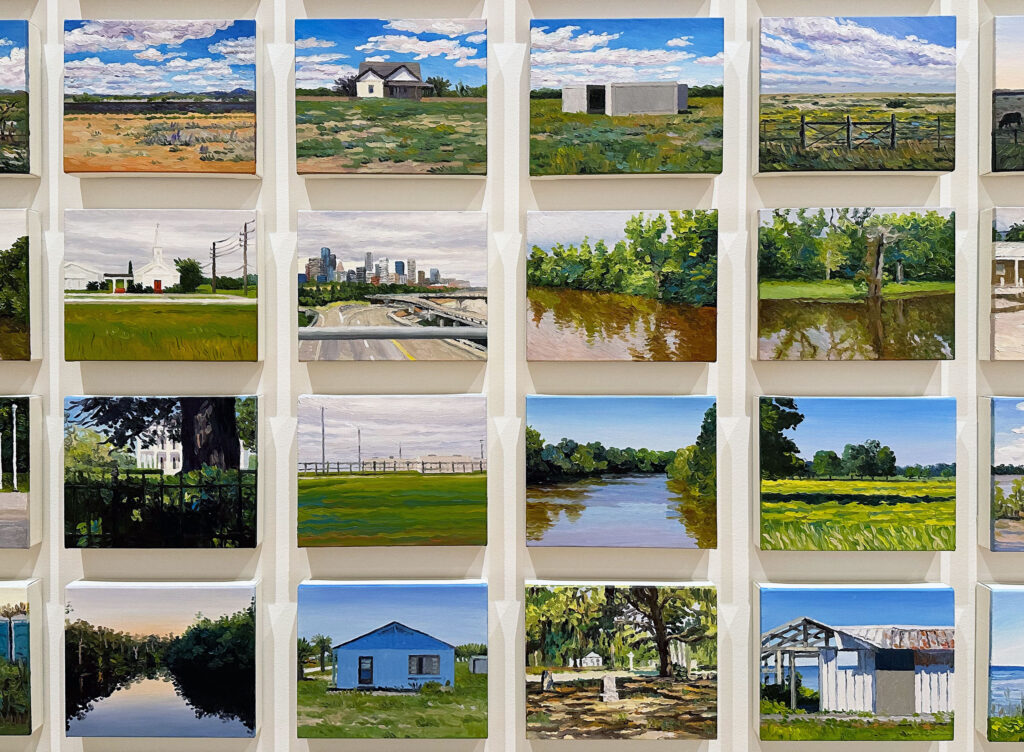
Cynthia Daignault, “Light Atlas”, 2014-2016, Oil on linen (detail)
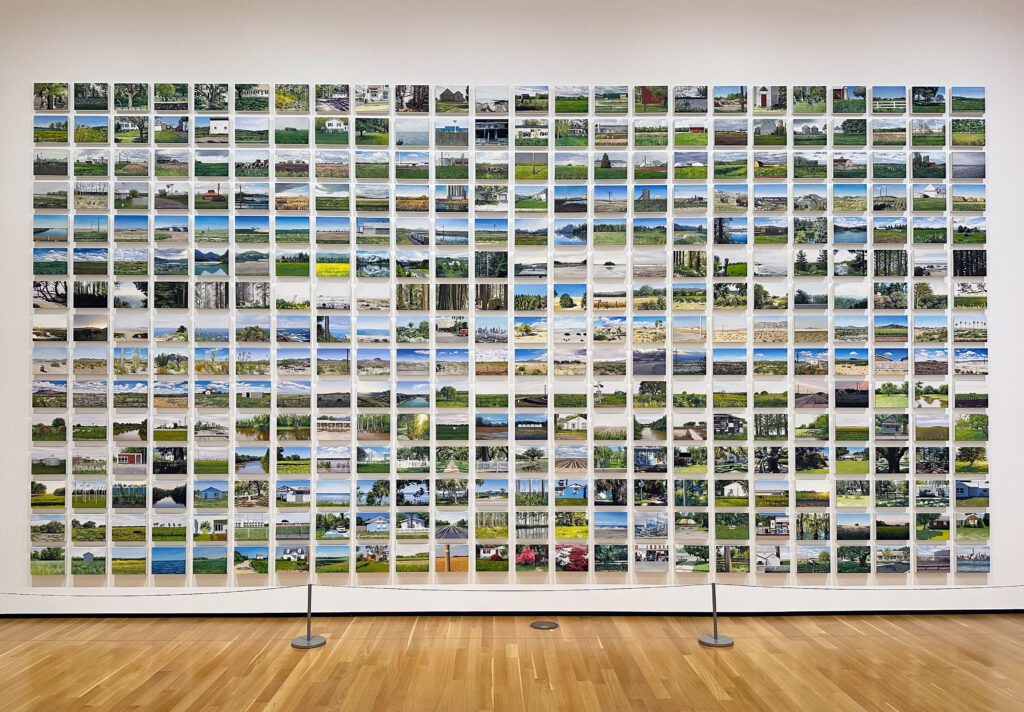
Light Atlas, a painting series by Cynthia Daignault, was on view at Akron Art Museum in 2024.

From the museum:

In 2014, Cynthia Daignault began driving north from her home in Brooklyn, New York. She turned west in New England and south at the Pacific Northwest, and she kept going until she had traced the entire outer perimeter of the continental United States. Having calculated the necessary distance, the artist stopped about every twenty-seven miles to make a sketch so that she could record a total of 360 images, representing the full circle of her journey. After five months on the road, she returned to her studio and created the paintings of Light Atlas. In each picture, Daignault placed the horizon line at the center, helping to suggest a continuous narrative and a collective portrait of the country. Having intentionally set out in the spring, she aimed to capture a mood of optimism and rebirth.

This series is currently on view as an installation at Thomas Cole National Historic Site in Catskill, NY. The 360 landscape paintings, will be on view until November 1st. On Saturday, September 12th, you can create a landscape painting with her for the site’s Second Saturday Workshop, and on Sunday she will be discussing Light Atlas for their Sunday Salon lecture series.

Daignault’s recent series, based on Yosemite National Park‘s iconic Tunnel View, is on view at the Institute of Contemporary Art / Boston until January 2027. For these paintings she used “the “mediated consciousness” of digital images, to meditate on our urgent and evolving relationship with the American landscape”.

For more about this series, this interview, from the museum’s website, provides more background on many of the conceptual ideas she is exploring with this work.
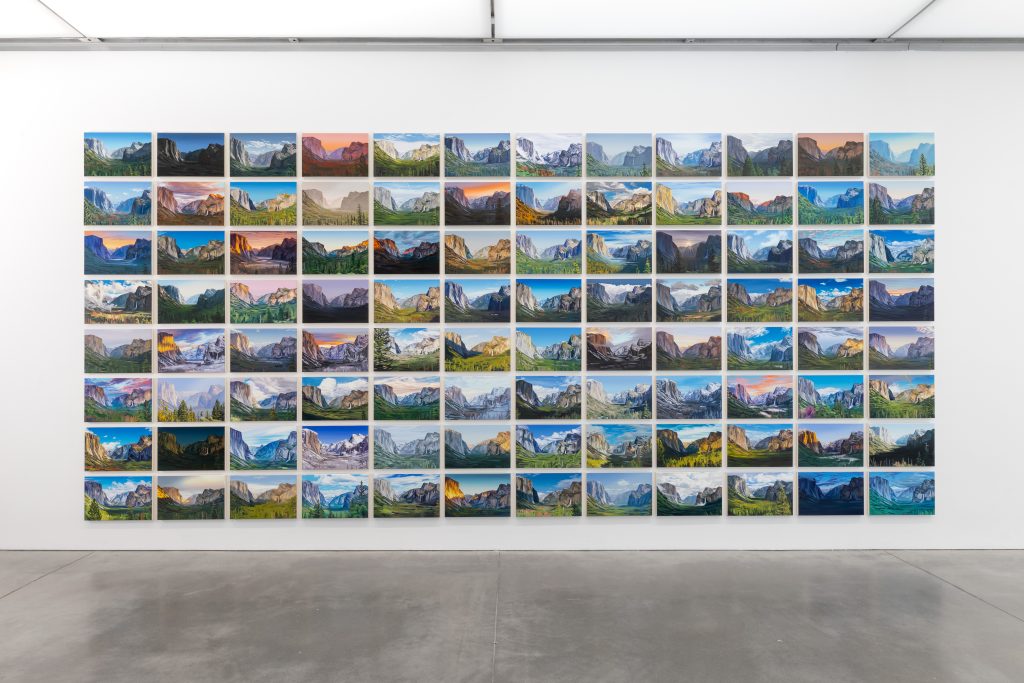
 

Installation view, Cynthia Daignault: Valley, the Institute of Contemporary Art/Boston, 2026-27. Photo by Mel Taing (Image via the Institute of Contemporary Art Boston website)

Mar 202026
 

Kay Rosen‘s painting Spring (2021), was part of the 2024 group exhibition Healing at Sikkema Molloy Jenkins in NYC. You can currently see this work as part of John Cage and Kay Rosen at Krakow Witkin Gallery in Boston. The exhibition opens 3/21 and runs until 5/9/26.

From Krakow Witkin Gallery about the exhibition-

The current exhibition arranges works from the past 15 years by Kay Rosen with works from 1983 by John Cage. While not an obvious aesthetic or conceptual pairing, the juxtaposition of works hopes to provide more nuanced understanding and appreciations of both artists’ approaches to observation, appreciation, chance, choice, and control.

And about the painting-

SPRING, like many of Rosen’s works, strives for efficiency and economy. It finds a way to enhance the meaning of spring without adding a word. It cannibalizes one of its own body parts, the letter N, turning spring into sprig, five little green shoots. SPRING is another one of those found works that almost makes itself. Her intervention is merely a small excision of a letter, leaving behind a new word that that suggests hope.


Mar 052026
 

Nonstop (2107) by Arden Bendler Browning was commissioned by Philadelphia’s Percent for Art Program and is on view at Philadelphia International Airport.

From Art at PHL about the work-

Philadelphia artist Arden Bendler Browning is known for creating large-scale, highly energized, gestural paintings inspired by her urban surroundings. Browning’s paintings are mostly abstract, yet include hints of realism with the suggestion of architectural structures, roadways, telephone poles, and green spaces. Browning’s paintings envelop the viewer with their scale, intensity, and sense of movement. Her imagery is derived from photos taken while traversing the city. The photos enable her to see the city from various vantage points and, as she has described, “jump through time and space.”

Browning’s paintings visually capture that sense of timelessness as she often conveys a disorienting landscape where colors and shapes collide and overlap, where only glimpses of reality come into focus. She speaks of the urban environment as “a vast sea of fluctuating boundaries arguing claim to the demarcation of space.” This statement also describes Browning’s work as she depicts the urban landscape using an amalgam of colors, shapes, and painterly marks adrift and influx.

Browning has said, “Nonstop is multifaceted and dense, full of action, and vibrancy in unexpected places with pockets of space and clusters of commotion. It is just like Philadelphia.”

Browning is currently part of the group exhibition, The Landscape: Lost and Found at Ellen Miller Gallery in Boston, on view until 3/28/26.