Mar 272025
 

“LOVE”, 1967, Oil on canvas

"LIP", 1960-1, Oil on canvas

“LIP”, 1960-1, Oil on canvas

Robert Indiana: The Source, 1959–1969, currently on view at Kasmin, presents a fascinating selection of the artist’s work from that decade. Several of his well known paintings like LOVE (pictured above) are included, but it is interesting to see his lesser known work as well as the progression in his work throughout this period.

From the gallery about the exhibition-

…Featuring 20 works drawn exclusively from the artist’s personal collection as endowed by Indiana to the Star of Hope Foundation, the exhibition includes an example from the artist’s first edition of LOVE sculptures, conceived in 1966 and executed between 1966—1968, and a vitrine display of archival materials including some of the artist’s journals. This exhibition marks Kasmin’s first collaboration with the Star of Hope Foundation, which was established by the artist in his lifetime, and the gallery’s eighth solo exhibition of work by Indiana since 2003.

Robert Indiana: The Source, 1959–1969 chronicles the Minimalist origins of Indiana’s signature use of signs, symbols, words and numbers. Pairing canonical works with those rarely seen by the public, the exhibition provides a deeper understanding of Indiana as an artist whose output remains emblematic of American culture. The paintings on view demonstrate the personal iconography the artist ascribed to his artwork: as his peers withdrew from the aesthetics of self-expression, Indiana embarked on a career-defining inquiry into the power of symbols to represent meaning. Organized thematically, the exhibition charts Indiana’s influential depictions of words and numbers in bold colors through his early abstractions, reflections on his personal history and the stages of life, and the poetic inevitability of transcendence—a return to the source.

From the gallery about LOVE and LIP

After discovering a trove of nineteenth-century packaging stencils in 1960, Indiana began incorporating words and numbers in his paintings, spearheading the adoption of commercial advertisement as a language of art. LIP (1960–61), an early example of a single word painting, features the title word’s yellow letters at the center of two intersecting orbs, whose contours suggestively form a pair of red lips. Unraveling the distinction between sign and symbol, the composition suggests a kiss, a universal bodily expression of love.

More selections and information from the gallery below-

“October Painting”, 1959-60, Oil on canvas

Indiana began this composition, which depicts the shadows of a dracaena plant, in October 1959. “This, I feel, is a very seminal painting,” he wrote in a journal entry the following December, seeking to distinguish his own visual language from artists Jack Youngerman and Ellsworth Kelly.

“Ra”, c.1961, Oil on canvas

From the gallery-

After painting a series of orbs in 1959, Indiana revisited the theme in Ra (c. 1961), a triptych arranging a number of red, blue, and green circles in flattened pictorial space. This work’s title reflects Indiana’s early interest in mythology, referencing the Egyptian sun god Ra, historically depicted with a red solar orb and cobra over his head.

Circles appear in Indiana’s work as early as 1958 and resound through paintings such as Mother and Father (1963-66) and Hallelujah (Jesus Saves) (1969). The arrangement of orbs in Ra suggests Indiana’s fascination with sequences, an avenue he would explore in paintings of numbers including Cardinal Nine (1966), on view nearby.

“Cardinal 9”, 1966, Oil on canvas

Indiana’s Cardinal Numbers series (1966) depicts the numbers one through zero in red, blue, and green. Adopting the typography of a business calendar, Indiana conceived of each number to represent a stage of life. Cardinal Nine represents the near end of the sequence, just before zero. The palette held sentimental significance for Indiana, who recalled memories of the red and green signage of Phillips 66, the gas company where his father worked, against the open blue sky.

“Mother and Father”, 1963-1966, Oil on canvas

From the gallery-

Indiana’s extraordinary diptych Mother and Father (1963-66) depicts the artist’s scantily dressed adoptive parents entering a Model T Ford within two circles, as if observed through a pair of binoculars. Conceived as the first to depict his parents in each of the four seasons, Indiana only realized one iteration of the series, set in the winter. Details of the vehicle’s license plate allude to Indiana’s conception ahead of his birth in September 1928, as if to mythologize the artist’s biography.

In an accompanying artist statement, Indiana described this painting as an essential part of his celebrated American Dream series (1961-2001), which earned Indiana’s first major recognition after early acquisitions by The Museum of Modern Art, Van Abbemuseum, Art Gallery of Ontario, Hirshhorn Museum and Sculpture Garden, and elsewhere.

Indiana exhibited this painting in an early state in 1964, later adding its stenciled lettering in 1966. He continued to exhibit the work extensively, including in the São Paulo Biennial in 1967 and his traveling institutional retrospectives of 1968, 1977, 1982, and 2013.

“August Is Memory Carmen”, 1963, Oil on canvas

From the gallery-

The number 8 held special resonance for Indiana, whose mother, Carmen, was born in the month of August. August Is Memory Carmen
(1963) incorporates the title of a lyric poem Indiana wrote in 1953, four years after her death. Indiana depicted her portrait alongside his father, Earl, in Mother and Father (1963-66), installed nearby.

This exhibition closes 3/29/25. It is presented in dialogue with Pace Gallery’s upcoming exhibition Robert Indiana: The American Dream, which will open May 9, 2025.
Mar 152024
 

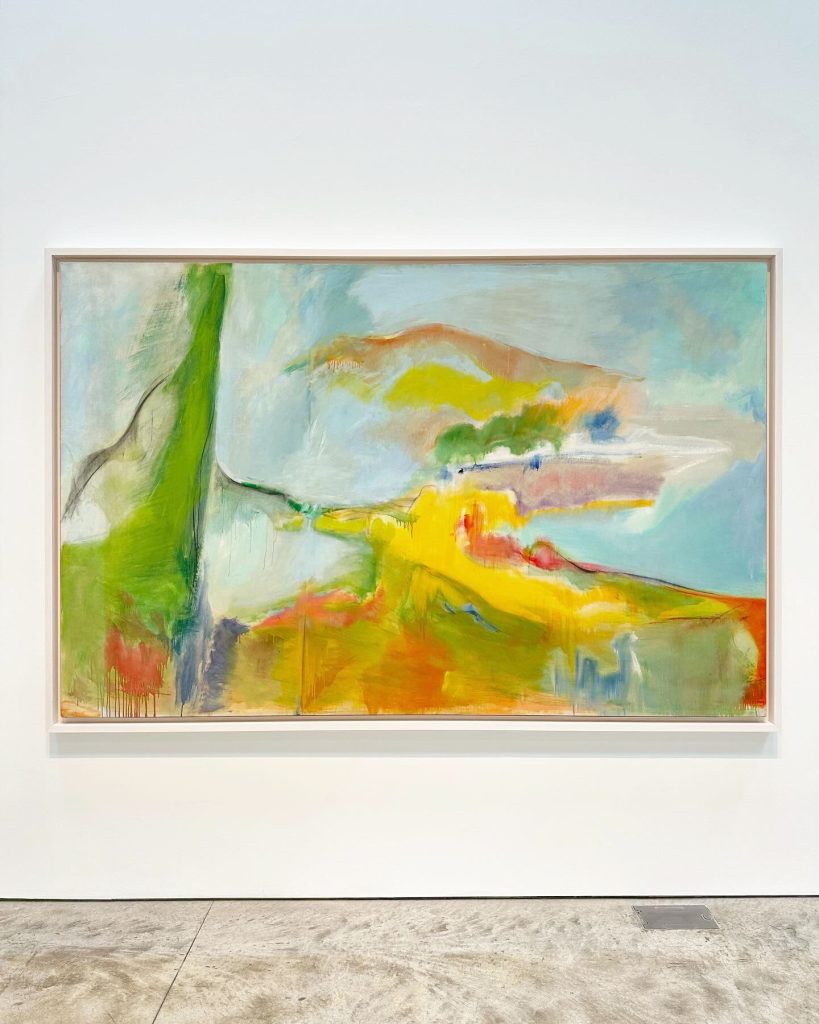
“Northern Lights”, 1959, oil on linen

“Untitled (Near the Cove)”, c. 1958, oil on linen

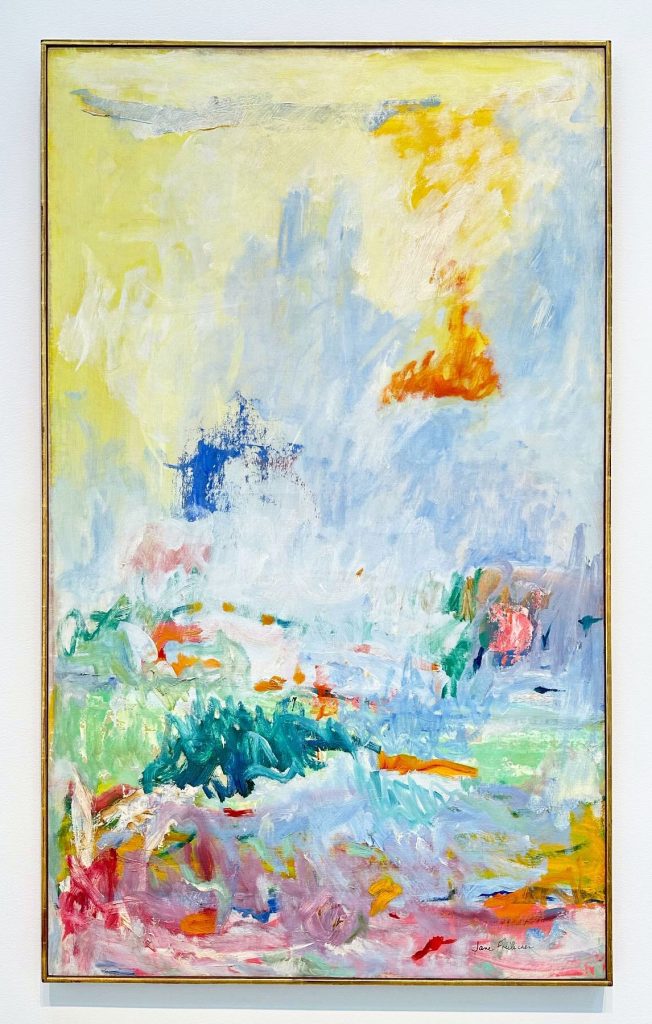
“Fresh Air”, c.1958-1962, oil on canvas

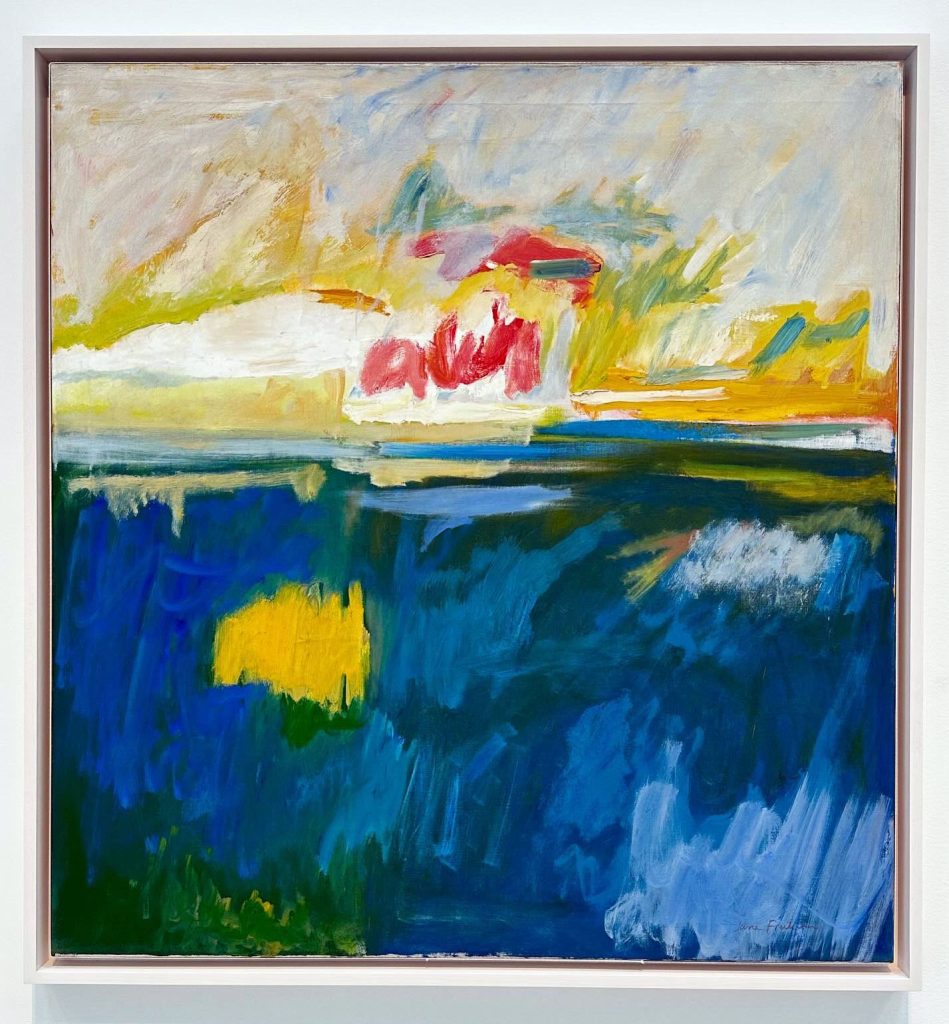
Although better known for her figurative paintings, Jane Freilicher also created several large abstract paintings which were on view last year at Kasmin gallery in NYC.  The paintings hint at a recognizable landscape, but through her use of color and energetic brush strokes she evokes the feeling of being immersed in the beauty of nature- without the boundaries of a more realistic representation.

From the gallery about the work-

The exhibition presents a group of paintings in degrees of abstraction, realized by Freilicher between 1958 and 1962, a period of great inventiveness when the artist was spending stretches of time in Long Island but had yet to establish a studio there. The series marks a crucial moment of discovery and focus for Freilicher, who went on to integrate the freedom, fluidity, and confidence developed during this period into her more recognizable still lifes and landscapes of later decades.

Freilicher’s abstractions have their roots in observation, informed by her studies with legendary abstract painter Hans Hofmann at his schools in New York and Provincetown. In this group of paintings, pastoral landscapes from Water Mill, Long Island, are translated through the lens of the artist’s memory into confident gestural compositions defined by their use of color and sensitive depiction of light. In a 2006 interview for The New York Sun, the artist tells writer Jennifer Samet of this evolutionary moment in her practice: “I remember being overwhelmed by aqueous light and the obliteration of the horizon by fog.” Freilicher’s palette returns repeatedly here to a combination of off-white and light blue, rendered in loose brushwork across an expansive pictorial space to give a palpable impression of the airy, open landscape of the country.

Breaking out of the domestic scale necessitated by previous studio spaces, this generative period saw Freilicher regularly visiting Water Mill and then returning to her Manhattan studio where she would collapse the formal elements of the rural and coastal environments into energetic, improvisational paintings that were significantly larger than her earlier works. While approaching pure abstraction, the paintings from this period retain a compositional recognition of their ordering principles—the horizon line, a boat’s mast, the position of the sun in the sky, and, in the artist’s words, “long vistas of clouds and water.”

The metamorphosis of landscapes that figure prominently in the artist’s life are representative of, as Roberta Smith identified in 2006, “a more personal, grounded version of Color Field painting.” This observation bridges Freilicher to a loose group of contemporaries whose considerations of their immediate environments brought great warmth and aliveness to varying shades of abstraction—Milton Avery, Etel Adnan, Joan Mitchell, Agnes Martin, and Willem de Kooning (whose own abstract landscapes inspired by his time on Long Island went on view at Sidney Janis Gallery in 1959).

Feb 222023
 

Diana Al-Hadid “The Long Defeat”, 2017-2023

Diana Al-Hadid “The Long Defeat”, 2017-2023 (detail)

Diana Al-Hadid “The Long Defeat”, 2017-2023 (detail 2)

Bianca Bondi, “The Antechamber (Myths of descent and return)”, 2023

Bianca Bondi, “The Antechamber (Myths of descent and return)”, 2023 (detail)

Bianca Bondi, “The Antechamber (Myths of descent and return)”, 2023 (detail)

Closing today at Kasmin in NYC, is Shades of Daphne, curated by Stephanie Cristello. It is a “timely survey of painting, sculpture, installation, and film by a group of 11 international and intergenerational contemporary artists, many of whom have not previously exhibited in the United States.”

From the Kasmin gallery website-

Bringing together recent and historical works spanning over three decades from the 1990s to the present, the exhibition includes new commissions, site-specific performances and installations that respond to the architecture of the gallery space.

Celebrating the spirit of resistance and revolt, the exhibition takes the figure of Daphne—the Ancient Greek nymph who turned herself into a laurel tree to escape Apollo’s pursuit—as metaphor to explore work that engages with hybrid figures, metamorphoses, and suspended states of becoming. Highlighting deconstructed impressions of the body in relation to mythologies of transformation, the exhibition focuses on work that features remnants of presence even when the figure is absent—objects that hold the memories of living things. Acting as portals, thresholds, and containers of shifting states, each work also engages with architecture as a framework, both in reference to the body and to spaces constructed for both personal and collective ritual.

Information on Diana Al-Hadid’s sculpture, The Long Defeat

Diana Al-Hadid’s (b. 1981 Aleppo, Syria) sculpture takes the Flemish primitive painter Hans Memling’s Allegory of Chastity (c. 1475) as a starting point. The work pictures the bodice of a female figure, her head bowed, hands interlaced at the waist, surrounded by the mouth of a volcanic mountain. Al-Hadid’s first interpretation of the painting culminated in the monumental sculpture Citadel (2017–18), a hollowed silhouette of a woman framed by the base of an embankment whose porous mass extends like a root system toward the ground. Her face is vacant of features, delineated instead by two severe lines like one would find in the initial sketch of a portrait artist, that indicate her gaze remains lowered. Yet in contrast to the demure painting, the massive scale of the work allows for her downcast eyes to stare straight into those of the viewer below.

Information on Bianca Bondi’s installation, The Antechamber (Myths of descent and return), 2023-

An iteration of Bianca Bondi’s (b. 1986, South Africa) installation for Busan Biennale 2020, The Antechamber (Myths of descent and return), grew from a translation of Kim Hyesoon’s poem, “Tundra Swan.” As Bondi states: “salt is essential for life but too much brings death.” Taking inspiration from paintings such as Henri Gervex’s Rolla (1878) or John Everett Millais’s Ophelia (1851–52), we observe a clinical but feminine bedroom setting composed of a bed with a pond at its center, echoing a circular mirror above a dresser at the end of a pathway through the tundra. Salt surrounds the installation, representing both preservation and resurrection. A swan stands alone, symbolizing the force of art and poetry. This is the third chapter of the installation, following the Thailand Biennial in 2021.


Mar 012019
 

Matvey Levenstein, LY, 2018

Currently at Kasmin Gallery are Matvey Levenstein’s paintings depicting scenes from his life in North Fork, Long Island. There’s a quiet, peaceful quality to the works, which begin with snapshots before they are turned into paintings. This exhibition closes Saturday 3/2/19.

Across the street at another of Kasmin Gallery’s Chelsea locations, and worth a visit, is an exhibition of some of Andy Warhol’s polaroid portraits.

Matvey Levenstein, Pink Moon, 2018

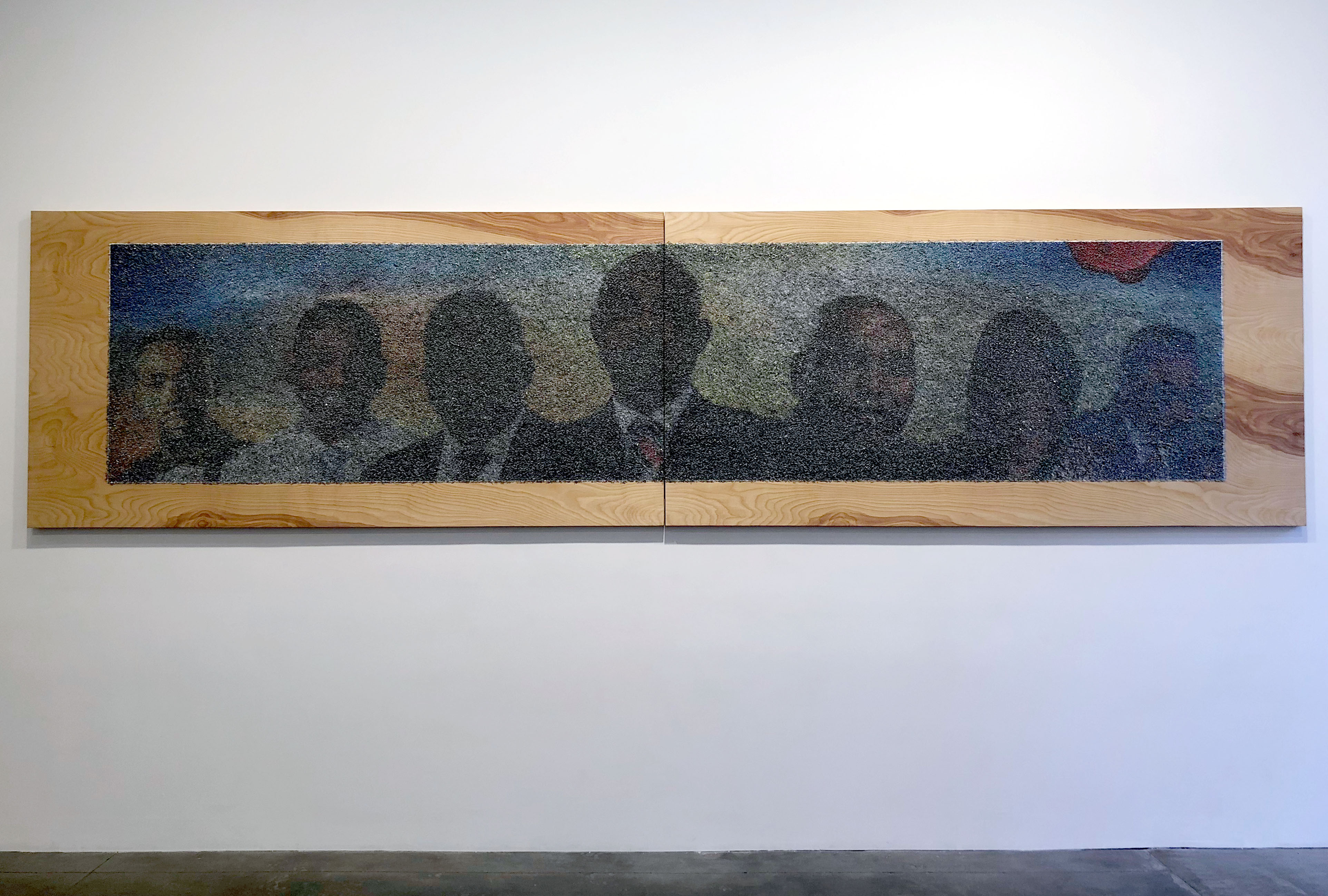
Susan Inglett Gallery is showing Slim… you don’t got the juice, an exhibition of work by Wilmer Wilson IV. His work with staples may seem familiar from its inclusion in the New Museum’s 2018 Triennial: Songs for Sabotage.

From the press release-

Slim… you don’t got the juice presents multidisciplinary departures from familiar modes of figurative representation, as they have evolved in the realm of photographic discourse. Wilmer Wilson IV has developed strategies of redaction and annotation in his work that begin to destabilize the norms of making and viewing portraiture through visual, material, and technical manipulation. An exploration into the complex renderings of individual subject-hood versus object-hood in portraiture, the artist has conceived of a stapled-surface-as-viewing-device that mediates image with material. The device is manifest in a series of staple works that almost fully shroud the photographic subjects beneath dense fields of metal fasteners. The austere, randomized application of the staples onto the surface of each portrait results in a resistance of visual penetration from many angles, complicating access to the underlying figures and deconstructing the voyeuristic inclinations of the viewer.

This exhibition closes 3/16/19.

Wilmer Wilson IV, Host, 2018


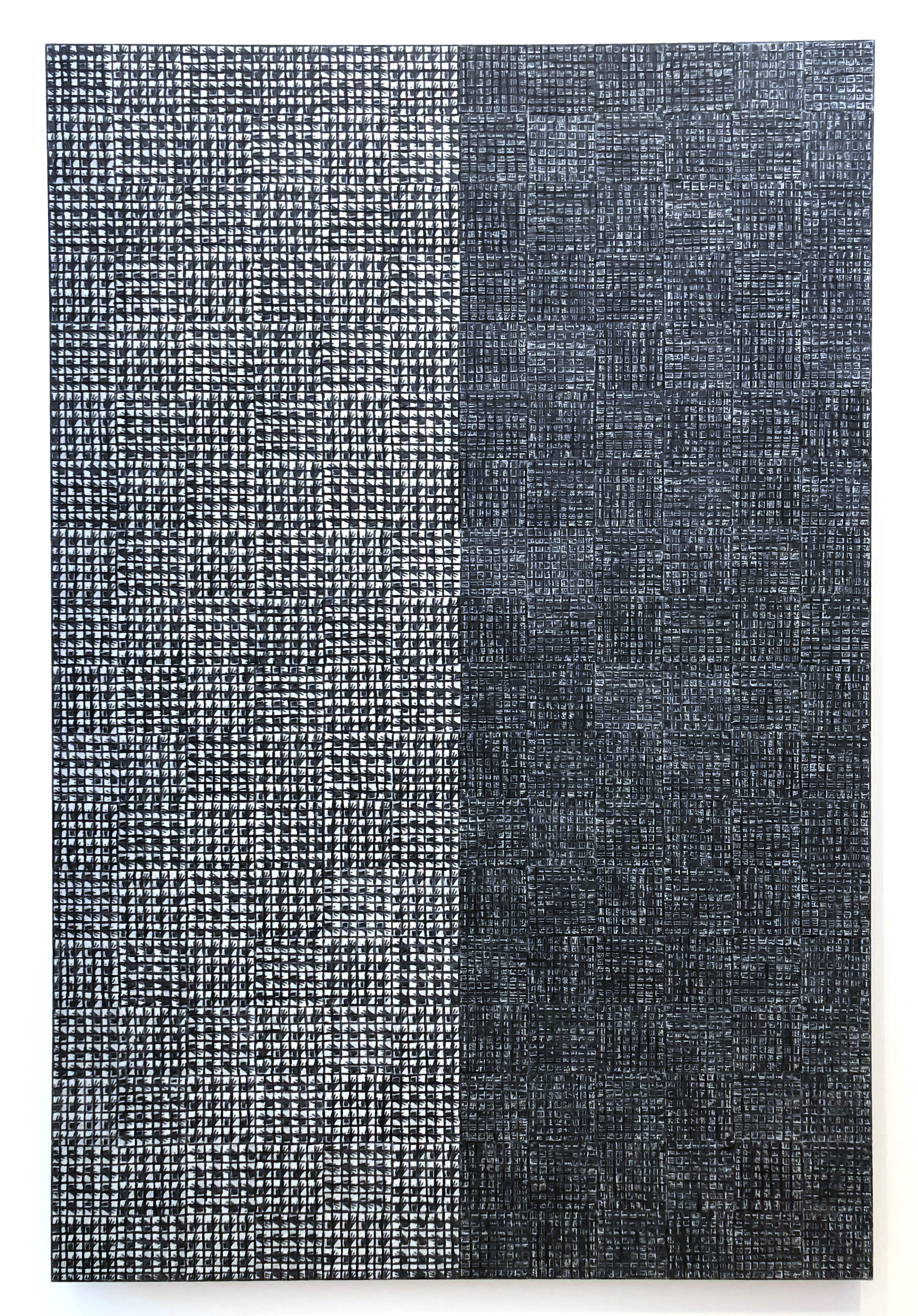
At Lehmann Maupin’s 24th Street location is McArthur Binion, Hand:Work, an exhibition of the artist’s grid paintings created with oil paint stick and paper on board. The patterns created in the work are overwhelming at first glance but then when seen up close, the personal details add a new dimension to the paintings.

From the press release

…For Binion, his personal documents represent the sum total of one’s social life: relationships, citizenship, vocation, and family life. The revealing and obscuring of these aspects of his life also addresses the larger sociopolitical reality of African-American identity—often obscured or erased from common knowledge, yet always present in tandem with major movements in American culture. In his newest Hand:Work paintings, Binion takes an introspective approach that is more closely aligned with the artist’s own self-perception—effectively, his first self-portraits. Using copies of a photo of the home where he was born, along with a photograph of his hand as the ground layer of the paintings, Binion pares down his identity to its most essential elements. These images are tiled in repeated succession, layered under his repetitious line work in oil stick. These gestures themselves relate to memories Binion has of his early childhood farm life, a disciplined approach to the cyclical, sustained effort he maintains in his work today. Through the insertion of his hand, literally in the photographs, and figuratively in his intricate, overlapping mark-making, the artist relates to his earliest introduction to artistry in his mother’s quilting, a tradition he modified and carried into his practice.

This exhibition closes 3/2/19.

McArthur Binion at Lehmann Maupin

McArthur Binion at Lehmann Maupin, detail of above painting

Robert Mann Gallery is showing the newly discovered work of photographer Ed Sievers. The exhibition of black and white photos also includes his later work from the 1970s in Venice Beach. The gallery also has an exhibition of Michael Kenna’s series of black and white female nudes made in Japan (not shown). Both shows close 3/2/19.

Ed Sievers, Untitled (woman in the shadows), c. 1960s, courtesy of the artist, image via Robert Mann Gallery

Damn! The Defiant, a group show curated by Damon Brandt and Andrew Freiser at Fredericks & Freiser Gallery, brings together “images of rebellion and dissent in contemporary portraiture” and includes a wide variety of work in different mediums from an incredible selection of artists that includes Mary Ellen Mark, Gordon Parks, Dana Schutz, Bruce Davidson, Whitfield Lovell and many more. It’s a show that’s very appropriate for a time period that is going to require more and more defiance.

From the press release-

Nothing creates projected personal territory more than the emotional push back generated from the recalcitrant expression of a defiant subject. Yet ironically, it is the very nature of this engagement that makes it difficult for the viewer to quickly detach or withdraw from what in fact amounts to an extended glare or moment of social tension. In a time of undeniable anxiety, finding both the common and contrasting ground in the portrayal of defiance speaks directly to the angst and pre-occupation for self-determination that has been and continues to be a pervasive human concern.

This exhibition closes 3/2/19.


Installation view of Damn! The Defiant, image via Fredericks & Freiser