Mar 042023
 

Alex Prager’s photographs, top floor of the gallery

Alex Prager, “Run” film still

Alex Prager, “Run” film still

Alex Prager, “Run” film still

Alex Prager, “Run” film still

It’s hard not to be delighted by Alex Prager’s latest exhibition, Part Two: Run at Lehmann Maupin gallery in NYC. Upon arriving on the lower level of the gallery you are met with a pinball machine, brightly colored photos, and the sculpture of a woman’s body with her head crushed under a giant silver ball. In the next room, the short film Run sucks you in to it’s strange world.

From the press release-

Directly responding to a period of cultural ambivalences and uncertainties, the exhibition urgently examines human perseverance and explores the opportunities for empathy, participation, and action present both within art and everyday life.

Across her practice, Prager crafts rich, often ambiguous narratives that examine the cultural mythologies and archetypes that shape collective existence. As she deploys and deconstructs artistic and narrative conventions, Prager explores how both our senses of self and our engagement with others are often mediated by familiar stories and tropes. Occupying a tenuous relationship to time and place, the artist’s carefully choreographed figures remain suspended between the past and the present, and Prager gestures to a collective will to exist that not only transcends our immediate circumstances but persists despite them.

The foundation for Prager’s latest body of work is the artist’s powerful new film, Run. Featuring musical compositions by Ellen Reid and Philip Glass and starring Katherine Waterston, the film deploys cinematic archetypes and absurdist humor as it examines human resilience in the face of catastrophe. An otherwise ordinary day in an uncannily generic setting erupts into chaos when a massive, mirrored sphere propels itself through a community. Here, forward motion is countered by retrospection. Figures collide into their own reflections in the sphere’s surface, and Prager suggests a curative, collective reckoning with those forces outside of our control.

The New York exhibition presents Run in dialogue with photographs and sculptures that further complicate and enrich the film’s fundamental concerns. Prager’s photographic work Sleep (2022) shows the intricately staged mass of people from Run, as they momentarily lay on the ground, after each colliding with the accelerating mirrored ball. Sleep humorously deconstructs the conventions of the film still, and Prager unveils the absurdist potential of suspending a single moment in time. Dramatizing the scene’s ambiguities, the work offers a narrative with a multitude of possible conclusions. Directly engaging the film’s central image, Prager’s sculpture Ball (2022) shows a hyper-realistic figure of a woman, whose head appears to be crushed by the mirrored sphere. As viewers approach the object, they are likewise confronted by their reflections, and they, too, become enfolded within Prager’s lively narratives. Here, as throughout the exhibition, Prager invites viewers into her visually and symbolically saturated works, suggesting that they, too, have critical parts to play.

Part Two: Run marks the culmination of a multipart exhibition, which also included distinct presentations at Lehmann Maupin Palm Beach in November 2022 and Lehmann Maupin London in January 2022.

Make sure to head to the top floor of the gallery as well, where the exhibition continues with more photographs.

This exhibition closes 3/4/23.

Mar 032023
 

Ulf Puder, “Winterlandschaft”, 2017

Ulf Puder, “Großer Felsen”, 2022

Ulf Puder “Taormina”, 2018

Ulf Puder, “Kleine Winterlandschaft”, 2022

Ulf Puder, “Willy Lott’s House”, 2022

For Ulf Puder’s painting exhibition at Marc Straus gallery in NYC, he has created paintings of subjects both natural and man-made in different states of decay and isolation, a reflection of the issues in our current world.

From the press release-

Ulf Puder, a landscape artist for 20 years, looks at the genre as a cultural concept, defining it as a clash between nature and culture. In his invented landscapes, he addresses cultural and political developments across Europe. He considers the two years of the pandemic, the energy crisis, the current Russian/Ukrainian war, other regional economic uncertainties, and various global conflicts. Puder approaches these struggles through romanticism, a viewpoint that is not in denial, but that plays on our weakness, laxed attitude, and idealism. Among the new works, one painting depicts a collapsing mountain, another an exploding rock. The rock, symbolic and powerful, signifies protection while also reflecting the broken state of the new world order. In addressing this dichotomy, the natural strength of the rock, millions of years unchanged, now begins to crumble with human intervention.

In Willy Lott’s House, Puder references a painting by John Constable that is influential in his work. The painting depicts a small American period house with contrasting dark clouds in the background and a well-lit foreground. The lighting is dramatic: electric lights, reflection on the water, an absence of sunlight and moonlight. A recurring question for Puder is how would one go about a painting today that was painted 100 or 200 years ago? He concludes that the first step is to recycle the title, closely followed by contemporary additions to the original version. The Icebergs, the title of a painting by American landscape artist Frederic Edwin Church, was painted in 1861. With this work, Puder has used the image in varying versions in his own work to address pressing contemporary issues. The icebergs, the mountains, and the alps are part of the artist’s experiences, while also acting as metaphors for cultural and political changes.

Puder’s creative process is traditional with a few contemporary twists. The earlier works were created entirely with brush and paint. He now uses a spatula with a deliberate application of paint to specific parts of the canvas; a roof, or a river path, for instance, are now more brilliant through the use of a new technique. He uses tape occasionally to create defined edges, and to create important elements of the pictorial plane, such as broken structures and melting icebergs. Puder argues that despite our infinite capacity to destroy, by shifting focus we can build up. In his continued quest to create quixotic worlds, he continues to look at nature and culture, and how a shift in one often impacts the other.

This exhibition closes 3/5/23.

Mar 032023
 

Renée Stout, “Navigating the Abyss”, 2022

Renée Stout, “A Question for Christoper Wool“, 2022

Renée Stout, “Escape Plan D (with Hi John Root, Connecting the Dots)”, 2022

Renée Stout, “Wall of the Forlorn”, 2022

Renée Stout, exhibition room

Renée Stout, “Armored Heart/Caged Heart”, 2005

Renée Stout’s exhibition at Marc Straus in NYC,  Navigating the Abyss, presents a collection of her recent work in various mediums. From sculpture and painting to photography, her skillful and inventive work draws you in.

From the press release-

Starting out as a photo-realist painter depicting life in everyday urban neighborhoods, Stout soon developed an interest in the mystical and spiritual traditions in African American communities. Fascinated with fortunetelling and the healing power of Hoodoo, Vodou and Santeria still practiced within the African Diaspora in the American Southeast and Caribbean, she delved into ancient spiritual traditions and belief systems. She has drawn inspiration from a wide variety of sources such as current social and political events, Western art history, the culture of African Diaspora, and daily city life. While her artistic practice is rich with references and resonances, her works are eventually unique manifestations of her own imagination, populated by mysterious narratives and imagined characters derived from the artist’s alter ego.

In this exhibition, we encounter a group of portraits depicting Hoodoo Assassins and Agents (#213 and #214) who, in Stout’s imagination, are healers, seers, and empaths from a Parallel Universe in which fairness and balance rules. Erzulie Yeux Rouge (Red Eyes) is a spirit from the Haitian Pantheon of spirits whose empathic nature makes her a fierce guardian or protector of women, children, and betrayed lovers. Ikengas, originating in the Igbo culture of Southeastern Nigeria, are shrine figures that are meant to store the owner’s chi (personal god), his ndichie (ancestors) and his ike (power), and are generally associated with men. Stout’s Ikenga (If You Come for the Queen, You Better Not Miss) is a powerful female figure with her breasts and horns turned into weapons, and she is adorned with jewels and charms to boost her powers. Beyond the playful yet powerful imagination of these female characters are serious undertones of political commentary as Stout ponders the concepts of these deities while witnessing the recent rulings in our society that infringe on women’s rights.

In Escape Plan D (With Hi John Root, Connecting the Dots) Stout maps out her potential escape to the Parallel Universe when the daily news weighs unbearably on her psyche.

Visions of the Fall, in Thumbnails is a series of five small paintings that comments on the current state of our world and its imagined future with the titles as upcoming stages of its evolution.

American Memory Jar is an entirely black sculpture consisting of a glass jar covered with thin-set mortar, plastic and metal toy guns, topped with a doll head and adorned with a bead and rhinestone cross pendant. Memory Jugs are an American folk-art form that memorializes the dead adorned with objects associated with the deceased. Stout’s jar is a bitter but painfully accurate assessment.

While Stout’s work alludes to history, racial stereotyping, societal decay, and a set of alarming tendencies in our socio-political structures and ecosystem, it also reveals possibilities and the promise of healing. Various works reference healing herbs, potions, and dreams. Herb List, Spell Diagram and The Magic I Manifest speak of Stout’s belief in the power of consciousness, in the existence of more solid and fertile grounds, and of individual responsibility.

There is one overarching narrative that clearly emerges from Stout’s work – her personal history and spiritual journey as a woman and as an artist.

This exhibition closes 3/5/23.


Mar 022023
 

Iulia Nistor “Evidence L3 W2 P8”, 2022, oil on wood, 50 x 40 cm

Iulia Nistor “Evidence L5 W8 P1”, 2022, oil on wood, 50 x 40 cm

Iulia Nistor “Evidence L/E0 F4 A5”, 2022, oil on wood, 50 x 40 cm

Iulia Nistor “Evidence L6 F2 A9”, 2023, oil on wood, 50 x 40 cm

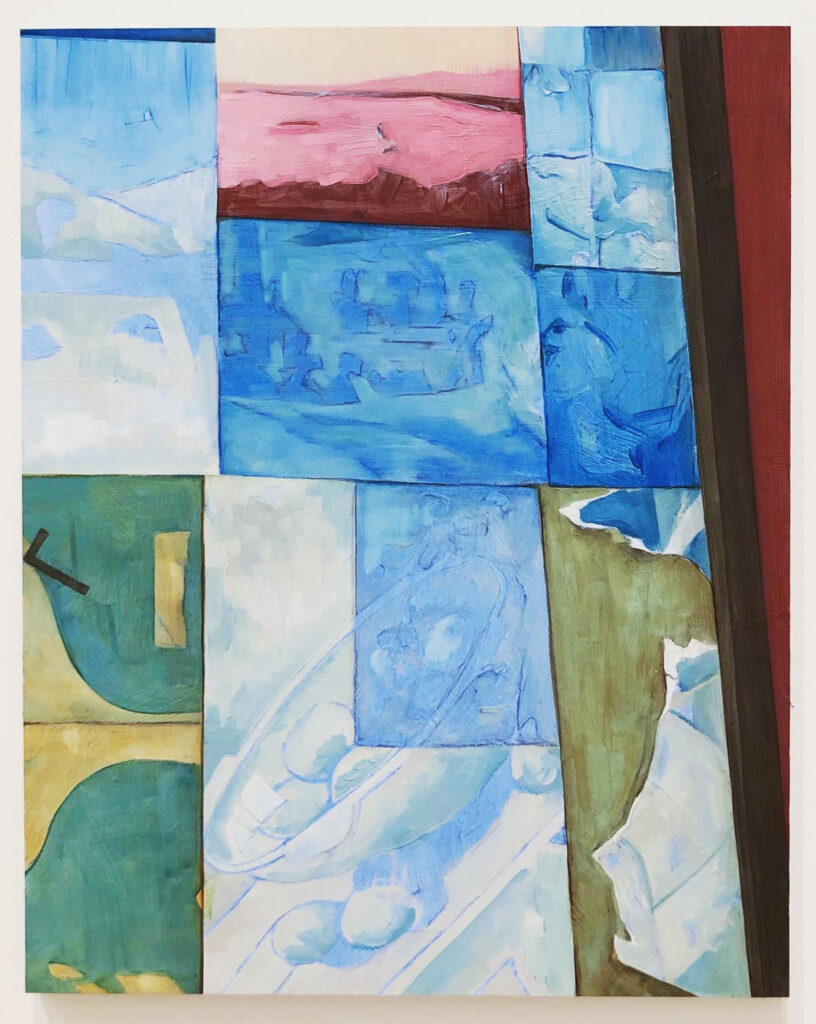
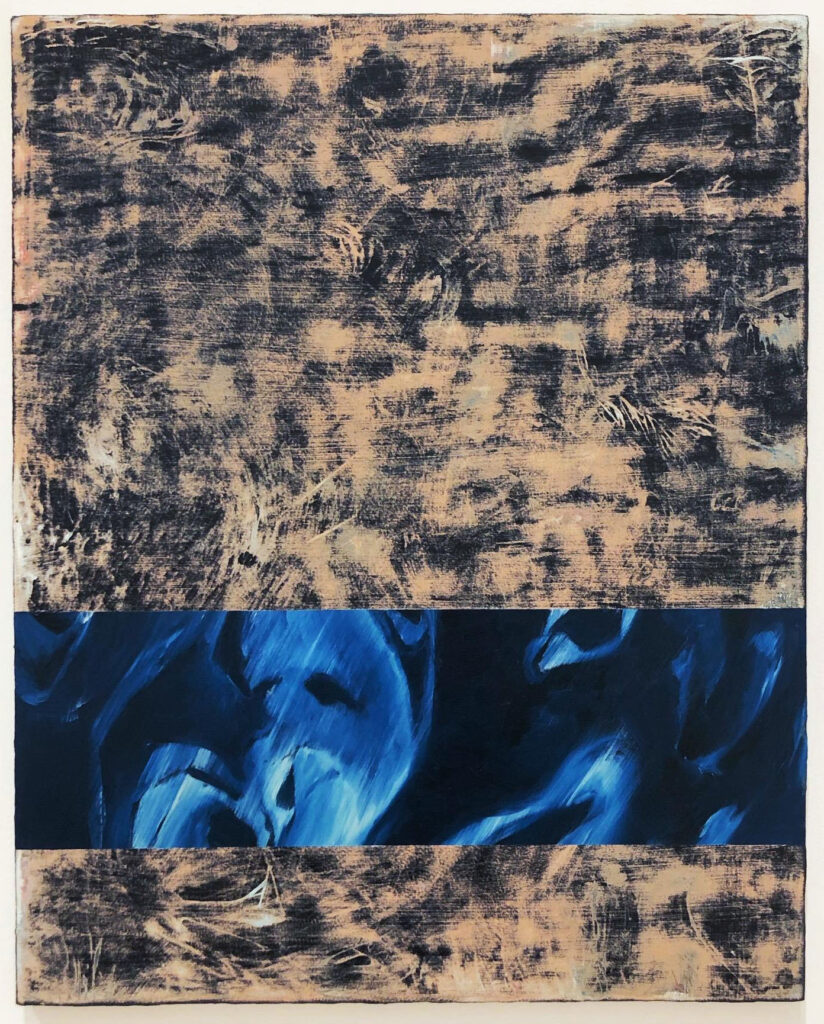
Currently at Mendes Wood Gallery in NYC are Iulia Nistor’s paintings for her solo exhibition properties without object. The new works are part of her Evidence Paintings series. Each painting is the same size and titled with coordinates “suggesting not only the representational function, but also documentary specificity, of paintings which rarely picture anything we can automatically name”.

More from the gallery’s press release-

Paint is used with a diverse range of techniques, applied with a fine brush in painstaking detail or with broad gestures. Hard-edged forms cede to organic scumbling. Deep illusionistic spaces, evoked by geometric lines of perspective, contrast with marks which emphasize painting’s limitations to its surface. Trompe l’oeil plays sly games with our habitual perceptions. Dried paint is removed with a sanding device, subverting Nistor’s intentions, producing unforeseen configurations and textures, and reducing multiple layers of paint to ground.

Irreducible to any singular style, these expressive resources are positioned to represent the properties of certain things, perhaps an observed aspect of an object, a place, a person, or the space between them. Nistor’s purpose is not primarily to represent the things themselves but the qualities which they possess. This aim makes her paintings register less as representations than inquiries into the nature of representation itself, questioning the opaque relation between how something appears, how it is perceived, and how that duality can be pictorially rendered. How much of what we experience is a given of the environment, and how is it changed by the subjectivity which accompanies it? Does a painting, unlike a photograph, need to depart from the ostensible form of its subject to, paradoxically, achieve a true likeness of it?

Nistor often proceeds through gestures of subtraction, isolating a property of an object by eliminating aspects of it. The specificities of her practice correspond to the specificity of the phenomena they are used to capture.

Alongside her paintings, for the first time, Nistor exhibits a pair of photographs, each showing one side of an A4 sheet of paper, upon which a sequence of propositions is printed. These are attempts to define the relationship between objects and the properties which seem to adhere to them. The spare sentences, phrased in objective, philosophical language, have been edited by queries and remarks, written in pencil and ballpoint pen, in the artist’s hand. This process of revision and redefinition, preempting the demand for a categorical answer, reflects the artist’s process in painting.

In both photographs, the sheets appear on a black studio surface. One rests parallel to its frame, resembling an aperture, while the other lies tilted, negating this illusion. The abstractions of language qualify—or are qualified by—the materiality of the wooden surface, much like those upon which Nistor paints, stained with traces of the artist’s process. A window into Nistor’s conceptual method doubles as a formal metaphor for the axis, central to her practice, between the given and the made.

Iulia Nistor, “Untitled (properties without object)”, 2023, photo on cotton paper (image via Mendes Wood )

This exhibition closes 3/5/23.

Feb 262023
 

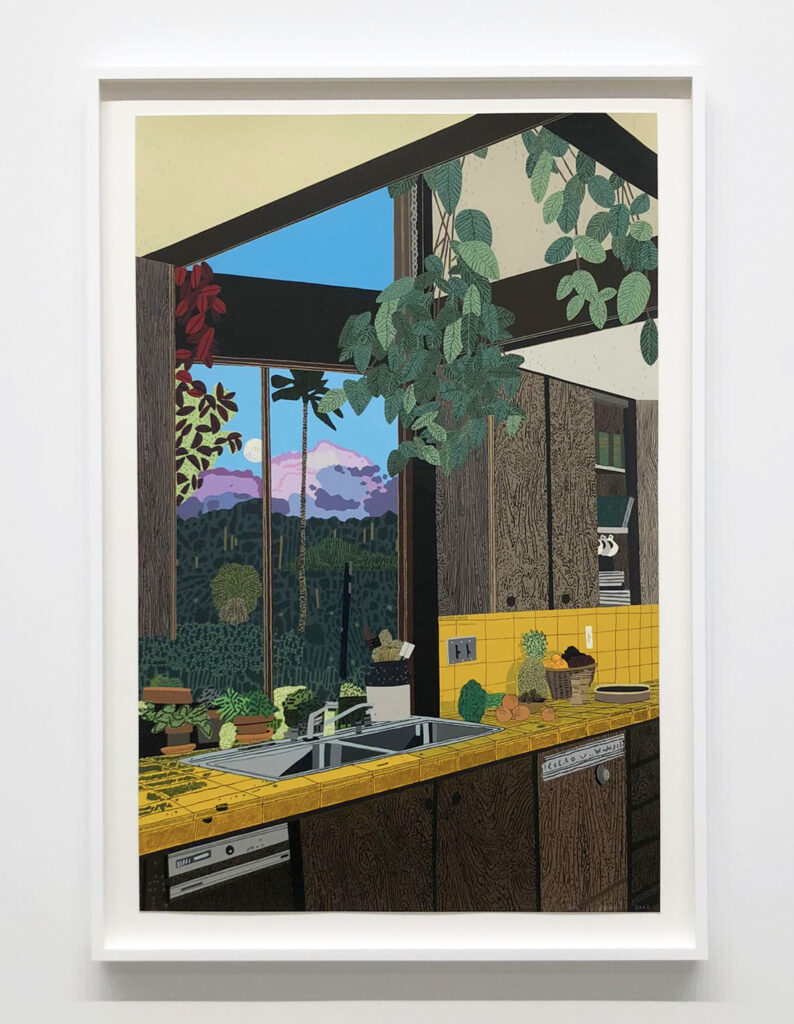
Jonas Wood, “Kitchen Interior”, 2022

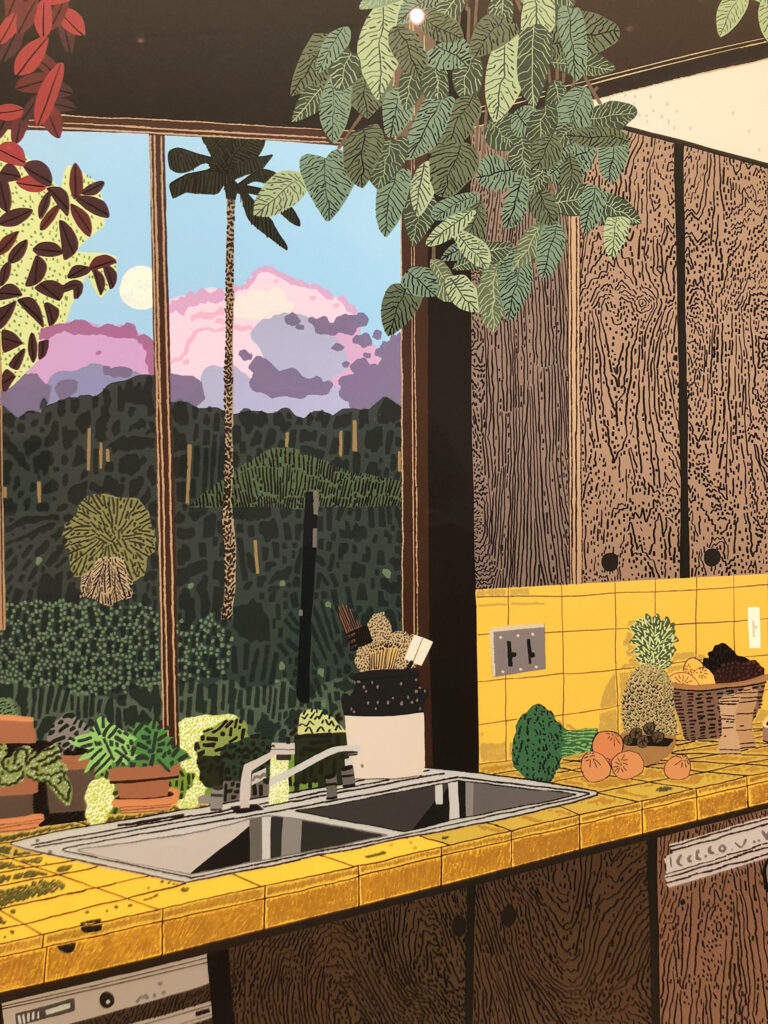
Jonas Wood, “Kitchen Interior”, 2022 (detail)


Prints 2, Jonas Wood’s exhibition at Gagosian Gallery in NYC, consists of over thirty prints made between 2018 and 2022, in a variety of styles and subject matter.

From the press release-

You have to build the print piece by piece. I just love the way it looks, the process, the whole feel of it. It’s irreplaceable.
—Jonas Wood

The works on view in Prints 2 feature Wood’s perennial motifs—plants, pottery, portraiture, interiors, landscapes, and basketball—reflecting the life of the artist through representations of home, studio, and natural spaces. They are united by Wood’s transformation of subject matter into images with skewed planar space, dense patterning, and vivid color. Developing his prints in parallel with his paintings, Wood has arrived at linked practices that continually inform one another.

Emphasizing the collaborative aspect of printmaking, Wood works with masters of traditional methods who have made innovative contributions to the field. Prints 2 features works made with Aliso Editions, Cirrus Gallery & Cirrus Editions Ltd., Counter Editions, Hamilton Press, Mixografía, and Pace Editions. In addition, Wood publishes and copublishes under his own imprint, WKS Editions.

The stylistic diversity of Wood’s prints results from his experimentation with pictorial effects, processes, and materials, effectively exploring the genre of printmaking itself. The methods used to produce the works in Prints 2 include hard-ground and soft-ground etching, lithography, screen printing, and woodcut, as well as various hybrid processes. Wood pairs these techniques with variations in mark making, color, texture, and density to harness and reveal the characteristics unique to the medium.

Feb 262023
 

Y.Z. Kami “Woman in Dark Sweater, 2022

Y.Z. Kami “Woman in Dark Sweater, 2022 (detail)

Y.Z. Kami “Aïsha”, 2012-22

Y.Z. Kami “Messenger IV”, 2022

Y.Z. Kami “Night Painting XV”, 2022

For his exhibition Night and Day at Gagosian in NYC, Y.Z. Kami is presenting two distinct bodies of work, his portrait paintings and a newer series, Night Paintings, started in 2017.

From the press release-

Each of Kami’s large-scale painted portraits depicts a single face in muted colors on an opaque ground. Frontally composed and closely cropped, Kami’s self-absorbed subjects are removed from the specificity of context. From Aïsha (2021–22) and Lu (2022) to The Monk (2022) and Woman in Dark Sweater (2022), these paintings are titled by first names or descriptions, marking a continuum between individual identity and universality. Using layers of brushstrokes to blur his subjects’ features, Kami concentrates on the ineffability of individual presence. From longtime friends and acquaintances to strangers he has met in passing, his subjects form an ensemble of varied age, gender, and ethnicity. Kami’s introspective faces also recall the Fayum portraits of Roman-era Egypt—naturalistic likenesses of the deceased that were affixed to mummies. The works in Night and Day affirm—as do their ancient precedents—the common humanity in our observation of others.

Kami’s Night Paintings are made using a single shade of indigo—said to be the color of the night—which he blends with gradations of white to summon the sensorial dynamics of presence and absence. Each canvas is filled with apparitions that float just past the limits of materiality and concrete representation. Composed with hazy, tenebrous brushwork, these abstractions evoke a mental inner state. Their shifting outlines and hazy boundaries make manifest soft edges and shimmering biomorphic patterns, enticing the viewer to recognize elements from the human realm while ultimately confounding all attempts to do so. The Night Paintings thereby limn the boundaries between the earthly and the sublime.

Messenger IV (2022), a single painting that belongs to neither series, represents a cloaked figure seen from behind, painted in a soft-focus style. The anonymous subject appears in the foreground of a crossroads, a setting of passage and transition. Kami has positioned this figure using the classical compositional device of the Rückenfigur (back-figure), with which the viewer is encouraged to identify, thus implicating him or her in the space and narrative suggested.

Contrary to the instantaneity of a photograph, Kami composes his paintings over an extended period, his nuanced brushwork built up in many layers. Consequently, they reward sustained looking, revealing their character over time and bringing awareness both to perception as a process and to contemplation of the nature of being.


Feb 252023
 

TIDE- “SEA E”

TIDE- “DAYS” and “CALM”


Closing on 2/25 at Ross + Kramer in NYC is artist TIDE’s  (Tatsuhiro Ide) debut solo exhibition, HAPPYSADEMPTYFULL.

From the gallery’s website-

TIDE is a Tokyo-based artist renowned for his signature cat character, which he depicts in monochromatic, domestic settings. Beginning in 2019, TIDE has made grayscale paintings of this cat character, existing within various domestic environments, often punctuated with art historical references. In this newest body of work, the cat, perhaps an avatar for the artist himself, lounges in a cozy bed, swathed in blankets and layers of duvets.

The title of the exhibition comes from a painting, HAPPYSADEMPTYFULL, and reflects the cycles of feelings that one experiences throughout a day. The subject matter feels especially relevant given current events—a housecat, much like humans in a pandemic lockdown, has a somewhat narrowed spectrum of experience.

TIDE works in multiple layers, using airbrush and spray paint to express the illusion of depth in a delicate environment, and employs a variety of brush stroke techniques in order to create the appearance of texture and natural elements. TIDE’s work wonderfully demonstrates the value and richness of harmonious composition. His monochromatic palette, coupled with crisp yet gentle silhouettes, ignites a pronounced sense of nostalgia.

Feb 242023
 

Danielle Roberts “The sky weighs heavy through the night”, 2023

Danielle Roberts “Picnic on the Roof (Moon Bath)”, 2022

Danielle Roberts “Adrift”, 2022

Danielle Roberts “Sunshine Market”, 2023

Currently at Fredericks and Freiser in NYC is Evening All Day, an exhibition of paintings by Danielle Roberts.

From the gallery’s press release-

In her moody and atmospheric paintings, Roberts explores the various psychological states brought on by her generation’s societal instability.  Roberts’ settings – strip mall parking lots, living room sofas, city rooftops, and outdoor parks – are familiar to wide audiences. Yet, when rendered with otherworldly color and dramatic chiaroscuro, they feel transitory and strange. Unstable emotions are communicated through uncanny lighting –both phenomenal and foreboding– and fragmented coloration that coalesces differently across canvases. Some figures are made up of geometric patches of hues that are visually delineated from each other. In contrast, other bodies are made up of a similar patchwork of coloration but by swaths that blur together slightly.

Solitude follows Roberts’ figures as they amble across an urban landscape populated by friends, lovers, and passersby.  These transitory moments, at once together yet disconnected, all seem to be anticipating something just out of reach.  A cinematic atmosphere bolstered by an artificial light imbues these scenes with Roberts’ signature radiant glow. The vivid and dark mood matches the internal, untethered state of the figures who seem oddly stuck. They wander as if they are perpetually spending their last $20 on another round of drinks.

Roberts does not shy away from discomfort and awkwardness in her worlds. She hones in on the pathos of her own experiences and those of her peers which are at once individual, unique to each of Roberts’ figures, and universal, instantly recognizable to audiences. The artist does not retreat into her painted worlds as an escape from the overwhelming anxiety and instability coursing through contemporary society; instead, she pushes right up against them, opening those spaces onto her audiences. There is an insistence on life and desire, even if those desires are complicated. The people of her scenes – withdrawn and ambivalent – wade through the mess, surviving on their own terms.

This show closes 2/25/23.


Feb 242023
 

Lars Fisk, “Court Tennis (v.1)”, 2023 with “das Ding (v.3)”, 2023

Lars Fisk, “Court Tennis (v.1)”, 2023 (right side)

Lars Fisk, “Court Tennis (v.1)”, 2023 (left side, closer) with “das Ding (v.3)”, 2023

Lars Fisk, “das Ding (v.1)”, 2023

Lars Fisk, “das Ding (v.1)”, 2023 (back view)

Lars Fisk, “das Ding (v.2)”, 2023

For 10SNE1, Lars Fisk’s exhibition at Broadway Gallery in NYC, he has created an immersive environment that is really fun to walk around in or even try playing in.

From the gallery’s press release-

Whatever isolation people experienced during the 2020 pandemic lockdown was, to residents of the remote enclave of Red Hook Brooklyn, both compounded and barely noticed at all.  Lars Fisk, who lives and works there in a stacked shipping container house and an adjacent studio, mostly carried on with his solitary practice fashioning astonishingly complex sculptures from glass, steel, brick and wood.  Apart from the occasional neighborly drop-in, he saw very few people.

As a result, when New York emerged from the fearful slumber of Covid, Fisk himself blossomed in late spring with a hunger for human connection. As luck would have it, he was invited by a Red Hook neighbor to join their softball league. Fisk had never really played before, but took a chance and shook off the isolation to give it a shot. He has described the profound uplift of multi-generational camaraderie and shared purpose; of competition and physical exertion in almost euphoric terms.

As summer wound down, Fisk was determined to find a way to perpetuate this endorphin rush. Simultaneously, he had also been playing tennis with some regularity, and, as is his inclination, had been researching the history of the game. He was delighted to discover that the game (known first as Court Tennis) originated in the Middle Ages with opponents paddling a cord-wound leather ball back and forth off of the sloping roofs of the stalls at the close of the public market—a version of what many a contemporary suburban kid would recall as a game of “Roofball”.

This gave Fisk the idea of creating a winter-ready racquet sport inside his studio. This portion of his workspace had been set aside for formal display of works that were complete but hadn’t yet been shipped out for exhibition—a place to present works to his now close-knit Red Hook community in an in-crowd acknowledgement of the locals’ contribution to his work and happiness. Therefore, this site (a White Cube with an absurdist twist of the traditional wattle and daub and timbering of Tudor architecture) became the obvious location for the court. Here, any neighbor or visiting friend that came to play and help develop the rules of this makeshift new sport became de facto performers—became the artwork that this space was designated to display. A low net was set up and a loose set of rules were developed to keep the play lively and competitive. Fisk experimented with different wall treatments (clapboard, asphalt shingles, etc.) that complicated the angle of rebound of volleyed shots and produced a controlled chaos that slowly refined itself as his visiting collaborators learned the peculiarities of the court.

Fisk was pleased that his passions for architecture, sculpture, competition and bonhomie had successfully converged in this new sport/performance/artwork and he began to develop the idea and how it might be realized within a more formal exhibition space.  In preparation for the show, he expanded upon the theatrical possibilities (both in presentation and potential for audience) that the commercial gallery setting in Tribeca would provide. The result is a kind of non-site environment that evokes an outer borough environment of vinyl sided clapboards and shingled rooftops that form the irregular angles and planes that recalls the architecture of Court Tennis. A basement bulkhead door emerges from the floor at a 45-degree angle perfect for bewildering bank-shots; a pre-fab bay window presents a multi-faceted surface refracting the ball in unexpected ways; an open garage shelters a sculpture based on a boxy 1970s Volkswagen “Thing” whose windshield is also fair play. Two more of these themed vehicle sculptures (one evoking a military ambulance and the other a preposterously tricked out off-road vehicle with aftermarket flood lights and winch) are arrayed in the court’s adjacent “gallery” acting alternately as obstacles, artworks and seating for viewers of the match. The sculptures’ angular geometry acts as a catalyst for the court’s faceted architecture, unifying the exhibition as a whole.

Formal concerns aside, the development of the game has naturally teased out conversations about court etiquette, dress and decorum as signifiers of class, and the twinned elitisms of the tennis club and art world. Within the exhibition these are reflected in the players’ tennis whites and the ritualistic manners of play. Perhaps as an antidote to this reality, the hope is that Fisk can expand his community by inviting exhibition visitors to engage with both the built environment and discrete artworks and to become a part of the artwork itself.  In the process, he may simultaneously democratize the lofty status of tennis and the gallery space itself.

This exhibition closes Saturday 2/25/23.


Feb 232023
 

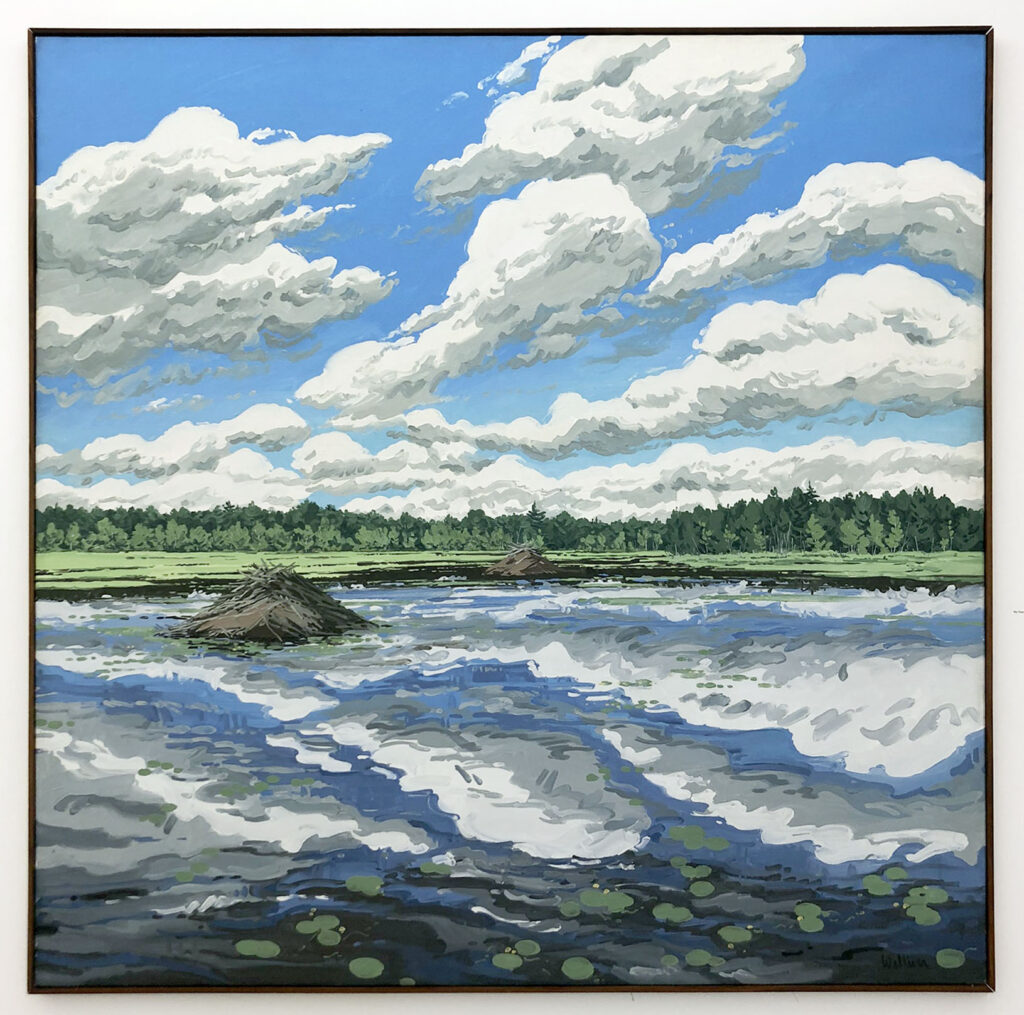
Neil Welliver, “Big Flowage”, 1979

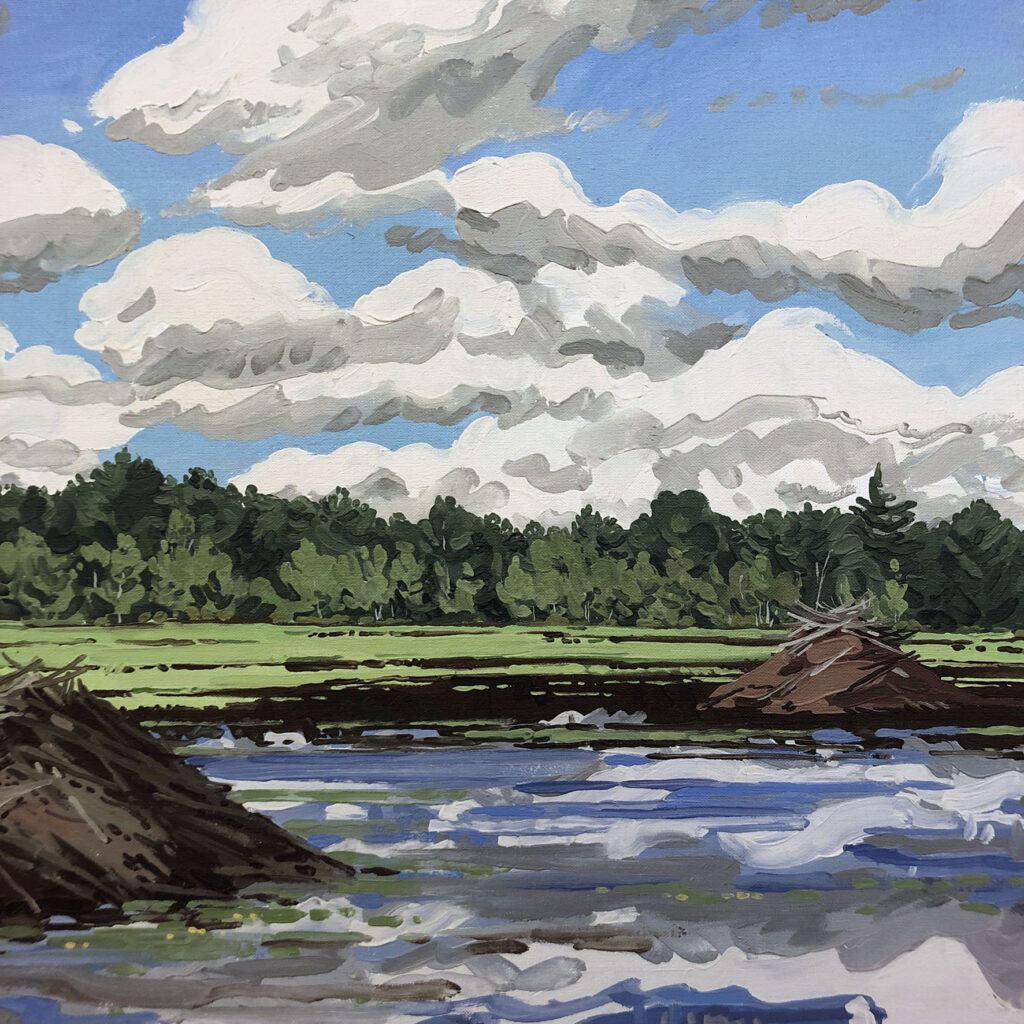
Neil Welliver, “Big Flowage”, 1979 (detail)

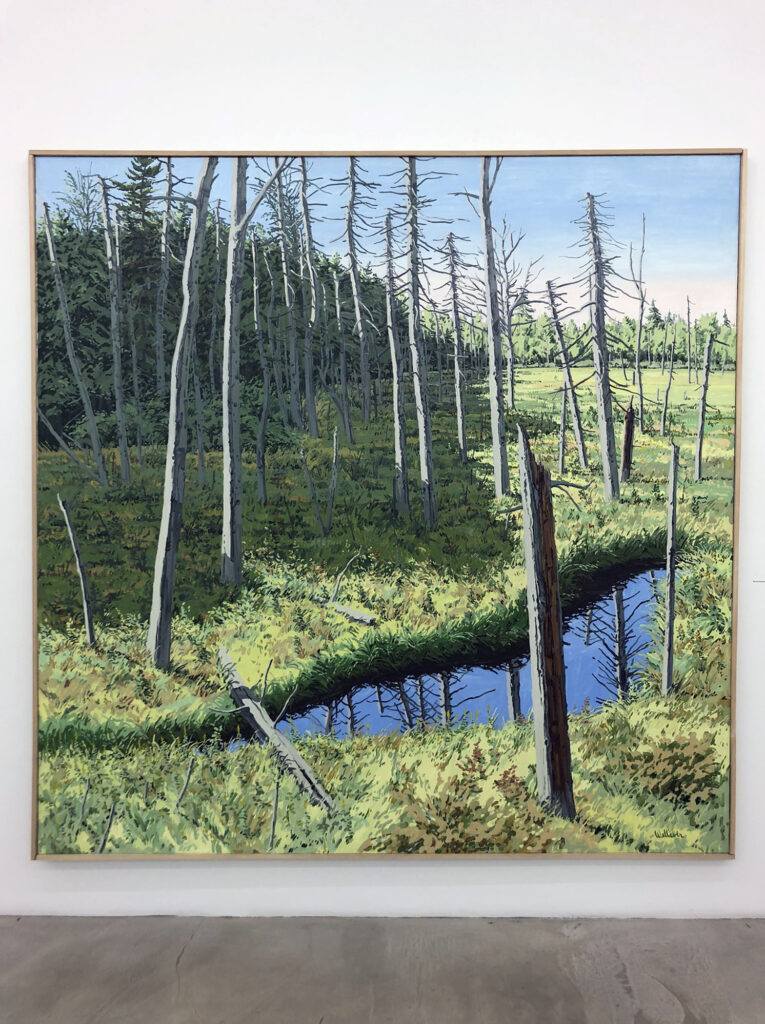
Neil Welliver, “Marsh Shadow”, 1984

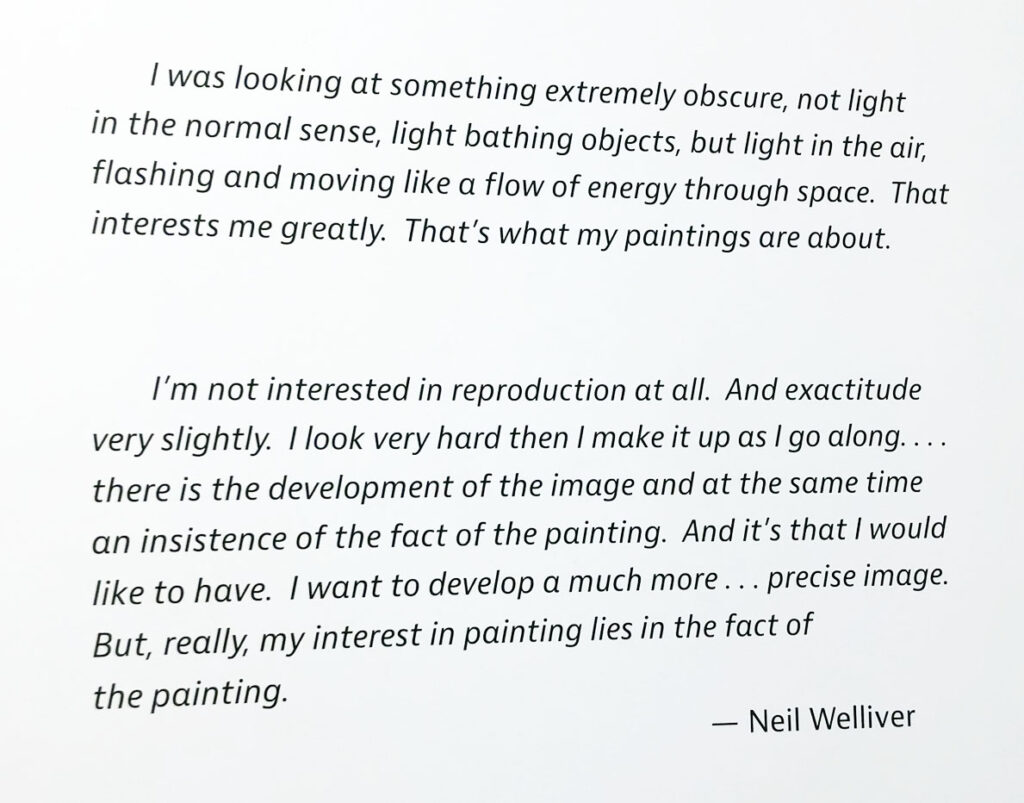
Neil Welliver quote on the gallery wall

Currently at Alexandre Gallery in NYC are Neil Welliver’s gorgeous paintings and works on paper, spanning his career from the late 1960s-2000, and including his last woodcut print, Stump.

From the gallery’s website–

In his 2005 New York Times obituary, Ken Johnson wrote:

Mr. Welliver came of age as an artist in the late 1950’s and 60’s, at a time when nonrepresentational styles of painting like Abstract Expressionism and, later, Color Field and Minimalism were accorded the highest critical prestige. Along with artists like Larry Rivers, Alex Katz and Philip Pearlstein, Mr. Welliver strove to paint representational images without sacrificing the formal innovations that the Abstract Expressionists Jackson Pollock and Willem de Kooning had introduced to modern painting.

Welliver’s lifelong friend, the American poet Mark Strand, wrote of his process in 2001:

What sets Welliver’s woods apart from the woods of others is that they are, of course, his. We see them and know instantly who painted them. That stream plunging and swirling around those gray rocks is familiar, so are those clouds parading in ragged order across that sky spreading a midday blue over those hills. They are all part of Welliver’s woods. The unaffectedness, the ease with which they are simply there, without a hint of what went into their making, without an indication anywhere of the turmoil that prompted them, is what sets them apart. Of course, we can see the many brush strokes in a large Welliver and believe that they—in their tireless application—tell us what goes into a Welliver, but we would be wrong, for there is much in a Welliver that we cannot see. In the past of each one are the long hikes into the woods, which Welliver takes, loaded down with easel, canvas, brushes, oil, thinner, and tubes of color, to the spot where he will paint; then there are the hours he stands, in all kinds of weather, and paints what will be the small preparatory paintings on which he bases the large drawings that lead finally to the large paintings.

This exhibition closes 2/25/23.