Feb 232023
 

Cynthia Talmadge, “Goodbye to All This: Alan Smithee Off Broadway”, 2023 installation view

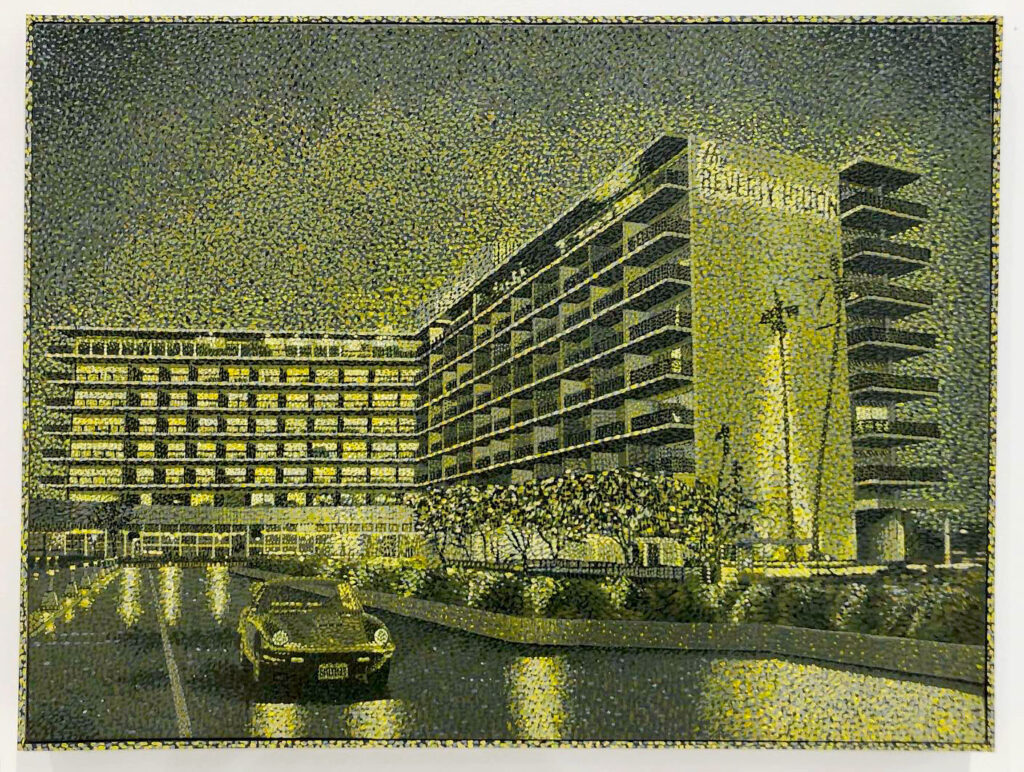
Cynthia Talmadge, “ACT 2: The Cabana”, 2022

Cynthia Talmadge, “Maserati (Dream Sequence)”, 2022

Cynthia Talmadge, “Maserati (The Strasberg Institute)”, 2022

Cynthia Talmadge, “Walk of Fame” 2023

Currently in Bortolami’s upstairs gallery is Cynthia Talmadge’s imaginative exhibition, Goodbye to All This: Alan Smithee Off Broadway.

From Bortolami’s press release-

“We find the narcissist in a reflective mood.” — stage directions penciled into a draft of act III, scene 1 of Alan Smithee’s Goodbye to All This

“Alan Smithee” is a pseudonym used by Hollywood directors to remove their names from movies over which they have lost creative control. In this exhibition Cynthia Talmadge animates Smithee, imagining him in the mid-1980s as a down-on-his-luck, middle-aged baby boomer, trying, elaborately but ineptly, to revive a career defined by burned bridges, bad behavior, and commercial failure. The show takes as its premise a fictitious play, an autobiographical avant-garde off-broadway Bildungsroman written and directed by Smithee in an effort to engineer his come back. The play–entitled Goodbye to All This is what Talmadge imagines as Smithee’s clumsy inversion of the title of Joan Didion’s essay about leaving New York for California – tells Smithee’s version of his rise and fall in Hollywood and his subsequent departure for New York, culminating in his redemption as a New York theater artist.

The only substance to the real-world “Smithee” is an extensive filmography of more than 80 credits. Talmadge takes this output at face value, envisioning for us the detailed biography and personality of a director whose career persists despite every job he’s done having gone badly awry amidst professional conflict. For Talmadge, this makes him a dubious American icon: an epitome of privilege and unwarranted confidence; a guy who – at least until recently – could only ever fail up.

Several Los Angeles and New York landmarks and former landmarks are included in the paintings along with Smithee’s Maserati- the Director’s Guild building, Chasen’s, the Friars Club, Scientology Celebrity Center, and the Beverly Hilton in Los Angeles and Elaine’s and The Lee Strasbourg Institute in New York. The Maserati’s final destination is 39 Walker in NYC, the address of the gallery.

The Playbill paintings have an incredible amount of detail within them and highlight the three acts of Smithee’s journey. The room includes a fallen column, a box of headshots, and Smithee’s set design model for Goodbye to All This, his autobiographical play.

Both Bortolami and Talmadge’s Instagram pages expand on the Smithee story in a few of their posts and are worth taking a look at as well.

This exhibition closes 2/25/23.

Feb 222023
 

Robert Yasuda, “Boundary” 2010-2020

Robert Yasuda, “Boundary” 2010-2020 (detail)

Robert Yasuda, “Pele”, 2022

Robert Yasuda, “Pele”, 2022 (side view)

Robert Yasuda, “Maluhia”, 2022

Robert Yasuda, “Pipeline”, 2022

Currently at Sundaram Tagore gallery in New York are Robert Yasuda’s sculptural paintings for his exhibition Transparent and Translucent.

From the gallery’s press release-

The artist’s latest body of work is a culmination of his decades-long exploration of perception, light and space. On view will be a series of atmospheric paintings rooted in his early encounters with nature in Hawaii where he was born and raised.

Yasuda’s iridescent paintings are composed of translucent veil-like fields of color layered on slabs of wood that protrude from the wall or nestle into corners. Several works are constructed to cast a reflected glow of colored light into the surrounding space. Depending on where you stand, the surfaces of the paintings shift in color and temperature.

“For many people, looking at a painting for 20 seconds can be extremely long but these are pieces that reveal themselves over time,” says Yasuda, who invites viewers to pause and immerse themselves in the work in order to perceive these subtle transformations.

Yasuda begins by shaping wooden panels, which are up to two inches thick, with chisels and grinders. Softening harsh vertical lines, he introduces bowed and gently sloping edges as well as sharply upturned corners. After painting a base layer onto the wood, he wraps the wood in diaphanous cotton. Adding as many as 40 layers of pearlescent acrylic paint, he suspends the fabric amid layers of luminous color. Most of his works are multi-paneled, with intricately wrought and detailed seams, and mounted on cradle-like structures that push them away from the wall.

Several of the works on view feature aqueous expanses of rich blues and lush greens evoking the ocean. In other pieces, sensuous swathes of paint evoke sunsets or the iridescent lining of seashells. “My entire childhood I saw myriad greens in the countryside of Hawaii and I spent a great deal of time diving…These works are connected with that point of view and the process of meditating on nature,” says Yasuda.

This exhibition closes 2/25/23.

Feb 222023
 

Diana Al-Hadid “The Long Defeat”, 2017-2023

Diana Al-Hadid “The Long Defeat”, 2017-2023 (detail)

Diana Al-Hadid “The Long Defeat”, 2017-2023 (detail 2)

Bianca Bondi, “The Antechamber (Myths of descent and return)”, 2023

Bianca Bondi, “The Antechamber (Myths of descent and return)”, 2023 (detail)

Bianca Bondi, “The Antechamber (Myths of descent and return)”, 2023 (detail)

Closing today at Kasmin in NYC, is Shades of Daphne, curated by Stephanie Cristello. It is a “timely survey of painting, sculpture, installation, and film by a group of 11 international and intergenerational contemporary artists, many of whom have not previously exhibited in the United States.”

From the Kasmin gallery website-

Bringing together recent and historical works spanning over three decades from the 1990s to the present, the exhibition includes new commissions, site-specific performances and installations that respond to the architecture of the gallery space.

Celebrating the spirit of resistance and revolt, the exhibition takes the figure of Daphne—the Ancient Greek nymph who turned herself into a laurel tree to escape Apollo’s pursuit—as metaphor to explore work that engages with hybrid figures, metamorphoses, and suspended states of becoming. Highlighting deconstructed impressions of the body in relation to mythologies of transformation, the exhibition focuses on work that features remnants of presence even when the figure is absent—objects that hold the memories of living things. Acting as portals, thresholds, and containers of shifting states, each work also engages with architecture as a framework, both in reference to the body and to spaces constructed for both personal and collective ritual.

Information on Diana Al-Hadid’s sculpture, The Long Defeat–

Diana Al-Hadid’s (b. 1981 Aleppo, Syria) sculpture takes the Flemish primitive painter Hans Memling’s Allegory of Chastity (c. 1475) as a starting point. The work pictures the bodice of a female figure, her head bowed, hands interlaced at the waist, surrounded by the mouth of a volcanic mountain. Al-Hadid’s first interpretation of the painting culminated in the monumental sculpture Citadel (2017–18), a hollowed silhouette of a woman framed by the base of an embankment whose porous mass extends like a root system toward the ground. Her face is vacant of features, delineated instead by two severe lines like one would find in the initial sketch of a portrait artist, that indicate her gaze remains lowered. Yet in contrast to the demure painting, the massive scale of the work allows for her downcast eyes to stare straight into those of the viewer below.

Information on Bianca Bondi’s installation, The Antechamber (Myths of descent and return), 2023-

An iteration of Bianca Bondi’s (b. 1986, South Africa) installation for Busan Biennale 2020, The Antechamber (Myths of descent and return), grew from a translation of Kim Hyesoon’s poem, “Tundra Swan.” As Bondi states: “salt is essential for life but too much brings death.” Taking inspiration from paintings such as Henri Gervex’s Rolla (1878) or John Everett Millais’s Ophelia (1851–52), we observe a clinical but feminine bedroom setting composed of a bed with a pond at its center, echoing a circular mirror above a dresser at the end of a pathway through the tundra. Salt surrounds the installation, representing both preservation and resurrection. A swan stands alone, symbolizing the force of art and poetry. This is the third chapter of the installation, following the Thailand Biennial in 2021.


Feb 212023
 

Nastaran Shahbazi, “In The Cold Nights, We Were Red As Blood”, 2022

Sung Hwa Kim, “When The Evening Song Begins, Everything Turns Into Nothing. From Nothing, You Find Everything.”, 2022

Sung Hwa Kim, “When The Evening Song Begins, Everything Turns Into Nothing. From Nothing, You Find Everything.”, 2022 (detail)

Lindsay Merril, “Come To Me”, 2022

Krzysztof Grzybacz, “Affection”, 2022

Jason Birmingham, “Path of Totality”, 2022

Dan Attoe, “Full Moon Rock Harvest”, 2022

Susan Metrican, “Cast, Cast”, 2022

For The Midnight Hour at The Hole NYC, curating team Scroll (Julien Pomerleau and Rachel Ng), assembled a gorgeous selection of paintings- it was difficult to narrow down which ones to post.

From The Hole’s press release-

The Midnight Hour is about nighttime rendered in landscape, domestic settings, still life, and portraiture. In these paintings, darkness is uniquely dimensional, with celestial blues and blacks composed of—and deepened by—a range of hues. Here you’ll find the coolness of the night sky offset by the warm incandescence of street lights and shop windows, or the silvery light of the moon. Inside glows a candle or a lamp.

The works depict all facets of the night, from nocturnal contemplation and solitude to after-hours festivities, some barely glimpsed in the shadows, some vivid and bustling. Not all the subjects in these paintings appear to partake in the recommended eight hours of sleep. Instead, The Midnight Hour presents happenings mostly outside of the bedroom, from Dan Attoe’s moonlit foragers to Paul-Sebastian Japaz’s late-night cigarette smokers. Whether through interpretations of dreams or by picturing the people we become once the sun sets, the exhibition reveals all that goes unseen during the day.

The lineup of artists welcomes both new talent and familiar names: Olga Abeleva, Dan Attoe, Jason Birmingham, Jose Bonell, Krzysztof Grzybacz, David Hamilton, Anthony Iacono, Paul-Sebastian Japaz, Claudia Keep, Sung Hwa Kim, Jean Lee, Lindsay Merrill, Susan Metrican, Keita Morimoto, Francesco Pirazzi, Cait Porter, Nastaran Shahbazi, Masamitsu Shigeta, Aaron Michael Skolnick, Mai Ta, James Ulmer, and Mikey Yates.

Founded by Julien Pomerleau and Rachel Ng, Scroll is a New York–based curatorial project focused on fostering community and uplifting the works of emerging and overlooked artists. Following first exhibitions in September and November 2022, The Midnight Hour is its largest show to date, bringing together twenty-two artists from around the world.


Feb 212023
 

Ted Gahl “Purgatory (2)”, 2022
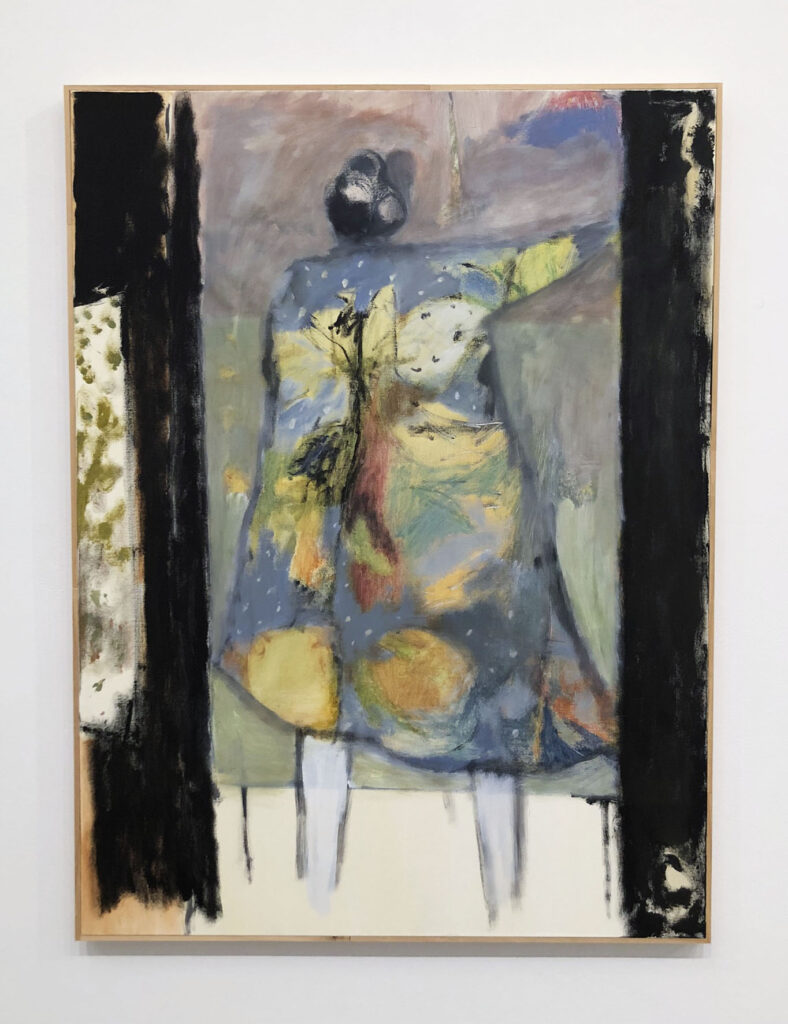
Ted Gahl “Woman Putting on Jacket”, 2022

Ted Gahl’s paintings for Le Goon at Harkawik Gallery draw you in the more you look at them, revealing layers of imagery.

From the gallery’s press release-

Building on imagery he developed in “Stories from the City, Stories from the Sea,” here he delves further into an ocean of muted memories and historical associations that are legible only as hazy apparitions. Gahl charts a course through an emotionally charged landscape: a trench where isolation and connection embrace, where melancholic figures strain to make contact with an ineffability beyond the border of the canvas. Through a dialogue between small, mid-size, and large-scale paintings on unstretched canvas, Gahl implores us to look under the surface, offering attentive viewers the gift of conjuring new meanings over time.

The frames on Gahl’s smaller paintings are composed of chopped paint stirrers, a nod to the artist’s youth spent painting houses and lattice framing techniques of the past, as well as an interest in blending high and low culture. He juxtaposes smaller figurative works with gargantuan 8-feet tall paintings that cascade down unstretched canvas, rooted in abstraction inspired by landscape. These large paintings are intuitive, with one movement or color influencing the next, allowing the artist the physical space to deepen his investigation of consciousness. He calls these works “tarps,” a nod to the cloths thrown down to catch errant paint drips. Here, he deepens his ethical engagement with the many modalities of paint and creative labor.

The artist employs figuration as a vehicle to explore abstraction, seamlessly gliding between the two methods. Figures are adorned in coats that serve as portals into another dimension, brimming with thin layers of muddy greens, sky blues, and merigold oranges that feel plucked out of a Post-Impressionist painting. Within Gahl’s controlled confines of abstraction, the world enlarges, revealing traces of the night sky, throngs of people, fish in a stream.

Gahl’s work is intensely cinematic, as if projected onto a screen or trapped inside an unraveled roll of film. Several scenes unfold within a single painting, allowing a multitude of emotion to erupt. Fleeting moments of tension abound. Two nude women emerge from a body of water reminiscent of a Georges Seurat or Milton Avery landscape, but their togetherness is fractured by a hulking tower of darkly-hued abstraction. A translucent trio bathing in a deep Rothko red exudes a biblical aura; an outline of an angelic body reaches towards the top of the canvas. Gahl’s airy yet deft brushstrokes feel like wading into a pond, while a ghostlike figure dissolves into the landscape, as if imprisoned in the sparse solitude of a Norbert Schwontkowski painting. The artist plays with the horizon, causing us to question if the shadowy form is sinking into water or simply lying in the grass. Are we above or below ground? Is this death or relaxation? Are they the same thing?

At the heart of Le Goon lives a yearning for connection. Mortality cannot help but leak through the canvases and become personified. Gahl’s work invites us towards intimacy, towards deeper questioning. The answers emerge from the water and evaporate towards the heavens before we can touch them, leaving us only with the feeling of the mist kissing our skin.

—Lauren Gagnon


Also at Harkawik are Eli Hill’s recent paintings for Some Days I Taste The World, a series of works that use the natural world to approach topics of identity.

Eli Hill “Wineberry Sight”, 2022
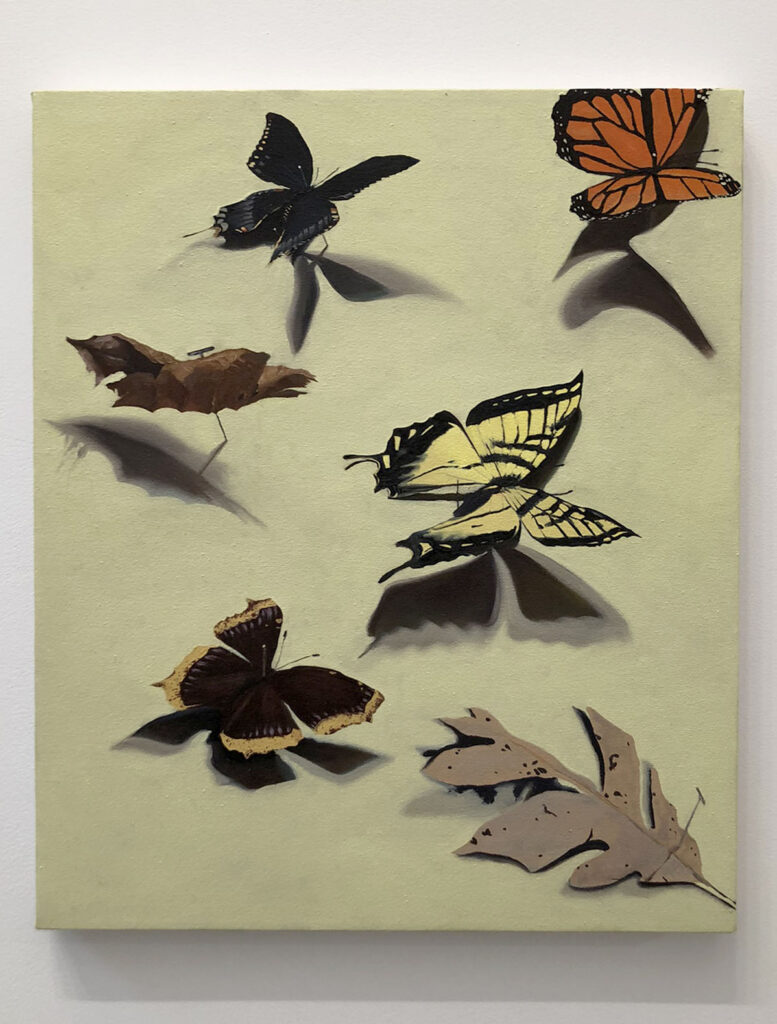
Eli Hill “Decidousness”, 2022

From the gallery’s press release-

Comprised of nine mid-size works, Some Days evidences Hill’s fascination with the way in which humans order and classify the natural world. His paintings speak to the problematics of anthropology, the subversion of the naturalist’s impulse to categorize, and the painter’s age-old communion with nature. Hill proposes a fascinating configuration of personal, political, and scientific concerns and draws parallels between the transgender body and planet Earth. Hill’s canvases merge figurative and landscape traditions, calling attention to the ways in which bodies—celestial, earthly or otherwise—are routinely subject to binaries, alienation, hierarchy and the struggle for survival and self-actualization.

The majority of the exhibition’s paintings are derived from the artist’s long distance runs and environmental work in the leafy Queens oasis of Forest Park. Here, we bid farewell to the gray grit of the city and emerge into a landscape that is simultaneously natural and hallucinogenic. Verdant greens and earthy browns mingle with pale lavenders and silvery blues. The umber shadows of trees streak the soil, basking in the blood orange glow of an artificial sunset. Fluid brushstrokes waterfall down the canvases. Hill’s paintings of the natural world are borderline devotional; he is imploring us to worship the beauty and drama of nature in its fullness. Not unlike the still-lifes of Rachel Ruysch, insects creep out and leaves decay and decompose back into the earth. Split depicts a tree the artist passes by, an image so striking you can almost hear the sound of bark cracking. The branches are split in half and upheld by the flora around it. Community, mortality, and the life cycle are omnipresent.

While some of Hill’s paintings engage traditional modes of depiction, others shift between recognizable and unrecognizable subjects. In Wineberry Sight, the invasive wineberry shrub masquerades itself as a raspberry bush to ensure survival. But are we peering through an eye of vines or veins? By creating images that refuse us easy associations, he provides an opportunity to find pleasure in images we cannot name or categorize. Under every branch we find trickery, performance, preservation. The notion of the “invasive species” itself calls attention to the ideological structures at play in our understanding of what’s “original,” “natural;” what has a right to proliferate and thrive.

The exhibition title is a line from a CA Conrad poem, as well as an homage to the influence of the poet’s writing and spiritual practice in Hill’s work. Revolutionary care permeates Hill’s depiction of the figure; whether his own body, a tree, or a friend, he actively opposes mining, objectifying, or exploiting his subjects. In The Artist as a Naturalist, a self-portrait is accompanied by two paintings within a painting of colorful moths. The work demands time and effort, as awkward cropping abstracts the body, consequently resisting commodification and denying easy consumption of the work from a historically cisgender gaze. Like German-Swedish figurative painter Lotte Laserstein’s Portrait With a Cat, Hill consolidates naturalistic observation with a figure that gazes back at the audience. The painting itself possesses a sort of agency, as multiple pairs of eyes appear, aware we are observing them, and throwing into uncertainty the subject of the examination; them, us, something else?

Some Days I Taste the World is like walking through a Ralph Waldo Emerson essay, where beauty takes on a cosmic quality that transcends the experience of individuals. Hill offers us a fascinating configuration of previously known quantities, suggesting a natural place for things like radical queer joy. Through a dense canopy sunlight streams through, lighting up our faces.


Feb 212023
 

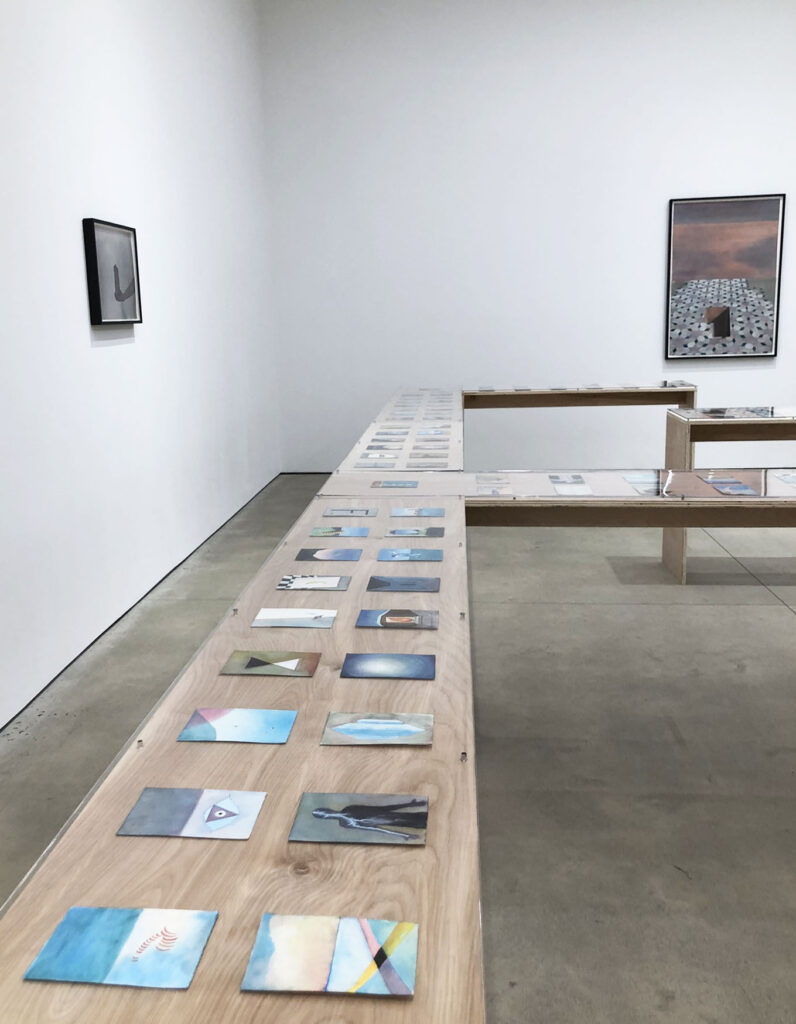
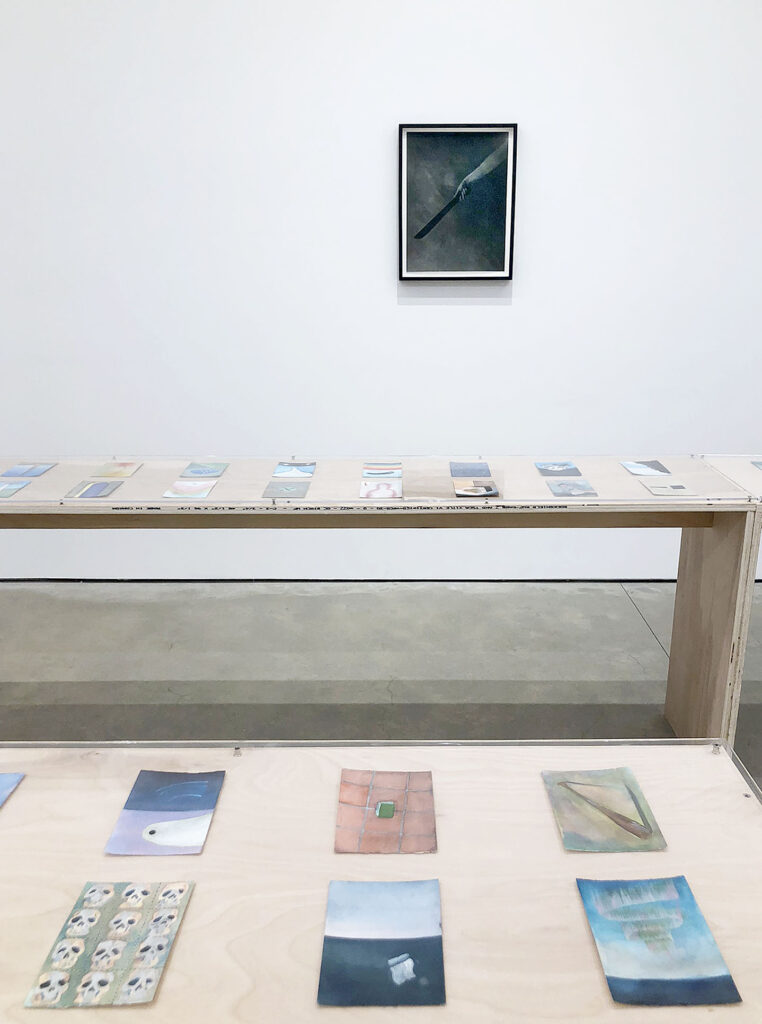
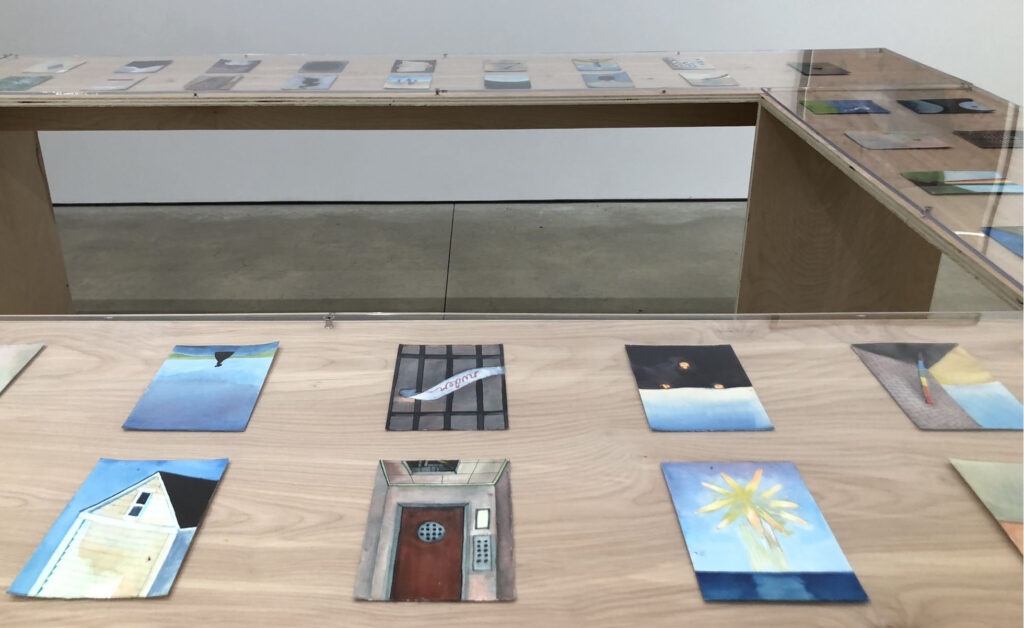
For Adam Putnam’s recent exhibition Holes at P.P.O.W gallery in New York, he takes the visitor on a multimedia journey into the self.

From P.P.O.W’s press release-

Through the building up of imagery by means of photography, drawing, sculpture, film, and performance, Adam Putnam continues an ongoing exploration of the boundaries between architecture, nature, the physical and the internal self, often using one as a stand in for the other.

A single, hand-carved wooden finger beckons the viewer toward a labyrinth of 365 “visualizations.” Initiated during the long months of lockdown, this mass of miniature drawings takes on an elusive arrangement, like an archaic diagram of the unconscious mind, with patterns emerging and dissolving as the visitor weaves through the space. Accompanying this accumulation are a new series of drawings and photographs, depicting architectural inversions and other implements such as a crumbling brick column and a rusty sword.

The labyrinth ultimately leads to a shadowy monolith vibrating with light, smoke and bubbles. Based on a 2022 site- specific, multi-sensory work commissioned in response to the experiential interests and preferences of a small group of people with Profound Mental and Learning Disabilities (PMLD) living in Midlothian, Scotland, the tower, which can be viewed alternately as a lighthouse, clocktower, steeple and sundial, aims to connect through touch, scent, light and sound. As we enter a post-pandemic world, Holes offers an opportunity for collective experience and contemplation of the otherworldliness imbedded in the everyday.

Putnam’s Instagram is currently private, but you can check out his Tarot influenced artwork here. He was giving Tarot readings throughout the duration of the show using his handmade cards.

Jan 202023
 

Artist Alex Katz created this mural, Bill 2, a portrait of modern dancer and choreographer Bill T. Jones, in 2019 for Murals of La Jolla in San Diego. Murals of La Jolla is a project started in 2010 by The Athenaeum and the La Jolla Community Foundation. It commissions artists to create work to be displayed on buildings around La Jolla. A map of all the murals currently on view can be found here.

From the Murals of La Jolla website about the work-

Alex Katz’s mural, Bill 2, celebrates Bill T. Jones, one of the most noted and recognized modern-dance choreographers of our time. Executed in Katz’s bold and simplified signature style, Bill 2 depicts Jones’ visage, through a series of distinct expressions. The repetition of his face has a cinematic and lyrical quality, reinforcing his place in the world of dance, music and film. Portions of the face are dramatically cropped, giving the viewer only quick and gestural glimpses of Jones. Bill 2, is a striking homage to two artists, Katz and Jones, both renowned in their respective fields of visual and performing arts. The mural’s proximity to the new Conrad Prebys Performing Arts Center gives a nod to the interconnected worlds of art, music, and dance.

The Guggenheim museum in NYC is currently showing Alex Katz: Gathering, a retrospective of the artist’s work from the late 1940’s until the present. The exhibition will be up until February 20, 2023.

From their website about the exhibition-

Emerging as an artist in the mid-20th century, Katz forged a mode of figurative painting that fused the energy of Abstract Expressionist canvases with the American vernaculars of the magazine, billboard, and movie screen. Throughout his practice, he has turned to his surroundings in downtown New York City and coastal Maine as his primary subject matter, documenting an evolving community of poets, artists, critics, dancers, and filmmakers who have animated the cultural avant-garde from the postwar period to the present.

Staged in the city where Katz has lived and worked his entire life, and prepared with the close collaboration of the artist, this retrospective will fill the museum’s Frank Lloyd Wright rotunda. Encompassing paintings, oil sketches, collages, drawings, prints, and freestanding “cutout” works, the exhibition will begin with the artist’s intimate sketches of riders on the New York City subway from the late 1940s and will culminate in the rapturous, immersive landscapes that have dominated his output in recent years.

Bill T. Jones/Arnie Zane Company has numerous performances every year. Conceived and directed by Bill T. Jones, and choreographed by Jones with Janet Wong and the Bill T. Jones/Arnie Zane Company, the latest work, Curriculum II, will be performed at on March 10, 11, and 12, at the Institute of Contemporary Art Boston.

Jones also hosts the series Bill Chats at NYC’s The New School. On January 30th, he will be in conversation with Bessie Award-winning theater director and performance artist, Niegel Smith and curator, producer, and director, Kamilah Forbes. For more events check out the New York Live Arts calendar.


Jan 052023
 

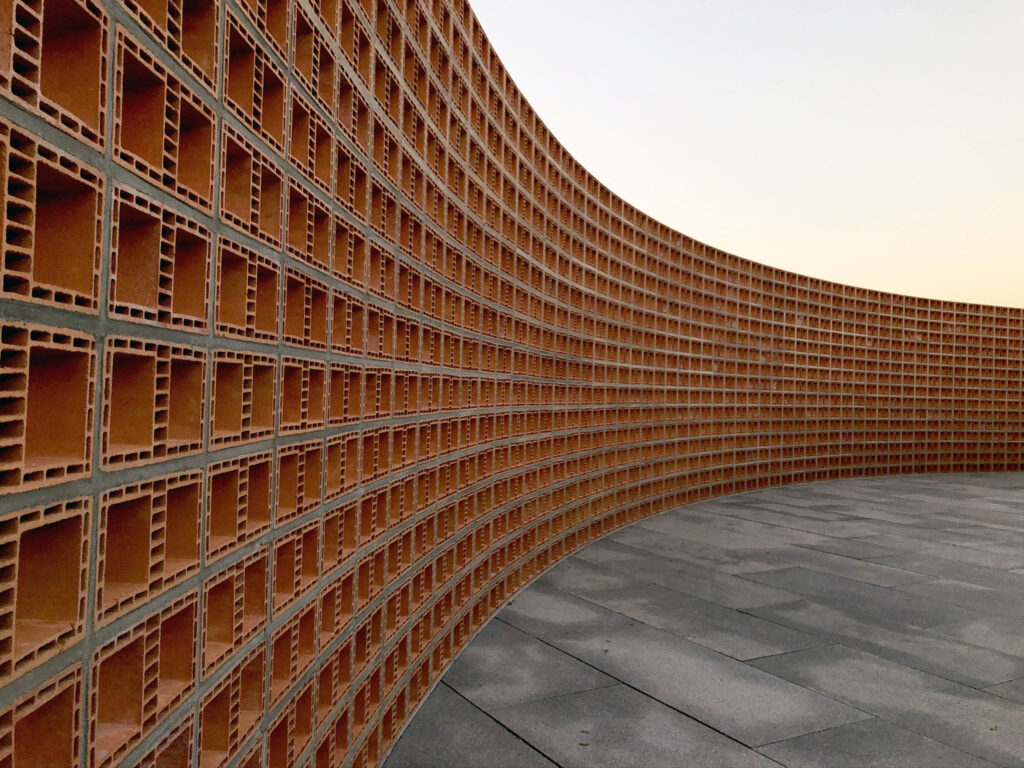
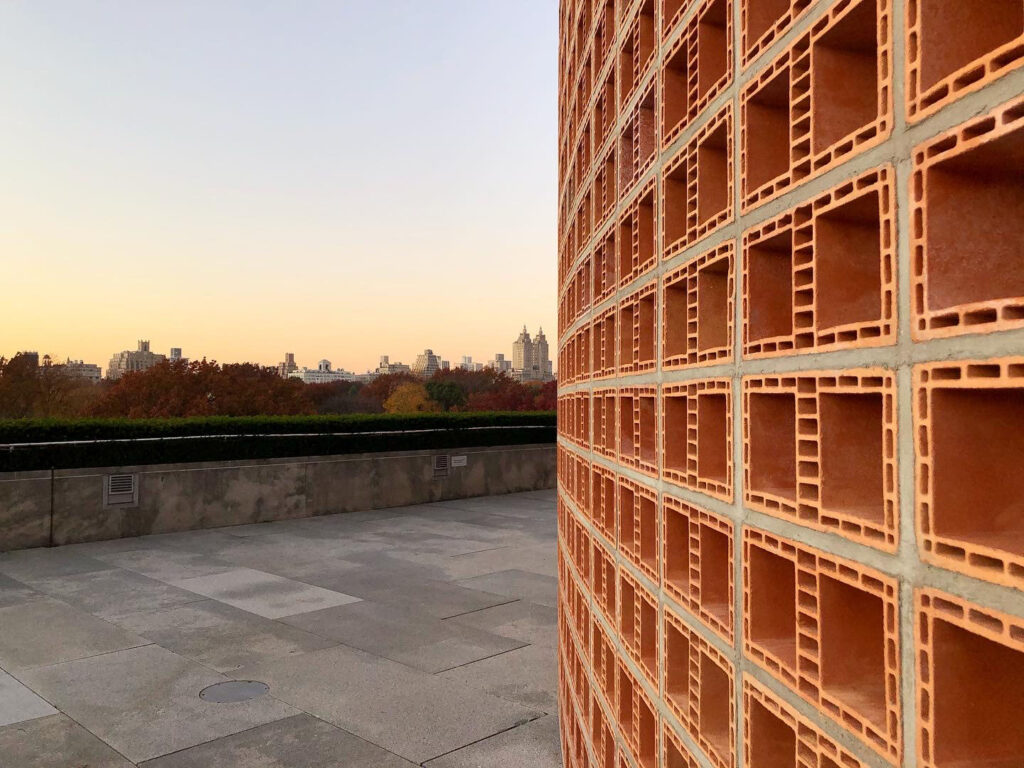
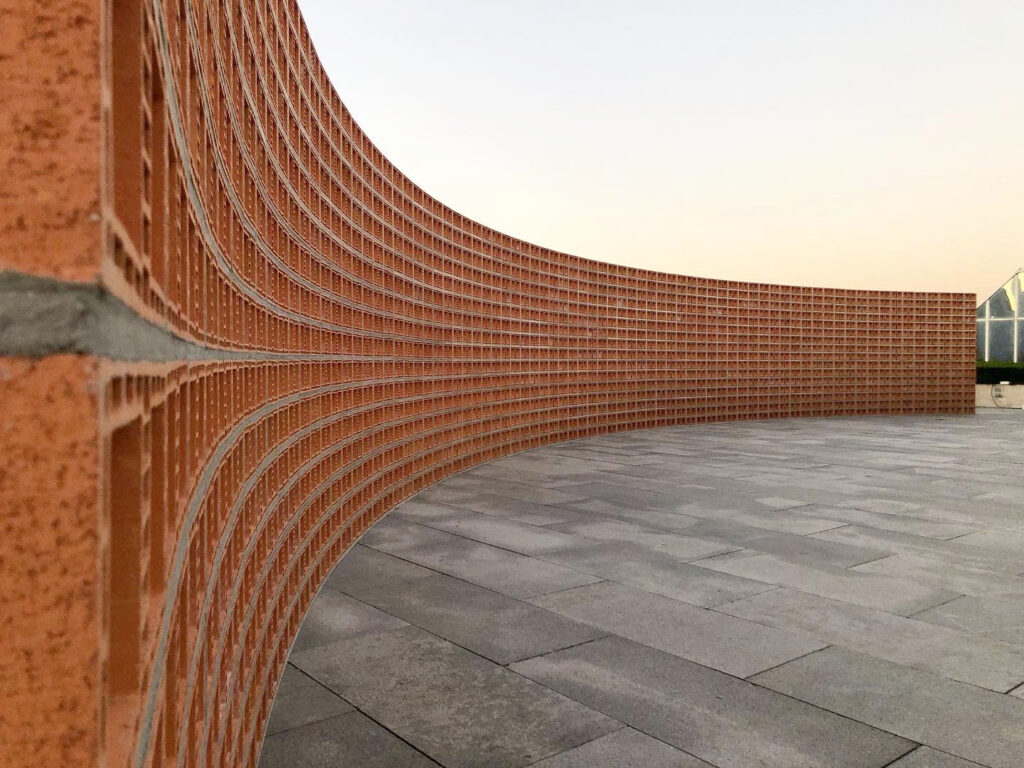
Héctor Zamora’s site-specific installation, Lattice Detour, located on the roof of The Metropolitan Museum of Art in 2020. It opened at the end of August of that year after being delayed when the museum shut down due to the pandemic.

The installation’s curved wall of terra cotta bricks measured at 100 feet long and 11 feet high. The bricks were not solid, as they first appeared, but hollow so viewers could see through to the other side. Throughout the day light would pass through the wall creating different patterns and shadows.

Zamora discusses the work in the video below from The Met’s website–


Dec 172022
 

“Tower, Houston”, 2020

“Tower, Houston”, 2020 (closer look)

“City Square at 4 am (Palazzo della Civiltà Italiana, Large Version)”, 2020

“Midtown, NYC”, 2020

The paintings above are from Daniel Rich’s 2020 exhibition at Miles McEnery Gallery in NYC.

From the gallery’s press release-

Daniel Rich’s reticulated cityscapes and slick façades appear at first glance to be quite literally superficial. Whether it is a geometric exterior pressed close to the picture plane or a cluster of multiple structures glimpsed from a distance, we experience architecture in his painting as a wholly exteriorized phenomenon— looming close up or made smaller through a bird’s-eye view.

His process-oriented paintings offer windows to different parts of the world— some figuratively, others much more literally—and can evoke a distorted experience of temporality for the viewer. Like compositions by Bernd and Hilla Becher or Andreas Gursky, Rich’s artworks offer clinical, complex architectural views onto the world that are filled with subtleties. However, Rich differs from Becher or Gursky in his painstaking, intricate process of translating found images into painting. The works also evoke early 20th century European Modernism, recalling Giorgio de Chirico’s metaphysical cityscapes and Germany’s Neue Sachlichkeit (New Objectivity) artists of the 1920s and 1930s.

Architecture, as it is commonly understood, is designed and implemented to house the human and is itself the manifestation of our constructed realities. When all signs of life are missing from buildings and spaces, as in Rich’s paintings, the result is an unsettling subversion that upends and questions what we have come to expect of both architectural spaces and the organized linearity of time. Rich probes viewers to consider what lies beyond the surface.

Rich also uses his anonymous architectural imagery to talk about history and politics. He speaks of his scenes as “failed utopias” and “changing political power structures.” In their seeming permanence, the fixed and rigid edifices that populate his work speak to a late capitalist urbanism that sees its monuments not as contingent, but as immovable and eternal.

His newest paintings are currently on view at the gallery for his exhibition Flat Earth on view until 1/28/23.

Jul 222022
 

Typewriter Eraser, Scale X, 1999, part of The ARIA Fine Art collection in Las Vegas

Artist Claes Oldenburg passed away this week at the age of 93. He was most famous for his large scale sculptures of everyday objects, many of which were produced with his wife Coosje van Bruggen, who passed away in 2009.

While primarily working in sculpture, early in his career in the 1960s he also created “happenings”- theatrical art related performances and collaborations with other artists in his circle. In 1985 he returned to performance and along with van Bruggen, architect Frank Gehry, and writer Germano Celant presented Il Corso del Coltello (The Course of the Knife) in Venice, Italy. In 2021, Pace Gallery in NYC, as part of the two gallery exhibition Claus & Coosje, showed work from this performance, pictured below.

From Pace’s website about the performance-

This ambitious event involved the creation and embarkation of a sea-worthy sculpture in the shape of a giant Swiss army knife. With oars protruding from its red-enameled hull as if from a Viking longship, the image of Oldenburg and van Bruggen’s Knife Ship sailing the Grand Canal has become iconic, while the massive kinetic sculpture was later shown in the rotunda of the Guggenheim Museum in New York, at the Centre Pompidou in Paris, and finally at the Museum of Contemporary Art, Los Angeles.

With so much of Oldenburg’s work, the examination of the ordinary object engages the viewer with what they might previously taken for granted and gives them a chance to look again with new eyes. There is also something lighthearted and fun, as well as investigative, about his body of work.

(image via Whitney Museum’s website)

The Whitney Museum has a video showing the process of assembling his soft sculpture Giant BLT (Bacon, Lettuce, and Tomato Sandwich) 1963, which involves putting the sandwich together piece by piece.

For more on Oldenburg, MoMA has a tribute that includes the words of people who knew him as well as his own. His 1961 artist statement is wonderful and worth reading in its entirety, here is the opening section-

I AM FOR

I am for an art that is political-erotical-mystical, that does something other than sit on its ass in a museum.
I am for an art that grows up not knowing it is art at all, an art given the chance of having a starting point of zero.
I am for an art that embroils itself with the everyday crap and still comes out on top.
I am for an art that imitates the human, that is comic, if necessary, or violent, or whatever is necessary.
I am for all art that takes its form from the lines of life itself, that twists and extends and accumulates and spits and drips, and is heavy and coarse and blunt and sweet and stupid as life itself.

I am for an artist who vanishes, turning up in a white cap painting signs or hallways.

The Guardian’s obituary is also worth a read for more information on the artist’s history.