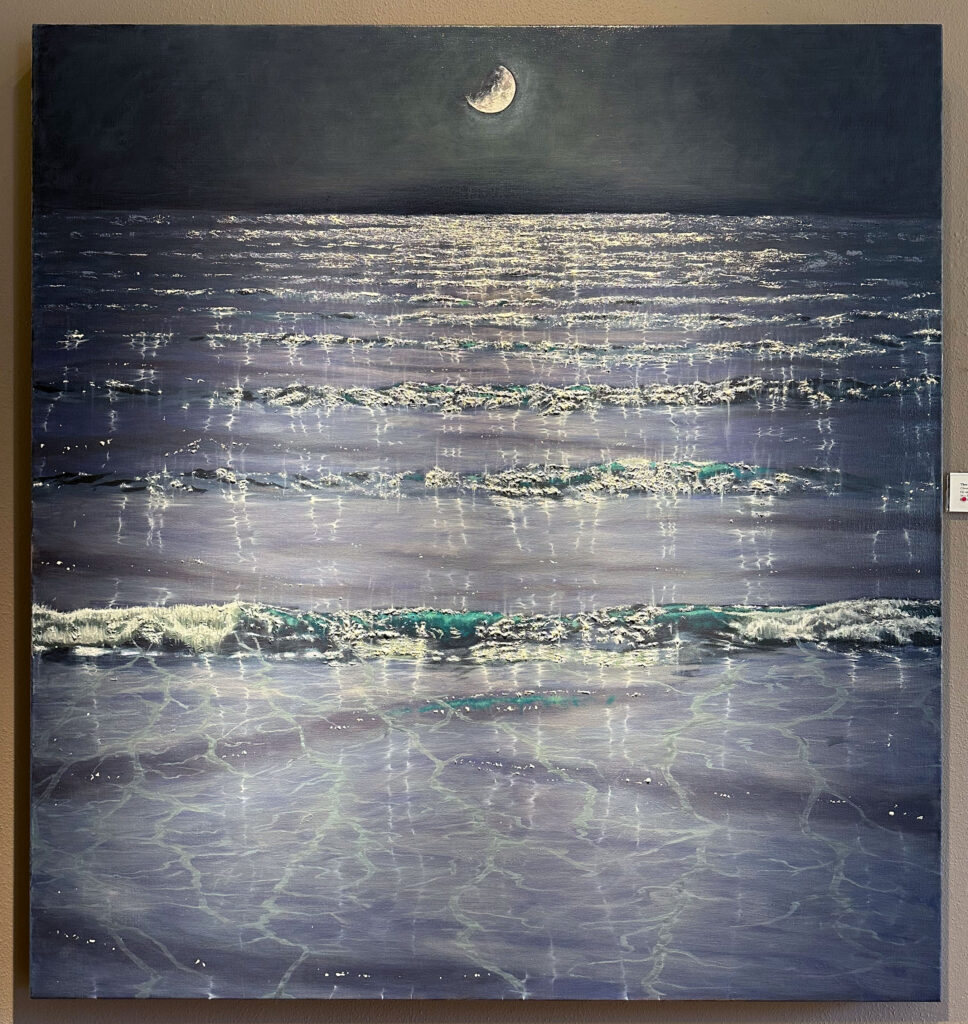
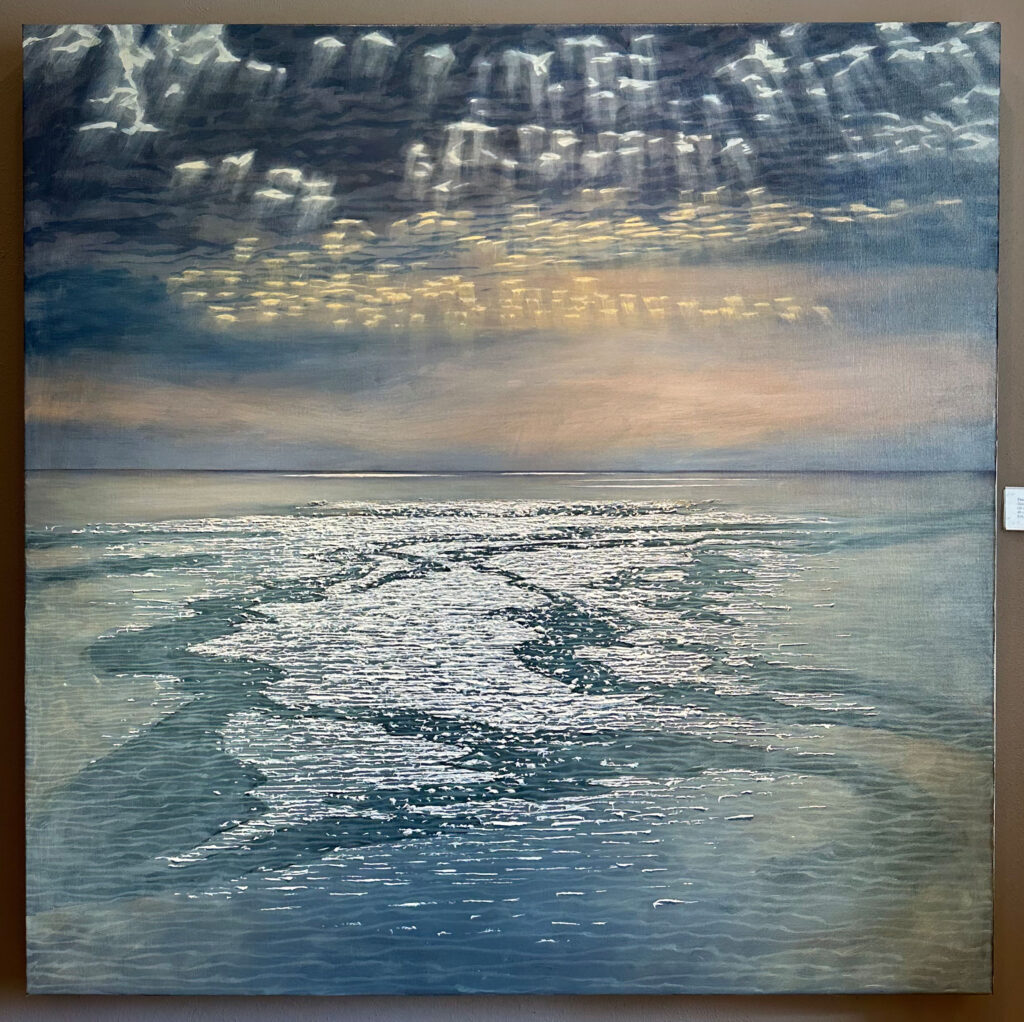
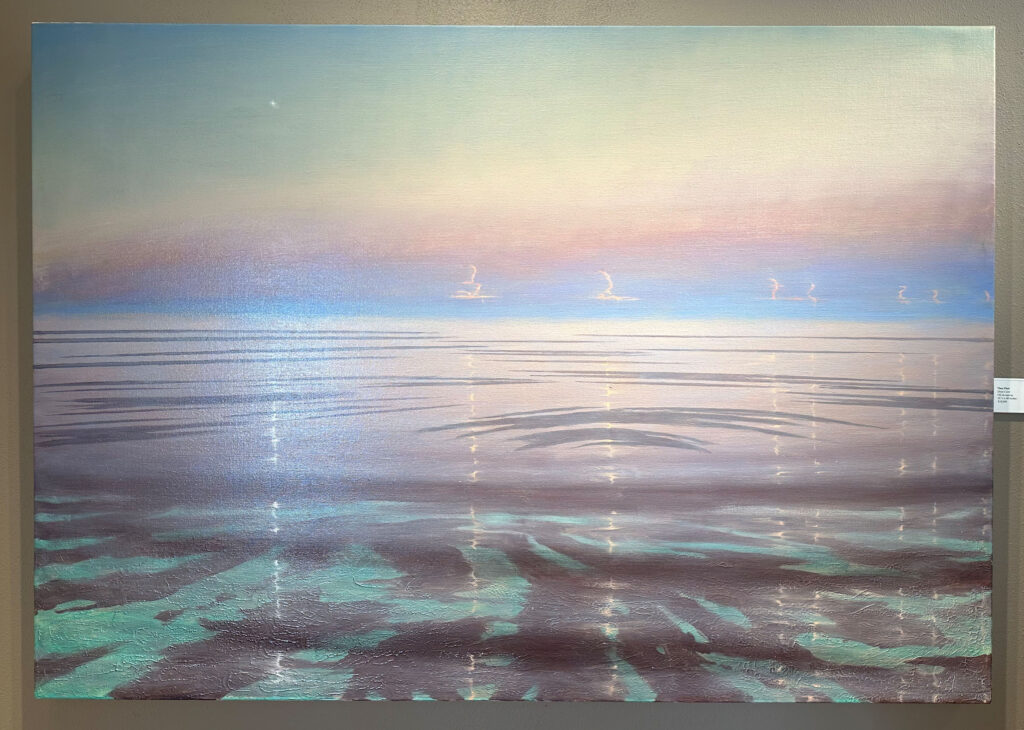
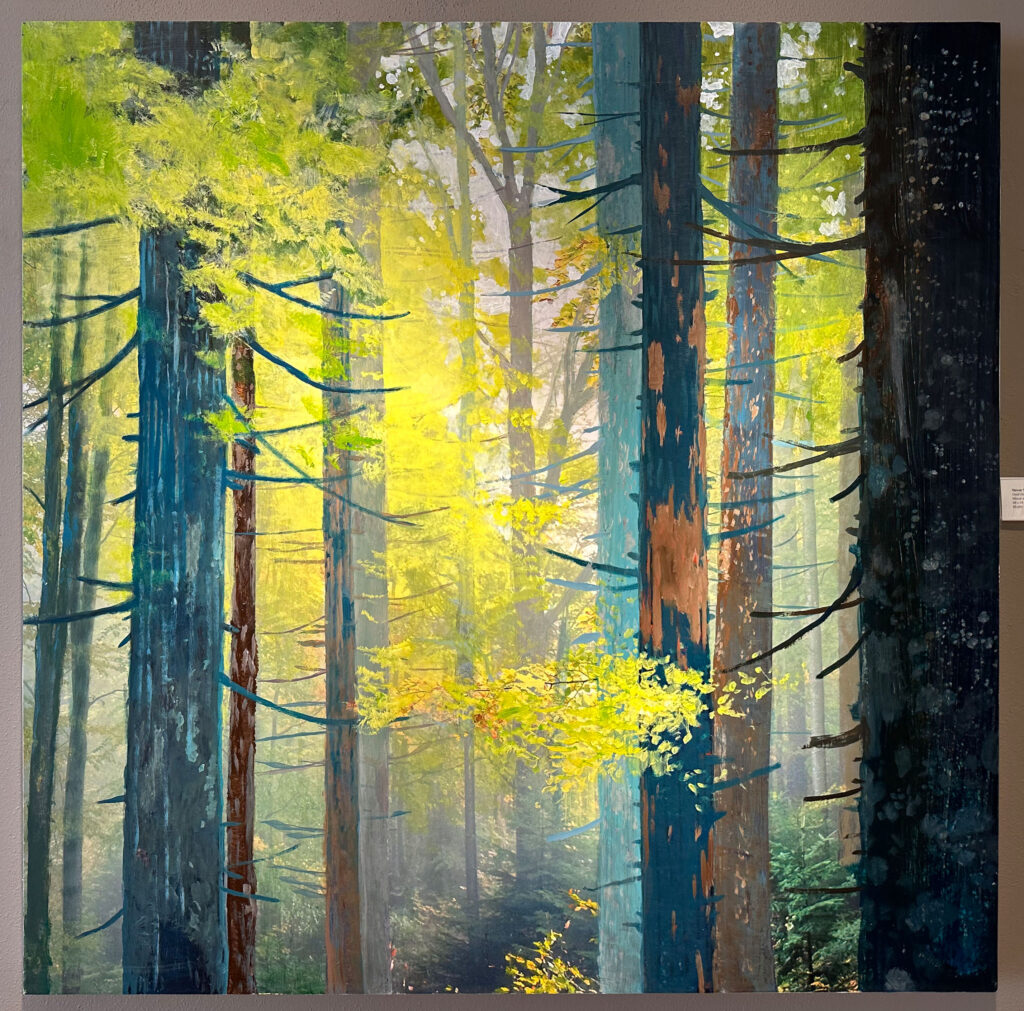
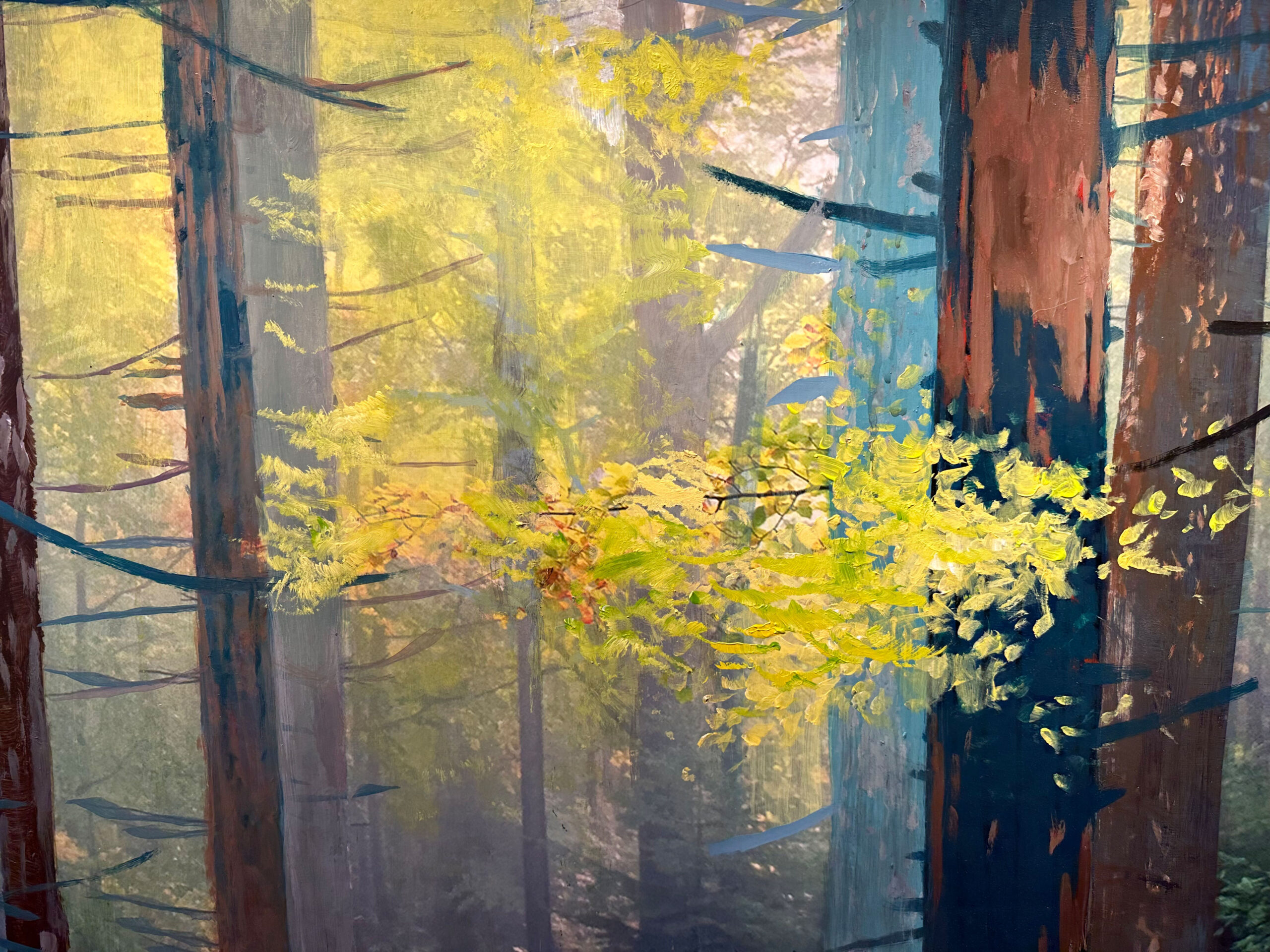
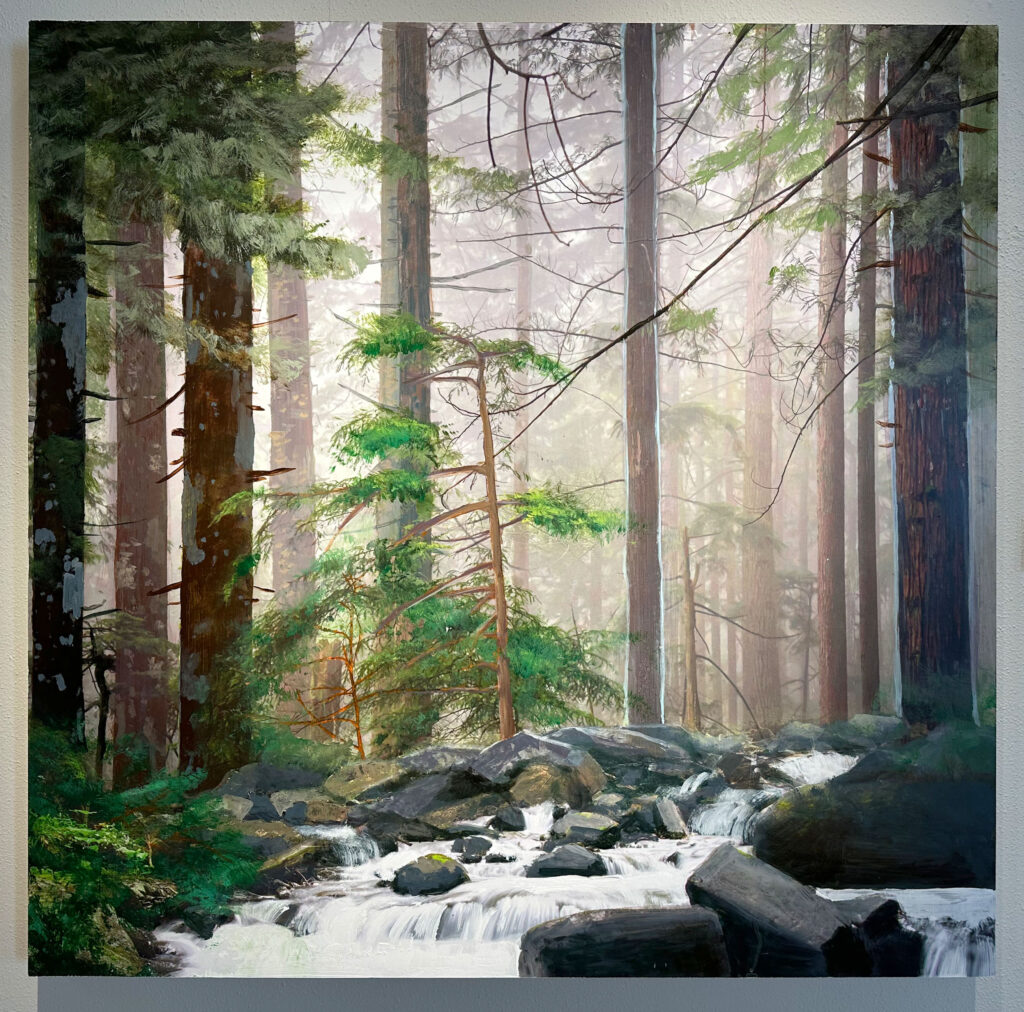
Below Nederveen describes his process for the work (pictured below)-
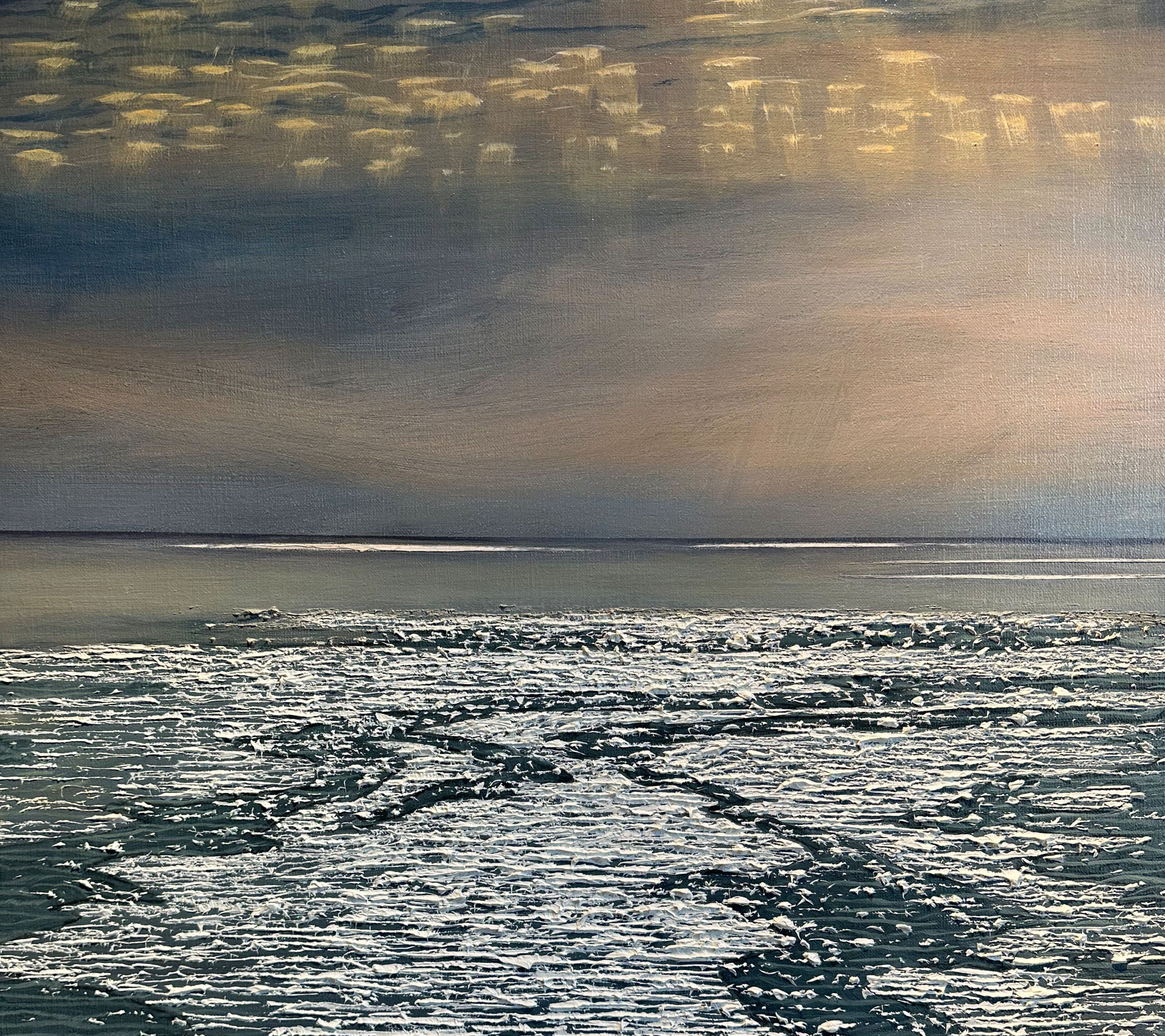
Using a mixed media approach to image making, I combine acrylic paint and C-print photographs. By layering these elements I can etch down into the emulsion of the photograph to reveal golden hues and also build up the surface with impasto and washes of colour. The result is an image with photo sharp detail in focal areas and painterly brush marks that obscure and create space for the imagination.
Both of these exhibitions close 10/11/25.
Steven Nederveen, “Gold Hidden Within”, Mixed Media
Steven Nederveen, “Gold Hidden Within”, Mixed Media (detail)
Steven Nederveen, “Breathe In the Forest Air”, Mixed Media
Jon Carsman‘s painting October Visions, 1975, was on view at Akron Art Museum in 2024 as part of their permanent collection.
From the museum about the artist-
Jon Carsman painted from photographs, but though his pictures have a clear quality of precision, his intention was never to simply recreate what he had recorded on film. In his own words: “I want to give you a feel of what it was like to be there when I was.” To achieve this goal, Carsman stylized many elements of his paintings, often working toward a visual equivalent of the rhythm, movement, and energy that he found in music. He also worked most frequently with the rural scenery of Pennsylvania’s Wyoming Valley, where he was born and raised. As a result, images that began as still photographs take on new life through the artist’s personal experiences and memories.
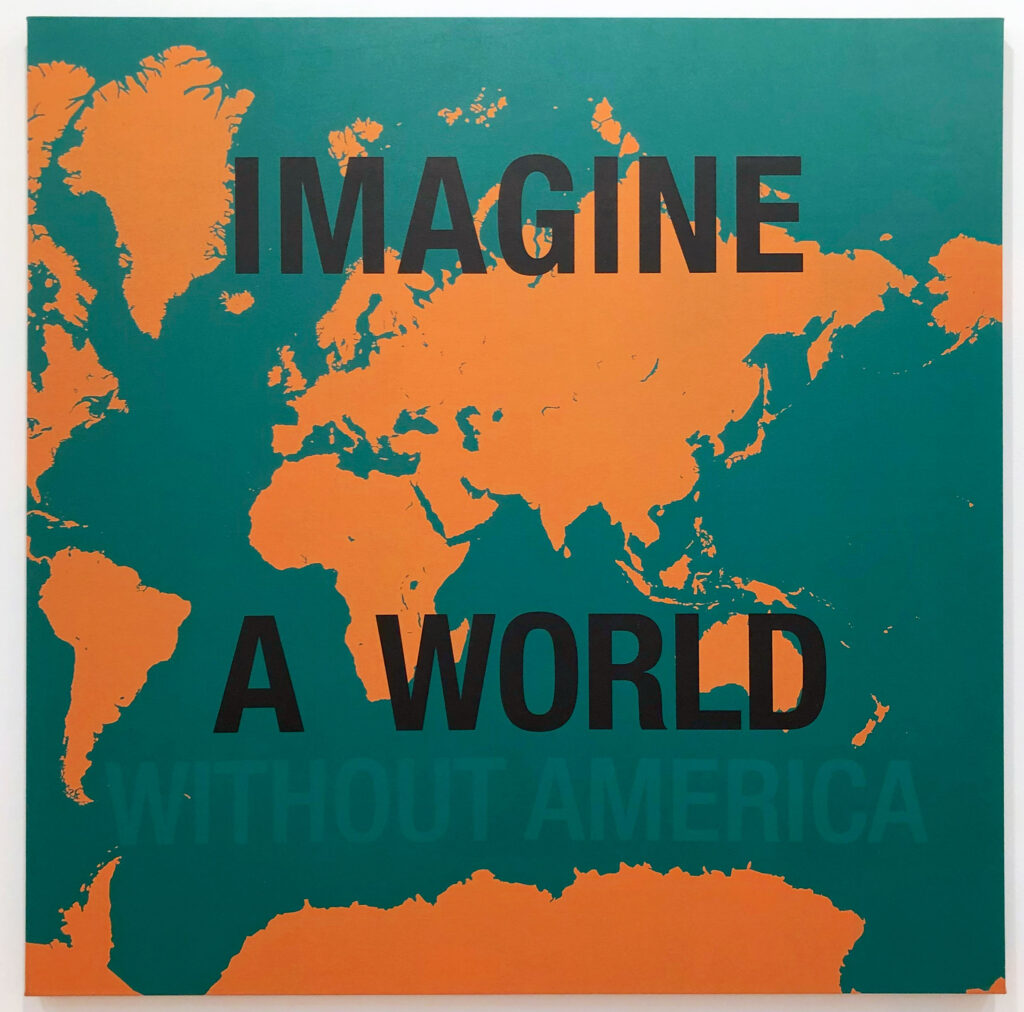
“Imagine a World Without America”, 2007, Screen print and acrylic on canvas
The painting above is by Brooklyn-based artist Dread Scott and was on view as part of the 2019 group exhibition Borders at James Cohan gallery in NYC.
From the press release about the work-
His 2007 work, Imagine a World Without America, calls upon the viewer to participate in the titular thought experiment and contemplate that absence. The painting de-centers the United States of America from the middle of the map that most Americans are familiar with. Scott utilizes the language of cartography to encourage the exploration of social questions, not geography. Land mass and sea are depicted but—like the world as it actually is—borders don’t exist.
The work is currently on view as part of 15, a group exhibition at Cristin Tierney gallery, celebrating the gallery’s anniversary and new location. 15 will be on view until 10/4/25.
Dread Scott has created political works throughout his career in a variety of mediums. In the video below he discusses how one of his art installations, What Is the Proper Way to Display a U.S. Flag (1989), drew controversy- including denouncement by then President George H.W. Bush.
Abstract expressionist artist Mark di Suvero‘s sculpture Declaration (pictured above) is located on the Venice Beach Boardwalk in Los Angeles. It was installed in 2001 to commemorate the Venice Art Walk’s 22nd year and in support of the Venice Family Clinic, a local organization that provides quality health care to those in need. Di Suvero turned 92 today, 9/18.
Although he is well known for his large sculptures, he is also a painter. Some of these works were shown in 2019 at L.A. Louver in Los Angeles along with some of his smaller sculptures (pictured below).
From the L.A. Louver press release about the paintings-
A selection of brilliant abstract paintings by the artist accompanies the sculptures. Like the sculptures, his paintings are never still. Created with dazzling colors in dense layers of linear and freeform gestures, they project a swirling sensation akin to the twirling movement in his three-dimensional works. Accented with phosphorescent paints, the works luminesce and reverberate even in the absence of light (and are especially dazzling when activated by black lights installed throughout the gallery space). “The heart of art is the search for form that is electrifying, that gives life to our vision,” explains di Suvero. “This is the language of emotion. Anesthetic is to kill feeling. Aesthetic is the opposite, aesthetic is feeling. The thing that is most important is the dream, the vision for what doesn’t exist that could exist.”
It was recently announced that L.A. Louver will be closing their Venice Beach space, but in happier news they will be donating the gallery’s complete archive and library to The Huntington in San Marino, California.
Born today, 9/12, artist Robert Irwin used light and space in his work as a way to create an experience for the observer. He started out as a painter but later became well known for his site-specific installations and architectural and outdoor projects- including the central garden at the Getty Center in Los Angeles (pictured below) and his work for the Chinati Foundation in Marfa, Texas.
The works above are from his 2020 exhibition, Unlights, at Pace Gallery in New York.
About that show from Pace-
Irwin’s new works are composed from unlit six-foot fluorescent lights mounted to fixtures and installed in vertical rows directly on the wall. The glass tubes are covered in layers of opulently colored translucent gels and thin strips of electrical tape, allowing the reflective surfaces of unlit glass and anodized aluminum to interact with ambient illumination in the surrounding space and produce shifting patterns of shadow and chromatic tonality. Reflecting his recent turn toward the perceptual possibilities of unlit bulbs, Irwin’s new body of work expands the range of possibilities for how we experience sensations of rhythm, pulsation, expansion and intensity, while continuing the artist’s long-standing interest in registering the immediacy of our own presence in space.
Expanding from his breakthrough disc paintings of the late 1960s, Irwin’s new works effectively dissolve the perceived border between object and environment, focusing the viewer’s consciousness on the act of perception. Each light fixture in Irwin’s sculptures contains one or two unlit bulbs—or no bulb at all—while alternating gaps of “empty” wall are painted in subtle shades of gray, producing a sense of uncertainty about what is tactile and what is merely optical. As the shadowed, painted and reflected intervals of space reverberate in the viewer’s visual field, the wall itself enters the composition, destabilizing any sense of figure and ground. To encounter Irwin’s sculptures is thus to allow oneself to be caught in a ceaseless oscillation between flatness and volume, transparency and opacity, solidity and atmosphere.
In Irwin’s art, the object functions as a kind of score for orchestrating “the continual development and extension of humans’ potential to perceive the world.” Although unlit, the bulbs in these new sculptures are therefore never “off.” Their optically rich surfaces serve as energetic loci for heightening the sensory possibilities of the human body. In their chromatic complexity, the works convey an almost painterly quality, recalling Irwin’s origins as a second-generation Abstract Expressionist painter in the 1950s. Suggesting a rhythmic, minimal composition of repeated linear elements, the works also evoke his innovative line paintings of the early 1960s, which involve us physically and perceptually in an open-ended, immersive and transitory experience of seeing.
Widely recognized as a pivotal figure in contemporary art, Irwin is closely associated with the Light and Space movement that emerged in Los Angeles in the 1960s, and he has continued to live and work in Southern California for his entire career. He first used fluorescent lights as substrates for producing what he has called a “conditional art” in the 1970s, often in combination with architectural scrims and other spatial interventions. In the 1990s he introduced colored gels to the fluorescent tubes to alter the chromaticism of the light, and, over the past decade, began isolating the bulbs and fixtures as sculptural objects in their own right. In returning to the use of solely ambient light, Irwin’s new sculptures embody the culmination of seven decades of rigorous experimentation.
“Everything in the world is ultimately conditional,” Irwin has observed. “There is nothing that’s transcended or infinite or whatever you want to call it. Everything acts within a set of conditions.” Like all of Irwin’s works, his new sculptures respond differently to the conditions of each specific environment in which they are installed, attuning our senses to a given context and making possible an intuitive and incidental experience of seeing that resists rational or conceptual explanation. “It’s not about answers,” the artist once remarked, but rather about the act of questioning: “It’s the constant pursuit of the possibilities of what art is.”
Getty Center, Los Angeles
Below is one of his earlier paintings Untitled, 1964-6, which was on view at Palm Springs Art Museum for the 2024 exhibition Particles and Waves: Southern California Abstraction and Science, 1945-1990.
From the museum about the work-
Although this work appears to have a monochromatic white surface from afar, a matrix of thousands of painted dots becomes visible from a closer vantage point. Irwin aimed to highlight the visual effects of color interaction by juxtaposing light green and lavender, complementary colors across from each other on a color wheel. The canvas’s outwardly bowed supports and the increasing density of dots towards the painting’s center further heighten the viewer’s perceptual experience of the work.
The documentary Robert Irwin: A Desert of Pure Feeling, does an excellent job detailing his life, art, and the philosophy behind his work. It is well worth a watch and inspiring to watch him still at work in Marfa at 87. He passed away in 2023 at the age of 95.
Nina Chanel Abney creates paintings, prints, and large-scale mural installations that reflect the frenzied pace of contemporary life. In a single painting, she may merge influences from news and politics, celebrity culture and gossip blogs, social media, art history, and popular television shows, all layered together to express the overabundance of contemporary culture. Layering spray paint and acrylic paint, Abney composes scenes of everyday life with graphic, angular figures posed in narrative scenes against bright, geometric backgrounds. In one of her recent series of works, Abney sets out to realize a rural Black queer utopia, inspired by the time she spent escaping New York City during the pandemic.
For the High Line, Abney realizes NYC LOVE, a new mural that celebrates the feeling of first arriving in New York City. NYC LOVE is a whimsical take on New York City’s classic iconography. When the artist moved to New York in 2005, she would meander through the city streets from Chelsea to Times Square, seduced by the hustle and bustle, bright lights, and the idea of a sleepless city. All of the “touristy” icons that most lifetime and long-time New Yorkers take for granted were gratifying and glossy to Abney, a self-described Midwestern suburbanite. NYC LOVE is representative of Abney’s first years as a student and tourist in New York City—an ode to the feeling of newness and unfamiliarity that breeds excitement and possibility. Featuring the many icons of New York—pizza slices and the Statue of Liberty, plenty of pigeons, and one Big Apple—Abney’s mural rides the subway, floats along the waterfront, and takes in all the city has to offer. NYC LOVE graces the High Line, an icon in itself that welcomes millions of New Yorkers and visitors alike to enjoy the many offerings of the bustling metropolis.
In honor of artist Sol LeWitt‘s birthday today (9/9), here is his work Wall Drawing #1240, Planes with broken bands of color (Akron), located at Akron Art Museum. It was created in 2005 and installed at the museum in 2007.
The piece was drawn by Megan Dyer, Tomas Ramberg, Joe Ayala, Jennifer Bair-Shipman, Ashlie Dyer, Kathy Ilg, Sarah Sutton and Kelly Urquhart.
From the museum about the work-
Presiding over the McDowell Grand Lobby is a wall drawing by Sol LeWitt, one of the leading artists of his time. LeWitt’s approach to art stressed rigorous design and geometric abstraction, rejecting narrative, emotion and representation for the reality of art’s elemental components—line, shape, space, color and the most important, concept.
LeWitt began creating wall drawings in 1968 in response to his concern-and that of other artists at the time-that art was becoming too much of a commodity. These drawings are not so much physical objects as ideas. The artist conceived and planned them; his “drafters” (artists themselves) draw them directly on the walls of museums and public spaces around the world. Drawings may share forms and motifs, but each is unique and many, like Akron’s, are site specific.
Wall Drawing #1240 was created by the artist for the 18 by 34 foot wall where the museum’s historic 1899 building and its 2007 expansion interconnect. The triangular shapes refer to the angled supports and folded forms of the newer glass and steel lobby, while the blocks of color echo the brick wall removed from the south façade of the older building. Two drafters, assisted by area artists, worked for five weeks to fabricate the wall drawing.
From the museum about the artist and the painting-
Mavis Pusey was born in Kingston, Jamaica, in 1928. She is known for her abstract paintings of bold shapes and hard edged lines found in architectural spaces. Pusey was a prolific artist who found inspiration in the geometric forms found both in fashion patternmaking and in the printmaking process. During sessions at the Robert Blackburn workshop, Pusey began to develop a body of work revealing the process of urban transformation happening in New York City. She was captivated by the shifts in the urban environment that kept the city suspended in a cycle of destruction and reconstruction.
Throughout her career, Pusey taught at institutions for higher education in New York, Pennsylvania, and was a high school teacher in Virginia. In 2019 at the age of ninety, Pusey passed away after years of declining health. Her legacy lives on through the collections of major cultural institutions across the U.S.
Inspired by the ever-evolving changes in the urban landscape, Pusey presents a familiar scene of demolition and construction in the painting Within Manhattan. Geometric forms resemble architectural building blocks in the process of being assembled or possibly deconstructed. The configuration of shapes in the work allows us to imagine the motion present at the site with scaffolding giving way to discarded boards, positioning us as spectators to change.
The first major museum survey of her work, titled Mobile Images, is currently at ICA Philadelphia until 12/5/25.
The lawn’s flat nature leads your eye to the edges in search of form, and if the edges are not sharp it will not show.
Spencer Brownstone Gallery is pleased to present Edges in Search of Form, Katie Bell’s second solo exhibition with the gallery. The show is composed of a collective of individual paintings, sculptures, and installation elements that share a common visual language with influences from architecture, the landscape, and Surrealism. The title of the exhibition references the quote above, advice from a gardener on crafting the perfect lawn.
Trained as a painter, Katie Bell’s sculptural practice stems from a rethinking of the painting process in the third dimension. Basic forms and simple found objects act as individual marks within the canvas of space, most evident in Through Line (Grass). The monochrome, matte grass green prisms are assembled together and around, activating space and generating an environment of its own. Pared down to its base attributes, shape, color, scale, and quantity foreground their objectness while their modularity alludes to a whole, greater than the sum of its individual parts. The rigidity and simplicity of the form is contrasted by its color and organic arrangement.
Operating similarly are the Line of Sight paintings, compact forms reduced to its base elements. Their shape, undulating line, softer hues, and subtle change in tones recall landscapes, shifting light, and the passage of time. The opposite wall features an amalgam of fabricated and found objects. In Search of Form is various in material and texture, with components overlapping, weaving, and puncturing the other. The eyes follow the intricacies of their interaction like a visual Rube-Goldberg machine. Or like the futile attempt of some to maintain the length and shape of grass, an exercise in controlling those things in our world that resist.
Reconciliation comes in the form of bird baths. Often found on lawns or backyards where the natural order is kept at bay to the best of one’s ability, they are beacons that welcome natural behavior. Composed of a patchwork of stone-like Corian, Water Table (Bird Bath) melds with the tones of our landscape while standing out in its formality.
Bell’s overall installation illustrates the light and often hard touches of human intervention. Her constructed worlds explore the absurdity of our extreme pursuit in controlling our environment, and ultimately its analogue in art making.