Nov 252025
 

Artist, writer and professional wrestler Rosalyn Drexler, born on November 25, 1926, sadly passed away in September of this year. In addition to her famous artworks, she also wrote several novels and won Obie awards for her plays.

The painting above, Marilyn Pursued by Death, 1963, is currently on view at the Whitney Museum of American Art in New York.

From the museum about the work-

Rosalyn Drexler’s work often explores the dark backstories of postwar media culture and gender roles. She frequently clipped subjects from printed materials-here, a news photograph of Marilyn Monroe fleeing the paparazzi with her bodyguard in tow-enlarged and collaged them onto canvas, and then painted over the image. In the artist’s words, her source images were “hidden but present, like a disturbing memory.” On the day this source photograph was taken in 1956, Marilyn Monroe and Arthur Miller were to announce their upcoming marriage; in the frenzy to cover the event, a car carrying reporters crashed, killing at least one member of the press.

Nov 212025
 

In The Recap this month- music, art, art shows, murals, spooky season posts and more. Check it out here and subscribe!

Nov 182025
 

Jasper Frances Cropsey, “Autumn in the Ramapo Valley, Erie Railway”,1873, Oil on canvas

Jasper Francis Cropsey, “Autumn in the Ramapo Valley, Erie Railway”,1873 (closer)

Andrew Wyeth “Fall at Archies”, 1937, Egg tempera on panel

Andrew Wyeth “Fall at Archies”, 1937,(detail)

Jasper Francis Cropsey, “Autumn on the Brandywine”, 1887, Oil on canvas

Autumn is a perfect time to see the latest exhibition Cropsey, Wyeth, and the American Landscape Tradition at the Brandywine Museum of Art. The exhibition offers the first opportunity to view the large painting Autumn in the Ramapo Valley, Erie Railway by Jasper Francis Cropsey in a museum, as well as to see several additional works by artists including the always wonderful Andrew Wyeth.

From the museum about the exhibition-

A stunning example of Gilded Age patronage, Autumn in the Ramapo Valley, Erie Railway of 1873, has been in private British collections since it was commissioned the same year by Irish-American railroad magnate James McHenry. This major canvas changes our understanding of Jasper Francis Cropsey, one of the iconic talents of American art. Almost seven feet in length, Autumn in the Ramapo Valley, Erie Railway is both a celebration of the American landscape and American industry. The train passing through the valley is a reference to the Erie Railroad, in which McHenry had recently acquired a majority stake. Just after it was completed, McHenry had the painting shipped to England where it remained until purchased in 2025 by the The J. Jeffrey and Ann Marie Fox Foundation for American Art. Seen by the public for the first time since 1873, the painting will be at the heart of a special exhibition, Cropsey, Wyeth, and the American Landscape Tradition, which draws on the rich and varied holdings of the Brandywine Museum of Art and the Wyeth Foundation for American Art to provide a focused appraisal of the complex art of American landscape painting.

Alongside this exceptional large-format Cropsey, additional works by Cropsey, Alfred Thompson Bricher, Albert Bierstadt, William Trost Richards, John Frederick Kensett, Mary Blood Mellen, Martin Johnson Heade, and more survey the nineteenth-century boom in landscape painting in the United States and the relationship to industry that was a key context at the heart of this movement. The exhibition continues the story with Cropsey’s afterlives. Through key works in the Brandywine and Wyeth Foundation collections, a clear line of descent traces the further development of American landscape art, via Homer, Bellows, and N.C. Wyeth to an especially rich flowering in the works of Andrew Wyeth (1917–2009). Documentation in the Wyeth family library and archives shows a depth of engagement with artists of the Hudson River School not previously recognized, including specific lessons in composition, allegory, and the aesthetic potential of industry that Andrew Wyeth learned from paintings like Autumn in the Ramapo Valley. With a variety of works in watercolor and tempera, some of which have never been exhibited before, the story of the rich American landscape tradition continues and intriguing commonalities between the artists of the Hudson River School and Wyeth emerge.

Some additional information about Cropsey from the museum-

Cropsey was one of the leading lights of American art in the third quarter of the nineteenth century: a period in which new fortunes from natural resources and transportation were being spent on ambitious landscape paintings depicting the very regions that were the sources of their wealth. Cropsey’s rivals included the likes of Frederic Edwin Church and Albert Bierstadt. All three worked regularly for railroad barons, and all three achieved notable success, while the so-called “landscape boom” lasted, that allowed them to build statement mansions in New York’s countryside.

It was at Cropsey’s country home, “Aladdin,” in Warwick, New York that he made this painting for the transatlantic businessman James McHenry. Irish-born, Philadelphia-raised, Liverpool-launched, and London-based by this time, McHenry was a European supplier for, and investor in, American railroads. By this date, he had taken control of the Erie Railway and, in celebration, commissioned a depiction from Cropsey of its passage through the scenery of the Ramapo Valley near the northeastern border of New Jersey with New York. Cropsey had already gained a national reputation for paintings that blend industrial and natural subjects in this way, most famously in his 1865 painting Starrucca Viaduct, Pennsylvania (Toledo Museum of Art) depicting a major engineering feat of the same railroad McHenry now controlled, so he was a fitting choice for this commission.

While many American landscape artists were traveling and painting internationally in the period, interest in their work generally came from American audiences. Cropsey was an exception: he worked in London for seven years and exhibited thirteen paintings at the Royal Academy of Art’s competitive annual exhibitions, was presented to Queen Victoria, and sold numerous works to British buyers. The return of Autumn in the Ramapo Valley, Erie Railway to the United States is a landmark moment for scholars and art lovers alike that helps in telling a fuller story of the global networks that surround historical American art.

This exhibition closes 5/31/26.

Nov 072025
 

“Drexler Pigeon (Columba blued)”, 2022, Oil on wood panel

Clive Smith‘s incredibly detailed trompe-l’œil paintings of birds were part of the 2024 exhibition From Cellar to Garret at Marc Straus gallery in NYC.

The first image is of the painting Drexler Pigeon (Columba blued) which uses elements from fellow artist Lynne Drexler’s 1961 painting Blued.


Oct 312025
 

Today’s flashback is to a few of the intricate works from Sofia Love‘s 2023 exhibition Vaquera at Shelter in NYC.

From the gallery about the exhibition-

Vaquera – not determined by an article, the word becomes both a noun and an adjective, an iconic figure and a way of being in the world. For Brooklyn-based painter Sofia Love’s debut solo exhibition in New York, vaquera is both a manifesto of queer self-fashioning and a patron saint.

Born and raised in Boston, but with deep family ties to the Mexican community of Laredo, TX, Love’s acrylic paintings serve as a negotiation between ancestral memory and contemporary identity. The titular cowgirl recurs throughout the exhibition – gun-slinging, brown, and frequently nude – framed by expanses of desert. She’s a real, historical cowgirl. She’s the artist traversing her own imagination. She’s a badass dyke. For Love, vaquera is an object of desire and an extension of herself.

While there are traditional canvases, the majority of works on view take the form of nichos, intimate yet elaborately decorated altars that can be found in homes across Mexico. Dedicated to deceased ancestors or particular saints, nichos blend folk spirituality with Catholicism, smuggling pre-Colombian vernacular traditions into contemporary, Westernized culture. Love’s nichos draw on this history to produce art objects that exist at the border of painting and sculpture, with frames that extend the content and imagery of the paintings they enshrine.

The resulting works each have interiors and exteriors, the painting and the frame, in which ambivalent scenes are surrounded by totems and animals that seem to hint at the psychological subtext of the central image. Figures reappear across the framed nichos like characters in a narrative, each with its own personal connotation for the artist. Skulls, moths, storks tell stories that are only partially legible from an external perspective. Like the vaquera herself, Love’s layered compositions refuse any easy interpretation.


Oct 302025
 

Betsy Lester, “The Weyward Sisters”, Acrylic and collage on canvas

Florida artist Betsy Orbe Lester‘s mixed media work blends the familiar with the mysterious. The works pictured are from a 2023 visit to her studio at ArtLofts in St. Pete.

Oct 242025
 

Threshold, 2020, a painting by Orlando-based artist Ericka Sobrack, was on view in 2021 as part of Morean Arts Center‘s Fresh Squeezed 5.  The annual Fresh Squeezed exhibitions focus on a selection of emerging artists currently living in Florida.

Her solo exhibition, Witching Hour, is currently on view at Cat Eye Creative in Decatur, Georgia, until 11/2/25.

From the artist about her work-

“My paintings are disorientations of everyday spaces, offering the viewer access into a realm of the unknown, ripe with psychological strangeness. Suburban environments are often subverted into a hyper-reality, revealing juxtapositions between the mundane and the eerie to create conflict and tension. I’m interested in how form, light and color within unassuming settings can be manipulated and orchestrated into uncomfortable, almost uncanny depictions of the banal. By deconstructing the mundane and colliding it with the abnormal, these familiar suburban settings transform into strange, otherworldly scenes that amplify human drama, usually suggesting an implied event, a vague story, or fragmentations of memory. Behind these charged scenes often lie personal yet common experiences that linger in a heightened state of uncertainty.

I often explore the idea of safety and threat within domestic spaces, where the viewer becomes a witness, an observer, or a participant of the narratives that unfold before them. These intimate scenes are an embodiment of the emotional discord many of us share, where vulnerability materializes, and we are forced to confront the uncomfortable truths of both physical and psychological isolation.”

Oct 232025
 

The paintings above by Nicole Parker were part of the exhibition, Phantasia, on view earlier this year at The Delaware Contemporary.

The artist’s statement about her work from her website-

I am a representational artist specializing in narrative and symbolic paintings and hand-pulled intaglio prints.  In my current body of work, I’m exploring the triangular relationship between my sense of self, my perception of what “home” means, and the physical spaces and environments that I’ve occupied throughout my life.  My imagery often involves structures, spaces and objects that represent a story or dream from a specific period in my life.  They are places and things that evoke strong emotions like love, loneliness, joy, or fear.  I’m often unable to physically visit or return to the things I’m rendering, so in the studio I work from memory and cobbled references.

Although memory is always unreliable and changing by nature, I’m interested in the potency of my own sensory memories, and the way that light, color and the smell of the air stick in my mind.  These concrete sensory ideas are always at the core of my practice.

Oct 202025
 

The Solitude-Funnel, 1921, was created by Suzanne Duchamp, who was born today, October 20th in 1889.

From the Museum of Modern Art about the work-

In Solitude-Funnel (1921), one of the last works that Duchamp made in the context of Dada in Paris, she combined fields of pigment with cut-out circles of metallic foil in a composition that juxtaposes painted and collaged geometric forms with a puzzling inscription. The thin, black lines emanating from the black circle at the center resemble the funnel described in the title, or the spokes of a bicycle wheel.

Her first comprehensive solo exhibition ever is currently on view at Schirn Kunsthalle Frankfurt until 1/11/26.

Oct 162025
 

Sahara Longe “Skull”, 2024, Oil on Linen

“As We Are (after Otto Friedrich)”, 2024, Oil on Linen

“Liar”, 2024, Oil on linen
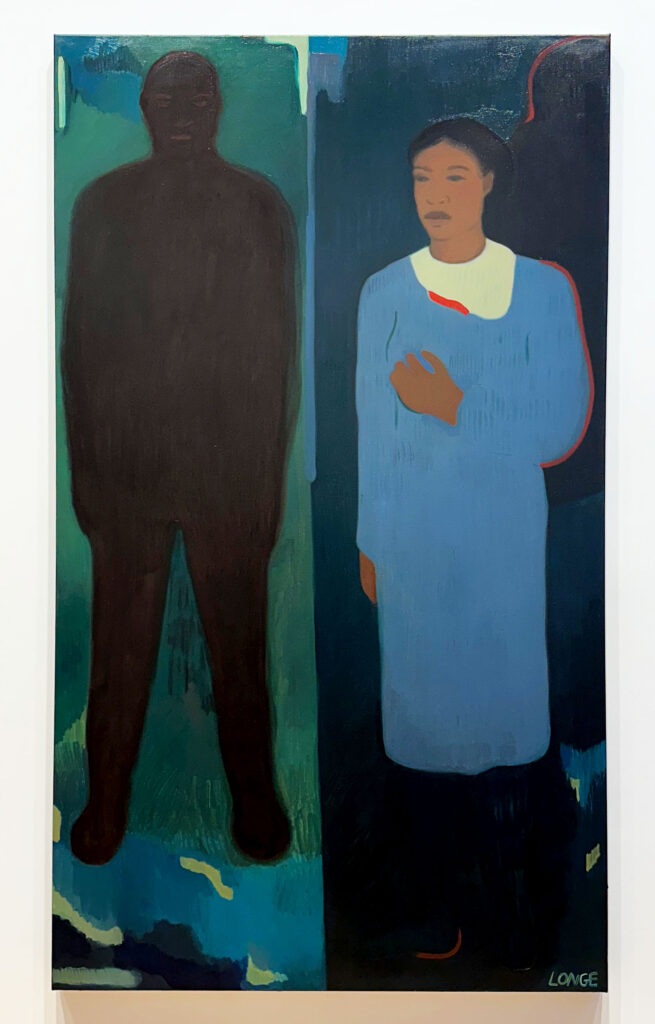
This week’s throwback is to Sahara Longe‘s paintings from her 2024 exhibition at Timothy Taylor gallery in NYC, Sugar.

From the gallery about the work-

Featuring twelve vivid and haunting canvases, Longe’s second exhibition with the gallery sees the artist reconceiving various art histories to arrive at an uncanny interplay of figures, allegories, and enigmatic landscapes. The show will be accompanied by an essay by Ferren Gipson, art historian and writer based in London.

In paintings characterised by a preternatural handling of line, colour, and figuration, Longe depicts partially abstracted subjects in atmospheric environments. Working on thick grain linen with raw pigment in a distinct palette of vermillion, lilac, raw sienna, and ochre, she renders her scenes with a fluid painterly freedom that is nevertheless quiet and precise in its effect. Across her work, she recalls aspects of the Symbolist ethos, which moved between nostalgia and rupture, seeking not to capture something directly, but rather convey the sensations it produces.

In her new paintings, Longe focuses on the nude. Articulated in spare, suggestive gestures, her subjects, largely women, are pictured huddled together, embracing a lover, or striding alone. Some set their gaze on an unknown distance, others stare down the viewer, and one confronts a fish. Each seems possessed by a disquieting tension that is emphasised by a shadowy apparition lurking in many of the works. Masculine in stature, the incubus perches over a scene or cradles another figure therein. Where Longe’s previous series reflect on social dynamics, depicting parties and crowds, these paintings are more personal; the artist explains that the new works look inward rather than outward. Expressive, brushy marks bring subtle notions of agitation, dreaminess, and intimacy to otherwise minimal passages of colour.

These paintings further explore the ideas set out in Longe’s earliest work, which emerged from her study of classical portraiture at Charles H. Cecil Studios in Florence; in her early canvases, Longe integrated and recontextualised themes and styles of old-master paintings. Here, her compositions draw from Secessionist painter Otto Friedrich’s nudes and Symbolist Ferdinand Hodler’s ominous portraits. They likewise reveal the influence of a recent trip to Oslo, where Longe was taken by Henrik Sorensen’s mural (1938–50) in Oslo City Hall (where the Nobel Peace Prize is selected), and the marginalia of illuminated manuscripts. Ushering these disparate sources and traditions into her singular aesthetic, Longe poses subtle questions about representation—who it serves, and what narratives it upholds—just as she underscores figuration’s expressive potential.