May 022023


Currently on view at Bortolami is Tom Burr’s excellent multimedia exhibition. With new discoveries around every corner, the show keeps you engaged, at times even on an emotional level.

From the press release-

Once more Burr has assumed his dual role as artist and exhibition maker, relocating the act of making from the traditional studio space into the gallery. An architectural intervention of four walls defines the show, a deconstructed box whose contents have been scattered both in view and out of sight yet remain connected on levels of materiality, memory, biography, and history. Moving through the gallery, the viewer is directly confronted by Burr’s work, activating the artworks and the physical space created for them. As the interconnectivity of the different facets of the exhibition comes into view, not only here and now but in its connection to the entirety of Burr’s career, we begin to understand this as not merely an assortment of objects as artworks, but on a larger scale as a total artwork.

Four new wooden panels populate each makeshift wall, continuing the signature plywood sculptural series begun in the 1990s. Each painted a different color, the artist loosely utilizes the shipping crate motif, a point of interest for Burr. Adhering stainless steel and brass plates to each panel, the images portray the artist himself as well as his own simulation of stereotypical “faggy gestures,” as he refers to them, creating an intersection of public expectations of artistic sensibility, identity performance and exposure.

Also on view in the main gallery are a series of furniture-based sculptures. Set behind the walls, each work draws the viewer into the constructed architectural space as they grapple with themes of legacy, memory, and biography. Pulse utilizes various items once belonging to the “lounge” at Burr’s project space in Torrington, Connecticut—a disco ball, a couch, a lamp, a wool blanket — the disco ball being a relic from American Fine Arts, the legendary SoHo gallery run by Colin de Land where Burr exhibited throughout the 1990s and early 2000s. Accompanying the work is a wall text listing the various academic definitions of the word “pulse,” while the last line, a new addition by the artist, is a reference to the infamous shooting at the gay nightclub in Orlando, Florida, a signal to both the individual and communal meanings associated with the word. Similarly, the artist has gathered various items belonging to his father to create Johns (my father’s chest)—a chest of drawers, long johns, a metal storage box, and a handkerchief— evoking the same ideas of legacy and biography.

A new photo series entitled Capricornus I, II, III, and IV lines the outer walls of the main gallery. Depicting Burr in the three public bathrooms of his Torrington space, he is in the midst of various movements—lounging, laying down, reading. In a string of associations from Bruce Nauman to Francesca Woodman, as well as nods to his own past work, here the studio becomes a stage as Burr equates the everyday banal and artmaking.

Occupying the small gallery space, Floor Model (adolescent), is the most recent continuation of the artist’s series His Personal Effects, while in the office Burr has installed a series of new collages made in homage to Stefania Bortolami. The Visit, I, II, III depicts images of a visit by Bortolami to Burr’s space in Torrington, CT, as well as images of plant foliage from Burr’s seminal work, Construction of An American Garden, currently installed in the Torrington space. In the words of scholar and curator Blake Oetting “the body of the dealer emphasizes the commercial system that supports Burr’s work and translates it into exchange-value, a framework, he reveals, that often moves beyond the physical boundaries of the gallery.”

This exhibition closes 5/4/23.
Apr 282023
 

“My Gut”, 2022, acrylic, ink, marker, wax crayon, paracord, thread on canvas

“My Gut”, 2022 (detail)

“Bodybuilder”, 2023, acrylic, ink, wax crayon, paracord, thread on canvas

Annie Bielski’s dynamic mixed media paintings from her exhibition, Agita, are currently on view in Rachel Uffner Gallery’s upstairs space.

From the gallery’s press release-

Annie Bielski makes works that are big washes of feeling, then she goes in and fills in the shapes. The volumes need to be filled—satiated. Going over and over them with crayon or oil stick in repetitive gestures. This is to say that her paintings are both records of the artist’s bodily limits (the paintings go as far as my arm) and examples of the limitless potential of materials left to their own devices (the oil stick is cakey and glossy lipstick falling off and crumbling and being smooth). The drawing ends when the stick is worn down and there is nothing but residue left on your hands.

The result of this dialogue is evident in the forms that she generates. Each form is an organ: it has a specific function, processes in its own way the work’s shared fluids and biles—but compacts to mass when crammed together in the cavity of the canvas. The material challenging the body to collapse into its most erratic gestures, the body wondering if the material might ultimately generate some kind of meaning. Everything is always taut, ready to burst.

What happens next? Eating a hotdog from a cart in Central Park (beginning a painting) when suddenly the agita rises (heartburning) and the world immediately becomes askance, shifting off its axis to accommodate room for your pain. How do I make this okay?? / When will the painting be finished?? Needing to take off every thing that constricts you; unbuttoning your pants, loosening your bra, unwinding your braid, then going to lie down. A body would be sexy but it’s the byproduct of spasmodic internal combustion. Classic.

For her, the conditions that painting creates are tragicomic. This understanding is traced in wavering—moments of gravity or self-seriousness are transmuted into a bunch of bananas or a floral motif. But each little disaster is kept in check by a kind of logic, perhaps provisional, a pact with the inherent nature of all unruly things to meander. It is ultimately a win-win contract between generosity and flexibility, a willingness on her part to accept the mess of point A to point B.

The result is a series of works that are bright and unsettled, grotesque and pulsating, alive with the pure tension of compromise. Rachel Uffner Gallery is pleased to present a solo exhibition of new paintings and drawings by artist Annie Bielski. The show is titled Agita, and if you know, you know.

This exhibition closes 4/29/23.
Apr 282023
 

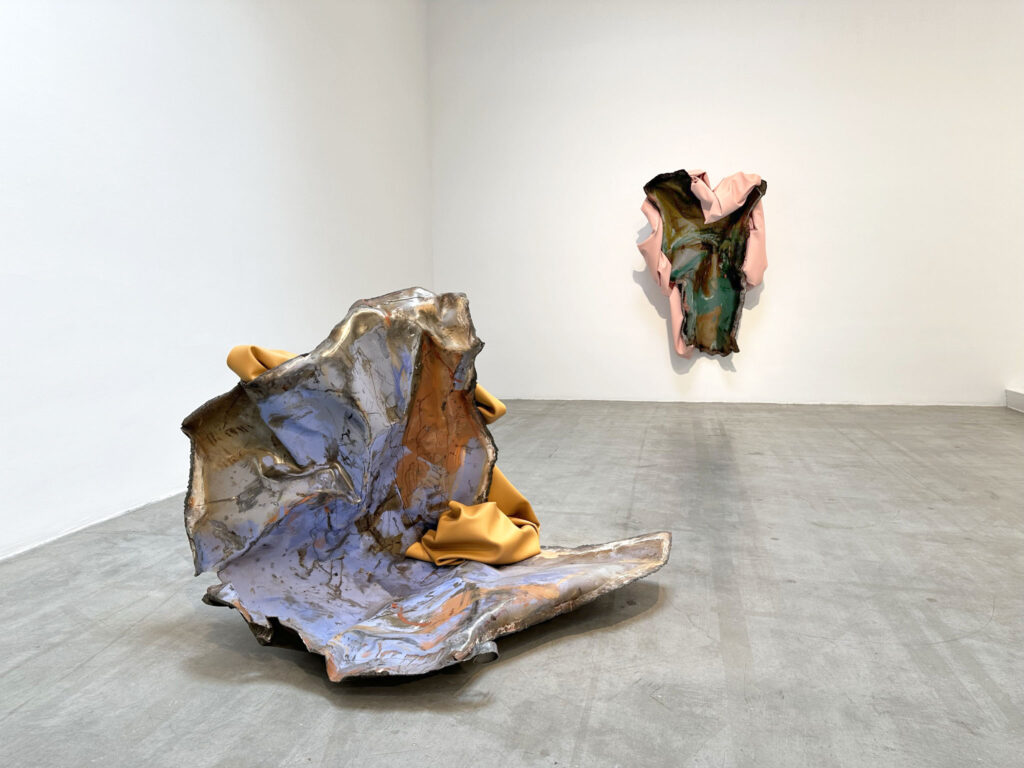
Installation by Molly A. Duff

Work by Trinity Oribio (left) and Manon VanScoder (videos on right)

Currently on view at The USF Contemporary Art Museum is SOMEDAY YOU’LL HAVE TO SAY IT OUT LOUD, an exhibition of eight students graduating with MFA degrees from the USF School of Art and Art History.

The artists included are Molly Duff, Kai Holyoke, Caitlin Nobilé, Trinity Oribio, Rachel Treide, Manon VanScoder, Alicia Watkinson, and Willow Wells.

For the artists’ statements about their work, as well as more information on the exhibition, the museum has produced this PDF.

The show will be on view until 5/6/2023.
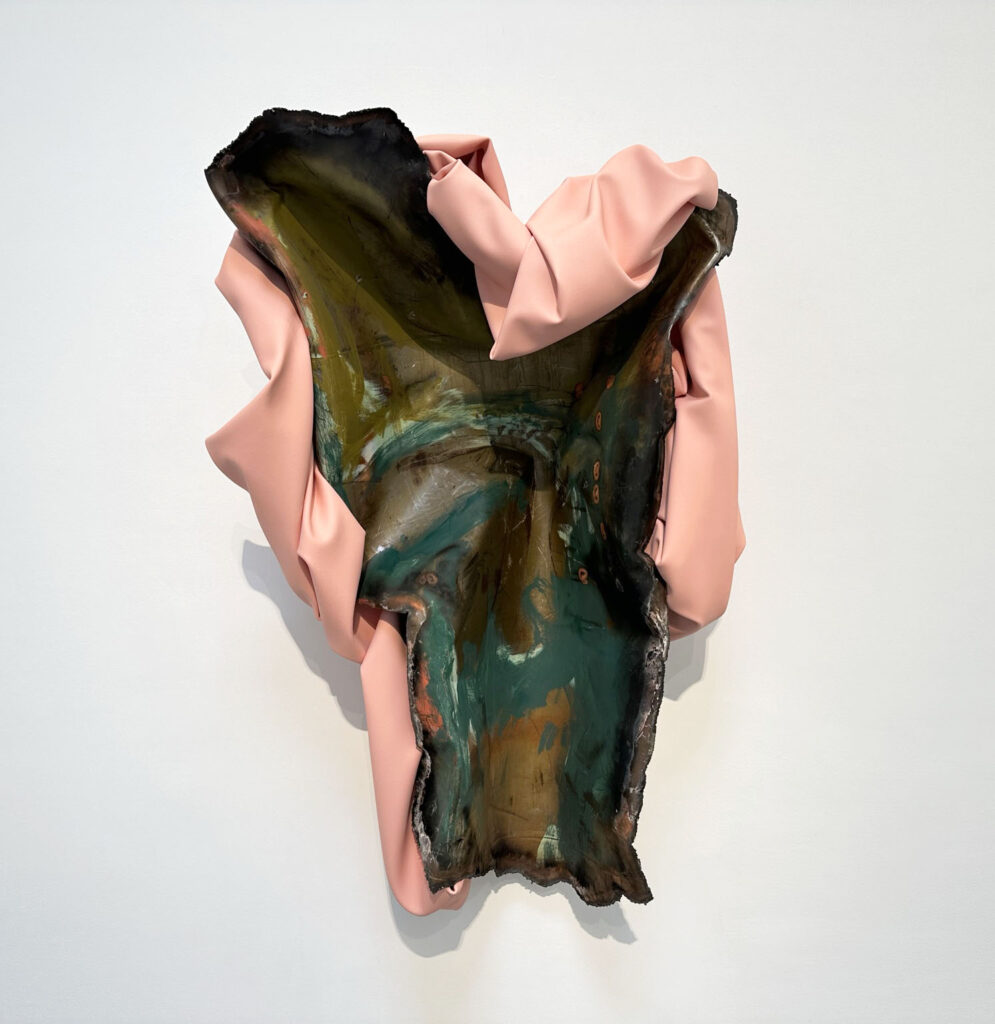
Installation by Molly A. Duff, another view

Alicia Watkinson, “Notations in Passing II”, 2023, plywood, lightbulbs, ceramic bases, timers. Duration of light set daily according to the previous day’s activities and observations

Alicia Watkinson, “Notations in Passing II”, 2023 (detail)

Photo transfer on glass by Rachel Treide

Still from video by Rachel Treide

Caitlin Nobilé, “The gap in the door”, 2023 triptych, acrylic on wood

Willow Wells, “Whispers”, 2023, oil painting on panel

Trinidad Oribio “Untitled”, 2023 oil on canvas

Trinidad Oribio, “La Trinidad”, 2023, archival pigment print

Video installation by Manon VanScoder

Manon VanScoder, “each day is an endless scroll”, 2023

Kai Holyoke “Paradise Lakes”, 2023

Kai Holyoke “Paradise Lakes”, 2023


Apr 252023
 

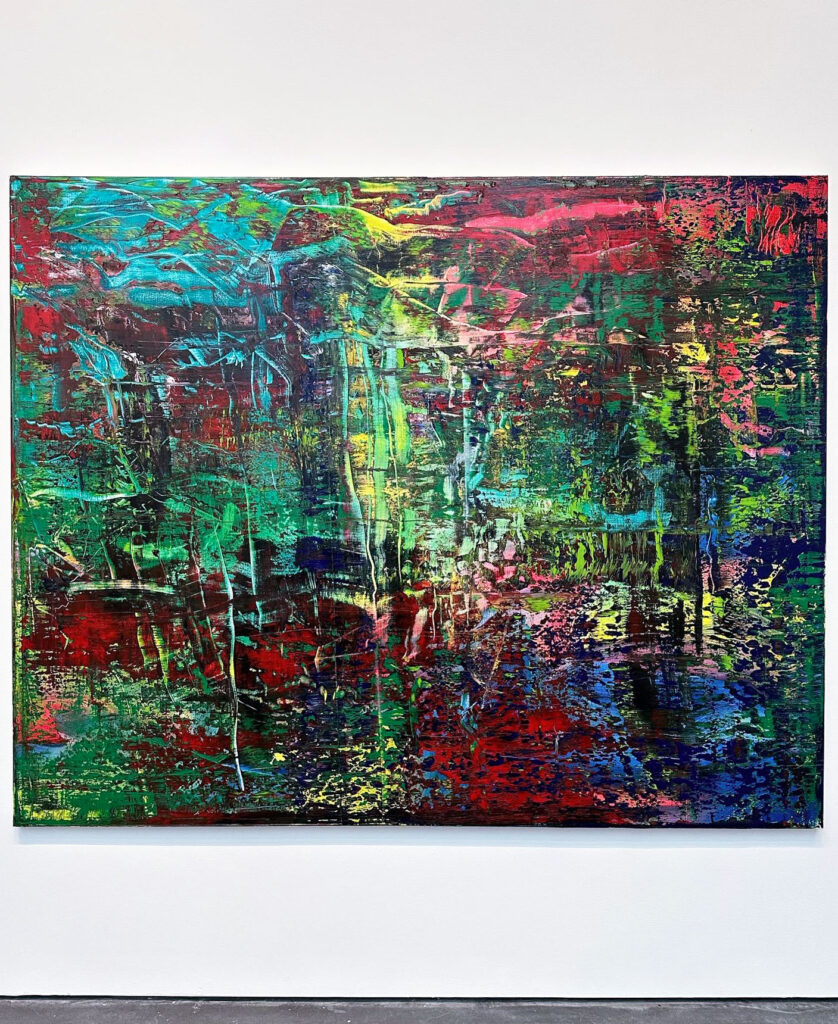
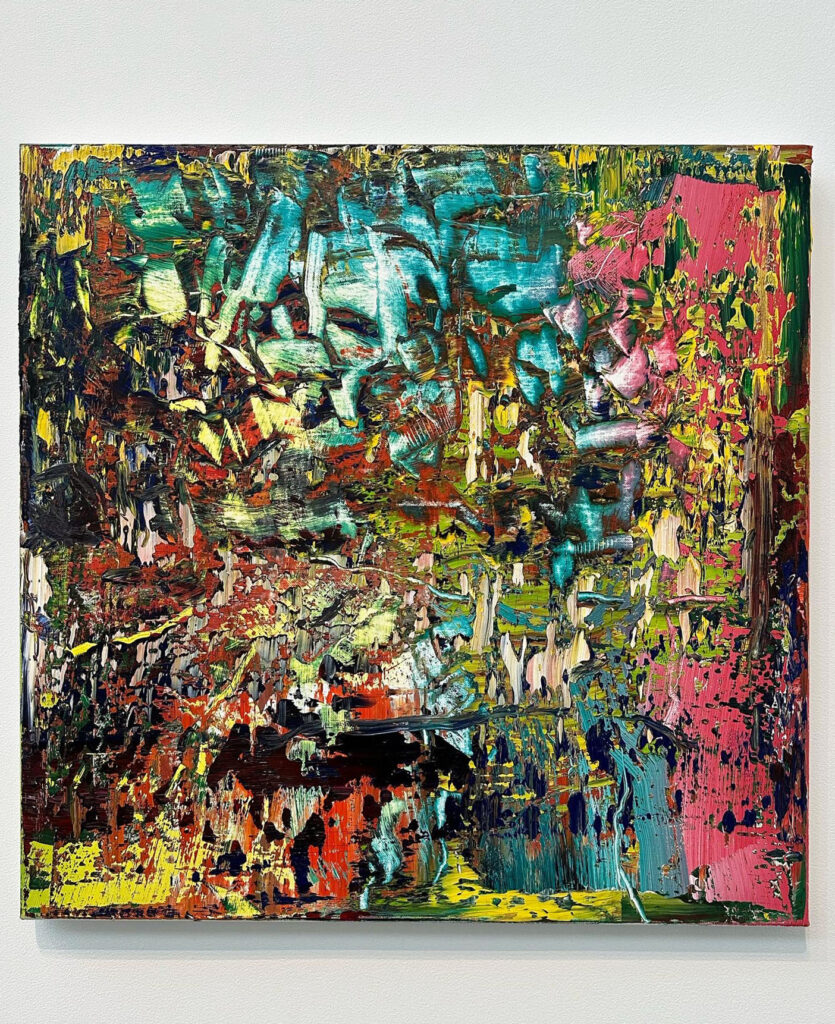
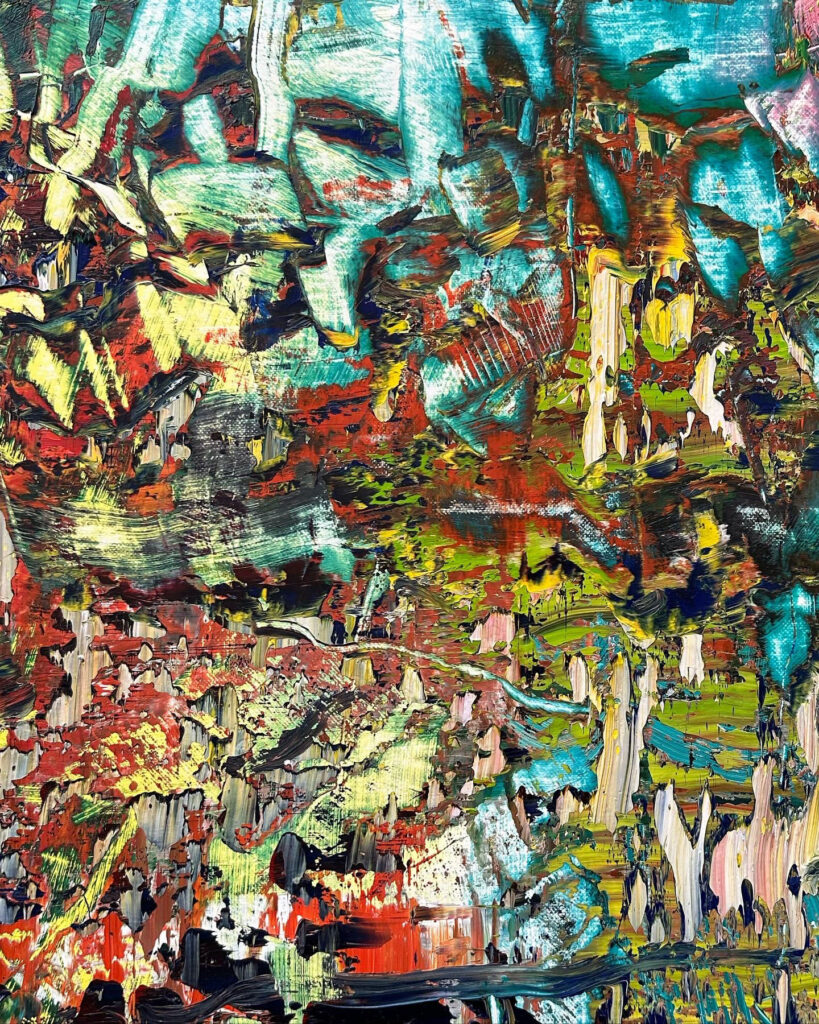
It’s the last week to see the Gerhard Richter exhibition at David Zwirner. The show includes a group of Richter’s last paintings from 2016-17, two of which are pictured above, as well as a new glass sculpture and recent works on paper.

From the press release-

Celebrated worldwide as one of the most important artists of his generation, with a career spanning from the 1960s to the present, Richter has pursued a diverse and influential practice characterized by a decades-long commitment to painting and its formal and conceptual possibilities. The artist has consistently probed the relationship between painting and photography, engaging a variety of styles and innovative techniques in a complex repositioning of genres. In Richter’s work, dual modes of representation and abstraction fundamentally question the way in which we relate to images.

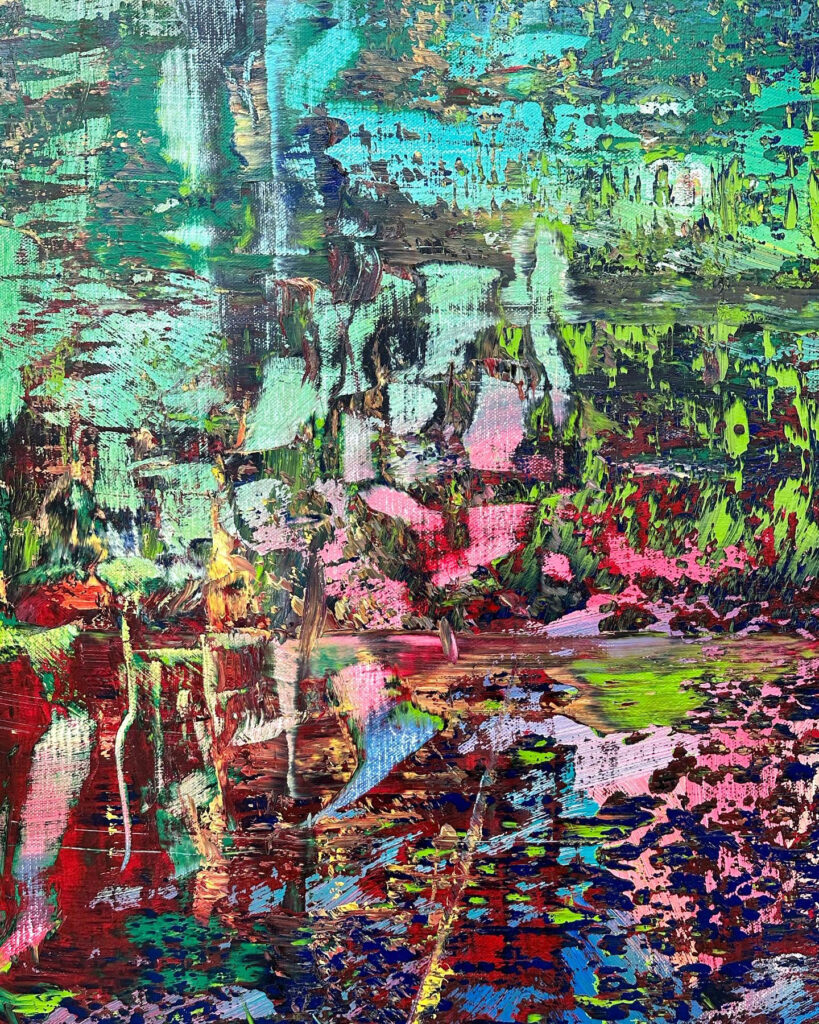
The exhibition will bring together a significant group of Richter’s last oil paintings, made in 2016–2017, a number of which will be shown in New York for the first time. Richter stopped making oil paintings in 2017, and the final work on canvas he made will be on view in the exhibition. Part of the artist’s Abstrakte Bilder (Abstract Paintings) series—a cornerstone of his practice since the 1970s—the works on view exemplify Richter’s investigations into chance occurrences and the painted medium’s historical and material properties. With their highly worked and intricately stratified surfaces, the last paintings foreground the sheer physical presence of paint and color, enacting a mode of composition that is aleatory yet deliberately planned.

Centrally featured will be 3 Scheiben (3 Panes) (2023), a new glass sculpture that continues Richter’s exploration of human perception and the built environment. Comprising three sequential rectangular panes of transparent yet reflective glass—each one positioned upright and measuring almost ten feet in height—the installation invites viewers to look at, through, and beyond its surface, revealing the inherently subjective and situational nature of perceived reality. Richter has consistently created glass and mirrored works since 1967, often presenting them alongside his paintings and drawings and placing them in the larger context of their surrounding architecture. Crucially, while sculptural, these free-standing glass works are also positioned as a literal reflection on painting and image-making; they respond to the art-historical notion of the painting as both a mirror and a window, while also acting as a powerful corollary to the blurred effect of Richter’s photo paintings, which the artist began experimenting with in the 1960s. As critic Hal Foster notes, “The felt analogy between a composed painting and a contemplative viewer is so fundamental that we are not aware of it until it is interfered with. And this is precisely what the glass pieces do: our reflection, in the sense of our mirrored image, disrupts our reflection, in the sense of our contemplation.”1

An expansive suite of new works on paper from 2021–2022—some made with ink and others with graphite and colored pencil—will also be on view. Richter’s drawings constitute a significant element of his practice, allowing him to explore another aspect of the role of the artist’s hand in the creation of a dynamic and abstract pictorial narrative. Many of these works feature passages of cloudy graphite rubbings juxtaposed with equally hazy semi-erased portions. The artist embeds a sparse network of crisscrossing arcs and lines amongst this backdrop, forming an enigmatic topography that seems to map out the very possibilities of image-making itself. Other drawings on view are composed of abstract monochrome washes of ink and graphite, taking on a decisively painterly appearance; as Richter describes, these works on paper chart out a parallel but complementary path to his painted oeuvre, much like that of “a poem and a novel by the same author.”2

Also on view will be mood, a group of inkjet prints that relate to a recent series of colored ink drawings by Richter, both of which debuted at the Fondation Beyeler in Basel in 2022. Part of the artist’s extensive career-long experiments with the iterative translation and interplay of mediums, these vibrant prints are almost indistinguishable from their ink counterparts, revealing Richter’s continued fascination with the possibilities of image reproduction.

This exhibition closes 4/29/23.
Apr 222023
 

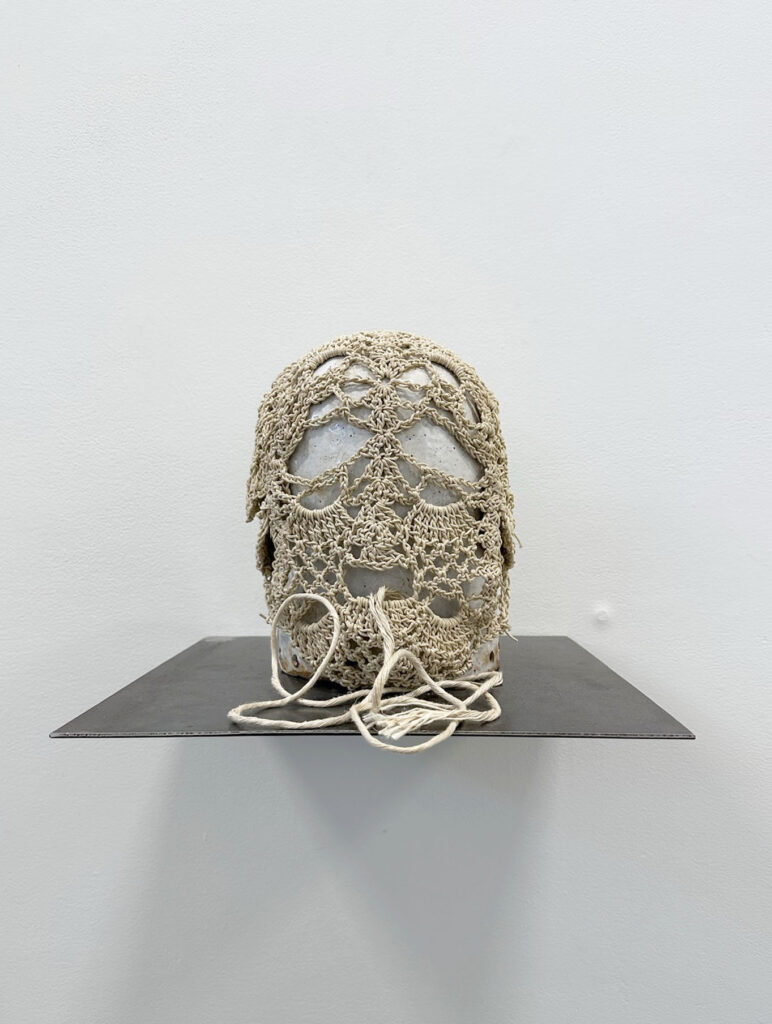
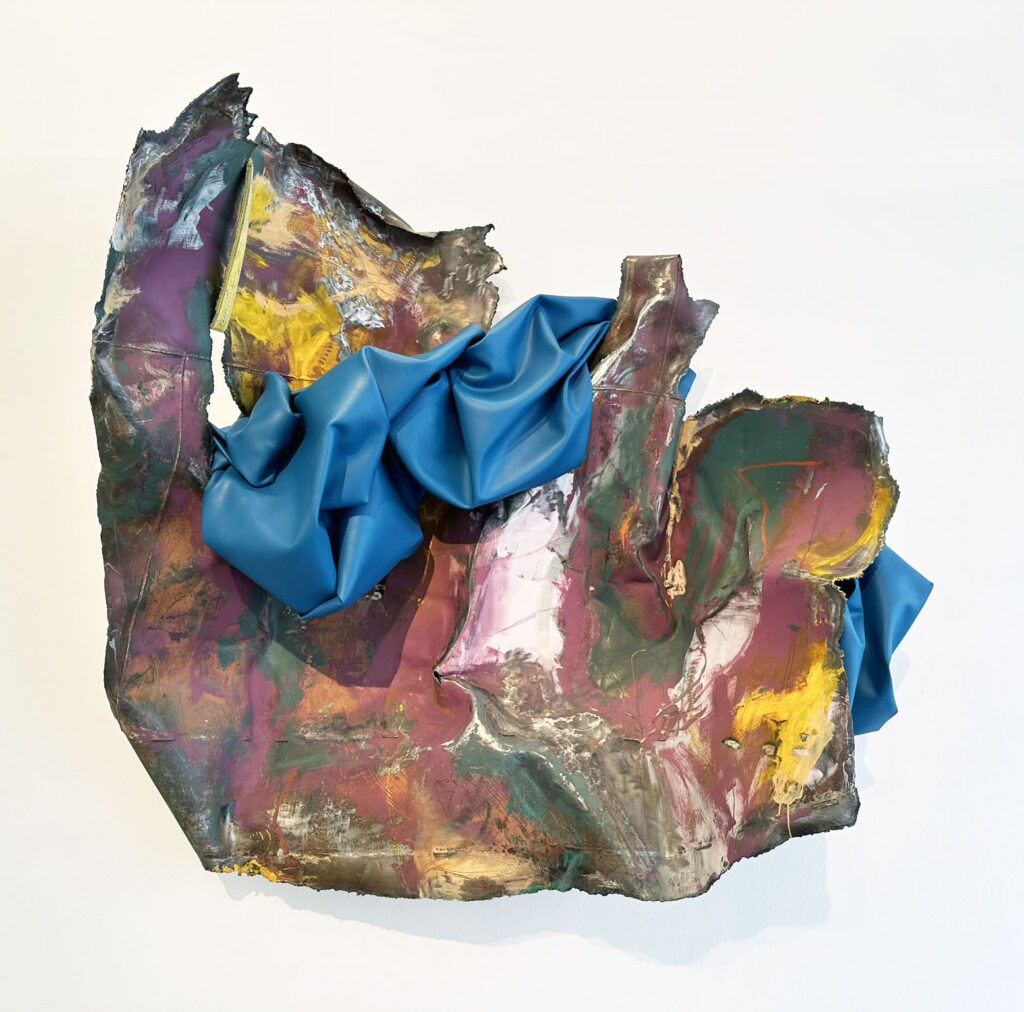
cabeza güera, 2019 Glazed ceramic and crochet cotton

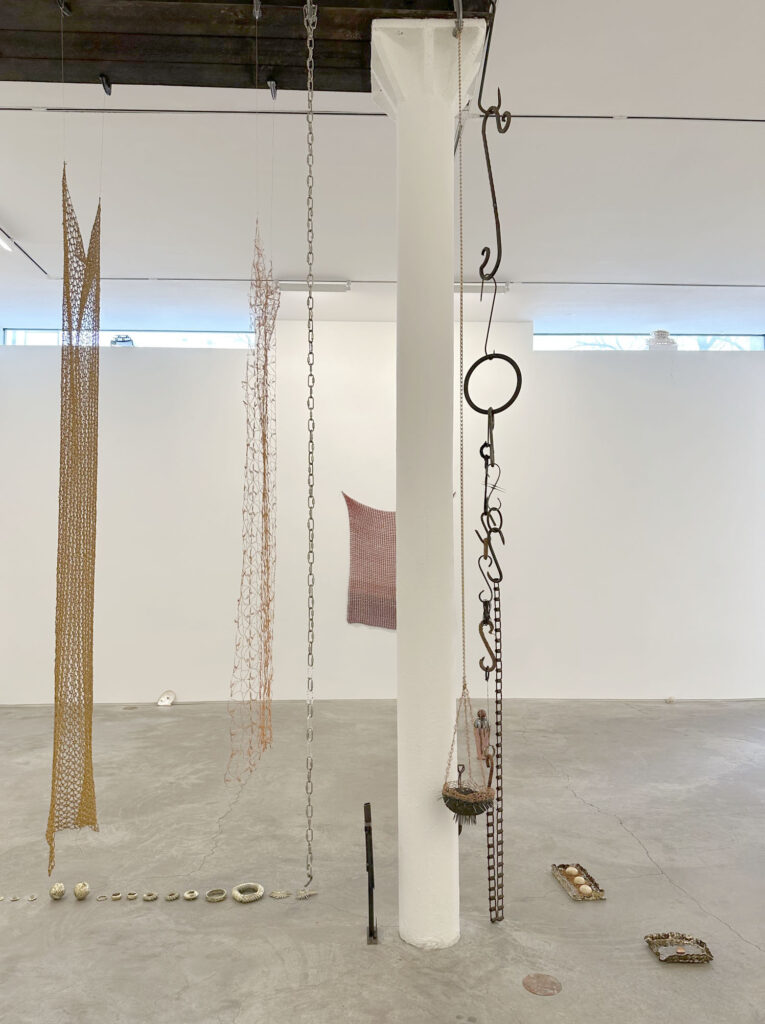
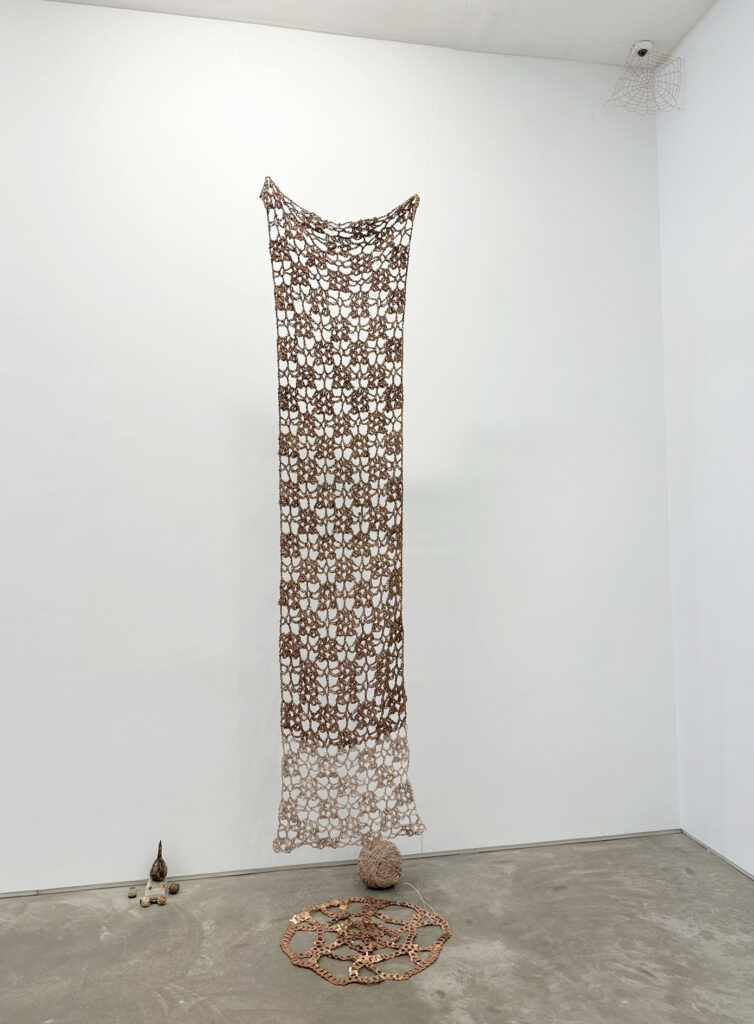
“encuero”, 2022-2023, Crochet leather and copper; “gotitas”, 2023 Agate, glazed ceramic, plasma cut metal, steel, onyx, palm, and seed podand; “telaraña de cobre”, 2020 (web in upper corner)

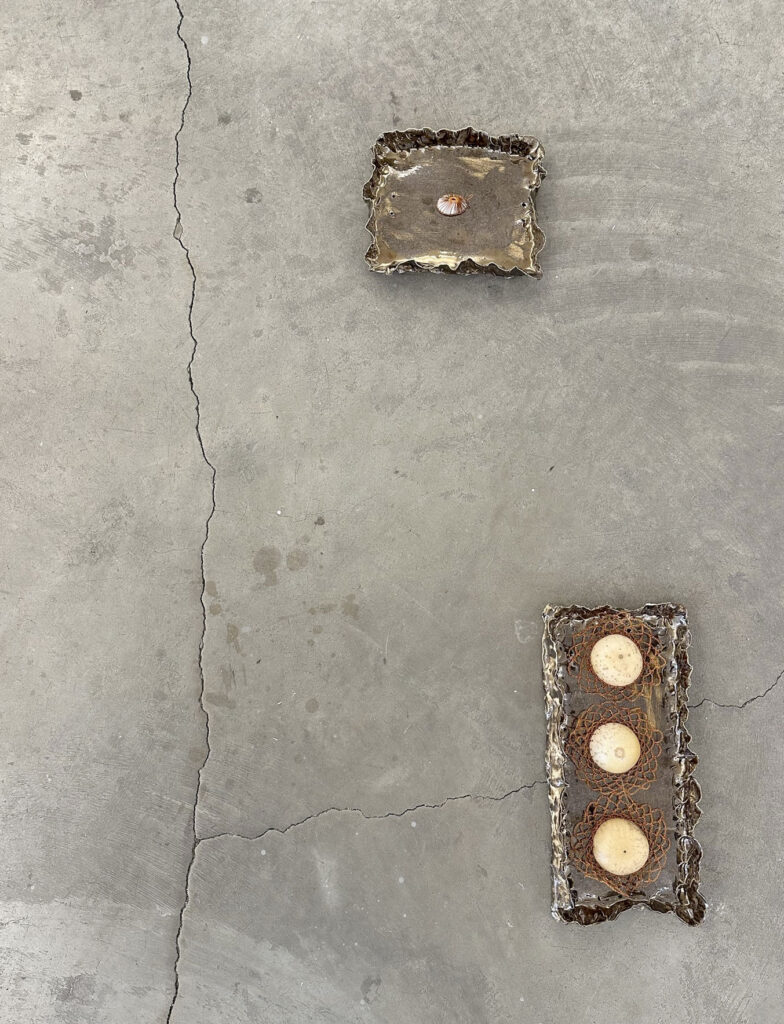
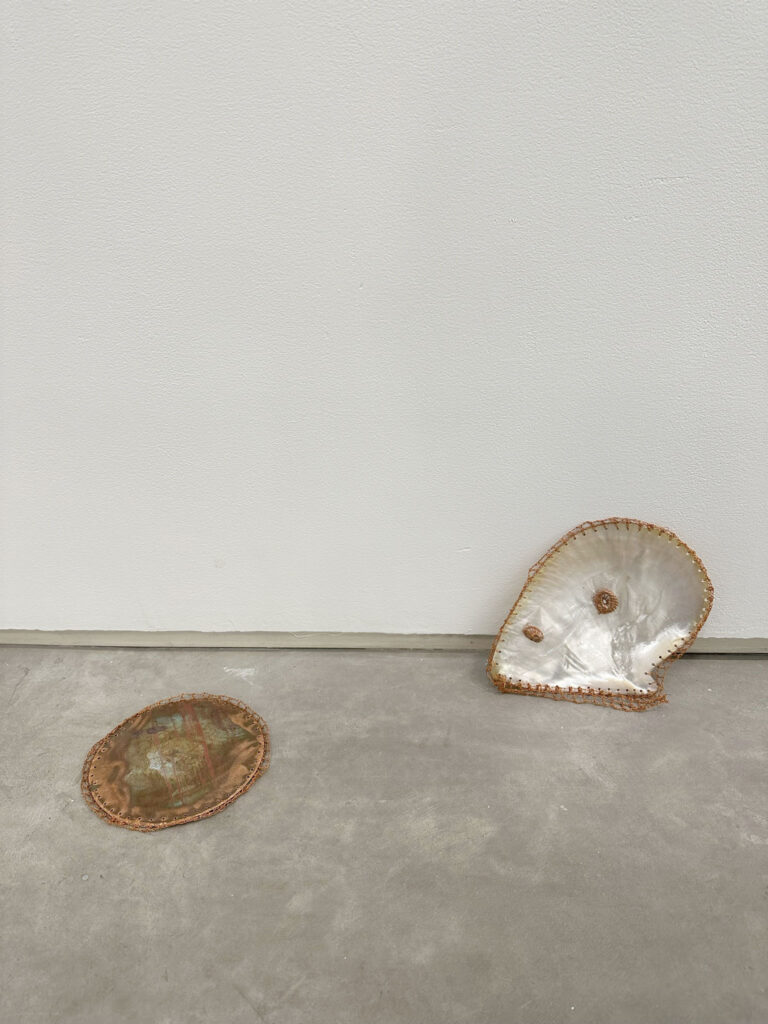
“trastes ceramica”, 2023 Glazed ceramic, gourds, crochet copper wire, and limpet shell

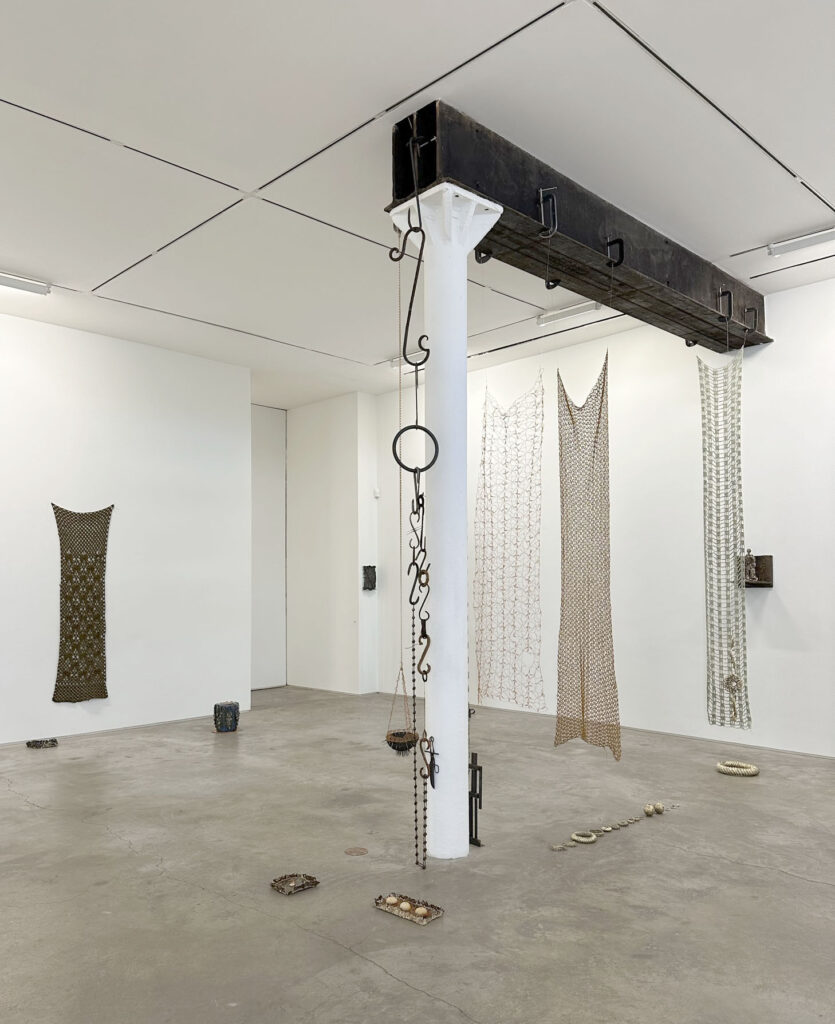
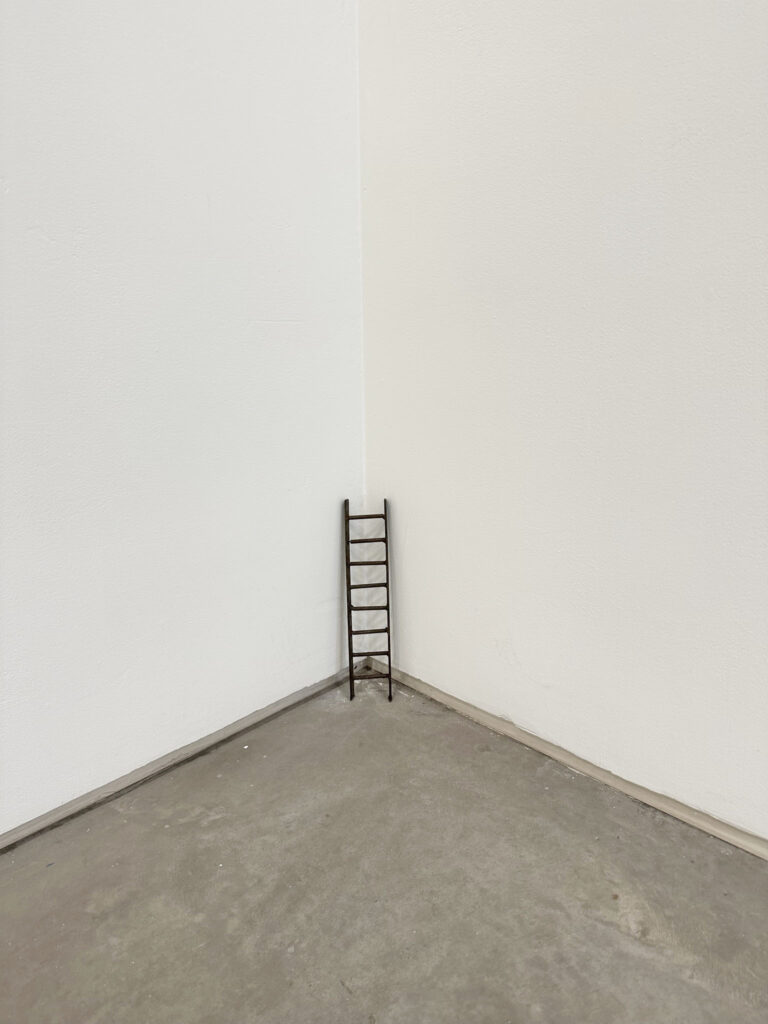
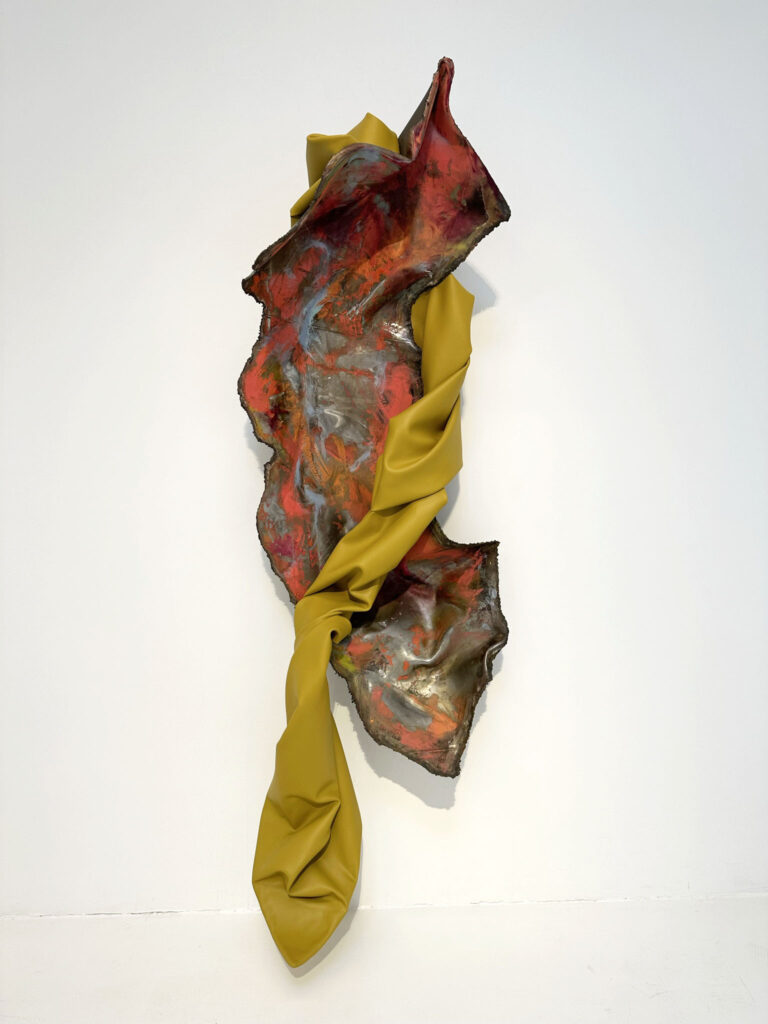
There’s only two days left to see ektor garcia: esfuerzo at James Fuentes. The enchanting sculptures inspire curiosity and encourage the viewer to imagine the story behind the work while also admiring their construction.
From Art Daily about the exhibition-

Each of ektor garcia’s exhibitions are more like a marker of a moment of pause in his work, rather than a presentation of something complete or discrete. In this way his works are evidence of a continual natural progression, as things build on top of each other, evolving. In relation to the specific time and place of this newest exhibition; it marks a cyclical continuation of the garcia’s presentations at the New Museum in 2017 and Sculpture Center in 2019—both of which moments in the artist’s life when he was traveling a lot, largely moving between Mexico, being on the road, and New York, specifically. This is the case once again, today:

For this show garcia traveled from his studio in Mexico City, suitcases filled with materials, to occupy the basement space below the gallery at 55 Delancey St in the lead up to the exhibition’s opening to the public. He has also retrieved objects previously exhibited or in storage—for example a 15-ft copper link piece recently exhibited at the Henry Art Museum has been broken into smaller pieces, added to and reconfigured into a new work(s). The exhibition title, esfuerzo translates to effort; as in a big push, like a birth, which feels apt for what the artist does. Pieces come together little by little over a long period of time; and the work comprises many small parts that each reflect his esfuerzo in making them. Another translation for esfuerzo could be output; and, shortened, fuerza means strength. Via his artistic practice, garcia is the conduit or vessel through which that life-force runs, resulting in an output that is this body of work. garcia is constantly making, hands always moving; this is simply part of how he lives his life. The work therefore isn’t made toward constructing a larger conceptual conceit; instead, its making is its meaning, the working is the work. Its presence in the space is evidence of all this; making room for it to be approached and even interceded, we inherently take part in the work’s life cycle, even potentially changing its course by entering this domain.

This sense of force, therefore, isn’t tied to garcia’s hand only, but relates externally as well. One piece in the show, cochinilla (2022), is woven from wool dyed red from the shell of the cochineal insect. Last year it was installed on the exterior of the Museum of Contemporary Art in Monterrey, Mexico, and upon taking it down garcia’s realized it had become sun bleached unexpectedly. With other pieces he more deliberately pushes, forcing change, for example by using a blowtorch against copper to catalyze an oil-spill patina. Over time, crochet has been one constant; a crocheted piece needs time, and then it meets time. In his words: “The materials are vibrating back and forth, taking turns. That is how they evolve.” And so although the works reference the past they do not prioritize it; likewise the future. Rather, in the style of the ouroboros, they are cyclical, perpetual, and most generous about the present.

Artist Cy Gavin wrote this piece to accompany the exhibition, which is worth a read as well.


Apr 212023
 

“Cocteau and Table”, 2023,oil on archival inkjet printed canvas

“The Seasons Between”, 2023, oil on archival inkjet printed canvas

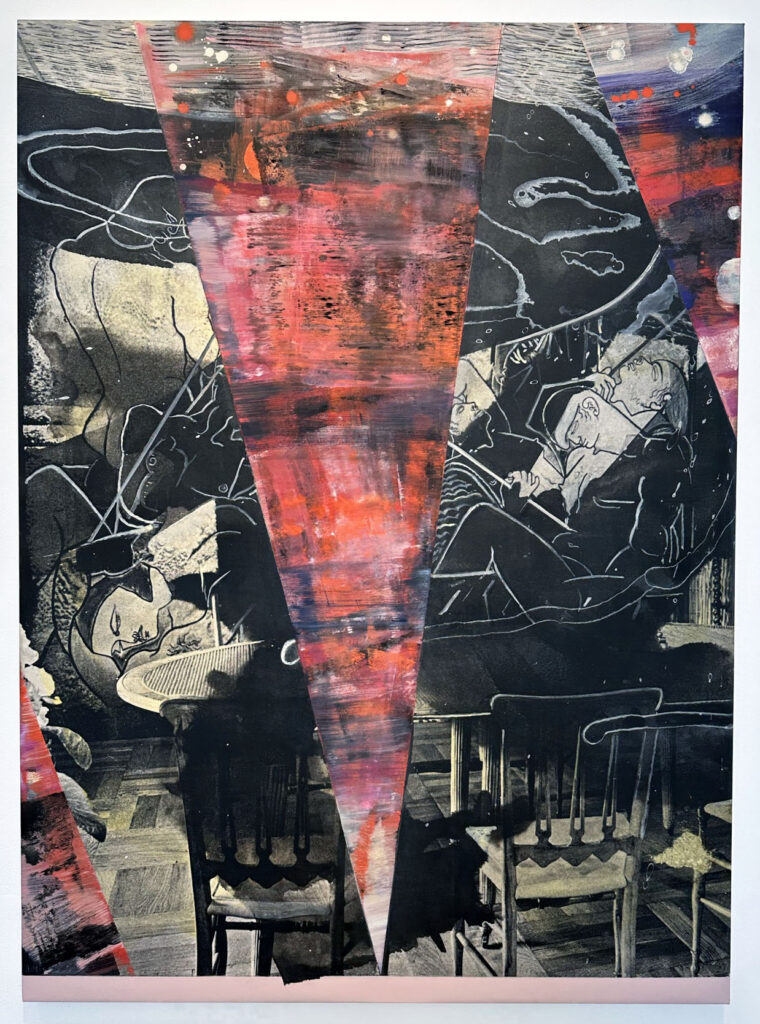
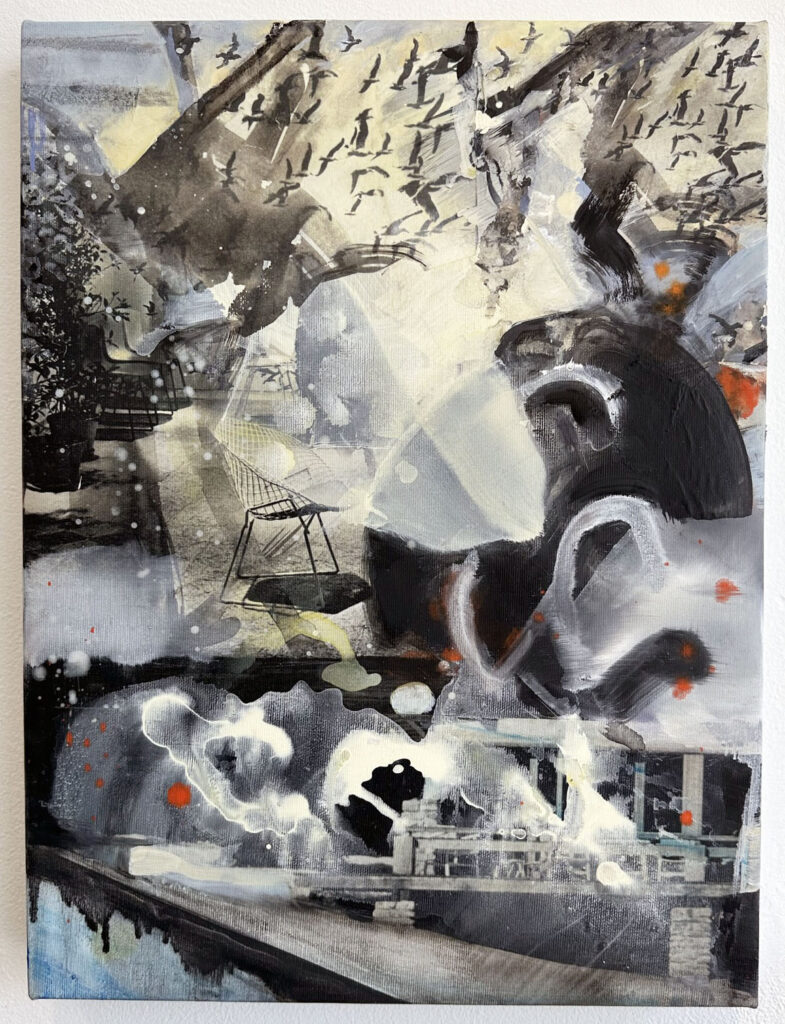
High Noon Gallery is currently showing Les Problémes du Confort, an exhibition of work by Mary Jones.

From the press release-

Jones began this most recent body of work, collectively called simply, “Interior Design,” by painting Sumi ink over the black and white printed pages of a comprehensive French Interior Design publication from the 1960s. “[I chose the series’ title] not only to underscore the attributes of the original images, but to address their psychological component: the topos of dreams, so notably analyzed by Gaston Bachelard and James Hillman, spaces we conjure to discover the elements of our inner lives. Homes and interiors are not only spaces we remember, but also labyrinths of symbolism, familiar to all of us as emotionally charged experiences,” she explains.

The addition of her signature mark making started as an exercise to identify patterns in the tonal pages, separate from the context of the imagery. It seemed to act as a compositional barometer of sorts, deflecting the space in certain areas and illuminating it in others. The painted catalog images were then collaged, blown up, printed on canvas, and painted again, further conflating space and gesture, and inhabiting the vacant interiors with a visible energy. In doing so, Jones satisfies the principles of high design with the paintings’ harmonic beauty, and also the open systems of fine art by positioning the work as cultural critique that challenges the colonialist motifs that permeate the aesthetic sensibility of many of the spaces.

Jones’s work has long gnawed at the malleability of subject matter. She consistently uses legible imagery to anchor her abstractions, prodding at the fickle divide between the two modalities. Her sensitivity to painting’s illusionistic properties is connected to her experience as a faux painter, freelance work she’s done for 25 years. While the object of faux painting is to not let the artist’s hand show, Jones riffs on her craft by skillfully merging gesture and image in ways that are largely indistinguishable. She allows the marks to emulate form and object, playing on the viewer’s expectations of pictorial logic and slyly addressing the disparity between fine art and design, as for many decades— and especially during painting’s theoretical heyday in the second half of the 20th century— they shared a tenuous opposition. Design is associated with expense, and American society is perpetually transfixed by the Romantic notion of the artist as a working class hero.

Ionic Memories (2023), depicts a decadent room steeped in Roman busts and columns, the title a tongue-in-cheek reference to the science of memory and the unstable nature of artistic movements and empires alike. Jones echoes the velvety matte blacks of the printed image in her direct painting gestures, mixing a near perfect replica of the tone and texture for her to set up a meta tromp-l’oeil effect. In the foreground, a collaged brush stroke swipes away at the interior revealing a snowy landscape wherein a bush and modernist cabin are obscured by a swath of pink oil paint. In the context of the whole, the landscape reads as decorative forms within the room, such as fan coral and glass spheres. Other works such as Cocteau and Table (2023) make greater use of a fragmented effect wherein decisively multiversal looking forms cut through the composition like a glimpse into a parallel reality. Through a mix of painterly and faux elements, Jones takes care to merge her augmented realities just enough to allow the viewer to believe the image exists in one picture plane.

Perhaps to be comfortable is to momentarily resist time, to be temporarily impervious to the clamors for change. In Les Problémes du Confort, Jones reminds us that the arrangements we make with ourselves are transitory, constructed illusions to describe and reflect a sense of our place in the world we know, and that improvisational beauty can be found in transitions, in languages we don’t know, and in uncertainty.

This exhibition closes 4/23/23.

Apr 212023
 

“when stone entwines”, 2023, Oil and enamel paint, graphite on cast aluminum, in two parts

“when stone entwines”, 2023, (detail)

“if only, if yet”, 2023, Oil and enamel paint, graphite on cast aluminum/painted wood

“if only, if yet”, 2023, detail

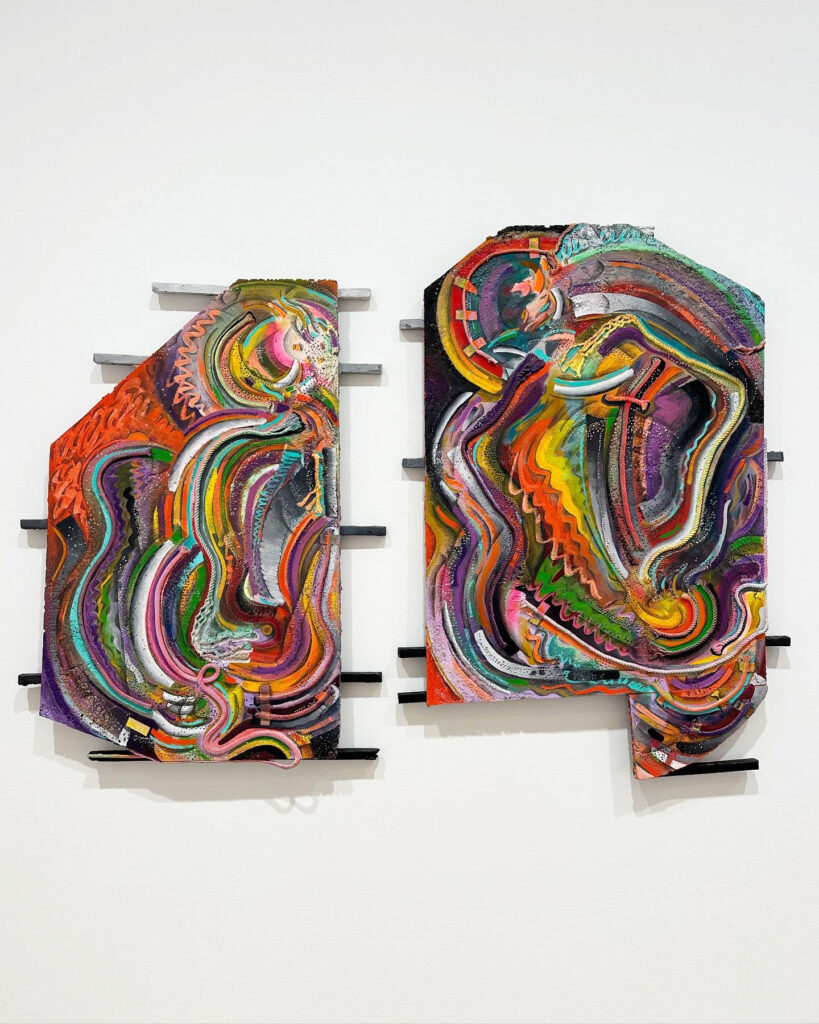
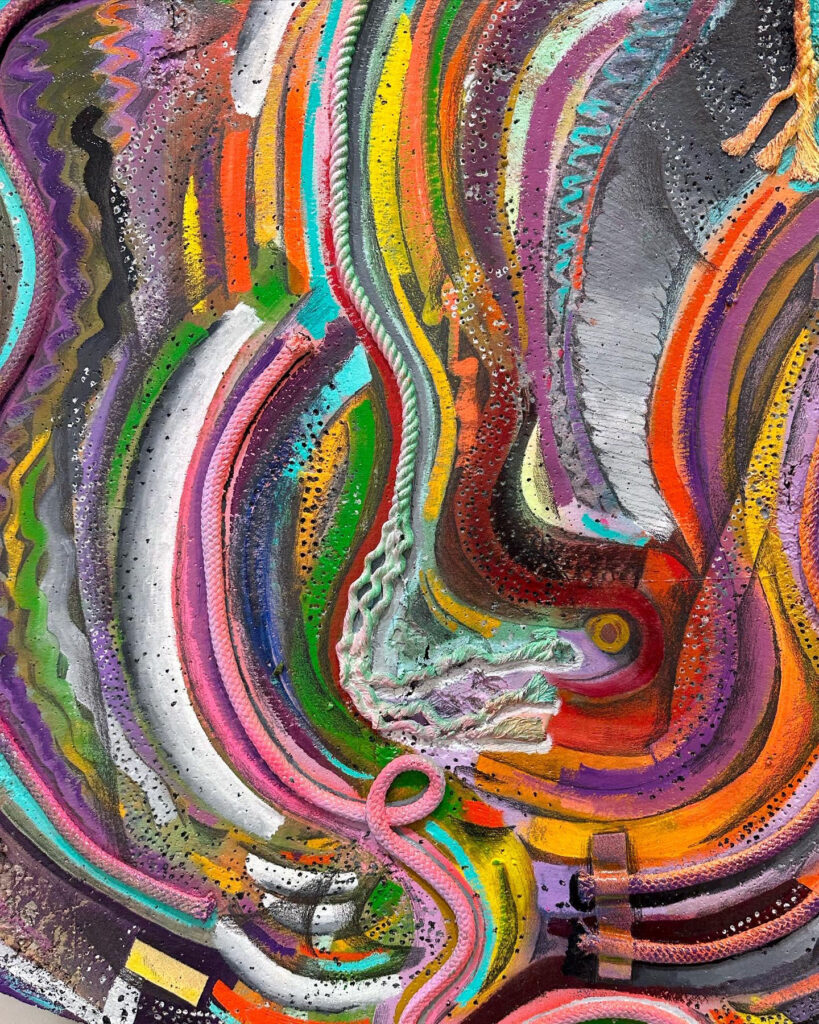
Miles McEnery Gallery is currently showing Katy Cowan’s colorful and intricate sculptures for her exhibition gods on a bridge.

From the press release-

gods on a bridge is Katy Cowan’s first exhibition of metalworks since relocating her artistic practice from California to Berlin. The resulting body of work is a culmination of her current experiences, coupled with engrained references to the historical presence of sculpture in the city.

Each work starts in a foundry where the artist casts solid aluminum forms, which are then adorned with a variety of mediums and methods: acrylic and enamel paints, sprayed and brushed. Cowan elects to retain the fractured casting bars, signaling a parallel to the remnants of the Berlin Wall. As personally described, a guiding principle in her process is to “combine a multitude of experiences onto one surface and find a way to seize that depiction.”

This overarching aim is realized when Cowan draws from natural and urban environment alike—the blooming trees, reflecting ponds, and embracing bodies. The most prominent of these influences are the stone sculptures that appear throughout the city, acting as constant fixtures in the landscape, changing with age, taking on the textures of time and layers of graffiti. In her essay, Stephanie Cristello cements their influence by the figurative turn in Cowan’s compositions, expressing that they “have manifested as sculptural abstractions and fragmented, embodied landscapes.”

Cowan translates this amalgamation of inspiration to her aluminum surfaces, contouring reflections with cast rope, painted lines and flowing points. “Each work constitutes at once a fleshing out of figures as much as a mapping of movements—whether bodies in a park or city street or marks that dance across the capacious plane of representation itself,” writes Stephanie Bailey. “[gods on a bridge is] where line, ground, and figure collapse into a vortex of intuitive becoming.”

This exhibition closes 4/22/23.

Apr 202023
 

“Pink and green music”, 2023

“What we re-quire is…silence”, 2023

“Within the Lattice”, 2023

“An Ode to Hugs”, 2023

It’s the last week to see Kennedy Yanko’s exhibition, Humming on Life at Jeffrey Deitch gallery’s Wooster Street location.

Tonight, 4/20/23, she will be at the gallery discussing her work with Alteronce Gumby.

From the press release-

By employing paint skin and metal in ways that both transmute a bodily essence and reposition the weight of gravity, Kennedy Yanko wields materiality and abstraction with the possibility of intervening in the viewers’ perceptions. In Humming on Life, Yanko‘s first exhibition at Jeffrey Deitch, the artist continues this exploration.

Although the tactile quality and lyrical processuality of Yanko’s works emphasize their sculptural quality, the artist considers herself foremost a painter. In her new body of work, Yanko takes an approach to sculpture that reconnects it, and her, with painting. In recent years, the weathered paint and bruised patinas found on salvaged metal relics informed her palette for the paint skins. Now, the artist is introducing colors to the metal she finds. By painting the metal directly, underpainting, fire-cutting forms and compositions, and then crushing those new shapes, Yanko is expanding the definition of painting through her process. She remarks:

Working this way has been labor-intensive and has exposed me to sounds, like water thrashing inside a metal tank while cleaning it. Feeling that thrashing—hearing a power that felt like infinity incarnate—encouraged me to probe water as a medium and examine my intuitive method more closely, which seemingly only comes from physical exchange: input and output, expansion and contraction. In pulling water apart and becoming more curious about its behavior and participation, I’ve enjoyed revisiting the ways in which it’s a web of activation, a source, and information. It’s a cue and a salve and carries with it tinges of what it’s gone through.

What water did for me in that moment was to point back to the livingness of my medium — of the metal and paint skin I rely on — and wash away the binary between life and matter. Erasing this divide expands the possibility of experience; it gives materiality an abstract power that we yield to. It’s that vitality, found in color, form, attention and consciousness, that I hope this work can be a language for.

The “Illuminating Sound” presented apart of the exhibition, composed by Samuel Kareem, is derived from audio Yanko recorded while working in the yard. Kareem expanded one striation of sound within the clip—one small element he excavated from the layers of water, metal, paint and movement—and created 10 ten unique soundscapes. Each of the scapes corresponds with a sculpture within the show, and illuminates it. Listen to “Illuminating Sound” here.

Apr 182023
 

“Untitled (Thicket)”, 2022, Steel, wood and paint

“Untitled”, 2020-22, Bronze and paint (two parts)

“Untitled (Fence I)”, 2020, Papier mache

Rachel Whiteread’s sculptures at Luhring Augustine’s Tribeca location draw the eye in with their textures, colors, and in some the unique combinations of items. They are even more intriguing when you discover they are often not what they first appear to be.

From the press release-

As is typical in Whiteread’s work, the sculptures in this exhibition communicate a high-low dialogue: discarded, seemingly inconsequential items are rendered in often precious, high-art materials, which transforms and elevates them from their original context and reading. The eye is tricked, and careful observation is required of the viewer. What appears to be spray-painted cardboard is in reality patinated bronze or silver, or shimmering metallic papier-mache, and assemblages of found materials are in reality amalgams of both found objects and hand-crafted simulacra. Cartons, boxes, branches, crates, cardboard, packing materials, and pipes overlap and interchange, creating an installation that becomes a pleasing visual puzzle. Whiteread created the works for this exhibition specifically with the light-filled, high-ceilinged Tribeca gallery in mind, so a beautiful optical play with colors and materials punctuates the space and draws the viewer into close examination of these human-scaled pieces. Silver and bronze casts of empty, anonymous boxes have a weighty presence, in contrast to the disposable nature of their form. The floor pieces are ghostly white assemblages of both found and cast objects, mostly debris; sitting wraithlike on the floor, each beckons the viewer to circle them and decode their elements.

This exhibition closes 4/22/23.


Apr 142023
 

Thornton Dial, “Memory of the Ladies That Gave Us the Good Life”, 2004, Tin, carpet, wood, glove, washbasin, scrub brush, yard ornament, motor-oil bottle, paint brush, clothing, wire, enamel, and spray paint on wood

David Hammons, “Untitled”, 1976-77, Wire, rope, pipe cleaner, hair, rubber ball, mesh, aluminum, sand paper, thumb tack

Robert Rauschenberg, “Matt’s Defense (Scenarios)”, 2005, Pigment transfer on polylaminate

Dial / Hammons / Rauschenberg at David Lewis presents several works by the three artists that, although different in many ways, work together well.

From the press release-

This is the first-ever exhibition to solely bring together these three great American artists, each of whose conceptual ingenuity is expressed by way of material transformation and possibility. In particular, Dial / Hammons / Rauschenberg seeks to articulate the intersection between the American Duchampian legacy, as expressed in the material invention and possibilities of postwar Neo-Dada, and African-American traditions of redemptive, alchemical, and visionary practices based in found and discarded objects.

The exhibition ranges over more than 50 years; the earliest work presented is in Rauschenberg’s iconic 1962 assemblage Cartoon, then includes an early Duchampian wire, rope, pipe cleaner, hair, ball, and tack construction by David Hammons (Untitled, 1976-77), and then focuses on the 90s and 2000s, featuring four magisterial assemblages from Thornton Dial’s ‘high,’ most modernist phase of work, as well as an example of each of Hammons Kool-Aid and Tarp series from 2006 and 2007 and additional later Rauschenberg works. The exhibition also features two important sculptures: Dial’s Top of the World (1998), and Rauschenberg’s extraordinary The Lurid Attack of the Monsters from the Postal News, August, 1875 (Kabal American Zephyr) (1981). The largest work in the exhibition, Dial’s astonishing Master of Space (2004), conjures and critiques the iconography of American imperialism, military and corporate both (the eagle is made of neckties), while simultaneously calling upon and vengefully subverting the most classical of all modernist devices: the grid.

Every piece in the exhibition deploys, invents, and reflects upon the logic of assemblage: the Duchampian act of appropriation, transmuted in postwar America, into the language of assemblage, the Rauschenbergian combine. Dial / Hammons / Rauschenberg highlights these acts of American alchemy, and asks us to imagine their power and possibilities in ways which revise, expand, and complicate the history of modern and contemporary art, and weave a broader tapestry.

This exhibition closes 4/15/23.