Mar 092023
 

Joani Tremblay “Untitled (naphthol red)”, 2022

Joani Tremblay “Untitled (Death Valley), 2022

Joani Tremblay “Untitled (violet mountains)”, 2022

Closing on 3/11/23 is Joani Tremblay’s exhibition of paintings, Intericonicity at Harper’s gallery in NYC.

From the press release-

Tremblay presents twelve oil paintings made since April 2022 that largely depict the landscape of rural Pennsylvania. In contrast to the chromatic levity of recent work portraying citrus fruits or the American southwest, here Tremblay hews to a darker palette of rich greens and blues inspired by farmland valleys just thawing at the start of spring. This is what she saw driving from New York City through the Laurel Highlands to reach Fallingwater, the iconic house that Frank Lloyd Wright designed as a nature retreat for a wealthy retail magnate.

How we use the land lies at the heart of Tremblay’s work. A road’s placement, a water reclamation initiative, or the machinations of land ownership matter for Tremblay not so much for their factual circumstance as for the power relations that structure them. Behind the myths of the untouched landscape or nature as a fierce inevitable conqueror over human ambition lies a question about our standpoint when we approach a particular vista. Will we simply look? Take a photograph, or retrieve a rock to carry with? Commission a plan to shape the earth this way or that? Wright erected Fallingwater over a waterfall so that it literally straddles but symbolically surmounts the tributary’s onrush. Even its windows are unframed, the better to create an illusion of coextension with the same nature it tames. Built from 1935–39, at the height of the great economic depression, Wright used nearby laborers, supporting the local economy to forge an elaborate private gem amid the picturesque.

In this vein, contradictory impulses about our treatment of the land fuel Tremblay’s paintings, which are, for the most part, each made of three constituent components painted in the following order: sky, ground, and internal frame that focuses our vision like an aperture on the landscape beyond. In Untitled (rain), ice blue shards interpose themselves between roiling clouds anchored by the slender arcs of an emerald frame, while a flaming sky tops amethyst buttes seen through the undulating rays of a cobalt-green opening in Untitled (violet mountains). Tremblay works in oil, building up the texture of certain parts of her internal borders through varying degrees of thickness applied with a loaded sponge, in contrast to the smooth finish of those borders’ flat gradients and the medium texture of her landscape’s painted fields. But as her framing devices and the near-realism of her depictions of earth suggest, the discourse of photography undergirds her work conceptually.

In the nineteenth century, government-funded photographers such as Timothy O’Sullivan spread westward, scrutinizing the earth. One of his images records a measuring stick alongside a text left on Inscription Rock by a Spanish invader, literalizing the human desire to regulate nature. Though Tremblay’s landscapes at first seem to aspire to such precision, she deploys lossy processes in the studio that encourage a departure from the indexical, supposedly truthful exactitude of landscape photography. Tremblay projects a digitally-mocked-up composition onto her canvas, but by using a poor-quality projector, she ensures that the image is too grainy to copy fastidiously at close range. And although she initially sourced one of her favorite skies—visible here in Untitled (rain)—from John Constable, she has painted it so many times that it has become her own via the minute changes materialized through repetition. She looks to her own work, not Constable’s, when she paints this sky anew. Thus, Tremblay charts a middle path between photography’s documentary dream and landscape painting’s glorification of subjective experiences in nature, drawing on these themes to surface accrued ideologies latent in the very notion of the landscape view.

Although Tremblay’s vistas arise from her personal travel, they seem uncannily familiar because they draw from a cultural imaginary rather than from specific locales. To wit, Tremblay conducts research on Instagram, where curated landscapes are already shot through with aesthetic codes long established by artists from Ansel Adams to Lawren Harris and Arthur Dove. Photography’s indexical referentiality is at a remove twice over in Tremblay’s work, first through the interpretive act of painting by hand, and second by encoding within it a whole set of images and conventions for their appearance that encircle us in the digital realm.

Unlike a palimpsest, in which a first layer of representation is covered over by a second, Tremblay’s work operates through intericonicity, a term derived from semiotics. Intericonicity offers a way to understand a relation of copresence between two or more images which may appear eidetically or actually as one image within another. This realm of infinite reproduction and false memory offsets a more straightforward mood each painting’s chromatic scheme seems to deliver. The smooth, inky valleys of Untitled (sunset and trees) might suggest placidity, for instance, the sheer height of Untitled (Laurel Highlands) soaring power. But because each work signals allusions to so many art historical or geographic references alongside their ideological effects, that mood resists resolution. Said differently, these are not easy paintings to decode. Their sharpness of focus functions on multiple strata at once.

Mar 082023
 

Chiharu Shiota, “Connected to the Universe”, 2023

Chiharu Shiota, “Connected to the Universe”, 2023 (detail)

Chiharu Shiota, “Connected to the Universe”, 2023, detail

“Connected to the Universe”, 2023

Chiharu Shiota’s gorgeous installations are just one part of her engaging exhibition, Signs of Life, at Templon in NYC. The installations lead to other rooms of smaller sculptures as well as  paintings.

From the press release-

After a foundation degree in painting at Seika University in Kyoto, Chiharu Shiota chose to pursue her artistic studies in Berlin, focusing on performance. Her practice soon shifted towards site-specific installations. She skilfully weaves knotted threads to create fantastical scenes combining salvaged window frames, a piano, suitcases, books and used clothes. Bordering on drawing and sculpture, her fabulous ephemeral, immersive installations have become her signature. Since her impressive installation for the Japanese Pavilion at the Venice Bienniale in 2015, she has become one of the key figures on the international art scene and is regularly invited to show her work at museums worldwide.

In a hyper-connected world, Chiharu Shiota’s new exhibition questions the notion of the “web”, a living organism similar to the structures that make up the universe or the neurons our brains are built on. Created on-site over two weeks, a large-scale installation made of red threads symbolizes this permanent connection of information, collective memory and the world’s knowledge which cuts across cultures and continents. At the heart of the work are two arms, her own, placed on the ground. They are cast in bronze, palms facing up to the sky. “I always thought that if death took my body, I wouldn’t exist anymore,” explains the artist. “I’m now convinced that my spirit will continue to exist because there is more to me than a body. My consciousness is connected to everything around me and my art unfolds by way of people’s memory.”

The installation is followed by a series of sculptures. Enfolded at the centre of each one, as though frozen in place by the intertwined threads, are objects from daily life. “I feel that the objects we possess are like a third skin,” she says. “We accumulate these things and transpose our presence and our memory to them.” Often obsolete, weighed down by impenetrable histories, these objects — old suitcases, stained dolls, miniature pieces of furniture and tiny bottles — represent the treasures offered up by memory, to be seen but not touched.

“State of Being (Dress)”, 2022

State of Being (Photos), 2022

State of Being (Photos), 2022 (detail)

This exhibition closes 3/9/23.

Mar 042023
 

Alex Prager’s photographs, top floor of the gallery

Alex Prager, “Run” film still

Alex Prager, “Run” film still

Alex Prager, “Run” film still

Alex Prager, “Run” film still

It’s hard not to be delighted by Alex Prager’s latest exhibition, Part Two: Run at Lehmann Maupin gallery in NYC. Upon arriving on the lower level of the gallery you are met with a pinball machine, brightly colored photos, and the sculpture of a woman’s body with her head crushed under a giant silver ball. In the next room, the short film Run sucks you in to it’s strange world.

From the press release-

Directly responding to a period of cultural ambivalences and uncertainties, the exhibition urgently examines human perseverance and explores the opportunities for empathy, participation, and action present both within art and everyday life.

Across her practice, Prager crafts rich, often ambiguous narratives that examine the cultural mythologies and archetypes that shape collective existence. As she deploys and deconstructs artistic and narrative conventions, Prager explores how both our senses of self and our engagement with others are often mediated by familiar stories and tropes. Occupying a tenuous relationship to time and place, the artist’s carefully choreographed figures remain suspended between the past and the present, and Prager gestures to a collective will to exist that not only transcends our immediate circumstances but persists despite them.

The foundation for Prager’s latest body of work is the artist’s powerful new film, Run. Featuring musical compositions by Ellen Reid and Philip Glass and starring Katherine Waterston, the film deploys cinematic archetypes and absurdist humor as it examines human resilience in the face of catastrophe. An otherwise ordinary day in an uncannily generic setting erupts into chaos when a massive, mirrored sphere propels itself through a community. Here, forward motion is countered by retrospection. Figures collide into their own reflections in the sphere’s surface, and Prager suggests a curative, collective reckoning with those forces outside of our control.

The New York exhibition presents Run in dialogue with photographs and sculptures that further complicate and enrich the film’s fundamental concerns. Prager’s photographic work Sleep (2022) shows the intricately staged mass of people from Run, as they momentarily lay on the ground, after each colliding with the accelerating mirrored ball. Sleep humorously deconstructs the conventions of the film still, and Prager unveils the absurdist potential of suspending a single moment in time. Dramatizing the scene’s ambiguities, the work offers a narrative with a multitude of possible conclusions. Directly engaging the film’s central image, Prager’s sculpture Ball (2022) shows a hyper-realistic figure of a woman, whose head appears to be crushed by the mirrored sphere. As viewers approach the object, they are likewise confronted by their reflections, and they, too, become enfolded within Prager’s lively narratives. Here, as throughout the exhibition, Prager invites viewers into her visually and symbolically saturated works, suggesting that they, too, have critical parts to play.

Part Two: Run marks the culmination of a multipart exhibition, which also included distinct presentations at Lehmann Maupin Palm Beach in November 2022 and Lehmann Maupin London in January 2022.

Make sure to head to the top floor of the gallery as well, where the exhibition continues with more photographs.

This exhibition closes 3/4/23.

Feb 262023
 

Jonas Wood, “Kitchen Interior”, 2022

Jonas Wood, “Kitchen Interior”, 2022 (detail)


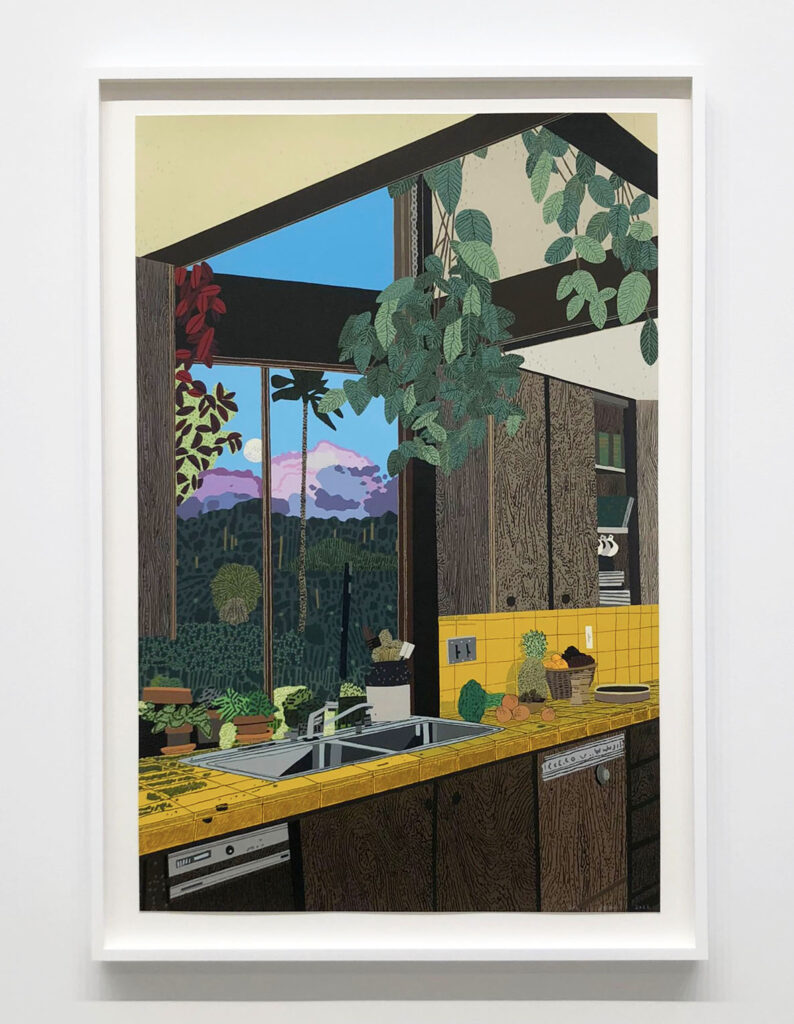
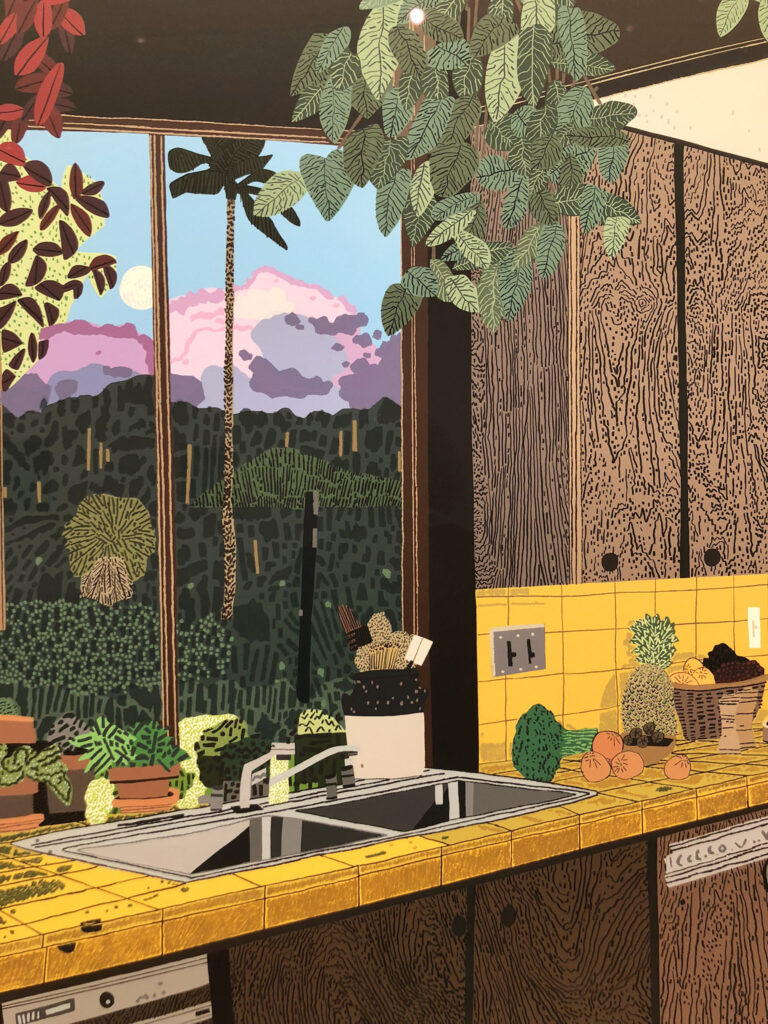
Prints 2, Jonas Wood’s exhibition at Gagosian Gallery in NYC, consists of over thirty prints made between 2018 and 2022, in a variety of styles and subject matter.

From the press release-

You have to build the print piece by piece. I just love the way it looks, the process, the whole feel of it. It’s irreplaceable.
—Jonas Wood

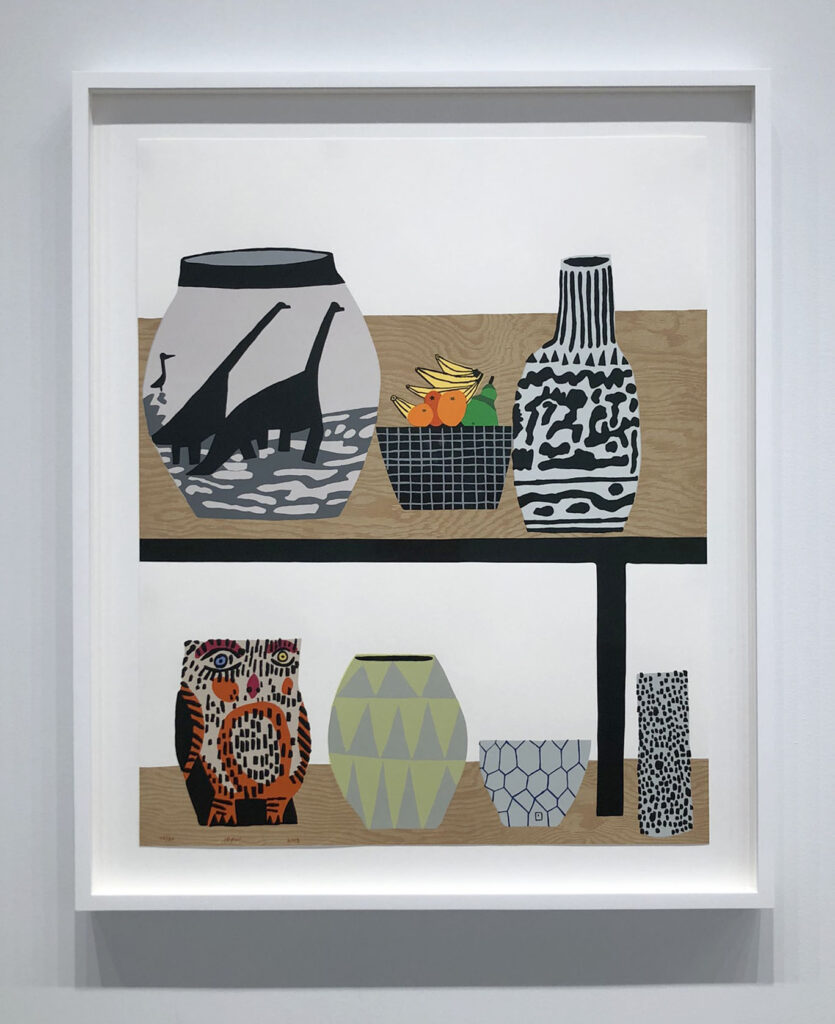
The works on view in Prints 2 feature Wood’s perennial motifs—plants, pottery, portraiture, interiors, landscapes, and basketball—reflecting the life of the artist through representations of home, studio, and natural spaces. They are united by Wood’s transformation of subject matter into images with skewed planar space, dense patterning, and vivid color. Developing his prints in parallel with his paintings, Wood has arrived at linked practices that continually inform one another.

Emphasizing the collaborative aspect of printmaking, Wood works with masters of traditional methods who have made innovative contributions to the field. Prints 2 features works made with Aliso Editions, Cirrus Gallery & Cirrus Editions Ltd., Counter Editions, Hamilton Press, Mixografía, and Pace Editions. In addition, Wood publishes and copublishes under his own imprint, WKS Editions.

The stylistic diversity of Wood’s prints results from his experimentation with pictorial effects, processes, and materials, effectively exploring the genre of printmaking itself. The methods used to produce the works in Prints 2 include hard-ground and soft-ground etching, lithography, screen printing, and woodcut, as well as various hybrid processes. Wood pairs these techniques with variations in mark making, color, texture, and density to harness and reveal the characteristics unique to the medium.

Feb 262023
 

Y.Z. Kami “Woman in Dark Sweater, 2022

Y.Z. Kami “Woman in Dark Sweater, 2022 (detail)

Y.Z. Kami “Aïsha”, 2012-22

Y.Z. Kami “Messenger IV”, 2022

Y.Z. Kami “Night Painting XV”, 2022

For his exhibition Night and Day at Gagosian in NYC, Y.Z. Kami is presenting two distinct bodies of work, his portrait paintings and a newer series, Night Paintings, started in 2017.

From the press release-

Each of Kami’s large-scale painted portraits depicts a single face in muted colors on an opaque ground. Frontally composed and closely cropped, Kami’s self-absorbed subjects are removed from the specificity of context. From Aïsha (2021–22) and Lu (2022) to The Monk (2022) and Woman in Dark Sweater (2022), these paintings are titled by first names or descriptions, marking a continuum between individual identity and universality. Using layers of brushstrokes to blur his subjects’ features, Kami concentrates on the ineffability of individual presence. From longtime friends and acquaintances to strangers he has met in passing, his subjects form an ensemble of varied age, gender, and ethnicity. Kami’s introspective faces also recall the Fayum portraits of Roman-era Egypt—naturalistic likenesses of the deceased that were affixed to mummies. The works in Night and Day affirm—as do their ancient precedents—the common humanity in our observation of others.

Kami’s Night Paintings are made using a single shade of indigo—said to be the color of the night—which he blends with gradations of white to summon the sensorial dynamics of presence and absence. Each canvas is filled with apparitions that float just past the limits of materiality and concrete representation. Composed with hazy, tenebrous brushwork, these abstractions evoke a mental inner state. Their shifting outlines and hazy boundaries make manifest soft edges and shimmering biomorphic patterns, enticing the viewer to recognize elements from the human realm while ultimately confounding all attempts to do so. The Night Paintings thereby limn the boundaries between the earthly and the sublime.

Messenger IV (2022), a single painting that belongs to neither series, represents a cloaked figure seen from behind, painted in a soft-focus style. The anonymous subject appears in the foreground of a crossroads, a setting of passage and transition. Kami has positioned this figure using the classical compositional device of the Rückenfigur (back-figure), with which the viewer is encouraged to identify, thus implicating him or her in the space and narrative suggested.

Contrary to the instantaneity of a photograph, Kami composes his paintings over an extended period, his nuanced brushwork built up in many layers. Consequently, they reward sustained looking, revealing their character over time and bringing awareness both to perception as a process and to contemplation of the nature of being.


Feb 252023
 

TIDE- “SEA E”

TIDE- “DAYS” and “CALM”


Closing on 2/25 at Ross + Kramer in NYC is artist TIDE’s  (Tatsuhiro Ide) debut solo exhibition, HAPPYSADEMPTYFULL.

From the gallery’s website-

TIDE is a Tokyo-based artist renowned for his signature cat character, which he depicts in monochromatic, domestic settings. Beginning in 2019, TIDE has made grayscale paintings of this cat character, existing within various domestic environments, often punctuated with art historical references. In this newest body of work, the cat, perhaps an avatar for the artist himself, lounges in a cozy bed, swathed in blankets and layers of duvets.

The title of the exhibition comes from a painting, HAPPYSADEMPTYFULL, and reflects the cycles of feelings that one experiences throughout a day. The subject matter feels especially relevant given current events—a housecat, much like humans in a pandemic lockdown, has a somewhat narrowed spectrum of experience.

TIDE works in multiple layers, using airbrush and spray paint to express the illusion of depth in a delicate environment, and employs a variety of brush stroke techniques in order to create the appearance of texture and natural elements. TIDE’s work wonderfully demonstrates the value and richness of harmonious composition. His monochromatic palette, coupled with crisp yet gentle silhouettes, ignites a pronounced sense of nostalgia.

Feb 242023
 

Danielle Roberts “The sky weighs heavy through the night”, 2023

Danielle Roberts “Picnic on the Roof (Moon Bath)”, 2022

Danielle Roberts “Adrift”, 2022

Danielle Roberts “Sunshine Market”, 2023

Currently at Fredericks and Freiser in NYC is Evening All Day, an exhibition of paintings by Danielle Roberts.

From the gallery’s press release-

In her moody and atmospheric paintings, Roberts explores the various psychological states brought on by her generation’s societal instability.  Roberts’ settings – strip mall parking lots, living room sofas, city rooftops, and outdoor parks – are familiar to wide audiences. Yet, when rendered with otherworldly color and dramatic chiaroscuro, they feel transitory and strange. Unstable emotions are communicated through uncanny lighting –both phenomenal and foreboding– and fragmented coloration that coalesces differently across canvases. Some figures are made up of geometric patches of hues that are visually delineated from each other. In contrast, other bodies are made up of a similar patchwork of coloration but by swaths that blur together slightly.

Solitude follows Roberts’ figures as they amble across an urban landscape populated by friends, lovers, and passersby.  These transitory moments, at once together yet disconnected, all seem to be anticipating something just out of reach.  A cinematic atmosphere bolstered by an artificial light imbues these scenes with Roberts’ signature radiant glow. The vivid and dark mood matches the internal, untethered state of the figures who seem oddly stuck. They wander as if they are perpetually spending their last $20 on another round of drinks.

Roberts does not shy away from discomfort and awkwardness in her worlds. She hones in on the pathos of her own experiences and those of her peers which are at once individual, unique to each of Roberts’ figures, and universal, instantly recognizable to audiences. The artist does not retreat into her painted worlds as an escape from the overwhelming anxiety and instability coursing through contemporary society; instead, she pushes right up against them, opening those spaces onto her audiences. There is an insistence on life and desire, even if those desires are complicated. The people of her scenes – withdrawn and ambivalent – wade through the mess, surviving on their own terms.

This show closes 2/25/23.


Feb 222023
 

Robert Yasuda, “Boundary” 2010-2020

Robert Yasuda, “Boundary” 2010-2020 (detail)

Robert Yasuda, “Pele”, 2022

Robert Yasuda, “Pele”, 2022 (side view)

Robert Yasuda, “Maluhia”, 2022

Robert Yasuda, “Pipeline”, 2022

Currently at Sundaram Tagore gallery in New York are Robert Yasuda’s sculptural paintings for his exhibition Transparent and Translucent.

From the gallery’s press release-

The artist’s latest body of work is a culmination of his decades-long exploration of perception, light and space. On view will be a series of atmospheric paintings rooted in his early encounters with nature in Hawaii where he was born and raised.

Yasuda’s iridescent paintings are composed of translucent veil-like fields of color layered on slabs of wood that protrude from the wall or nestle into corners. Several works are constructed to cast a reflected glow of colored light into the surrounding space. Depending on where you stand, the surfaces of the paintings shift in color and temperature.

“For many people, looking at a painting for 20 seconds can be extremely long but these are pieces that reveal themselves over time,” says Yasuda, who invites viewers to pause and immerse themselves in the work in order to perceive these subtle transformations.

Yasuda begins by shaping wooden panels, which are up to two inches thick, with chisels and grinders. Softening harsh vertical lines, he introduces bowed and gently sloping edges as well as sharply upturned corners. After painting a base layer onto the wood, he wraps the wood in diaphanous cotton. Adding as many as 40 layers of pearlescent acrylic paint, he suspends the fabric amid layers of luminous color. Most of his works are multi-paneled, with intricately wrought and detailed seams, and mounted on cradle-like structures that push them away from the wall.

Several of the works on view feature aqueous expanses of rich blues and lush greens evoking the ocean. In other pieces, sensuous swathes of paint evoke sunsets or the iridescent lining of seashells. “My entire childhood I saw myriad greens in the countryside of Hawaii and I spent a great deal of time diving…These works are connected with that point of view and the process of meditating on nature,” says Yasuda.

This exhibition closes 2/25/23.

Feb 222023
 

Diana Al-Hadid “The Long Defeat”, 2017-2023

Diana Al-Hadid “The Long Defeat”, 2017-2023 (detail)

Diana Al-Hadid “The Long Defeat”, 2017-2023 (detail 2)

Bianca Bondi, “The Antechamber (Myths of descent and return)”, 2023

Bianca Bondi, “The Antechamber (Myths of descent and return)”, 2023 (detail)

Bianca Bondi, “The Antechamber (Myths of descent and return)”, 2023 (detail)

Closing today at Kasmin in NYC, is Shades of Daphne, curated by Stephanie Cristello. It is a “timely survey of painting, sculpture, installation, and film by a group of 11 international and intergenerational contemporary artists, many of whom have not previously exhibited in the United States.”

From the Kasmin gallery website-

Bringing together recent and historical works spanning over three decades from the 1990s to the present, the exhibition includes new commissions, site-specific performances and installations that respond to the architecture of the gallery space.

Celebrating the spirit of resistance and revolt, the exhibition takes the figure of Daphne—the Ancient Greek nymph who turned herself into a laurel tree to escape Apollo’s pursuit—as metaphor to explore work that engages with hybrid figures, metamorphoses, and suspended states of becoming. Highlighting deconstructed impressions of the body in relation to mythologies of transformation, the exhibition focuses on work that features remnants of presence even when the figure is absent—objects that hold the memories of living things. Acting as portals, thresholds, and containers of shifting states, each work also engages with architecture as a framework, both in reference to the body and to spaces constructed for both personal and collective ritual.

Information on Diana Al-Hadid’s sculpture, The Long Defeat–

Diana Al-Hadid’s (b. 1981 Aleppo, Syria) sculpture takes the Flemish primitive painter Hans Memling’s Allegory of Chastity (c. 1475) as a starting point. The work pictures the bodice of a female figure, her head bowed, hands interlaced at the waist, surrounded by the mouth of a volcanic mountain. Al-Hadid’s first interpretation of the painting culminated in the monumental sculpture Citadel (2017–18), a hollowed silhouette of a woman framed by the base of an embankment whose porous mass extends like a root system toward the ground. Her face is vacant of features, delineated instead by two severe lines like one would find in the initial sketch of a portrait artist, that indicate her gaze remains lowered. Yet in contrast to the demure painting, the massive scale of the work allows for her downcast eyes to stare straight into those of the viewer below.

Information on Bianca Bondi’s installation, The Antechamber (Myths of descent and return), 2023-

An iteration of Bianca Bondi’s (b. 1986, South Africa) installation for Busan Biennale 2020, The Antechamber (Myths of descent and return), grew from a translation of Kim Hyesoon’s poem, “Tundra Swan.” As Bondi states: “salt is essential for life but too much brings death.” Taking inspiration from paintings such as Henri Gervex’s Rolla (1878) or John Everett Millais’s Ophelia (1851–52), we observe a clinical but feminine bedroom setting composed of a bed with a pond at its center, echoing a circular mirror above a dresser at the end of a pathway through the tundra. Salt surrounds the installation, representing both preservation and resurrection. A swan stands alone, symbolizing the force of art and poetry. This is the third chapter of the installation, following the Thailand Biennial in 2021.


Dec 172022
 

“Tower, Houston”, 2020

“Tower, Houston”, 2020 (closer look)

“City Square at 4 am (Palazzo della Civiltà Italiana, Large Version)”, 2020

“Midtown, NYC”, 2020

The paintings above are from Daniel Rich’s 2020 exhibition at Miles McEnery Gallery in NYC.

From the gallery’s press release-

Daniel Rich’s reticulated cityscapes and slick façades appear at first glance to be quite literally superficial. Whether it is a geometric exterior pressed close to the picture plane or a cluster of multiple structures glimpsed from a distance, we experience architecture in his painting as a wholly exteriorized phenomenon— looming close up or made smaller through a bird’s-eye view.

His process-oriented paintings offer windows to different parts of the world— some figuratively, others much more literally—and can evoke a distorted experience of temporality for the viewer. Like compositions by Bernd and Hilla Becher or Andreas Gursky, Rich’s artworks offer clinical, complex architectural views onto the world that are filled with subtleties. However, Rich differs from Becher or Gursky in his painstaking, intricate process of translating found images into painting. The works also evoke early 20th century European Modernism, recalling Giorgio de Chirico’s metaphysical cityscapes and Germany’s Neue Sachlichkeit (New Objectivity) artists of the 1920s and 1930s.

Architecture, as it is commonly understood, is designed and implemented to house the human and is itself the manifestation of our constructed realities. When all signs of life are missing from buildings and spaces, as in Rich’s paintings, the result is an unsettling subversion that upends and questions what we have come to expect of both architectural spaces and the organized linearity of time. Rich probes viewers to consider what lies beyond the surface.

Rich also uses his anonymous architectural imagery to talk about history and politics. He speaks of his scenes as “failed utopias” and “changing political power structures.” In their seeming permanence, the fixed and rigid edifices that populate his work speak to a late capitalist urbanism that sees its monuments not as contingent, but as immovable and eternal.

His newest paintings are currently on view at the gallery for his exhibition Flat Earth on view until 1/28/23.