Feb 062026
 

Giorgio de Chirico, “Portrait of Guillaume Apollinaire”,1914, Oil and charcoal on canvas

René Magritte, “The Secret Double”, 1927, Oil on Canvas

Dreamworld: Surrealism at 100 at the Philadelphia Museum of Art presents a large collection of works, in a variety of mediums, from the artistic movement. The show takes you through Surrealism’s history and is filled with many inventive and imaginative pieces- including several from lesser-known artists.
From the museum about the exhibition-

Surrealism burst onto the scene in Paris in 1924. French writer André Breton announced the aims of this revolutionary literary and artistic movement in his Manifesto of Surrealism. It started with a question: How, ideally, should we live? Breton observed that, at about twenty years of age, we make the error of trading our childlike imaginations for adult good sense and logic. Yet it’s the imagination that allows access to the innate state of freedom that we all possess. And maintaining freedom, Breton proposed, should always be the highest human aspiration.

Surrealism’s ambitions were broad and bold: its adherents wanted nothing less than a revolution in consciousness. To that end, they explored a method of experimental poetry called automatic writing, comparable to spoken free association, done spontaneously and, as far as possible, without conscious intent. Sigmund Freud’s theories about the role of the unconscious and the interpretation of dreams were an important inspiration. The Surrealists looked to access the unconscious mind to break free from the constraining rationality of the modern world.

Visual artists were part of the Surrealist movement from the start. They took up surprising and often challenging subject matter, imagery, and techniques across many mediums: painting, sculpture, drawing, printmaking, photography, book illustration and design, and film. In Dreamworld: Surrealism at 100, we explore how, from the movement’s 1920s beginnings through the 1950s, these trailblazing artists made good on Surrealism’s revolution in consciousness.

The exhibition is split into six categories- Waking Dream which features Surrealism’s beginnings in the 1920s, Natural History, focused on the influence of nature, Desire, Premonition of War, Exiles, and Magic Art, which focuses on the new type of esotericism that emerged within Surrealism in the aftermath of World War II.

Lee Miller’s photographs of natural rock formations

Salvador Dalí, “Aphrodisiac Telephone” 1938, Plastic, metal

From the museum about Aphrodisiac Telephone, one of the artworks in the Desire section

Salvador Dalí likened the Surrealist object, which uses found items, as a symbolic creation with improbable juxtapositions, comparable to poetry and sexual perversion. He applied this idea in Aphrodisiac Telephone. Its basis is the substitution of a lobster— a real lobster in the sculpture’s first iteration for display in 1938, a factitious lobster in white plastic for the editioned version —for a similarly shaped telephone handset. The title alludes to the lobster’s reputation as an aphrodisiac when eaten.

Max Ernst, “The Fireside Angel (The Triumph of Surrealism)”, 1937, Oil on canvas

From the museum about the Max Ernst painting above, from the Premonition of War section-

Ernst painted The Fireside Angel (The Triumph of Surrealism) to protest the atrocities of the Spanish Civil War as well as the defeat of the Republican side. But this depiction of a rampaging bird-headed beast also served as an allegorical reflection on the nature of evil. Ernst exhibited this painting as The Triumph of Surrealism — a despairingly ironic title given the situation in Europe — at the 1938 International Surrealist Exhibition in Paris.

During World War II many European artists escaped to New York City and Mexico. The Exiles section features works by these artists, as well as Mexican (like Roberto Montenegro pictured below) and American artists whose work could also be seen as part of the Surrealist movement.

Roberto Montenegro, “The Double”, 1938, Oil on panel

The last section of the exhibition Magic Art, focuses on the increase in post-war interest in supernatural themes. There was also a room devoted to the work of artist friends Leonora Carrington and Remedios Varo, who had moved to Mexico during the war.

Leonora Carrington, “And Then We Saw the Daughter of the Minotaur”, 1953, Oil on canvas

Remedios Varo, “Creation of the Birds”, 1957, Oil on Masonite

This exhibition is on view until 2/16/25.

Oct 182025
 

https://substackcdn.com/image/fetch/$s_!5vrz!,f_auto,q_auto:best,fl_progressive:steep/https%3A%2F%2Flonglistshort.substack.com%2Fapi%2Fv1%2Fpress_kit%2F175577049.jpg%3FtextColor%3D%2523ffffff%26aspectRatio%3Dinstagram%26bgImage%3Dtrue%26hidePreviewText%3Dtrue%26isDraft%3Dfalse%26hash%3D86331169%26version%3D13

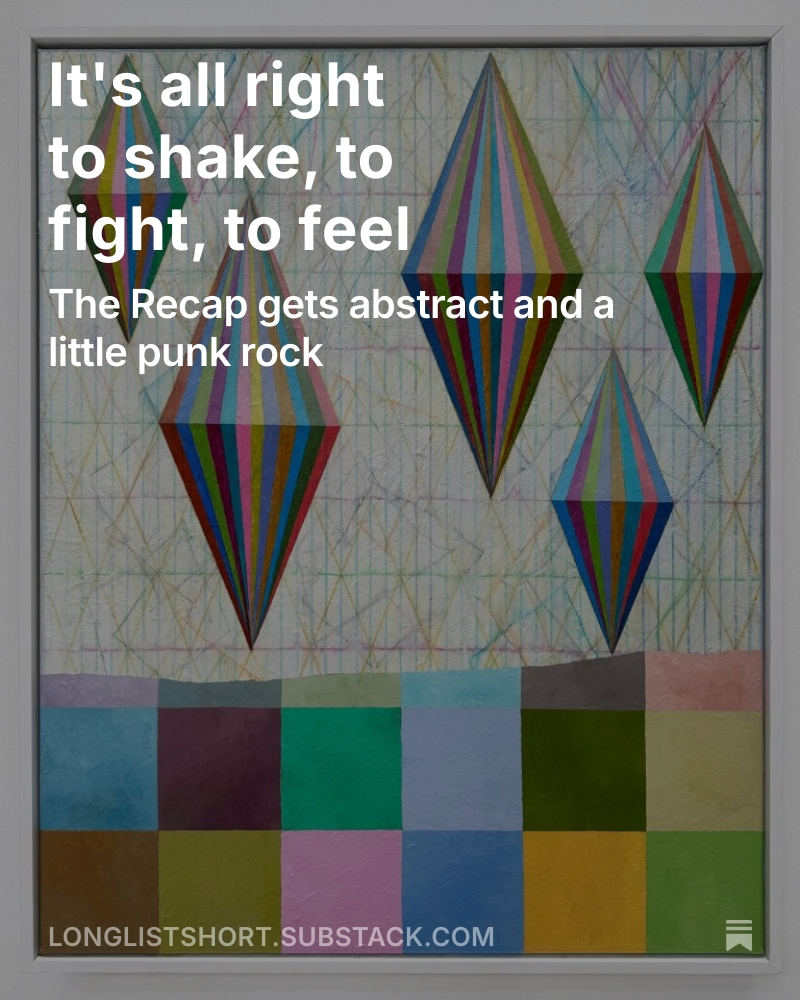
The Recap, my Substack newsletter, returns today with a focus on abstract art, punk rock, the American flag, the 90s, and more. It adds a little more dimension to what I post on the website and ties things together thematically.

Check it out and subscribe!

Sep 092025
 

In honor of artist Sol LeWitt‘s birthday today (9/9), here is his work Wall Drawing #1240, Planes with broken bands of color (Akron), located at Akron Art Museum. It was created in 2005 and installed at the museum in 2007.

The piece was drawn by Megan Dyer, Tomas Ramberg, Joe Ayala, Jennifer Bair-Shipman, Ashlie Dyer, Kathy Ilg, Sarah Sutton and Kelly Urquhart.

From the museum about the work-

Presiding over the McDowell Grand Lobby is a wall drawing by Sol LeWitt, one of the leading artists of his time. LeWitt’s approach to art stressed rigorous design and geometric abstraction, rejecting narrative, emotion and representation for the reality of art’s elemental components—line, shape, space, color and the most important, concept.

LeWitt began creating wall drawings in 1968 in response to his concern-and that of other artists at the time-that art was becoming too much of a commodity. These drawings are not so much physical objects as ideas. The artist conceived and planned them; his “drafters” (artists themselves) draw them directly on the walls of museums and public spaces around the world. Drawings may share forms and motifs, but each is unique and many, like Akron’s, are site specific.

Wall Drawing #1240 was created by the artist for the 18 by 34 foot wall where the museum’s historic 1899 building and its 2007 expansion interconnect. The triangular shapes refer to the angled supports and folded forms of the newer glass and steel lobby, while the blocks of color echo the brick wall removed from the south façade of the older building. Two drafters, assisted by area artists, worked for five weeks to fabricate the wall drawing.


Aug 212025
 

Work by Tracey Tse

The Delaware Contemporary currently has several shows on view for their summer series Radius. Several of these exhibitions include emerging artists including ARC 2025. The exhibition will close 8/24/25.

More from the museum-

The Artist-in-Residence Cohort (ARC) identifies and supports local emerging artists poised for careers as dedicated artists. This year, jurors Dr. Casey Smith and former ARC resident Shefon Taylor chose four regional artists: Geraldo Gonzalez, Oscar De Paz, Tracy Tse, and Lucy H. West. These artists have spent several months in intensive professional development seminars, formal and informal critiques, and one-on-one meetings with mentors to prepare for their culminating exhibition. This year, the ARC residents “came full circle” through mini-residencies at Art-O-Mat by the Wilmington Alliance. This extended their perspective on the creative needs and opportunities of Wilmington, Delaware. You are seeing the results of ten months of their experimentation, planning, and growth.

This year’s cohort pushed the envelope to develop their skills beyond what they came to the museum doing. Lucy H. West has incorporated sophisticated video editing, performance, and sculpture into a tracing of sensory experience. Oscar De Paz has refined his political commentary in his painting practice, deeply rooted in social revolution iconography. Geraldo Gonzalez increased his scale and output, documenting the legacy and daily role DART plays in his life. And Tracy Tse, with the help of a new loom, weaves plastic nets and tapestries. These artists grew through a new partnership with Wilmington Alliance, where they each spent one month in the Art-O-Mat studio space. Their time working with a view to mid-center city grounded their work in an even deeper Wilmington context.

Below are additional selections and the artists’ bios from the museum-

Tracy Tse– “I like this little life of mine. It’s not something amazing, and it’s not a tragedy. However, every day doing art is enough in my world.

I’m a first generation Chinese American who grew up in a family tailoring business. Like many family-run businesses, I started helping out at a young age where I picked up skills in mending and tailoring. Over the years I’m grown into the career as a contemporary artist, where I used my skills interconnectively to express myself.

In my current work, I have been incorporating plarn (yarn made from plastic) to construct large-scale sculptures that protrude from the wall. Each piece is completed through labor-intensive repetition of sewing, knitting, crocheting, weaving, braiding, and knotting techniques to sculpt. The use of a variety of techniques is then adopted and shaped to form a specific look that is derived from family, tradition, heritage, history, and childhood.

Manufactured goods go through many hands and iterations before becoming the final product. Every hand played a role by putting blood, sweat, and tears into the production. Honoring and paying homage to the human touch and the sentiments that are overlooked during the production process is important. My collection of depicts efforts laborers and craftsmen. Convey the message of what human touch means.”

Geraldo Gonzalez

“I am, first and foremost, a transit artist. I began working as an artist in the early 2000s. I first started taking photos for a homework assignment in middle school, which inspired me to start taking photographs of local transit systems. Public transit has always been an interest of mine. I regularly took the bus as a teenager going to and from school, then went out and got to know other transit routes within the greater Delaware valley, like SEPTA, PATCO, AMTRAK, MTA, NJT, and DTC. My passion for public transportation has led me to make thousands of artworks to encourage people to use and find the beauty in these local transportation systems. I am a self-taught multimedia artist, working in colored pencil, acrylic paint, oil paint, watercolor, photography, video and sculpture. My process is to project images that I take and find online and translate them into my artwork through tracing, then going back and adding color.

Issues surrounding transportation like road rage and gas inflation have inspired me to spread my message about public transportation. Outside of transit-related art, I also create self portraits that express my identity and feelings. My Puerto Rican culture influences my art, in my self portraits and expressive use of color.”

Oscar Eduardo De Paz

“My drawings, paintings, and books tie together the threads of my personal experiences and sociopolitical issues. I reflect on my personal experiences of poverty, discrimination, homelessness, immigration, and disruptions in my family and education to explore how these experiences engage with their historical and sociopolitical expressions and contexts, and shape who I am. My intent is to stimulate reflection, discussion, and examination of the impacts of sociopolitical institutions and systems on individuals, specifically vulnerable populations. My artistic process begins with writing personal narratives and poetry that become sources for me to interpret or amend into visual representations. Historical, sociological, and visual research provide further inspiration in the process of creating my work. Subjects and elements in my work often function as symbolic representations of the idea and emotions evoked by my written pieces. The writing is rarely literately translated into a visual representation, but instead through a process of association translated into figurative and metaphorical representations that contain subjects and elements laden with personal, cultural, spiritual, and mythological meanings.

Sometimes, the work stands alone visually. At other times, the work stands with the written text in a unity. It is the space between the text and image where the audience, both as viewer and reader, is invited to experience the themes of my work, and to contribute their insights.”

Lucy H. West investigates intimacy, mindfulness, incorporeal inner experiences, and understanding of the worlds we inhabit and cohabit. Using painting, installation, and most recently multi-sensory media, West seeks to push the boundaries between the artist and spectator by inviting the viewers to be involved in her work, transforming them into active collaborators.

Through participatory art projects, she is interested in eliciting social consciousness, playfulness, curiosity, experimentation, and introspection from her collaborators, creating avenues for her work to evolve and be defined by the community who engages.

West is a Philadelphia-based artist from Tokyo, Japan. She has exhibited and had works acquired in Philadelphia, New York, Tokyo, Rome, and Madrid. Her artwork has also been selected and acquired by the University of Pennsylvania’s Department of Medicine.

Jul 162025
 

Kentucky Route Zero  is a point-and-click adventure game created by Jake Elliott, Tamas Kemenczy, and musician Ben Babbitt working together as Cardboard Computer. Started in 2011 with Kickstarter funding, it contains five parts and four interludes that were released over several years, with the final section completed in 2020.

The game begins with a truck driver named Conway arriving at a highway gas station with his dog. He is having trouble finding the address he was given for his delivery. From there you travel with him over various roads, an underground highway, and eventually even by boat. Along the way you stop at museums, an abandoned mine, local bars, an odd office building, a cave filled with bats, and more while meeting several of the area’s residents. You can choose to learn more about the characters and often join them to explore locations. The story unfolds with no sense of urgency and you are often given the choice to move on or to stay and explore further.

Filled with magical realist elements, it is often a world that can still feel depressingly familiar. Most of the characters are struggling in some way with the effects a failing economy, something that feels even more relevant since 2020. But there are also glimmers of hope in the ways the characters show up for each other- adapting, creating, and forming communities.

Below are a few selections from the game’s interludes that provide engaging breaks from the main story.

In Limits and Demonstrations three characters visit an art museum. You can check out several artworks including- Overdubbed Nam June Paik installation in the style of Edward Packard, which pays homage to Nam June Paik’s 1963 work, Random Access.

Scenes from The Entertainment– a play directed by one of the characters-

One of the phones from Here and There Along The Echo– you dial the number and the character Will (played by musician Will Oldham) reads information from the Echo River’s Bureau of Secret Tourism.

Scenes from Un Pueblo De Nada take place at the public access station- you can also find a live action version here.

Kentucky Route Zero is a game that stays with you long after it finishes. There are lots of things to discover and it’s worth playing more than once to find them. The website Highway Zero is good for things you may have missed.

The game is available for purchase on their website and can also currently be found on Netflix.


Jun 112025
 

In 2016, Taylor Mac performed his immersive 24-Decade History of Popular Music in a theater in Brooklyn for a full twenty four hours. Normally performed in sections, this was the first and only time this had been done. Decade by decade, from 1776-2016, the history of popular music and the history of America merge, with a decidedly queer slant.

The documentary, directed by Rob Epstein and Jeffrey Friedman, includes footage from the show combined with interviews with Mac, his incredible costume designer Machine Dazzle, his musical director Matt Ray, and his co-director Niegel Smith. Although Mac is the main performer, the show includes a stage full of musicians, additional singers, and his “Dandy Minions” who can often be found offstage interacting with the audience. Mac’s desire to draw people together and build community is highlighted during several moments focused on the audience’s participation.

Throughout the many hours, performers leave the stage for good leaving only Mac by the end of the show. This is meant to mirror the losses from the AIDS epidemic. Even with only a small selection of these moments, you can feel the effect this creates.

Inventive, beautiful, funny, and often moving, this documentary provides a small taste of the performance and will leave you wanting more.

Mac’s costume for the 1980s

Taylor Mac and Machine Dazzle

Mac’s costume photo shoot for the 1950s

Mac with an audience member

May 222025
 

For Mia Fabrizio’s installation in the lobby of The Delaware Contemporary, Pull Up A Chair, she has created several sculptures that use domestic objects to explore a variety of social issues. It is part of the museum’s Winter/Spring three-part exhibition, Dinner Table.

From the museum-

Mia Fabrizio is an interdisciplinary artist creating mixed media portraits, freestanding sculptures and installations composed of building materials and domestic items. She carves away, mends, and cobbles together assemblages from a domestic landscape that is both nostalgic and full of pathos.

In these works, Fabrizio explores the power structures and cultural paradigms associated with, “having a seat at the table.” Fabrizio reveals how furniture conventions can grant power to the user. It is the “power to be seen, power to be heard, and power to contribute to the framing of a society” that Fabrizio aims to scrutinize. The chair sculptures become vessels for memories with details that reference labor, gender, and cultural constructs. Her multilayered constructions toggle between tearing apart and memorializing her personal experience. The assembly and material choices subvert the basic understood function of a “seat” and reveal illusions of functional space. She asserts that, “these seats are invitations in name only, token representations.”

Mama Liked the Roses links past to present by combining images and materials from Fabrizio family home with images collected from regions in Italy where her great grandparents had originated. The details within the piece reference labor, food, gender and religion.

And from the artist-

I am an interdisciplinary artist. Mixed media portraits, freestanding sculptures and installations are composed of building materials and domestic items. Multilayered concepts relating to identity and social constructs are presented through a variety of artistic mediums and processes. Consumed with hidden and exposed structure, my investigation of physical construction, cultural paradigms and their relationship, originates from the framework most familiar to me, the house in which I grew up. Contradictions within this space spark my desire to highlight the fluidity of perceived binaries, particularly those relating to feminine and masculine, public and private and modern and traditional.

Ascribing to the visual context of home as well as the ethos of homemade I paint, adhere, carve and chip away at plywood, drywall and paper. I vacillate between tearing apart and tenderly memorializing my personal experience, concurrently the work points outward to larger societal conversations around immigrant status, feminism, and queerness.

This exhibition closes 5/25/29.

May 032025
 

Currently at The Art Spot in Asbury Park are the incredible cardboard creations of multi-disciplinary artists Michael La Vallee (aka Porkchop) and Bradley Hoffer for Anti AI: A 2025 Cardboard Odyssey. Along with the exhibitions, the gallery also serves as a studio for La Vallee and a shop selling items by him and others, including a large section of modified clothing items.

Outside of the gallery are two large murals, pictured below. The first is by Porkchop and Hoffer and the second is by artists Joe Iurato and Logan Hicks.

Mural by Porkchop and Bradley Hofffer

Mural by Joe Iurato and Logan Hicks (with Bradley Hoffer section from the previous mural)

This show is on view until May 8th, 2025.

Apr 252025
 

Mural by Donald Walker

ArtFields Community Mural by Jessica Diaz, Morgan Funkhouser, Olivia Cramer, Sam Ogden

Today’s flashback is to 2021 and a trip to Lake City, South Carolina to check out ArtFields.  Started in 2013, the event is a wonderful example of how the arts can revitalize local economies.

So what is ArtFields? Every year for one week local businesses and galleries host works created by artists from the Southeastern United States for a competition with prizes totaling over $145,000. There are also two People’s Choice Awards which are determined by the attendees of the festival. The other awards are chosen by a panel of art professionals. Special events take place throughout the week and ArtFields Jr. offers a chance to see work by South Carolina students.

This year the event runs from April 25th to May 3rd, 2025. Even if you can’t make it, it’s worth taking a look here at this year’s artwork as well as from past years.

Below are a few selections from 2021-

Mural by Lance Turner

“From This Moment Forward” by Herman A. Keith Jr. inspired by Gee’s Bend Quilters

Partially finished mural by Broderick Flanigan honoring Lake City educators Elouise Cooper and Derrick Faison.

“7 Red Wolves” by Joann Galarza Vega

About the work from the above by Joann Galarza Vega

“There may be as few as only 7 red wolves remaining in the wild. These animals, like so many others, are disappearing in the shadows of our periphery. Their very existence depends on us, as did their extinction. Let us see them, acknowledge them, acknowledge that biodiversity and the balance of life matters. They are painted bright red in order to stand out and bring attention, no longer hidden away.”

Pictured above is The House on Church Street which in 2021 was used for several art installations including the two below. The first is New Histories: The Gadsden Farm Project by Michael Austin Diaz and Holly Hanessian.

About the installation-

The installation below, All Too Brief, was created by Gainesville, Florida artist Cindy Steiler.

From the ArtFields website about the installation-

All Too Brief was inspired by the movement of time and the unconscious process where our present moment is being continuously converted to memory. The elements comprising All Too Brief include a series of scrolls of cyanotype photographs and repurposed textiles wound on antique industrial weaving bobbins. Each scroll has a WW2-era laundry pin embossed with a number that corresponds to the written narrative of the images and textiles it holds. This piece is my attempt to document and archive people, places, and fleeting moments I hold dear. This piece became even more meaningful to me this year. My studio assistant at the time this piece was created has since passed.

Finally- while in town it’s also worth checking out the Ronald E. McNair Life History Center and Memorial Park. The Lake City-born astronaut and physicist died tragically in the 1986 Space Shuttle Challenger explosion.

Apr 162025
 

“Night”, 2014, Oil on canvas

“Ocean Ladies”, 1988, Oil on canvas

“Untitled”, 1964, Oil on canvas

Currently on view at Matthew Marks Gallery is Good Things and Bad Things, an exhibition of paintings, drawings and objects by the late Suellen Rocca. The collection highlights the artist’s use of a variety of styles throughout her career to express similar themes.

From the gallery-

Suellen Rocca’s work is marked by dream-like ambient landscapes filled with pictograms arranged in loose grids. She drew inspiration from various types of “picture writing,” such as ancient Egyptian hieroglyphs, advertisements, and children’s activity books. Fantastical, witty, and deeply personal, Rocca’s unique visual language comprises a collection of images from her life, including 1950s dollhouse furniture, jewelers’ catalogs, bodily sensations, and the work of artists such as Marc Chagall and Max Beckmann. Rocca combined these symbols in eccentric compositions. As one critic observed, “Rocca offers up mysterious mystical visions for contemplation.”

The exhibition, whose title, Good Things and Bad Things, is borrowed from one of Rocca’s paintings, includes two large-scale paintings made in 1964. In one painting, palm trees, shoes, and gold rings with gemstones emerge from a turquoise ground. Another painting presents repeating images of Santa Claus, dancing couples, and winter landscapes. Later canvases envision interior worlds in electrifying fields of vibrant color.

Purses were also an important motif for Rocca, which she first developed from images in a 1940s manual on how to crochet purses. For Rocca, they were examples of “the cultural icons of beauty and romance expressed by the media that promised happiness to young women of that generation.” In the late 1960s, Rocca expanded this imagery to sculpture and began painting on purses. Describing Rocca’s sculpture Purse Curse (1968), Dan Nadel has written, “it reminds me of a world of images that did not have double meanings, and of the fantasy of love, pure and simple. But the purse also conceals. What’s inside?”

This exhibition closes 4/19/25.