Apr 122024
 

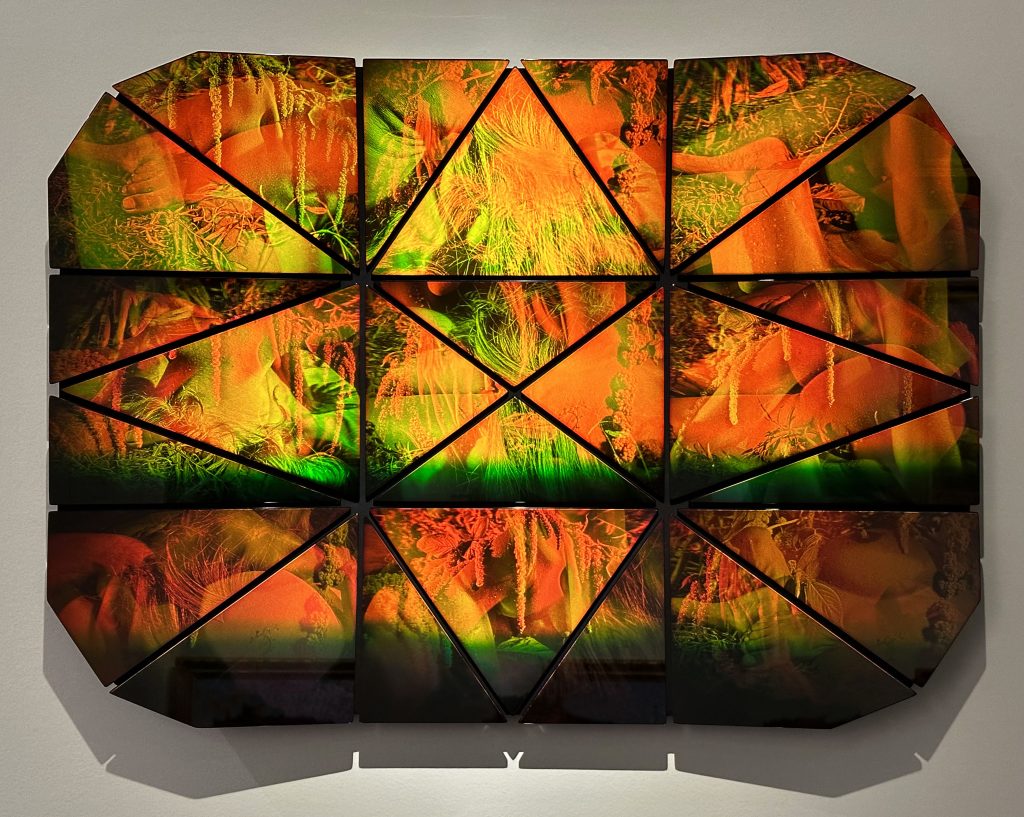
Sarah Meyohas, “Interference #19”, 2023, Holograms, mirrored black glass, aluminum
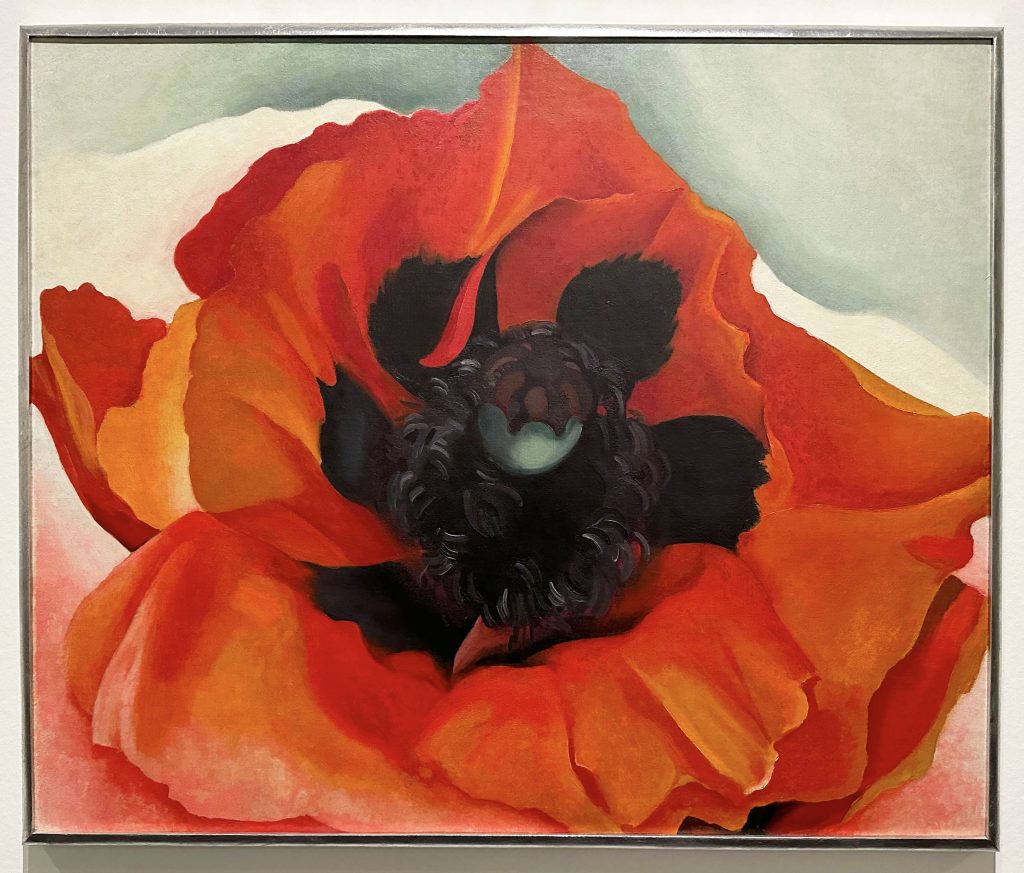
Georgia O’Keeffe, “Poppy”, 1927, Oil on canvas
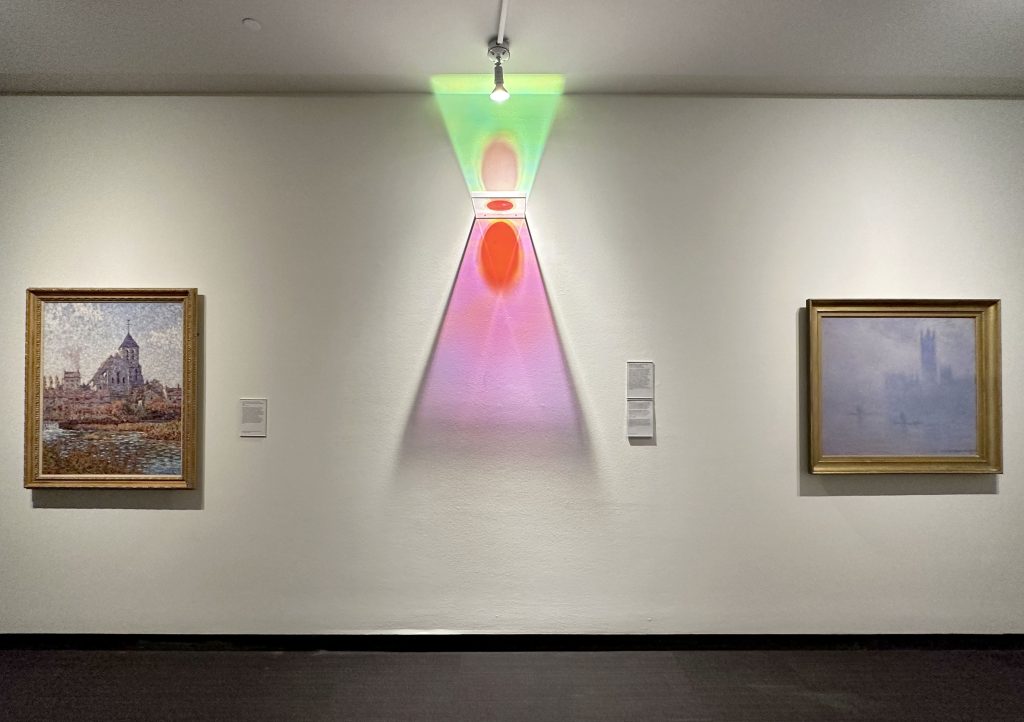
Francis Picabia “The Church of Montigny, Effect of Sunlight” 1908, Oil on canvas (left); Christian Sampson “Projection Painting”, 2023, Acrylic and films with LED light; and Claude Monet “The Houses of Parliament, Effect of Fog, London” 1904, Oil on canvas (right)
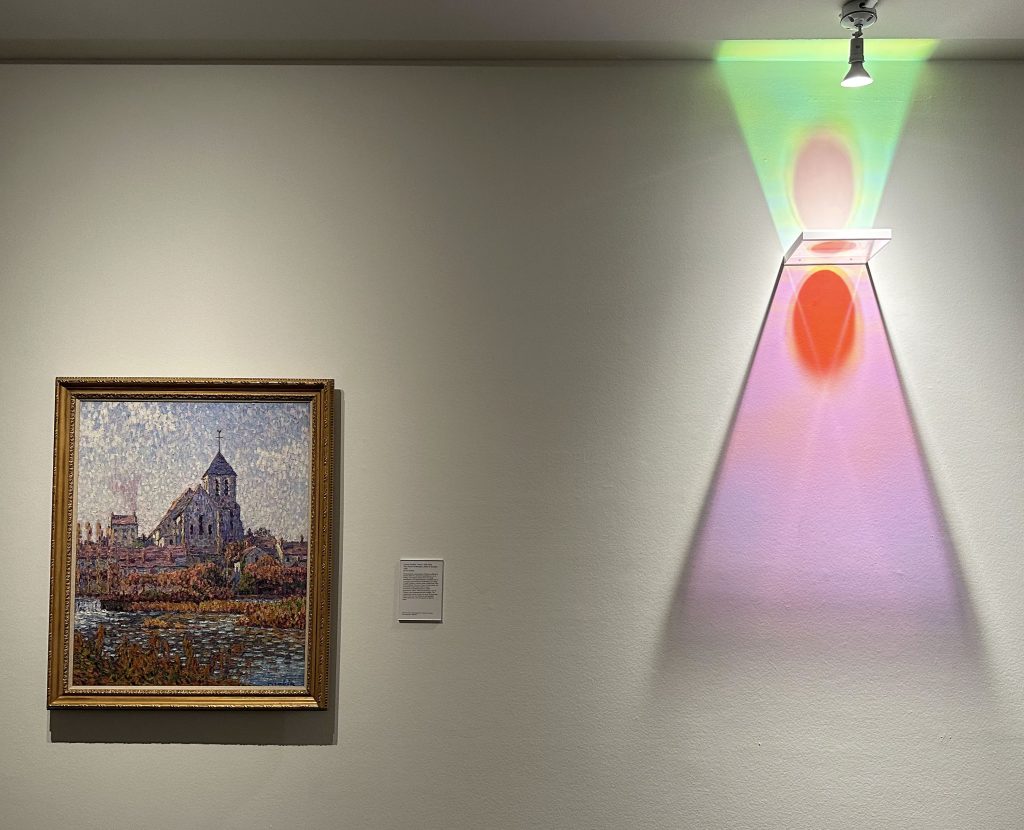
The Nature of Art exhibition at the Museum of Fine Arts St. Petersburg merges art from the museum’s collection with loaned works to explore- “art’s crucial role in our evolving quest to understand our relationship with nature and our place in the cosmos”.

One of the benefits of an encyclopedic museum is that visitors have the opportunity to experience art throughout history, and to revisit works that resonate with them. For the section titled Artist as Curator, Sarah Meyohas and Christian Sampson chose pieces from the museum’s collection to pair with their own work.

From the museum-

At first glance, perhaps, these may seem like unusual combinations, but upon deeper contemplation, their selections reveal complementary artistic intents. For instance, Meyohas and Georgia O’Keeffe share an interest in close looking, particularly in finding new ways to examine underappreciated aspects of the natural world. Sampson, influenced by the California Light and Space Movement, is interested in current scholarship that suggests the hazy fog found in Claude Monet’s work is an early depiction of air pollution, offering an entirely new perspective on the artist’s representations of light.

Sampson also created the four-part installation, Tempus volat, hora fugit, on view until 2025 at the museum.

Below are some of the works from additional sections of the exhibition.
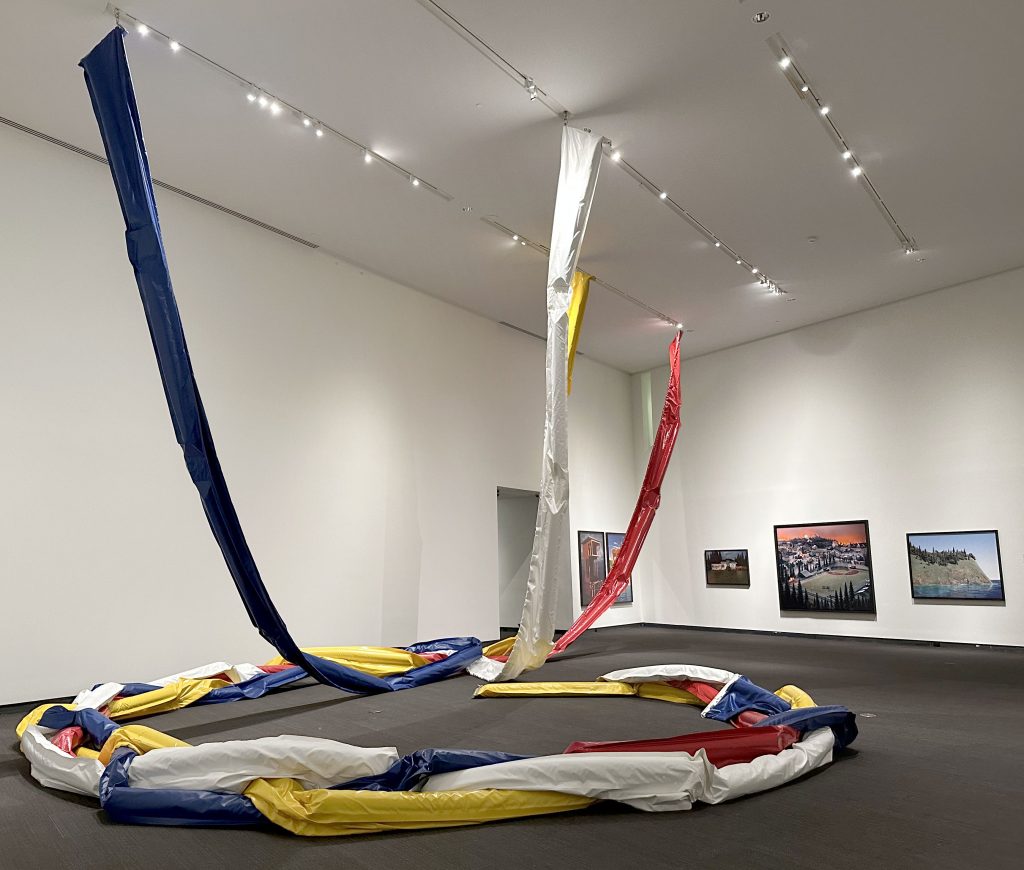
Postcommodity, “kinaypikowiyâs”, 2021, Four 30.5-metre industrial debris booms
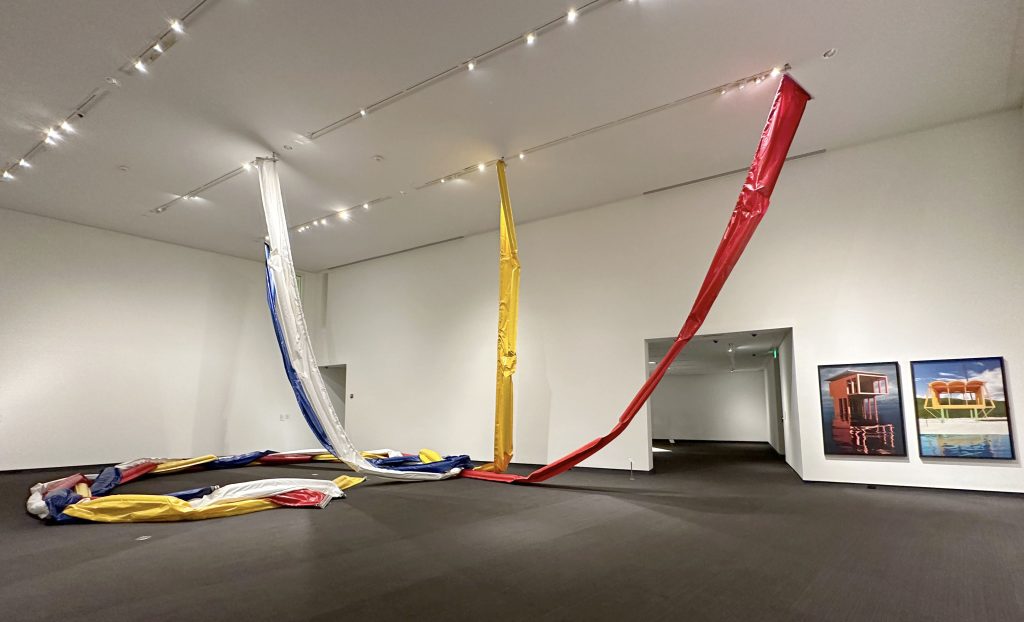
Postcommodity, “kinaypikowiyâs”, 2021, Four 30.5-metre industrial debris booms

Postcommodity is an interdisciplinary art collective comprised of Cristóbal Martínez (Genizaro, Manito, Xicano), and Kade L. Twist (Cherokee).

About Postcommodity’s work, kinaypikowiyâs, (seen above) from the museum-

This work is composed of debris booms, used to catch and hold environmental contaminants such as garbage, oil, and chemicals. The colors of the booms correspond to different types of threats— red (flammable), yellow (radioactive), blue (dangerous), and white (poisonous)-in the labeling system for hazardous materials. To indigenous peoples, these are shared medicine colors that carry knowledge, purpose and meaning throughout the Western Hemisphere. Suspended like hung meat, the booms represent a snake that has been chopped into four parts. Each part represents an area of the colonial map of the Western Hemisphere: South America, Central America, North America, and all of the surrounding islands. The title, kinaypikowiyâs, is a Plains Cree word, meaning snake meat. Divided by borders, Postcommodity asserts that all people living in the Americas are riding on the back of this snake.
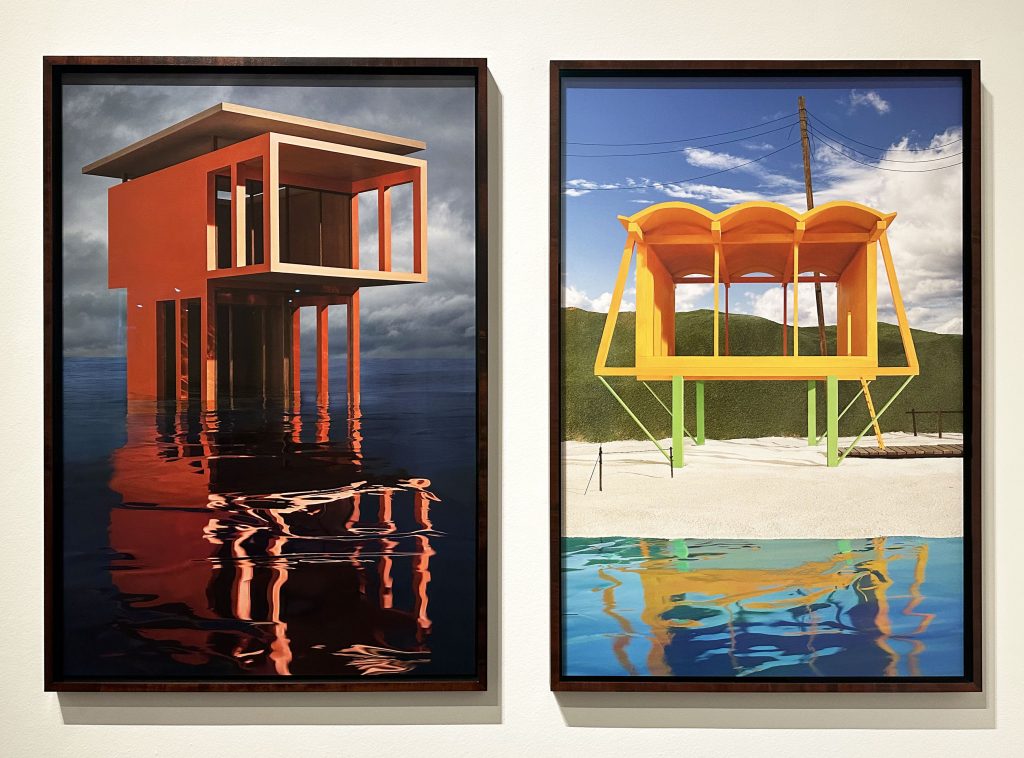
James Casebere, “Red/Orange Solo Pavilion”, and “Orange Guesthouse”, 2018, Archival pigment print mounted to Dibond
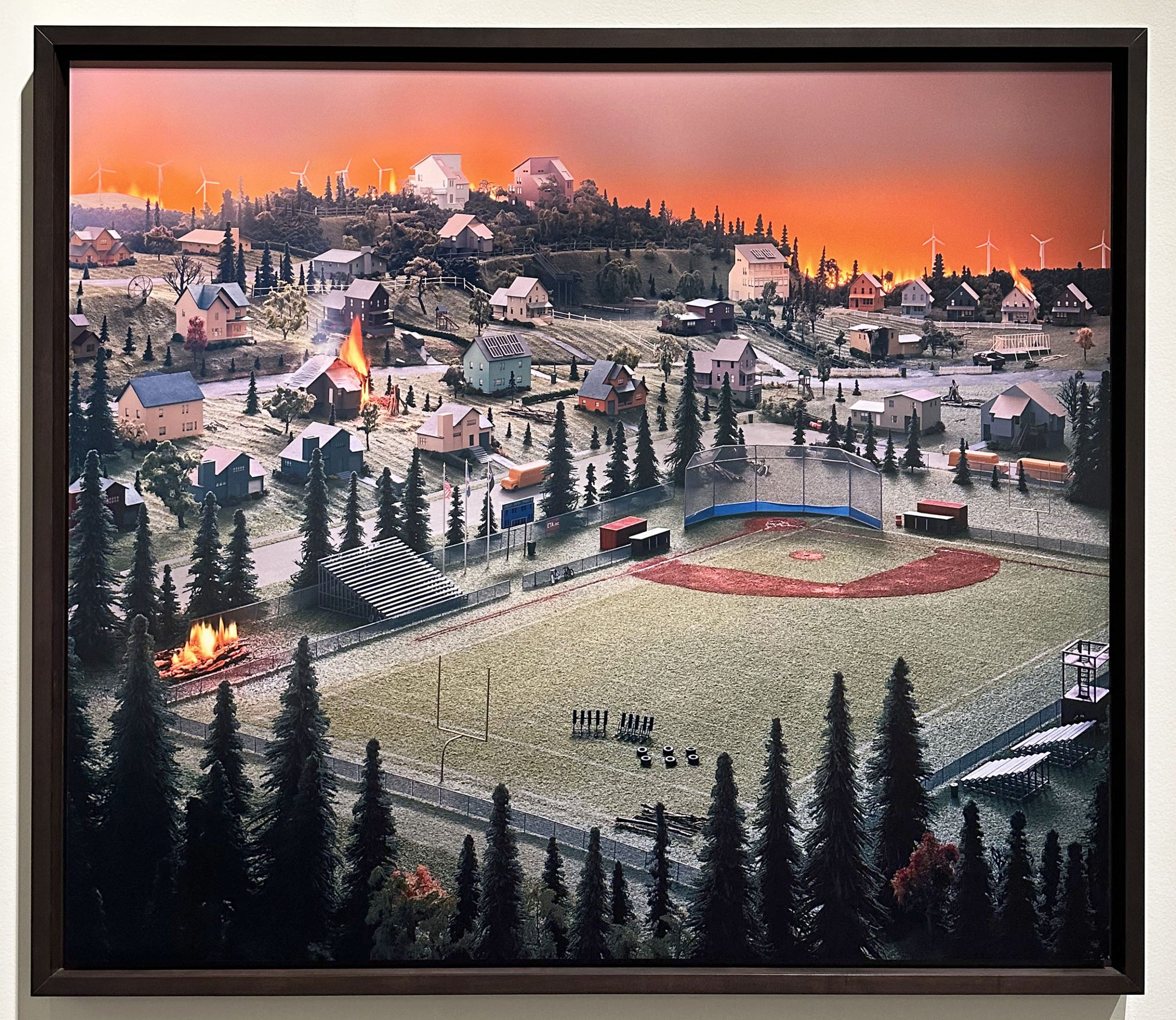
James Casebere, “Landscape with Houses (Dutchess County, NY), 2009, Archival pigment print mounted to Dibond

James Casebere creates architecturally based models for the large scale photographs seen above.
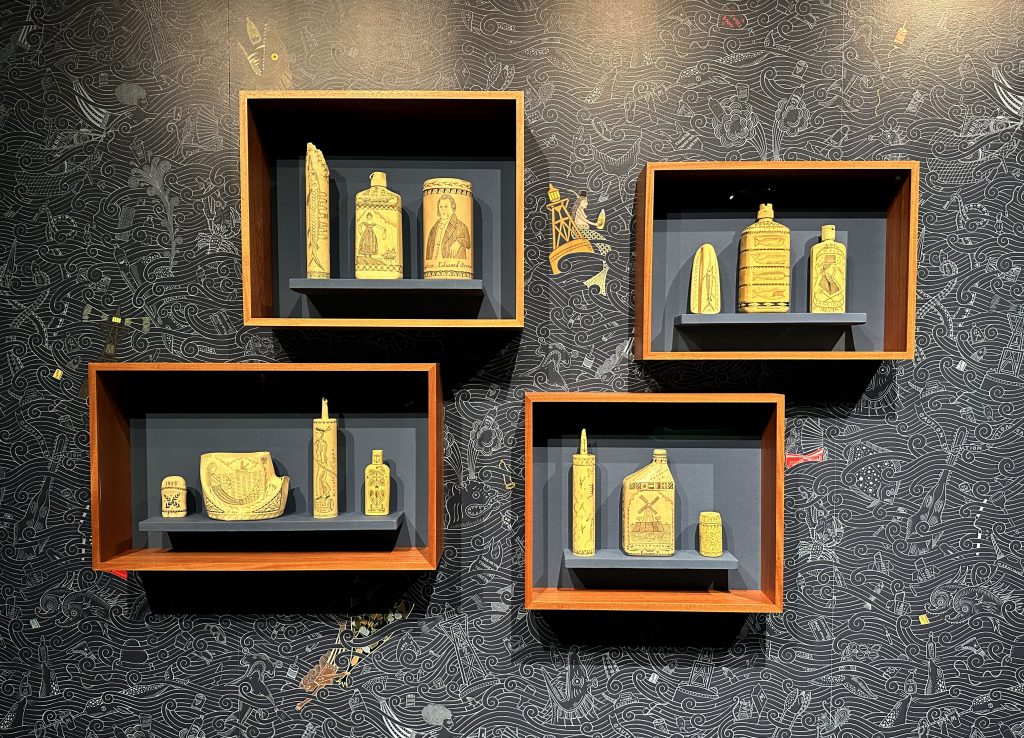
Reclaimed ocean plastic sculptures and “Tidal Fool” wallpaper by Duke Riley
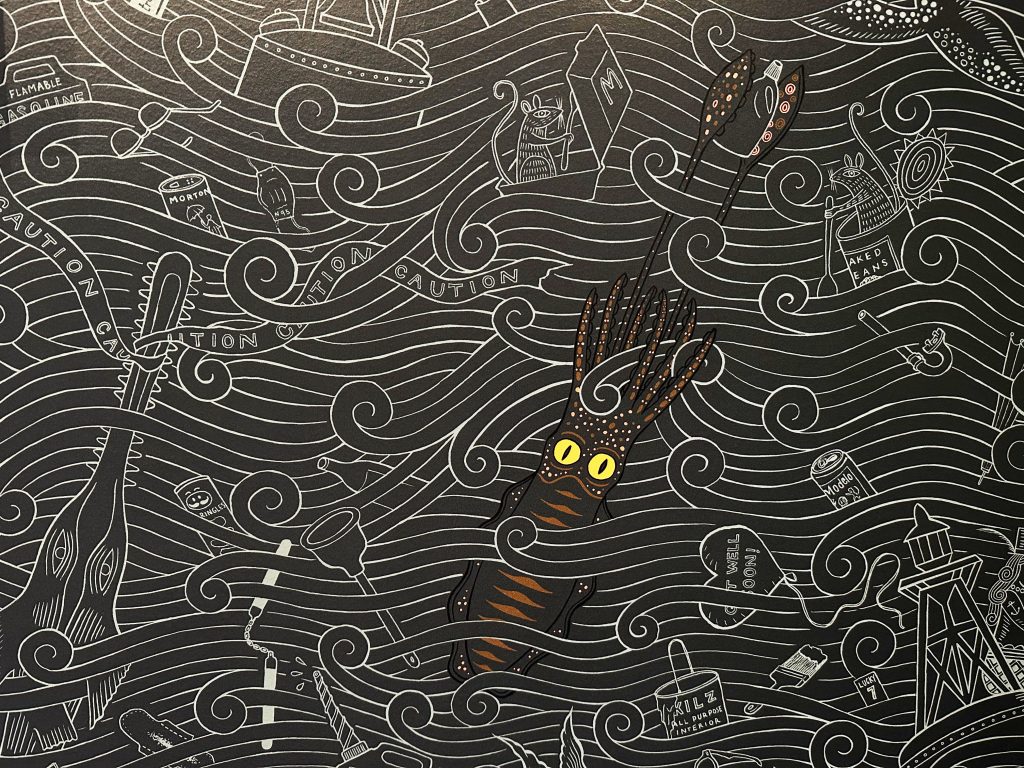
Duke Riley custom wallpaper, Tidal Fool, detail
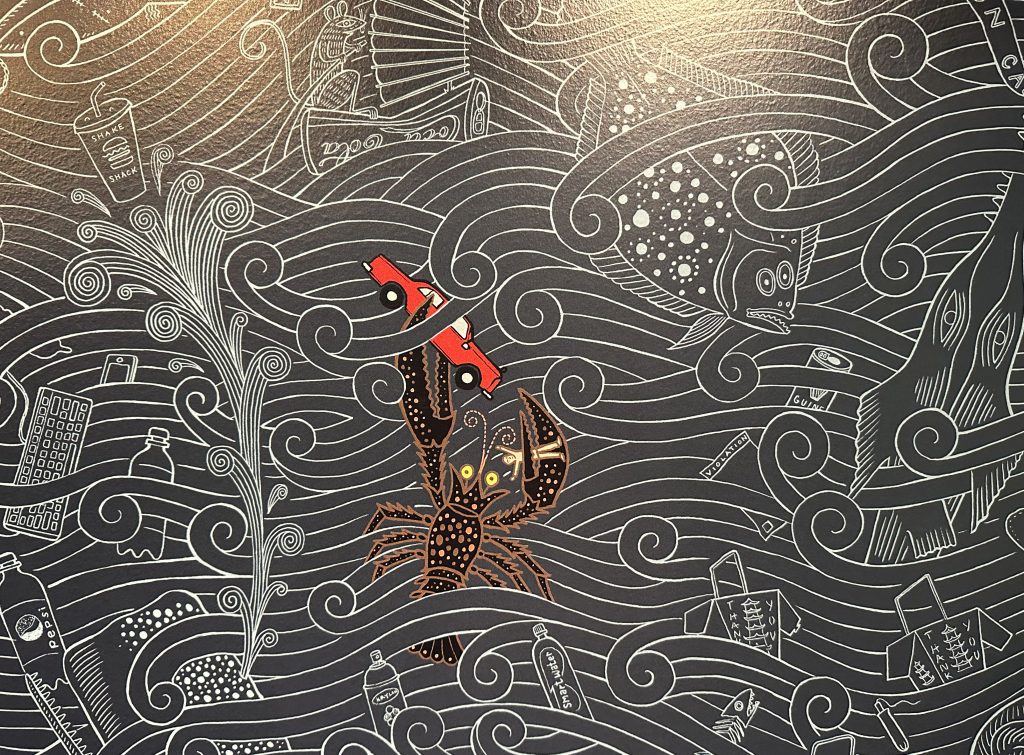
Duke Riley custom wallpaper, Tidal Fool, detail

Duke Riley’s work, which was previously shown at Brooklyn Museum, addresses issues of environmental pollution by using discarded plastics found in the ocean and other waterways to create new work inspired by the past. You can hear him discuss his work in this video.

From the museum-

Inspired by the maritime museum displays he saw while a child growing up in New England, Riley’s scrimshaw series is a cutting observation of capitalist economies-historic and today-that endanger sea life. The sculptures were created for the fictional Poly S. Tyrene Memorial Maritime Museum, and are contemporary versions of sailors’ scrimshaw, or delicately ink-etched whale teeth and bone. Riley first thought about using plastic as an ode to scrimshaw when he saw what he thought was a whale bone washed up on the beach in Rhode Island; it turned out to be the white handle of a deck brush. Riley regularly removes trash from beaches and waterways, and often uses this refuse in his work.

Riley collaborated with Brooklyn-based Flavor Paper to create these two custom wallpapers for his solo exhibition DEATH TO THE LIVING, Long Live Trash at the Brooklyn Museum. Tidal Fool exhibits Riley’s trademark humor in the face of devastating water pollution; notice the Colt 45-guzzling mermaid. Wall Bait vibrantly references Riley’s meticulous fishing lures, which he crafts from refuse found in the waters around New York City.
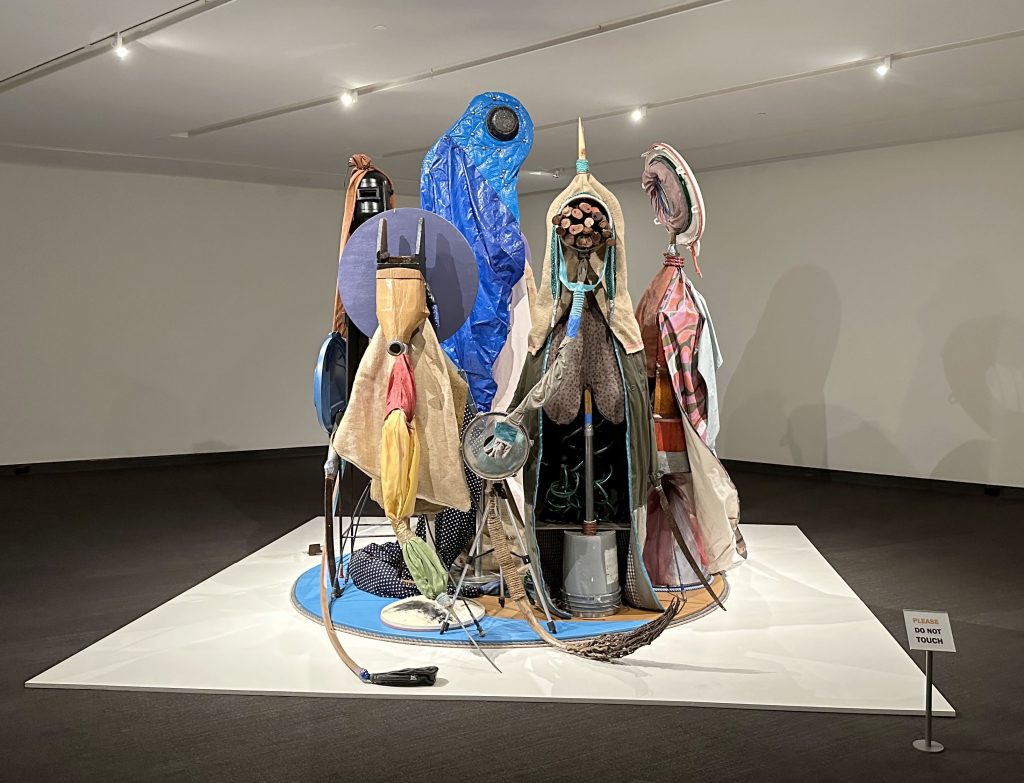
Daniel Lind-Ramos,”Centinelas de la luna nueva (Sentinels of the New Moon)”, 2022-2023, Mixed media
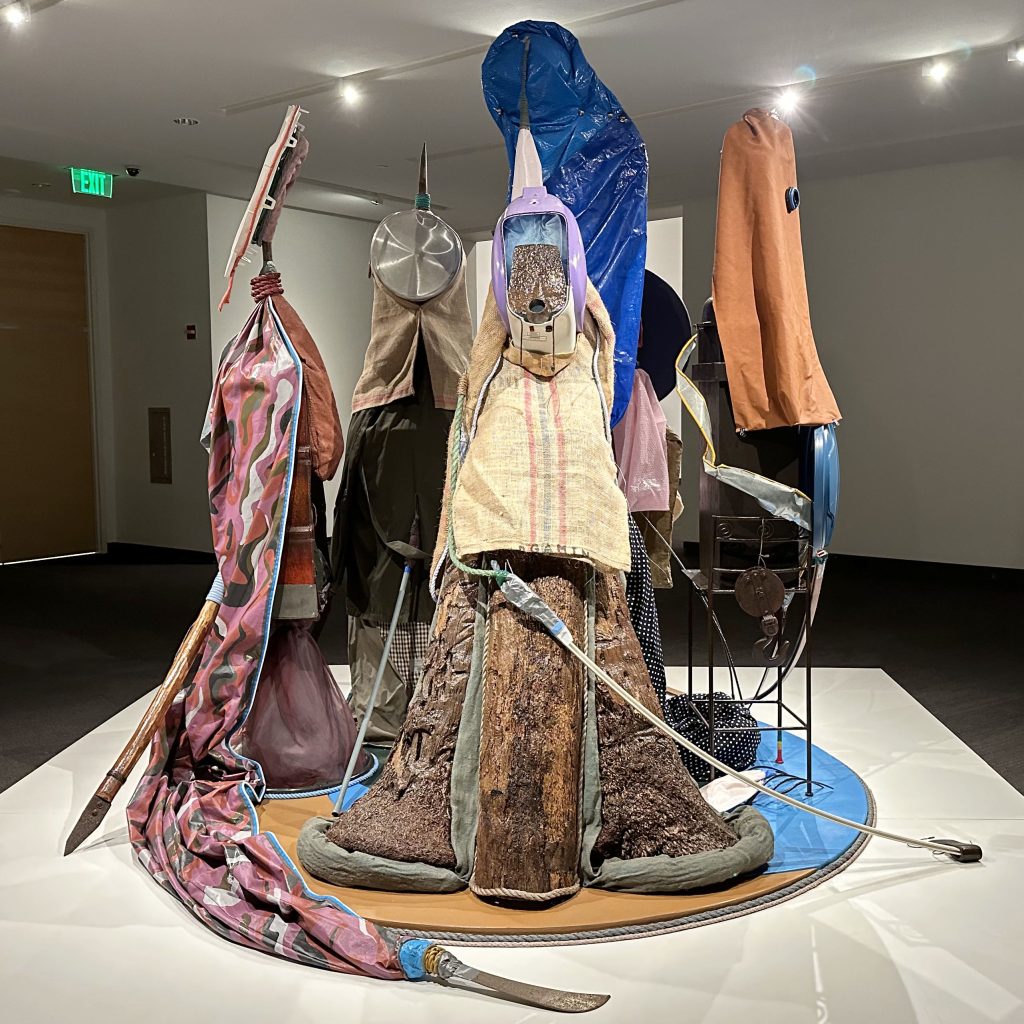
Daniel Lind-Ramos,”Centinelas de la luna nueva (Sentinels of the New Moon)”, 2022-2023, Mixed media

Daniel Lind-Ramos also uses a variety of recycled objects to create his sculptures.

From the museum about this work-

In Centinelas de la luna nueva, he evokes the elders of the mangroves, spiritual beings who watch over and ensure the health of this essential coastal tree. Mangroves are the basis for a complex ecosystem that shelters sea life and serves as the first line of defense in the tropical storms that batter the sub-tropics—including Florida.

Lind-Ramos’s practice reflects the vibrant culture of his native Loíza, Puerto Rico, by honoring local agriculture, fishing, cooking, and masquerade. His sculptures also evoke Hurricane Maria (2017), the COVID-19 pandemic, and ongoing environmental degradation. Lind-Ramos is committed to the survival and sustenance of Afro-Taíno traditions and people of the Puerto Rican archipelago. However, his art engages the global community through shared emotions, parallel histories, and the commonality of human experience.

The next post will discuss two other artists in the exhibition, Brookhart Jonquil and Janaina Tschäpe.
Mar 202024
 

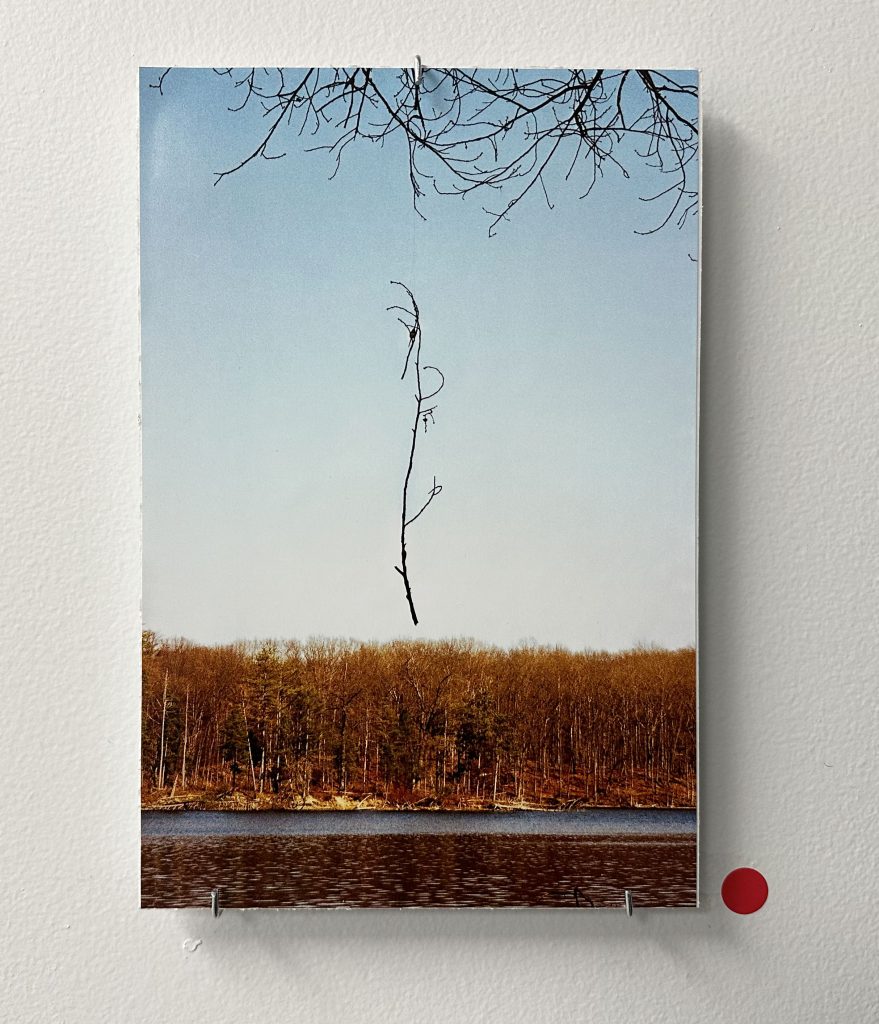
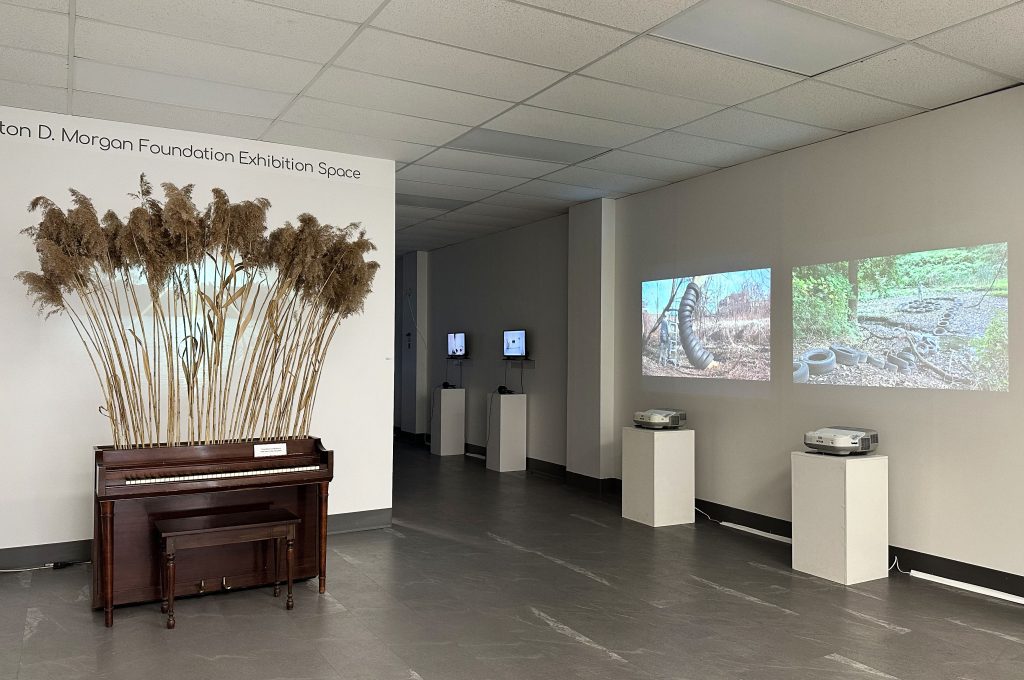
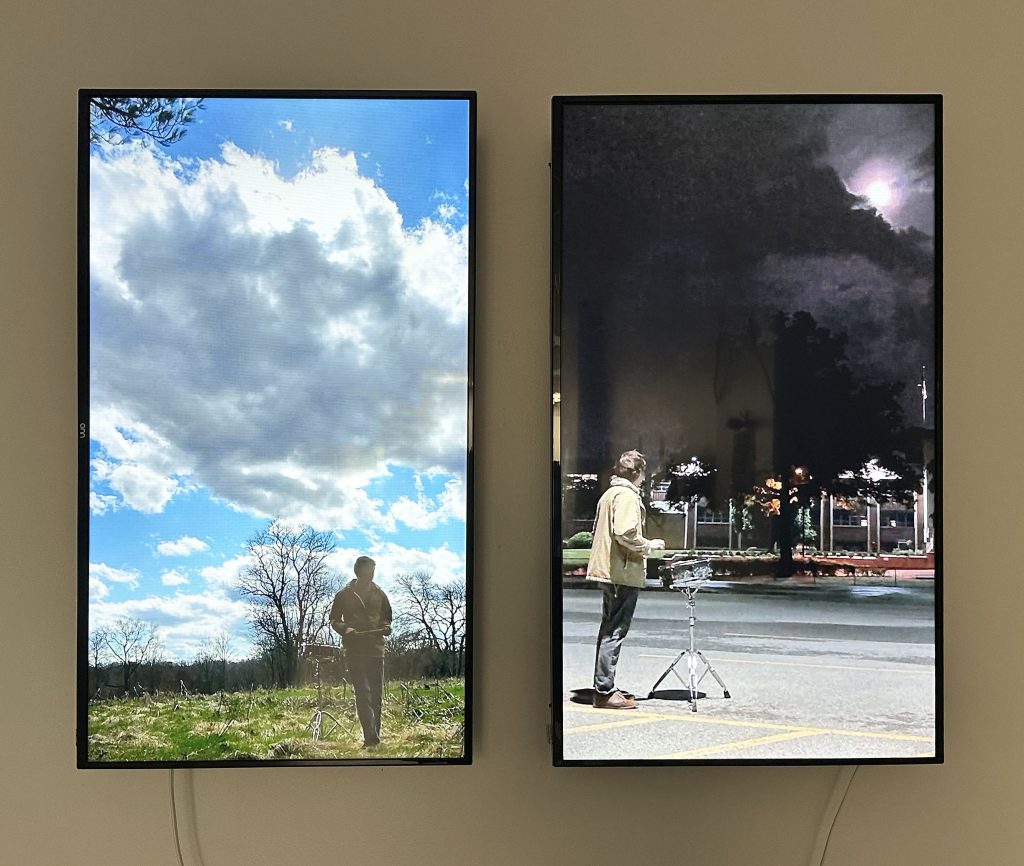
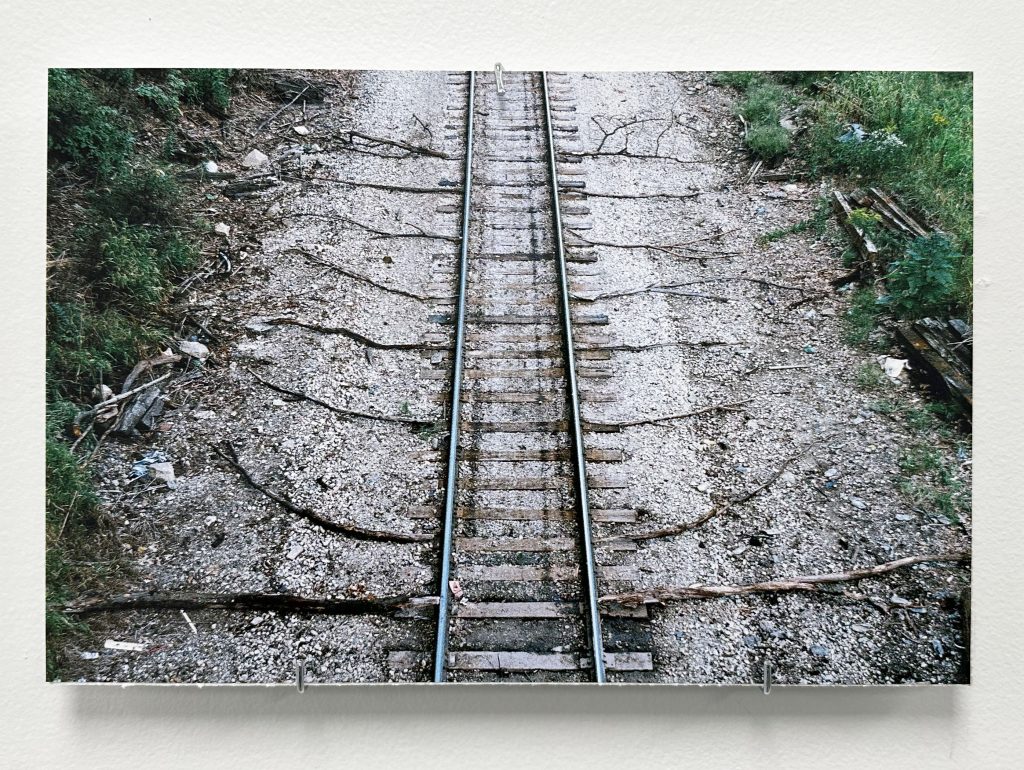
Akron Soul Train supports local artists through a residency program, exhibitions, and a shop in the front of the gallery which sells their work. Currently the gallery is showing work by Matthew Kurtz (work seen above) and Thomas Smith (work pictured below). Both artists are approaching the environment in different and interesting ways. Several of Kurz’s video pieces are focused on his upcoming performance for the solar eclipse. His photographs, for which he’s created additions to scenes he finds, are charming- as is his sculpture- a piano that moves his natural additions when played.

From the gallery-

Performance artist Matthew B. Kurtz presents Drumroll for a Total Eclipse: A Preliminary Exhibition, a prelude to his upcoming live performance with this year’s solar eclipse. Kurtz’s work fuses place, nature, sound, rhythm, and movement to question the mystery of existence. With humor, curiosity, and in tandem with his surroundings, Drumroll explores the process of trying to understand wonder.

For his upcoming performance on April 8, 2024, Kurtz will invite an audience to celebrate the total eclipse. Collaborating with the cosmos, he will perform a drumroll before “totality” passes over Northeast Ohio and creates the natural phenomenon known as “the blackout.”

“When I engage with a site for an art piece, I consider its history, recontextualize its objects, and insert my identity through intuitive gestures. I was raised to believe that humans are supposed to connect the lines between their innate feelings and the unknown. Making art is [my] attempt to reclaim this existential directive. These experiences are documented so outside viewers can participate in my examination of ambiguities, systems, and the sublime.” — Matthew B. Kurtz

Kurtz is also a musician. Check out his Instagram and Bandcamp to listen to his 2021 album 107.

For Thomas Smith’s sculptures he creates natural environments within man-made structures and uses the results as a commentary on the growth and sustainability of suburban development.

From the gallery-

In SUBARIUM II reprise, Thomas Smith combines materials from big box stores with contained terrariums to generate a sense of security and quality. However, upon second look, the viewer may see past the façade of what may look safe to what is substandard. Perhaps it is even denying growth and positive change. Smith’s sculptures dare to ask questions about survival, public image, and the landscape of today.

“Akin to an ecosystem enclosed in a terrarium, my sculptures depict a vibrant but, ultimately, unsustainable artificial environment. As plants within the terrarium grow, competition for space intensifies, turning the once-comfortable space into a struggle for survival. The metaphor extends to suburban America, where curated living conditions prioritize aesthetics over functionality, reflecting an impermanent American Dream.”

— Thomas Smith


Both of these exhibitions close 3/23/24.​

Mar 152024


The mural above is a reproduction of Masumi Hayashi’s Edgewater Park no.2, Cleveland, OH. The mural is located in Cleveland and is one of the many public art projects organized by LAND Studio.

From the information plaque next to the mural about the artist-

Masumi Hayashi (1945- 2006) was a visionary fine art photographer who taught at Cleveland State University for 25 years. During her time in Cleveland, she lived in the Gordon Square neighborhood in the first residential development project of the Detroit Shoreway Community Development Organization. Dr. Hayashi was a beloved neighbor, friend, and local artist. She achieved global success with her signature format, the panoramic photo collage.

Hayashi was born in the Gila River War Relocation Camp in Rivers, Arizona, which was one of the U.S. government’s Internment camps for Japanese-Americans during World War II. Hayashi created her striking panoramic photo collages by assembling individually shot color photographs into a composition, like tiles in a mosaic. She shot photographs in a meticulously ordered sequence using a completely manual, non-digital film camera on a tripod. A single piece could take four to eight hours to shoot, and she might not see the results for days or weeks. When working at a site, she had to imagine the composition she desired from a location, and then create the individual photographs, while considering factors like time of day, weather, and location of the sun, through the entire shoot. Many of her large panoramic compositions involve more than one hundred individual photographic prints.

Much of Hayashi’s work explores socially difficult subjects, like the Japanese-American Internment camps, abandoned prisons, and EPA Superfund cleanup sites. She was able to create artwork that makes difficult subjects approachable. Her earlier work includes many significant sites in Cleveland, including the Cultural Gardens, RTA stops, Lake Erie and Edgewater Park (as seen in the artwork shown to the left). Later in her career, her artwork reflected a deep interest in culturally significant spiritual sites in India, Nepal, Japan, and Thailand.

Feb 282024
 

The images above are from Brianna Lynn Hernandez’s exhibition Anticipatory|Después, one of three currently on view at Spaces gallery in Cleveland. Her moving video and sculptural installations focus on themes of end-of-life-care, grief, and mourning.

From the gallery about the work-

Anticipatory|Después visualizes the anticipatory grief of caregiving and the process of dying through performative videos and photography. Each piece shares the physical and emotional state of the dying, the caregiver, and at times the two concurrently. Ranging from fast and aggressive dance-like movement to slow and meditative contemplation, the enacted scenes capture a range of emotions and thought processes of understanding and untangling the intertwined traumas of caregiving and acute grief.

As her mother’s caregiver in the final year of her life, Hernández translated her personal experience of grief into her studio practice in order to combat the isolation and shame many grievers face in our death-avoidant culture. Through several series including Anticipatory | Después, the works aim to normalize honest conversations of grief and act as an entry point into education on end-of-life planning. Hernandez states that while we will all eventually experience the pains of loss, preparing for the logistics of death and nurturing supportive communities for grievers can provide comfort and lessen the unnecessary stressors attached to loss.

A Botanical Conversation, Mehdi-Georges Lahlou’s exhibition, explores environmental, identity, and cultural issues using the natural world as a backdrop. The two large murals are of an enlarged palm tree cell as seen through a microscope.

The exhibition statement by curator Conor Moynihan-

The palm tree is a central component of Mehdi-Georges Lahlou’s practice, a motif he has explored to highlight themes of exoticism, migration, and cultural heritage. Recently, Mehdi- Georges Lahlou has used the palm tree to explore themes of colonization, climate change, and history. While members of the Arecaceae family- palm trees- can be found in many parts of the world, they are not found here in Ohio. Unless, of course, you go to the Cleveland Botanical Garden as Mehdi-Georges Lahlou did for his residency at Spaces.

For A Botanical Conversation, Mehdi-Georges Lahlou has created four new video works using the Cleveland Botanical Garden as the setting and backdrop. While many of the plants visible in these works come from elsewhere across the world, his collaborators Diwe Augustin-Glave, CHIMI x Nature, and Dr Lady J are based in Cleveland. In many ways, this body of work imagines the conversations that might happen if the flora in the Cleveland Botanical Garden could speak, sing, chant, and educate, and then transports this dialogue in the gallery space.

Microscopy, the mural that extends over two walls in the gallery, serves a double function. Based on the cell of a dead palm tree, it enlarges from an unusual perspective a motif central to the exhibition. And it also serves as a container and a frame for the four videos. This conversation emerges within the boundaries of the palm tree cell, transporting this exhibition into the botanical garden.

Characteristic of his practice, Mehdi-Georges Lahlou draws our attention to how plants and botanical gardens become ways to highlight histories of colonization, compulsory heterosexuality, and climate disaster all contained under canopies of glass. Yet, especially through the performances of Diwe Augustin-Glave, CHIMI x Nature, and Dr Lady J, they also celebrate new queer ecologies and configurations, melding African and African American musical traditions, queer theory and scholarship, ecological history, and environmental justice towards new ends.

A Botanical Conversation is a cacophony. It asks us to listen carefully to hear all the voices that make up this chorus.

Aaron D. Williams has created a video installation, ESCAPING AAWFUL LAND, that continues the work created for his previous Aawful Friends exhibition. This new creation addresses the issue of anxiety and the power of collaboration as a way to combat it.

From the gallery-

ESCAPING AAWFUL LAND is an immersive exhibition that builds upon the success of Aaron D. William’s previous Aawful Friends showcase at Zygote Press. This new showcase explores the creative journey between Williams and collaborating artists. By delving into anxiety through art, we seek to acknowledge its profound impact on our collective well-being. We must address anxiety as a shared concern and foster a future community that supports and uplifts one another. Through individual and collective artistic expression, we can overcome the gravity of the situation and find healing and unity. In our fast-paced society, anxiety affects people from all walks of life, taking various forms and manifesting in relentless thoughts, paralyzing fear, and an overwhelming sense of unease. Despite its grip, we encourage you to embrace your inner courage and take the leap. The installation will be held at The Vault in SPACES gallery, where you will be transported to AAWFUL LAND – a hidden realm within our city accessible only to those who know it exists. Guided by the mysterious GUARDIAN, you will journey through its enigmatic mysteries. As you step into AAWFUL LAND, you will be captivated by a mesmerizing video presentation. Witness AAWFUL AARON engaged in a gripping game against a formidable opponent, reminding us that we have the inner strength to persevere and pursue our dreams even amidst anxiety. In Aawful Land, anxiety takes on tangible forms and bursts forth in vibrant colors. CREATURE is at the heart of our narrative, an overbearing shadowy figure personifying anxiety and serving as the central antagonist. Aawful Aaron is locked in a fierce battle against CREATURE, desperately seeking escape from this hidden world. However, a subtle hint suggests that Aaron may need assistance to overcome his challenges. Within Aawful Land, a group of trapped artists may hold the key to their collective liberation. Together, they offer a glimmer of hope, representing collaboration’s power in overcoming Aawful Land’s perils. This work serves as a proof-of-concept or work-in-progress, paving the way for Aawful Friends II. In the forthcoming installation, we will feature this newfound group of artists, showcasing their collective efforts and unveiling the transformative power of collaboration. Their shared experience demonstrates that collective creativity and expression can lead to freedom and transcendence. ANXIETY IS HARD – TAKE YOUR SHOT ANYWAY.

All three of these exhibitions close 3/1/24.

Dec 072023
 

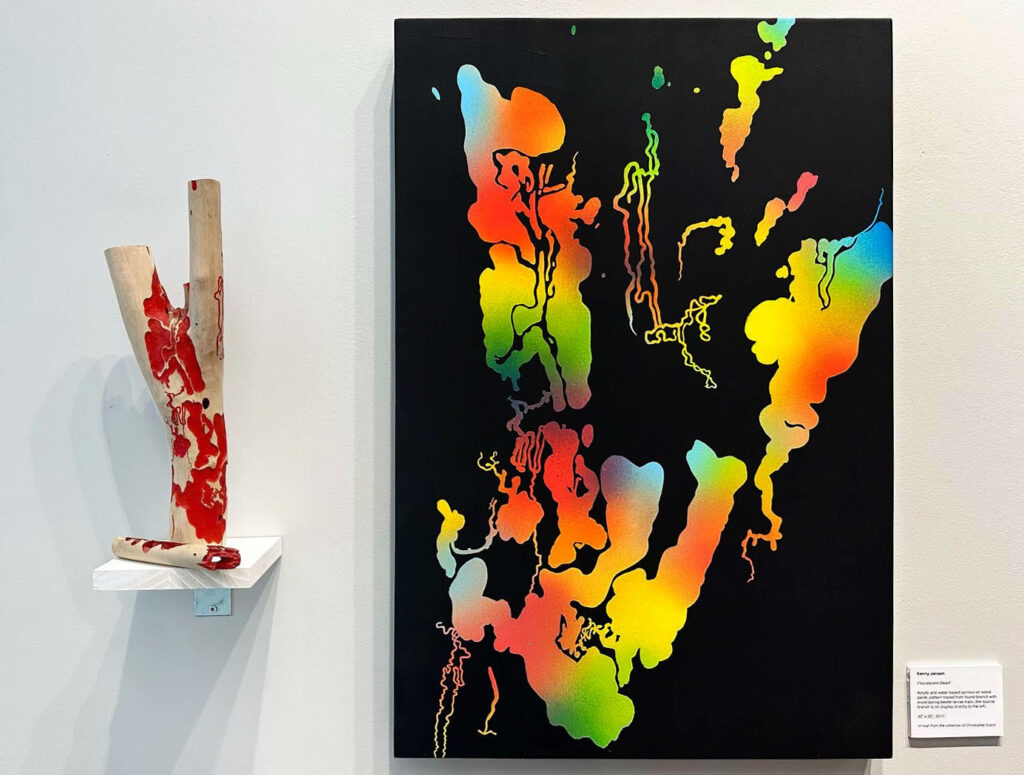
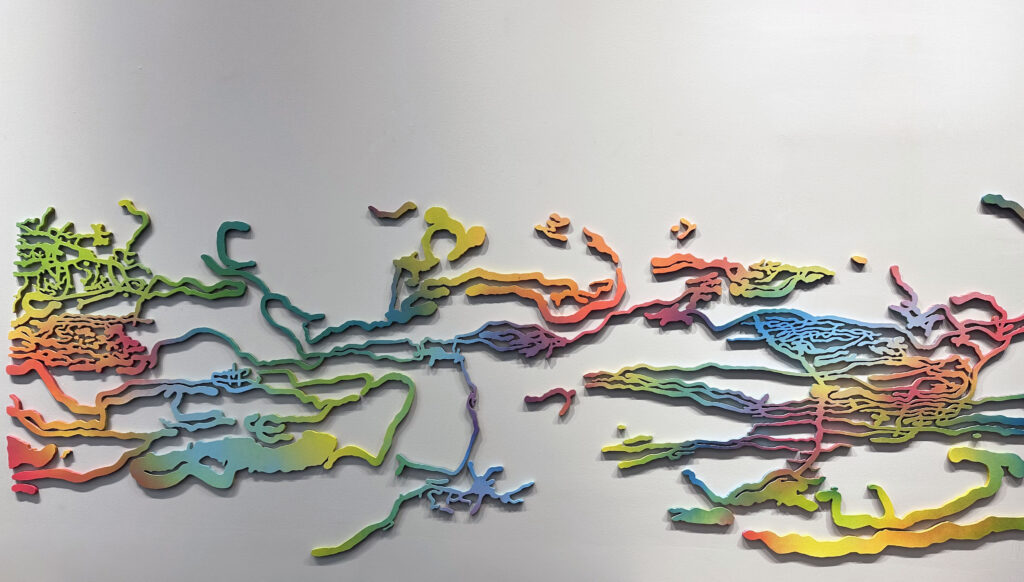
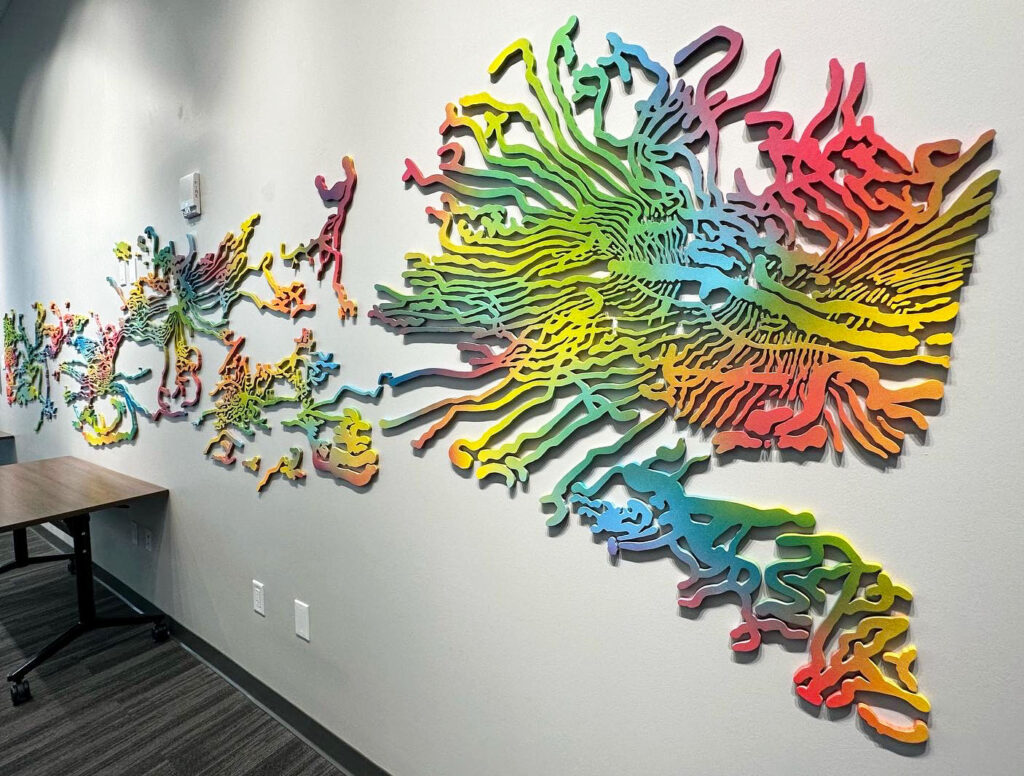
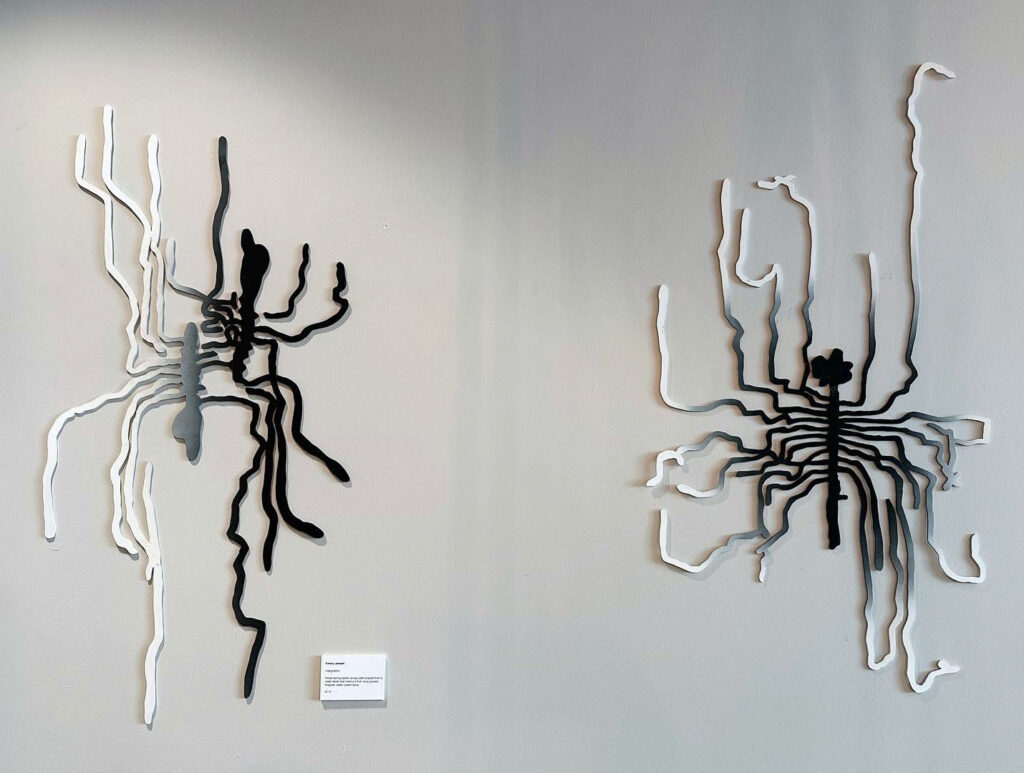
“Fluorescent Dwarf”, 2017, Acrylic and water based aerosol on wood panel, pattern traced from found branch with wood boring beetle larvae trails (the source branch is on display directly to the left)

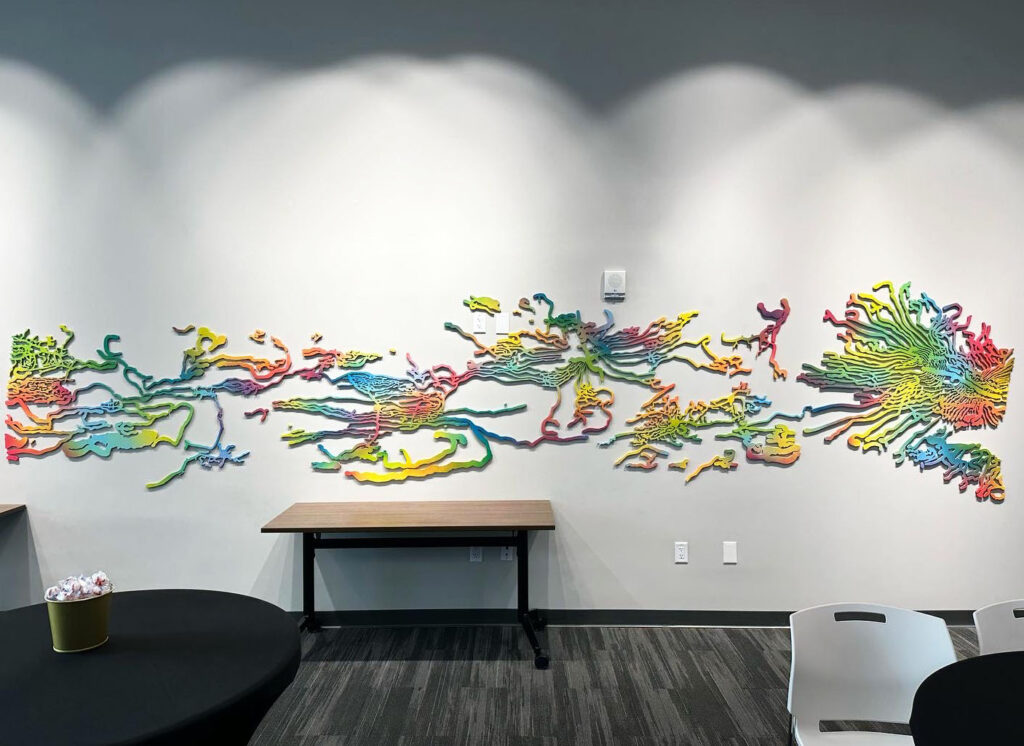
“The Expanding Universe”, 2017, Hand cut (jigsaw) plywood, water based spray, nails, pattern traced from found branch with wood boring beetle larvae trails

“Transcend and Include”, 2019, Wood boring beetle larvae paths traced from a dead cedar tree hand-cut from re-purposed Aluplast, water based spray

Community Foundation Tampa Bay works to match people and organizations with the resources they need to carry out projects that make a positive impact on local communities. In their space in St. Pete they also exhibit work by local artists. Currently on view are selections from Kenny Jensen’s Paths of Consumption series.

From the artist about this work-

As a Florida native who spent much of my childhood outdoors both in the city and the country, I have always had an essential connection to our unique natural environment. This relationship has steadily deepened over the years through my evolving art practice, and related ecological research. Becoming a parent has also raised the stakes and heightened my ecological awareness and concern. As a result there is a tension present in my work – An earnest desire to share the wonder and mystery I continually encounter in common, overlooked nature while also expressing grief and frustration over what is actively being lost.

All of the work on display here is a part of an ongoing environmentally focused sculpture project entitled Paths of Consumption which recreates found patterns eaten out of by various insect larvae at exaggerated scale and with a full spectrum of layered hues. This series is a meditation on our consumption of the natural environment. The inverted insect paths act as a kind of metaphorical map to guide us to reflect on our own record of consumption as we develop and grow, both as individuals and as a society.

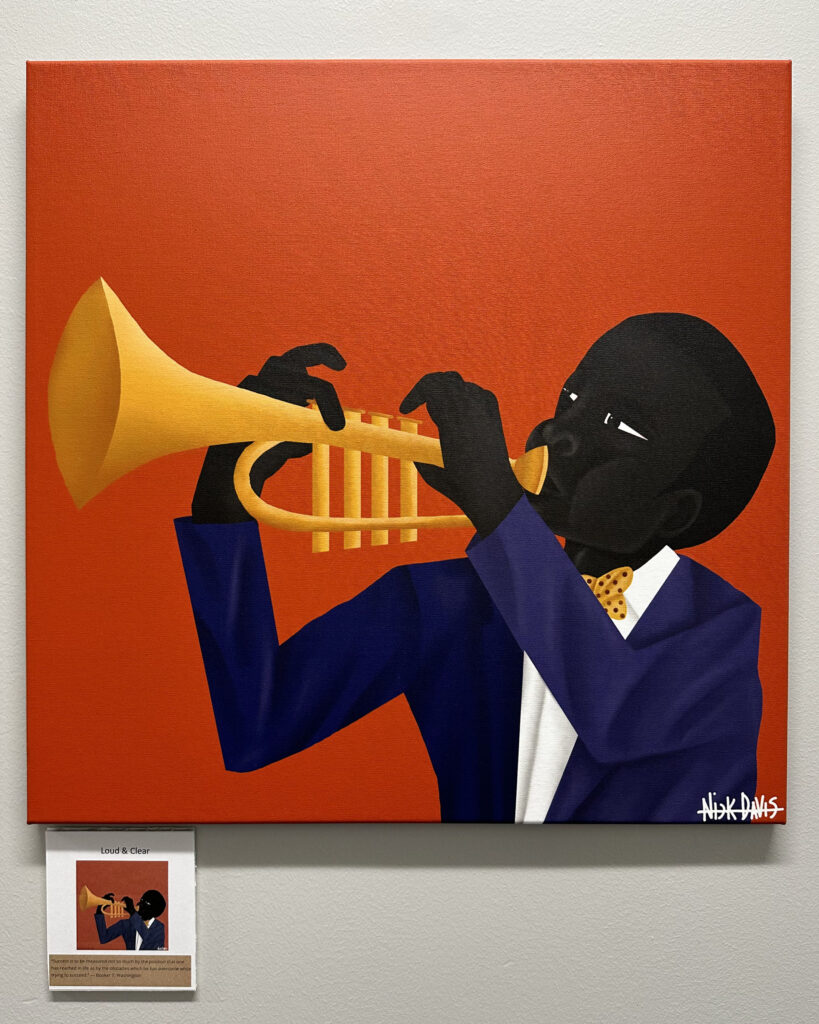
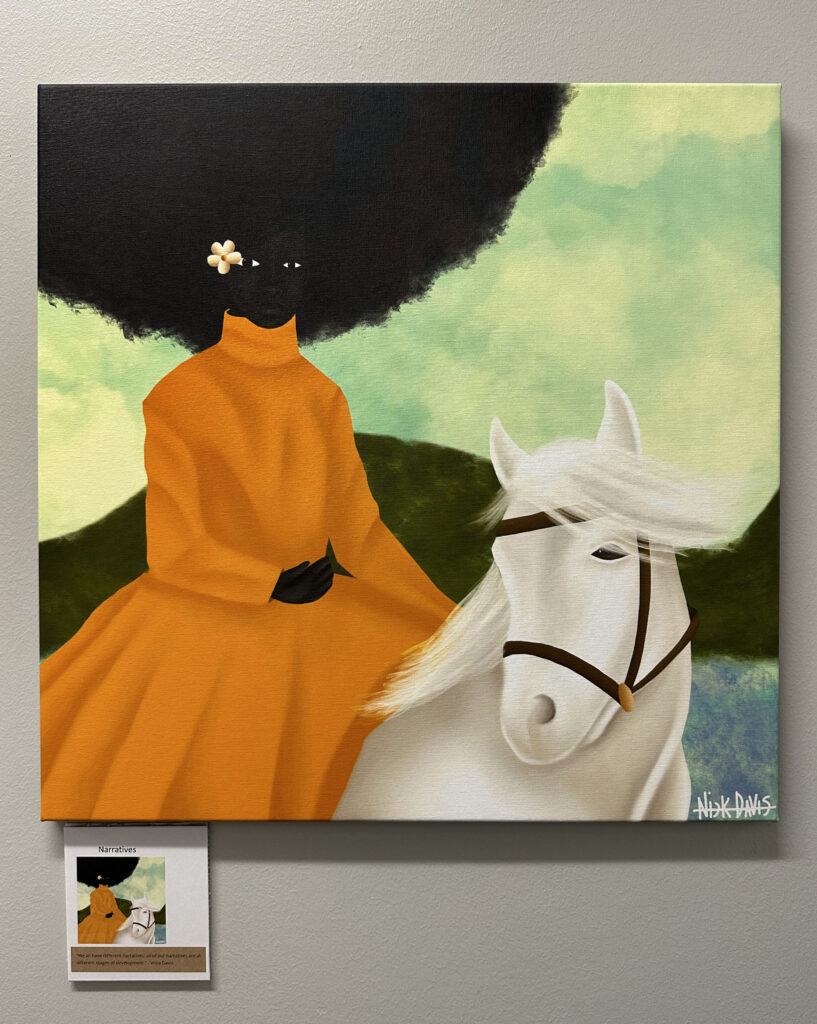
Also on view at the gallery are digital works from Nick Davis’s Black is Beautiful series. Sadly, Davis passed away in December of 2022.


Nov 152023
 

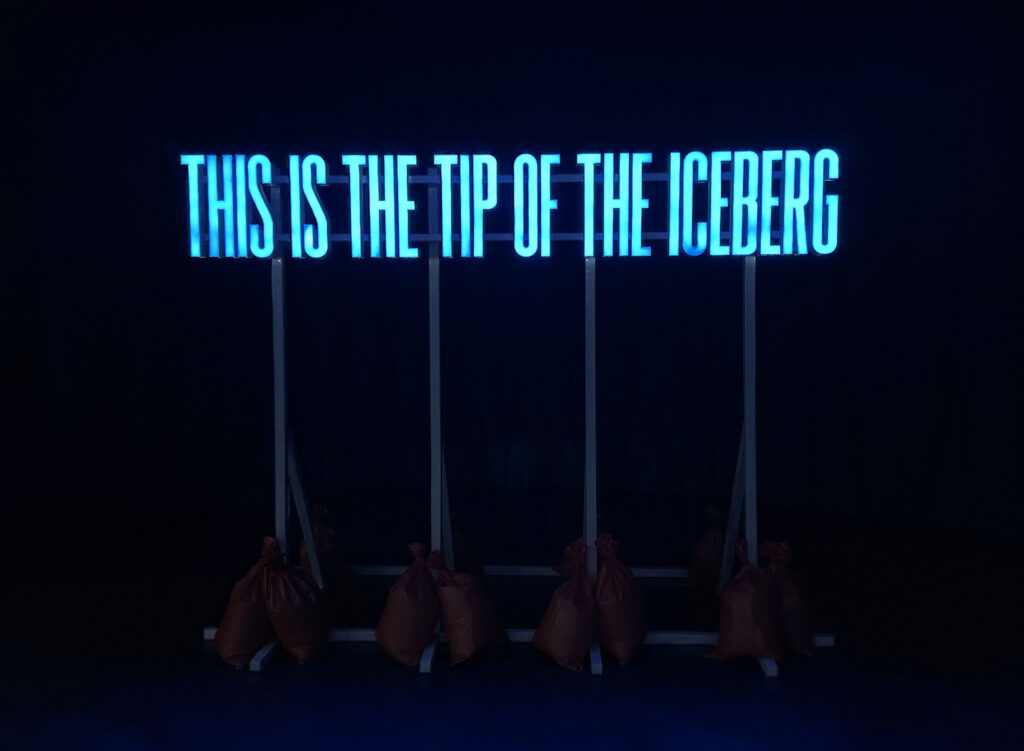
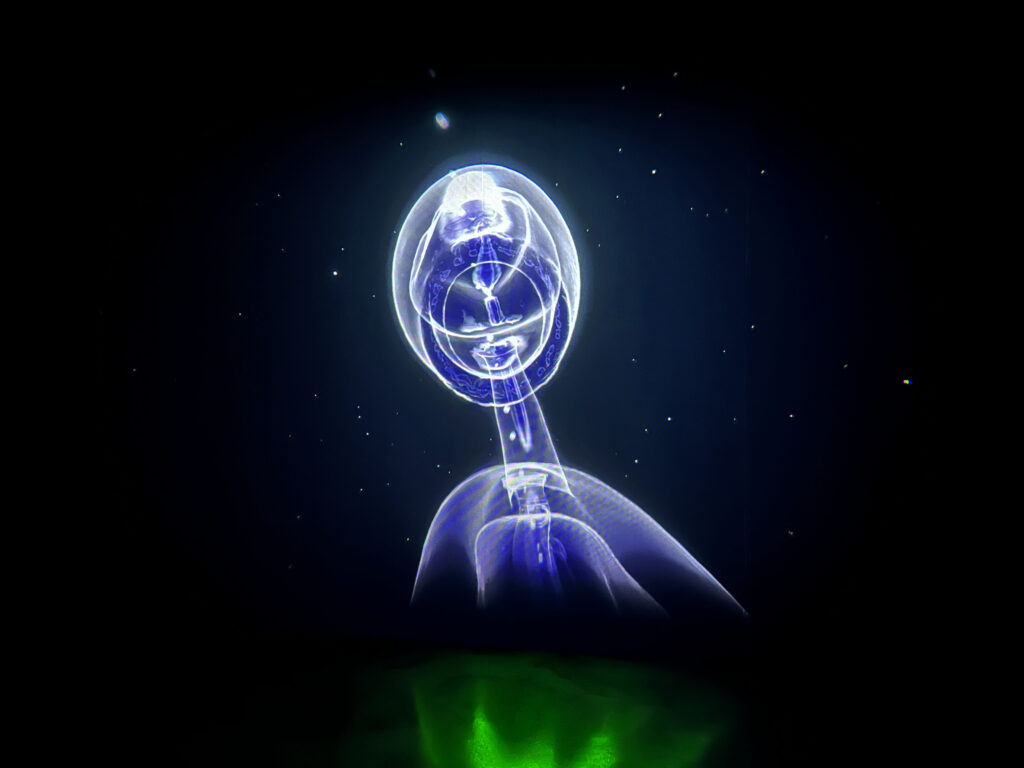
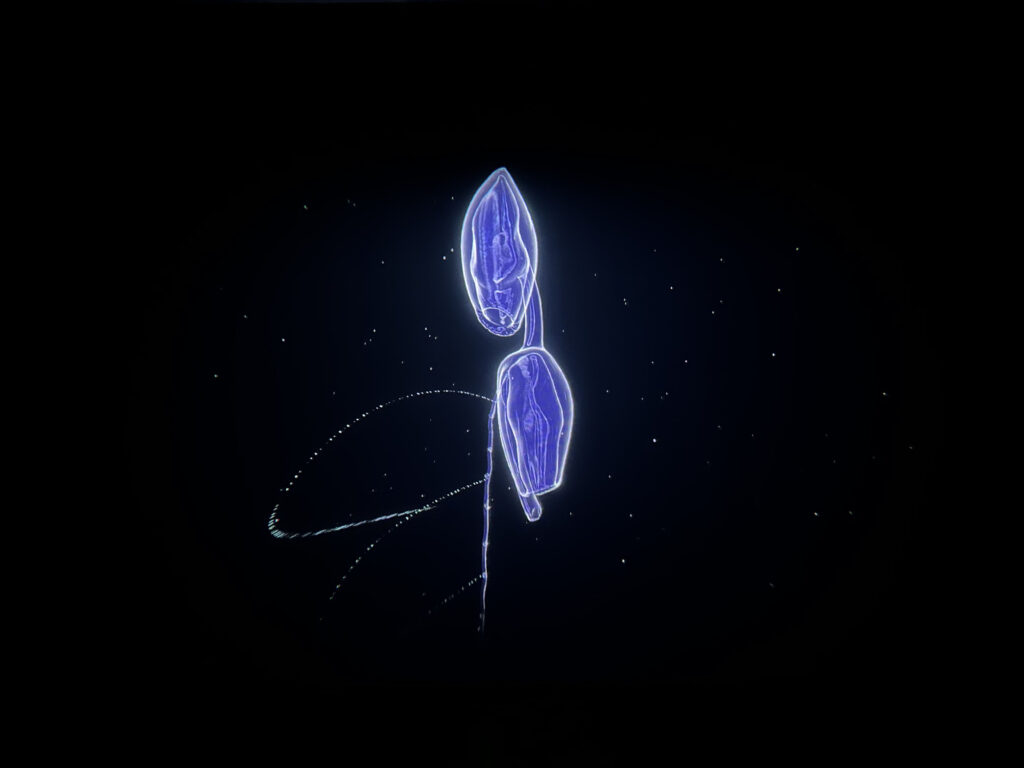
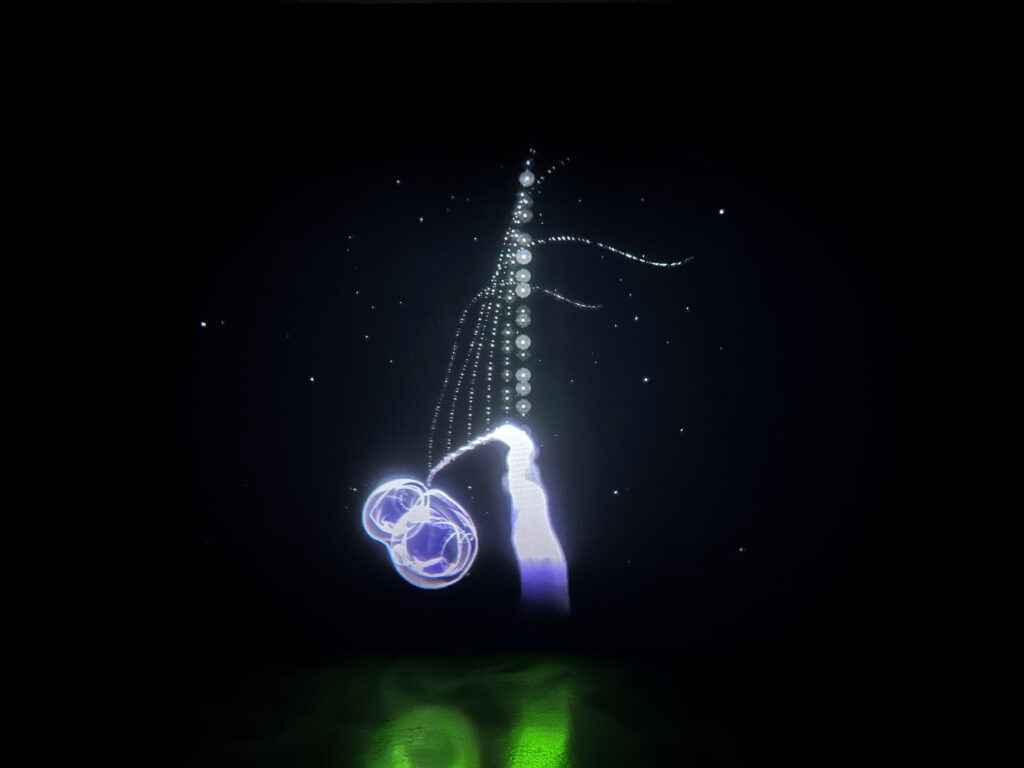
The images above are from SUPERFLEX: This Is The Tip Of The Iceberg, GENERATOR: USF Contemporary Art Museum’s inaugural exhibition. The two part exhibition includes a sculptural installation and the mesmerizing interactive animation Vertical Migration, in which viewers encounter a siphonophore that reacts to their movements.

From the gallery about the exhibition-

This Is The Tip Of The Iceberg emerges from SUPERFLEX’s in-depth research into the deep sea, biodiversity, and the climate. The exhibition immerses viewers in two parallel and interconnected realms, separated by a curtain which acts as an imaginary filter between land and sea. Passing through the curtain brings visitors from a terrestrial space unsettled by rising water to the ocean’s dark depths, to meet one of the most important cleaners of the ocean, the siphonophore. Relatives of the jellyfish, siphonophores bring between two and six billion tons of carbon a year from the surface down to the seabed, where it is stored. This Is The Tip Of The Iceberg offers an opportunity to encounter this unfamiliar species, prompting reflection on the impacts and consequences of climate change, especially relevant to Florida and its coastal communities, and encouraging humans to imagine a future defined by interspecies living and ecological coexistence.

For a more detailed discussion of the work, the gallery has created an exhibition catalogue that can be viewed online or downloaded as a pdf.

Vertical Migration was originally created in 2021 by SUPERFLEX for ART 2030  and was projected on the United Nations Secretariat Building in NYC during the 76th United Nations General Assembly.

SUPERFLEX’s statement on the project-

The sea is not an abyss. It teems with an almost unimaginable array of life. Every night, the largest biological migration on Earth takes place, as trillions of creatures travel closer to the surface to feed. Some of these animals, like shrimp, are well-known. Others, like siphonophores—relatives of jellyfish—are unfamiliar: varying wildly in size, from the slightness of a fingernail to the length of a whale, they look like nothing that we find on land.

How does it feel to be one of these creatures? To explore this question, SUPERFLEX designed a computer-generated siphonophore and created an animated film, Vertical Migration, depicting its ascent. At first, the film mechanically circles the creature, getting closer and closer while giving the audience a view of it from all angles. But eventually the perspective shifts, the camera’s movements become more fluid, and the viewer sees the world from the perspective of the siphonophore.

Unsettling our perceptions of scale and otherness, Vertical Migration is an intimate encounter with a life form that bears no resemblance to human beings, though we share a planet, an ecosystem, and a future. Because of sea-level rise, humans will also be migrating vertically in the coming centuries, to higher elevations and raised buildings. The siphonophore’s story is our story. Though we can never experience its journey through the pitch-black ocean depths, we can shift our perspective to recognize that we’re connected, that our actions affect each other, and that we share a common fate.

For a look at the work in motion, below is the trailer from ART 2030.

About SUPERFLEX from their website-

SUPERFLEX was founded in 1993 by Jakob Fenger, Bjørnstjerne Christiansen, and Rasmus Rosengren Nielsen. Conceived as an expanded collective, SUPERFLEX has consistently worked with a wide variety of collaborators, from gardeners to engineers to audience members. Engaging with alternative models for the creation of social and economic organisation, works have taken the form of energy systems, beverages, sculptures, copies, hypnosis sessions, infrastructure, paintings, plant nurseries, contracts, and public spaces.

Working in and outside the physical location of the exhibition space, SUPERFLEX has been engaged in major public space projects since their award-winning Superkilen opened in 2011. These projects often involve participation, involving the input of local communities, specialists, and children. Taking the idea of collaboration even further, recent works have involved soliciting the participation of other species. SUPERFLEX has been developing a new kind of urbanism that includes the perspectives of plants and animals, aiming to move society towards interspecies living. For SUPERFLEX, the best idea might come from a fish.

This exhibition closes 11/22/23.

Mar 182016
 
amyyaoatvsfgalleryroomview

Doppelgangers (in foreground)

amyyaovsfricedetail

Detail of Doppelgangers

amyyaovsfhomeiswhereyouarehappy

Home is Where You Are Happy, No.1

At Amy Yao’s solo exhibition, Bay of Smokes, at Various Small Fires, the fear of a polluted and harmfully modified environment plays a central role. An industrial manufactured scent fills the gallery, lead blankets are on towel racks, and a mountain of rice reveals on closer inspection that it has bits of plastic and pearls (real and fake) mixed in.

In this time of GMO’s, toxic water in Flint, and the gas leak at Porter Ranch, it’s hard not to be paranoid about what is really happening to our natural surroundings and how poisonous our daily lives really are, especially in ways we cannot discern. Yao’s exhibition is a creative and at times playful examination of these issues- but the darkness of the theme, like the scent, remains a constant presence.

This exhibition closes 3/18/16.