Oct 312025
 

Today’s flashback is to a few of the intricate works from Sofia Love‘s 2023 exhibition Vaquera at Shelter in NYC.

From the gallery about the exhibition-

Vaquera – not determined by an article, the word becomes both a noun and an adjective, an iconic figure and a way of being in the world. For Brooklyn-based painter Sofia Love’s debut solo exhibition in New York, vaquera is both a manifesto of queer self-fashioning and a patron saint.

Born and raised in Boston, but with deep family ties to the Mexican community of Laredo, TX, Love’s acrylic paintings serve as a negotiation between ancestral memory and contemporary identity. The titular cowgirl recurs throughout the exhibition – gun-slinging, brown, and frequently nude – framed by expanses of desert. She’s a real, historical cowgirl. She’s the artist traversing her own imagination. She’s a badass dyke. For Love, vaquera is an object of desire and an extension of herself.

While there are traditional canvases, the majority of works on view take the form of nichos, intimate yet elaborately decorated altars that can be found in homes across Mexico. Dedicated to deceased ancestors or particular saints, nichos blend folk spirituality with Catholicism, smuggling pre-Colombian vernacular traditions into contemporary, Westernized culture. Love’s nichos draw on this history to produce art objects that exist at the border of painting and sculpture, with frames that extend the content and imagery of the paintings they enshrine.

The resulting works each have interiors and exteriors, the painting and the frame, in which ambivalent scenes are surrounded by totems and animals that seem to hint at the psychological subtext of the central image. Figures reappear across the framed nichos like characters in a narrative, each with its own personal connotation for the artist. Skulls, moths, storks tell stories that are only partially legible from an external perspective. Like the vaquera herself, Love’s layered compositions refuse any easy interpretation.


Oct 302025
 

Betsy Lester, “The Weyward Sisters”, Acrylic and collage on canvas

Florida artist Betsy Orbe Lester‘s mixed media work blends the familiar with the mysterious. The works pictured are from a 2023 visit to her studio at ArtLofts in St. Pete.

Oct 202025
 

The Solitude-Funnel, 1921, was created by Suzanne Duchamp, who was born today, October 20th in 1889.

From the Museum of Modern Art about the work-

In Solitude-Funnel (1921), one of the last works that Duchamp made in the context of Dada in Paris, she combined fields of pigment with cut-out circles of metallic foil in a composition that juxtaposes painted and collaged geometric forms with a puzzling inscription. The thin, black lines emanating from the black circle at the center resemble the funnel described in the title, or the spokes of a bicycle wheel.

Her first comprehensive solo exhibition ever is currently on view at Schirn Kunsthalle Frankfurt until 1/11/26.

Oct 082025
 

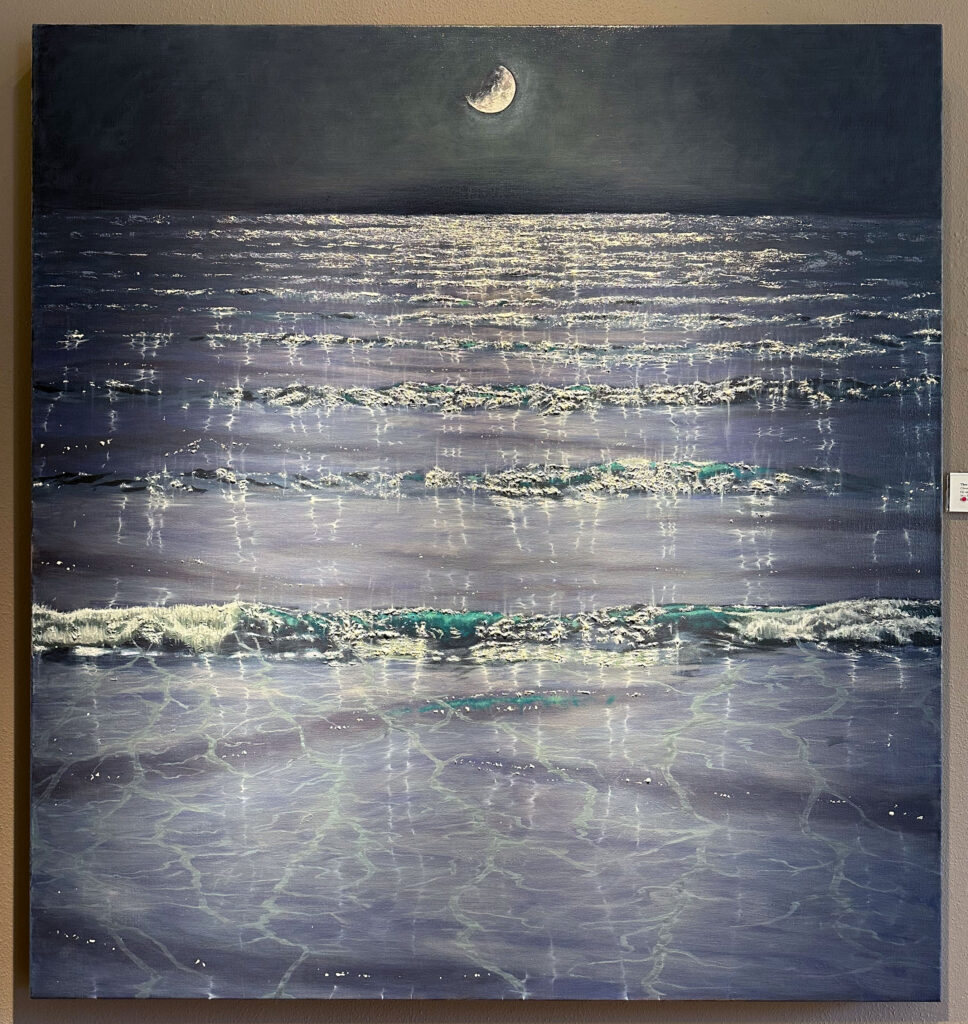
Theo Platt, “Chrome”, Oil on canvas

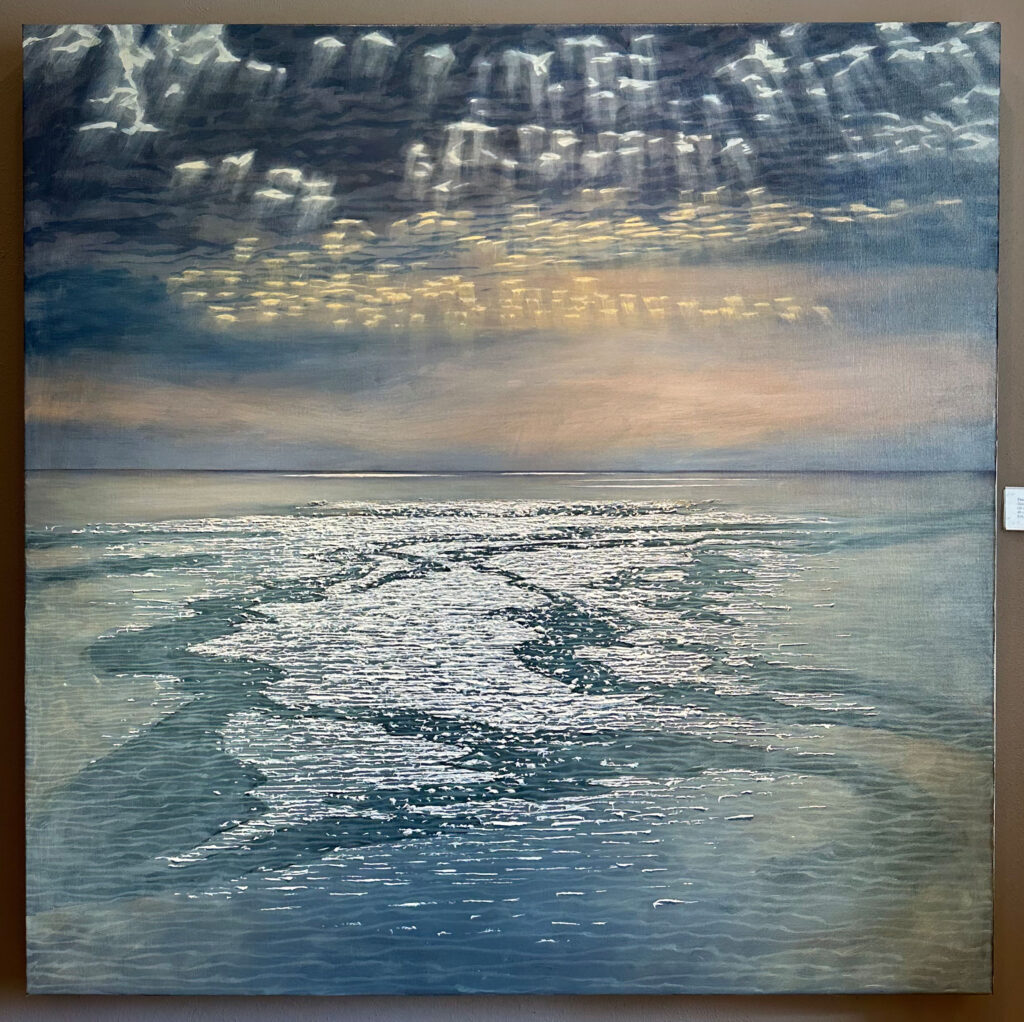
Theo Platt, “Sunstream”, Oil on canvas

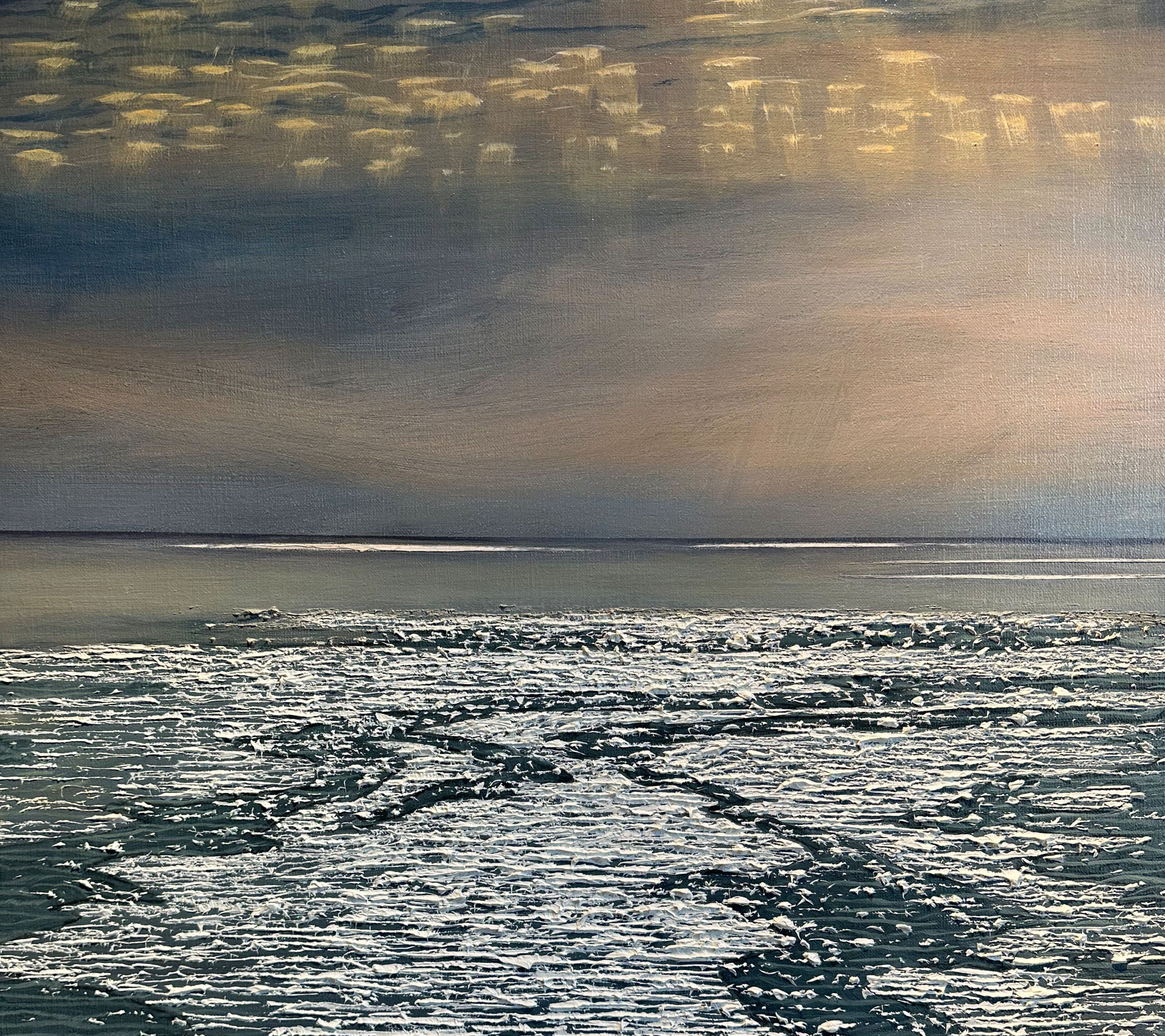
Theo Platt, “Sunstream”, Oil on canvas (detail)

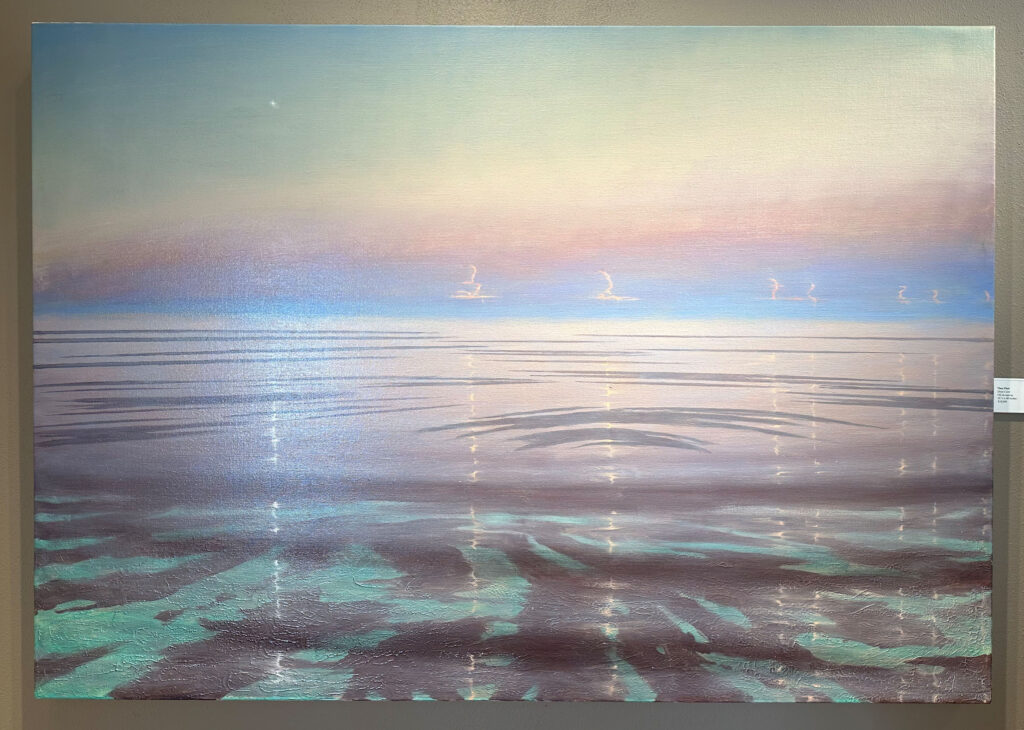
Theo Platt, “Deep Calm”, Oil on canvas

Somerville Manning Gallery is currently showing two painting exhibitions: Theo Platt‘s textured oil paintings from his Oceans series of works (pictured above) and Steven Nederveen‘s Stillness in the Shade of Green.

Below Nederveen describes his process for the work (pictured below)-

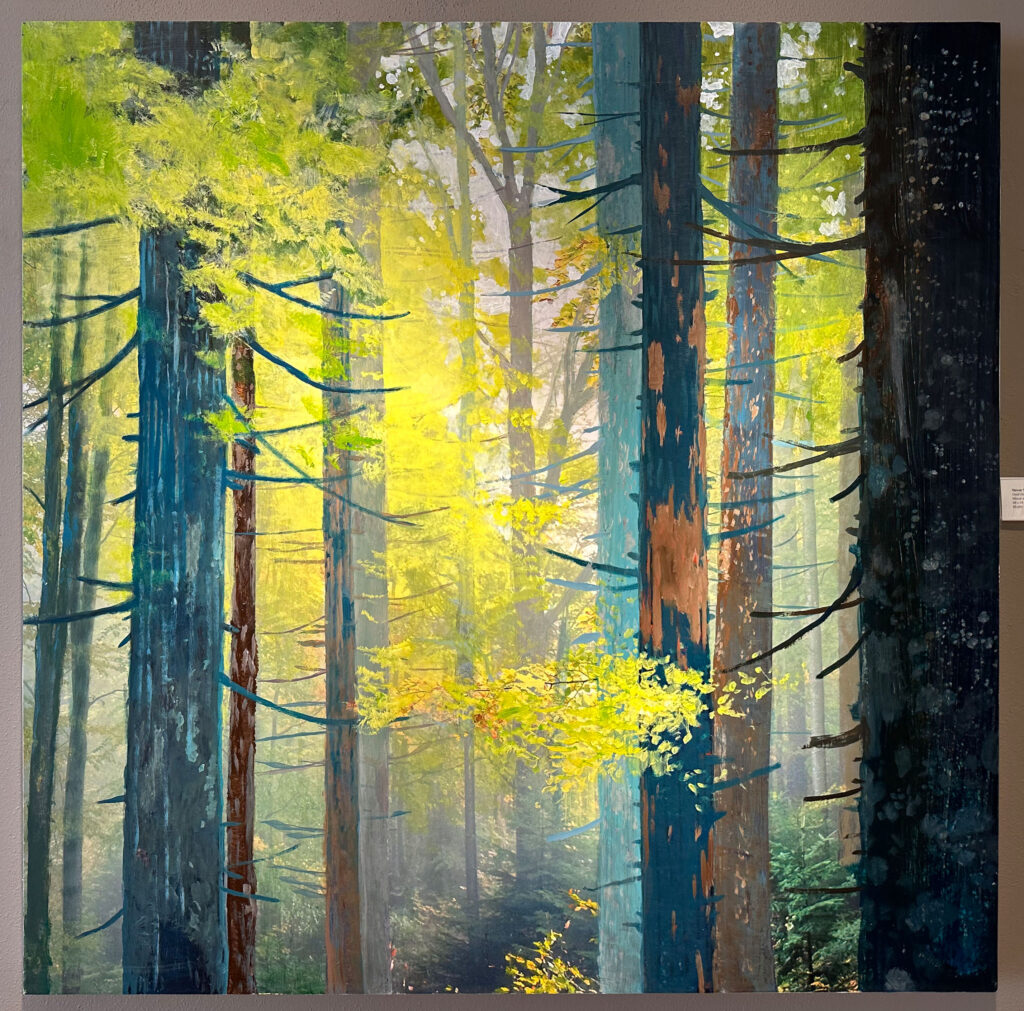
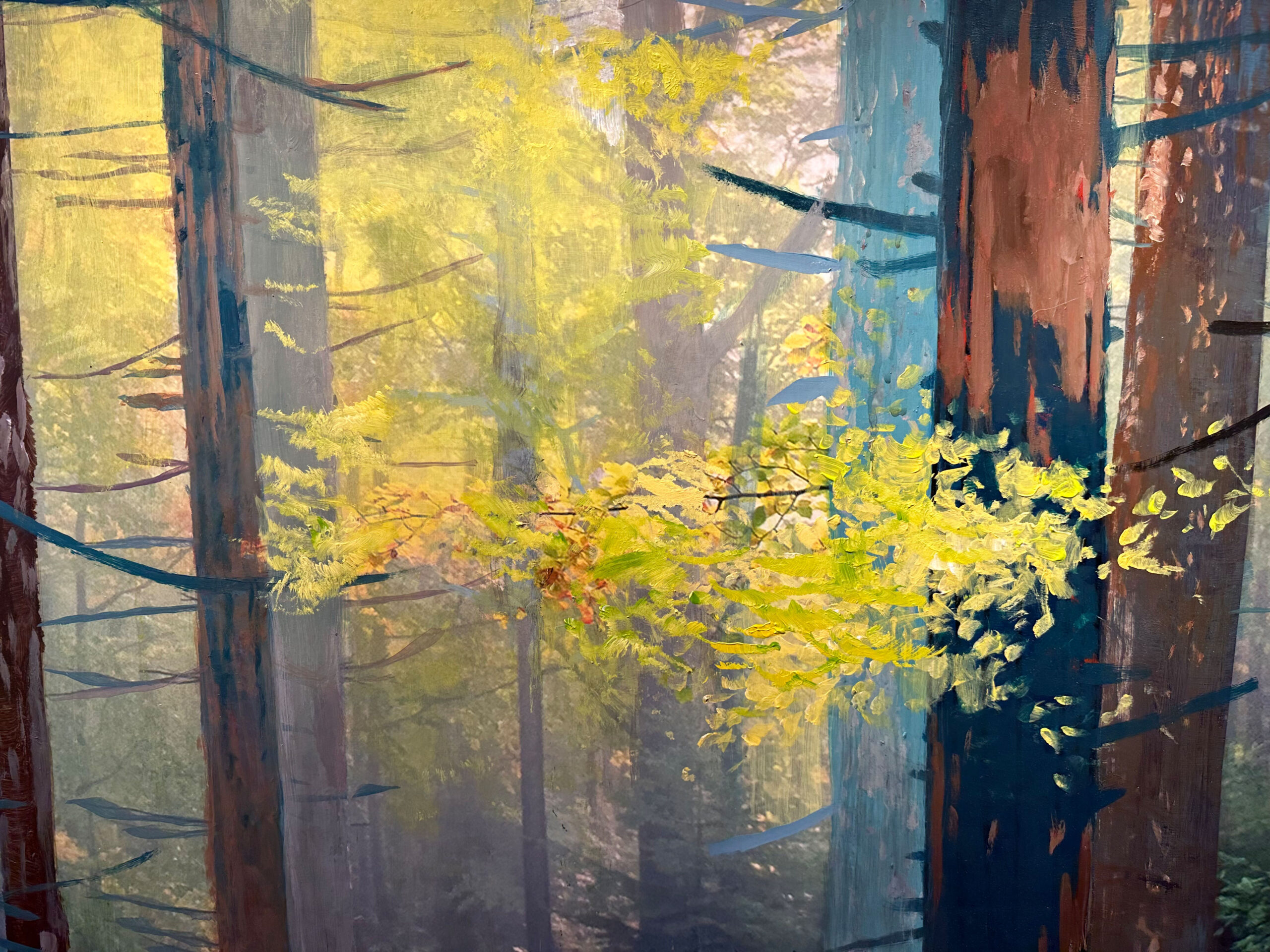
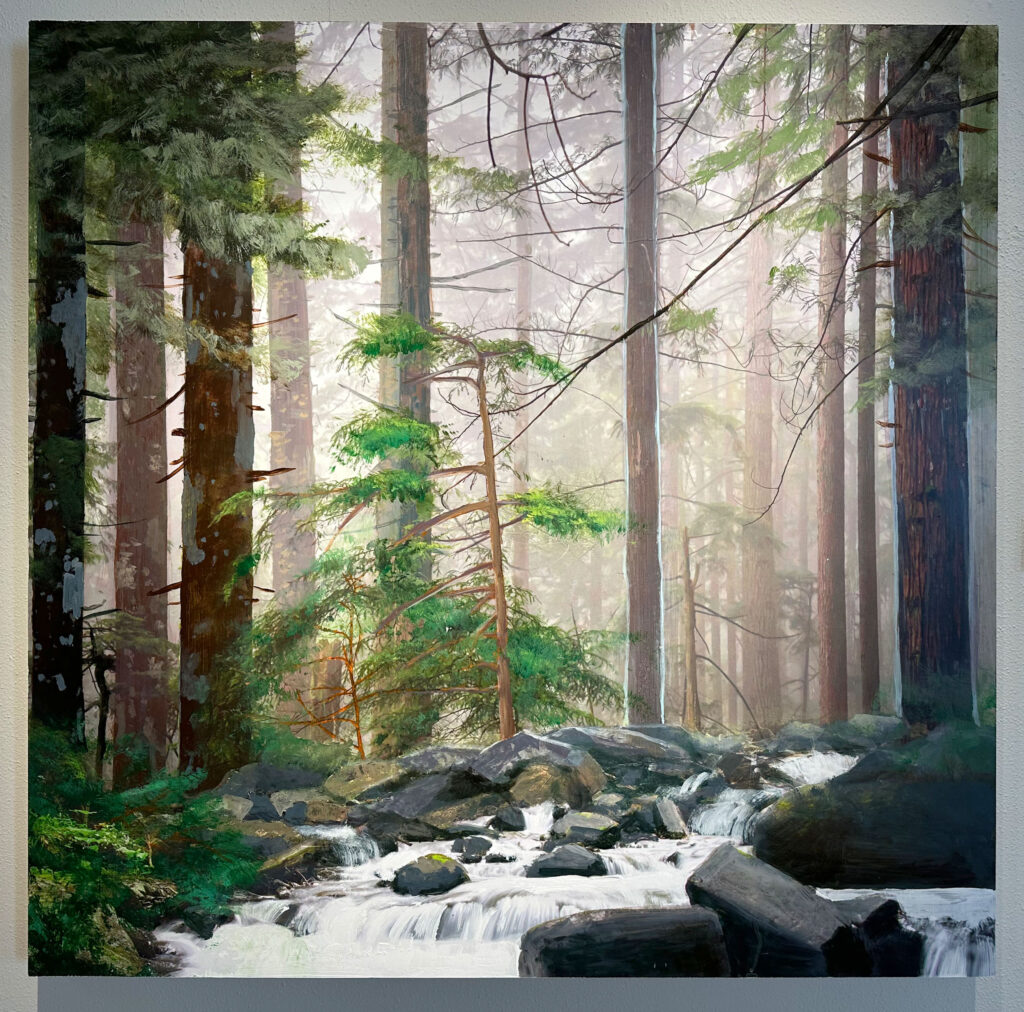
Using a mixed media approach to image making, I combine acrylic paint and C-print photographs. By layering these elements I can etch down into the emulsion of the photograph to reveal golden hues and also build up the surface with impasto and washes of colour. The result is an image with photo sharp detail in focal areas and painterly brush marks that obscure and create space for the imagination.

Both of these exhibitions close 10/11/25.

Steven Nederveen, “Gold Hidden Within”, Mixed Media

Steven Nederveen, “Gold Hidden Within”, Mixed Media (detail)

Steven Nederveen, “Breathe In the Forest Air”, Mixed Media


Jul 182025
 

“Arches Symbolize Growth”, 2024, Acrylic and spray paint on canvas

“Pulse: Contemporary Meets Classical”, 2023, Acrylic and spray paint on canvas

Over this past winter Delaware artist Jennifer Small had two solo exhibitions in Wilmington- Walking in the City at The Delaware Division of the Arts’ Mezzanine Gallery and Facades and Rooftops at The Delaware Contemporary.

For Walking in the City, the paintings (pictured above) capture elements from a single day in Venice, Italy. In Facades and Rooftops, works on paper and laser cut wood panels (a selection of which are pictured below) are based on homes and businesses she observed and photographed on neighborhood walks.

The works in both of these shows capture the fleeting nature of memory and observation, and the fragments that linger- juxtaposing these elements in unique ways.

Here’s what she says in her Artist Statement about the work (from her website)-

My art, initially abstract in appearance, records a journey of a day in the life—a practice that starts with documentation through the lens of a camera. I see my experiences through special goggles with the ability to transform banal spaces and objects into engaging formal elements that are pulled out of their environment and placed into my painting compositions strictly for their aesthetic significance. The process of cataloging my everyday leads to the solidification of my memories in a specific time and place and constant access to a breadth of inspiration for my paintings. New inspiration comes out of each new environment I experience whether as a resident or a visitor allowing the work to be an ever-evolving documentation of my days.

The observations I collect are combined into compositions through a process of drawing and collage where I am selecting and joining bits of each sighting to build abstract structures in imagined worlds displaying a combination of shallow and deep space. The work demonstrates loose, painterly applications juxtaposed with more rigid, hard-edge areas of the acrylic paint and spray paint that I use. While the palette is imagined, each painting is an archive of a time and place connected to a personal experience.

I want to challenge the viewer to see the work as personal yet universal. A compilation of my experiences, but also as a way to connect with abstract painting in a tangible way. I want to elevate the humble from unnoticed and small to colorful and grand by putting a spotlight on the unrecognized poetry of daily routine.

For more information, Small also recently joined fellow artist Kat Collins to discuss her process on the podcast The Artist is In.

Jul 042025
 

Bang, 1994, by Kerry James Marshall was on view at the Cleveland Museum of Art in 2024.

From the museum about the painting-

One of Kerry James Marshall’s earliest and most iconic large-scale paintings, Bang depicts three Black children in a verdant suburban backyard, observing the Fourth of July. Invoking the grand tradition of European history painting, the work exemplifies Marshall’s commitment to, in the artist’s words, “representing Blackness in the extreme and letting it be beautiful. Bang embodies Marshall’s dedication to a vision of American culture that includes and honors Black histories.


May 302025
 

Tania Figueroa‘s painting Oronym, pictured above, was part of a group exhibition at The Werk Gallery in St. Pete, Florida, in April of 2023.

About the artwork from the artist-

Expressing a point of view feeling restricted. Throwing your truth only between the lines. Not being able to express your thoughts openly because of fear, pressure or prejudice. In that restriction, we feel trapped, we feel with two faces. The one the world wants to see and the genuine face.

Like an oronym.

You might hear one thing, but what is it really saying?

The  artist is currently part of the three person exhibition, Between Worlds on view at The Studio @620, also in St. Pete. The other Florida artists included are Sketzii (Ketsy Ruiz) and Alexa Espinosa (ArttByLexx).

From the gallery-

In Between Worlds, artists Sketzii, ArttByLexx, and Tania Figueroa bring together layered narratives of memory, identity, and cultural connection. Their work moves across genres and materials—painting, digital illustration, and mixed media—to explore what it means to exist in the spaces between home and heritage, past and present, tradition and personal truth. Each artist offers a unique lens through which to view belonging, storytelling, and the way art creates meaning across generations.

Sketzii is a celebration of her Puerto Rican heritage and the experience of living within the Latinx diaspora. Her bold, vibrant compositions honor communities that are often overlooked—uplifting stories of cultural pride, displacement, and the longing for connection that spans across geography and time.

ArttByLexx’s practice centers on her connection to ancestry and the inward journey of self-discovery. Her practice embraces nature’s rhythms and emotional depth, creating intuitive pieces that blur boundaries between past and present. Through her exploration of joy, grief, and transformation, her art becomes a spiritual and reflective space.

Tania Figueroa brings a rich history of movement to her visual art practice. Trained in classical ballet and theater, her work now lives in the textures of mixed media—combining textiles, sand, and paper to evoke memory, place, and care. Her pieces draw on deep personal experience, blending the sensorial and the sacred to reflect both resilience and tenderness.

Together, their work maps a shared space between worlds—charting stories of belonging, resilience, and the quiet beauty found in complexity.

This Saturday, 5/31/25, there will be a reception held from 1:00 PM – 3:30 PM with an artist talk at 2:30 PM.

May 282025
 

“Khola”, Mixed media, acrylic paint, fabric and collage on canvas

“Kanga Amricani”, Mixed media, acrylic paint, fabric and collage on canvas

The images above are from Fabric Secrets, Maurice Evans‘ solo exhibition of mixed media paintings, on view at Bridge Art Gallery in Wilmington until 5/31/25.

From the gallery-

Born in Smyrna, Tennessee, Maurice Evans discovered his artistic passion through music before transitioning to visual arts. After studying Fashion Illustration at the Art Institute of Atlanta, he pursued a career that blended bold colors, cultural narratives, and mixed media. In 1994, his independent career took off with a successful exhibition at the Black Arts Festival in Atlanta, leading to national and international recognition.

Evans’ work, often incorporating photography, painting, and sculpture, explores themes of music, culture, gender, and politics. His distinctive style has been showcased in numerous galleries, museums, and collections, including Hartsfield-Jackson International Airport and the Hammonds House Museum.

Residing in Atlanta, Evans continues to push artistic boundaries, living by the mantra, “Create art for art’s sake,” inspiring artists and audiences alike.

It’s also worth checking out his Instagram account where he posts videos of his process, as well as his most recent work.

Apr 162025
 

“Night”, 2014, Oil on canvas

“Ocean Ladies”, 1988, Oil on canvas

“Untitled”, 1964, Oil on canvas

Currently on view at Matthew Marks Gallery is Good Things and Bad Things, an exhibition of paintings, drawings and objects by the late Suellen Rocca. The collection highlights the artist’s use of a variety of styles throughout her career to express similar themes.

From the gallery-

Suellen Rocca’s work is marked by dream-like ambient landscapes filled with pictograms arranged in loose grids. She drew inspiration from various types of “picture writing,” such as ancient Egyptian hieroglyphs, advertisements, and children’s activity books. Fantastical, witty, and deeply personal, Rocca’s unique visual language comprises a collection of images from her life, including 1950s dollhouse furniture, jewelers’ catalogs, bodily sensations, and the work of artists such as Marc Chagall and Max Beckmann. Rocca combined these symbols in eccentric compositions. As one critic observed, “Rocca offers up mysterious mystical visions for contemplation.”

The exhibition, whose title, Good Things and Bad Things, is borrowed from one of Rocca’s paintings, includes two large-scale paintings made in 1964. In one painting, palm trees, shoes, and gold rings with gemstones emerge from a turquoise ground. Another painting presents repeating images of Santa Claus, dancing couples, and winter landscapes. Later canvases envision interior worlds in electrifying fields of vibrant color.

Purses were also an important motif for Rocca, which she first developed from images in a 1940s manual on how to crochet purses. For Rocca, they were examples of “the cultural icons of beauty and romance expressed by the media that promised happiness to young women of that generation.” In the late 1960s, Rocca expanded this imagery to sculpture and began painting on purses. Describing Rocca’s sculpture Purse Curse (1968), Dan Nadel has written, “it reminds me of a world of images that did not have double meanings, and of the fantasy of love, pure and simple. But the purse also conceals. What’s inside?”

This exhibition closes 4/19/25.

Apr 162025
 

“Sí y No”, 1990, Acrylic and collage on canvas

“Sí y No”, 1990, Acrylic and collage on canvas (detail)

“Sí y No”, 1990, Acrylic and collage on canvas (detail)

Luhring Augustine and kurimanzutto are currently showing paintings by the late Mexican artist Julio Galán in both of their galleries. The captivating paintings are filled with symbolic imagery and reflect the artist’s struggles with identity.

From kurimanzutto-

Galán’s brilliant career, which spanned from the mid-1980s until his untimely death in 2006, was primarily centered in New York City, Paris, and Monterrey, Mexico. While his work has not been broadly exhibited outside of his native country since his passing, his work was exhibited internationally extensively during his life, and he is widely considered the preeminent Mexican painter of his generation. Galán’s nonconformist and expansive multidisciplinary practice addresses issues of identity, gender, culture, and social constructs in works that layer self-representation and aspects of the personal with larger themes of cultural and sexual difference. Infused with an allegorical quality and woven throughout with a complex array of signifiers—enigmatic iconography and cultural references—his works, as well as his carefully crafted public persona, embraced a self-conscious othering and an ambiguous mutability that refused fixed interpretation. As art historian and professor Teresa Eckmann writes, “On canvas, he recounted and constructed illogical visions, teasing out the line between the real and artifice, his artwork deemed an “inaccessible yet formally intoxicating fabrication of self.” Galán hid from the viewer his artwork’s content as much as he revealed it; simultaneously, with his body, he explored fluid identity through masquerade.”

Rendered in a pastiche of styles, with a syncretic approach to culture, Galán’s work blends references and influences from Mexican folk and religious imagery to Surrealism, Pop Art, and graffiti. While he has often been associated with the Neomexicanismo movement of his native country and the Neo-expressionism of his peers in New York, these were characterizations he resisted, much in the way that he deliberately rejected any form of restrictive definition or singular interpretation. Magalí Arriola, former director of Museo Tamayo and curator of Galán’s most recent major retrospective, notes, “Though in some of his work [he] resorted to an iconography associated with popular Mexican culture…the use of stereotypical figures such as the charro of the Tehuana, was also related to his interest in transvestism and disguises as strategies to subvert sexual identities and other cultural constructs.” Galán’s approach exposes the limitations and issues inherent in the interrelated sentiments and systems that create and uphold any form of binary classification or fixed characterization, be they related to sexuality, nationality, spirituality, or any categorization. As writer Evan Moffitt notes, “Galán’s adoption of Mexican stereotypes and Platonic personalities reveals nationalism to be a kind of pompous drag…. There’s plenty of kitsch in Galán’s paintings, to be sure, but that kitsch is fundamental to their radicalism.” Continuing to resonate today are the remarkable energy, intelligence, and theatricality of Galán’s work, and the questions he explored regarding the relationship of individual identity and the creation of the self to oversignified notions of culture and nationalism.

For more detail on Galán, kurimanzutto has provided a link to an excellent essay by Evan Moffit about the artist and his work.

This exhibition closes 4/19/25.