Jul 112025
 

Ai Weiwei‘s Arch, pictured above, was part of his 2017 multi-site exhibition Good Fences Make Good Neighbors. The exhibition was curated by Public Art Fund and took place in several parts of New York City. This work was located in Washington Square Park.

About the exhibition from Public Art Fund’s website-

Ai Weiwei conceived this multi-site, multi-media exhibition for public spaces, monuments, buildings, transportation sites, and advertising platforms throughout New York City. Collectively, these elements comprise a passionate response to the global migration crisis and a reflection on the profound social and political impulse to divide people from each other. For Ai, these themes have deep roots. He experienced exile with his family as a child, life as an immigrant and art student in New York, and more recently, brutal repression as an artist and activist in China. The exhibition draws on many aspects of Ai’s career as a visual artist and architect, and is informed by both his own life experience and the plight of displaced people. In 2016, Ai and his team traveled to 23 countries and more than 40 refugee camps while filming his documentary, Human Flow.

“Good fences make good neighbors” is a folksy proverb cited in American poet Robert Frost’s Mending Wall, where the need for a boundary wall is being questioned. Ai chose this title with an ironic smile and a keen sense of how populist notions often stir up fear and prejudice. Visitors to the exhibition will discover that Ai’s “good fences” are not impenetrable barriers but powerful, immersive, and resonant additions to the fabric of the city.

Seattle Art Museum is currently showing Ai, Rebel: The Art and Activism of Ai Weiwei, his first US retrospective in over a decade. The exhibition “highlights the artistic strategies of his 40-year career for questioning forms of power”. It will be on view until 9/7/2025.

Jun 202025
 

The hand carved wood sculptures above were created from 2020-2022 by Pittsburgh artist Thaddeus Mosley and were on view at Karma in NYC in 2023.

From the gallery’s press release-

In a recent photograph taken in his studio, Thaddeus Mosley peers between the soaring columns of his sculptures. They are gallant constructions of wood, each hand-carved and formed out of unique sections from three to four logs. With his chisel, Mosley exalts the warm tones and woodgrain which lay beneath the outer tree bark. His dimensions vary, ranging from monumental to modest, rounded to angular, vaulted to hovering just above the ground. Their presence is determined by Mosley’s negotiation between natural materials and an exploration of weight and space. A feat of balance, his sculptures exist in a constant state of suspension: heavy sections seem to float above the delicately-carved pieces that support them.

Mosley began creating wooden sculptures in the 1950s while working at the United States Postal Service, which enabled him to both provide for his family and develop his craft in his free time. At 96 years old, Mosley continues his life’s work as an artist in his Pittsburgh studio near the Allegheny River. A strong influence in his practice can be traced to his encounter with a photograph of African American grave markers in Georgia. According to Mosley, their slender, soaring forms called to mind Constantin Brâncuși’s Bird in Space (1923). He explains that “in each of them I saw a similar spirit, a similar approach to clean fluid shapes coming from people working close to the earth and trying to fuse the earth and human spirituality into a single form.”

Mosley allows the natural forms of wood to guide him toward a conceptual and aesthetic meeting point, where European modernism meets the abstract and interpretive traditions of West African mask-making, and the movement of his chisel captures the rhythmic improvisations of a Jazz soloist. Mosley’s process bears traces of Isamu Noguchi’s own navigation of natural materials, providing new meaning to the late sculptor’s adage that “it is weight which provides meaning to weightlessness.”

Working primarily in hardwoods such as walnut, cherry, and chestnut, Mosley reveres the surfaces he uncovers with his chisel: deep lustres, arcs of bright coloration, growth rings, and the shadowy depth within deep cuts. Panoramic Quarter (2021) brings together inverted forms, in which recessed spirals and connected logs create a dramatic inflection. Horizontality is emphasized in Phase of a Phrase (2022), while Path of Pendulum (2020) delights in the vertical movement of arching forms, which are composed in a gravity-defying embrace. His work dances with viewers as they encircle it.  Mosley’s dynamic forms encourage deep looking, whether it is in Id (2021), a low, conical carving, or Southwestern Suite (2021), in which monumental sections seem to vanish when viewed at specific angles. In Elegiac Stanza for Sam Gilliam (2022), Mosley honors the life of the abstract painter and close friend through a lyrical intersection of walnut, varying between hewn and smooth surfaces.

On rare occasions, Mosley has incorporated salvaged metals into particular pieces of hardwood. In the case of Industrial Collage (2022), a curved cut of steel is affixed to a base of walnut, from which Mosley has balanced two pieces of chestnut, adorned with pounded metal that has been grounded off from the steel section. Mosley salvaged the steel piece from an abandoned industrial building, where it was previously used as a support beam for an industrial fan. It stayed with him in his studio for fourteen years while Mosley waited, searching for the right slab of wood. Each piece of wood, every material for Mosley is subject to this process of aesthetic consideration: a three-dimensional call-and-response.

His work can currently be seen in City Hall Park in NYC for the exhibition Touching the Earth, on view until 11/16/2025. The eight bronzes included were cast from wood sculptures he made between 1996 and 2021.

For more information on the artist- this ARTNews article is an interesting read.

Jun 122025
 

This mural was created in 2019 by Tomokazu “Matzu” Matsuyama as a commission for The Houston Bowery Wall in NYC.

Matsuyama recently completed the painting Morning Sun Dance, inspired by Edward Hopper’s 1952 painting, Morning Sun. An exhibition of his paintings and works on paper centered around this new work opens at Edward Hopper House Museum in Nyack, New York, on Friday, 6/20/25.

From the museum about the exhibition-

The exhibition centers around Matsu’s new large-scale painting Morning Sun Dance. Of the work that inspired his painting, Matsu says, “While Hopper’s Morning Sun captures a moment of introspective stillness within the psychological landscape of mid-century urban life, his treatment of solitude, light, and constructed space continues to influence my own approach to thinking about isolation as well as my approach to painting.”

In Morning Sun, Hopper depicts a woman sitting on her bed in the sun, alone in an empty room, wearing a plain orange dress and a simple, contemplative expression. In Morning Sun Dance, Matsu paints a solitary woman with a similarly meditative demeanor. However, her environment is far more richly layered: the room is filled with personal artifacts—dogs, magazines, and a luxurious couch—reflecting contemporary material life. Notably, the presence of dogs, while suggesting companionship, also references historical depictions such as Toutou, le bien aimé by Rosa Bonheur (1885) and A Nurse and a Child in an Elegant Foyer by Jacob Ochtervelt (1663), in which dogs symbolized wealth and ownership. In Matsu’s work, these animals subtly underscore solitude rather than alleviate it—suggesting not connection, but the heightened self-awareness of being alone.

Her clothing fuses Western and Japanese motifs—a William Morris textile layered with traditional patterns—while a Sports Illustrated poster of Muhammad Ali nods to her alignment with diversity, strength, and modern identity. In contrast to Hopper’s figure, who gazes outward toward the cityscape, Matsu’s subject turns inward, facing her domestic space. This shift in gaze implies a broader narrative: solitude, once externalized and meditative, is now negotiated through personal space and cultural consumption.

The exhibition will also feature Matsu’s process drawings, which reveal how the artist engaged with Hopper’s use of light, figuration, and abstraction. Two additional smaller paintings by Matsu also reinterpret Hopper’s iconic figure in the orange dress—one from Hopper’s original perspective, and the other from an external vantage point, as if observing the figure from the outside.

“This exhibition offers a fascinating dialogue between two artists from different eras, both grappling with the complexities of modern life and the experience of solitude,” says Kathleen Motes Bennewitz, Executive Director of the Edward Hopper House Museum. “Matsu’s vibrant and layered response to Hopper’s work invites us to reconsider themes of isolation and introspection through a contemporary lens, highlighting the enduring relevance of Hopper’s vision while embracing new perspectives.”

Jun 042025
 

Currently on view on the High Line in NYC is Teresa Solar-Abboud‘s colorful sculpture, Birth of Islands.

From the High Line’s website about the commission-

Teresa Solar-Abboud creates sculptures, drawings, and videos characterized by an interest in fiction, storytelling, natural history, ecology, and anatomy. In her work, she alludes to material entities in states of transformation and the tension between the organic and synthetic, interior and exterior, gestation and birth, and embryonic and advanced. Solar-Abboud wields these tensions as a tool, not to draw binary juxtapositions, but rather to suggest that they co-exist in a quantum world, in a constant flow state of evolution. This is articulated in her work through an interest in and re-imagination of life’s diverse and sophisticated networks—cultural, geological, industrial, and anatomical—and how these systems overlap or sometimes clash.

For the High Line, Solar-Abboud presents Birth of Islands, a new sculpture in her series of zoomorphic shapes inspired by animals and prehistoric life forms. Birth of Islands, is composed of slick, blade-like foam-coated resin elements that emanate outward from the pores of a muddy, gray ceramic stump. When visiting New York, Solar-Abboud was struck by the landscape—building after building rising from the soil in a fight for prominence, just as vegetation in the forest combats for sunlight in order to survive. Birth of Islands refers to this competitive ecosystem, while also evoking human anatomy: two yellow, tongue-like emanations have seemingly tunneled their way from underground onto the High Line. The forms are spoon-like in their appearance, concave or convex, depending on one’s vantage point. The result appears simultaneously post-human and primordial, sophisticated and elementary—a representation of our own unending transformation alongside nature’s ever-evolving state.

This sculpture will be on view through July 2025.

May 092025
 

The Creation of the Creatures of Day and Night by Rosana Paulino was recently commissioned by the High Line in New York and is on view until December 2025.

From the High Line’s website about the artist and the work-

Rosana Paulino’s practice spans drawing, painting, suture, printmaking, collage, sculpture, and installation. Her work foregrounds social, ethnic, and gender issues, taking particular care to explore the lasting legacy of slavery and the history of both racial and gender-based violence in Brazil. The artist weaves personal, scientific, and historical archives throughout her work, using these materials to demonstrate and then deconstruct violent colonial structures, particularly as they relate to Afro-Brazilian women. Taking into account the impact these archives and memories have on collective values and belief systems, Paulino examines the construction of myths—not only as an aesthetic pillar but also as a key influence on cultural consciousness.

The Creation of the Creatures of Day and Night is a continuation of the artist’s mangrove series, which depicts tree-women as a mythological archetype and symbol for the Brazilian biome. Paulino notes that mangroves, like the country’s Black and Indigenous people, have been mistreated and exploited. The artist highlights the symbolic meaning inherent in this ecosystem: It is where life begins, as a home for countless species and as a blue carbon reservoir, and where life ends, due to the decomposition of the mangrove itself. In The Creation of the Creatures of Day and Night, Paulino re-imagines this duality between life and death as day and night. From left to right, the color of the sky fades from daylight to a deeper, midnight hue. In lieu of gilded halos traditionally seen in European representations of holy figures, the tree-women’s heads are framed by halos resembling the sun and the moon. Similarly, the animals surrounding the goddesses also reference the transition from day to night. On the left side of the composition, Paulino depicts two diurnal birds native to the mangrove biome: the white egret and, in the tree-woman’s hands, the scarlet ibis. To her right, the other goddess holds an owl and is flanked by two bats, both of which are nocturnal. Together, these elements present a rich, new mythological framework for the mangrove, offering a departure from depictions shaped by colonization and exploitation.

Dec 122024
 

The pictures above are of Kapwani Kiwanga’s sculpture On Growth, commissioned for the High Line in NYC. This sculpture will be on view until February of 2025.

From the High Line about the artist and the work-

Kapwani Kiwanga is a conceptual artist working across film, performance, sculpture, and installation. Through exhaustive research into topics including colonial history, social segregation, and marginalized stories, Kiwanga constructs artworks that tease apart power imbalances and the imperceptible nuances that comprise the aesthetics of power. Often grounding her projects in architecture and horticulture, Kiwanga has created artworks that engage a wide variety of subjects including mono-crop agriculture in Tanzania, the oil and fracking industries, ceremonies related to key moments in African independence, and historical racist lantern laws from New England and New York. In her ongoing work Flowers for Africa, Kiwanga installs fresh arrangements of cut flowers that are replicas of bouquets visible in archival images of the inauguration ceremonies of African countries.

For the High Line, Kiwanga presents On Growth, a sculpture of a fern encased in glass. The multi-faceted case is constructed from dichroic glass, which captures and transforms the light that passes through it, changing tone and color as it’s viewed from different vantage points. The work references Wardian cases, a predecessor of the terrarium, which were used to transport uprooted plants to Europe from overseas, allowing those species to continue to thrive amid London’s polluted air in the late 19th century. These enclosures resembled jewelry cases at the time and, similarly, often protected treasures from distant lands. On Growth draws on the colonial histories of institutional and commercial botanic nurseries that heavily influenced the scientific understanding of plants and horticulture of today.

Sep 062024
 

Old Tree, the sculpture pictured above, was created by Pamela Rosenkranz for the High Line in NYC.

From the High Line website–

For the third High Line Plinth commission, Rosenkranz presents Old Tree, a bright red-and-pink sculpture that animates myriad historical archetypes wherein the tree of life connects heaven and earth. The tree’s sanguine color resembles the branching systems of human organs, blood vessels, and tissue, inviting viewers to consider the indivisible connection between human and plant life. Old Tree evokes metaphors for the ancient wisdom of human evolution as well as a future in which the synthetic has become nature. On the High Line—a contemporary urban park built on a relic of industry—Old Tree raises questions about what is truly “artificial” or “natural” in our world. Made of man-made materials and standing at a height of 25 feet atop the Plinth, it provides a social space, creating shade while casting an ever-changing, luminous aura amid New York’s changing seasons.

Pamela Rosenkranz creates sculptures, paintings, videos, and installations that reflect on the human need to anthropomorphize our surroundings in order to understand them. In doing so, she investigates the codes through which people give meaning to the natural world. Her projects center synthetic materials created in the image of nature: a swimming pool filled with viscous fluid, collections of mineral water bottles filled with silicone, or a kitchen faucet streaming water colored with E131 “sky blue” synthetic dye. Color is paramount for Rosenkranz, who employs fabricated colors intended to reflect unblemished and idealized nature. She elaborates on the condition of the body as a malleable system. Questioning the worldview that centers human beings, Rosenkranz addresses our relentless attempts to domesticate and tame the other living beings around us, as well as our own bodies.

Aug 302024
 

Raúl de Nieves created these sculptures for the group exhibition The Musical Brain, located on the High Line in NYC in 2021.

From the High Line’s website about the exhibition-

The Musical Brain is a group exhibition that reflects on the power music has to bring us together. The exhibition is named after a short story by the Argentine contemporary writer César Aira, and explores the ways that artists use music as a tool to inhabit and understand the world. The featured artists approach music through different lenses—historical, political, performative, and playful—to create new installations and soundscapes installed throughout the park.

Traditionally, music is thought of as an art form we construct ourselves. With different organizing rules, instruments, and traditions across cultures, music has underpinned essential collective moments in societies for as long as we know. But music is also the way that we hear the world around us. Often used to described nature (wind whistling through trees), the cosmos (in the Music of the Spheres, or musica universalis), and even the built industrial environment (the rhythmic lull of a train car), music is the order we project onto a cacophonous world. Humans seek order and patterns but also relish chaos and noise; in many ways, music becomes the way that we can experience both at the same time.

The artists in this exhibition listen closely to the sonic world and explore the different temporal, sculptural, social, and historical dimensions of the ways we make music, and the ways we listen. They wonder what stories discarded objects tell when played, what happens when a railway spike becomes a bell, and how the youth of our generation sing out warnings to save our planet. They remind us that music is a powerful tool for communication, especially in times when spoken language fails us. The sonic brings us together to celebrate, protest, mark the passage of time, and simply be together.

And about the artist and this work-

Raúl de Nieves (b. 1983, Morelia, Mexico) makes colorful sculptures and elaborately costumed performances. Having learned to sew and crochet as a child, de Nieves collages found fabrics onto mannequins and coveralls to create fantastical figures that he displays as sculptures and wears in musical performances. De Nieves installs three of these figures sitting on benches on the High Line. The sculptures reference the costumes musicians wear to become their larger-than-life personas and interrupt the crowds with their magical splendor.

Feb 092024
 

This sculpture, The Only Other, 2021, by the artist Midabi, was located in Union Square Park in NYC from June 2021- June 2022.

It is currently located adjacent to Palm Springs Art Museum in California.

Sep 042023
 

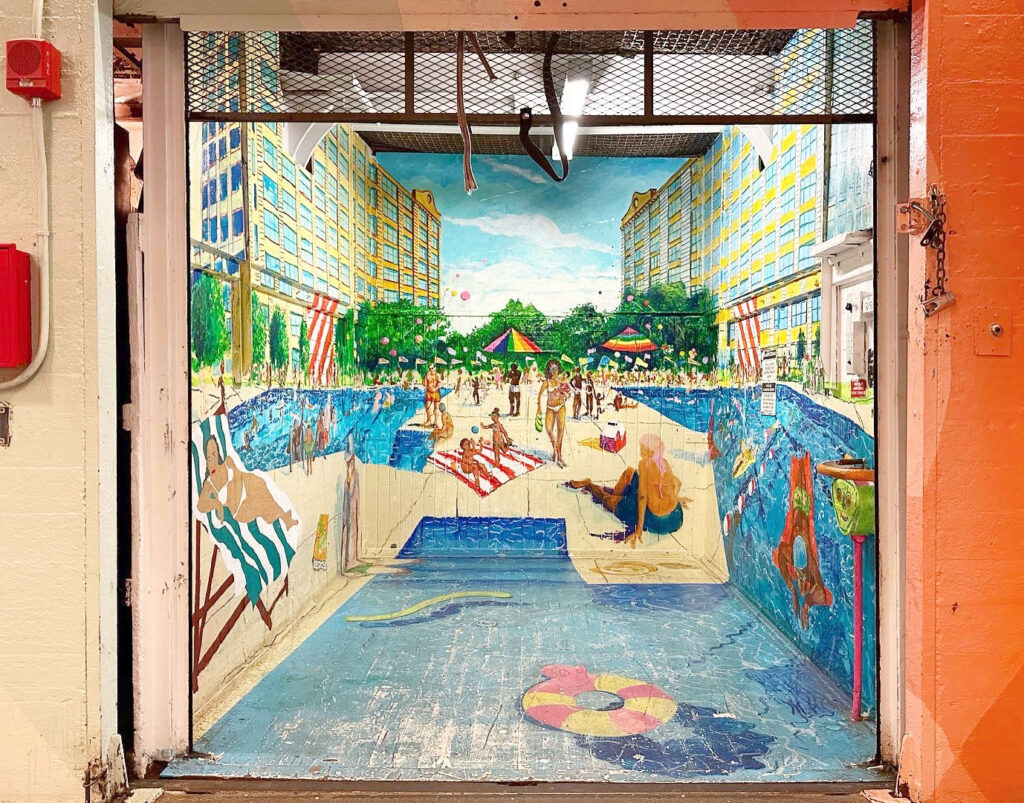
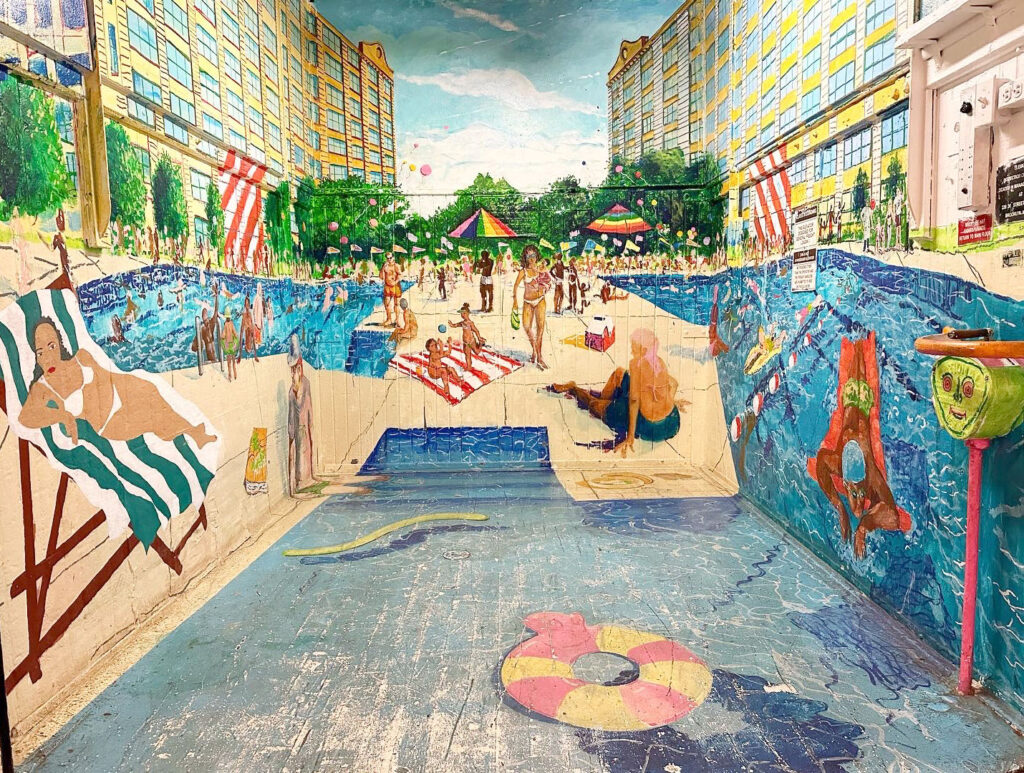
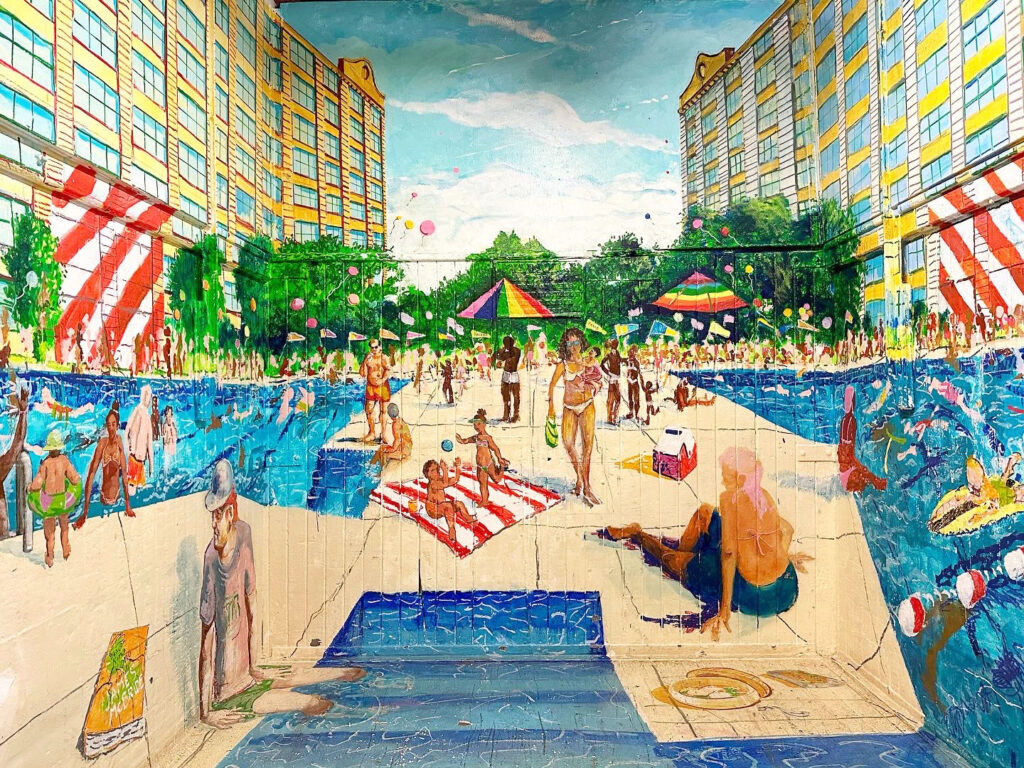
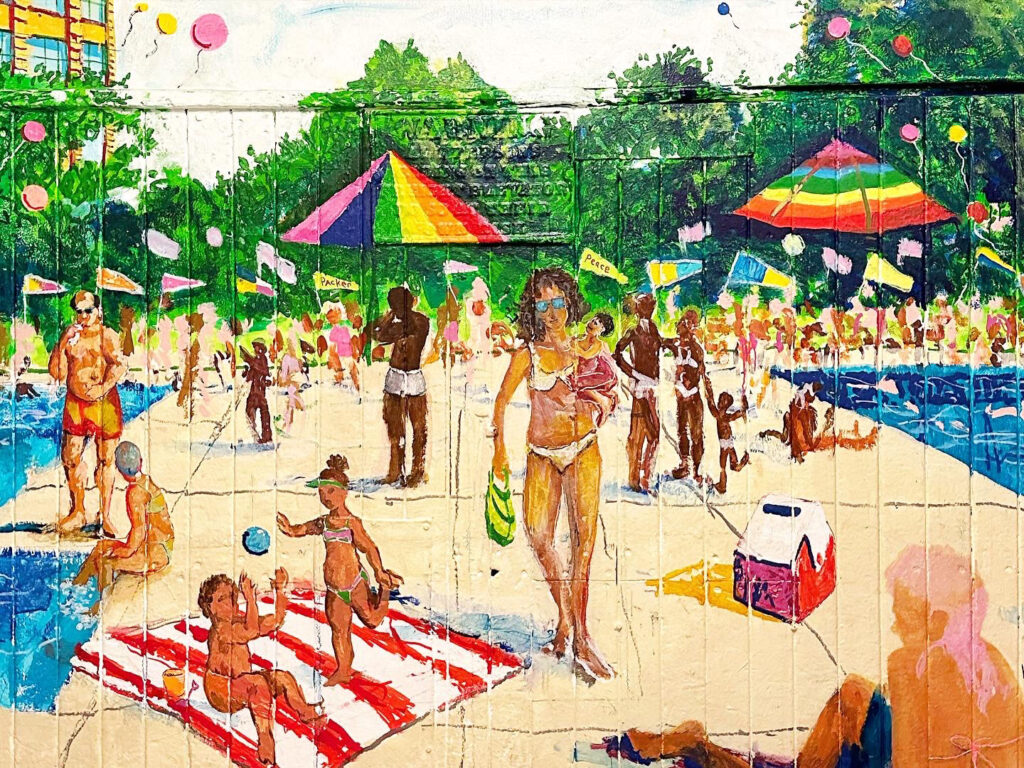
Brooklyn artist Ken Rush’s Poolevator is one of several works located in Industry City– organized by The Collision Project.

From The Collision Project about the work-

This installation represents both the reality and fantasy. The reality is depicted in the inspiring monumental architecture, while the fantasy emerges in the joyful addition of a swimming club with a celebration of swimming, sunbathing, recreation and play. For Rush, the work is a homage to Impressionist painters like Monet and Suerat, and the way that they depicted urban and rural pleasures. This is a group project between Rush and three of his students from High School Visual Arts at Packer Collegiate Institute in Brooklyn Heights.