Justine Kelley is a Filipino-American, Philadelphia-based printmaker, illustrator, and designer. She is inspired by vibrant colors, emotions, and the accidents that happen during the art-making process. Most of Kelley’s work is hand-drawn, infusing it with an honest, intimate quality. Her illustrations aim to explore the social barriers that exist between people to create new structures of meaning and connectivity. Kelley likens her art-making process to cooking—she uses the resources she has to feed the people she loves. Her goal is to synthesize emotion as a raw material and use it to create a magic funhouse mirror which reflects the world back at itself.
For her exhibition at Philadelphia International Airport, Kelley presents the Bella Vista neighborhood with an emphasis on the Italian Market, the nation’s oldest open-air market which spans 20 city blocks in South Philly. Bella Vista means “Beautiful Sight” in Italian. For many generations, this neighborhood has been home to a variety of immigrant communities, from Irish, Italian, and African descendants in the 1800s to Vietnamese, Korean, Cambodian, and Mexican communities settling in the 1900s. Having recently moved to South Philly, Kelley says, “I wanted to celebrate the abundance of food and fresh produce, colorful signage and typography, and bustling community that exist in the Italian Market and Bella Vista area, with much thanks to the shopkeepers who run their businesses and the neighbors who live here… If the path to one’s heart is through the stomach, then this place is an artery pumping vitality to the city, feeding us with nutritious foods and delicious sights. It’s a feast for all the senses. If I were to rename Bella Vista, it would be the Italian words for “Beautiful Sights, Sounds, Tastes, Smells, and Feelings”.
Currently on view at Philadelphia International Airport,It’s A Wrap 2, brightens a section of the airport with art work and installations by several local artists.
This exhibition features work by Philadelphia area artists who were invited to create unique architectural interventions within the Airport terminal. Using yarn, fabric, felt, found objects, tape, paint, wheat paste, and wood, the artists applied their work to the ceiling tiles, columns, rockers, walls, walkway, and windows. They have visually transformed this location into an immersive and experiential art-filled passageway.
The artists responded to the existing architectural elements to create an unexpected visual experience and an engaging space for people to pass through. It is a form of urban interventionism where art activates the built environment with the intention to see a public space in a new and creative way.
If you have a layover or arrive early to Philadelphia International Airport, make sure to take some time to check out some of the art on display. Works like the murals in this post, are part of the airport’s Exhibitions Program.
About Art at PHL:
The Airport’s Exhibitions Program is a nationally-recognized, award-winning visual arts initiative.
In 1998, Philadelphia International Airport established an Exhibitions Program – a visual arts initiative to humanize the Airport environment, provide visibility for Philadelphia’s unique cultural life, and to enrich the experience of the traveling public.
The Exhibitions Program is responsible for organizing and presenting rotating exhibitions that are located throughout the Airport. The exhibits change throughout the year to provide a variety of educational and cultural programs. This forum for presenting visual arts attests to the Airport’s commitment to supporting arts and culture.
The Exhibitions Program provides millions of visitors from around the world access to a wide variety of art forms by artists and arts institutions from the Philadelphia area.
“Nous Visited The Seine, But Did Not Swim”, 2022, Oil on canvas
“The Senses”, 2021, Oil and oil stick on canvas
The paintings in Jerrell Gibbs‘s solo exhibition at Brandywine Museum of Art, No Solace in the Shade, are alive with colors and movement, capturing moments in time both real and imagined.
From the museum about the show-
“Jerrell Gibbs: No Solace in the Shade” surveys the first decade of contemporary Baltimore artist Jerrell Gibbs’s (b. 1988) career and marks his first one-person Museum exhibition. A painter with astonishing creativity, Gibbs’s dynamic, large-scale figurative paintings explore facets of Black life, including family, friends, and community. His highly personal approach creates a narrative that centers everyday moments in Black life, representations of which have been excluded from art history until recent decades. Throughout his body of work, Gibbs transforms scenes of ordinary life into monumental moments while exploring themes of identity, reflection, and belonging.
Across his career, Gibbs has challenged the near invisibility of Black life in American art. He does so by celebrating identity and culture with profound compassion and insight, often weaving in elements of his own upbringing. Several works featured in the exhibition represent people from his own life. Old family photographs are also an inspiration in his creative process, prompting Gibbs to explore questions of identity and the passage of time. Gibbs conveys the joy, liveliness, and contemplation of Black life in positive representations. Shifting away from menacing racial stereotypes present in previous depictions of Black life in art (particularly images of Black men), Gibbs’ paintings show Black people living, not just surviving.
Jasper Frances Cropsey, “Autumn in the Ramapo Valley, Erie Railway”,1873, Oil on canvas
Jasper Francis Cropsey, “Autumn in the Ramapo Valley, Erie Railway”,1873 (closer)
Andrew Wyeth “Fall at Archies”, 1937, Egg tempera on panel
Andrew Wyeth “Fall at Archies”, 1937,(detail)
Jasper Francis Cropsey, “Autumn on the Brandywine”, 1887, Oil on canvas
Autumn is a perfect time to see the latest exhibition Cropsey, Wyeth, and the American Landscape Tradition at the Brandywine Museum of Art. The exhibition offers the first opportunity to view the large painting Autumn in the Ramapo Valley, Erie Railway by Jasper Francis Cropsey in a museum, as well as to see several additional works by artists including the always wonderful Andrew Wyeth.
From the museum about the exhibition-
A stunning example of Gilded Age patronage, Autumn in the Ramapo Valley, Erie Railway of 1873, has been in private British collections since it was commissioned the same year by Irish-American railroad magnate James McHenry. This major canvas changes our understanding of Jasper Francis Cropsey, one of the iconic talents of American art. Almost seven feet in length, Autumn in the Ramapo Valley, Erie Railway is both a celebration of the American landscape and American industry. The train passing through the valley is a reference to the Erie Railroad, in which McHenry had recently acquired a majority stake. Just after it was completed, McHenry had the painting shipped to England where it remained until purchased in 2025 by the The J. Jeffrey and Ann Marie Fox Foundation for American Art. Seen by the public for the first time since 1873, the painting will be at the heart of a special exhibition, Cropsey, Wyeth, and the American Landscape Tradition, which draws on the rich and varied holdings of the Brandywine Museum of Art and the Wyeth Foundation for American Art to provide a focused appraisal of the complex art of American landscape painting.
Alongside this exceptional large-format Cropsey, additional works by Cropsey, Alfred Thompson Bricher, Albert Bierstadt, William Trost Richards, John Frederick Kensett, Mary Blood Mellen, Martin Johnson Heade, and more survey the nineteenth-century boom in landscape painting in the United States and the relationship to industry that was a key context at the heart of this movement. The exhibition continues the story with Cropsey’s afterlives. Through key works in the Brandywine and Wyeth Foundation collections, a clear line of descent traces the further development of American landscape art, via Homer, Bellows, and N.C. Wyeth to an especially rich flowering in the works of Andrew Wyeth (1917–2009). Documentation in the Wyeth family library and archives shows a depth of engagement with artists of the Hudson River School not previously recognized, including specific lessons in composition, allegory, and the aesthetic potential of industry that Andrew Wyeth learned from paintings like Autumn in the Ramapo Valley. With a variety of works in watercolor and tempera, some of which have never been exhibited before, the story of the rich American landscape tradition continues and intriguing commonalities between the artists of the Hudson River School and Wyeth emerge.
Some additional information about Cropsey from the museum-
Cropsey was one of the leading lights of American art in the third quarter of the nineteenth century: a period in which new fortunes from natural resources and transportation were being spent on ambitious landscape paintings depicting the very regions that were the sources of their wealth. Cropsey’s rivals included the likes of Frederic Edwin Church and Albert Bierstadt. All three worked regularly for railroad barons, and all three achieved notable success, while the so-called “landscape boom” lasted, that allowed them to build statement mansions in New York’s countryside.
It was at Cropsey’s country home, “Aladdin,” in Warwick, New York that he made this painting for the transatlantic businessman James McHenry. Irish-born, Philadelphia-raised, Liverpool-launched, and London-based by this time, McHenry was a European supplier for, and investor in, American railroads. By this date, he had taken control of the Erie Railway and, in celebration, commissioned a depiction from Cropsey of its passage through the scenery of the Ramapo Valley near the northeastern border of New Jersey with New York. Cropsey had already gained a national reputation for paintings that blend industrial and natural subjects in this way, most famously in his 1865 painting Starrucca Viaduct, Pennsylvania (Toledo Museum of Art) depicting a major engineering feat of the same railroad McHenry now controlled, so he was a fitting choice for this commission.
While many American landscape artists were traveling and painting internationally in the period, interest in their work generally came from American audiences. Cropsey was an exception: he worked in London for seven years and exhibited thirteen paintings at the Royal Academy of Art’s competitive annual exhibitions, was presented to Queen Victoria, and sold numerous works to British buyers. The return of Autumn in the Ramapo Valley, Erie Railway to the United States is a landmark moment for scholars and art lovers alike that helps in telling a fuller story of the global networks that surround historical American art.
The Brandywine Museum of Art is currently showing Human Nature, a selection of work by Andrew Wyeth focused on the human form. The museum has an extensive collection of the artist’s paintings and often has shows focused on him and his artistic family.
From the museum about this exhibition-
One of the artist Andrew Wyeth’s enduring legacies is his highly original response to the subject of the human body. Alongside his iconic landscapes and visionary responses to buildings, botany, and beyond, his figure paintings and drawings offer particular insight into how this unique creative journey took shape, and how he was connected to the history of art.
The rarely seen paintings and drawings on view in Human Nature reveal an artist who was steeped in the tradition of Western art, engaged in a diligent study of the human form via the long-tested methods of sketching from live models and plaster casts, and who found in his portrait subjects ways of evoking enigmatic narratives and inner lives.
The works in this exhibition, drawn from the Brandywine and Wyeth Foundation collections as well as one exciting loan from a private collection, present a unique opportunity to understand Wyeth’s eye. Case studies include early figure drawings made in his father’s studio, self-portraits, intimate depictions of close family members, a little known and fascinating body of commissioned portraits, a broad representation of his mature practice including many major figural temperas and watercolors, and a final section on how he approached the nude figure. One highlight is the loan of Wyeth’s portrait of Professor Joyce Hill Stoner, a leading art conservator who shares in the exhibition’s wall texts some firsthand reflection on the process of being painted by Wyeth. Visitors will come away with new understanding of a remarkable lifelong practice that clarifies the operations and values at work across his art.
The painting above is of Adam Johnson who raised chickens and pigs a short walk from Wyeth’s studio in Chadds Ford. When this was painted, Wyeth had already known him for thirty years. Other interesting paintings in the show include the two very different portraits of Wyeth’s sister Ann, from earlier in his career, pictured below.
“Ann Wyeth in White”, 1936, Oil on canvas
“Ann”, 1939, Egg tempera on panel
From the museum about these two works-
As a young artist, Wyeth made a few dozen works in oil on canvas before abandoning this medium for good. There is a stark difference between the two portraits of pianist and composer Ann Wyeth, the artist’s sister, made three years apart. This depiction is handled very freely, in contrast to the more tightly painted tempera to the right, in which the artist and, by extension, the viewer loom over the subject in a most unsettling way while Ann Wyeth ignores our gaze in her peripheral vision.
Flat Top Desk, 1929 and 1962, Walnut and padauk, Flat Top Desk Chair, 1929, Walnut, padauk and laced leather seat, Flat Top Desk Figure, 1929, Bronze cast of cocobolo original
“Head of Dreiser”, ca.1927, Pine- This is a portrait of writer Theodore Dreiser who Esherick met in 1924 through the Hedgerow Theatre. This was a rough, geometric sketch for a finished mahogany piece.
“Self Portrait”, 1919, Oil on canvas
The Crafted World of Wharton Esherick, on view at Brandywine Museum of Art, presents a wonderful look at the artist’s varied work from throughout his career.
From the museum-
This exhibition explores the interdisciplinary creativity of Wharton Esherick (1887-1970), the famed American artist best known as the father of the Studio Furniture Movement.
Esherick considered his hillside home and studio, now the Wharton Esherick Museum (WEM), the best representation of his iconoclastic vision, calling it “an autobiography in three dimensions.” Built between 1926 and 1966, his unconventional escape on the verdant slopes of Valley Forge Mountain houses almost 3000 iconic works of art from across Esherick’s seven decades of artistic practice.
The Crafted World brings selections from this rich and rarely loaned collection to a broader public, including many objects never before seen except in Esherick’s home and studio. Detailing the artist’s career from his early woodcut illustrations for books by members of the avant-garde literati to his revolutionary reimagining of furniture forms as organic sculpture, works will be presented in thematic vignettes that invite visitors into Esherick’s story and bring the essence of his creative world into the gallery.
Esherick made numerous objects centering on the twist or spiral to represent natural growth. He returned to this form in models for staircase commissions for the Bok House- in which the spiral is created through gradual shifts in the shape and width of each step- and for the Hedgerow Theatre– which features a staircase like the Studio’s that revolves around a center post.
“Moonlight on Alabama Pines”,1919-20, Oil on canvas, carved wood frame with metallic paint
Alabama Pine woodblock, 1929
“Oblivion” 1934, Walnut
About the sculpture above, Oblivion, from the museum-
Moved by the emotion and physicality of actors, Esherick spent many hours in the balcony of the Hedgerow Theatre, in nearby Rose Valley, sketching performers, and many more hours designing stage sets, props, posters, and other visual elements for their productions. Oblivion was inspired by the passionate embrace of two actors in The Son of Perdition, a play by Lynn Riggs. This organic, fluid sculpture offers an exaggerated rendering of emotion as two intertwined bodies, carved from a single log, seem to softly dissolve into one another. Oblivion was prominently featured in the sculpture portion of the second Whitney Biennial in 1936.
Best known for the paintings he did as cover illustrations for The Saturday Evening Post, Rockwell also did extensive work for other major publications. “The Fiddler” appeared as a cover for The Country Gentleman in October 1921, still relatively early in his career. Rockwell celebrates autumn and Halloween, represented by both the grinning jack-o-lantern and the corn cob and autumn leaf garland. He skillfully mimics the effect of stage lighting in this painting, highlighting the musician’s expression and hands, creating an illusion of three-dimensionality.
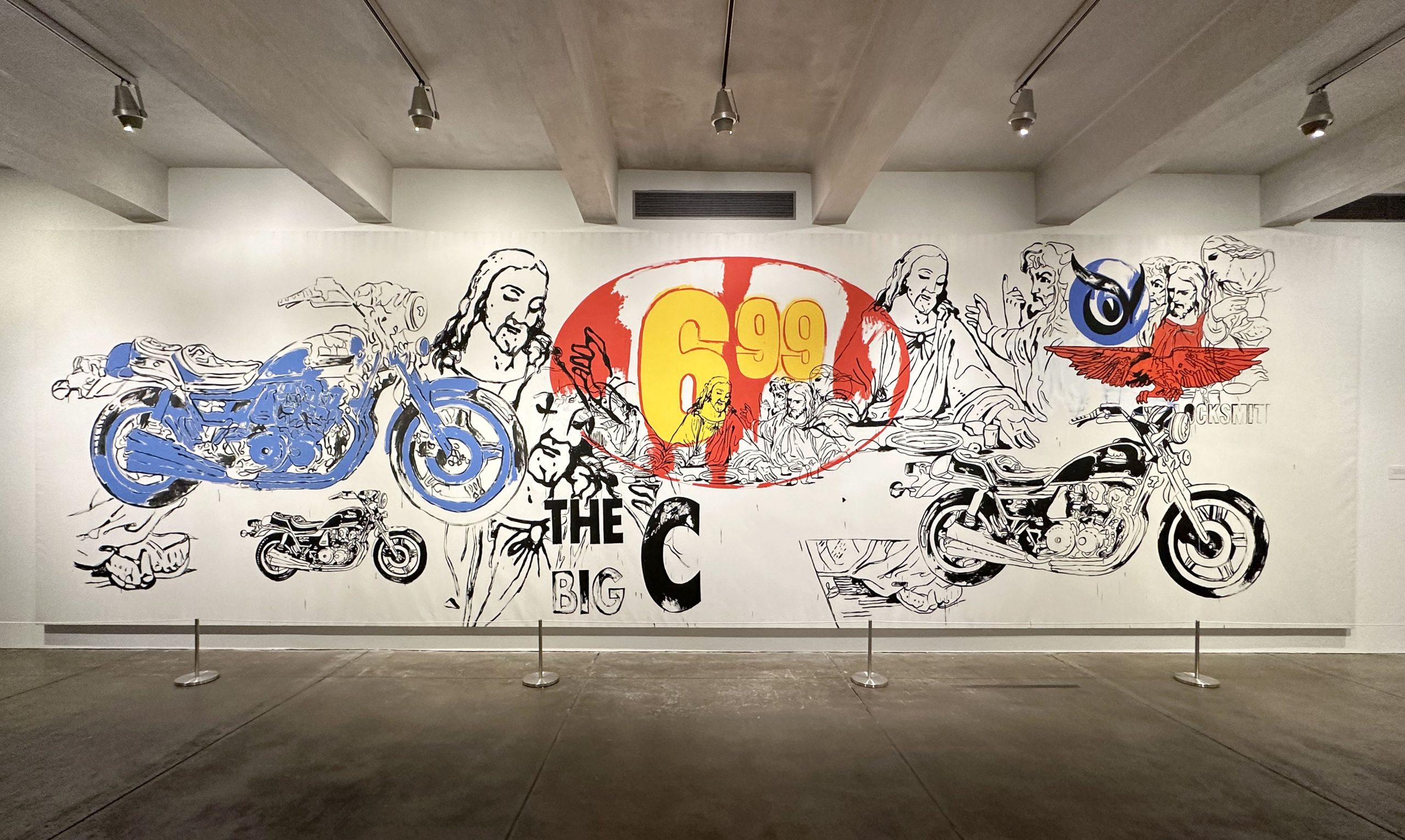
“The Last Supper”, 1986, Acrylic and silkscreen ink on linen
In the 1980s Andy Warhol created a series of paintings based around Leonardo da Vinci’s The Last Supper. The one above is currently on view at The Warhol Museum in Pittsburgh, Pennsylvania.
In 2010 it was on view as part of the Brooklyn Museum’s exhibition Andy Warhol: The Last Decade.
From their website about the work-
The Last Supper series was commissioned to inaugurate a new gallery in Milan, Italy, located across the street from the site of the Italian Renaissance artist Leonardo da Vinci’s iconic fresco (circa 1495–98) depicting Jesus’s last meal with his followers. Warhol worked obsessively for more than a year on this series, producing more than a hundred Last Supper paintings, both silkscreened and hand-painted, that were some of the largest paintings of his career.
Despite his public proclamations to the contrary, Warhol was profoundly moved by the series. Of these works, he remarked, “I painted them all by hand—I myself; so now I’ve become a Sunday painter. . . . That’s why the project took so long. But I worked with a passion.” These paintings manifest both his religious beliefs—his practice of Catholicism remained private until it was revealed at his funeral—and an irreverence toward the subject, expressed through ironic commercial logos and transgressive repetitions of Christ’s image.
Warhol created many variations using versions and pieces of da Vinci’s fresco and there is some debate as to the meanings behind them. In 2018, curator Jessica Beck wrote Warhol’s Confession: Love, Faith, and AIDs, an in-depth essay exploring possible meanings behind the work. She suggests Warhol was referencing AIDS, suffering, health, and mortality, along with his relationship to Christianity.
In this section of the essay she discusses the imagery from the painting-
The tension between Warhol’s sexuality and his religious life has its fullest expression in paintings such as The Last Supper (The Big C), in which signs and symbols create a private reference to AIDS. Hand-painted via a projection process, like paintings of 1961–62 such as Before and After, Wigs, and Dr. Scholl’s Corns, the canvas is left partly unfinished, and Warhol employs a light touch with an abstract brushstroke. On this canvas the figure of Christ recurs four times, while hands appear repeatedly. Thomas’s finger pointing to the sky, intimating that heaven knows he is free of guilt, appears prominently next to the “eye” in the Wise potato-chip logo.
…The source material for the painting, in the archives of The Andy Warhol Museum, Pittsburgh, is a collage made up of headlines from the New York Post, motorcycle ads, and clippings reading “the Big C” and “AIDS” cut from a front-page article in the Post. Warhol ultimately left out the AIDS headline while keeping the more covert “The Big C,” but given the direct references to “gay cancer” in his diaries, it becomes clear that this image of Christ was connected for him to the rapid rate at which people were dying around him. “The Big C” was synonymous with AIDS. The Last Supper (The Big C) reflects on sex and shame through appropriated images of Christ’s betrayal, the piercing owl’s eye (the Wise logo), and the numbers 699, appropriated from a price tag—$6.99—but indexing both the sexual position “69” and the “mark of the beast,” 666, in the Book of Revelations. Even the details of Christ’s feet at the far right of the canvas seem to point to the notion of punishment: for Steinberg, writing on Leonardo’s Last Supper, “as [Christ’s feet] rejoin the rest of the body, they foreshadow it glorified; and they foreshadow it crucified.”34 The image of Christ offering his flesh in the Eucharist was a symbol of salvation during a time of suffering, an unusually personal and emotional image for Warhol. In keeping with the complexities of his construction of death in the Death and Disasters, and with its repression in the diaries, the painting speaks of sex and of judgment. It is an allegorical triangulation of mourning, punishment, and fear.
For more on Warhol an his diaries, the Netflix documentary is really informative as well as entertaining. It’s a moving portrait that goes beyond what most people know about Warhol, both as an artist and as a person.
Workflow, the first institutional solo exhibition of artist Jenson Leonard, centers on a titular film that explores the velocity and momentum of Blackness as it relates to the philosophical concept of acceleration—the notion that the only way out of capitalism is through its intensification.
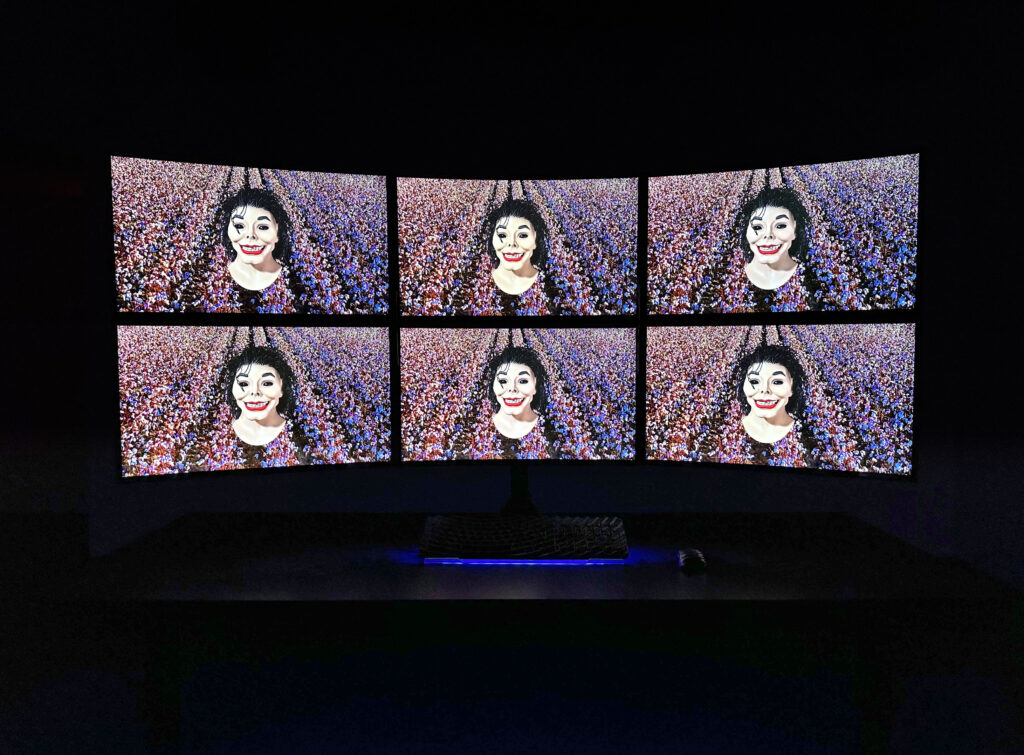
In Workflow, a spectral Michael Jackson Halloween mask recites a surrealistic quarterly earnings reports. Building on a 2017 essay by artist Aria Dean titled “Notes on Blacceleration,” the short film centers on the ways in which the Black subject grapples with its commodified status within the labor market despite—or, resultant of—its own history as a commodity, stemming back to the Trans-Atlantic slave trade. Completed during Leonard’s residency at Pioneer Works in 2021, the video utilizes uncanny humor as a mechanism to expose the shared grammars inherent in Afro-pessimism and speculative finance.
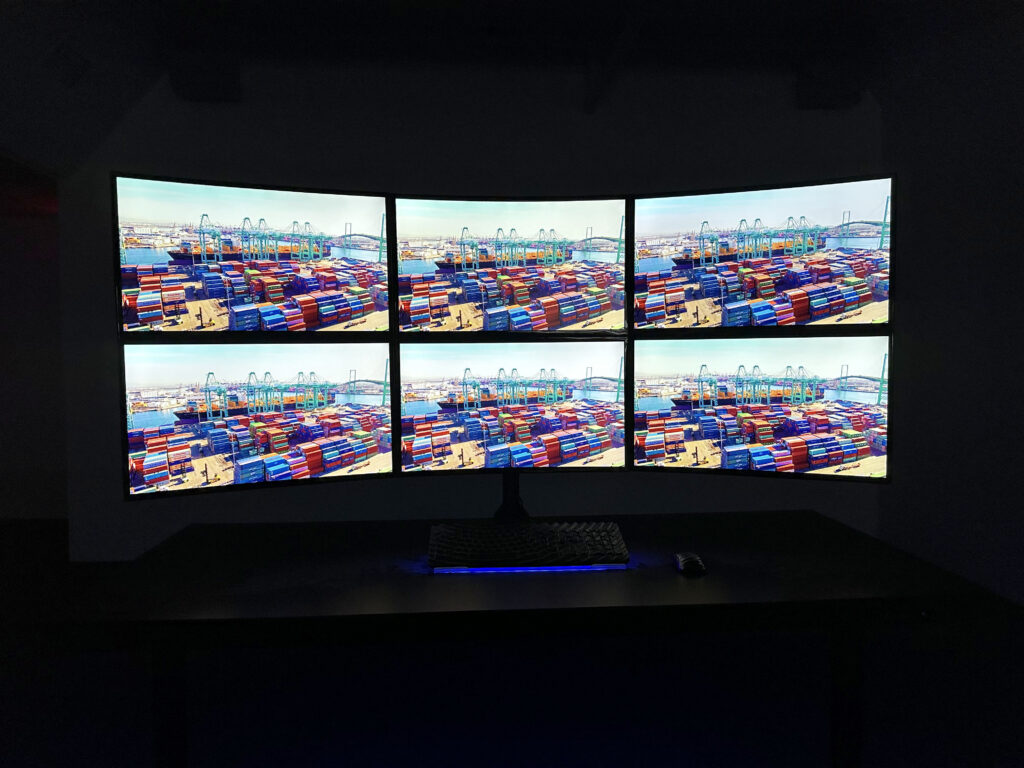
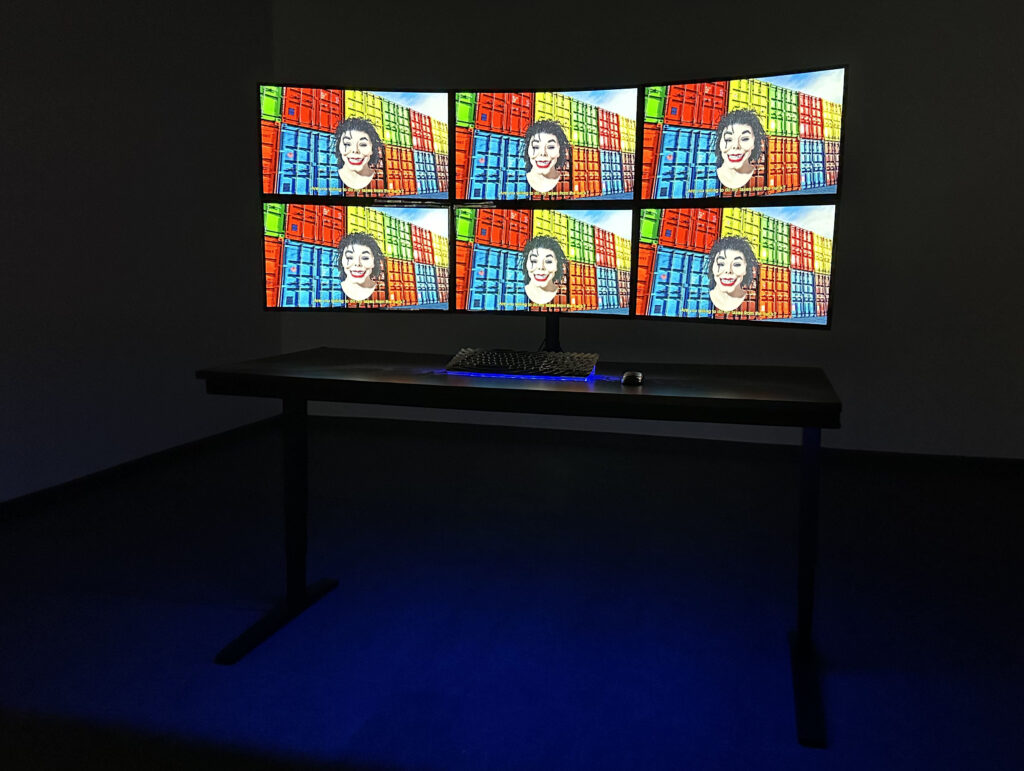
Within the exhibition, the film repeats simultaneously across two grids of computer monitors situated on ergonomic desks that flank the gallery, mimicking the workstations that can be found ubiquitously across stock trading floors and financial institutions. Sculptures modeled after computer keyboards and mouses are displayed on the desks, each rendered inoperable by concentric riffs that symbolize the erratic transformations caused by the flows of capital. The appearance of Jackson represents a transmogrification of its own; whereas many have aligned the controversial pop icon’s bleached skin and surgical procedures with Black self-hatred, Leonard positions his bodily modifications as a radical rupture from racial paradigms of being.
In Leonard’s own words, “Workflow is defined as the sequence of industrial, administrative, or other processes through which a piece of work passes from initiation to completion. My film seeks to disabuse notions of completion, whether it be completion of the human, the nation state, or civil society. As Dean notes, Blackness is ‘always already accelerationist’ via its incongruence with Western humanism, a wrench thrown into the locomotive gears of ‘capital and subjecthood.’ Her essay prompts us to look toward the way that the Black has been historically constructed outside of the human, as coterminous with the slave. Slavery therefore represents a kind of proto-automation, a mass forced coercion of labor, and the Blacks’ transition from object to subject calls for a reappraisal of accelerationist ideas about the (non)human entity and its revolutionary potential.”
The artist continues, “There is something about going to work—the repetition of it—that gets inscribed at an epigenetic level, as an everyday, embodied violence. From there, I thought about the panoptic workplace (open air plan, transparent yet closely surveilled, management that does not have to be in the room to be monitoring you), the fetish of efficiency (ergonomic mouse and keyboards so you can work longer), biometric data of a labor force (fingerprint and facial scans to help reduce repeat processing tasks). All of these methods to maximize profits and production can be traced back to methods worked out and perfected in the cotton and sugar cane fields hundreds of years prior.”
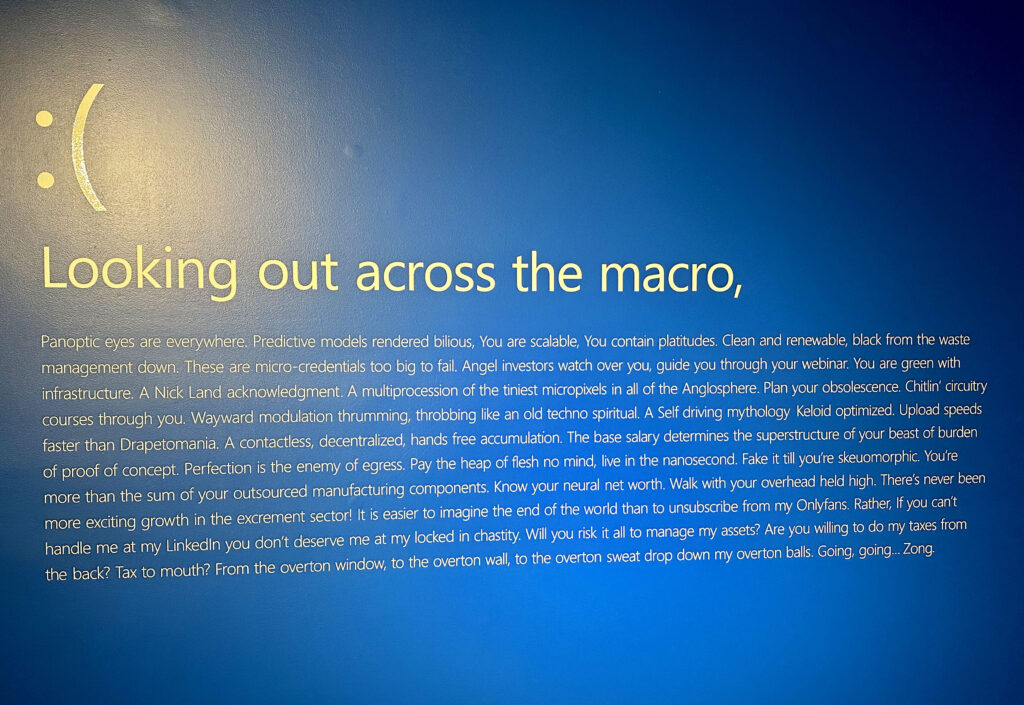
The text from the video was included on one of the gallery walls (image above) but I’ve included it below as well as it is definitely worth reading.
“Looking out across the macro- Panoptic eyes are everywhere. Predictive models rendered bilious, You are scalable, You contain platitudes. Clean and renewable, black from the waste management down. These are micro-credentials too big to fail. Angel investors watch over you, guide you through your webinar. You are green with infrastructure. A Nick Land acknowledgment. A multiprocession of the tiniest micropixels in all of the Anglosphere. Plan your obsolescence. Chitin’ circuitry courses through you. Wayward modulation thrumming, throbbing like an old techno spiritual. A Self driving mythology Keloid optimized. Upload speeds faster than Drapetomania. A contactless, decentralized, hands free accumulation. The base salary determines the superstructure of your beast of burden of proof of concept. Perfection is the enemy of egress. Pay the heap of flesh no mind, live in the nanosecond. Fake it till you’re skeuomorphic. You’re more than the sum of your outsourced manufacturing components. Know your neural net worth. Walk with your overhead held high. There’s never been more exciting growth in the excrement sector! It is easier to imagine the end of the world than to unsubscribe from my Onlyfans. Rather, If you can’t handle me at my Linkedin you don’t deserve me at my locked in chastity. Will you risk it all to manage my assets? Are you willing to do my taxes from the back? Tax to mouth? From the overton window, to the overton wall, to the overton sweat drop down my overton balls. Going, going… Zong.”