Oct 202017
 

                                                            Fanon (Even the Dead Are Not Safe) 2017 (image via Metro Pictures)

Artificial intelligence is a growing field with numerous implications for the future, some more sinister than others. Trevor Paglen’s current exhibition at Metro Pictures gives some insight into this evolving technology.

From the Metro Pictures press release-

Trevor Paglen’s A Study of Invisible Images is the first exhibition of works to emerge from his ongoing research into computer vision, artificial intelligence (AI) and the changing status of images. This body of work has formed over years of collaboration with software developers and computer scientists and as an artist-in-residence at Stanford University. The resulting prints and moving images reveal a proliferating and otherwise imperceptible category of “invisible images” characteristic of computer vision.

Paglen’s exhibition focuses on three distinct kinds of invisible images: training libraries, machine-readable landscapes, and images made by computers for themselves. For Machine-Readable Hito, for example, Paglen took hundreds of images of artist Hito Steyerl and subjected them to various facial recognition algorithms. This portrait of Steyerl presents the images alongside metadata indicating the age, gender, emotional state and other signifiers that the algorithms have interpreted from the images. In another portrait in the show, Paglen trained facial recognition software to read the face of philosopher Frantz Fanon. A ghostly image of Fanon shows the facial signature–the unique qualities of a face as determined by biometric recognition software–used by computer vision to identify an individual.

To make the prints in Adversarially Evolved Hallucinations, Paglen trained an AI to recognize images associated with taxonomies such as omens and portents, monsters, and dreams. A second AI worked in tandem with the first to generate the eerie, beautiful images that speak to the exuberant promises and dark undercurrents characterizing our increasingly automated world.

The video installation Behold These Glorious Times! brings together hundreds of thousands of training images routinely used for standardized computer vision experiments and pairs them with visual representations of an AI learning to recognize the objects, faces, expressions and actions. A loose narrative begins to emerge about the collapsing distinctions between humans, machines and nature. Electronic musician Holly Herndon composed a soundtrack using libraries of voices created to teach AI networks how to recognize speech and other acoustic phenomena.

The image below is one of the prints from Adversarially Evolved Hallucinations. A series of these images, presented all in one room in the back gallery, are particularly unsettling as they have elements that seem familiar while remaining distorted. As artworks, they are captivating in their strangeness as well as their beauty.

                                                                Porn (Corpus: The Humans) 2017 (image via Metro Pictures)

The exhibition also has a printout with more detail about the creation of the work that goes beyond the press release, located at the front of the gallery. Make sure to leave time to take in this fascinating show. A Study of Invisible Images closes 10/21/17.
May 202017
 

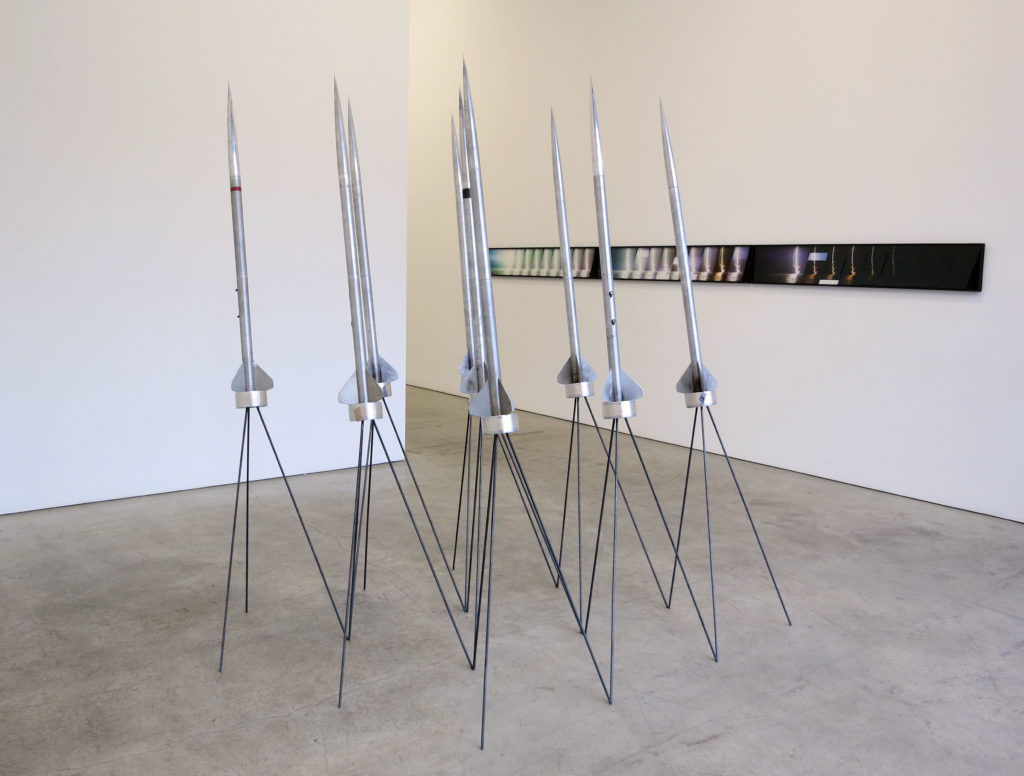
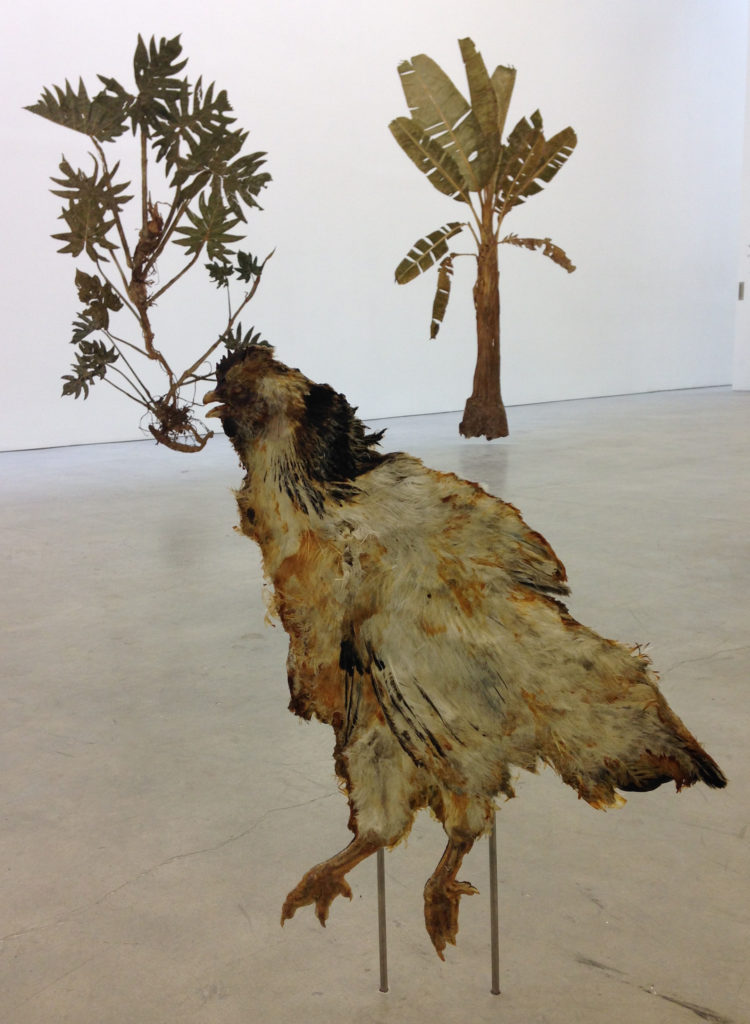
Julius von Bismarck’s Good Weather at Marlborough Contemporary is an interesting meditation on man’s desire to control nature. The first half of the exhibition focuses on Bismarck’s attempts to capture a lightning bolt with the rockets pictured above. In a side room there is a mesmerizing video of a storm rolling into a jungle and the lightning that he used for his experiment. The second half of the gallery focuses on pressed plant species and chickens.

In the press release his process for achieving these flattened works is described in detail-

Like a Colonial scientist, von Bismarck has collected plant species from jungle. Rather than pressing tiny flowers in a notebook, the artist has pressed large plants and entire palm trees into flattened specimens. Heated to a precise 250 degrees in an enormous custom-built oven and a 50-ton hydraulic press, the plants are completely dehydrated without losing their verdant coloration, and squashed astonishingly flat. They are then backed with thin stainless steel to maintain their shape for presentation.

This exhibition closes 5/20/17.

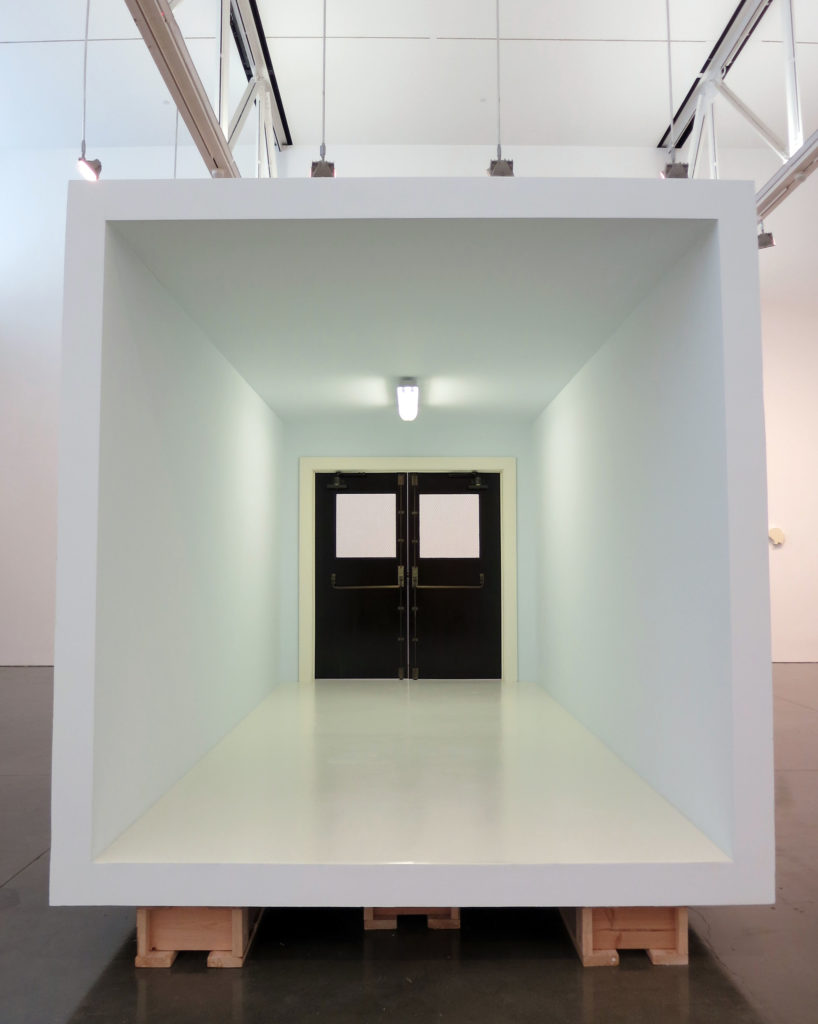
                                                                                       No title (room, panic doors), 2013-14
At Gagosian gallery is Robert Therrien‘s first show in New York in ten years. The artist, well known for his sculptures of massive tables, chairs and plates, is now creating rooms and new objects- which include drops, a bow, and a flagpole. The rooms are the works that stand out most, both in scale and in the disconcerting feeling of environments that should feel more normal than they do.

From the press release-

Despite their verisimilitude, Therrien’s rooms impede the viewer’s ability to engage with space in any comfortable way.  Meticulously assembled features of common industrial design allow one to stand in front of architectural vistas. Elevated above ground level and cut away to show interiors that, like dioramas, become impenetrable replicas of reality, each is like a mise-en-scène or readymade. No title (room, panic doors) (2013–14) presents a set of doors in a room filled with fluorescent light. In No title (paneled room) (2017), tambourines rest silent on the floor of a room luxuriously paneled in hardwood, and a ladder leads to a trapdoor in the ceiling. Each room transports the viewer out of the gallery and into a new narrative situation, prompting connections between material details and their subconscious associations. By making use of everyday things that are often overlooked, Therrien situates the viewer in familiar territory, then allows the objects to demand reassessment as instruments of subjectivity and of consciousness itself.

This exhibition closes 5/26/17.

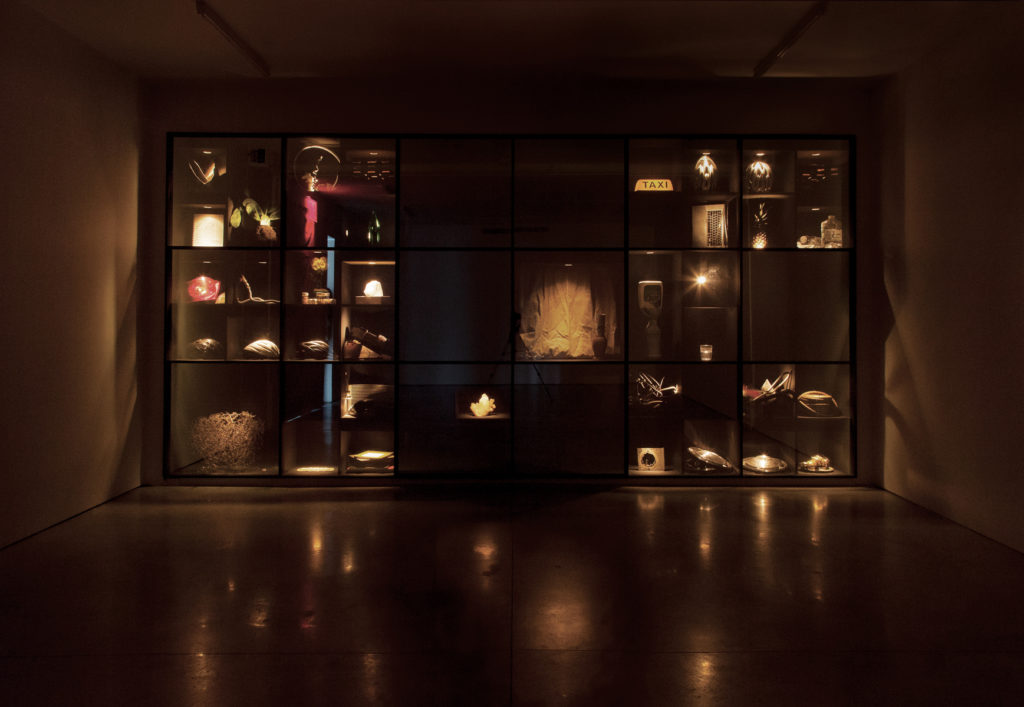
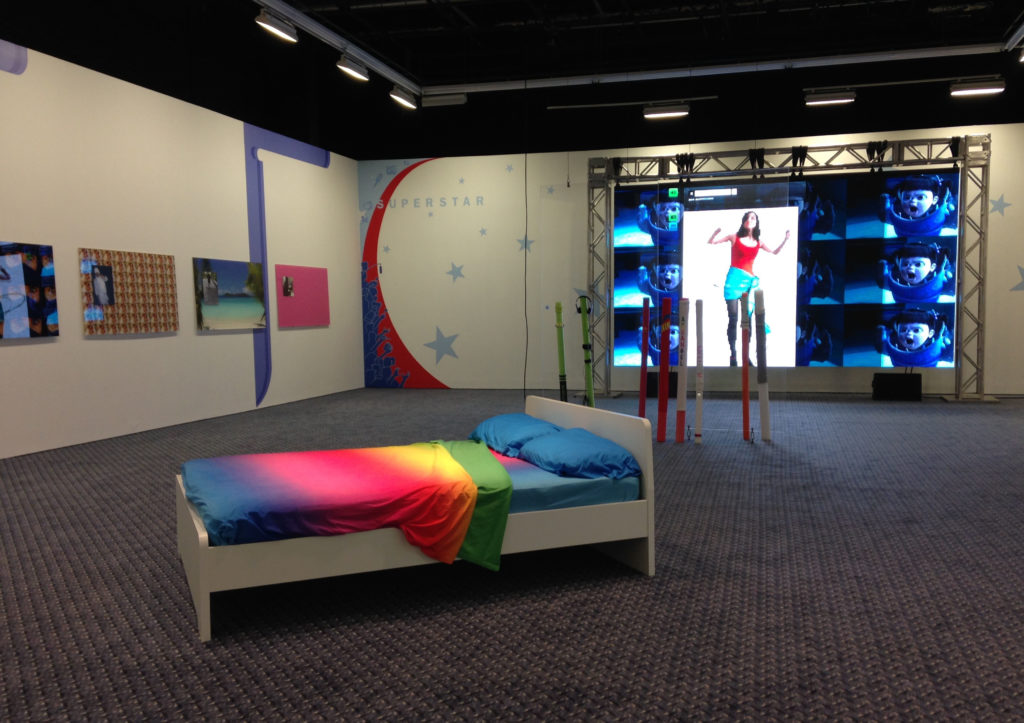
For a room of a different sort, there is Gabriel Lester’s Nevada at Ryan Lee gallery, in which various sections of a wall sized installation light up as assorted voices tell their stories.

                                                                                        Nevada, 2017 (image courtesy of Ryan Lee)
From the press release-

Questions of presence and absence resurface in Nevada, the second component of this exhibition. Nevada confronts the viewer with a floor to ceiling modular wall. Carefully selected objects that correspond with the individual stories combined in Nevada’s multilayered narrative occupy each compartment. Guided by light and sound, the viewer navigates the histories of a series of anonymous characters that find themselves locked out of the world they used to inhabit. In an effort to escape the parallel world in which they have come to dwell, each character attempts to understand the nature and cause of their own existence. Considering personal memories and local histories of migration, mining, gambling, nuclear test sites, and mysterious locations like Area 51 and the Nevada triangle (an area in the California-Nevada desert where numerous aircrafts have vanished), Lester’s Nevada probes the tensions that link the seemingly distinct characteristics of this place to a number of characters looking for a way back to a life they have lost.

The exhibition opens onto a room of low-resolution LED panels showing internet-sourced images of near extinct animals and their habitats. The two rooms feel like separate exhibitions but are brought together by their shared qualities of losing one’s place in the current world.

This show runs until 5/20/17.

Feb 182017
 

For Cory Arcangel and Olia Lialina’s exhibition at The Kitchen, Asymmetrical Response, the early days of the internet come to life in various artworks. The carpet is made of a diamond plate pattern that used to be a common background on 1990s websites and the wallpaper uses patterns from early Yahoo templates. One of the most interesting pieces is Lialina’s Give me time/This page is no more, a slide projection of former popular hosting site Geocities’ members home pages that promise a site they will create or come back to in the future. It’s hard not to look at these pages and wonder how soon what we are seeing now on the web will seem as antiquated as these images.

From the press release-

In military parlance, the terms asymmetrical and symmetrical are employed to refer to political provocations and diplomatic démarches, escalation and tension, and power dynamics of the highest order. Not specific to war, these terms also refer more generally to a set of relations that define our connections to power.

On the eve of Y2K, Russian­-born Olia Lialina—who is among the best-known participants in the 1990s net.art scene—first met American artist Cory Arcangel. Ever since, the artists have been deep in dialogue about the social and cultural impact of the Internet’s historical shift from a tool for military communication to an “information superhighway” promising open and equal exchange, and, finally, the increasingly asymmetric “content delivery system” we experience today.

This show closes 2/18/17.

Feb 112017
 

                                                                            Rodeo 10, 2016 (Photo credit Jeff McLane)

                                                                       Hillary Clinton, 2016 (Photo credit Robert Wedemeyer)

Karl Haendel‘s solo exhibition BY AND BY at Susanne Vielmetter Los Angeles Projects, is a collection of  highly detailed drawings mixed with earlier work made in 2000, and a new video piece. Included in the earlier work is State Motto Map, a colorful map of the United States, with each state’s motto labeled on it. Washington State’s motto is Alki, or Al-ki, a Native American word meaning bye and bye, and is where the title of this exhibition is drawn from.

From the press release–

In this exhibition, Haendel uses the idea of the portrait to explore contemporary definitions of masculinity, power, and public identity. He undertakes the challenging task of drawing a portrait of what it is to be a man, or perhaps what is expected of men, in images that span a broad range of representations from the heroic to the abject, from the depiction of male achievement in the highest ranks of power to a raw and unsympathetic examination of a middle-aged convicted sex offender. An inquiry into what represents masculinity also requires a look at the conventions of gender representation, as masculinity and femininity have so long been defined, particularly in images, as a codependent set of complimentary traits. In “By and By” Haendel both reasserts and undermines these conventions in heroic portraits of teenage girls riding rodeo, reproductions of murals depicting black civil rights leaders, and a monumental portrait of Hillary Clinton. His drawings and his video work against a tradition of portraiture that collapses individuals into ciphers and symbols that read as shorthand for historical legacies and narrative tropes.

This show closes 2/11/17.


(images via Susanne Vielmetter Los Angeles Projects)

Nov 062016
 

Unsatisfying by Parallel Studio

Love this funny, relatable video.

Here is some information from their Vimeo page-

During the summer of 2016, We created and directed a video about unsatisfying situations: the frustrating, annoying, disappointing little things of everyday life, that are so painful to live or even to watch.

We quickly realized that there are a lot of other situations that would be fun to see animated, so we decided to run an animation challenge around this idea.

Join the Unsatisfying Challenge Here : unsatisfying.tv/

Direction Animation and illustration : Parallel Studio
Sound Design : Zelig Sound
Music : Samuel Barber
Special Thanks to : Hugo Leick

Follow us on
facebook.com/parallelstudioparis/
dribbble.com/Parallel_Studio
instagram.com/parallel_studio_/

Jul 032015
 

Diller + Scofidio- Soft Sell

Walking by a small room on the third floor of the Hammer Building at LACMA, you may hear the voice from this video calling out to you with a series of questions that all start off  “hey you, wanna buy…?”. The choices range from the more abstract ideas of “a second chance” or “a piece of the American dream” to the more practical, like “a set of encyclopedias with a four color atlas”, to the more ominous options of “a judge” or “the mayor’s ear”.

The video was created by the team of Elizabeth Diller and Ricardo Scofidio working together as Diller+Scofidio.  Soft Sell was originally displayed in the windows of an abandoned porno theater on 42nd Street in NYC in 1993 and is currently part of LACMA’s photo exhibition titled Lens Work: Celebrating LACMA’s Experimental Photography at 50.

Diller and Scofidio added Charles Renfro as partner in 2004 to form Diller Scofidio + Renfro,“an interdisciplinary design studio that integrates architecture, the visual arts, and the performing arts”. They have designed many high profile projects including the first mile of the High Line in NYC, the Institute of Contemporary Art in Boston, and the Broad Museum, soon to be opened in Los Angeles.

More info:

This 2007 article from the New Yorker about Diller Scofidio + Renfro offers an interesting portrait of the group.

Apr 092015
 

Interpol- NYC

NYC is a single from Interpol’s debut album Turn on the Bright Lights, which was released in 2002. This video was created and directed by multimedia artist Doug Aitken.

Interpol are playing on the Friday (4/10) of Coachella this year. For the full lineup and set times for the first weekend, check here.

Nov 132013
 

perrybreitz

Image from the film- The Audition- by Candice Breitz

From the press release for her show, The Woods, at Perry Rubenstein Gallery –

The Woods encompasses installations filmed in three of the world’s leading centers of film production – Hollywood (Los Angeles, USA), Bollywood (Mumbai, India) and Nollywood (Lagos, Nigeria). Two of the three installations that make up the trilogy – The Audition (filmed in Los Angeles) and The Rehearsal (filmed in Mumbai) – present aspiring and working child actors, situating them in scenarios in which they ventriloquize voices and personae that would typically belong to adults. The third installation, The Interview (filmed in Lagos), features two adult actors who are best known on the African continent for their portrayal of child characters, and mimics the format of a conventional celebrity interview. As suggested by their titles, The Audition, The Rehearsal and The Interview zoom in on generally unseen show business rituals, which collectively become the loci of meaning through which Breitz reflects on and decodes the myth-making machinery of mainstream cinema.

The Audition, pictured above, has two video sets running at the same time- the child actor’s screen tests on one wall and on another wall, a set of screens with different child actors alternating between performing lines of advice from industry professionals, introducing themselves, and singing songs. The juxtaposition between their reading the words of adults and their free-form (no direction was given) screen tests, really accentuates this world where children grow up early for the sake of fame.

Each of these installations run close to or longer than an hour (the longest is 76 minutes). That said, they make an impression even without being seen in their entirety.