Nov 052025
 

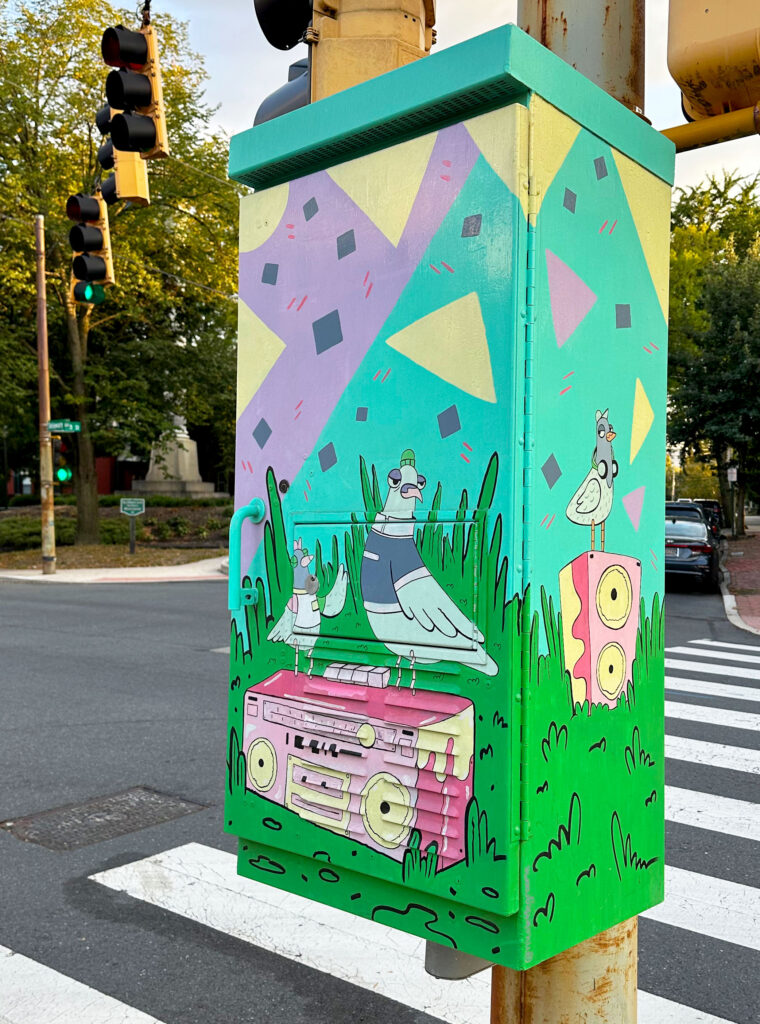
Nicolette Groome created Hip Hop Pigeons for the 2022 Trolley Square Mural Project, in Wilmington, Delaware. Organized by the Delaware Avenue Community Association, several artists created fun utility box murals to brighten up the neighborhood with art.

From more of Groome’s more recent work, also check out her Instagram.

Apr 152025
 

Artist and illustrator Joseph Christian Leyendecker created this painting in 1926 for the cover of The Saturday Evening Post. Leyendecker produced annual covers featuring timely takes on “Baby New Year” for several years.

This work was part of Delaware Art Museum’s 2024 exhibition Jazz Age Illustration, which focused on the art of popular illustration in the United States between 1919 and 1942.

Apr 042025
 

Create Magic Studios, made up of husband and wife team Todd and Allison Purse, has recently taken over local book store Huxley & Hiro‘s future home with a pop-up shop and gallery. The space is filled with artwork from local artists and Todd’s bright, colorful murals.

Along with making artwork and comics, Todd Purse also designs artwork for Brandywine Coffee Roasters, including their hand printed bags. In one of the rooms in the gallery several of them are on display.

Tonight, 4/4/25, is one of the last times to see the space and will be open from 5-8pm with live music from Danny and the Darlings.

It is also ArtLoop Wilmington, a monthly First Friday art walk with several venues around the city staying open late.

Mar 052025
 

Pictured are two paintings by artist and illustrator Howard Pyle, The Mermaid (1910) and The Flying Dutchman (1900), currently on view at Delaware Art Museum. Pyle played an important part in the history of the arts in Delaware, especially in Wilmington, where he was based. The Mermaid was his last painting. He passed away in Italy in 1911 and the painting was left unfinished on his easel. It was completed by his student Frank Schoonover.

From the museum about the artist-

Howard Pyle captivated American readers and aspiring illustrators with his passion for storytelling. Based in Wilmington, Delaware, Pyle illustrated and wrote for the nation’s most popular magazines. His art breathed life into fictional villains and historical heroes. Pyle taught a generation of students including Violet Oakley, Frank Schoonover, and N. C. Wyeth. Today, illustrators, filmmakers, and animators still celebrate his lasting imprint on the nations visual culture.

Launching his illustration practice in the 1870s, Pyle built a successful career that spanned thirty years. He excelled throughout rapid industry expansion and vast changes in printing technology. Pyle published thousands of images in books and magazines. Beginning in 1905, Pyle transferred his skills as a storyteller into mural painting. When he died, his students and friends came together to preserve his extraordinary legacy. They formed the Wilmington Society of the Fine Arts, which became the Delaware Art Museum.

Howard Pyle was born on this day in (3/5) in 1853.

Feb 062025
 

Detail from “Chromatic Landscapes” by Lisa Marie Patzer

Along with its exhibitions and programming, The Delaware Contemporary houses several artist studios. Several times a year the artists open their doors to the public. The images included in this post are from the December 2024 event.

The first images are from new media digital media artist Lisa Marie Patzer’s Chromatic Landscapes series.

From her website about the work-

Employing digital chroma-based processes, Patzer sorted, separated, and reconfigured images derived from more than one thousand 35mm slides. Originally captured by photographer Ben Kabakow during the mid-1950’s, the slides reflect his view of life in New York City and international travel. Lisa Marie Patzer’s treatment of this large archive emphasizes the role nostalgia and personal association play when interpreting another’s visual anthology. The result is a colorful set of vignettes and landscapes that are abstracted from the original context inviting the viewer in for playful association.

Below are selections from some of the other artists studios and from the walls surrounding them and their bios and quotes from the museum’s website.

Still life paintings by Jenna Lucente

Jenna Lucente is an artist and educator currently living in Delaware. She recently completed a public art commission that includes 28 glass windows for the above-ground Arthur Kill train station in Staten Island, New York. Commissioning agency: MTA Art and Design; glass fabrication by Franz Mayer of Munich.

Work by Ruth Ansel

Ruth Ansel creates paintings using egg tempera. “My egg tempera paintings are meditations in pigment and brushstroke.”

Sculptures by Jennifer Borders

Jennifer Borders is a visual artist whose sculpture and drawing is installation-based and often participatory. She uses history, personal family stories, and current events to prompt viewers into inquiry.

Painting by Caroline Chen

Caroline Chen paints primarily with oil on canvas. “Painting is personal. The slow act of seeing takes time and hands and grace. I’m striving to express simple truths before me, to paint the emotion as well as the subject itself.”

Work by Caroline Coolidge Brown

Woodblocks by Caroline Coolidge Brown

Caroline Coolidge Brown is a mixed-media printmaker and visual journaler who collects inspiration from her travels far and near. Her playful work combines traditional printmaking processes (etching, monotype, lino and wood block) with collage and paint. “Mixed media printmaking allows me to push expected boundaries of “what is a print?” or “what is a painting?” For me, it’s all about the layers – of color, shape and meaning.”

Paintings by John Breakey

John Breakey– “The familiar space above the horizon line provides conditions that empower my vision. The powerful brevity of Minimalism and the lasting voices of the Abstract Expressionists motivate me to treat the pure instance of looking out not as an act of passive observance but as a call to action.”

Paintings by Lauren E. Peters

Lauren E. Peters– Through self-portraits based on staged photographs, Peters explores the multifaceted nature of identity.

Work by Diane Hulse

Diane Hulse is an abstract, mixed media artist whose work includes painting, drawing, and objects. With a background in science and the fine arts, she explores internal and external landscapes, as found in the psychological terrain of self and the beauty of our embattled Earth. Intensely curious about almost everything, she studies nature, architecture, poetry, spiritualism, and psychology. Just as curiosity is a pillar of her art, so is imagination. A pink ocean or a monster perched on a beach ball are not farfetched for her. In fact, Hulse often pretends that she can miniaturize herself and walk through her paintings. She agrees with Picasso, who said that it is essential for artists to keep alive the child inside of all of us.

Tomorrow, 2/7/25, the studios will be open to the public as part of the monthly Art Loop Wilmington event. The museum will extend its hours to 8pm and there will be musical guests, food trucks, and a cash bar.



Dec 272024
 

This is the last weekend to see the interactive installation Pixel Promenade Remix by Radiance (Erin Barry-Dutro and Kyle Steely) at The Delaware Contemporary in Wilmington. The work, located in its own room, is activated by body movement and creates fun multicolored light shows for participants.

From the museum-

Baltimore-based artist duo Erin Barry-Dutro and Kyle Steely, known as Radiance, construct site-specific installations that merge technology with active sensory participation. Their individual practices inform the ultimate collaboration; Erin Barry-Dutro is a visual artist and Kyle Steely is a designer/maker working with coding programs. Together, they envision products and environments that are aesthetically dynamic through functionality. Largely, the resulting projects have responded to music, movement, and the senses, ultimately addressing our humanity and how we interact with our environment.

In response to the theme of “Design”, Radiance proposed an interior version of the Pixel Promenade, which was originally installed for the Baltimore Light City Festival in 2016. Based on the original concept, Pixel Promenade Remix invites visitors to move within the installation, acting as the catalyst for oscillating color and light. Participant body movement is captured and tracked to orchestrate a light show orchestrated and centered on the individual. This simple gesture enables a sensorial experience; a direct connection between our bodies and a reactionary force.

This revitalized installation offers not only an elegantly crafted encounter but additionally initiates a dialogue about the nature of technology-based art forms and their inevitable decay. When invited to re-create the installation, Radiance took the opportunity to reflect, update, and consider the space with new possibilities. In doing so, they sought to answer questions about design innovation; what does it mean to reuse and recycle these materials? How can artwork that relies on technology be adapted to more closely resonate with contemporary topics and ideas? Pixel Promenade Remix presents the conceptual argument that “the new” is not always necessary, rather the importance lies in its relevancy and ability to reflect its participants.

This exhibition closes 12/29/24.

Dec 202024
 

Work by Carl Durkow (cloud chair), Trish Tillman Wood sculpture far left and sculpture far right pictured below) and Langdon Graves installation (blue walled area)

Installation by Langdon Graves, mixed media sculptures and framed drawing

Trish Tillman, “One Last Drink”, 2018, vegan leather, tweed, ultrasuede, chrome edging, wood, foam, thread, and glass

Trish Tillman, “One Last Drink”, 2018, vegan leather, tweed, ultrasuede, chrome edging, wood, foam, thread, and glass (detail)

Trish Tillman, “Candy Cigarettes”, 2024, hand-dyed leather, UV print on leather, thread, leather buttons, wood, foam, and metal hardware

Trish Tillman, “Giving Space”, 2023, hand dyed and UV printed leather, wood, foam, thread, polymer clay, and acrylic

Carl Durkow (left to right) “Cloud Side Tables”, 2023, MDF, formica, aluminum; “Diced Pineapples”, 2021, fiberglass, pigmented resin, polystyrene; “Musque Benches”, 2023, fiberglass, pigmented resin, polystyrene; “Peek Lamp I”, 2023, MDF, formica, aluminum, fabric, and “Peek Lamp II”, 2023, MDF, formica, aluminum, fabric, neon

“Musque Benches”, 2023, fiberglass, pigmented resin, polystyrene; “Peek Lamp I”, 2023, MDF, formica, aluminum, fabric, and “Peek Lamp II”, 2023, MDF, formica, aluminum, fabric, neon

Langdon Graves, Trish Tillman, and Carl Durkow all bring a distinctive vision to their sculptures for The Dream Expedition: A Design Exhibition, currently on view at The Delaware Contemporary. The intriguing works combine the familiar with the enigmatic to capture the viewers imagination.

From the museum-

This year marks the 100th anniversary of the Surrealist movement. Introduced by poet and critic André Breton’s Surrealist Manifesto (1924), Surrealism reaches beyond reality to explore dreams, unconsciousness, and absurdities of the human condition. The movement greatly influenced the future landscape of design through the phenomenon of Surrealist Objects–exemplified by the work of artists like Méret Oppenheim or Man Ray. The Surrealist Object, and other surrealist sculpture, presented three-dimensional manifestations of unconscious symbolisms offering introspective and reflective opportunities.

Over the last century, the field of design and the concepts of surrealism have consistently informed one another; design objects were often the focal point of surrealist sculpture or assemblage, while designers incorporated surrealist processes into their design work. Today, contemporary artists and designers continue to draw inspiration from surrealist concepts to reflect a diverse range of emotions, ideas, and experiences. The Dream Expedition aims to celebrate the elements of surrealism that influence contemporary design and sculpture to further bridge the divide between “Fine Art” and “Design.”

Each of these three artists pushes preconceived notions of sculpture and design to their limits. Carl Durkow’s works are fully functional design objects, yet they venture into the surreal through their abstraction of forms and aesthetics. Langdon Graves’ sculptural works engage familiar design and organic objects in new, unexpected ways questioning our relationship to memory and the world around us. In her work, Trish Tillman incorporates materials that we typically associate with design–vegan leather, cushions, wood, or upholstery–creating sculptures that seem to morph and bend with dreamlike movement.

This exhibition closes 12/29/24.

Dec 192024
 

“Fire in the Fishtank (Synchronized Dance)”, 2022, oil on birch, white oak, cherry, walnut

“Blue Like Jazz”, 2022, oil on birch, oak, and “Who more Sci-Fi than us?”, 2023, acrylic on mdf, walnut

“Blue Like Jazz”, 2022, oil on birch, oak, and “Who more Sci-Fi than us?”, 2023, acrylic on mdf, walnut (detail)

“Even Keel”, 2019, various wood, and “Yellow Butter, Purple Jelly, Red Jam, Black Bread”, 2023, acrylic on mdf, cherry

“Even Keel”, 2019, various wood

“Crowd IV”, 2016, woodcut print on BFK Rives cream

Multidisciplinary artist Nate Harris’s work for Arrangement, his solo exhibition at The Delaware Contemporary, highlights his ability to use his training in graphic design to create unique work using a variety of materials.

From the museum-

Design begins with the fundamentals; lines, shapes, and colors create compositional variety. No matter how complex the resulting product is, it can be broken down into these foundational elements. A keystone of design is “arrangement”. It defines whether the composition is representational or abstract, if it is a pattern and showcases repetition, or highlights key moments of visual interest. Multidisciplinary artist, Nate Harris, understands the critical nature of arrangement and by examining several mediums, showcases his expansive power of this knowledge base.

Based in New York City, Nate Harris is a formally trained graphic designer, who utilizes these fundamental elements as a launching point to direct variable bodies of work. While Harris produces with an array of mediums and in a range of scale, wood is a central throughline in much of his work. In his practice, wood can be utilized as an incised tool to create graphic prints or carved as an added sculptural element. Inspired by experimentation, Harris does not discard materials, opting to hold onto wood shards and other spare pieces. These leftovers are saved, sometimes for years, as shapes destined for unknown, future works. Harris navigates this “library of materials” as an iterative resource and a welcome limitation; the path into his experimentation that is also influenced by spatial constraints within his studio.

With a deep understanding of graphic elements, Harris can combine this education with his innate comfortability with wood as a medium. As a young man, Harris liked to work with his hands; fixing his bike and building skate ramps with friends, and this foundation has allowed Harris to transcend the medium within his practice. Through shape, color, and line, Harris consistently redefines his aesthetic. His woodblock prints can depict geometric figures animated with movement, while others may showcase abstract and clean duplication, ultimately becoming patterns themselves. Harris will expand from the surface itself, layering wood in conjunction with other materials, or will use numerous types of wood to create a free-standing sculpture.

Harris’s approach is based on fundamentals, uniquely propelled through material, and grounded in experimental vigor. These works showcase his keen sensibility as a designer, while simultaneously blurring this concept with fine woodworking. Harris is in dialogue with these two constructs continuously to create a style that expands definitions of design and fine art together.

This exhibition closes 12/29/24.
Dec 192024
 

Lillian Bayley Hoover, “a planet swayed by breath”, 2024, oil on Dibond panel

Lillian Bayley Hoover, “a planet swayed by breath”, 2024, oil on Dibond panel (detail)

Marion Fink, “A mountain top full of achievements-a woman thinking of the sea.”, 2022, monotype, oil color and wax pastel on paper (left) and Lillian Bayley Hoover “here, witnessing now”, 2021, oil and pastel pencil on Dibond panel (right)

Marion Fink, “Night Sky Dreamer”, 2022, monotype, oil color and wax pastel on paper

Lillian Bayley Hoover, “the grass still sings”, 2019, acrylic and oil on Dibond panel, and “no ruined stones”, 2020, oil on Dibond panel

Teresa Shields, “Trending Threads”, 2016-17, embroidered felt and wool letter blocks, wood

Part of The Delaware Contemporary’s series of exhibitions exploring the intersection of art and design, Fissures in the Frame presents work from three artists- Marion Fink, Lillian Bayley Hoover, and Teresa Shields.

From the museum-

Although technology has increased the ease and availability of interaction, human connection has arguably become more difficult. Our daily lives have become reliant on those systems that enable, and even promote, us to interact. Modes of interchange have become more mediated; physical spaces and resources are afforded to those with access, while digital realms are accessible, but commandeer attention away to fabricated unrealities. The undercurrents of which reveal cracks; and fractured existences due to disconnect. Marion Fink, Lillian Bayley Hoover, and Teresa Shields probe these fissures, unveiling their nuance and paradox.

Marion Fink creates layered, large-scale monotype portraits that are rich with narrative elements in surrealistic settings. Raised in the early years of the digital age, Fink’s portraits allude to moments of fragmented realities; the paradox of actual, lived experiences conflated with their existence through the internet. Figures are isolated within fabricated spaces, revealing the parallels between emotion and circumstance. Fink beautifully captures these moments through competing perspectives and complex feelings.

Lillian Bayley Hoover paints landscapes that reveal features realistically while omitting others. These visual fissures that bar the viewer from accessing the remaining painting reflect the perceived separation between nature and the “human world”; one that frequently feels disconnected even though we are all of one world. Hoover investigates how nature is a witness to human life; the designed spaces that shape our world, but also those that we have inherited and how nature acts as a historical record of us.

Multimedia artist, Teresa Shields, presents an interactive installation consisting of 140 individual wooden panels that represent the maximum characters of a post on X (formerly a Tweet on Twitter) and are meant to be moved to form a message. Shields explores our relationship with language; the contradiction between the immediacy of a digital post versus that of a physically crafted message. The activity is simple but offers the opportunity to slow down, collaborate with others, and make new meanings entirely.

This exhibition closes 12/29/24.

Nov 012024
 

Work by Jani Duerr (left) and Yarissa Luna (right)

Work by Jess Slavic (left) and Andy Vible (right)

Work by Andy Vible (left) and Seth Pala (right)

Work by Roderick Hidalgo II

Tonight is the closing reception for Awakening at Chris White Gallery in Wilmington, Delaware, curated by Seth Pala of Alone Time. The exhibition included 27 artists and 141 pieces of art.

Below is a list of the artists from the gallery’s website-

This event is part of Wilmington’s First Friday Art Loop, an event highlighting the city’s arts and cultural scene.