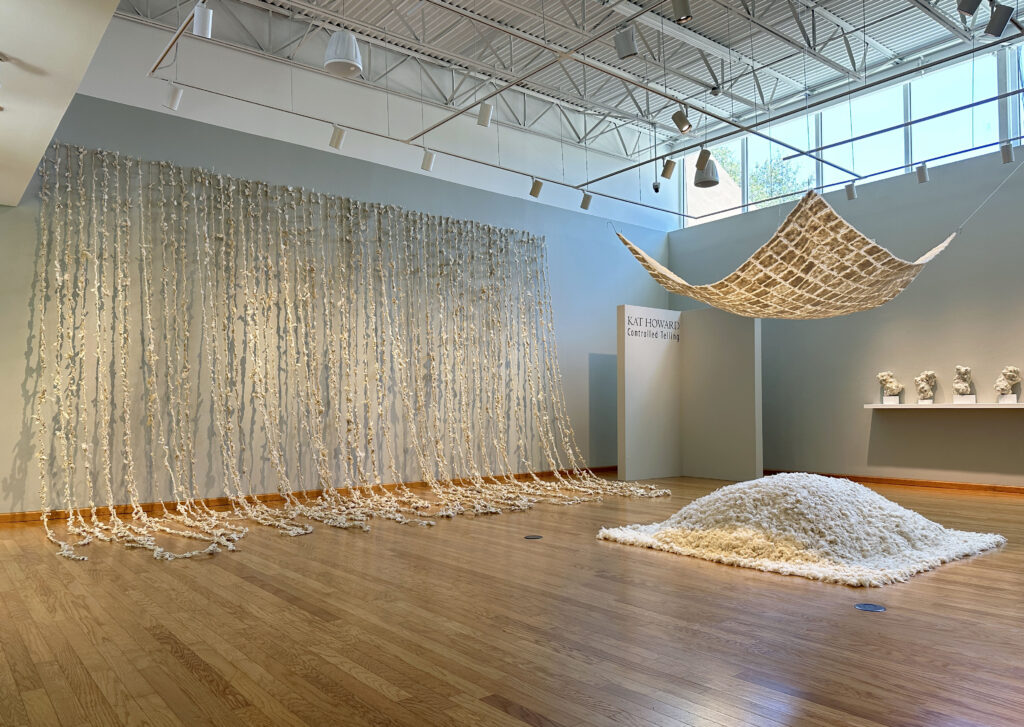
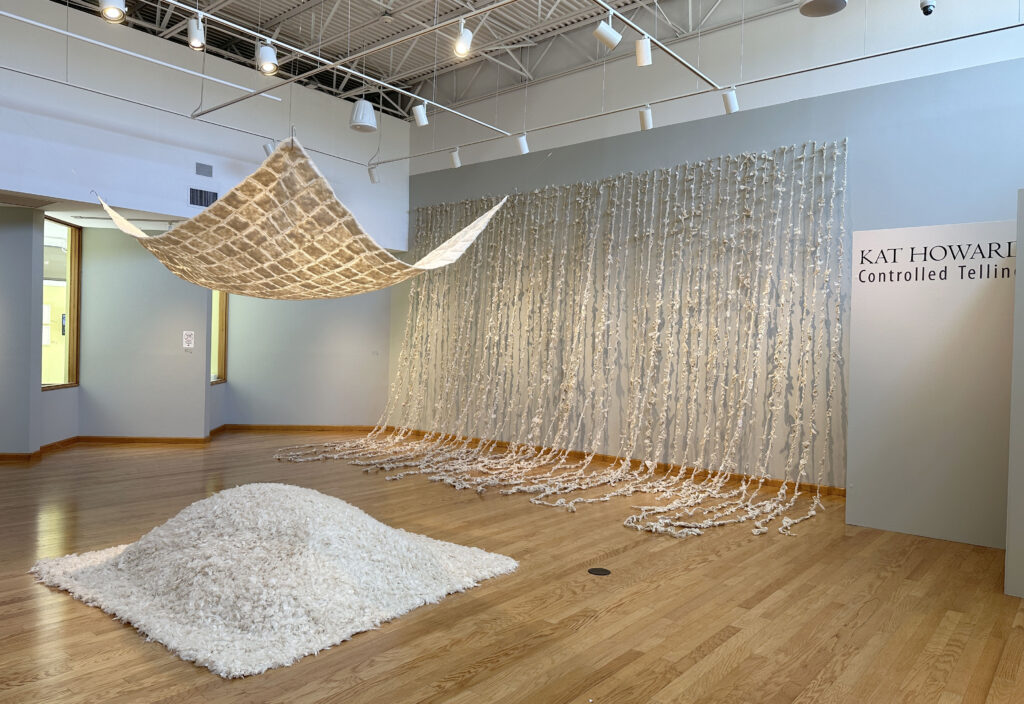
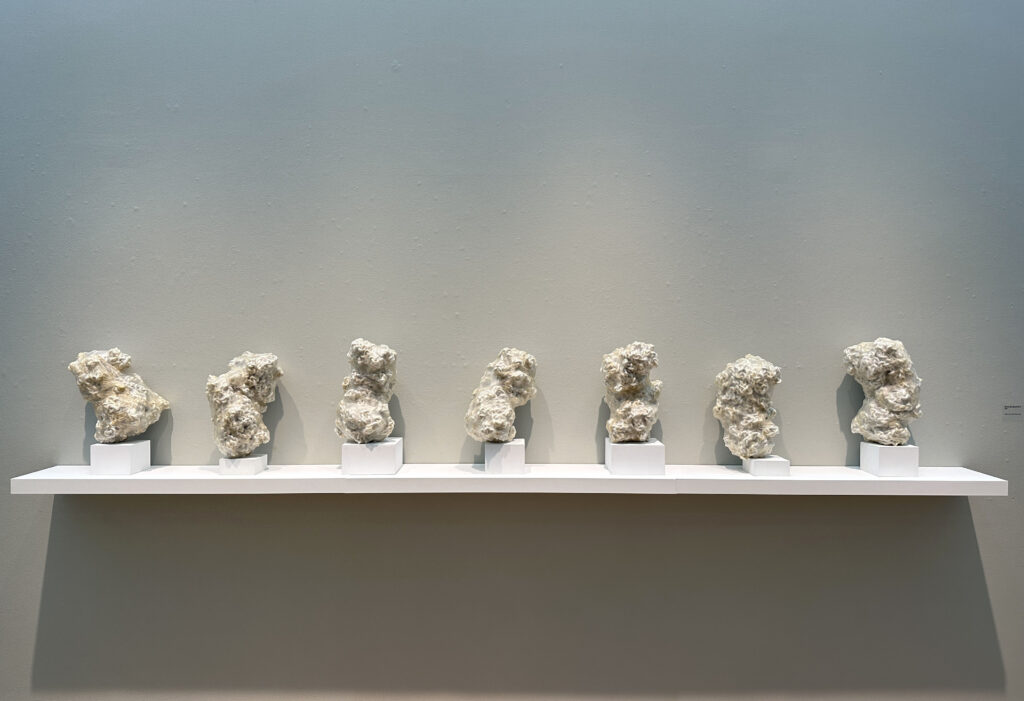
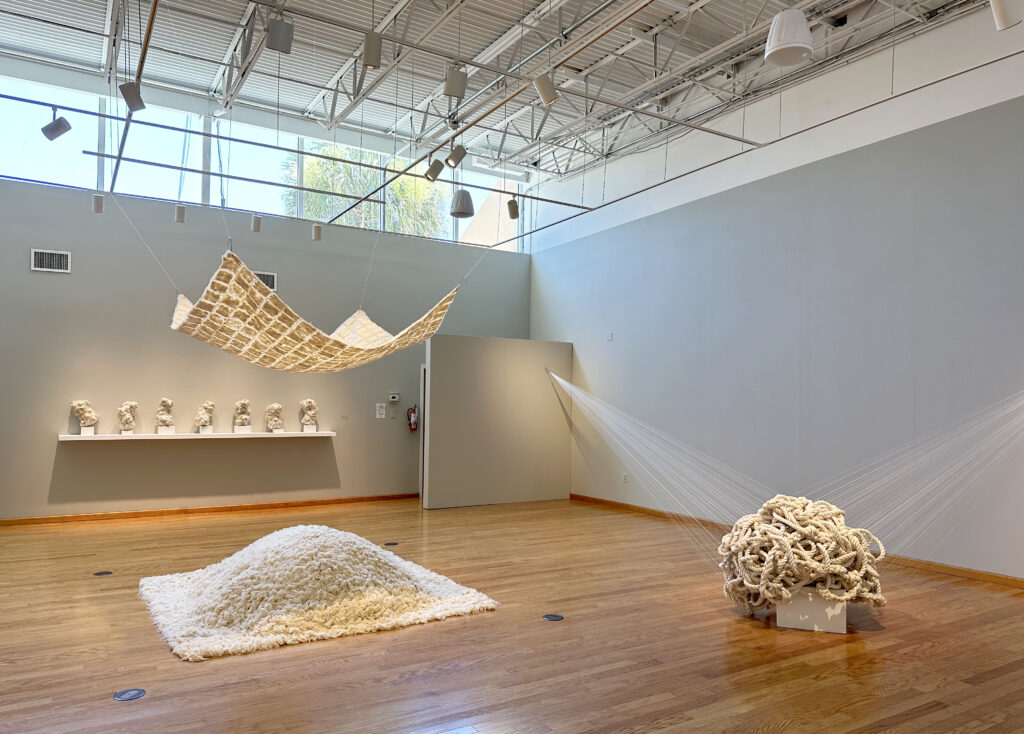
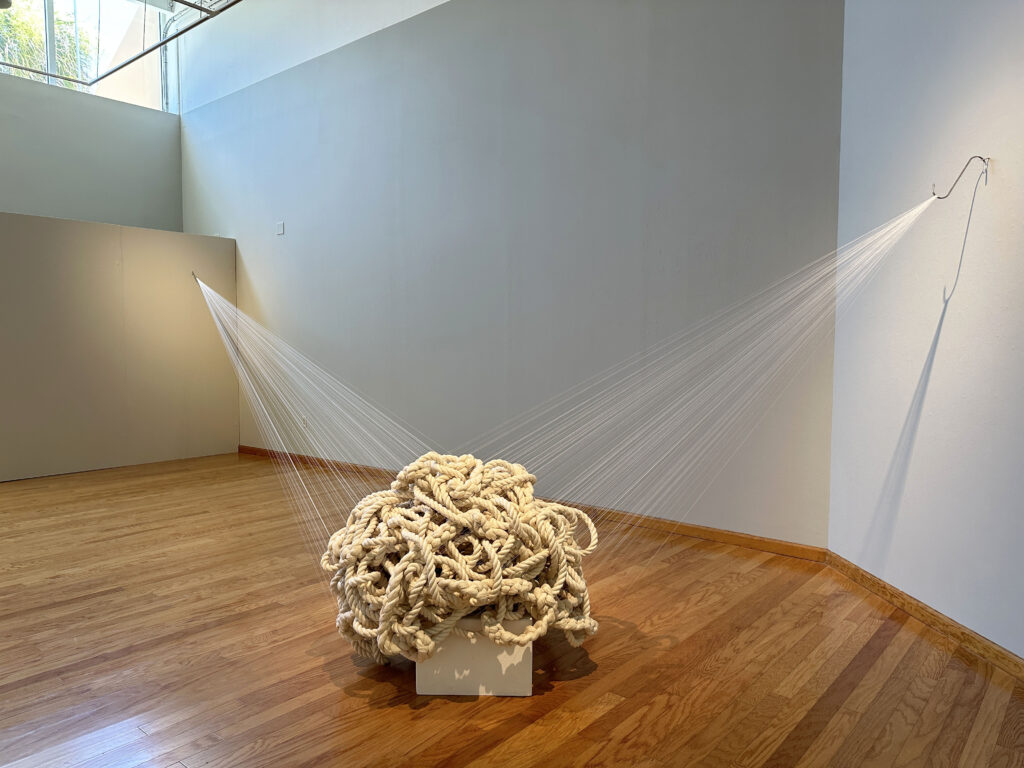
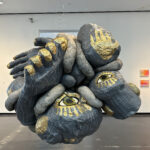
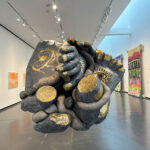
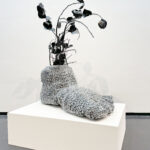
Kat Howard’s work interrogates the complicated process of healing from trauma. The sculptures in ‘Controlled Telling’ examines the burden and pressure to conceal the truth.
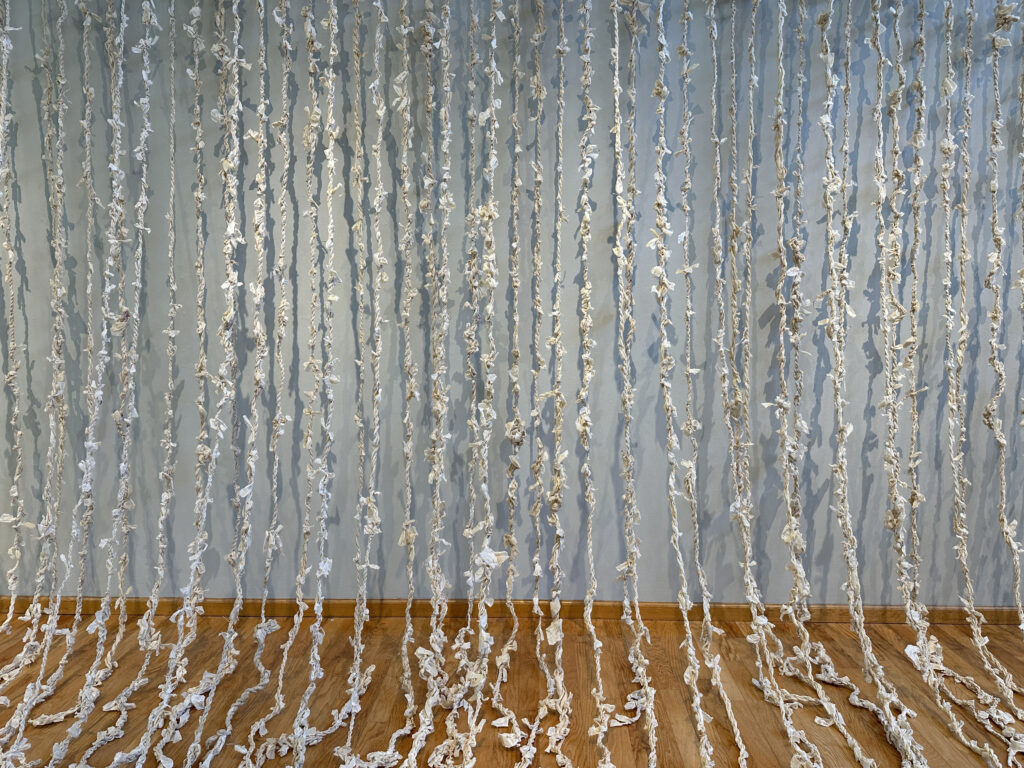
Existing as various restricted forms of cotton, bound braids, transparent quilts, compressed scraps of muslin, mound of raw material, or hand-twined waxed rope, the writhing abstracted bodily forms overwhelm and invade the viewer’s personal space, emulate the feeling of tension, imploring the viewer to navigate physically and emotionally around them.
Howard creates visual art that uses abstraction, the innate language of texture, and the repulsion/attraction of touch to interrogate her identity as a survivor of abuse and sexual violence. The material and texture of the object is integral to her practice, and its connection to the body. Evidence of the hand and the physical marks of the body are always present in her work. What happens to the body when it is forced to become a vessel for trauma? In what ways do we physically carry pain? How is the self altered afterwards?
Howard’s pieces either have a physicality to them that feels almost human, or they are twisted abstractions from the domestic landscape. Repetition and labor are vital aspects to the work. Through the labor, the anxiety tethered to a desire for freedom is palpable. The viewer can sense the thousands of hours, and the fevered precision which act as an echo of the madness in the mind that comes to claim the body. What does freedom look like? The answer is in taking up space. The answer is in speaking up. The answer is in the attempt.
“From the moment we are born until we die, we are almost constantly in contact with cloth as we move through our lives. Without thinking about it, we are familiar with its varied qualities–the simplicity of white cotton, the luxury of silk velvet, the flexibility of knitting, the structure of weaving. We can see the impact of time in a piece of fabric: how it wrinkles, stains, takes repairs, unravels. Handmade paper is a kind of non-woven cloth and is in fact often made of recycled cotton or linen. It can be dyed, stitched, wrinkled, torn, and repaired much in the same way as fabric.
My work explores the expressive possibilities of these materials, which I use to deal with my fascination with time altered urban and rural landscapes. A piece of land in the Oregon outback, the brick wall of buildings in Madison, a leafy Minneapolis neighborhood, etc. are all impacted by the passing of time, actions of human beings, weather. These occurrences can be incremental or sudden, and the change they bring almost imperceptible or very radical, each change layering on top of what came before. I use that observation to inspire my work. Fabric surfaces are worked over with layers and layers of pigments, embellished with embroidery, dunked into dye, cut and torn. Paper pulp is poured, dipped, mixed with sawdust, painted, crumpled and smoothed out again. In this small human way, I am channeling the world into the objects I create.”
Polly E. Perkins, “Woodstork Portrait”, 2022 from Ferman Center for the Arts
24 Hands is a printmaking collective of Florida Gulf Coast printmakers founded by Marjorie Greene Graff. The group has regular exhibitions throughout the year at various locations in the area.
Recently a group of their artists were showing work at The Ferman Center for the Arts, on the University of Tampa’s campus. Below are a few selections from that exhibition.
For more information on Polly E. Perkins, whose work is in the first image, check out her Instagram.
Linda Dee Guy, “Botanical Shroud”, 2021, acrylic, Inkjet print, Goldleaf on canvas
Linda Dee Guy, “Nucleus”, 2021
Linda Dee Guy, “Seascape”, 2021
For more work by Linda Dee Guy, check out her website and Instagram.
The 2023 Emerging Artist Exhibition in Creative Pinellas’ gallery space highlights work from the ten Pinellas County artists chosen by the organization for this year’s Emerging Artist Grant.
Above are sculptures by Amy Wolf. She has written several articles for the Creative Pinellas website which give some insight into her work and are worth a read.
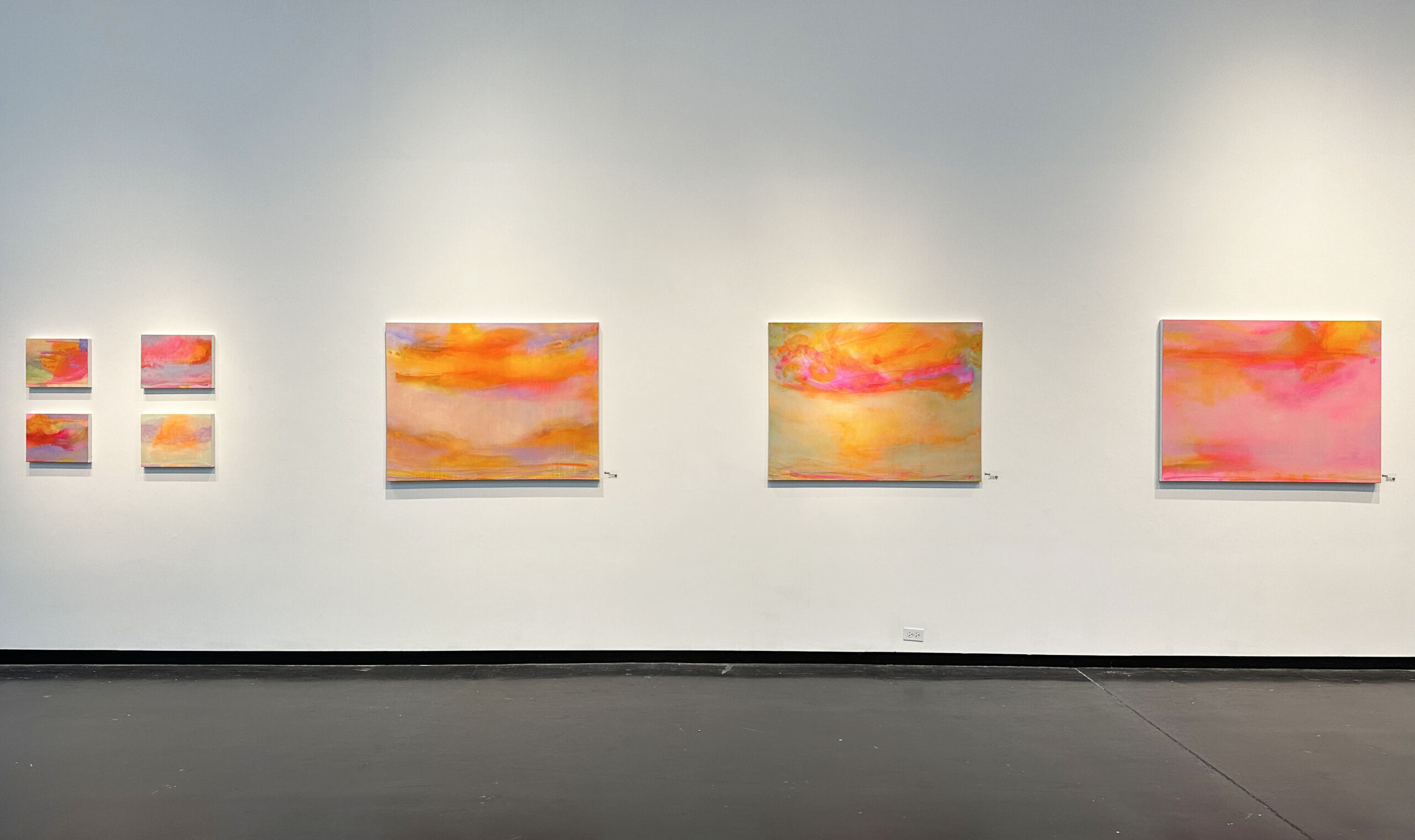
According to artist Kimberly Engel, the paintings above “explore vibrant color interaction while inviting viewers to meditate on an illusive horizon line where sky meets water.”
From the Creative Pinellas website-
Kimberly Engel is a contemporary abstract painter who lives and works in Clearwater, Florida. Her distinct gestural style combines a love for color interaction with spontaneous mark making. Engel’s paintings explore levels of transparency, evoking depth and light. She is inspired by the constant presence and changing states of large bodies of water. She has lived on the shore of Lake Erie in Euclid, Ohio prior to moving to the Gulf Coast.
Engel describes her process as an exploration of herself and ultimately the dissolving of herself mirrored in the process of making and deconstructing works. Her gestural marks have been described as both compulsive and somewhat calligraphic. They undulate and disappear under thin veils of color.
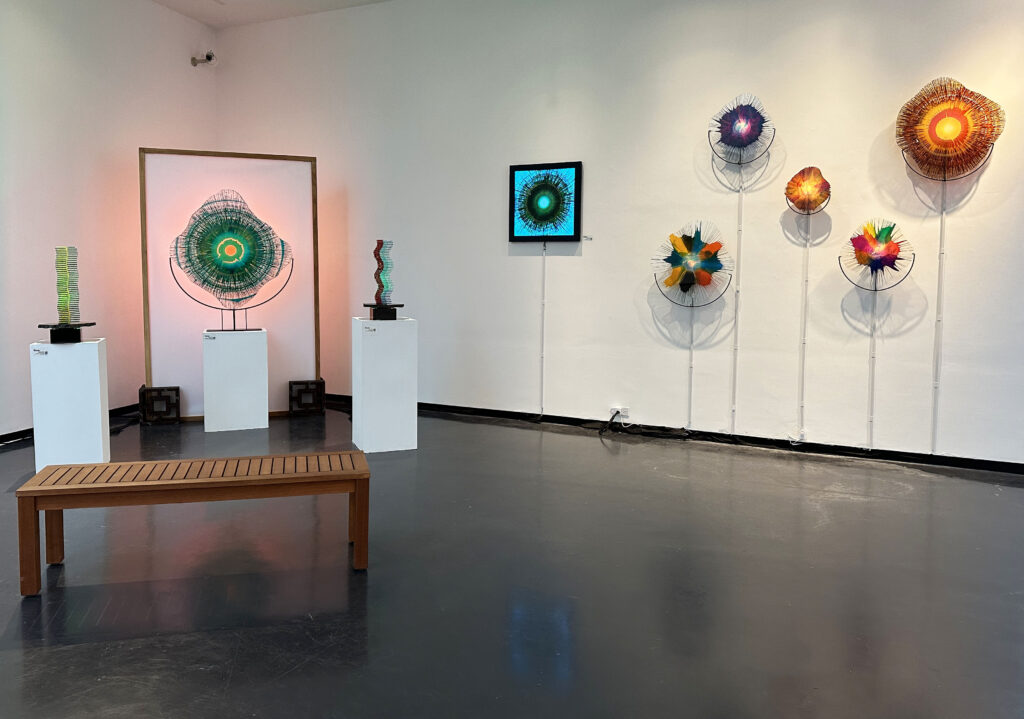
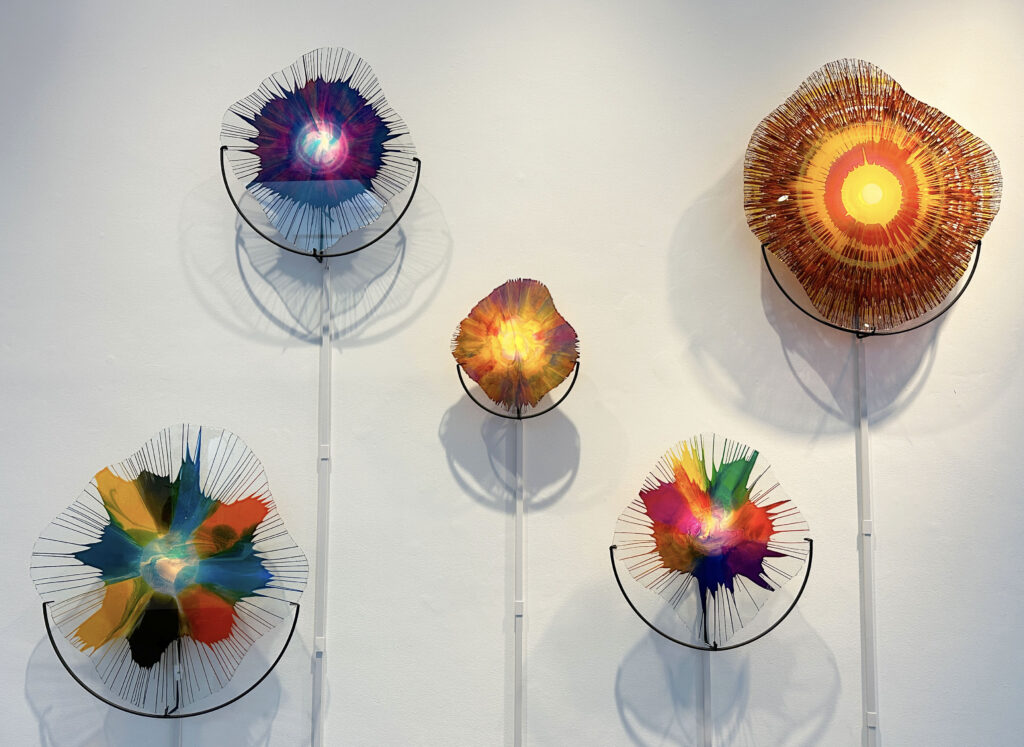
Denis DeBon created the unique glass works seen above.
His biography from the gallery website-
Dennis DeBon is the creator of EnergyWebs, which are one-of-a-kind works of modern glass art. He is often been compared to artist Jackson Pollock. Like Pollack, Dennis uses simple artistic techniques and has combined reverse painting on glass with spin art and taken both to a whole new level.
Each EnergyWeb is cut from a large sheet of plate glass, then free-style hand-cut into shape, scalloped, polished then spun. Dennis uses a multitude of application techniques and color combinations when creating each piece before firing and hand-signing them.
Every EnergyWeb is a unique, one-of-a-kind work of modern glass art and he is the only artist in the world creating them.
In addition to selling his artwork at fine art festivals across the country, Dennis was commissioned as the artist to create the Richard Dawkins Awards. In addition, his past creations have been presented to James “The Amazing” Randi, Carl Sagan’s widow, Ann Druyan, and the Zora Neale Hurston and the Koi Society of America award winners.
Dennis was born and raised in Buffalo, New York and attended the Rochester Institute of Technology in Rochester, New York, where he studied photography and graphic design.
He now lives in Saint Petersburg, Florida and when he isn’t creating art, you might find him writing screenplays or in the boxing ring . . . working as a professional boxing referee.
For more of the artists in the exhibition, head to the pages below.
Morean Arts Center in St. Pete, Florida, is currently showing Fresh Squeezed 7, their annual exhibition of emerging artists in Florida. It’s a great opportunity to see some of the best artwork being done by local artists. The exhibition closes 6/22/23.
From the the Morean Arts Center’s press release-
As always, our selection panel culled over 120 applications from across the state, narrowing the exhibition down to the six artists featured here. It’s always a joyful and heartbreaking process, seeing so much inspiring good work and only having a limited amount of space in which to show it all.We were looking for diversity in medium, in ideas, and in geographical location, all of which somehow comes together to form a delightful, cohesive whole.
While we don’t necessarily plan it that way, themes and commonalities do emerge among the artists selected for the exhibition. We’re happy to announce this is the first year that we have an ALL FEMALE line up. And due to the inclusive interpretation we use to define an emerging artist (no previous solo shows in Florida), you’ll find artists here who are still pursuing their MFAs (KJ Skidmore and Leeann Rae) AND artists who are returning to their first love of art after finding fulfillment in decades of other related careers (Latonya Hicks and Deborah W. Perlman).
Other themes you may notice as you peruse the galleries are the inventive (and exuberant!) use of materials. Denise Treizman and Latonya Hicks both incorporate cast off, recycled and vintage materials in their dimensional wall work. While Denise’s process is more spontaneous and Latonya’s is deliberate and measured, they both create joyful works of art that invite contemplation and perhaps a spark of recognition from the viewer.
KJ Skidmore and Laura De Valencia both deal with contemporary issues and pop culture in their work, though to wildly different effect. KJ’s humorous mixed media paintings address the notion of the male gaze, and the women who must endure it. Laura’s installations use fashion culture as a jumping off point to raise questions about international stereotypes and the borders (both visible and not) that immigrants have to experience on a daily basis.
Both Leeann Rae and Deborah W. Perlman create work that challenge the viewer to look longer, and to think deeper. With their disparate materials (Leeann with soft pastel and Deborah with cut paper), they raise notions of space, whether physical or mental, real or imagined, in the present or a memory from the past.
KJ Skidmore “Squeeze ‘n’ Block”, Acrylic and coffee
KJ Skidmore
KJ Skidmore “Angel’s Bar”, Acrylic, fabric, trim, paste and wood paper
The work above is by Tampa based artist KJ Skidmore.
Morean Arts Center’s information about the artist-
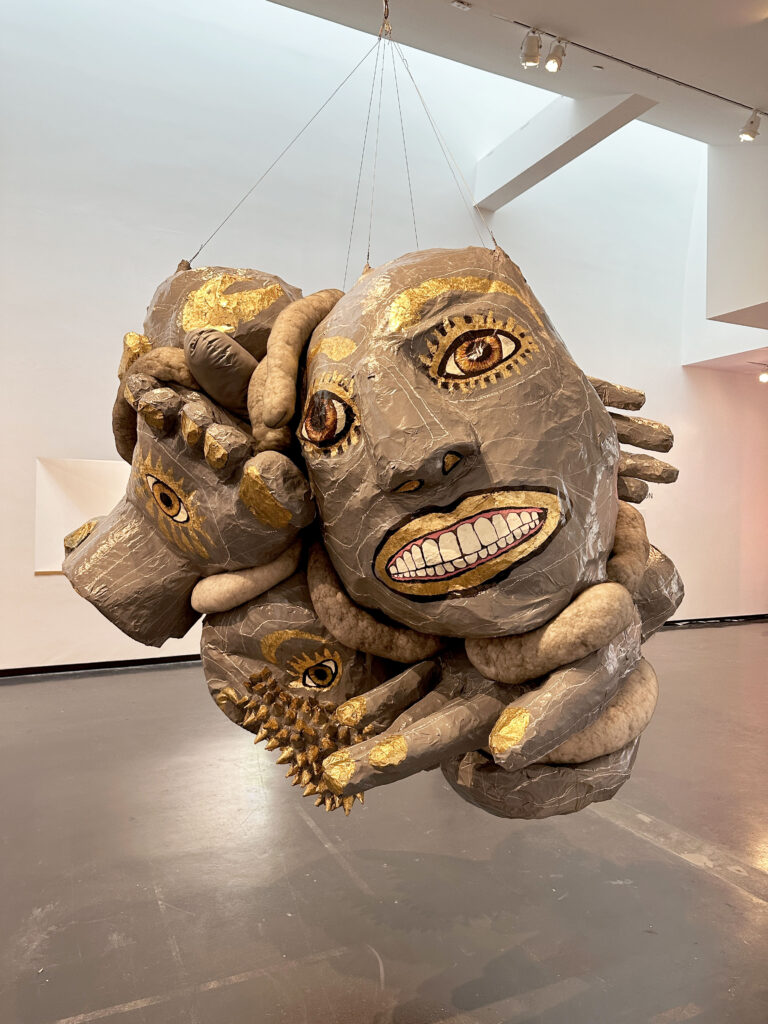
KJ’s current work is based in painting/drawing that extends into3-D space through multimedia installation. Her immersive spaces are chaotic and aggressive, but at the same time alluring. She works within her own bizarre and disjointed narratives and themes containing warped textual elements, strange cartoon characters, and color palettes that are both grimy and fluorescent. Her material use is variable and may include masses of hair clumped together with canned beets, pink stained carpet, fabrics, wood, plaster, teeth, rain jackets, and Smurf-themed objects.
KJ’s painted series Burger Time caricatures leering male clientele as flat, monster-like cartoons that interact with a staring waitress to explore gendered tropes and forms of voyeurism. This series reconstructs reality in relation to being female by presenting experiences like getting stared at or groped within a hokey themed attraction called “Burger Time” restaurant. Her series is meant to revolt the viewer through acknowledging the male gaze, while also celebrating its trashiness and the culture surrounding it. She uses humor to poke fun at this harmful and uneven power dynamic. The series presents this sickening concept through more palatable presentation such as expressive cartoon figures and bright colors.
KJ is from Gainesville, FL, but was living on the West Coast until recently. She is back in Florida pursuing an MFA at USF in Tampa.
For more of the artists in the show, continue to the next page.
Between 1915 and 1970, in the wake of racial terror during the post-Reconstruction period, millions of Black Americans fled from their homes to other areas within the South and to other parts of the country. This remarkable movement of people, known as the Great Migration, caused a radical shift in the demographic, economic, and sociopolitical makeup of the United States. A Movement in Every Direction: Legacies of the Great Migration brings together twelve contemporary artists to consider the complex impact of this period on their lives, as well as on social and cultural life, with newly commissioned works ranging from large-scale installation, immersive film, and tapestry to photography, painting, and mixed media. Featured artists are Akea Brionne, Mark Bradford, Zoë Charlton, Larry W. Cook, Torkwase Dyson, Theaster Gates Jr., Allison Janae Hamilton, Leslie Hewitt, Steffani Jemison, Robert Pruitt, Jamea Richmond-Edwards, and Carrie Mae Weems.
A Movement in Every Direction presents a departure from traditional accounts of the Great Migration, which are often understood through a lens of trauma, and reconceptualizes them through stories of self-possession, self-determination, and self-examination. While the South did lose generations of courageous, creative, and productive Black Americans due to racial and social inequities, the exhibition expands the narrative by introducing people who stayed in, or returned to, the region during this time. Additionally, the Brooklyn Museum’s presentation centers Brooklyn as another important site in the Great Migration, highlighting historical and contemporary census data about the borough’s migration patterns. Visitors are encouraged to share their own personal and familial stories of migration through an oral history “pod” available in the exhibition galleries.
About Robert Pruitt’s work, pictured above, from the museum’s wall information plaque-
“A Song for Travelers” celebrates the individual and Black collective experiences that have shaped the histories of rural East Texas and Houston’s Third, Fourth, and Fifth Wards. In this drawing-based on an early 1970’s photograph of a reunion of the artist’s family in Dobbin, Texas -sixteen people gather around a seated central figure about to embark on a journey. During the creation of this work, the masked traveler became a stand-in for Pruitt, who had recently left his hometown of Houston.
Pruitt often draws inspiration from his and others’ family photographs while examining historical events that have impacted Houston’s Black communities. Wearing costumes and adorned with items that reference various aspects of Black culture found in schools, social clubs, and religious spaces, the figures in the work reflect the numerous networks that remained and flourished in the South. Merging the Great Migration period with the present, Pruitt centers the Black neighborhoods across the southern region that served as safe havens and rich sites of cultural expression for migrants during the twentieth century. This link extends to today as many Black Americans leave the northern and western cities that once attracted their elders and return to the South.
Allison Janae Hamilton’sA House Called Florida, below, takes the viewer on a journey through part of northern Florida’s natural beauty.
From the museum’s information plaque about the video installation-
Allison Janae Hamilton produced the three-channel film installation A House Called Florida in her hometown region of northern Florida. The breathtaking landscapes of Apalachicola Bay and the swampy Blackwater Lakes of Florida’s Big Bend frame musicians, dancers, motorists, a Victorian house, and a slow resounding rhythm.
The artist references French Argentinian writer Julio Cortázar’s 1946 short story “Casa Tomada.” (“House Taken Over”) about ghosts that slowly take over a home and eventually push out its owners, room by room. Hamilton echoes the story’s theme of displacement with two regally dressed, spirit-like protagonists who move about the house engaging in mark-making and ritual performances. Hamilton’s film pays tribute to the Black Floridians who remained in the Red Hills and the Forgotten Coast regions, despite the racial violence and environmental precariousness they faced throughout the nineteenth and twentieth centuries.
Carrie Mae Weems‘ personal and moving contribution is in two parts- a series of photographs and a unique digital video installation.
The museum’s description of the work-
Carrie Mae Weems explores a painful family story: the disappearance of her grandfather Frank Weems, a tenant farmer and union activist who was attacked by a white mob in Earle Arkansas, in 1936. Presumed dead, he narrowly escaped and made his way to Chicago on foot, never again reuniting with his family. Frank Weems may have followed the North Star to Chicago. Weems’s series of seven prints, The North Star, makes an apt metaphor for Frank’s life. In Leave! Leave Now! Weems conjures the figure of her grandfather with a Pepper’s Ghost, a late nineteenth-century form of illusion first used in theater. By weaving historical events with fragmented family stories, photographs, poetry, music, and interviews, the artist reveals the tragedy of her grandfather’s disappearance and the aftermath.
This exhibition will close on Sunday, June 25th, 2023.
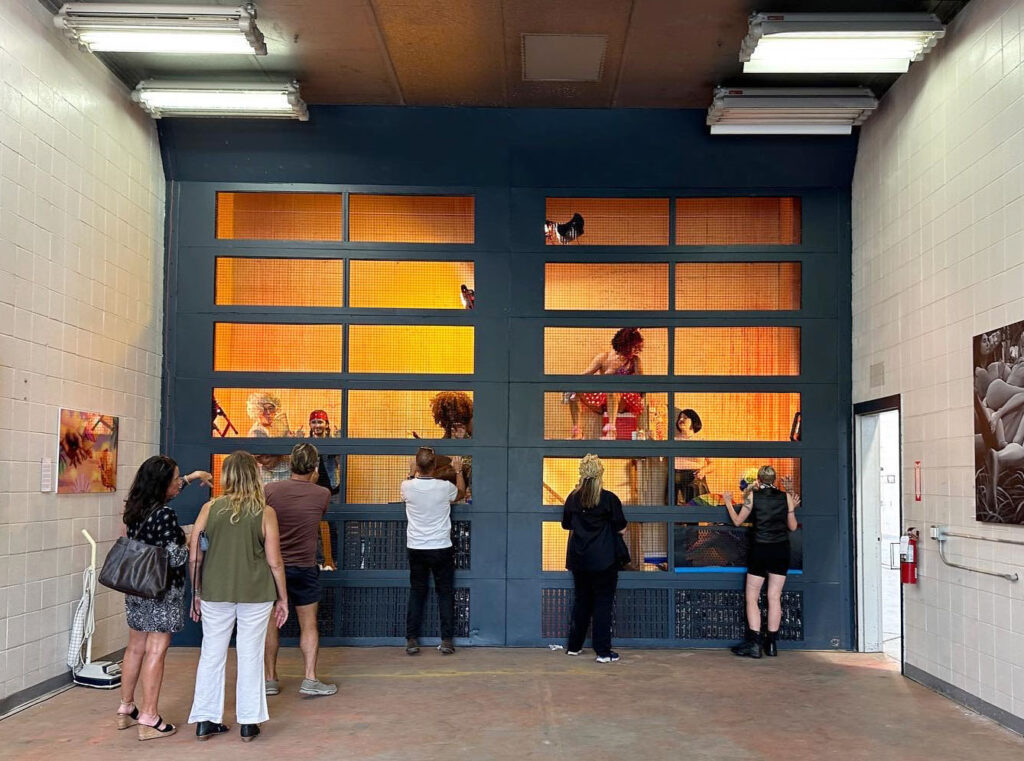
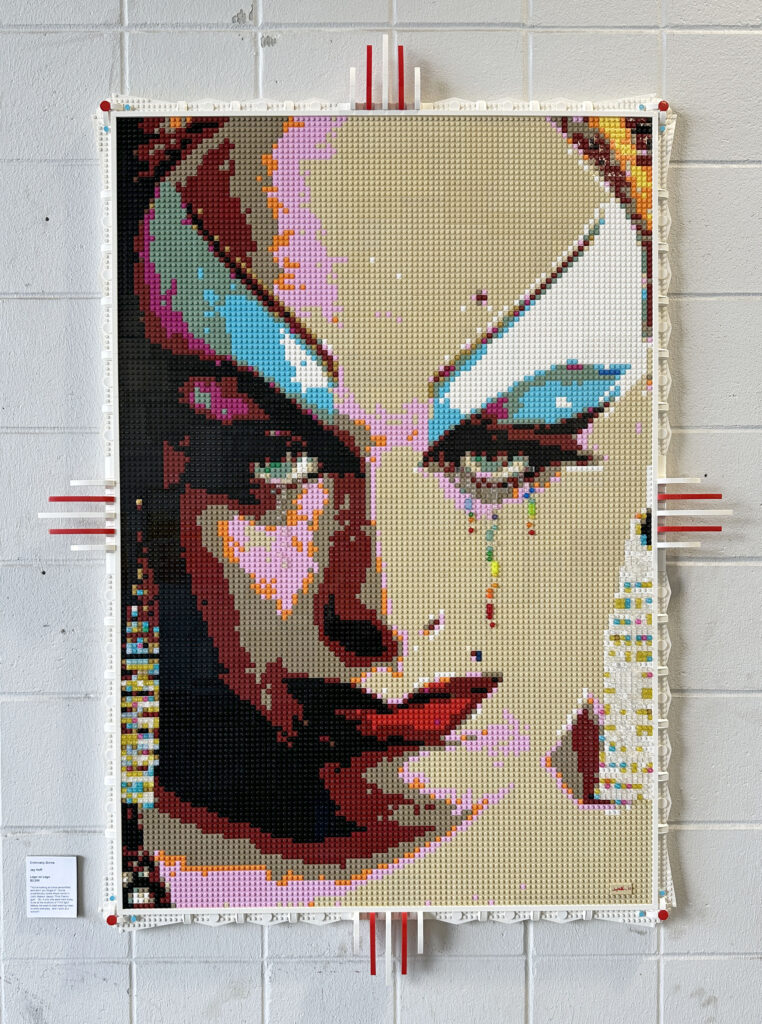
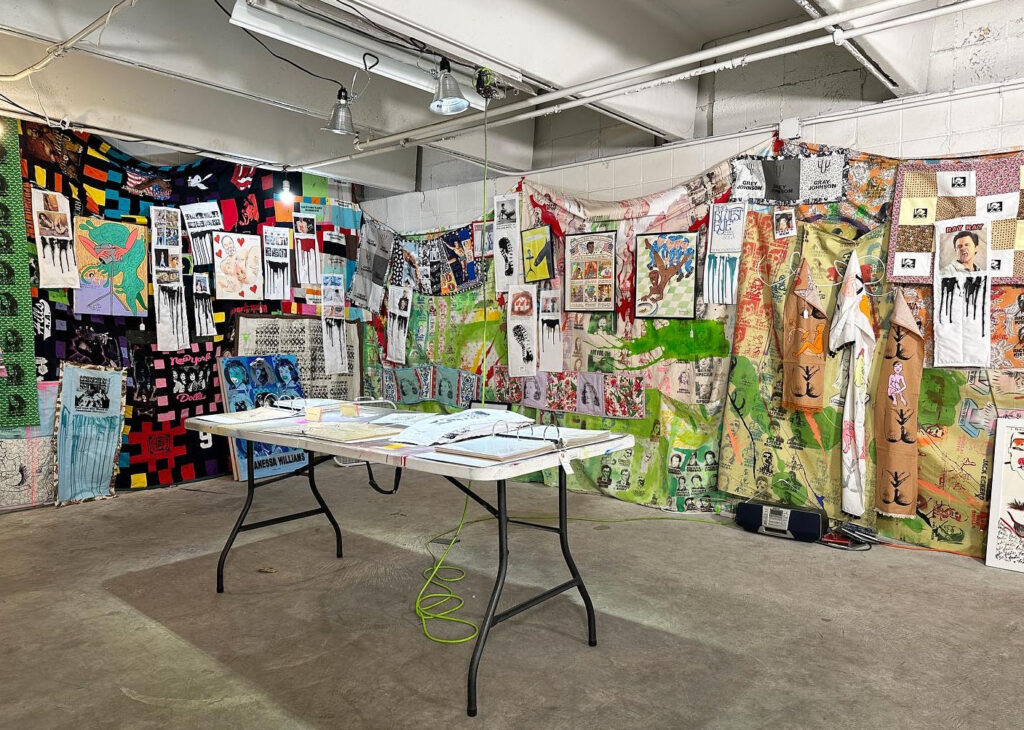
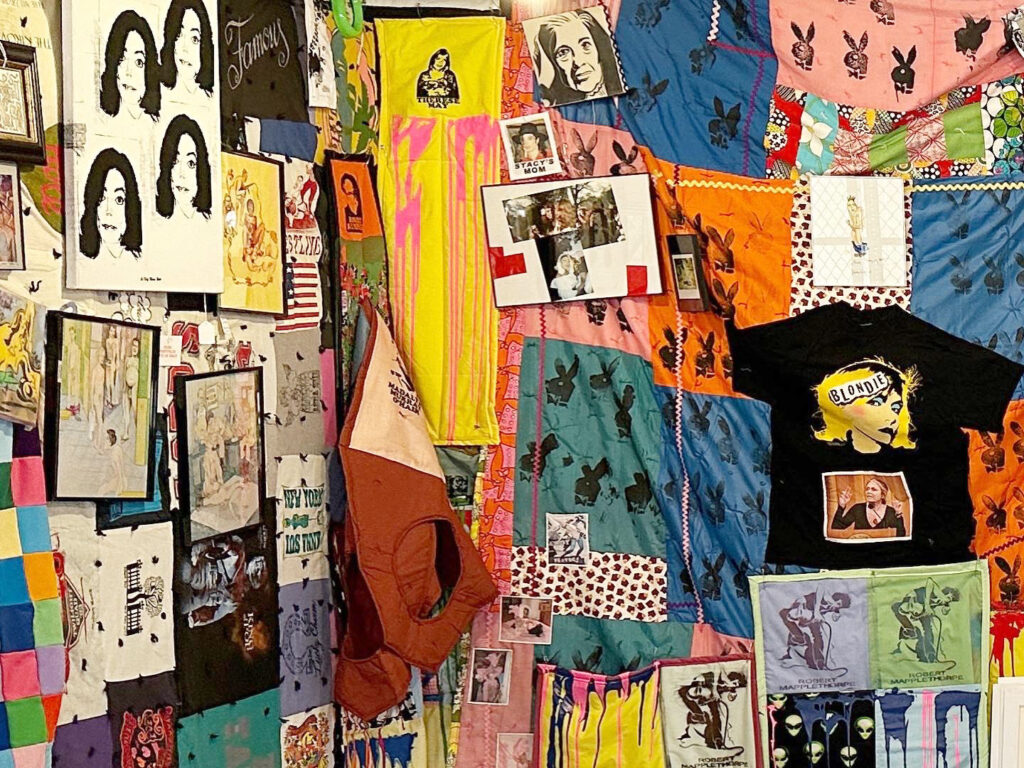
The latest pop-up exhibition at Chad Mize’sSPACE in St. Pete’s Warehouse Arts District, is Hot Box, which opened Friday 6/9/23. The show includes a LOT of artists and installations as well as, for this past weekend, an immersive performance by Dirty John’s comedy troupe.
Fashioned after both the artist’s workspace and print editions he created during his Arts Council of Princeton’s Anne Reeves Artist-in-Residency, Somatic Pause invites Princeton to contemplate the transformational power of rest, and how time changes each of us.
Somatic Pause – a wheat-pasted, painted, and collaged installation – is an ephemeral one. Meant to change over time, the mural will be exposed to harsh winter weather, early spring rains, and glaring sun, each doing its own work to fade, soften, tear, and mar its surface.
Change is the constant.
And about the artist-
Dave DiMarchi is a queer, multi-disciplinary artist working in printmaking, papermaking and sculptural book forms. He engages in a relentless material practice, nurturing ideas into singular and editioned works. As a multi-disciplinary artist, he has exhibited works on paper, installations and books in the US and internationally. He maintains a small collaborative studio and art space in New Hope, Pennsylvania and teaches printmaking, papermaking and book forms extensively throughout the New York, New Jersey and Pennsylvania area. In Fall of 2022, he was announced as the ACP Artist-in-Residence which will allow him to continue to explore collage-based multi-media and print works.
Since 2012, he has created his own work, curated exhibitions, provided print exchange opportunities, and published fine art prints as 9INHANDPRESS, a fine art printmaking and education studio located in New Hope, Pennsylvania.
Rachel Ratcliff, “Roll of the Kaleidoscope”, 2021, acrylic on canvas
Richard Logan “Sea Oats”, 2022, photographic transfer on metal with etched glass
Steven Spathelf, “Orange Blossom”, 2022, acrylic on canvas
This past Friday the city of Dunedin, Florida, celebrated the opening of its new City Hall. As part of the celebration, the building and all of its offices were open to the public. It was the first opportunity to see all the wonderful art by Florida artists- selected and commissioned by Elizabeth Brincklow.
Pictured above are works by Rachel Ratcliff (wave painting) and Richard Logan (photography). The third work is by Steven Spathelf whose oranges can be seen adorning buildings and homes all around town.
Scroll through the pages below to see the other works on view.
A member of the Seneca Nation, Watt also has German-Scott ancestry. Her layered and complex influences include Indigenous knowledge and Iroquois proto-feminism, the matriarchal structures of certain Native American nations, the rise of social activism throughout the 20th century, and the anti-war and anti-hate content of the 1960s and 1970s music scene.
Central to the exhibition are three Sewing Circle pieces that were initiated at communal gatherings at the Whitney Museum of American Art in 2022. Watt’s sewing circles are cross generational, multicultural gatherings that she has been organizing for over a decade. Inspired by poet laurate Joy Harjo’s (Mvskoke/Creek) poem Singing Everything, Watt collects words from the participants of her sewing circles with the prompt, “what do you want to sing a song for in this moment?” The submitted words are then embroidered or sewn onto patches of fabric during the sewing circle. For the Whitney Sewing Circle, with over 300 participants, Watt, for the first time, used all the submitted words. Each panel is patterned in a way that stays true to the original hand. She thinks of ones handwriting as an extension of the cadence of one’s voice and in this project, it becomes part of a larger chorus. By composing large-scale wall works from these pieces of fabric, Watt creates collaborative artworks that interweave many individual handwritings, touches, and the stories that were exchanged in a shared space.
When entering the gallery, the visitor is greeted by a sweeping, 24-foot-long neon sign spelling out the words “deer, skywalker, heron, bass, great lake, woodland, beaver, turtle, wolf, lowly, muskrat, rat” in various hues that evoke the sky on the horizon during sunset and sunrise. While the piece represents a new direction in Watt’s work, she views neon as an extension of beadwork. The glass itself is at once thread and bead, and both neon and beads have a relationship to trade. They both envelop light, color, and sound, embodying sunrises and sunsets on the horizon.
Two blanket towers, her signature sculptural works, appear in the show but now with tin bells or jingles added to the reclaimed wool blankets. This choice of added material felt like a natural extension to Watt. She writes: “Blankets are danced and so are jingles, there is something healing about them both. They are objects of comfort” – by way of touch or sound. “Jingles acknowledge the Jingle Dress Dance which began as a healing ritual in the Ojibwe tribe in the 1910s during the influenza pandemic. The Jingle Dress Dance was also a radical act. In 1883, the United States banned Indigenous ceremonial gatherings. Though the ban was repealed in 1978 with the American Indian Religious Freedom Act, during its century-long prohibition the Jingle Dress Dance was shared with other tribal communities. Today it is a pow-wow dance and continues to be associated with healing. The relevance of this dance extends beyond pandemics.” By including jingles Watt brings the potential of sound into her work, adding to their visual and tactile aspects.
While drawing from long craft traditions such as textile or glass work, Watt is expanding her work by including contemporary stories and both individual and collective experiences. Her primary interest is to think about art as more experiential, rather than only visual, a direction she plans to explore further.