Dec 202019


Jack Shainman Gallery is currently showing two solo exhibitions of recent paintings by Meleko Mokgosi. The first, (a painting from which is pictured above) is titled The social revolution of our time cannot take its poetry from the past but only from the poetry of the future.

From the press release-

The title of Mokgosi’s 20th Street installation, The social revolution of our time cannot take its poetry from the past but only from the poetry of the future., is taken from Karl Marx’s The Eighteenth Brumaire of Louis Bonaparte. This text points to the limits of revolutionary discourses and proposes that it is only through disavowing the past that revolutionary action can occur. Similar to this argument, this body of work argues both for a disavowal of past grand narratives as well as the recuperation of non-Western forms of knowledge that were not privileged to coexist with conventional or established discursive frameworks. All twelve paintings are paired with a text that is taken from the writings of women either from Africa or the African Diaspora. The texts and paintings examine a wide range of issues, from African feminism and the struggle for liberation by African countries, to love, solidarity, and aesthetics. By pairing text and image, Mokgosi’s work aims to further questions around the politics of representation and strategies of resistance.

The second exhibition is Pan-African Pulp, pictured below.

From the press release-

…Mokgosi’s body of work at 24th Street, uses popular southern African pulp magazines or photo-novels to examine, broadly, the history of Pan-Africanism. These photo-novels, colloquially referred to as look-books, were first printed in the 1960s as an off-shoot of Drum Publications. Unlike Drum magazine, which addressed politics and issues of race in South Africa, photo-novels such as Lance Spearman avoided engaging with debates around politics, instead choosing to offer entertaining James Bond-like episodes of crime fighting. The photo novels—a less expensive alternative to filmmaking—are composed of staged photographs depicting action scenes, and follow a script conveyed with speech bubbles written in English, combining elements of comic books, films, and magazines.

Mokgosi has appropriated this trope and created new dialogue and plots within the existing imagery. By specifically focusing on Pan-Africanism, Mokgosi hopes to find meaningful ways of reconceptualizing the importance of a movement that sought to build alliances towards Black consciousness and foregrounding the rights and aspirations of Africans to self-determination and self-governance. Mokgosi reflects, “There is no doubt about the injustices, inhumanity, exploitation, violence, and racism caused by and associated with the Euro-American slave trade, European imperialism in Africa, and institutionalized racism in the Americas; the effects of these are ongoing and reflected not only in cultural and geopolitical contexts but also in the very reproduction and circulation of capital.” This work is the first of many stages through which Mokgosi intends to engage with and ask urgent questions around Pan-Africanism and solidarity.

Both of these exhibitions close 12/21/19.

Dec 202019
 

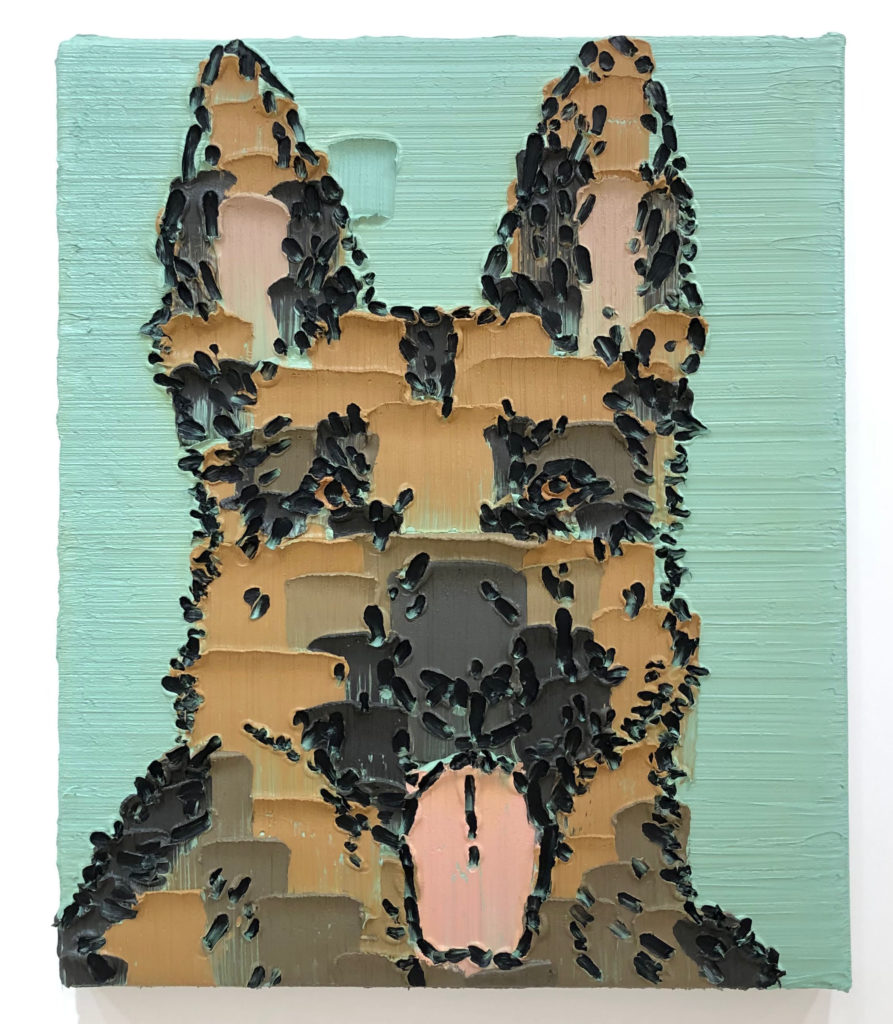
The paintings in Li Songsong’s One of My Ancestors, at Pace Gallery in Chelsea, are rich in both color and texture. Li creates his paintings from found photographs, adding another dimension to the work.

From the press release-

In the process of reinterpreting found imagery drawn from public sources such as everyday news items, Li adopts an impartial attitude. “I did not deliberately look for these images,” he explains, “It just happened. For example, a friend of mine went to an old book stall in Beijing to buy old magazines. I saw a good photo, and then I used it. I don’t seem to care about the content of the image itself. Of course, they are a starting point, but they will affect you more on a psychological level than in a narrative way.”

Li is interested in the ways in which images can trigger memories and emotions—a psychological impact magnified by his technique. The use of impasto and the dense materiality of his brushstrokes elicit a potent haptic response, while his palette of cool shades of gray, green, and beige create an estrangement from his chosen subject matter, as seen in Little Brother (2017), South (2017), and Civil Rather than Military (2018). Through his signature use of compact blocks of color, Li deconstructs and reassembles images, pushing his art towards abstraction.

This exhibition closes 12/21/19.

Dec 192019
 

Anish Kapoor’s exhibition at Lisson Gallery’s 24th Street location is a reflective wonderland where the sculptures twist your perception of your surroundings as you move around them. If his work looks familiar, he has created many public outdoor works including Cloud Gate, also known as “The Bean”, which is permanently installed in Millennium Park in Chicago.

The exhibition continues at Lisson Gallery’s smaller 10th Avenue space with several of Kapoor’s colorful wall-based circular sculptures in semi-reflective hues.

Both of these exhibitions close 12/20/19.


Dec 192019
 

For Peter Halley’s Heterotopia II, at Greene Naftali’s ground floor gallery in Chelsea, he has created a delightful, brightly colored maze-like installation.

From the press release

In Des Espaces Autres (1984), Michel Foucault defines heterotopia in opposition to utopia. While utopias are unrealized representations of a perfected society, heterotopias exist within all societies as realms differentiated from everyday life. Examples include ceremonial, sacred, and institutional spaces such as chapels, cemeteries, libraries, and prisons. They are spaces designated for special activities – creating their own sense of time and operating according to their own standards.

Through a range of media – painting, architectural installation, digital prints, and critical writing – Peter Halley’s work has illuminated the structures of social space and communication that shape our experience of contemporary life. For his second solo exhibition at Greene Naftali, Halley presents Heterotopia II, the latest in a series of large-scale installations exploring the relationship between painting and architectural space. Halley has created a multi-colored, labyrinthine structure in the ground floor gallery housing eight new shaped-canvas paintings, titled after imaginary planets from Isaac Asimov’s science-fictional universe.

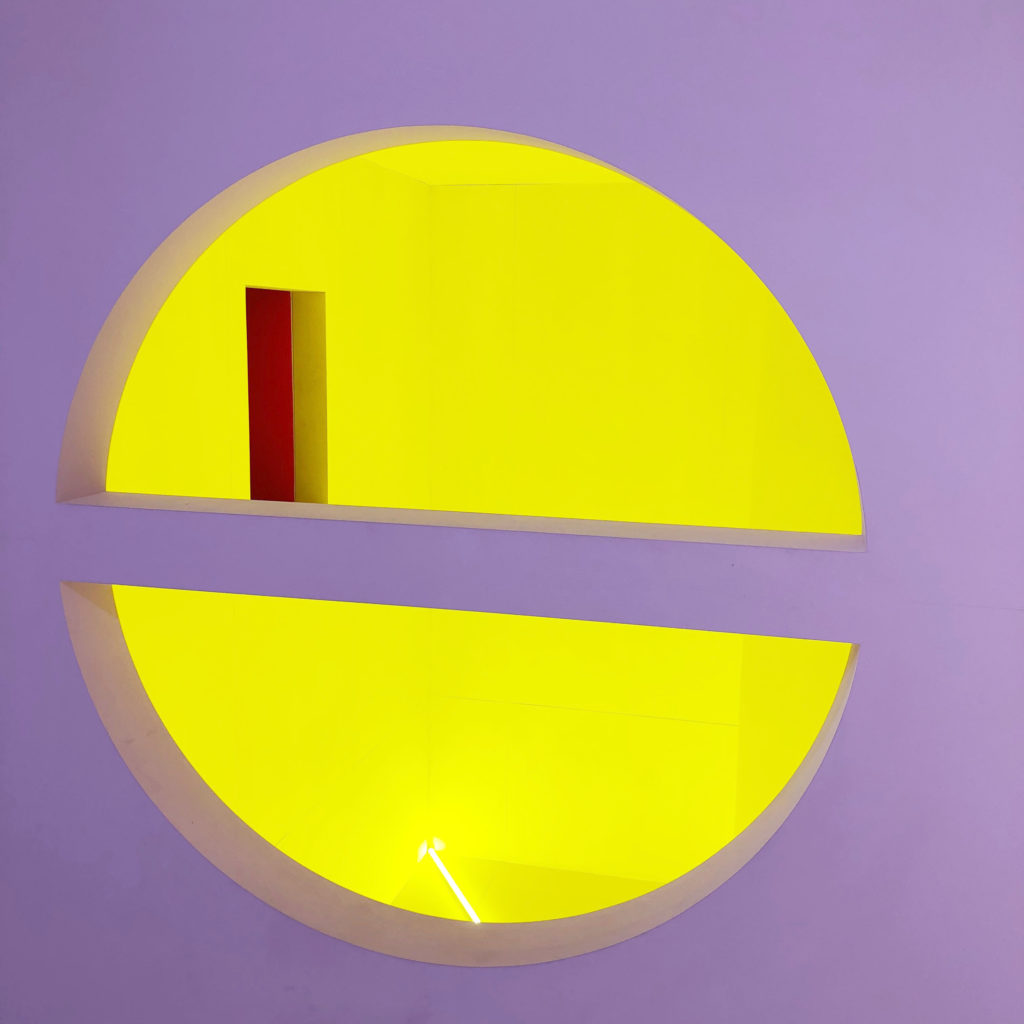
The installation is enclosed by tall neon yellow walls coated in Roll-a-Tex, with only a narrow slot in the front wall offering the viewer a preemptive glimpse inside. The interior space is organized around a glowing yellow core – an inaccessible inner sanctum whose light is solely visible through three distinctive apertures. Around the core are arrayed eight interconnected rooms rendered in vivid colors, each defined by architectural elements, including staircases, keyhole windows, beams, and columns. The arrangement of these elements playfully nods to motifs in the work of architects Peter Eisenmann, Hans Hollein, Luis Barragán, and Louis Kahn, as well as to Halley’s own oeuvre. Halley’s installation, with its candy colored surfaces, is a postmodern reverie on neoplasticism and modernist geometry, founded on a tension between rationalist geometry and lyrical color.

Visitors circulating through the maze-like installation encounter Halley’s shaped-canvas paintings one-by-one, as the interactions between two-dimensional image and three-dimensional architecture unfolds. Composed of multiple interlocking prisons and cells, the paintings create ambiguous figure-ground relationships, while echoing the geometric plan of their three-dimensional setting.

This exhibition closes 12/20/19.

Dec 122019
 

Petzel Gallery is currently showing Walead Beshty’s solo show “Abstract of A Partial Disassembling of an Invention Without a Future: Helter-Skelter and Random Notes in Which the Pulleys and Cogwheels Are Lying Around at Random All Over the Workbench”. The sheer volume of work covering the walls is overwhelming and impressive in its assembly.

From the press release-

The work A Partial Disassembling of an Invention Without a Future: Helter-Skelter and Random Notes in Which the Pulleys and Cogwheels Are Lying Around at Random All Over the Workbench, was originally commissioned by the Barbican Centre, London. The London-born, Los Angeles-based artist first exhibited the work there in 2014, covering the 273 ft long Curve gallery from floor to ceiling in cyanotype prints. The prints were produced over the duration of a year (October 9, 2013–October 8, 2014) and are chronologically installed in proportion to the exhibition space. For its New York première at Petzel, approximately 5,120 cyanotypes (38% of the total 15,616 sq. ft work) will be presented.

In A Partial Disassembling of an Invention … , each cyanotype (a 19th Century photographic process using ferric ammonium citrate and potassium ferro-cyanide) was produced by placing tools and other objects used in the production process of the studio on cellulose waste material generated by that same process (such as wood, cardboard, or paper) that was coated with UV-sensitive cyanotype material. After being exposed to sunlight and washed in water, the object’s silhouette appears in reverse against a cyan-blue background.

In using everyday objects, such as receipts, prescriptions, invoices, financial statements, legal documents, letters, gallery invitations, etc. from the working life of the studio, an inherent transparency is embedded in the work, demystifying the artwork and exposing its process of coming to be. Representative of the lives of those who made it, the cyanotypes expose both aspects of identity and circumstance, situating the work within political, social, and economic exchange without being representational or depictive in the conventional sense. While both the Barbican and Petzel iterations deal with debris, this new display has a more overtly American immediacy to it. Considering the resurgent discourse on the politics of representation, there is a new urgency to exhibiting the work for the questions it evokes about the modes and uses of representation, such as how art can accurately display real world conditions of labor, production and power, and whether a truly accurate and transparent form of representation is possible.

Beshty will also show Prologue to A Partial Disassembling of an Invention Without a Future: Helter-Skelter and Random Notes in Which the Pulleys and Cogwheels Are Lying Around at Random All Over the Workbench, which are the cyanotypes that were produced in anticipation of the Barbican work from August 1, 2013–October 8, 2013, along with seven volumes of the 59-volume archive of the work. The books—in their Prologue and Opus volumes—comprise bound pages printed recto and verso of the entire work reproduced at 1:2 scale. The volumes create both an archival record of Beshty’s workspace as well as an index of all the tools and artefacts used for the work’s own making.

The title of the project is a reference to Hollis Frampton’s hypothetical lecture he muses about in a talk delivered at the Whitney Museum of American Art, but never actually gives. The title of this phantom lecture alludes to the origins of the medium, and its inevitable obsolescence. It also calls forward the question of the role objects play when they have ceased being useful. Wrenched by time from their intended use, the objects become purely aesthetic, becoming the focus of contemplation in both historical and poetic terms.

This exhibition closes 12/14/19.

Dec 062019
 

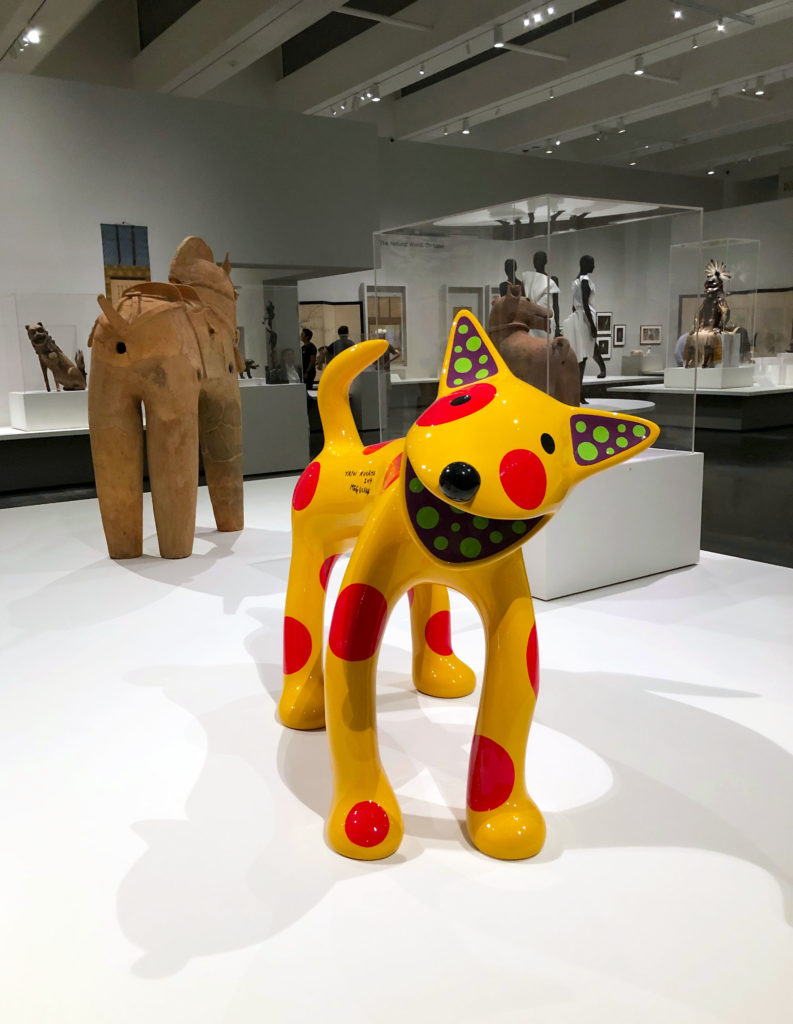
Closing 12/8/19 at LACMA is Every Living Thing: Animals in Japanese Art. It’s a really fun of exhibition with a good selection of art from different time periods, including Yayoi Kusama’s dog sculptures from Megu-chan (2014), two of which are pictured above.

From LACMA’s website-

Every Living Thing: Animals in Japanese Art celebrates one of the most distinctive and compelling aspects of Japanese art: the depiction of animals. Underpinned by Japan’s unique spiritual heritage of Shintō and Buddhism, the Japanese reverence for nature—and the place of animals within that realm—is expressed in sculpture, painting, lacquer-work, ceramics, metalwork, cloisonné, and woodblock prints.

Lions, dogs, horses, oxen, cats, fish, insects, birds, dragons, phoenixes—animals warm and cold-blooded, real and imaginary—are meticulously and beautifully rendered in myriad works from ancient 6th-century clay sculpture to contemporary art. Arranged in themes such as Zodiac Animals, Animals from Nature, Religion, Myth and Folklore, and Leisure, the exhibition draws heavily from LACMA’s permanent collection and includes masterpieces from Japanese and American public and private collections, some of which are on view for the first time.


Nov 012019
 

It’s the last weekend to see Theaster Gates’ exhibition Line Drawing for Shirt and Cloak at Regen Projects in Los Angeles, closing 11/2/19.

From the press release

Line Drawing for Shirt and Cloak presents a complex reflection on desire, consumption and surrender using contemporary activations of the storefront as a vehicle for expressing both emotional and aesthetic intent. With a highly honed metal strategy and the artist’s entire wardrobe, this multi-faceted installation represents a conscious movement toward the freedom found when one’s appetite and the world’s insistence asks for everything, and a moment of clearing when emotive freedom is found.

Referencing the exhibition’s title, the gallery will be transformed by a series of free-standing and wall-mounted metal structures that demarcate the interior of the space, forming a series of line drawings onto which varying sculptural and quotidian works will hang. Additional sculptural forms supported by large stone pillars and large metal and wood platforms form the basis of an extant atelier. In preparation for the exhibition, Gates will transform his entire wardrobe into many smaller symbolic works, which will be placed en masse as a large sculptural work. This body of work, while a departure in material motif, underscores Gates’ ongoing interest in both the transcendental acts of reclusion and denouncement, and his inability to totally reconcile his appetite for spiritual truth with his competing desire for the things of this world. Through painting, sculpture, sound, and up-cycling, Gates continues to find truth in the unseen and evidence growth in ways unexpected.

A new vocal score conceived of and performed by Gates punctuates the exhibition space. The lyrics of the piece playfully riff on the biblical verse from which the exhibition’s title is inspired, and offer an explication for the artist’s metamorphosis.

“I’ve always been a lover of material things; fashion, antiques, adornment. A believer in the beautiful. But in this moment, I’ve never felt more need to question my own contempt and appetite. This process is not a spiritual attempt; it’s actually quite worldly. I can’t feel growth because I’m weighted by the things around me and people can’t see my growth. The accumulations are a distraction. But the title has much to do with what happens when the world charges you – the outside forces that judge and gnaw and hate. If the world wants to pursue me for this shirt, well, they can have it all.

The sculptural intent of the show is to introduce an unexpected spatial strategy at Regen that gives me permission to be free of conventional gallery tropes and form a set of new sculptural dictates that consider more of the everyday world of fashion and street activity. The project is a minor response to the growth of interest that the fashion world has in art and perhaps my own reckoning with the power of the hyper-public, hyper-everyday considerations that fashion affords. I’m in dialogue with Willie Wear, Girbaud, the Prada concern, retail projects in China, the historic fashions that Chicago House Music produced, and my mama’s church hats. While none of these things need to be immediately perceived, they are no-less present.” –Theaster Gates, 2019

Nov 012019
 

Closing 11/2 at Tanya Bonakdar’s Los Angeles location is Ernesto Neto’s interactive exhibition Children of the Earth.

From the press release-

In Children of the Earth, Neto creates an alluring environment of color, materials, fragrances and sound, transforming the gallery into a living organism, where visitors are encouraged to wander, touch, feel, interact and connect.

Upon entering the gallery, a curtain in green and brown patterns invites the viewer to walk through a tunnel-like path which leads to the main gallery space. Entitled Children of the Earth, a large-scale installation of crochet, spices and leaves hangs from the ceiling to the floor. The large biomorphic shape—hand knitted in vibrant colors of yellows, greens, purples and reds—is flanged by drop-shaped crochet vines that serve as counterbalance and establish the delicate equilibrium of the piece. Here, references to nature interconnect with formal questions of tension, gravity and weight. On the floor, tracing the outline of the structure above, a soft surface of handmade textile is installed. Ceramic vases sprout from the ground, representing the diversity of peoples inhabiting the planet, and that ultimately, we are all the children of the earth. Musical instruments, spices, and crystals comprise an integral part of this malleable, highly tactile sculpture, which engages the five senses, and invites viewers to connect with one another in new and meaningful ways. In expanding the boundaries of physical space and calling for a new type of interaction, Neto creates an experience that is physical, sensorial, intellectual and social all at once.

Surrounding the piece, as another layer of skin, hand-sewn fabric hangs. The organic pattern and color pallet further recall the natural world, as they invoke the forest, wood grain, or the circulatory system of a plant. The path the visitor follows throughout the space, and from within the piece—like an organic line in nature—is analogues to Neto’s conception of life where there is “no separation between humans and nature, nor between art making and art experience”, highlighting that in the exhibition, as in life, everything is connected.

In the back gallery a hanging platform with a crochet canopy and crochet tendrils is installed. Designed for direct interaction, this is a healing bed that offers a moment of rest and respite, where people can connect to themselves, as to one another.  The tendrils function as ‘connectors’, as they amplify the pulse of life while connecting us to the environment and to our own physicality. Embracing the participant in its serenity, the healing bed investigates the meeting point of art, sensation, personal connection and the human body.

The exhibition as a whole connects mind, body and nature through a sensory experience that is unmediated. It is an invitation to connect to ourselves and to our planet at a time when connectivity is most needed. For Neto, sculpture is an extension of the body, and the body is ultimately an extension of earth.

Oct 312019
 

Located in LACMA’s B. Gerald Cantor Sculpture Garden among the sculptures by Rodin is Zak Ové’s sculptural installation, The Invisible Man and the Masque of Blackness.

From the LACMA’s website-

The title’s references—Ben Jonson’s 1605 play, The Masque of Blackness, and Ralph Ellison’s 1952 novel, Invisible Man—mark two milestones in black history: the first stage production to utilize blackface makeup, and the first novel by an African American to win the National Book Award. In addition to literary references, the artist draws inspiration from Caribbean Carnival, a festival that originated from the Mardi Gras celebrations of the region’s French colonists, and Canboulay, a parallel celebration in which enslaved people expressed themselves through music and costume and paid homage to their African traditions. The installation’s 40 graphite figures stand tall and dignified to represent the strength and resilience of the African diaspora.

In the the video below, Ové  provides some interesting insight and information on the work.

This exhibition closes 11/3/19. LACMA is free for residents with ID from 3pm and is open late on Fridays until 8pm.

Oct 302019
 

Currently at Gladstone Gallery’s 21st Street Location in New York is Allora & Calzadilla’s exhibition Cadestre.

From the press release

The exhibition revisits the Surrealist encounter with the anti-colonial movement in the Caribbean to consider present forms of coloniality and its relation to climate justice. The artists have taken inspiration from the radical and transformative collection of poems by Martinican poet and politician Aimé Césaire under the same name. The term “cadastre” refers to the means by which the territorial limits of private property are publicly registered. Taking cue from the powerful mechanics of Césaire’s writing, Allora & Calzadilla’s exhibition Cadastre brings together three works all informed by a poetics of mark making, traces, and survival.

In April 1941, the anti-colonial Martinican poets and theoreticians Susanne and Aimé Césaire, founders of the literary journal Tropiques, met with a group of artists and intellectuals fleeing Nazi-occupied France, whose boat had temporarily docked at the West Indian port of Fort-de-France. The refugees included Helena Benitez, André Breton, Wifredo Lam, Jacqueline Lamba, Claude Lévi-Strauss, André Masson, and Victor Serge, among others. Penumbra takes as its point of departure the now mythic hikes the group took in the gouffre d’Absalom valley in Martinique, which served in part as inspiration for Lam’s masterpiece, The Jungle. Penumbra is a soundscape of “shadow tones,” a psycho-acoustic phenomenon perceived when two real tones create the semblance of a third. The original musical composition by David Lang uses nonlinear distortion of violin sounds to evoke the sensation of walking through that tropical forest.

In Graft, thousands of cast blossoms of the Tabebuia chrysantha tree, a common native species in the Caribbean, appear as though a wind had swept them across the gallery floor. Graft alludes to environmental changes set in motion through the interlocking effects of colonial exploitation and global climatic transformation. Systemic deforestation and depletion of the Caribbean’s original flora and fauna is one of the primary legacies of colonialism. Nevertheless, the Caribbean remains a biodiversity hotspot and, along with thirty-five other hotspots worldwide (which amount to just 2.4% of the earth’s land surface), supports nearly 60% of the world’s plant, bird, mammal, reptile, and amphibian species. As rising global temperatures result in more frequent and violently destructive weather, adding even more pressure to the Caribbean, the uncanny presence of tropical tree blossoms in Graft stands as a potent harbinger for the immeasurable losses that continue unabated after centuries of colonial plunder.

Measuring 6 feet in height and 70 feet in length, and covering the east and south walls, the exhibition’s eponymous work, Cadastre takes electromagnetism as its subject and medium. To make the work, Allora & Calzadilla dropped iron filings on top of a canvas and placed it above an array of copper cables connected to an electrical breaker in the artists’ studio in San Juan, which gets its power from the Puerto Rico Electric Power Authority. When the breaker is turned on, the electrical current causes the iron particles to self-organize into a composition of lines and shapes governed by the electromagnetic field. As the Latin title and full subtitle (Meter Number 18257262, Consumption Charge 36.9kWh x $0.02564, Rider FCA-Fuel Charge Adjusted 36.9 kWh x $0.053323, Rider PPCA-Purchase Power Charge Adjusted 36.9kWh x $0.016752, Rider CILTA-Municipalities Adjusted 36.9kWh x $0.002376, Rider SUBA Subsidies $1.084) suggest, the work probes the propriety politics of electricity and the power grid. Cadastre is part of a continuum of multiple sites and actors that the artists are probing through their artistic process working with electricity, from the oil futures market, to the transnational holders of PREPA bond debt, to the local consumers who are forced to pay for the recently privatized power company’s fiscal mismanagement.

This exhibition closes 11/2/19.

Recently, their film, The Great Silence, was shown at Marciano Art Foundation in Los Angeles. It is subtitled with thoughts from the perspective of an endangered Puerto Rican parrot who lives in the same area as the Arecibo Observatory, which was created to capture and transmit radio waves from and into outer space. The parrot questions why humans look to communicate and make a connection with extraterrestrial life, when there are parrots who can potentially use human language nearby.

It’s a thought provoking and moving piece, well worth a watch.