Oct 262025
 

In Andrei Tarkovsky‘s Mirror (1975) we follow the history of a dying poet, told through his dreamlike memories. It’s one of Tarkovsky’s most personal films and is semi-autobiographical. His older mother appears in the film, and he includes poetry by his father, Arseny Tarkovsky. Alternating between black-and-white and color film, as well as Russian archival footage, the film is nonlinear. Different characters are at times played by the same actor, like the younger version of his mother and his wife.

The visual poetry of the film captures something universal that is hard to describe in words, but is very affecting. Mirrors, reflections, flooding, fire, a gust of wind- even just watching the condensation from a cup disappear from a table- there’s so much to take in and contemplate.

Filled with his famous long takes, time moves more slowly in Mirror, and provides a much-needed break from our often too fast-paced world.

Oct 242025
 

Threshold, 2020, a painting by Orlando-based artist Ericka Sobrack, was on view in 2021 as part of Morean Arts Center‘s Fresh Squeezed 5.  The annual Fresh Squeezed exhibitions focus on a selection of emerging artists currently living in Florida.

Her solo exhibition, Witching Hour, is currently on view at Cat Eye Creative in Decatur, Georgia, until 11/2/25.

From the artist about her work-

“My paintings are disorientations of everyday spaces, offering the viewer access into a realm of the unknown, ripe with psychological strangeness. Suburban environments are often subverted into a hyper-reality, revealing juxtapositions between the mundane and the eerie to create conflict and tension. I’m interested in how form, light and color within unassuming settings can be manipulated and orchestrated into uncomfortable, almost uncanny depictions of the banal. By deconstructing the mundane and colliding it with the abnormal, these familiar suburban settings transform into strange, otherworldly scenes that amplify human drama, usually suggesting an implied event, a vague story, or fragmentations of memory. Behind these charged scenes often lie personal yet common experiences that linger in a heightened state of uncertainty.

I often explore the idea of safety and threat within domestic spaces, where the viewer becomes a witness, an observer, or a participant of the narratives that unfold before them. These intimate scenes are an embodiment of the emotional discord many of us share, where vulnerability materializes, and we are forced to confront the uncomfortable truths of both physical and psychological isolation.”

Oct 232025
 

The paintings above by Nicole Parker were part of the exhibition, Phantasia, on view earlier this year at The Delaware Contemporary.

The artist’s statement about her work from her website-

I am a representational artist specializing in narrative and symbolic paintings and hand-pulled intaglio prints.  In my current body of work, I’m exploring the triangular relationship between my sense of self, my perception of what “home” means, and the physical spaces and environments that I’ve occupied throughout my life.  My imagery often involves structures, spaces and objects that represent a story or dream from a specific period in my life.  They are places and things that evoke strong emotions like love, loneliness, joy, or fear.  I’m often unable to physically visit or return to the things I’m rendering, so in the studio I work from memory and cobbled references.

Although memory is always unreliable and changing by nature, I’m interested in the potency of my own sensory memories, and the way that light, color and the smell of the air stick in my mind.  These concrete sensory ideas are always at the core of my practice.

Oct 182025
 

https://substackcdn.com/image/fetch/$s_!5vrz!,f_auto,q_auto:best,fl_progressive:steep/https%3A%2F%2Flonglistshort.substack.com%2Fapi%2Fv1%2Fpress_kit%2F175577049.jpg%3FtextColor%3D%2523ffffff%26aspectRatio%3Dinstagram%26bgImage%3Dtrue%26hidePreviewText%3Dtrue%26isDraft%3Dfalse%26hash%3D86331169%26version%3D13

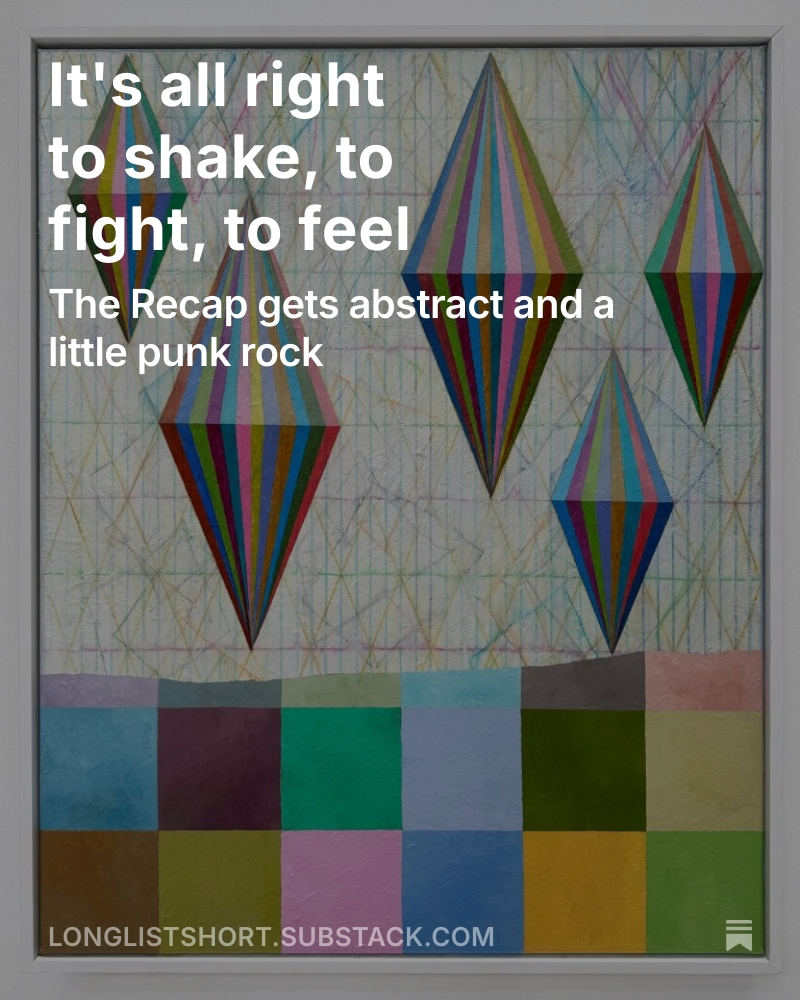
The Recap, my Substack newsletter, returns today with a focus on abstract art, punk rock, the American flag, the 90s, and more. It adds a little more dimension to what I post on the website and ties things together thematically.

Check it out and subscribe!

Oct 162025
 

Sahara Longe “Skull”, 2024, Oil on Linen

“As We Are (after Otto Friedrich)”, 2024, Oil on Linen

“Liar”, 2024, Oil on linen
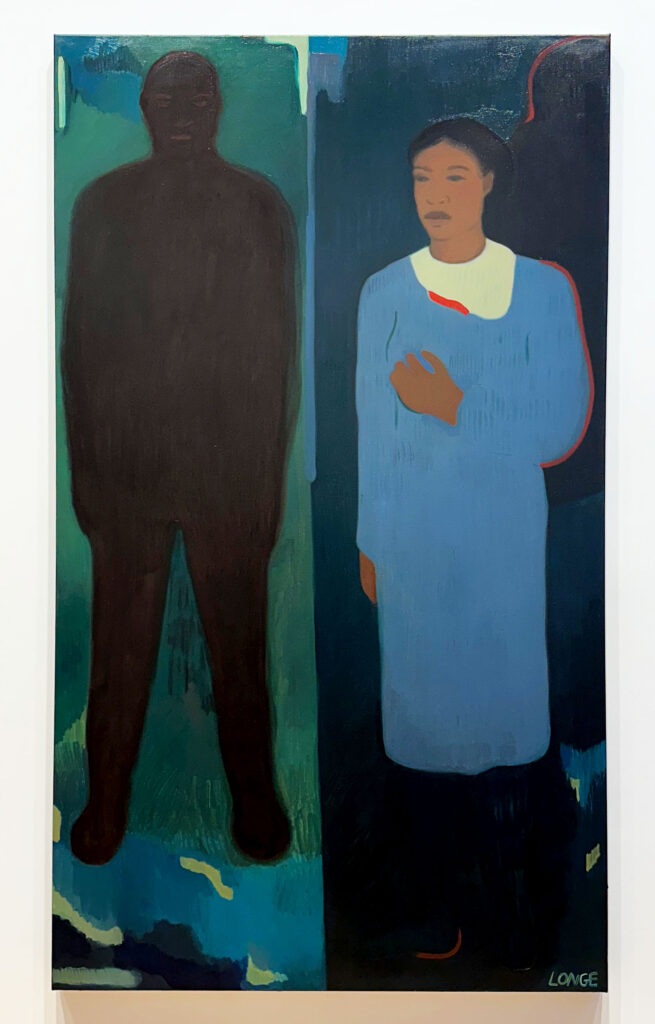
This week’s throwback is to Sahara Longe‘s paintings from her 2024 exhibition at Timothy Taylor gallery in NYC, Sugar.

From the gallery about the work-

Featuring twelve vivid and haunting canvases, Longe’s second exhibition with the gallery sees the artist reconceiving various art histories to arrive at an uncanny interplay of figures, allegories, and enigmatic landscapes. The show will be accompanied by an essay by Ferren Gipson, art historian and writer based in London.

In paintings characterised by a preternatural handling of line, colour, and figuration, Longe depicts partially abstracted subjects in atmospheric environments. Working on thick grain linen with raw pigment in a distinct palette of vermillion, lilac, raw sienna, and ochre, she renders her scenes with a fluid painterly freedom that is nevertheless quiet and precise in its effect. Across her work, she recalls aspects of the Symbolist ethos, which moved between nostalgia and rupture, seeking not to capture something directly, but rather convey the sensations it produces.

In her new paintings, Longe focuses on the nude. Articulated in spare, suggestive gestures, her subjects, largely women, are pictured huddled together, embracing a lover, or striding alone. Some set their gaze on an unknown distance, others stare down the viewer, and one confronts a fish. Each seems possessed by a disquieting tension that is emphasised by a shadowy apparition lurking in many of the works. Masculine in stature, the incubus perches over a scene or cradles another figure therein. Where Longe’s previous series reflect on social dynamics, depicting parties and crowds, these paintings are more personal; the artist explains that the new works look inward rather than outward. Expressive, brushy marks bring subtle notions of agitation, dreaminess, and intimacy to otherwise minimal passages of colour.

These paintings further explore the ideas set out in Longe’s earliest work, which emerged from her study of classical portraiture at Charles H. Cecil Studios in Florence; in her early canvases, Longe integrated and recontextualised themes and styles of old-master paintings. Here, her compositions draw from Secessionist painter Otto Friedrich’s nudes and Symbolist Ferdinand Hodler’s ominous portraits. They likewise reveal the influence of a recent trip to Oslo, where Longe was taken by Henrik Sorensen’s mural (1938–50) in Oslo City Hall (where the Nobel Peace Prize is selected), and the marginalia of illuminated manuscripts. Ushering these disparate sources and traditions into her singular aesthetic, Longe poses subtle questions about representation—who it serves, and what narratives it upholds—just as she underscores figuration’s expressive potential.

Oct 142025
 

This colorful mural by Iker Muro (aka MurOne) was created for the 2018 edition of Sacramento’s Wide Open Walls Festival.

From Wide Open Walls about the artist-

Iker Muro (MurOne) is an illustrator and graphic designer who began creating public murals in 2002. Born in Bilbao, Spain, Muro describes his work as “an acid mixture of pop culture, graffiti, illustration, and graphic design.” As a youth, he began painting on skateboards and drawing caricatures of teachers and classmates at his desk in the back of the classroom. He went on to complete his studies in graphic design and has worked in many different disciplines including graffiti, graphic design, prints, and large-scale murals.

Muro’s vibrant, bold murals strike a distinctive balance between design and art. His work draws from his extensive international travels, and he takes inspiration from whatever city he is painting in. “Travelling and discovering different cultures is a gift,” he says. “I feel lucky to make my living with what I love, I don’t know what will happen in the future, I don’t have a job and a stable life, but painting and giving life to places that don’t have any is very gratifying.”

For more of his work, also check out his Instagram.


Oct 102025
 

Today’s flashback is to Huma Bhabha‘s spooky figures for Before The End, which was on view until March of this year at Brooklyn Bridge Park.  It is just one of the many projects organized by Public Art Fund.

From Public Art Fund about the work-

With the ominous title Before the End, Huma Bhabha (b. 1962, Karachi, Pakistan) sets the stage to evoke mythologies as old as humankind. Conceived for Brooklyn Bridge Park, Bhabha’s four monumental painted and patinated bronzes were cast from carved cork and skull fragments. The mysterious figures recall ancient effigies cut into tombstones, their surfaces evoking centuries of eroded sediment and stone. Yet, unlike a tomb, these four-sided vertical forms stand elevated above the earth, their bones open to the sky.

“Before the End” is a title borrowed from the writings of Vincent of Beauvais (ca. 1184–1264), whose medieval imagination sparked with supernatural and apocalyptic visions. Today, the related popular genres of horror and science fiction continue to inspire Bhabha, as does art history from antiquity to the present day. Her rough-hewn figures are ambiguous—are they emerging or trapped within, rising from the depths of the earth or returning to the underworld? Set amidst an expansive landscape where the natural and man-made converge, Bhabha’s sculptures captivate through contradiction, seemingly forged in geological time yet animated with a visceral sense of immediacy.


Oct 082025
 

Theo Platt, “Chrome”, Oil on canvas

Theo Platt, “Sunstream”, Oil on canvas

Theo Platt, “Sunstream”, Oil on canvas (detail)

Theo Platt, “Deep Calm”, Oil on canvas

Somerville Manning Gallery is currently showing two painting exhibitions: Theo Platt‘s textured oil paintings from his Oceans series of works (pictured above) and Steven Nederveen‘s Stillness in the Shade of Green.

Below Nederveen describes his process for the work (pictured below)-

Using a mixed media approach to image making, I combine acrylic paint and C-print photographs. By layering these elements I can etch down into the emulsion of the photograph to reveal golden hues and also build up the surface with impasto and washes of colour. The result is an image with photo sharp detail in focal areas and painterly brush marks that obscure and create space for the imagination.

Both of these exhibitions close 10/11/25.

Steven Nederveen, “Gold Hidden Within”, Mixed Media

Steven Nederveen, “Gold Hidden Within”, Mixed Media (detail)

Steven Nederveen, “Breathe In the Forest Air”, Mixed Media


Oct 022025
 

Corita Kent (Sister Mary Corita)’s print I Should Like to Be Able to Love My Country and Still Love Justice, 1968, was on view at the Museum of Modern Art in NYC in June of 2024.

From the museum about the artist-

Corita Kent, also known in the Catholic Church as Sister Mary Corita, incorporated a range of references into her silkscreen prints, spanning pop culture imagery and song lyrics, biblical allusions, and literary conceits. After seeing Andy Warhol’s Campbell’s Soup Cans in 1962, she was inspired to embrace the language of Pop art, using bold, graphic designs to convey anti-war messages. In the 1980s Kent’s posters and ephemera were collected by PAD/D (Political Art Documentation/Distribution), a New York-based art activism group with a mission to create an archive of politically concerned art and ephemera from around the world. The materials are now part of the MoMA Archives, Library, and Research Collections.

You can currently see some of her photographic archive at Marciano Art Foundation in Los Angeles for the exhibition Corita Kent: The Sorcery of Images, on view until 1/24/26. The show “focuses on a little seen part of Corita’s artistic practice: her archive of over fifteen thousand 35 mm slides that she and her cohorts took between 1955 and 1968 while she was a beloved teacher in the art department at Immaculate Heart College”.

As part of their press release they include this lovely quote from the artist-

“In a sense, the whole world around the artist is his source, his sorting and relating powers are his sorcery, and the one isn’t much good without the other. … Anything can be a source, even a mistake. The sorcery or the thievery is the art of relating sources into a new solution.”

Her work can also be seen in Los Angeles at the Corita Art Center. The center is free to visit on Saturdays (with appointment).


Oct 012025
 

Jon Carsman‘s painting October Visions, 1975, was on view at Akron Art Museum in 2024 as part of their permanent collection.

From the museum about the artist-

Jon Carsman painted from photographs, but though his pictures have a clear quality of precision, his intention was never to simply recreate what he had recorded on film. In his own words: “I want to give you a feel of what it was like to be there when I was.” To achieve this goal, Carsman stylized many elements of his paintings, often working toward a visual equivalent of the rhythm, movement, and energy that he found in music. He also worked most frequently with the rural scenery of Pennsylvania’s Wyoming Valley, where he was born and raised. As a result, images that began as still photographs take on new life through the artist’s personal experiences and memories.