Apr 102026
 

Lindsey Cherek Waller, “Making Plans”, 2025, acrylic on stretched canvas (It was also used for the cover of the upcoming book “Girls Our Age” by Phoebe Thompson)

Perry Picasshoe, “Splitting Heaven”, 2025, oil on unstretched canvas (part of a performance piece)

Perry Picasshoe, “Splitting Heaven”, 2025 (detail)

Creative Influence(r), currently on view at The Delaware Contemporary, features work by Lindsey Cherek Waller and Perry Picasshoe, two artists who use social media platforms to increase their visibility and success.

From the museum about the exhibition-

For centuries, art museums have wielded their power to define a predictable, prescribed path for aspiring artists. An artist striving to build a career from their work traditionally starts with a formal arts education, then builds a portfolio, hoping to secure gallery representation, which will garner the attention of collectors, galleries, and museums. But since the 2010s, that has shifted. Increasingly, young and emerging artists are utilizing social media platforms to subvert the traditional routes to becoming a working artist; a path that, for many, has numerous real and perceived barriers to entry. Using social media platforms, like TikTok and Instagram, artists have found ways to circumvent the traditional hierarchy of the art world, building their own audiences and collector bases by sharing their work online for millions to discover and appreciate. By utilizing these platforms, artists have also found a way to reinvigorate art for younger generations and those who feel excluded from institutional structures, making contemporary art more accessible for all.

Lindsey Cherek Waller and Perry Picasshoe built their artistic career on social media platforms where their art is activism. Their public artwork has protested ICE abductions, it has protected queer virtual and physical queer spaces, and has raised funds to support causes important to them. These artists are only two of many who are redefining “success in the art world”, their success comes directly from their fearlessness and advocacy for their work and communities.

Creative Influence(r) is on view until 4/26/26.

Apr 092026
 

Thea Abu El-Haj, “Architecture of Exile”, 2023, oil on board

Rayan Elnayal, “The courtyard lit up-Al Hoash Nawar”, 2023, digital print

Shira Walinsky’s installation

For This Place Meant at The Delaware Contemporary, artists Thea Abu El-Haj, Rayan Elnayal, and Shira Walinsky each present work that reflects aspects of what home means to them.

From the museum about the exhibition-

This Place Meant explores how three artists think about and imagine home when they are far from it. Each artist explores their lived or past relationship with the place they call home and where they are now. Thea Abu El-Haj remembers the home she once knew, Rayan Elnayal imagines a home she hopes to know, and Shira Walinsky shares the home she knows with new neighbors. If you were forced to leave your home, whether to be closer to family, to find a better life, to escape natural disasters or political trouble, how would you share memories from where you once lived? What parts of that place would you describe: the colors, the smells, the sounds?

We hope you tell them what that place meant to you.

Below are some additional works and the artist bios from The Delaware Contemporary’s website.

Paintings by Thea Abu El-Haj

As a Palestinian American artist, Thea’s work excavates personal and collective narratives of loss, exile, and resistance, even as it celebrates the beauty and joy around us. She is drawn to the imprint of human history on the natural landscape. Growing up in the Middle East, the colors, quality of light, and traces of millennia of human presence continue to resonate through her work, even as the landscapes of the Northeastern U.S. where she has lived her adult life influence what she paints. Buildings and stone walls in the process of decay; light coming through dark and dark through light; the quality of color at different times of day are all sources for her work.

Digital prints by Rayan Elnayal

Rayan Elnayal is a Sudanese artist, designer, and educator based in London, with a background in architecture. In 2020, she transitioned from traditional practice to an alternative one that fosters a more equitable and creative approach to design but also nurtures her artistic pursuits. She is also the co-founder and director of Space Black, a collective of Black professionals in the built environment, dedicated to imagining alternative spatial futures for marginalised communities.

Her pieces invite viewers to step into these imagined spaces and explore them. Her work challenges us to reflect on our personal attitudes toward futurism and futuristic aesthetics, while reminding us that our envisioned future built environments can honour our heritages, communities, and shared joy.

Shira Walinsky is an interdisciplinary artist and teacher. Her work centers on people and places in the City of Philadelphia. She has worked in Philadelphia for 20 years on murals, paintings, photography, films and other public participatory work. The map can be a portrait of places and the face a map of our experiences. She is interested in how the vibrant and the sensory can amplify the stories of people and place. This manifests in bus wraps, films, photography, painting and murals. In 2012 she co-founded Southeast by Southeast with Mural Arts Philadelphia. Southeast by Southeast is a community space co-created with social workers and artists and community leaders for and with refugee and immigrant communities. Shira strives to create innovative projects which elevate the resilience of immigrant and refugee stories.

This exhibition, part of the museum’s Winter/Spring exhibitions, closes on 4/26/26.

Feb 262026
 

Kadir Nelson, “Harlem On My Mind”, 2016, Oil on canvas, Cover for The New Yorker, February 22, 2016

There’s only a few days left to see the excellent and informative exhibition Imprinted: Illustrating Race at Delaware Art Museum.

From the museum about the exhibition

The Norman Rockwell Museum assembled Imprinted: Illustrating Race with co-curator Robyn Phillips-Pendleton, a professor at the University of Delaware. The exhibition honors Rockwell’s powerful images supporting the Civil Rights Movement, displaying his work within a sweeping historical survey of American illustration that features illustrators including Romare Bearden, Emory Douglas, Howard Pyle, and Loveis Wise.

Illustration has been at the forefront of defining events in the United States, from the American Civil War and Reconstruction Era to the Harlem Renaissance and the Civil Rights Movement of the 1960s, moving forward to today. Imprinted examines widely circulated imagery, conceived and published over the course of more than three centuries, which has reflected and shaped perceptions of race across time.

Featuring over 200 artworks commissioned by publishers and advertisers, the exhibition traces harmful and prolific stereotypical representations of race that were historically sanctioned and prominently featured in newspapers, magazines, and books, on trade cards, posters, and advertisements, and on packaging and products. Imprinted also celebrates the concerted efforts of 20th and 21st century artists and editors to shift the cultural narrative through the publication—in print and across digital platforms—of positive, inclusive imagery emphasizing full agency and equity for all.

Norman Rockwell, “Murder in Mississippi”, 1965, Oil on canvas (Unpublished, intended as the final illustration for “Southern Justice” by Charles Morgan, Jr, in Look, June 29, 1965)

From the museum about the Rockwell work above-

In 1963, Rockwell turned his attention to the documentation of America’s most pressing social concerns and the subject of human rights by making works for Look magazine.

In the beginning of 1965, Rockwell began work on a piece about the murders of Michael Schwerner, James Chaney, and Andrew Goodman-three young civil rights workers who were in Mississippi to expand voter registration.

He wanted the painting to express his outrage. In a letter to Look art director Allen Hurlburt, Rockwell wrote: “I tried in a big way…to make an angry picture. If I just had a bit of Ben Shahn in me it would have helped.”

Shahn’s portraits of the three activists are also on view next Rockwell’s.

Below is Jacob Lawrence‘s painting, The Brown Angel.

Jacob Lawrence, “The Brown Angel”, 1959, Tempera on gesso panel

From the museum-

In the 1940s and 1950s, Lawrence painted a series of compelling works inspired by nightlife and its social atmosphere. In The Brown Angel, the painting’s sharp, edgy forms convey a sense of unease, perhaps pointing to the mounting racial tensions of the time.

Several of Ahmed Samuel Milai’s series of comic-style historical portraits are also on view.

Ahmed Samuel Milai, “Marie Laveau, III”, 1966, Ink, benday, and conte crayon on board    For “Facts About the Negro” by J. A. Rogers, in The Pittsburgh Courier, April 2, 1966

From the museum-

Milai was an editorial and comic strip cartoonist for the Pittsburgh Courier, an influential African American weekly newspaper published from 1907 to 1966. For 30 years, he illustrated “Your History,” a cartoon feature that became known in the 1960s as “Facts About the Negro.”

Designed to celebrate and inspire pride in the accomplishments of people of color across the fields of the arts, literature, education, and science, the series brought Black history to light at a time when such information was not widely acknowledged or shared.

You can find a few more of his illustrations here.

Thanks to the support of The Gilliam Foundation, for Black History Month the museum is offering free admission (including the exhibition), every Saturday in February. The exhibition closes 3/1/26.

Dec 182025
 

Work by Mel Rosen (sculpture) and Stass Shpanin (mural, video, and paintings)

Detail from Stass Shpanin’s “Dance of Birth” animated video

Ceramic sculptures by Mel Rosen

Paintings by Stass Shpanin

The Delaware Contemporary is currently showing three exhibitions as part of its 2025 Biennial  Art + AI programming. This post covers two of them, the third is here.
Construct | Disrupt: Artificial Intelligence as Tool and Material features work by artists Mel Rosen, Stass Shpanin, Sol Kim, and Mark Burchick.

From the museum about the exhibition-

In an age when reality itself feels unstable—filtered through algorithms, fragmented by digital archives, and refracted through competing narratives—artists are increasingly turning to the tools of fiction and speculation not to obscure the truth, but to question how we construct it. Construct | Disrupt brings together the work of Mel Rosen, Sol Kim, Stass Shpanin, and Mark Burchick, four artists who use artificial intelligence, language, and archival material to explore the porous boundaries between perception, memory, and belief.

Across diverse practices—from ceramics, drawing, and painting to video, installation, and text—these artists engage with AI not as a replacement for the hand, but as a provocateur, a co-conspirator, and a mirror to the human imagination. Rather than seeking resolution or certainty, their works open up space for doubt, complexity, and contradiction.

Together, the artists in Construct | Disrupt invite us to consider how we construct meaning in a world where the archive is no longer fixed and where the image can be endlessly generated. The work of these artists does not offer answers, but rather asks: What do we trust? What do we remember? And how do we decide what is worth believing?

About the two artists pictured above, from the museum-

Stass Shpanin engages history as a space of imaginative reconstruction. Working with visual fragments from American folk traditions and immigrant archives, he uses AI to distort and reconfigure the past, generating speculative images that blend glitch, myth, and memory. His paintings and drawings present broken, layered timelines where visual language is both preserved and interrupted. Rather than restoring a singular truth, Shpanin’s work embraces the possibility of many coexisting histories—ones shaped as much by fantasy as by fact, as much by the digital as the ancestral.

Mel Rosen’s practice draws from archaeology, natural history, and personal memory to create objects and images that feel both ancient and otherworldly. Her use of AI image generation allows her to iterate quickly, mutating prompts based on her own drawings and a mental library of organic and cultural references—from Pompeian frescoes and fossils to barnacles and talismans. The resulting images feed back into her ceramics and drawings, where mythic forms and geometric distortions coexist in a suspended cosmology. Rosen’s work suggests that artifacts—whether material or digital—are always evolving, reshaped by time, environment, and interpretation.

Still from the video “Person Enough” by Sol Kim

Sol Kim (video still above) approaches language as a material form, using words to subtly disrupt social and technological systems. Her works often begin with a textual prompt—an instruction, label, or survey—that gives rise to absurd, humorous, or quietly unsettling performances. In The Cookiest Cookie, cookies are judged and destroyed by AI based on their perceived “cookie-ness,” while in Person Enough?, performers attempt to become more legibly “human” to computer vision systems. Through these gestures, Kim reveals the tensions between human nuance and machine classification, exposing the strange logic that governs our interactions with technology—and with one another.

Mark Burchick Installation

Images from Mark Burchick’s “Felt Presence”

Mark Burchick’s Felt Presence explores the intersection of faith, media, and artificial intelligence through the lens of Catholic mysticism. Drawing on archival photographs from the 1917 “Miracle of the Sun” in Fatima, Portugal, Burchick trains AI models to generate photorealistic images of miracles that were never captured on film. Presented alongside historical documentation and witness testimony, these fabricated scenes invite viewers to question the boundaries between belief, evidence, and visual truth—highlighting the unseen technological, institutional, and spiritual forces that shape our perception of reality.

In NOO Icons, Burchick expands this inquiry through an immersive video installation framed like a reliquary. A five-minute rear-projected loop, trained on over 100 images of stained glass Rose Windows, morphs into abstract color fields via AI animation. At its center is a 3D-printed altar piece generated using DreamFusion, a text-to-3D tool prompted to create a “solar monstrance.” The resulting object—gold-finished, internally lit, and housing Lithium batteries—evokes both the Communion host and a technological relic. As Kate Crawford notes in Atlas of AI, Lithium is a sacred yet finite resource driving modern AI. By encasing it in plastic and low-res form, Burchick critiques the planned obsolescence and ecological cost of our AI-powered age, reframing divine presence through the lens of material decay.

In another of the museum’s galleries is- Reimagine | Reveal: Challenging the Algorithmic Gaze featuring work by Danielle Glovin, Stephanie Dinkins, and Leah Modigliani.

About the show from the museum-

The works covering this exhibition theme approach AI not as a neutral instrument, but as a complex cultural system—one that reflects, amplifies, and at times distorts the values of its makers. Through the intersecting strategies of critique, reimagination, and bias exposure, Danielle Glovin, Stephanie Dinkins, and Leah Modigliani probe the systems—algorithmic, archival, social—that dictate what is preserved, who is recognized, and how knowledge circulates.

Together, these artists ask urgent questions: Who trains the algorithm? Whose histories are encoded, and whose are left out? What does it mean to build an intelligence—and who is it built for? In doing so, they model a critical engagement with AI, one that challenges default narratives, centers marginalized perspectives, and opens up space for new possibilities. Their practices call us to reconsider what it means to know, to remember, and to be recognized in a world increasingly shaped by invisible systems of intelligence.

Stephanie Dinkins’ interactive sculpture Not The Only One (N’TOO)

Stephanie Dinkins’ “Conversations with Bina48” (back wall) and Leah Modigliani’s AI generated letters for “Cultural Capital”

From Danielle Glovin’s series “Future Generations”

About the artists’ work pictured above-

Stephanie DinkinsNot The Only One (N’TOO) and Conversations with Bina48 extend this inquiry into the realm of relational AI, specifically that of minority groups in the tech sector. In N’TOO, an interactive sculpture gives voice to the oral histories of three generations of Black women, creating an AI entity intentionally designed, trained, and aligned with their values and lived experiences. It is a poignant reversal: instead of AI extracting meaning from biased data sets, Dinkins encodes her AI, reorienting the goals of intelligence design toward inclusivity and equal representation.

In Conversations with Bina48, Dinkins engages in an evolving dialogue with one of the world’s most advanced humanoid robots- probing the limits of kinship, consciousness, and identity. The recorded exchanges navigate tensions between human and machine, emotion and algorithm, intimacy and abstraction—underscoring the urgency of developing AI systems coded to reflect the full richness and diversity of human stories, cultures, and embodied experiences.

Leah Modigliani’s Cultural Capital offers a satirical yet incisive intervention into the circuits of artistic legitimacy. Through a fictional archive of AI-generated letters of recommendation and rejection—authored in the mimicked voices of historical critics and curators—Modigliani reveals how the rhetoric of value and genius in the art world is both constructed and recursively reinforced. The project uses generative tools to lay bare the biases embedded in cultural gatekeeping, drawing attention to the ways AI might amplify inherited hierarchies under the guise of neutrality.

Danielle Glovin’s Future Generations presents AI-generated reinterpretations of inherited family photographs, exposing the mechanics of machine vision and the flattening effects of automated classification. By transposing Midjourney text outputs onto her photographs, Glovin literalizes the collision between personal history and digital taxonomy. The result is a visual language at once familiar and estranged—where nostalgia meets simulation, and memory is rewritten through the aesthetics of machine learning.

These exhibitions will close on 12/28/25.

Dec 182025
 

Portraits by Carrie Ann Baade

Reclaim | Reframe: Datasets and Cultural Visibility, is one of three exhibitions that make up The Delaware Contemporary’s 2025 Biennial- Art + AI. The timely show features work by Carrie Ann Baade, Tyanna Buie, Blažo Kovačević, and Tara Youngborg.

From the museum

Through AI and computational technologies, artists Carrie Ann Baade, Tyanna Buie, Blažo Kovačević, and Tara Youngborg construct layered narratives that reclaim overlooked and marginalized histories. In doing so, these artists unsettle dominant cultural and media frameworks that have long erased, distorted, or commodified lived experience. Exploring themes of identity, ancestry, and displacement, they use generative tools as critical instruments to question, expose, and reconfigure the archival and institutional biases embedded in history, culture, and the environment. From ancestral reclamation and speculative futures to immersive storytelling and data-driven environmental translations, their work advances a reimagining of social justice through the lens of artificial intelligence.

Together, these artists offer a complex portrait of making in the age of AI, revealing how tools shaped by those in power can both perpetuate bias and enable resistance. Their work asks: Who shapes the cultural record? When an AI model “remembers,” whose truth is it repeating? How can we reclaim agency within these systems (built on our collective labor)?

The images at the beginning of this post are from Carrie Anne Baade’s series, Birthplace. Her mixed media portraits of her ancestors, created with the help of AI, present a fascinating look at the stories of several women from early in American history.

From Baade’s statement about the work-

Birthplace is a visual exploration of personal ancestry, delving into the lives of women from colonial Louisiana between 1690 and 1750. Through oil painting, collage, and Al-generated imagery, I reconstruct the presence of these women-figures shaped by French colonial rule, Indigenous displacement, and Romani migration-whose stories have been largely absent from recorded history. Employing a methodology that blends archival research with imaginative storytelling, I create portraits that serve as visual hypotheses-acts of artistic and ancestral repair. The compositions incorporate antique lace, colonial maps, domestic fabrics, and found objects, mirroring the intertwined textures of lineage, migration, and identity. Al-generated image blending aids in synthesizing historically plausible references, speculating on the appearance and presence of women who were never visually recorded.

This project is not about one family, but a shared American inheritance. It reveals the complexity of identity in a land shaped by colonization, migration, and erasure. In rematriating these women to history, Birthplace offers viewers a visual counter-history-one rooted in survival, interconnection, and the enduring power of maternal lineage.

Pictured below are works from the other artists in the exhibition along with information provided by the museum.

Tara Youngborg examines how institutional data and machine learning shape our understanding of land and environment. Using field research, environmental archives, and US Geological Survey datasets, her datastream translates waterflow data and topographic maps into immersive video installations that highlight the limitations of digital representation. By transforming statistics into layered, shifting media, Youngborg portrays landscapes as dynamic terrains of knowledge. Glitches and ruptures in the work expose gaps between digital abstraction and lived experience, prompting questions about algorithmic authority and what is lost when place is reduced to data.

Tara Youngborg’s installation

Tara Youngborg’s installation (detail)

In AR (Argumentative Reality) and Truck for Three Illegal Passengers, Blažo Kovačević uses augmented reality, 3D modeling, and game engine software to confront invasive state surveillance and the dehumanization of migrants. Using digitally enhanced X-ray images from European Border Patrol inspections, he reconstructs a 2015 tragedy in Serbia where 54 undocumented passengers died in a van crash. His works shift between detached aerial views and intimate interior scans, altering typical media frames into ethical engagement. Kovačević warns how AI-driven technologies can perpetuate oppression through automated surveillance, data collection, and erasure, urging reflection on the politics of visibility and mediated violence.

A still from Blažo Kovačević’s video

Tyanna Buie reconstructs erased family histories and reimagines Black identity through speculative Afro-Futurist frameworks. Using ChatGPT and DeepFake technology, she remixes images, sound, and text to create narratives where absence becomes presence. In The Guardians of Nyala, Buie overlays her own likeness onto eighteenth-century Dutch dignitary portraits, then collaborates with AI to imagine a family history untouched by colonization. Rooted in personal narrative and Black popular culture, her counter-archive elevates erased lives and transforms AI from a tool of replication into one of radical self-authorship.

Two of the portraits from Tyanna Buie’s “The Guardians of Nyala”

This exhibition closes 12/28/25.

Dec 102025
 

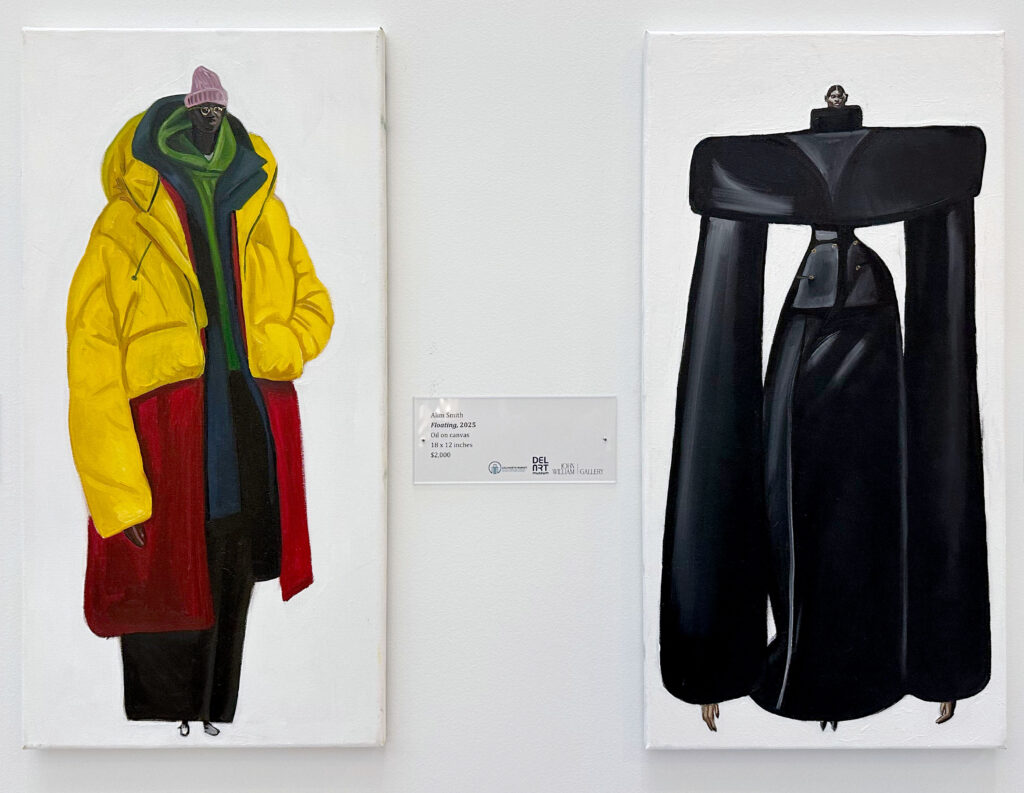
Alim Smith, “Floating” and “Thought A New Dress Would Make it Better”, 2025, Oil on canvas

Paintings by Alim Smith

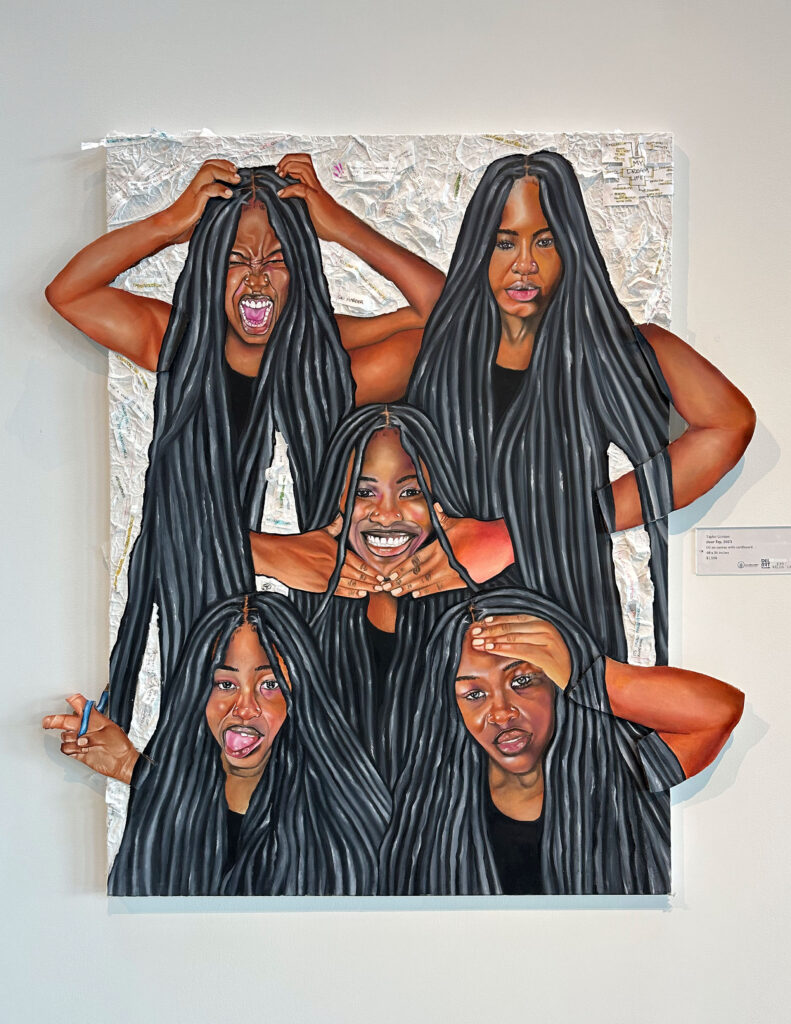
Taylor Gordon, “To Be A Black Woman”, 2023, Oil on canvas

Taylor Gordon, “Dear Tay”, 2023, Oil on canvas with cardboard

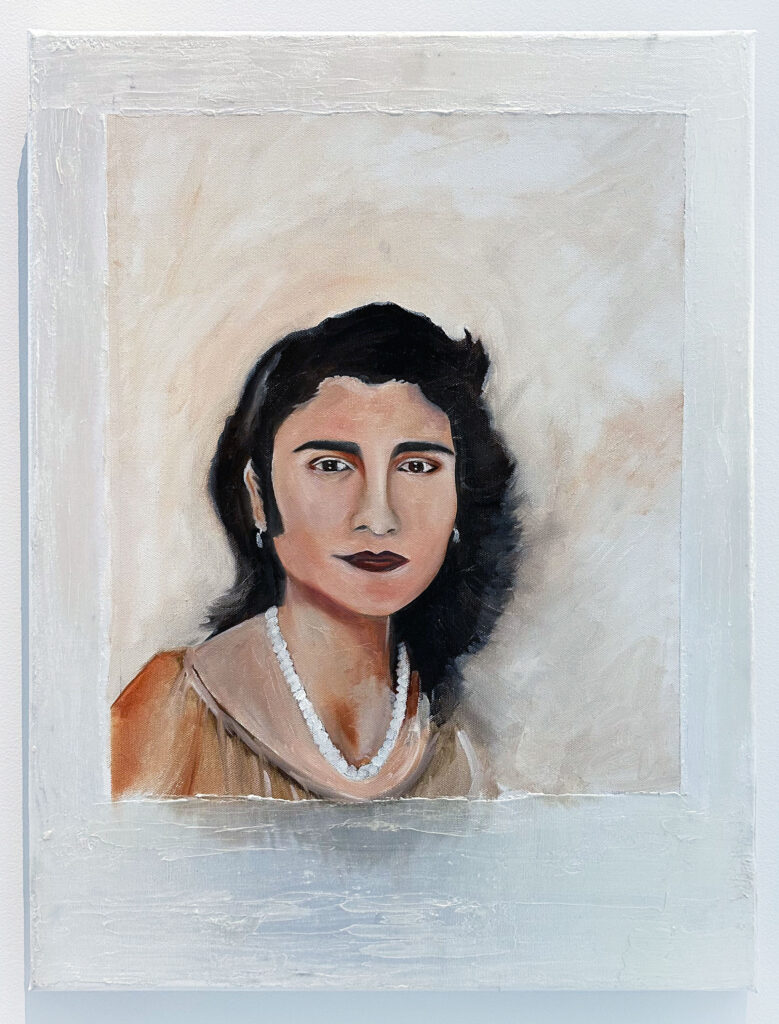
Manuel Ramos, “Abuela Gorin”, 2025, Oil on canvas

Manuel Ramos, “Abuela Olga”, 2025, Oil on canvas

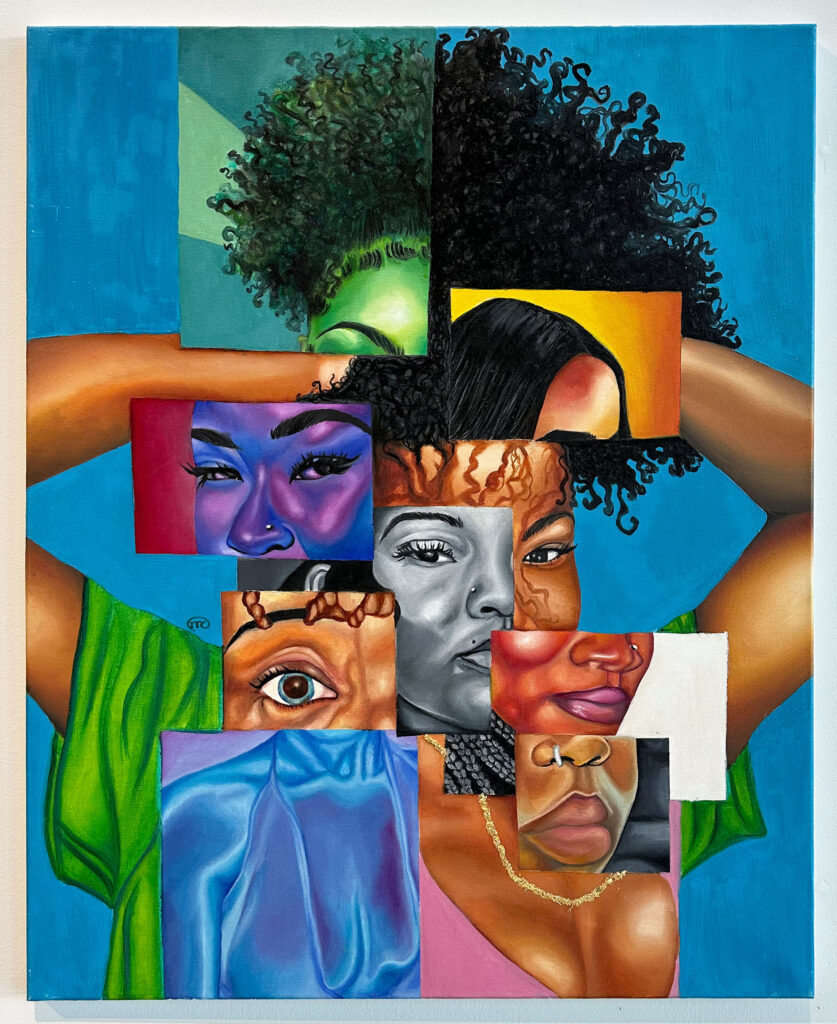
Currently on view at John William Gallery in Wilmington is Colorful Voices: Taylor Gordon, Alim Smith, Manuel Ramos, featuring unique paintings by the three Delaware artists.

From the gallery about the exhibition-

Colorful Voices: Taylor Gordon, Alim Smith, Manuel Ramos brings together three distinctive practices that articulate the richness of contemporary community life through color, portraiture, and cultural reference. The exhibition seeks to foreground the vitality of local voices while offering a space in which viewers might consider how identity, humor, and heritage are translated into visual form.

Taylor Gordon’s paintings situate themselves within the lineage of Black contemporary art, yet remain deeply personal. Her chromatic sensibility infuses each figure with layered emotional resonance, encouraging conversations around beauty, resilience, and the multiplicity of Black experience beyond reductive narratives. Manuel Ramos, or “RAmos ART,” approaches portraiture with a keen attentiveness to light and surface, imbuing his sitters with an understated dignity that resonates quietly yet powerfully. Emerging from a self-taught practice shaped during the pandemic, his canvases record moments of presence that hover between the intimate and universal. Alim Smith, or “Yesterday Nite,” works in a spontaneous visual language, fusing surrealism, popular culture, and sly humor. His rhythmic compositions and vivid palette translate music, memory, and cultural archetypes into forms at once playful and incisive.

Together these artists propose color as more than visual pleasure: it becomes a conduit for empathy, critique, and joy. Colorful Voices invites us to engage with works that are celebratory yet searching, attuned to both the textures of daily life and the broader currents shaping our communities. In gathering their practices, the exhibition hopes to affirm art’s capacity to nurture dialogue and to render visible the stories that animate shared experience.

This exhibition is on view until 12/18/25.

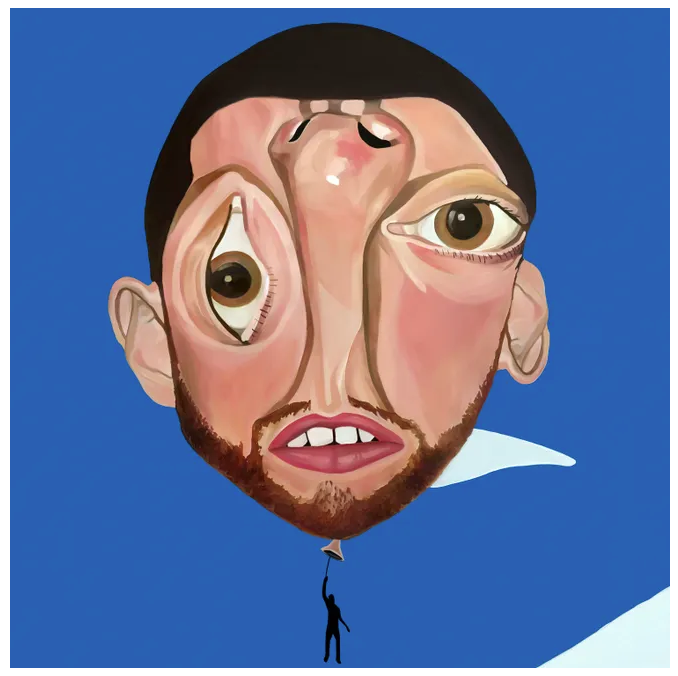
Alim Smith’s work may look familiar- he created work for the television series Atlanta and the cover art for Mac Miller‘s second posthumous album, Balloonerism, released earlier this year. Miller reached out to him in 2018, after finding his work on Instagram. Smith was recently nominated for a Grammy award for “Best Recording Package” for this album.

Mac Miller’s “Balloonerism” cover art by Alim Smith

Oct 232025
 

The paintings above by Nicole Parker were part of the exhibition, Phantasia, on view earlier this year at The Delaware Contemporary.

The artist’s statement about her work from her website-

I am a representational artist specializing in narrative and symbolic paintings and hand-pulled intaglio prints.  In my current body of work, I’m exploring the triangular relationship between my sense of self, my perception of what “home” means, and the physical spaces and environments that I’ve occupied throughout my life.  My imagery often involves structures, spaces and objects that represent a story or dream from a specific period in my life.  They are places and things that evoke strong emotions like love, loneliness, joy, or fear.  I’m often unable to physically visit or return to the things I’m rendering, so in the studio I work from memory and cobbled references.

Although memory is always unreliable and changing by nature, I’m interested in the potency of my own sensory memories, and the way that light, color and the smell of the air stick in my mind.  These concrete sensory ideas are always at the core of my practice.

Oct 082025
 

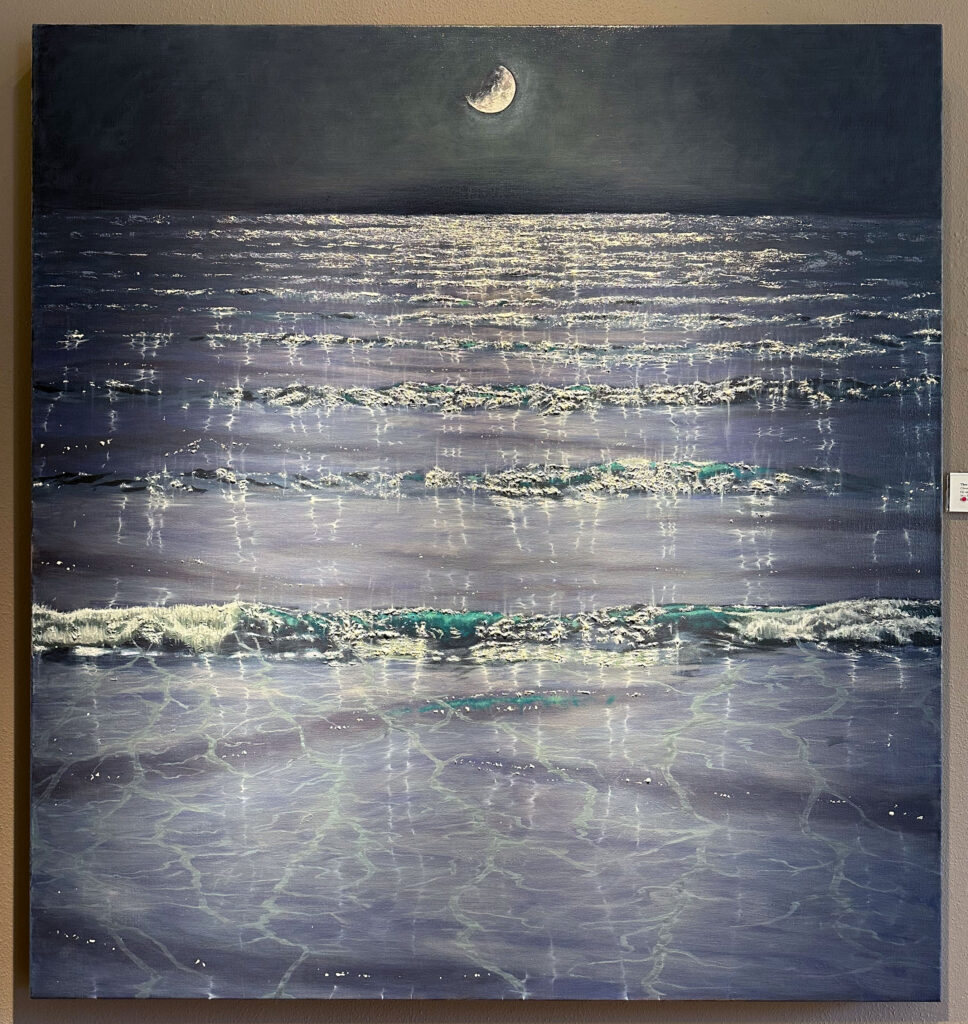
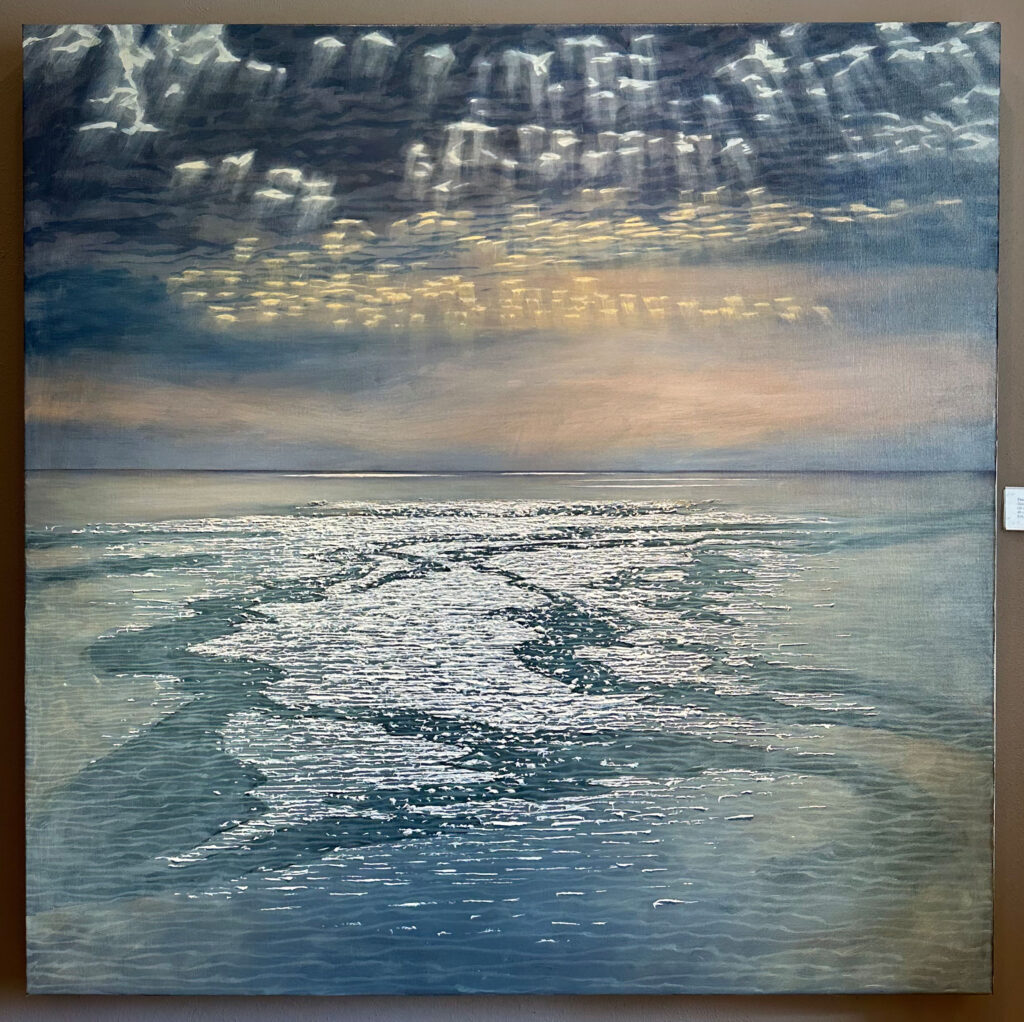
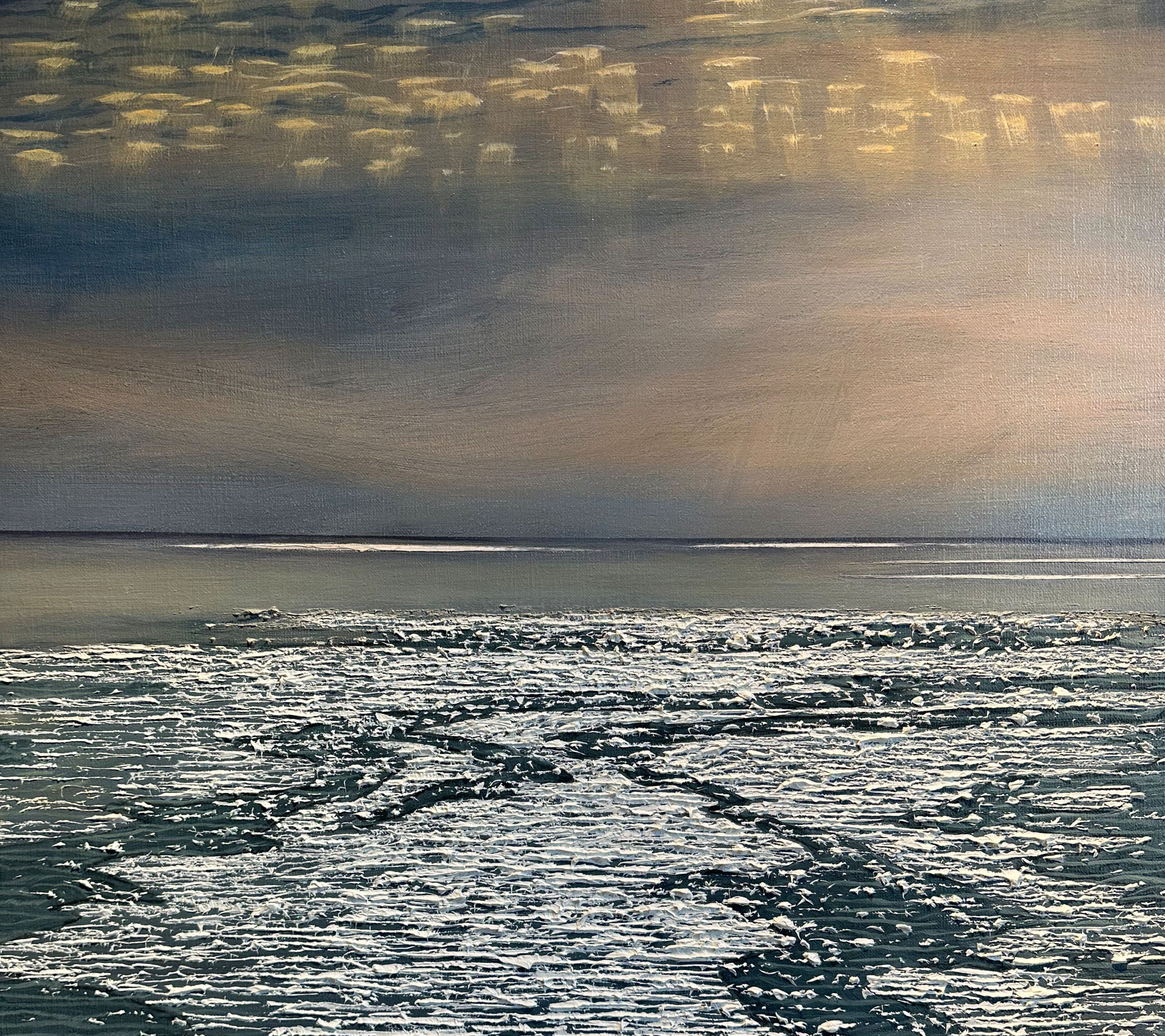
Theo Platt, “Chrome”, Oil on canvas

Theo Platt, “Sunstream”, Oil on canvas

Theo Platt, “Sunstream”, Oil on canvas (detail)

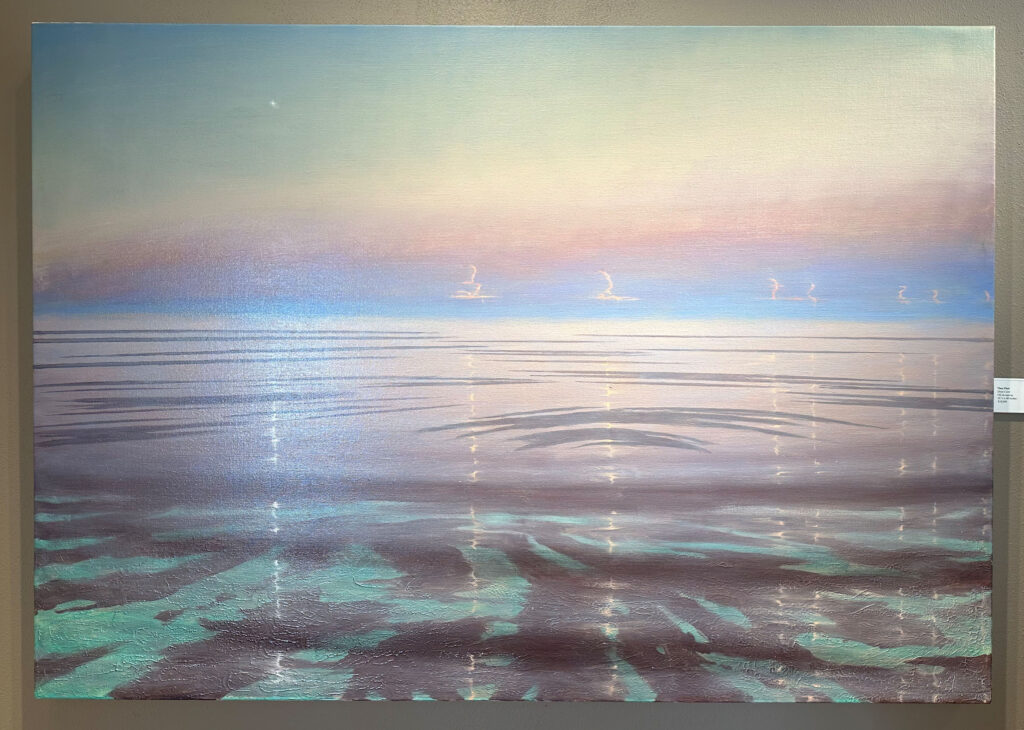
Theo Platt, “Deep Calm”, Oil on canvas

Somerville Manning Gallery is currently showing two painting exhibitions: Theo Platt‘s textured oil paintings from his Oceans series of works (pictured above) and Steven Nederveen‘s Stillness in the Shade of Green.

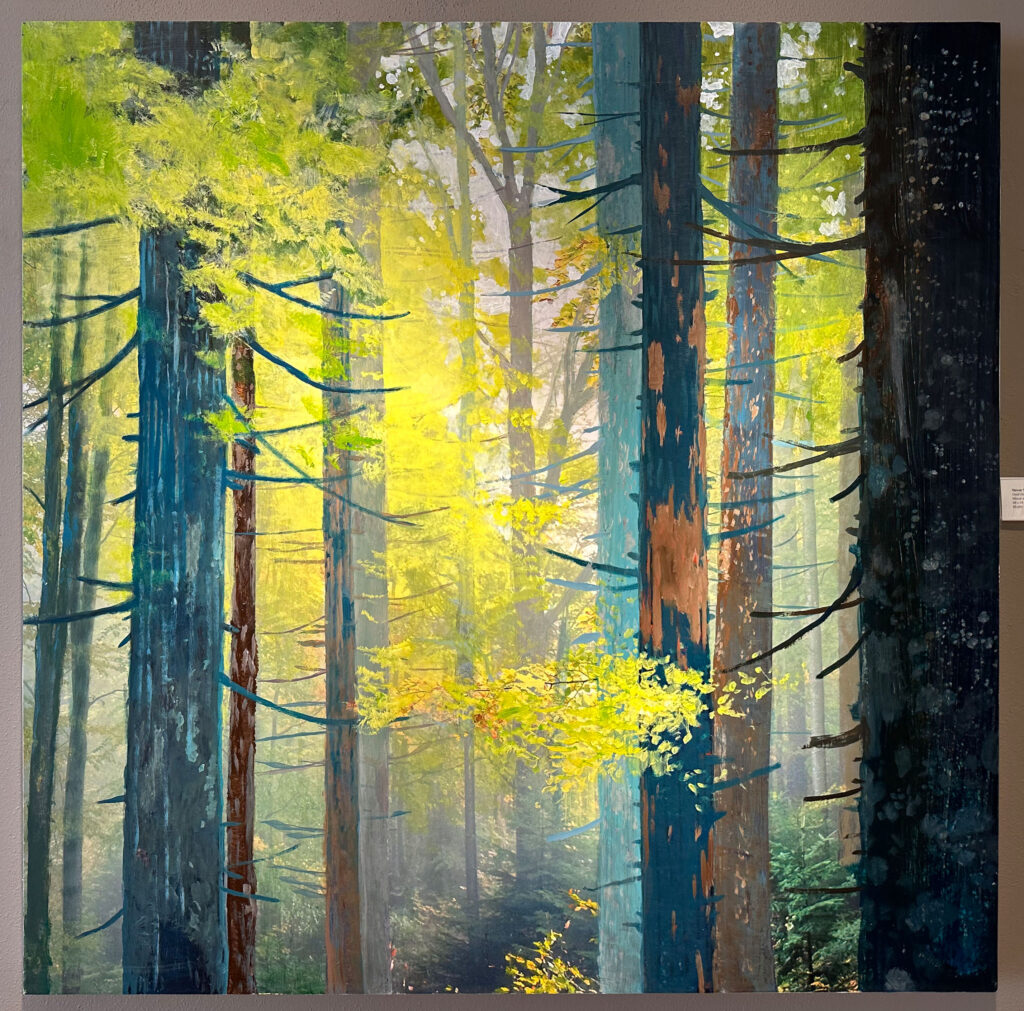
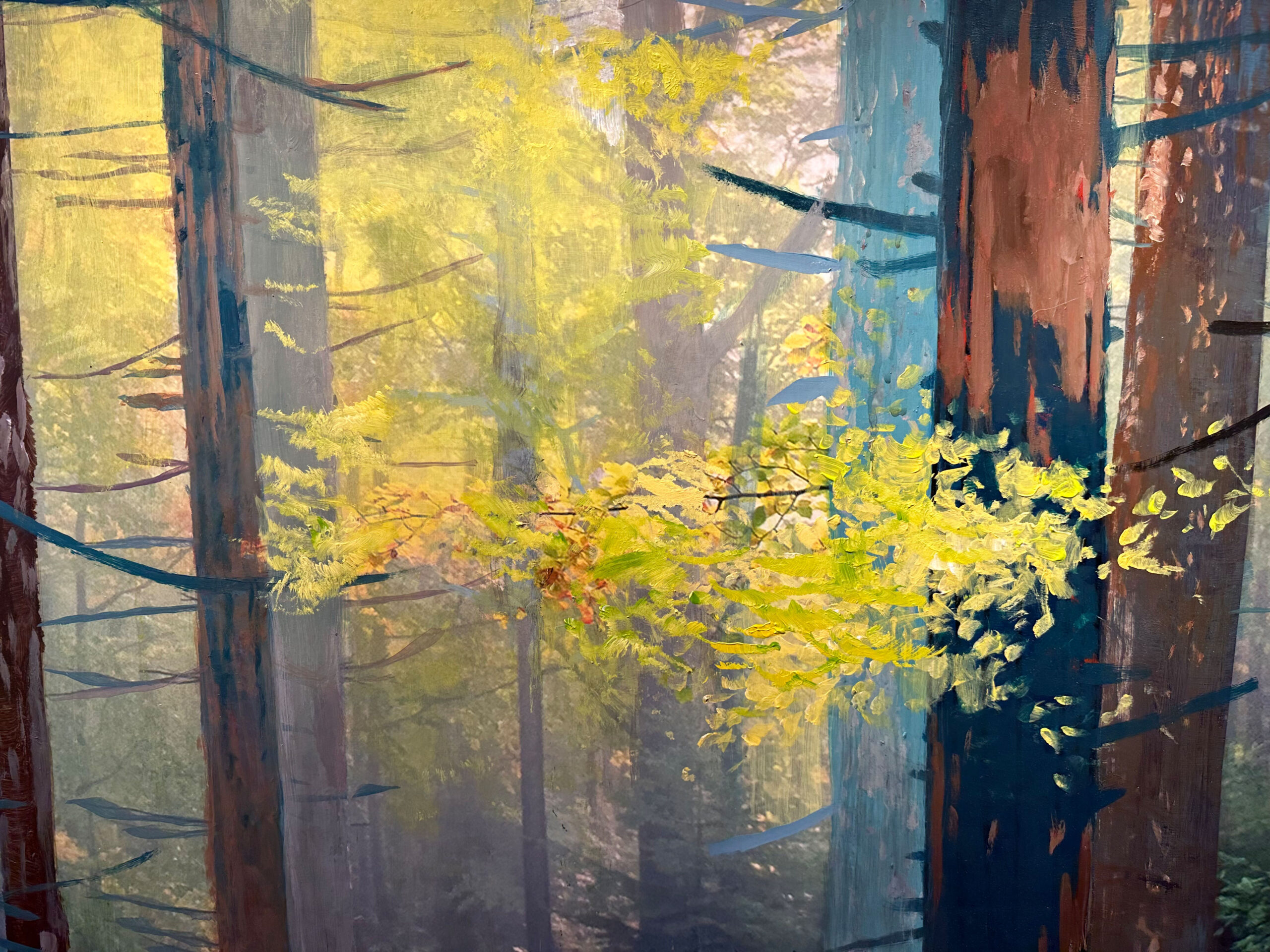
Below Nederveen describes his process for the work (pictured below)-

Using a mixed media approach to image making, I combine acrylic paint and C-print photographs. By layering these elements I can etch down into the emulsion of the photograph to reveal golden hues and also build up the surface with impasto and washes of colour. The result is an image with photo sharp detail in focal areas and painterly brush marks that obscure and create space for the imagination.

Both of these exhibitions close 10/11/25.

Steven Nederveen, “Gold Hidden Within”, Mixed Media

Steven Nederveen, “Gold Hidden Within”, Mixed Media (detail)

Steven Nederveen, “Breathe In the Forest Air”, Mixed Media


Aug 272025
 

William T. Williams, “Walter’s Advice”, 1970, Oil on canvas

10-color screen prints by William T. Williams in collaboration with HKL Ltd.

A selection of books surrounded by posters created for The Pennsylvania Opera Company

Six works by painter and printmaker Gabor Peterdi

Prints by Ilya Bolotowsky

Delaware Art Museum is currently showing an impressive collection of prints from a variety of artists for Marisol to Warhol: Printmaking and Creative Collaboration.

From the museum about the exhibition-

Marisol to Warhol: Printmaking and Creative Collaboration, brings together more than a dozen portfolios and suites in DelArt’s collection. The featured prints showcase the creative collaboration of artists who experiment across media. The exhibition presents a who’s who of American artists working in the second half of the 20th century, including Marisol, William Majors, Jacob Lawrence, Andy Warhol, Audrey Flack, Robert Blackburn, Ben Sakoguchi, Lorna Simpson, Lowell Nesbitt, and Luis Jiménez. Produced by individuals and print shops, these groups of prints functioned as tools for commemoration, fundraising, and political awareness in a range of techniques, styles and intentions.

Joining the exhibition is a special loan from Art Bridges, William T. Williams’ painting Walter’s Advice from 1970. Produced the same year as a newly acquired print portfolio by Williams, Walter’s Advice employs similar forms and colors. The two are displayed together to showcase an artist’s creative exploration across media and the collaborative aspect of printmaking.

Below are a few more selections-

Pages from Dead Birds, a book which combined poetry by Christopher Erb with prints by 24 artists.

From the museum-

Dead Birds pairs poetry by Christopher Erb with prints by 24 artists, demonstrating the vibrant artistic community around the poet and his wife Elena Laza, a printer, designer, and typographer. Erb penned the poems and sent them to artists who used them as inspiration for their prints. Once the prints were produced, Laza typeset and printed the text using a turn-of-the-century press and created boxes to house the prints.

Several of the collaborating artists were affiliated with Robert Blackburn’s Printmaking Workshop and the Center for Book Arts in New York, where Erb and Laza exhibited. Others worked and studied at the Art Students League of New York and were introduced to the project through Will Barnet, a master printer and longtime instructor at the League. Dead Birds was among Erb’s most ambitious and collaborative projects.

Above are four prints from Lowell Nesbitt‘s Moon Shot print series.

From the museum-

Lowell Nesbitt produced this suite of prints, published by the Palley Gallery, following his participation in NASA’s Artist Cooperation Program. Artists working for NASA had behind-the-scenes access to witness events like launches and splashdowns up close and in person. For this series, though, Nesbitt reproduces photographs of the one place NASA can’t let him go: the Moon.

Nesbitt is often associated with Photorealism, but these prints take evocative liberties with their approach to depicting the Moon. Bolstered by quotes from astronauts, Nesbitt meditates on the visual experience of seeing the Moon up close and undistorted by the Earth’s atmosphere. The cratered surface appears in shimmering gestural whorls against the black paper-an appropriate stand-in for the unpigmented vacuum of outer space. Nesbitt’s portfolio considers space exploration alongside his printmaking process. One lithograph showing the footprint of an astronaut’s boot pressed into the lunar soil seems to reference the lithographic process itself.

Upstairs in a separate section are prints from Salvador Dalí’s playing card series, seen below.

From the museum-

In 1967 and 1969, Salvador Dali designed a set of playing cards for the renowned French printing house Draeger Freés. Several years later, the artist revisited the project and created a series of 17 designs featuring an ace, jack, queen, king, and joker in each suit. The art dealer Reese Palley later published the 250-print edition with the goal of selling individual prints at an elaborate, 50th birthday party in Paris. The sales scheme, and the chartered Pan American flights from Atlantic City to the event, were widely covered in national press in January 1972. Both the original cards and the prints that followed feature Dali’s surreal motifs and reference many of his most famous paintings.

This exhibition closes 9/7/25.

Aug 212025
 

Painting by Kelly Irvine

Installation of sculptures by Allison Hudson

Work by Anna Guarneri

Each of the five artists in Bricolage: Artists and Accumulation, currently on view at The Delaware Contemporary, use their materials to express meaning through a layering process.

From the curators, Kasia J. Bunofsky and Leah Triplett-

“I have a very simple theory. I have always pretended that objects themselves formed a self-composition. My composition consisted of allowing them to compose themselves.” – Armand Pierre Fernandez (Arman) (November 17, 1928 – October 22, 2005)

When ‘assemblage’ first circulated as an art-historical term in the early twentieth century, it referred to the primarily formalist practice of joining tangible, often discarded or found, materials. Like a three-dimensional collage, assemblages made novel juxtapositions of individual components to create a whole artwork with its own impact. As the topography of the art world shifted mid-century, assemblage was often used to critique the post-war era’s burgeoning consumerism. Similarly, “accumulation” refers to a kind of assemblage that emphasizes materiality through the mass repetition of similar objects or forms. Accumulations lent themselves particularly well to expressing discontent with consumerism. They underscored the commodity’s necessity as a medium while maintaining the artist’s agency to reclaim meaning through the processes of recontextualization and repetition. As time persisted, assemblage continued to inspire and lend credibility to avant-garde contemporary movements. Even the new wave of ‘conceptual art’–a blatant rejection of materiality–was seen as an assemblage that forwent concrete objects to assemble ideas, language, or concepts. From installation art, to performance, to ‘relational aesthetics’, assemblage and accumulation helped pave the way for today’s contemporary art world and its many innovations.

Assemblage and accumulation emphasize the importance of each material element to the message of the completed work of art. This idea evokes a sense of collectivism; a metaphorical microcosm of material cooperation that might inspire a yearning to change our individualistic society, as art reminds us the whole cannot exist without the contributions of every one of its parts.

The artists and works featured in Bricolage: Artists and Accumulation reference the tradition of assemblage, accumulation, and their many corollaries; either through the performance held within their artistic process, their compilation of abstract concepts, or their passion to speak through material. They build, assemble, accumulate, gather, and collect. Using assemblage as both a method and technique, these artists engage assemblage as an action that is always in perpetual evolution of form. Be their medium drawing or sculpting, painting or installation-their material glass or found objects, acrylic or graphite- Anna Guarneri, Allison Hudson, Brynn Hurlstone, Kelly Irvine, and Emilio Maldonado, apply an iterative, intuitive approach to making, resulting in a bricolage.

This aesthetic- in which the whole is a sum of parts-demonstrates a depth of material knowledge. The works presented here require long looks to unfold and reveal their discrete components. Layering, stacking, blending, and amalgamating are processes and aesthetic devices that enable the viewer to experience the work in an instinctual way. Throughout these artists’ individual practices, an emphasis on transformation through collecting and comingling materials, media, and forms is paramount, with bricolage being a means for metamorphosis.

Below are additional works by the artists and information from the museum-

Allison Hudson

“My work explores the nature of cycles and the emergence of growth from decay. It’s tactile and fragile- a combination of unfired clay, wool, fabric, resin, and wax. Driven to manipulate raw materials into something new and unrecognizable, I enjoy the physicality of building, tearing apart, and mending together – striving to create work that is at once ethereal and visceral.”

Kelly Irvine

“My abstract color field paintings invite the viewer to step into a lush, translucent world of color. Drawn to the beauty of layered transparent hues from an early age, I use sheer color, overlapping forms, gestural brush work, organic forms, and repeating motifs that flow and intersect, resulting in delicious new hues and increased tonal depth. Contrast is important in my work as well; hard edges are in conversation with areas of soft gradation, while vibrant, neon hues pop against muted tints and natural, raw canvas.

I’m especially inspired by the canvas staining techniques and paintings of Helen Frankenthaler and Washington Color School artists Morris Louis and Kenneth Victor Young. I pair that inspiration with constant experimentation and manipulation of materials, developing new processes as a natural outcome.”

Anna Guarneri‘s work explores the possibilities of suggestive imagery and the devotional connotations of stained glass. She uses crude marks and associations to tap into early human experience, pulling from a range of sources – ancient art, architecture, dance history, and her own body. Colors in her work conjure poignant memories, turning drawn forms and glass structures into celebrations, memorials, or premonitions.

Guarneri’s latest body of work pulls from the visual world of postpartum life, incorporating imagery of bodily landscapes and interiors, and the various devices, accessories, and toys encountered during pregnancy, birth, and early motherhood.

Brynn Hurlstone

In Time explores the process of healing from trauma, and the permanent transformation left behind once that process begins. Layers of broken safety glass are frozen within ice and slowly melt over a steel platform. The thaw allows for the release of contained breakage onto the foundation, where it rests in a slowly evaporating pool of water. Over time the water evaporates and the shattered glass may be swept away, but the foundational steel upon which the process took place will forever carry its traces.”

Emilio Maldonado

“I create art to explore personal narratives and navigate life through the material culture of capitalist America.
My work raises questions about social constructs, structural inequalities, and the dynamics of race and class. Through a multidisciplinary approach, I repurpose discarded objects as a means to reflect on memory, identity, and social conventions.”

This exhibition is on view until 8/24/25.