Jun 102026
 

Donald Lipski, “Who’s Afraid of Red, White and Blue #37”, 1990, White wool gabardine, made in collaboration with The Fabric Workshop and Museum

Rose B. Simpson, “Tonantzin”, 2022, Linen, cotton, clay, and thread, made in collaboration with The Fabric Workshop and Museum

(L to R) Rev. Howard Finster, “George Washington Meets Martha Custis, 1984, Pigment on cotton t-shirt; James Luna, “High Tech War Shirt”, 1997-98, Smoked hide, nylon setting, silk suiting, horse hair, metal, shell buttons, bead work with watches and necklace (shell, thermometer, and plastic toys); Hock E Aye VI Edgar Heap Of Birds, “Who Owns History”, 1992, Pigment on cotton t-shirt (all works made in collaboration with The Fabric Workshop and Museum)

S.A. Bachman, “Are You Telling Yourself A Little White Lie?”, 1988, Edition of 5, Halftone photographic silkscreen pigment on nylon, made in collaboration with The Fabric Workshop and Museum

Pictured are just a few of the many excellent artworks currently on view in Some American Dreams at The Fabric Workshop and Museum in Philadelphia. Exploring the concept of America and the American dream, all the works were created by an impressive list of artists who were Artists in Residence at the museum over the past four decades.

From the museum and curator Hilde Nelson:

In her 1986 essay “Waking Up in the Middle of Some American Dreams,” poet June Jordan calls for a multiplicity of American dreams rather than a singular paradigm. For Jordan, those in pursuit of these dreams include:

the white people the black people the female people the lonely people the terrorized people the elderly people the young people the visionary people the unemployed people the regular ordinary omnipresent people who crave grace and variety and surprise and safety and one new day after another.

On the occasion of the 250th anniversary of the U.S. Declaration of Independence, this presentation of works from The Fabric Workshop and Museum’s collection explores the complexity of American-ness through lenses of history, memory, and mythology. Made by past Artists in Residence in collaboration with the FWM Studio, the projects reimagine symbols of nationhood and belonging, critique ongoing legacies of inequity, and offer expanded visions of kinship and community.

The works on view represent four decades of making at FWM. They meditate on themes including indigeneity and race, alternative origin stories, landscape and the environment, the construction of historical narrative, memory and resistance, and images of cultural affiliation. Sections of the exhibition invite additional voices, drawing their titles from a chorus of American poets, songwriters, essayists, abolitionists, and historians.

The artists featured in Some American Dreams break down borders and categorical distinctions to propose a polyphony of American dreams shaped by hybridity, friction, and affinity. They ask: what if America is not one project, but many? And how might these Americas be affirmed, resisted or remade, in Jordan’s words, to envision “one new day after another?”

This exhibition closes 6/14/26.
Feb 292024
 

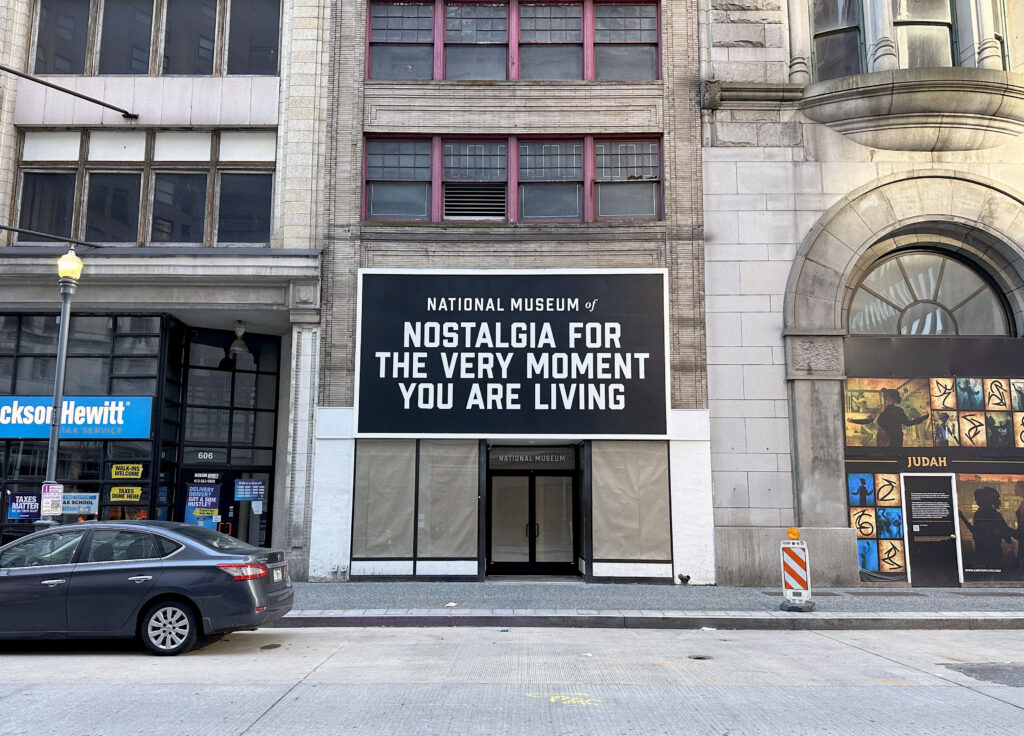
The National Museum is a public art project founded and curated by Jon Rubin and presented by Pittsburgh Cultural Trust. Different artists are invited to change the name of the museum and an essay is written using the title as a jumping off point. The first iteration is by artist and writer Pablo Helguera.

About the project from Jon Rubin’s website

The National Museum repeatedly asks which stories, histories and futures are deemed worth saving and which are ignored or forgotten. Each month, a different artist is invited to change the name of the museum and a national writer is invited to use that museum title as the jumping off point for an essay. In its first year, the project currently consists of storefront signage, street posters, printed broadsheets, a website and monthly accompanying essays.

When a name starts with “The National Museum” it triggers contentious and political associations with borders, nationhood, even citizenship and belonging. Who gets to determine the belonging of an entire group of people bound only by the fact of their geographical location. There’s something absurd about that, if you think about it. Instead of claiming ownership over a diverse populous or even a disparate set of objects, can the notion of the “national” be rethought as something that is less tangible, less object-oriented?

There is a fundamental hubris and absurdity in calling something, anything, a museum, let alone The National Museum. But, in many ways, it’s really no different than any other museum that someone, usually with far more money, privilege, and power than any of my artist peers or myself, has simply made up. So, in a way, the project functions as a kind of loophole or work-around, a participatory fiction that allows a variety of artists to put forth an ongoing series of grand propositions, a theoretical institution that repeatedly brings into question the certainty and reality of our pre-existing institutions.

The National Museum elucidates how museums, especially national ones, are perhaps no different than the nation-states in which they reside. Each is an imagined political construct, a collective fiction used to collect, categorize, narrativize, and control. Throughout modern history museums have used the collections they steward and the stories they tell to validate extractive legacies of colonialism. And, although our current museums, both national and private, are staffed by people with experience in the arts and humanities, the ultimate decision-makers in many of these institutions are wealthy donors and trustees who derive financial benefits from, and exert ideological control over, the fundamental mission of museums. So, while the general public think museums are nominally for “everyone,” the truth is that they are delimited by economic, geographic, racial, and cultural boundaries that restrict their function, design, and access to select publics.

Pablo Helguera’s essay on building façades as art and metaphor, Creditable Unrealities, is included on the broadsheet for the project (as well as his Substack Beautiful Eccentrics) and is a highly enjoyable read.

It includes this passage on how he came up with his name for the museum-

“Ultimately, I reasoned that façades are  the most direct indicator of the time when they were built:  they are the things that we try to use as visual reference to identify a city we know in a historic photograph; they are time markers. And when it comes to museums, they traditionally seek to project timelessness, especially those august institutions whose neoclassic façades promise a container of art for the ages. So I thought that this façade should be the threshold not of art history but of our own awareness of that history and our minuscule place in it, knowing that the present that we are living so vividly will soon wash away, largely unimportant within the broader scope of human life. In 2001, doing research on people who consumed ecstasy, I was struck by the effect that their drug had in some people’s temporal awareness, and how it resonated with my own  (drug-free) experiences. Thus the phrase “I have nostalgia for the moment I am living”, which gave the inaugural title to the National Museum.”

The next iteration of the museum will feature Edgar Heap of Birds (Hock E Aye Vi). The broadside will be written by poet, writer, lecturer, curator and policy advocate Suzan Shown Harjo.

Nov 172023
 

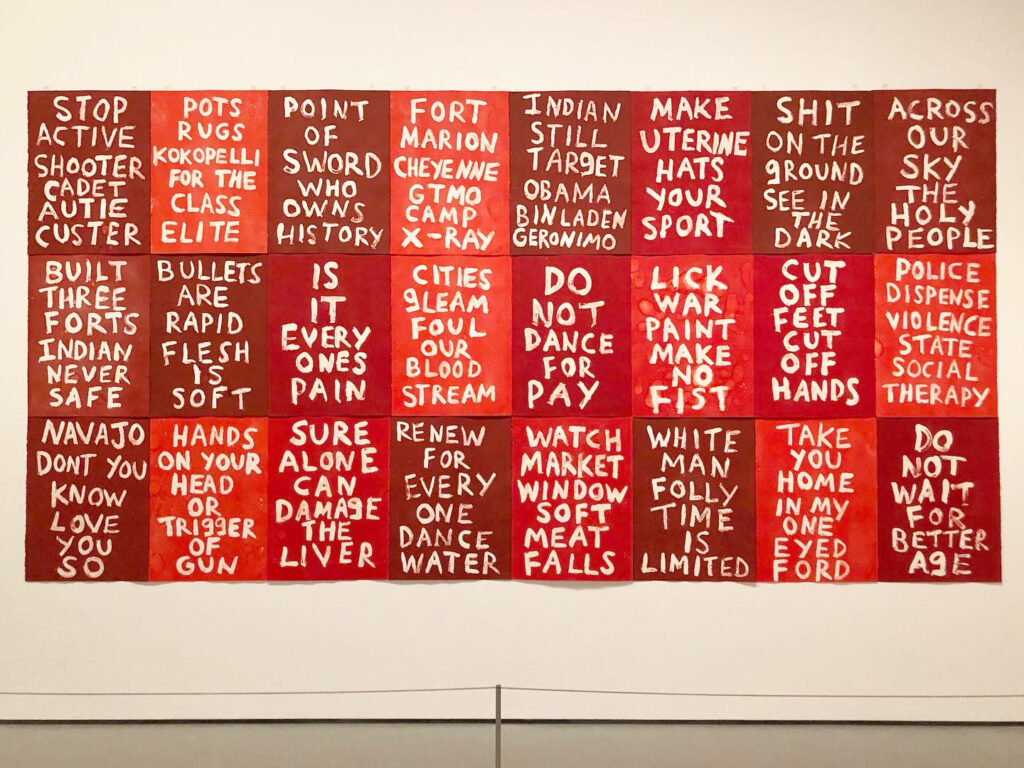
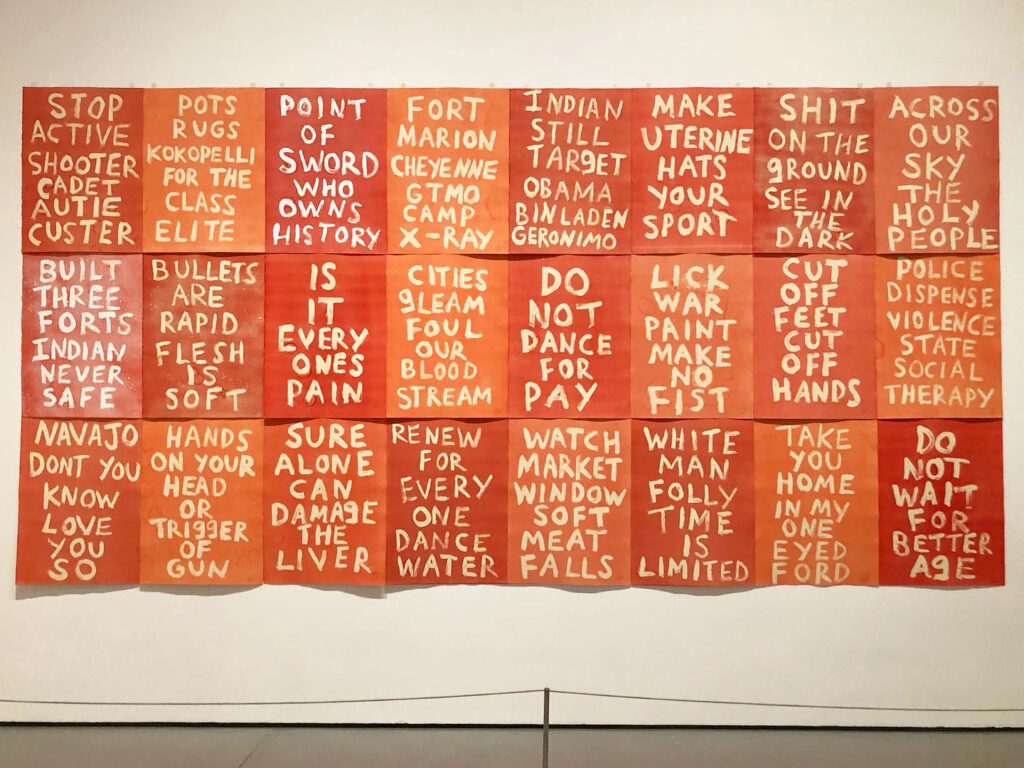
Above is Hock E Aye Vi Edgar Heap of Birds’s work Surviving Active Shooter Custer, 48 monoprints, 2018, from the Museum of Modern Art in New York City, on view in 2021.

From the museum about the work-

The term “active shooter” is one we hear too often in today’s news. Here, Heap of Birds uses this contemporary phrase to characterize massacres committed by United States troops against Native Americans in the 1800s. Each of this work’s panels contains six lines of text evoking the violence of not only this country’s history but ongoing acts of oppression against Indigenous communities. The prints on the right are “ghost prints” of those on the left, made by using the residual ink remaining on the printing plate after the first print was produced. For the artist, these prints recall the “ghosts of a whole culture.”

In the video below from the museum, the artist discusses the work with two of MoMa’s curators.