Jan 092020
 

Blum & Poe in Los Angeles is currently showing two very different exhibitions. In the main gallery is a selected survey of work by Harvey Quaytman spanning three decades.

From the press release-

Harvey Quaytman (b. 1937, Rockaway, NY; d. 2002, New York, NY) came of age in the downtown art scene of 1960s New York, living and working in SoHo studios first on Grand Street and later at 231 Bowery, where he would remain through the late ’90s. Long considered an artist’s artist, the painter enjoyed a close-knit and vibrant artistic and social milieu, over the years sharing studio addresses with Brice Marden, Ron Gorchov, and James Rosenquist, among others. Quaytman’s emerging career as a young painter began in the heyday of Ab Ex with a marked allegiance to Gorky and de Kooning. This approach was slowly shed as the decade unfolded, as his work began to lean towards sculpture—compositions with curvilinear shaped canvases and rectilinear U-shaped bases that inhabited a newfound objecthood. This was followed by a forty-year engagement with geometric abstraction, his approach to painting in contradistinction to the prevailing trends of the era—first with Pop Art and later Neo Expressionism. Despite painting being declared “dead” by Minimalist and Conceptual artists of the time, Quaytman maintained a commitment to the medium and to his vision throughout, helping to shape an alternate trajectory for American painting.

The artist’s work in the ‘70s developed into shield-like forms that balance on curved platforms, conjuring a motion that would result in a critic calling them “rocking rectangles”—the body of work later known simply as “rocker” paintings. These eccentrically shaped works were hand-crafted (he would steam and bend the wooden stretchers himself), and inherently related to movement—inspired by Islamic calligraphy, rocking chairs, and the flight patterns of airplanes and birds. His experiments with shape continued in the late ‘70s, and through the manipulation of geometric intersections and overlapping forms that all the while imply motion, a unique group of paintings resembling anchors or pendulums emerged. In the 1980s, Quaytman began his cruciform paintings, investigations of the cross shape not as emblem but as two meeting vectors; Constructivist, perpendicular geometric compositions that focused on the reduced palette of black, white, red, rusted iron, and metallic gold. While these paintings represented a stark departure from his previous work, Quaytman continued to pursue visual movement as he conjured an interplay of symmetry and asymmetry.

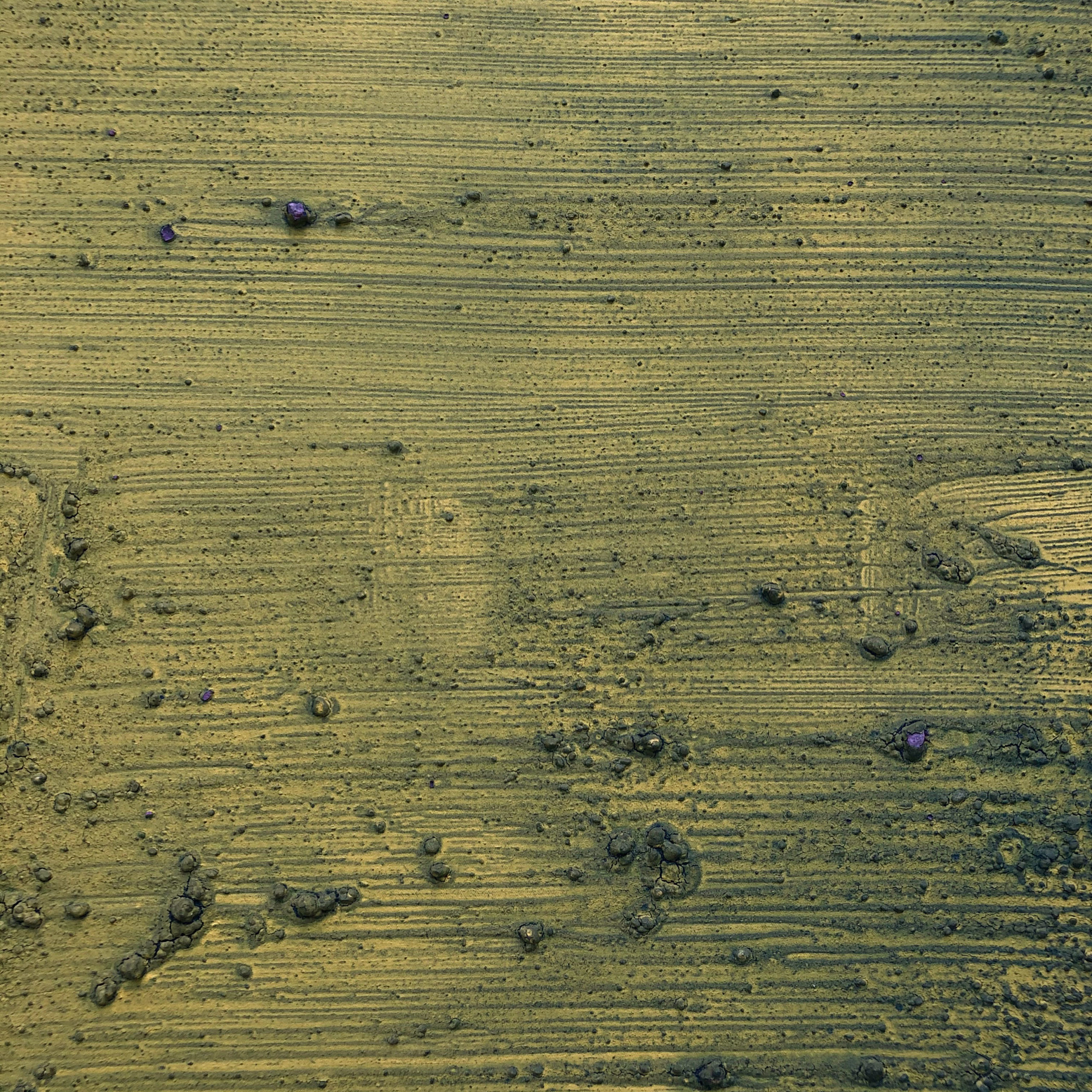
Many of the works become even more intriguing up close.  His use of different materials to achieve varying tones and textures makes them come alive.

The press release discusses a bit about his process in creating them-

As his paintings evolved in form and shape, variously touching upon Abstract Expressionism, Minimalism, Process Art, and Constructivism, Quaytman simultaneously developed a rigorous practice of experimentation with pigment. He was interested in the history, alchemy, and chromatic effects of color, seeking out unique tonalities at specialty stores at home and abroad, becoming a master of color and texture. He skillfully poured paint, spreading Rhoplex over canvas with broad wallpaper brushes after dusting it with pure pigment that settled in thick, unpredictable strata. He later flecked canvas with glass or iron filings and used additives such as marble dust in paint he always mixed himself. On this subject, he said: “It is very important to me to be reminded that I am not an alchemist but a man engaged in coded, layered conversation with my fellow man on what I hope to be (on another) level than words or music.”

On the second floor are Matt Johnson’s delightful sculptures whose familiar materials seem to defy gravity as they balance on each other in the compositions.

From the press release

In an ever-expanding practice in search of the peculiar and the sublime, Johnson elevates the mundane to the exceptional. With a new body of work in carved and polychromed wood sculpture, Johnson depicts configurations of raw industrial materials from cinder block, brick, rebar, to traffic cones—permutations of information composed according to gravity, balance, and primitive instinct. A crude horse, a procession of block figures, cantilevered props, and fragile towers make reference to the concept of knowledge with small gestures—a lighter, a match book, a lightbulb, an atlas, and a monograph on Matisse. The doweled joints of glue and/or epoxy between bricks, blocks, and bars exist here not to defy gravity but to freeze balance and preserve delicate moments of experimental groupings. Like a still life, these works are organized information, like subatomic particles, atoms and elements, molecules and compounds, glued by gravity, and magnetic polarity, surfing in a sea of electrical conductivity.

Both of these exhibitions close 1/11/20.


Jan 042020
 

A Chinese Dream by Wang Jin

First Class by Xu Bing

First Class (detail)

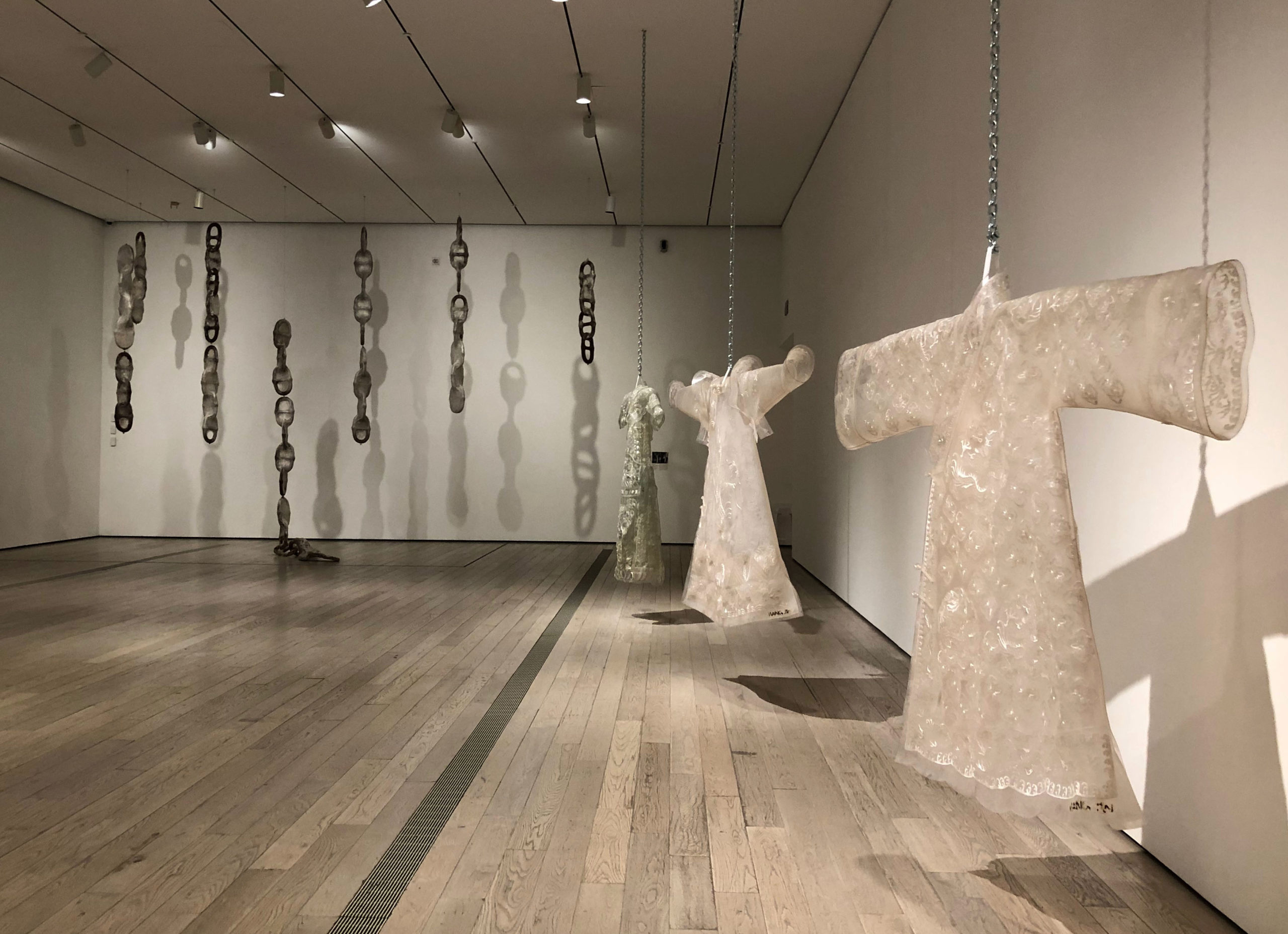
Closing 1/5/20 is The Allure of Matter: Material Art from China at LACMA.

From their website-

Since the 1980s, Chinese contemporary artists have cultivated intimate relationships with their materials, establishing a framework of interpretation revolving around materiality. Their media range from the commonplace to the unconventional, the natural to the synthetic, the elemental to the composite: from plastic, water, and wood, to hair, tobacco, and Coca-Cola. Artists continue to explore and develop this creative mode, with some devoting decades of their practice to experiments with a single material. The Allure of Matter: Material Art from China brings together works from the past four decades in which conscious material choice has become a symbol of the artists’ expression, representing this unique trend throughout recent history. Some of the most influential Chinese contemporary artists today are featured in this exhibition, including Xu Bing, Cai Guo-Qiang, Lin Tianmiao, and Ai Weiwei.

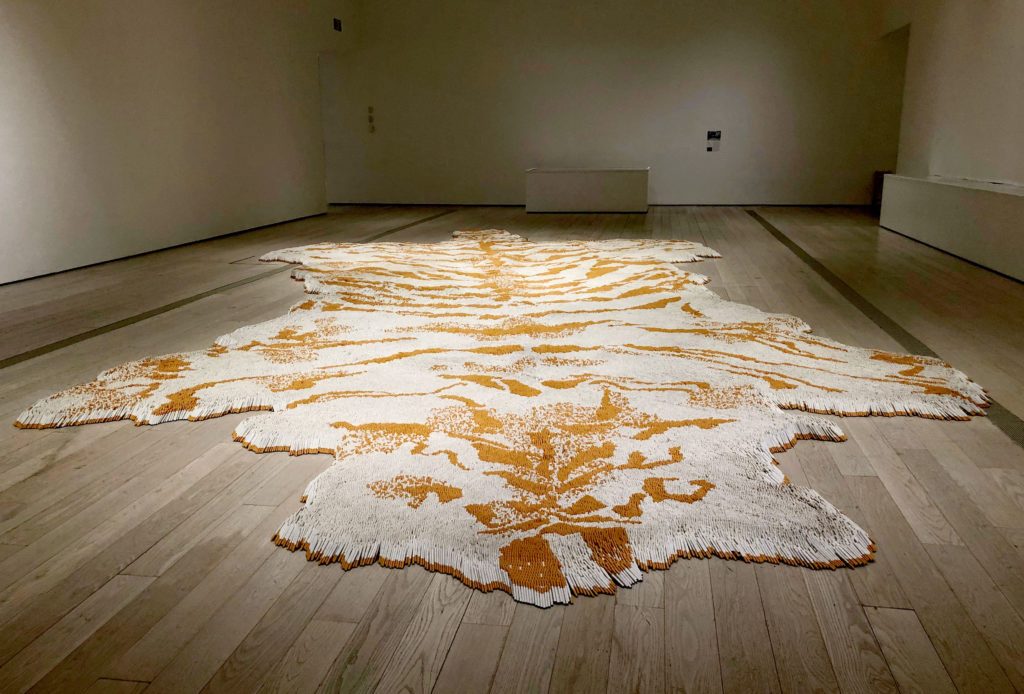
There are a lot of impressive pieces in the show, including Xu Bing’s First Class, pictured above. Inspired by a photograph of a tiger-skin rug in a colonial home in Shanghai, it was created using cigarettes, also considered a luxury item by many. 

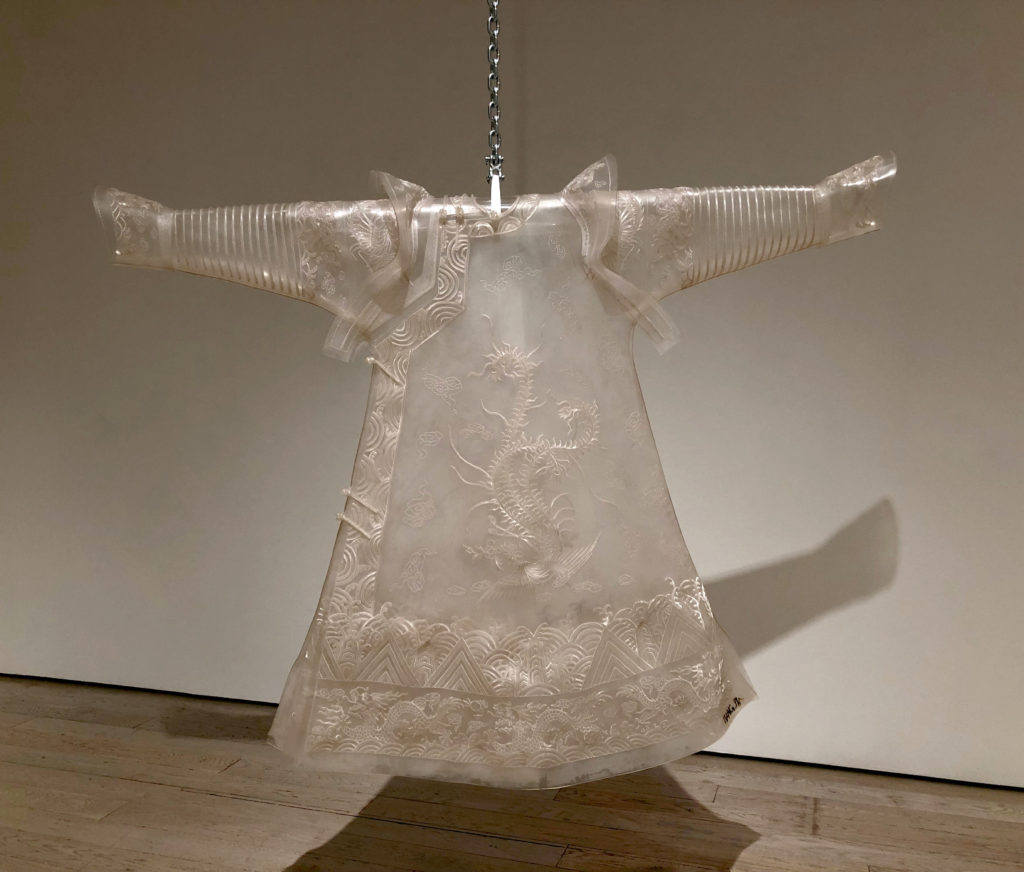
Also pictured are Wang Jin’s imperial robes/theatrical costumes that were created using PVC and fishing wire- replacing the traditional silk material. According to the wall description, the title Chinese Dream “alludes to the commercialization of tradition”. Held up by thick metal chains, they are also much heavier than the originals they copy.

Jan 032020
 

Closing 1/5/20  at Hauser & Wirth’s Los Angeles location is Charles Gaines’ exhibition Palm Trees and Other Works. This exhibition will debut new works from his signature Gridworks series.

Using photographs of native trees from Palm Canyon near Palm Springs, Gaines selectively layers paint on acrylic sheets atop black and white photographs of corresponding landscapes with trees. Following this process, each tree is assigned a distinctive color and a numbered grid that reflects the positive space of the tree in the original photographic image.

The exhibition also includes new watercolor work and Manifesto 3– which takes Martin Luther King, Jr.’s speech given at the University of Newcastle upon Tyne (1967) and James Baldwin’s essay Princes and Powers (1957) and using a rule-based system to convert letters from the text into their equivalent musical notes creating a musical score.

From Hauser & Wirth’s website-

Reflecting on his personal history, Gaines observed that ‘one thing that made me different from other conceptual artists is that I was not shying away from language or meaning or content’ – a truth perhaps best exemplified by ‘Manifestos 3’ (2018). This work functions as a systematic transliteration of revolutionary manifestos into musical notation. The installation is comprised of two parts: a single channel video monitor that scrolls the manifesto texts, and two large graphite drawings of the music scores that were produced by the translation. Each text scrolls in succession on a monitor while a recording of the music produced by Gaines’s system plays. Created by way of a rule-based system, Gaines transcribes letters ‘A – H’ from the text into their equivalent musical notes. The use of the letter ‘H’ represents the code used in early Baroque tradition for B-flat. All other letters and spaces between words are noted as rests or silent beats. While the resulting composition does sound intentional, it is controlled only by the preconceived notation system that follows the compositional structure of language. This produces the fluidity that the audience hears.

The two political texts transcribed in ‘Manifestos 3’ are Martin Luther King, Jr.’s speech given at the University of Newcastle upon Tyne (1967), wherein King nominates racism, poverty, and war as the three most urgent problems of the contemporary world, and James Baldwin’s essay ‘Princes and Powers’ (1957) which describes the dominating power of cultural control. These two manifestos are systematically translated into the above described musical notations as written and arranged for piano by Gaines and edited by John Eagle.

This series not only takes social justice and politics on as its subject, but also as it may critique our understanding of the relationship of the practice of art and politics. By converting these powerful and poignant texts into music, Gaines unites the rational, mathematical, and lyrical structures of music with the irrationality of violence, racial tensions, and social injustice. The predetermined process developed by Gaines widens the distance between concepts and their interpretation, effectively removing the artist’s subjectivity while empowering the viewer’s. The combination of the elegiac music with the stirring words of the scrolling manifestos creates an unexpected conflict for the viewer; it is within this dissonance that the indelible truths of Gaines’s work are revealed.


Jan 032020
 

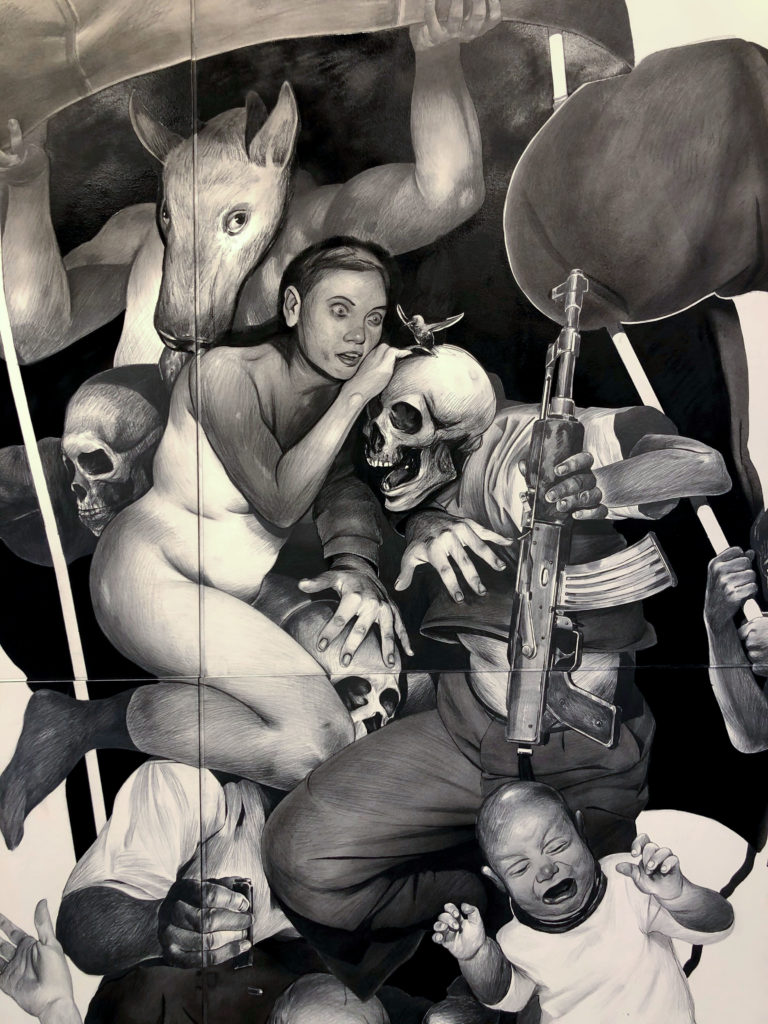
Death March, 2012

Death March, 2012 (detail)

Currently at Luis de Jesus Los Angeles is Hugo Crosthwaite’s incredible exhibition, TIJUAS!(Death March, Tijuana Bibles, and Other Legends).

From the press release-

Hugo Crosthwaite has spent much of his adult life working on both sides of the U.S. and Mexico border, observing and documenting the extraordinary ebb and flow of humanity that makes this region one of the most existentially dynamic places on the North American continent. In Tijuas!, Crosthwaite will present selections from several bodies of work that continue his exploration of this ever-evolving culture, among them the Tijuana Bibles, a new series of animated videos and books, recent graphite-and-ink on canvas and panel paintings, new Tijuanerias ink drawings, and Death March, a phenomenal and monumental work that preceded his celebrated performative murals. This will be the first time this work will be presented since it was commissioned in 2010 for Morbid Curiosity: The Richard Harris Collection at the Chicago Cultural Center.

This exhibition closes 1/4/20.

Dec 132019


Closing on 12/14/19 is Kenny Scharf’s current exhibition at Honor Fraser, Optimistically Melting!. The exhibition includes multiple installations, paintings, and sculptures- including new ceramic work.

From the press release-

After four decades of constant production, Scharf’s latest group of paintings introduces a new subject: the still life. The trope of flowers in a vase appears throughout Western art, notably in the work of artists such as Jan Brueghel the Elder, Vincent Van Gogh, and Andy Warhol. In Flores Flores Flores (2019), happy flowers spring from a vase casually set on a table at the center. Closer inspection finds a less happy flower at the edge of the table with X’s over its eyes, a cartoon signifier of death. Further, the viewer notices the drips of darkness in the background, adding to a growing sense of unease in the work, something sinister lurks behind the pleasant centerpiece. These signifiers of global anxiety become more overt in the artist’s Sloppy Melt series of paintings, also to be included in the exhibition, which feature dripping cartoon figures and screen-printed news headlines in English and Korean about climate change. With clear memories of smog days as a child growing up in Southern California, environmental concerns have appeared throughout Scharf’s oeuvre. The artist believes it is important to be mindful of future damage we will cause to the environment if we continue to prioritize comfort and ease in the present.

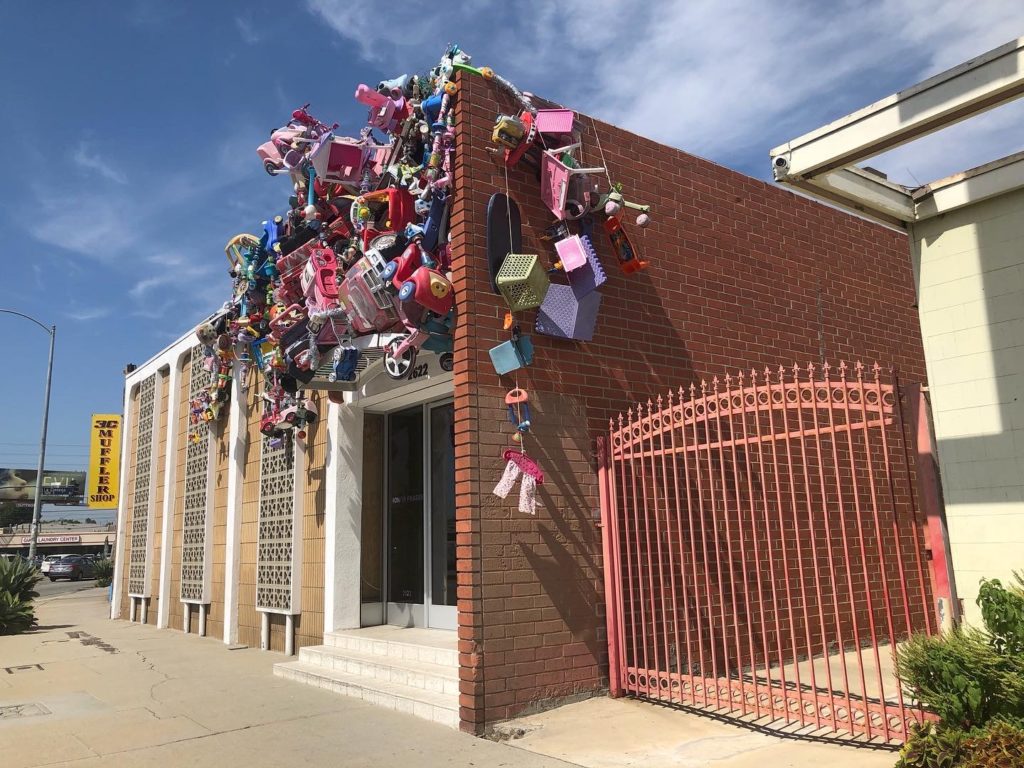
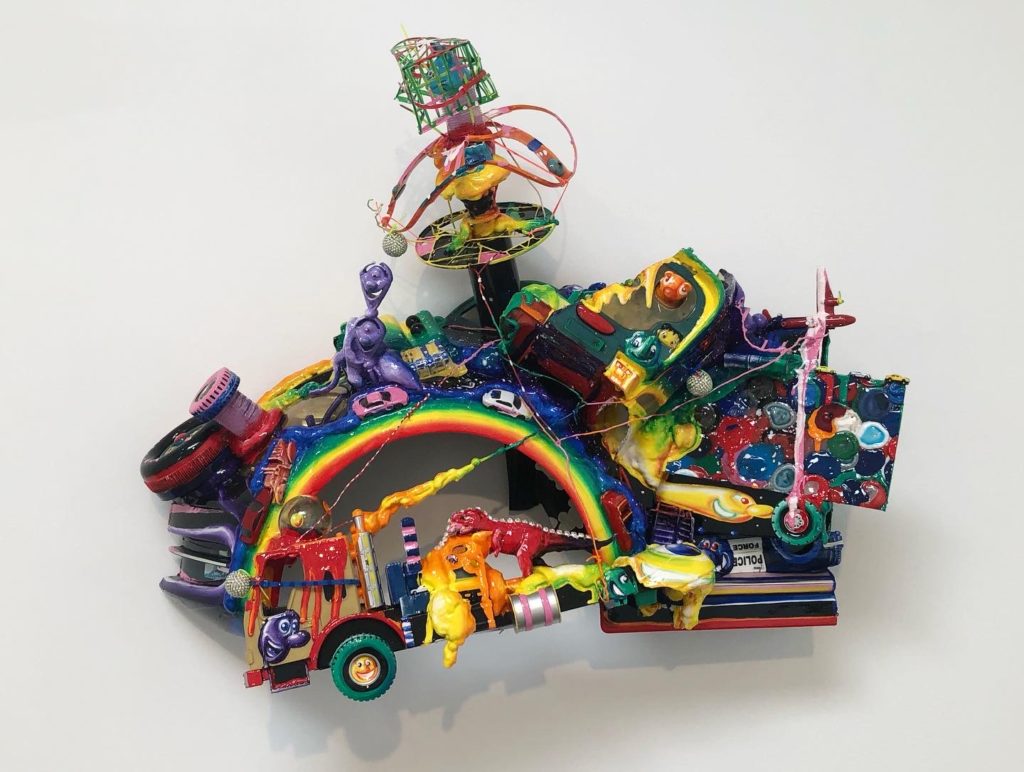
In the 80s, Kenny Scharf began collecting plastic detritus that he found along the beach in Brazil, where he was living at the time. The artist would assemble these discarded items into sculptures for the wall, giving them new life as aesthetic objects called Lixos (“trash” in Portuguese). Though the sculptural practice has continued intermittently, Scharf made a habit of collecting discarded plastics from around the world, which have not degraded over the years. More recently, the artist began collecting all of his single-use plastics and stringing them together as a garland around his studio, a constant reminder of daily waste. In light of the current reckoning with the overproduction of plastics and climate change denial, Scharf will present a new body of Lixos in the gallery along with a giant garland wrapped around the outside of the building. Materials for the garland will be collected at Honor Fraser Gallery throughout the summer and leading up to the exhibition. In addition to creating a personal alternative to recycling methods that require more toxic chemicals, Scharf aims to shine more light on this urgent issue. As in his paintings, deep concerns about our future lie beneath these brightly colored works.

Expanding his sculptural practice, Kenny Scharf will unveil a group of large ceramics featuring his signature characters in the round. Produced in collaboration with Stan Edmondson in Pasadena, these works were fired locally and hand-glazed by the artist. Bordering on living sculpture, the pots will contain greenery to be nurtured beyond the term of the exhibition, a gesture of possibility and hope rom the artist. In addition to converting carbon dioxide into oxygen, caring for plants has proven to be a beneficial practice for humans as it requires patience, reduces stress, and promotes close observation. These plants grown by the artist himself contain Scharf’s intention for a more respectful and conscientious future.

Dec 062019
 

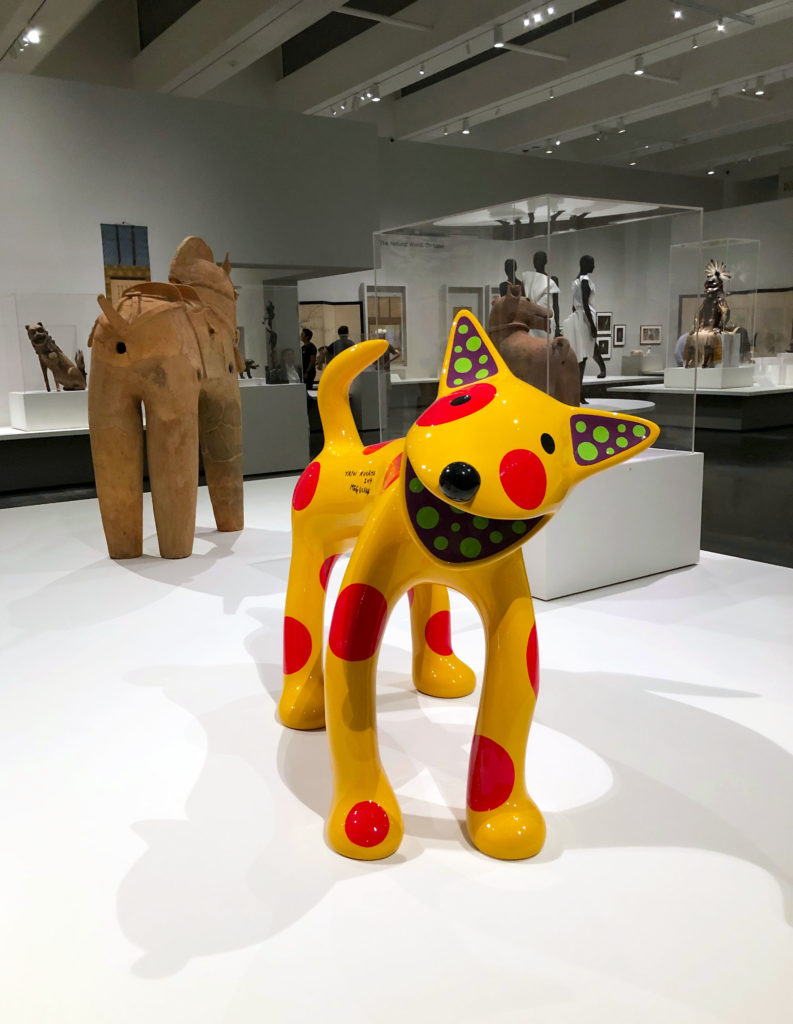
Closing 12/8/19 at LACMA is Every Living Thing: Animals in Japanese Art. It’s a really fun of exhibition with a good selection of art from different time periods, including Yayoi Kusama’s dog sculptures from Megu-chan (2014), two of which are pictured above.

From LACMA’s website-

Every Living Thing: Animals in Japanese Art celebrates one of the most distinctive and compelling aspects of Japanese art: the depiction of animals. Underpinned by Japan’s unique spiritual heritage of Shintō and Buddhism, the Japanese reverence for nature—and the place of animals within that realm—is expressed in sculpture, painting, lacquer-work, ceramics, metalwork, cloisonné, and woodblock prints.

Lions, dogs, horses, oxen, cats, fish, insects, birds, dragons, phoenixes—animals warm and cold-blooded, real and imaginary—are meticulously and beautifully rendered in myriad works from ancient 6th-century clay sculpture to contemporary art. Arranged in themes such as Zodiac Animals, Animals from Nature, Religion, Myth and Folklore, and Leisure, the exhibition draws heavily from LACMA’s permanent collection and includes masterpieces from Japanese and American public and private collections, some of which are on view for the first time.


Nov 012019
 

It’s the last weekend to see Theaster Gates’ exhibition Line Drawing for Shirt and Cloak at Regen Projects in Los Angeles, closing 11/2/19.

From the press release

Line Drawing for Shirt and Cloak presents a complex reflection on desire, consumption and surrender using contemporary activations of the storefront as a vehicle for expressing both emotional and aesthetic intent. With a highly honed metal strategy and the artist’s entire wardrobe, this multi-faceted installation represents a conscious movement toward the freedom found when one’s appetite and the world’s insistence asks for everything, and a moment of clearing when emotive freedom is found.

Referencing the exhibition’s title, the gallery will be transformed by a series of free-standing and wall-mounted metal structures that demarcate the interior of the space, forming a series of line drawings onto which varying sculptural and quotidian works will hang. Additional sculptural forms supported by large stone pillars and large metal and wood platforms form the basis of an extant atelier. In preparation for the exhibition, Gates will transform his entire wardrobe into many smaller symbolic works, which will be placed en masse as a large sculptural work. This body of work, while a departure in material motif, underscores Gates’ ongoing interest in both the transcendental acts of reclusion and denouncement, and his inability to totally reconcile his appetite for spiritual truth with his competing desire for the things of this world. Through painting, sculpture, sound, and up-cycling, Gates continues to find truth in the unseen and evidence growth in ways unexpected.

A new vocal score conceived of and performed by Gates punctuates the exhibition space. The lyrics of the piece playfully riff on the biblical verse from which the exhibition’s title is inspired, and offer an explication for the artist’s metamorphosis.

“I’ve always been a lover of material things; fashion, antiques, adornment. A believer in the beautiful. But in this moment, I’ve never felt more need to question my own contempt and appetite. This process is not a spiritual attempt; it’s actually quite worldly. I can’t feel growth because I’m weighted by the things around me and people can’t see my growth. The accumulations are a distraction. But the title has much to do with what happens when the world charges you – the outside forces that judge and gnaw and hate. If the world wants to pursue me for this shirt, well, they can have it all.

The sculptural intent of the show is to introduce an unexpected spatial strategy at Regen that gives me permission to be free of conventional gallery tropes and form a set of new sculptural dictates that consider more of the everyday world of fashion and street activity. The project is a minor response to the growth of interest that the fashion world has in art and perhaps my own reckoning with the power of the hyper-public, hyper-everyday considerations that fashion affords. I’m in dialogue with Willie Wear, Girbaud, the Prada concern, retail projects in China, the historic fashions that Chicago House Music produced, and my mama’s church hats. While none of these things need to be immediately perceived, they are no-less present.” –Theaster Gates, 2019

Nov 012019
 

Closing 11/2 at Tanya Bonakdar’s Los Angeles location is Ernesto Neto’s interactive exhibition Children of the Earth.

From the press release-

In Children of the Earth, Neto creates an alluring environment of color, materials, fragrances and sound, transforming the gallery into a living organism, where visitors are encouraged to wander, touch, feel, interact and connect.

Upon entering the gallery, a curtain in green and brown patterns invites the viewer to walk through a tunnel-like path which leads to the main gallery space. Entitled Children of the Earth, a large-scale installation of crochet, spices and leaves hangs from the ceiling to the floor. The large biomorphic shape—hand knitted in vibrant colors of yellows, greens, purples and reds—is flanged by drop-shaped crochet vines that serve as counterbalance and establish the delicate equilibrium of the piece. Here, references to nature interconnect with formal questions of tension, gravity and weight. On the floor, tracing the outline of the structure above, a soft surface of handmade textile is installed. Ceramic vases sprout from the ground, representing the diversity of peoples inhabiting the planet, and that ultimately, we are all the children of the earth. Musical instruments, spices, and crystals comprise an integral part of this malleable, highly tactile sculpture, which engages the five senses, and invites viewers to connect with one another in new and meaningful ways. In expanding the boundaries of physical space and calling for a new type of interaction, Neto creates an experience that is physical, sensorial, intellectual and social all at once.

Surrounding the piece, as another layer of skin, hand-sewn fabric hangs. The organic pattern and color pallet further recall the natural world, as they invoke the forest, wood grain, or the circulatory system of a plant. The path the visitor follows throughout the space, and from within the piece—like an organic line in nature—is analogues to Neto’s conception of life where there is “no separation between humans and nature, nor between art making and art experience”, highlighting that in the exhibition, as in life, everything is connected.

In the back gallery a hanging platform with a crochet canopy and crochet tendrils is installed. Designed for direct interaction, this is a healing bed that offers a moment of rest and respite, where people can connect to themselves, as to one another.  The tendrils function as ‘connectors’, as they amplify the pulse of life while connecting us to the environment and to our own physicality. Embracing the participant in its serenity, the healing bed investigates the meeting point of art, sensation, personal connection and the human body.

The exhibition as a whole connects mind, body and nature through a sensory experience that is unmediated. It is an invitation to connect to ourselves and to our planet at a time when connectivity is most needed. For Neto, sculpture is an extension of the body, and the body is ultimately an extension of earth.

Oct 312019
 

Located in LACMA’s B. Gerald Cantor Sculpture Garden among the sculptures by Rodin is Zak Ové’s sculptural installation, The Invisible Man and the Masque of Blackness.

From the LACMA’s website-

The title’s references—Ben Jonson’s 1605 play, The Masque of Blackness, and Ralph Ellison’s 1952 novel, Invisible Man—mark two milestones in black history: the first stage production to utilize blackface makeup, and the first novel by an African American to win the National Book Award. In addition to literary references, the artist draws inspiration from Caribbean Carnival, a festival that originated from the Mardi Gras celebrations of the region’s French colonists, and Canboulay, a parallel celebration in which enslaved people expressed themselves through music and costume and paid homage to their African traditions. The installation’s 40 graphite figures stand tall and dignified to represent the strength and resilience of the African diaspora.

In the the video below, Ové  provides some interesting insight and information on the work.

This exhibition closes 11/3/19. LACMA is free for residents with ID from 3pm and is open late on Fridays until 8pm.

Oct 292019
 

Closing this week on 11/1/19 is Enrique Martínez Celaya’s exhibition The Tears of Things, at Kohn Gallery.

From the press release-

This new body of work consists of a series of paintings and one sculpture that revolve around three dualities: our alienation from and interconnectedness with all that there is, the absurdity and redeeming possibility of embarking, and the tension between promise and risk. The imagery brings together skaters, ice-covered lakes, black apple trees, golden landscapes, bullfighting, moonlit butterflies, and whale bones. The work featured in The Tears of Things continues Martínez Celaya’s concern with displacement and exile in its psychological sense, while deepening his ongoing exploration of the limitations and possibilities of art’s capacity to reveal or create meaning.

Martínez Celaya is widely celebrated for a practice that arises from sustained engagement with literature, poetry, philosophy, and science, as well as his own writing practice. An artist, author and former physicist, he works in a variety of mediums and materials that include oil, wax, tar, mirrors, dirt, steel, silk and bronze, which he weaves together with physical, emotional and conceptual qualities into a multi-layered exploration of the human condition evoking both immediacy and timelessness. His practice is laden with a depth of textures and philosophical touchstones, often incorporating elements of mysticism and fairy tales, yet he creates works that resist narrative interpretations. His paintings, sculptures, photographs and environments address universal questions about life and the individual experience, loss, memory, failure and one’s place in an emotionally radiant yet chaotic world.