Dec 272019
 

Volcanic Eruption At The Junk Yard, 2019

Standoff at the Bedrock Bunny Club, 2019

After The Rapture (Border Town), 2019

Rosson Crow’s paintings for her exhibition Trust Fall at The Hole are bright, chaotic, and very reflective of the times we are living in.

From the press release-

Rosson Crow is in one sense an American History Painter—capitalized—who has made paintings across a range of subjects, foreign and domestic, but always meditating on the American story and her place in it. Since her debut show at Canada Gallery in 2004 while still an undergrad, Crow has established herself as a big, brainy, macho painter who nonetheless maintains a performative seduction with color and content.

This new exhibition features ten immersive panorama paintings that meditate on our 2019 moment in America. In what is her most urgent and timely work to date, she grapples with the erosion of American institutions and even of reality and truth itself. “Chaos autopsies” she calls them, each taking on specific aspects of her thinking—or dreaming—about current issues. KonMari is about the latest trend of disciplinary minimalism but depicts a giant landfill of “fast fashion”; After the Rapture in a Border Town shows a human-free street at the Mexican border; Volcanic Eruption at the Junk Yard is a fierce, fiery pit of melting old cars, while Ocean Front Property in Arizona is pretty self explanatory. No humans are present in any of the works, unless a cardboard cutout or statue; in this trust fall there is no one to catch us.

Using luminous oil paint, spray paint and thrown enamel, Crow builds up the surfaces of her works as she layers their content; bleeding into one another, the paintings feel like a tinted vintage post card, hi-contrast outlines whose colors have melted with time. Using moments of photo transfer for snippets of text, bumper stickers or beer cans, the repeating transfers confer a sense of glitching in the painted image, heightening their theatrical illusionism while questioning their reality; has this image been photoshopped? Has this video been edited? How much can we trust our own eyes?

The paintings are topical but not didactic. Ignorance, absurdity and swirling misinformation make the current political landscape untraversable; to a civilian psyche it makes analysis and action extremely difficult.  The exhaustion that comes from this onslaught must make artmaking even harder; most retreat, make head-in-the-sand works that don’t attempt any sociopolitical issues. Crow has always made works that highlight the staged nature of space, that look at fake or contrived scenes, like the painting above; in this Garden of Eden recreation from a religious-themed creationism park, the plants look like they are from Home Depot not an actual tropical jungle. Looking “behind the curtain” at manipulated reality is a non-partisan issue that speaks to both sides of the cultural divide, as everyone is stuck in this morass together; everyone wants to unravel the myriad ways we are secretly controlled and how power is written into our lived and virtual environment.

This exhibition closes 12.29.19.

Dec 202019
 

Artist Jennifer Bartlett has been exploring the image of the archetypal house since the 1970s. For her current exhibition at Marianne Boesky Gallery, The House was Quiet and the World was Calm: Jennifer Bartlett 1970–2014, a variety of these works are on display. It’s interesting to think of the traditional basic shape of the house, one often used to draw a house as a child, here expanded upon and explored in various ways and mediums. The viewer is also challenged to think about what they imagine when they think of the concept of house, of home.

From the press release–

… For Bartlett, the appeal of the house lies, in part, in its incredible universality. The simple square crowned with a triangle conjures an expansive array of emotions, memories, and associations across the spectrum of individuals. And in the U.S., it holds a particular place in the national psyche—a symbol of the deeply entrenched notion of the American dream. Subjected to Bartlett’s ongoing and systematic explorations of painting and printing techniques, however, the house in instances is flattened, reformulated, and distorted to a range of formal and emotional effects.

This exhibition closes 12/21/19.

Dec 202019


Jack Shainman Gallery is currently showing two solo exhibitions of recent paintings by Meleko Mokgosi. The first, (a painting from which is pictured above) is titled The social revolution of our time cannot take its poetry from the past but only from the poetry of the future.

From the press release-

The title of Mokgosi’s 20th Street installation, The social revolution of our time cannot take its poetry from the past but only from the poetry of the future., is taken from Karl Marx’s The Eighteenth Brumaire of Louis Bonaparte. This text points to the limits of revolutionary discourses and proposes that it is only through disavowing the past that revolutionary action can occur. Similar to this argument, this body of work argues both for a disavowal of past grand narratives as well as the recuperation of non-Western forms of knowledge that were not privileged to coexist with conventional or established discursive frameworks. All twelve paintings are paired with a text that is taken from the writings of women either from Africa or the African Diaspora. The texts and paintings examine a wide range of issues, from African feminism and the struggle for liberation by African countries, to love, solidarity, and aesthetics. By pairing text and image, Mokgosi’s work aims to further questions around the politics of representation and strategies of resistance.

The second exhibition is Pan-African Pulp, pictured below.

From the press release-

…Mokgosi’s body of work at 24th Street, uses popular southern African pulp magazines or photo-novels to examine, broadly, the history of Pan-Africanism. These photo-novels, colloquially referred to as look-books, were first printed in the 1960s as an off-shoot of Drum Publications. Unlike Drum magazine, which addressed politics and issues of race in South Africa, photo-novels such as Lance Spearman avoided engaging with debates around politics, instead choosing to offer entertaining James Bond-like episodes of crime fighting. The photo novels—a less expensive alternative to filmmaking—are composed of staged photographs depicting action scenes, and follow a script conveyed with speech bubbles written in English, combining elements of comic books, films, and magazines.

Mokgosi has appropriated this trope and created new dialogue and plots within the existing imagery. By specifically focusing on Pan-Africanism, Mokgosi hopes to find meaningful ways of reconceptualizing the importance of a movement that sought to build alliances towards Black consciousness and foregrounding the rights and aspirations of Africans to self-determination and self-governance. Mokgosi reflects, “There is no doubt about the injustices, inhumanity, exploitation, violence, and racism caused by and associated with the Euro-American slave trade, European imperialism in Africa, and institutionalized racism in the Americas; the effects of these are ongoing and reflected not only in cultural and geopolitical contexts but also in the very reproduction and circulation of capital.” This work is the first of many stages through which Mokgosi intends to engage with and ask urgent questions around Pan-Africanism and solidarity.

Both of these exhibitions close 12/21/19.

Dec 202019
 

The paintings in Li Songsong’s One of My Ancestors, at Pace Gallery in Chelsea, are rich in both color and texture. Li creates his paintings from found photographs, adding another dimension to the work.

From the press release-

In the process of reinterpreting found imagery drawn from public sources such as everyday news items, Li adopts an impartial attitude. “I did not deliberately look for these images,” he explains, “It just happened. For example, a friend of mine went to an old book stall in Beijing to buy old magazines. I saw a good photo, and then I used it. I don’t seem to care about the content of the image itself. Of course, they are a starting point, but they will affect you more on a psychological level than in a narrative way.”

Li is interested in the ways in which images can trigger memories and emotions—a psychological impact magnified by his technique. The use of impasto and the dense materiality of his brushstrokes elicit a potent haptic response, while his palette of cool shades of gray, green, and beige create an estrangement from his chosen subject matter, as seen in Little Brother (2017), South (2017), and Civil Rather than Military (2018). Through his signature use of compact blocks of color, Li deconstructs and reassembles images, pushing his art towards abstraction.

This exhibition closes 12/21/19.

Dec 192019
 

Anish Kapoor’s exhibition at Lisson Gallery’s 24th Street location is a reflective wonderland where the sculptures twist your perception of your surroundings as you move around them. If his work looks familiar, he has created many public outdoor works including Cloud Gate, also known as “The Bean”, which is permanently installed in Millennium Park in Chicago.

The exhibition continues at Lisson Gallery’s smaller 10th Avenue space with several of Kapoor’s colorful wall-based circular sculptures in semi-reflective hues.

Both of these exhibitions close 12/20/19.


Dec 192019
 

For Peter Halley’s Heterotopia II, at Greene Naftali’s ground floor gallery in Chelsea, he has created a delightful, brightly colored maze-like installation.

From the press release–

In Des Espaces Autres (1984), Michel Foucault defines heterotopia in opposition to utopia. While utopias are unrealized representations of a perfected society, heterotopias exist within all societies as realms differentiated from everyday life. Examples include ceremonial, sacred, and institutional spaces such as chapels, cemeteries, libraries, and prisons. They are spaces designated for special activities – creating their own sense of time and operating according to their own standards.

Through a range of media – painting, architectural installation, digital prints, and critical writing – Peter Halley’s work has illuminated the structures of social space and communication that shape our experience of contemporary life. For his second solo exhibition at Greene Naftali, Halley presents Heterotopia II, the latest in a series of large-scale installations exploring the relationship between painting and architectural space. Halley has created a multi-colored, labyrinthine structure in the ground floor gallery housing eight new shaped-canvas paintings, titled after imaginary planets from Isaac Asimov’s science-fictional universe.

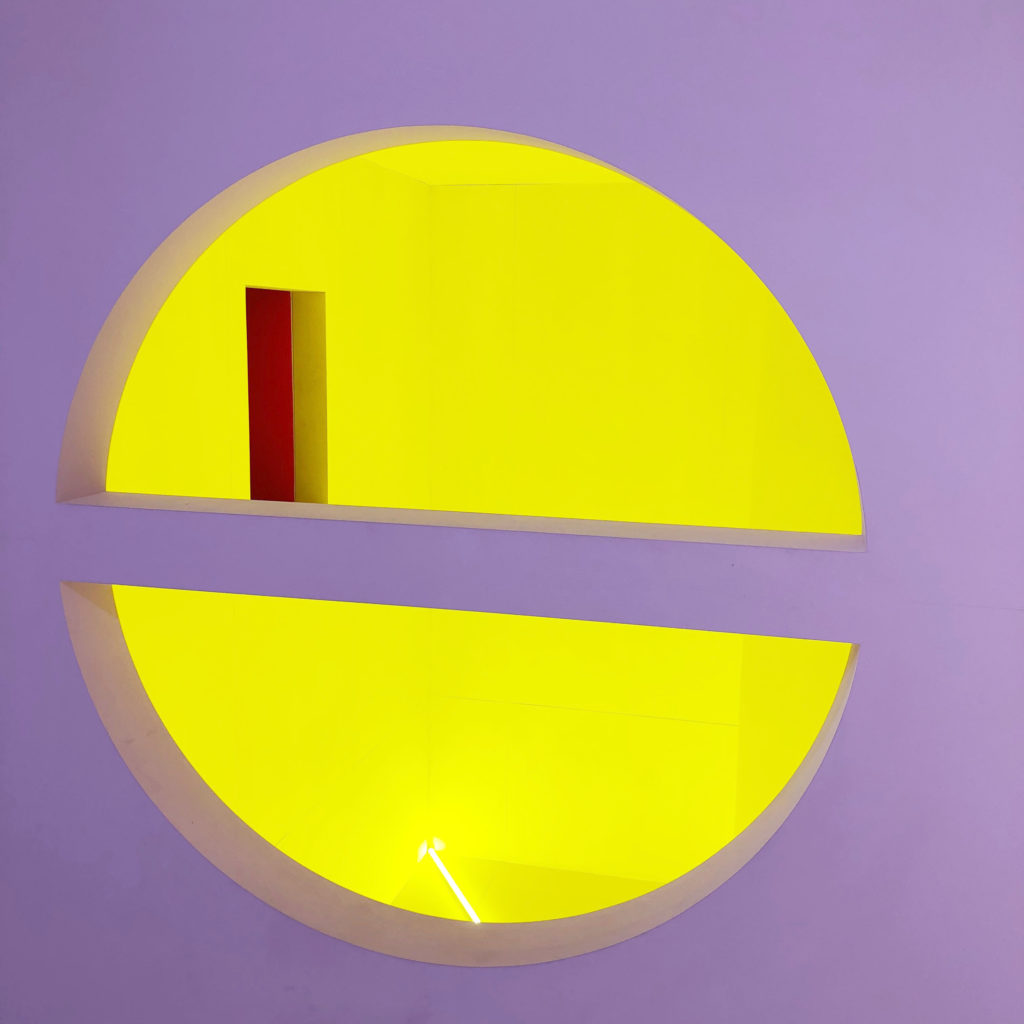
The installation is enclosed by tall neon yellow walls coated in Roll-a-Tex, with only a narrow slot in the front wall offering the viewer a preemptive glimpse inside. The interior space is organized around a glowing yellow core – an inaccessible inner sanctum whose light is solely visible through three distinctive apertures. Around the core are arrayed eight interconnected rooms rendered in vivid colors, each defined by architectural elements, including staircases, keyhole windows, beams, and columns. The arrangement of these elements playfully nods to motifs in the work of architects Peter Eisenmann, Hans Hollein, Luis Barragán, and Louis Kahn, as well as to Halley’s own oeuvre. Halley’s installation, with its candy colored surfaces, is a postmodern reverie on neoplasticism and modernist geometry, founded on a tension between rationalist geometry and lyrical color.

Visitors circulating through the maze-like installation encounter Halley’s shaped-canvas paintings one-by-one, as the interactions between two-dimensional image and three-dimensional architecture unfolds. Composed of multiple interlocking prisons and cells, the paintings create ambiguous figure-ground relationships, while echoing the geometric plan of their three-dimensional setting.

This exhibition closes 12/20/19.

Dec 122019
 

Petzel Gallery is currently showing Walead Beshty’s solo show “Abstract of A Partial Disassembling of an Invention Without a Future: Helter-Skelter and Random Notes in Which the Pulleys and Cogwheels Are Lying Around at Random All Over the Workbench”. The sheer volume of work covering the walls is overwhelming and impressive in its assembly.

From the press release-

The work A Partial Disassembling of an Invention Without a Future: Helter-Skelter and Random Notes in Which the Pulleys and Cogwheels Are Lying Around at Random All Over the Workbench, was originally commissioned by the Barbican Centre, London. The London-born, Los Angeles-based artist first exhibited the work there in 2014, covering the 273 ft long Curve gallery from floor to ceiling in cyanotype prints. The prints were produced over the duration of a year (October 9, 2013–October 8, 2014) and are chronologically installed in proportion to the exhibition space. For its New York première at Petzel, approximately 5,120 cyanotypes (38% of the total 15,616 sq. ft work) will be presented.

In A Partial Disassembling of an Invention … , each cyanotype (a 19th Century photographic process using ferric ammonium citrate and potassium ferro-cyanide) was produced by placing tools and other objects used in the production process of the studio on cellulose waste material generated by that same process (such as wood, cardboard, or paper) that was coated with UV-sensitive cyanotype material. After being exposed to sunlight and washed in water, the object’s silhouette appears in reverse against a cyan-blue background.

In using everyday objects, such as receipts, prescriptions, invoices, financial statements, legal documents, letters, gallery invitations, etc. from the working life of the studio, an inherent transparency is embedded in the work, demystifying the artwork and exposing its process of coming to be. Representative of the lives of those who made it, the cyanotypes expose both aspects of identity and circumstance, situating the work within political, social, and economic exchange without being representational or depictive in the conventional sense. While both the Barbican and Petzel iterations deal with debris, this new display has a more overtly American immediacy to it. Considering the resurgent discourse on the politics of representation, there is a new urgency to exhibiting the work for the questions it evokes about the modes and uses of representation, such as how art can accurately display real world conditions of labor, production and power, and whether a truly accurate and transparent form of representation is possible.

Beshty will also show Prologue to A Partial Disassembling of an Invention Without a Future: Helter-Skelter and Random Notes in Which the Pulleys and Cogwheels Are Lying Around at Random All Over the Workbench, which are the cyanotypes that were produced in anticipation of the Barbican work from August 1, 2013–October 8, 2013, along with seven volumes of the 59-volume archive of the work. The books—in their Prologue and Opus volumes—comprise bound pages printed recto and verso of the entire work reproduced at 1:2 scale. The volumes create both an archival record of Beshty’s workspace as well as an index of all the tools and artefacts used for the work’s own making.

The title of the project is a reference to Hollis Frampton’s hypothetical lecture he muses about in a talk delivered at the Whitney Museum of American Art, but never actually gives. The title of this phantom lecture alludes to the origins of the medium, and its inevitable obsolescence. It also calls forward the question of the role objects play when they have ceased being useful. Wrenched by time from their intended use, the objects become purely aesthetic, becoming the focus of contemplation in both historical and poetic terms.

This exhibition closes 12/14/19.

Oct 302019
 

Currently at Gladstone Gallery’s 21st Street Location in New York is Allora & Calzadilla’s exhibition Cadestre.

From the press release–

The exhibition revisits the Surrealist encounter with the anti-colonial movement in the Caribbean to consider present forms of coloniality and its relation to climate justice. The artists have taken inspiration from the radical and transformative collection of poems by Martinican poet and politician Aimé Césaire under the same name. The term “cadastre” refers to the means by which the territorial limits of private property are publicly registered. Taking cue from the powerful mechanics of Césaire’s writing, Allora & Calzadilla’s exhibition Cadastre brings together three works all informed by a poetics of mark making, traces, and survival.

In April 1941, the anti-colonial Martinican poets and theoreticians Susanne and Aimé Césaire, founders of the literary journal Tropiques, met with a group of artists and intellectuals fleeing Nazi-occupied France, whose boat had temporarily docked at the West Indian port of Fort-de-France. The refugees included Helena Benitez, André Breton, Wifredo Lam, Jacqueline Lamba, Claude Lévi-Strauss, André Masson, and Victor Serge, among others. Penumbra takes as its point of departure the now mythic hikes the group took in the gouffre d’Absalom valley in Martinique, which served in part as inspiration for Lam’s masterpiece, The Jungle. Penumbra is a soundscape of “shadow tones,” a psycho-acoustic phenomenon perceived when two real tones create the semblance of a third. The original musical composition by David Lang uses nonlinear distortion of violin sounds to evoke the sensation of walking through that tropical forest.

In Graft, thousands of cast blossoms of the Tabebuia chrysantha tree, a common native species in the Caribbean, appear as though a wind had swept them across the gallery floor. Graft alludes to environmental changes set in motion through the interlocking effects of colonial exploitation and global climatic transformation. Systemic deforestation and depletion of the Caribbean’s original flora and fauna is one of the primary legacies of colonialism. Nevertheless, the Caribbean remains a biodiversity hotspot and, along with thirty-five other hotspots worldwide (which amount to just 2.4% of the earth’s land surface), supports nearly 60% of the world’s plant, bird, mammal, reptile, and amphibian species. As rising global temperatures result in more frequent and violently destructive weather, adding even more pressure to the Caribbean, the uncanny presence of tropical tree blossoms in Graft stands as a potent harbinger for the immeasurable losses that continue unabated after centuries of colonial plunder.

Measuring 6 feet in height and 70 feet in length, and covering the east and south walls, the exhibition’s eponymous work, Cadastre takes electromagnetism as its subject and medium. To make the work, Allora & Calzadilla dropped iron filings on top of a canvas and placed it above an array of copper cables connected to an electrical breaker in the artists’ studio in San Juan, which gets its power from the Puerto Rico Electric Power Authority. When the breaker is turned on, the electrical current causes the iron particles to self-organize into a composition of lines and shapes governed by the electromagnetic field. As the Latin title and full subtitle (Meter Number 18257262, Consumption Charge 36.9kWh x $0.02564, Rider FCA-Fuel Charge Adjusted 36.9 kWh x $0.053323, Rider PPCA-Purchase Power Charge Adjusted 36.9kWh x $0.016752, Rider CILTA-Municipalities Adjusted 36.9kWh x $0.002376, Rider SUBA Subsidies $1.084) suggest, the work probes the propriety politics of electricity and the power grid. Cadastre is part of a continuum of multiple sites and actors that the artists are probing through their artistic process working with electricity, from the oil futures market, to the transnational holders of PREPA bond debt, to the local consumers who are forced to pay for the recently privatized power company’s fiscal mismanagement.

This exhibition closes 11/2/19.

Recently, their film, The Great Silence, was shown at Marciano Art Foundation in Los Angeles. It is subtitled with thoughts from the perspective of an endangered Puerto Rican parrot who lives in the same area as the Arecibo Observatory, which was created to capture and transmit radio waves from and into outer space. The parrot questions why humans look to communicate and make a connection with extraterrestrial life, when there are parrots who can potentially use human language nearby.

It’s a thought provoking and moving piece, well worth a watch.

Oct 222019
 

Alex Prager’s exhibition at Lehmann Maupin’s 22nd Street location combines sculpture and still photography with her new film Play The Wind. The photographs in the show recreate scenes from the film, but are not from the film itself.  There are also photos of scenes that could have been from the film, but are not. These allow the viewer to consider alternate narratives to the story they have just seen. The photos also offer an opportunity to see many of the details from the film seen only briefly while watching.

Running for eight minutes, Play the Wind is a journey into a bizarre version of Los Angeles. It’s seen mainly through the window of a car, the way many Los Angeles residents often see it. Places seem familiar, as do many of the large cast of extras who inhabit this world, even if you are not personally familiar with the city.

The cab driver, played by Dimitri Chamblas (dean of the Sharon Disney Lund School of Dance at CalArts), drives through situations that seem both surreal and possible at the same time, like many things that happen in LA. At one point the cab driver, drives past an accident on the highway and sees a car vertical between two other cars with children in a school bus leaning out of the windows to observe. He passes alongside and moves on. It’s just another moment in a chaotic Los Angeles day. When he locks eyes with a woman played by actress Riley Keough, the film changes to her perspective and it all becomes even more dreamlike.

From the press release–

…She anchors her characteristically elaborate fictional scenes within the real Los Angeles, shooting for the first time in many years primarily on location rather than in the studio—a decision that harkens back to when Prager began her career over a decade ago. Though the images contain large constructed set pieces and are populated with carefully cast extras (numbering up to 300), the presence of the Los Angeles streets infuses an element of urban lifeblood that is palpable in the work. Prager’s perception of Los Angeles is one of the artifice and drama befitting Hollywood, with real world chaos that overflows into sci-fi dystopia and post-apocalyptic dread. She toys with these visions of the city disseminated on film, TV, and within the popular imagination, which inform our characterization of a place as much as our own memories.

Technically important to the making of this film was Prager’s collaboration with a team to produce set designs and props that would add a layer of artifice and duplicity to her real-world locations. The interference of these traditional illusionary effects upon the actual Los Angeles streets and locations Prager shot on creates an unnerving sensation, hinting at the reality that might exist just outside of our perception. All of these elements are recast in the series of photographs, which appear in different configurations or on various scales that further destabilize any linear narrative. Drawing on the concept of a distorted memory, Prager has found ways to incorporate objects seen in the photographs and film into the gallery as sculpture, with the intent to further dislodge our understanding of place and time and bring us deeper into her highly constructed world.

Connoisseurs of Prager’s work will likely spot the references to her past series, such as the noir themed Compulsion (2012), or the archetypical ingénue of The Big Valley (2008). This self-referencing becomes yet another layering device, mixing Prager’s career-spanning themes and the greater art historical genres from which they are drawn to create work both entirely new, yet seemingly familiar. Prager’s incorporation of her past into her present work serves as a reminder that while the past may not be returned to, it does remain with us, appearing in surprising, sometimes unsettling ways.

This exhibition closes 10/26/19.

Oct 222019
 

An assortment of beaded and marble creations have taken over Marianne Boesky Gallery in Chelsea, courtesy of The Haas Brothers’ exhibition Madonna.

From the press release-

As is now a signature of The Haas Brothers’ presentations, Madonna will transport viewers into an otherworldly realm, where fantastical animals and odd hybrids reside. Here, colorful sculptures and objects that resemble futuristic creatures will be positioned among seemingly rare tropical plants, and connected into a cohesive environment through undulating platforms. The featured works capture the Brothers’ wide-ranging artistic processes, from intricate beading techniques to monumental stonework to the incorporation of woven elements, and produce an incredibly tactile and evocative experience. The exhibition also highlights the Brothers’ diverse collaborations, including with workshops in California, South Africa, and Portugal, and encapsulates their deep engagement and support for those working in traditionally understood craft.

The Haas Brothers were first introduced to beading in 2015, when they met a group of women artisans selling beadworks in a craft market in Cape Town, South Africa. The Brothers’ were enamored with both the complexity of the technique and the incredible artistry in the women’s work. Seizing the serendipity of the moment, the Brothers’ established a collaboration with the artisans, which led to the development of the Afreaks series, a group of beaded creatures that were shown at the Cooper Hewitt’s Design Triennial in 2016. Since then, The Haas Brothers’ collaboration with the collective of women, who warmly go by The Haas Sisters, has grown and matured.

For Madonna, the collective will support the production of the featured beaded objects, guided by The Haas Brothers’ preparatory drawings and using a selection of Murano glass beads produced in Venice between 1880 and 1980, which The Haas Brothers purchased after the factory became defunct. In addition, Simon Haas has developed a complex system that captures the expansive creative opportunities that beading allows and that provides a guide to learning the craft. This system has been articulated in The Haas Brothers’ Bead Book, which has allowed Simon and Niki to teach the techniques to people local to the area of Lost Hills in Central California, establishing a workshop that offers work and pay in an area that lacks employment options. As part of their work with different communities and artisans, The Haas Brothers establish fair pay systems that include both economic support for the creation of works as well as in some instances profit sharing from sales.

“Part of the vision for our practice, and what we see as essential to the creation of art, is the establishment of communities. We are constantly asking how we can engage with others to achieve something new; something beautiful; something that excites or brings joy—that is really the importance and value of art and artmaking,” said The Haas Brothers. “At the same time, we recognize the platform and voice that we have been given, and think it is critical that we use both to uplift and support others, especially women who have traditionally not been recognized for their craftwork and skills. We feel so lucky to have developed this relationship with The Haas Sisters, and to have the opportunity to shed light on their dedication and tremendous work, while also paying a fair and right wage for their contributions.”

The beadwork in the exhibition will be augmented by several sculptures made with Portuguese Pele de Tigre marble. The Brothers first came to stone carving in their youth, learning from their father, artist Berthold Haas, and recently returned to the material, showing several large pieces at Marianne Boesky Gallery’s Aspen location in June 2018. The solid, smooth, and monumental nature of the stone works provides a powerful counterpoint to the more delicate and finely detailed beadworks and highlights the range of The Haas Brother’s practice. Here too, community proves an important element, as The Haas Brothers’ engagement has helped spur the development of stone-carving as an economic engine at the quarry that they use. The anchor figure, the Madonna, within the upcoming exhibition combines the efforts and visions of the various communities with which the Brothers are involved—each lending to an aspect of its creation and making it a true embodiment of their collaborative vision.

This exhibition closes 10/26/19.