Oct 222019
 

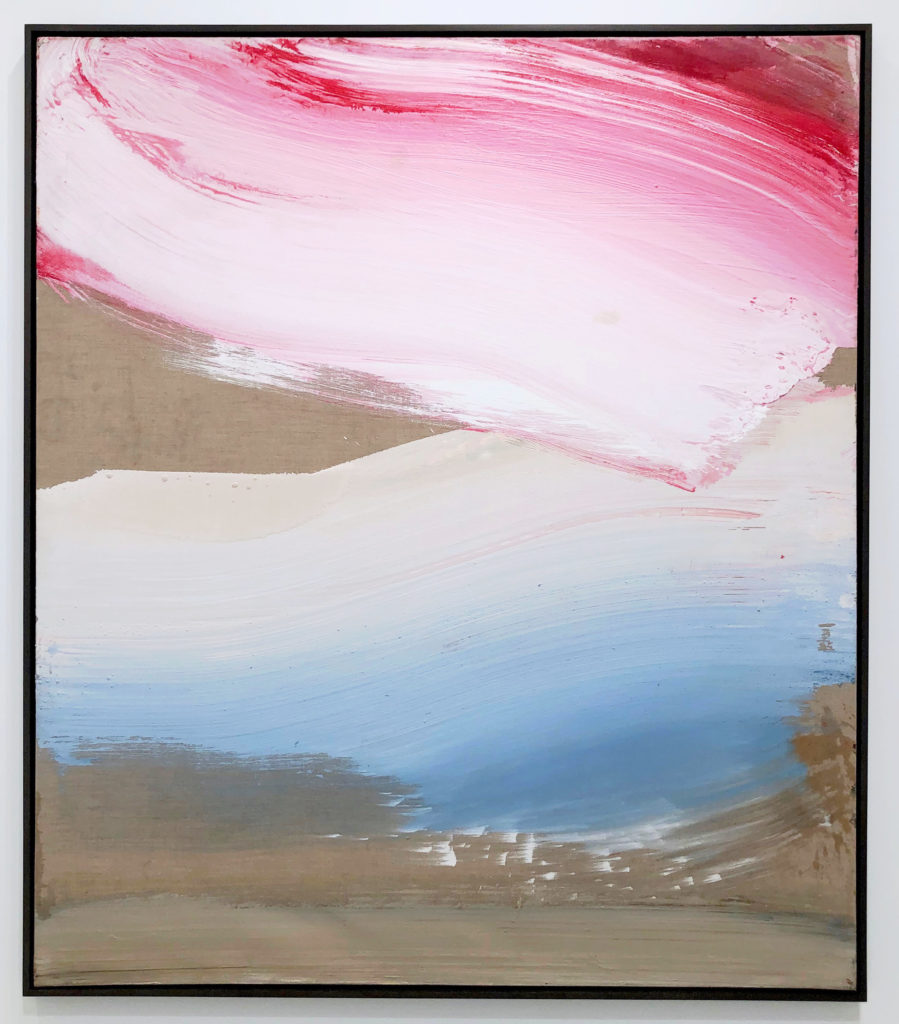
Hauser & Wirth is currently showing two painting exhibitions. On the ground floor of their 22nd Street location are Ed Clark’s gorgeous abstract works, some of which are pictured above. The paintings on view are recent, made between 2000 and 2013. Created on the floor using a push broom, there is a high energy in the motion and blend of color in these canvases.

Sadly, Clark passed away on Friday, October 18th at the age of 93. He was an innovative abstract painter who worked for more than 60 years. This is a wonderful opportunity to see his work in person.

On the second floor of the gallery is Amy Sherald’s the heart of the matter… , (pictured below) her inaugural exhibition with the gallery. If her style looks familiar, it may be because she gained a lot of attention with her portrait of Michelle Obama for the Smithsonian’s National Portrait Gallery.

“If you surrendered to the air you could ride it” (2019)

“Precious jewels by the sea” (2019)

From the press release-

Informed by the artist’s reading of key texts that explore tensions between interior and public realms, the heart of the matter… draws its title from the first chapter of bell hooks’ seminal book ‘Salvation,’ and builds on themes of silence and stillness explored in Kevin Quashie’s ‘Sovereignty of Quiet’ and U.S. Poet Laureate Elizabeth Alexander’s ‘Black Interior.’ In her new paintings, Sherald considers how these relate to the conceptualization of blackness as it is represented publicly, questioning representation of black identity, which often negates the complex reality of an interior life. She envisions black American identity beyond the conceits to which it has largely been restricted, attempting to restore a broader, fuller picture of humanity.

Sherald’s portraits are vivid, large in scale but intimate in effect, capturing both the ordinary likeness and extraordinary essence of her subjects while simultaneously detaching them from everyday reality. Varying in expressiveness, gesture, clothing, and emotional auras, the individuals portrayed maintain a persistent sense of privacy and mystery, requiring viewers to ponder the sitters’ thoughts and dreams. Drawn to each of her subjects instinctively and spontaneously, these ‘Americans doing everyday American things,’ as Sherald has described them, are part of an informal network of people who populate our universe.

Once Sherald commences painting, a transformational moment ensues as the artist begins to view her sitter as an archetype in the history of representation and therefore a vehicle for challenging assumptions. Working from carefully composed and dramatically staged photographs, Sherald situates her subjects in brightly colored, ambiguous environments, then meticulously tweaks expressions and patterns to emphasize a sense of universality and connection. While her subjects are always African-American, Sherald renders their skin-tone exclusively in grisaille – an absence of color that directly challenges perceptions of black identity.

the heart of the matter… debuts two paintings that reach a new, monumental scale for the artist. In these works, Sherald’s monochromatic backgrounds evolve into fully realized scenes that reference quintessential Americana: friends posed at the beach and a man atop a metal construction beam. For the latter, Sherald draws inspiration from Charles C. Ebbet’s iconic photography of 30 Rockefeller Plaza in New York City. Sherald often looks to vintage photography for source material, drawn to what she describes as its capacity ‘to narrate a truer history that counters a dominant historical narrative… Photography was the first medium I saw that made what was absent, visible.’ Sherald continues, ‘It gave people who once had no control over the proliferation of their own image the ability to become authors of their narratives.’ By mining and positioning images associated with archetypal or nostalgic American moments – burgeoning industry, sunny beachside locales – Sherald is able to firmly situate and make fully visible black Americans within the canon of American iconography. In this way, her portraits reclaim space and author a narrative for people that official art history omitted, speaking to the human condition and holding up a mirror to American life.

Lastly,  take a trip to the top floor for the group show Personal Private Public, a group exhibition “exploring the idea of the inner life in three main themes: introspection, intimacy, and voyeurism”.  The exhibition includes work by Jonathan Lyndon Chase, Ivy Haldeman, Celia Hempton, Tala Madani, Paul McCarthy, B. Ingrid Olson, Paul Mpagi Sepuya, Emily Mae Smith, Mira Schor, and Kohei Yoshiyuki.

All three of these exhibitions close 10/26/19.


Oct 182019
 

“Crescent (Timekeeper)”

“Crescent (Timekeeper)”

“Crescent (Timekeeper)” Detail

Sarah Sze’s exhibition at Tanya Bonakdar’s gallery in New York is stunning. There is so much to look at, to appreciate. There are so many pieces to all of the work, and yet it never feels overwhelming. It makes you want to keep looking.

It’s also immersive. The windows on the outside of the gallery are covered in her work, as is the staircase alcove. The video projections in the main room travel all around the room, surrounding you with visuals and sound. Upstairs the floors of the gallery have paint splattered on them, accompanying the works on the walls.

Detail of the above work

In a room on the first floor is a “studio space” where you can gain insight into Sze’s process and how she makes these elaborate works.

From the press release-

Sze’s latest body of work frays “the seam between the real and the image” (Smith). Through complex constellations of objects and a proliferation of images, Sze expands upon the never- ending stream of visual narratives that we negotiate daily, from magazines and newspapers, television and iPhones, to cyberspace and outer space. The works evoke the generative and recursive process of image-making in a world where consumption and production are more interdependent, where the beginning of one idea is the ending of another—and where sculpture gives rise to images, and images to sculpture.

In this new exhibition, Sze expands her work by embedding her nuanced sculptural language into the material surfaces of painting and into the digital realm through the interplay of cloth, ink, wood, paper, metal, paint, found objects, light, sound and structural supports—collapsing distinctions between two, three and four dimensions. This body of work fundamentally alters our sense of time, place, and memory by transforming our experiences of the physical world around us. Both objects and images, Sze says, are “ultimately reminders of our own ephemerality”.

This exhibition closes 10/19/19.


Oct 172019
 

From Ishiuchi Miyako’s “Scars” series (1991-)

Images from the “ひろしま/ hiroshima” series, 2007-present

Ishiuchi Miyako’s exhibition occupies both floors of Fergus McCaffrey’s Chelsea gallery space and includes over 70 photographs from five series made over four decades, including many early and never-before-seen works.

On the first floor are the artist’s somber black and white photos of the buildings of her hometown of Yokosuka. Yokosuka was also the home of a US Naval Base, established in 1945.  In another room is work from her Scars series, for which she photographed the damage left behind by injury, illness, and trauma. These portraits focus not on the people but on the imprints on their bodies. Despite that, they don’t feel impersonal or voyeuristic. There is a tenderness to these images.

Photographs of objects dominate the rest of the exhibition. There are a series of images of her mother’s possessions, taken before she passed away. She also photographed Frida Kahlo’s belongings, including a pair of her shoes that were different sizes- accommodating the physical issues Kahlo had after her bout with polio as a child.

The photos of items donated to the Hiroshima Peace Museum, for the ひろしま/ hiroshima series, are especially moving. The articles of clothing worn by residents of Hiroshima when the atomic bomb was dropped on the city are worn and damaged. It’s hard not to think of what happened to the people who owned them.

Each series of photographs is unique, but tying them together is the idea of capturing what gets left behind. It can be a city or a scar or a person’s possessions after they die, but they have an effect. Ishiuchi’s photos record that effect in an impressive and thought provoking way.

This exhibition closes 10/18/19.


Oct 082019
 

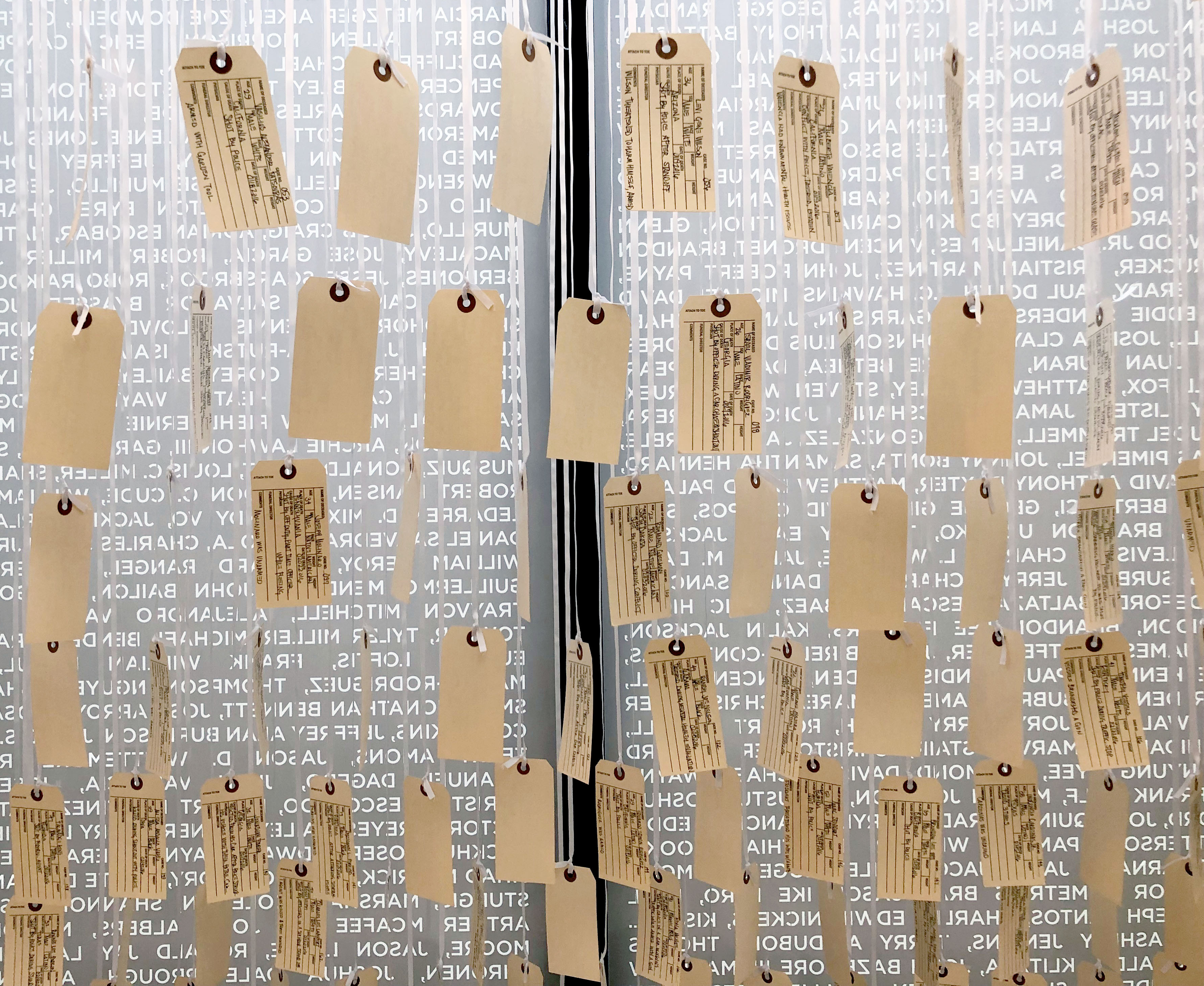
The Museum of Broken Windows is a free pop-up experience in New York City, a project by the NYCLU currently located Cooper Union.

From the Museum of Broken Windows/ NYCLU websites-

The broken windows theory is an academic theory proposed by social scientists James Q. Wilson and George Kelling in 1982. The academic theory, which first appeared in The Atlantic Monthly, states that signs of disorder in a neighborhood, like a broken window, encourages petty crimes and leads to more serious crimes. This postulation was adopted by the New York City Police Department and has led to the criminalization of poverty and the over-policing of Black and Brown communities at disproportionate rates. The theory has never been proven to be effective at reducing crime.

The Museum showcases the ineffectiveness of broken windows policing, which criminalizes our most vulnerable communities. The strategy of broken windows policing is outdated and has never been proven to be effective at reducing crime. For decades, communities of color have been disproportionately impacted by broken windows policing.

It is time for a change. New Yorkers are coming together for important conversations on policing and what it means to feel and be safe. Using art and creativity, the Museum of Broken Windows will provide a powerful and emotional experience that critically looks at the system of policing in New York.


Pictured above are “…and counting” by Ann Lewis (each tag is filled out with the name of a person killed by police) and one of the group of portraits by Tracy Hetzel of women who have lost loved ones because of broken window policing. The one pictured is of Gwen Carr who is holding a picture of her son Eric Garner.

This show ends on 10/8/19.

Oct 032019
 

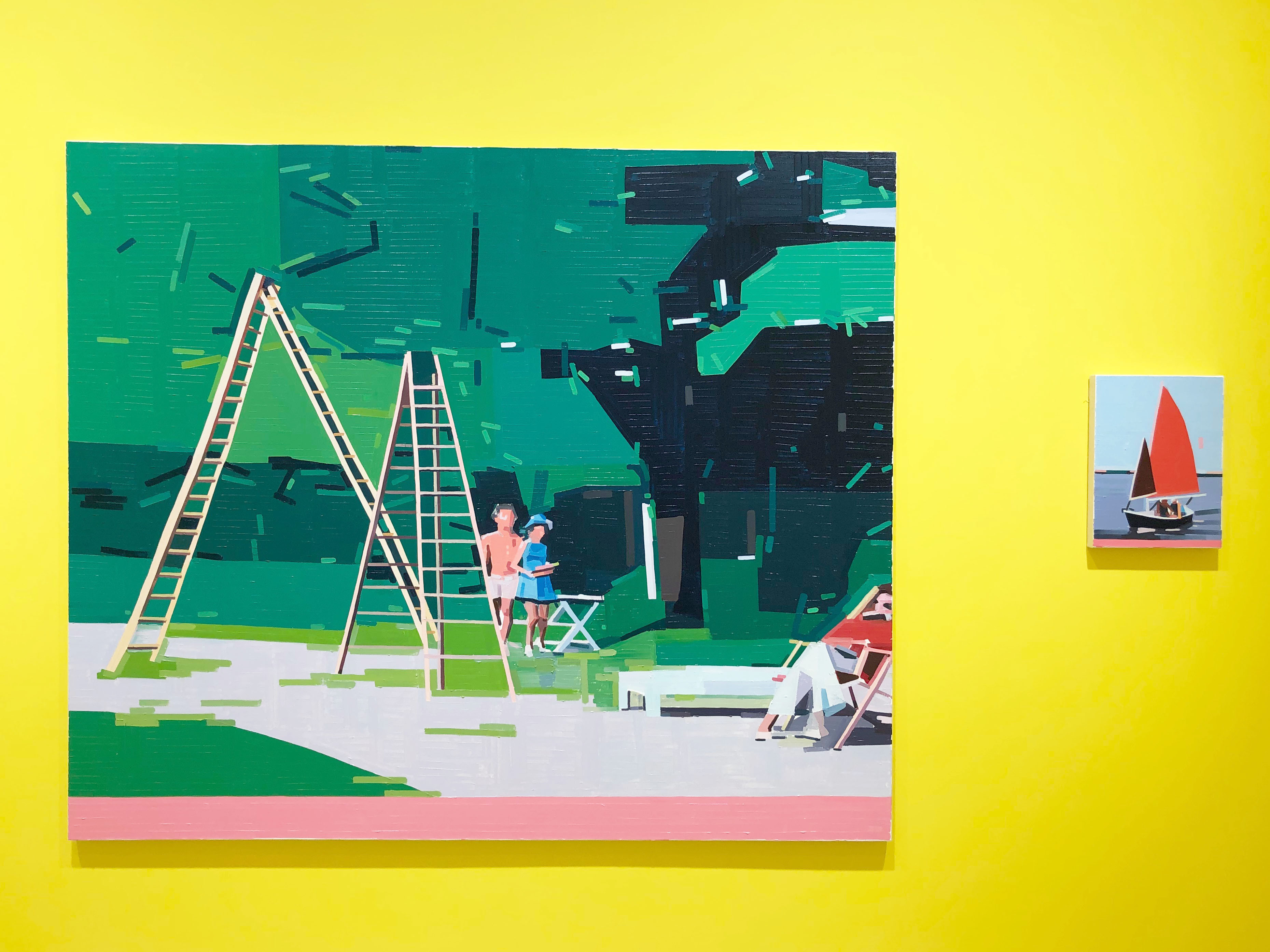
“Lake Annecy”, 2019 and “Sailboat”, 2019

Lake Annecy, 2019 detail

Currently at Miles McEnery’s gallery locations in Chelsea are two engaging painting exhibitions.

Guy Yanai’s paintings, at the 21st Street location, are created with strips of oil paint and are fascinating to walk up close to, observing the details, and then to pull back from to see as a whole. He also chose a bright yellow for the walls of the gallery to be painted, which brings out the colors of the paintings even further.

From the press release–

Guy Yanai strips his subjects down to geometric necessity and builds them back up again in oil paint, establishing a tension on his canvases between the spatially flat and the physically multidimensional. A combination of diagrammatic delineation of form and vivid color, Yanai’s paintings are an optical delight.

Yanai accomplishes this willful distillation of his subjects by painting obsessively in tight chromatic strips. While from afar the individual brushstrokes fade into the larger landscape, up close one can notice the stops and starts of each metered stroke. This synthesis speaks to Yanai’s desire for his works “to have such tension that if you take out one brushstroke, the painting will collapse.” The smoothness and uniformity of his taut oil bands offer a linear precision that can only be accomplished by the most disciplined draftsman.

While Yanai harkens back to modernist masters such as Matisse and Cézanne, his compositions are pixelated in a manner that is fundamentally contemporary. The collection of short and disconnected brushstrokes merge in the viewer’s eye to create a fully realized image. Yanai’s paintings experiment with the digital in contemporary art. “As beholden to the virtual imagery of the internet as to the history of modernism,” Ara H. Merjian writes in his essay, Élan Vital, “Yanai’s work proves beguilingly complex despite – or rather, precisely in – its congenial simplicity.”

Often revisiting the same subject, he paints from memory – of a place, of a moment, of a feeling. Just as recollections brighten and fade in the mind over time, Yanai recalls his own inspirations and recreates them in different ways as they evolve. What results is a proliferation of works that demonstrate Yanai’s rich meditation on his experiences. Whether an open window or an ocean view, Yanai’s nostalgic passion has a lasting impact on its viewer.

At their 22nd Street location are Brian Alfred’s colorful graphic paintings of places in New York City.

“W. 4th St.”, 2018-2019

“Central Park at Dusk”, 2019

From the press release-

Alfred navigates these complex themes using an approach characterized by sharp lines and blocked colors. Tightly-cropped compositions manipulate the viewer’s perception of space, conflating overlapping buildings, signage, and other urban elements. These vibrant, city-shaped configurations capture ephemeral moments: the view through the gap between two skyscrapers, the contour of a passing storefront from a car window, and a downward glance into a subway entrance. While they might not last long, these unique fields of vision are fundamental parts of the experience of the city.

Both of these exhibitions close 10/5/19.

Oct 032019
 

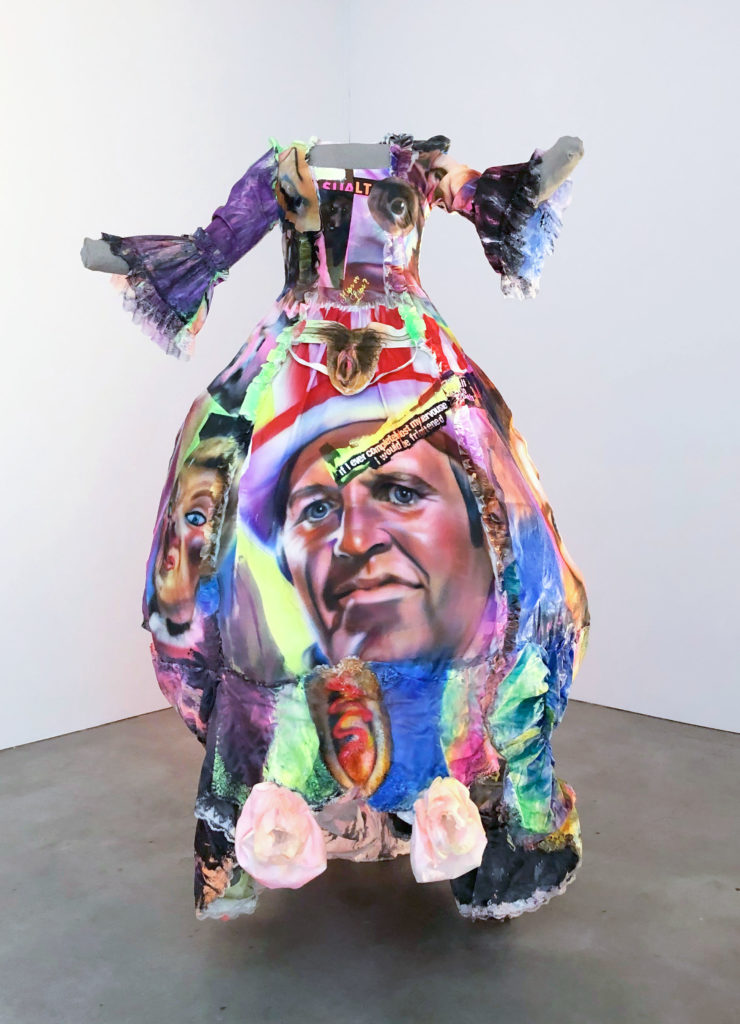
Jim Krewson’s “tribute to a vanishing subculture”, A Requiem for Paul Lynde, currently in the Viewing Room in the back of Marlborough Gallery’s downtown location, “questions the loss and amnesia of marginal identity in a new age of equality, instant access, Instagram influencers and celebrity, from homosexuality to homogenization in 20 short years.”

The airbrushed wedding dress spins with images that include Lynde himself, as well as Lady Elaine Fairchild from Mister Rogers’ Neighborhood, and the Madame puppet, a Wayland Flowers creation. Flowers’ puppet had her own sitcom in 1982 and also took over Paul Lynde’s center square on Hollywood Squares. Sadly Flowers, an openly gay entertainer, passed away in 1988 at the age of 48 from AIDS related Kaposi’s sarcoma.

If you love of a certain time period of pop culture and Paul Lynde than it will be hard not to embrace this project. But it’s also interesting as a meditation on the state of gay pop culture in the past, the place it is in today, and the question of where it may go in the future now that it is has such a strong, but less subversive place, within mainstream media.

In the main viewing space of Marlborough Gallery is Joe Zucker’s multi-panel 100-Foot-Long-Piece created from 1968 to 1969.

From the press release–

This masterwork, exhibited here with a large body of related archival material, comprises a blueprint for Zucker’s long and diverse practice. It plants a flag for the artist’s ongoing inventiveness, irony, and eclecticism.

With the creation of this work, Zucker presents the viewer with a puzzle-like, encyclopedic visual vocabulary, anticipating subsequent pictorial and conceptual approaches such as New Image, Neo-Expressionism, Appropriation, Neo Geo, as well as more recent process- based abstraction, with a self-referential, wry regard for the embedded, associative meaning of his imagery and materials.

100-Foot-Long Piece is a linear aggregate in which gestural abstraction rubs elbows with hard edged grids, silk-screened passages, sculptural reliefs, and a host of other styles and forms. One is mindful of both physical and critical tropes of progressive art history from the physicality of the frieze to a qualitative timeline tracing the contributions of Modernism.

Both shows close 10/5/19.

Sep 202019
 

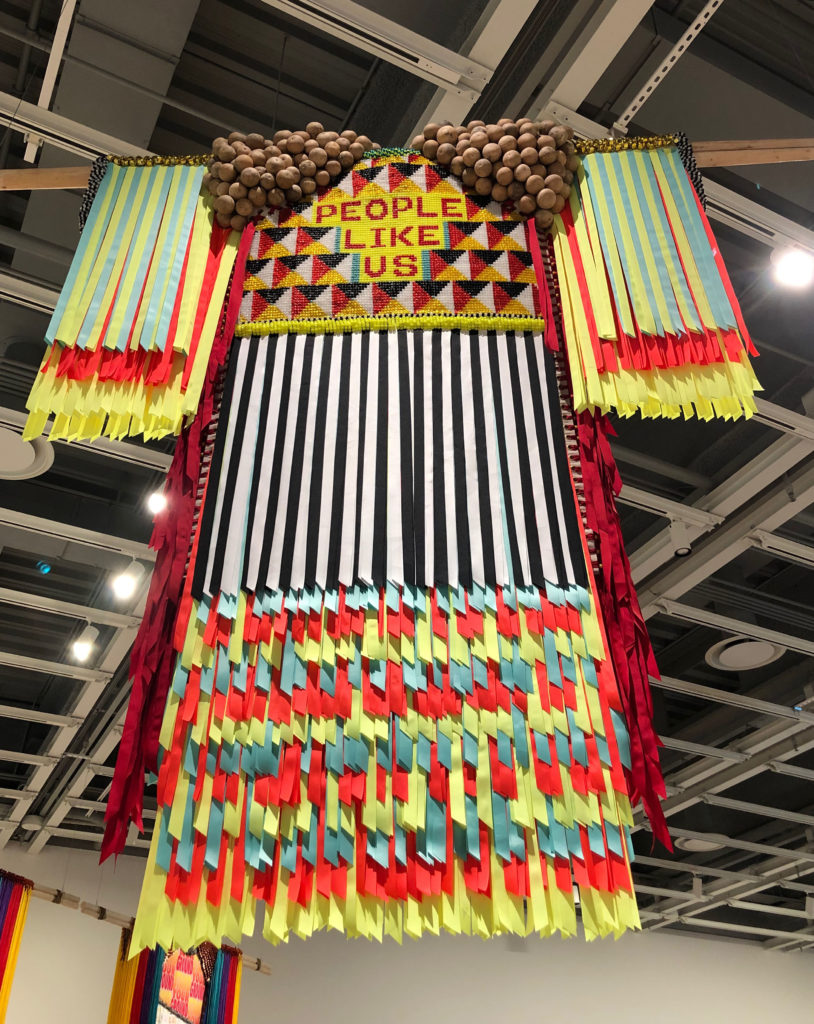
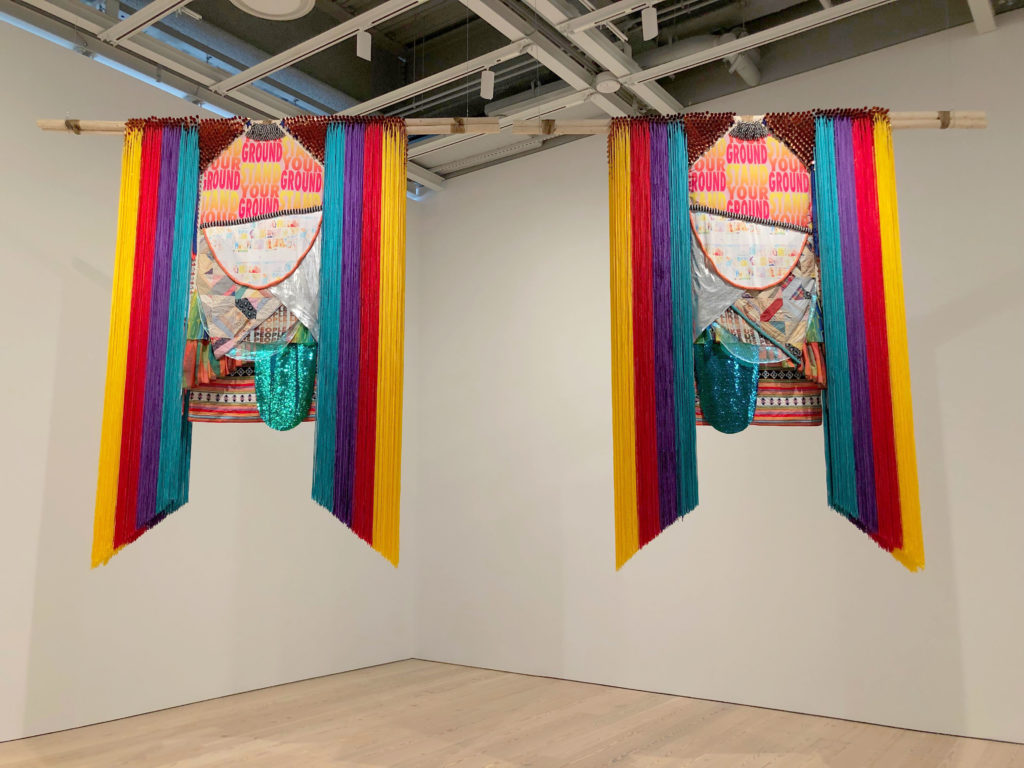
Jeffrey Gibson, “PEOPLE LIKE US”, 2019

Jeffrey Gibson

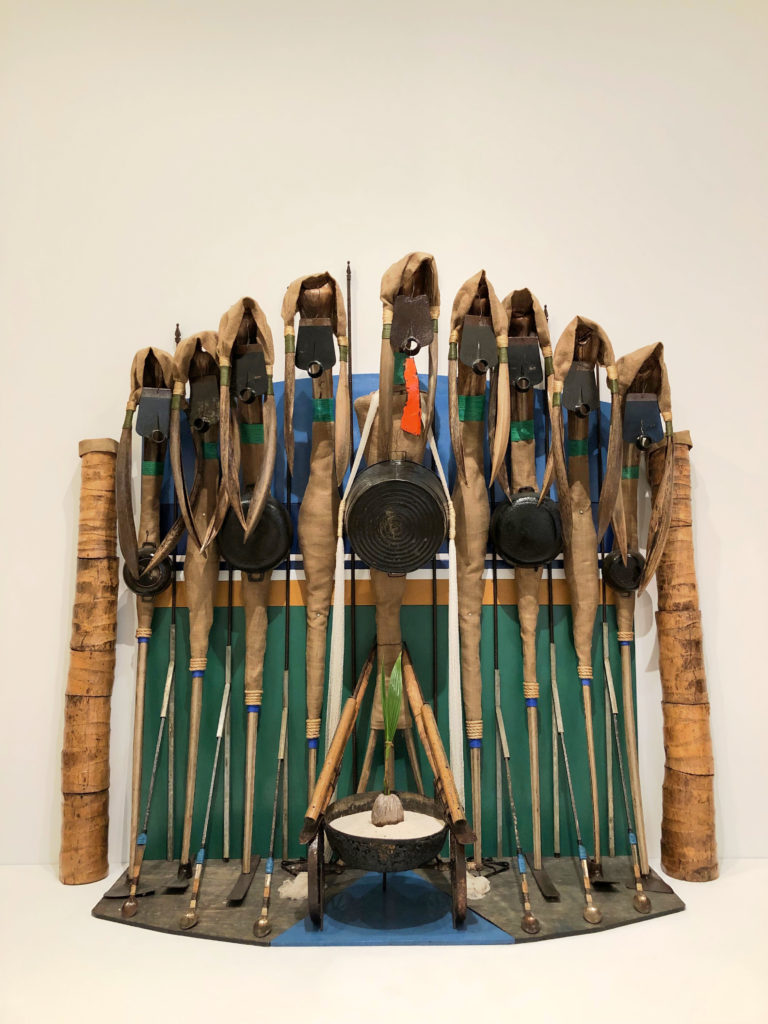
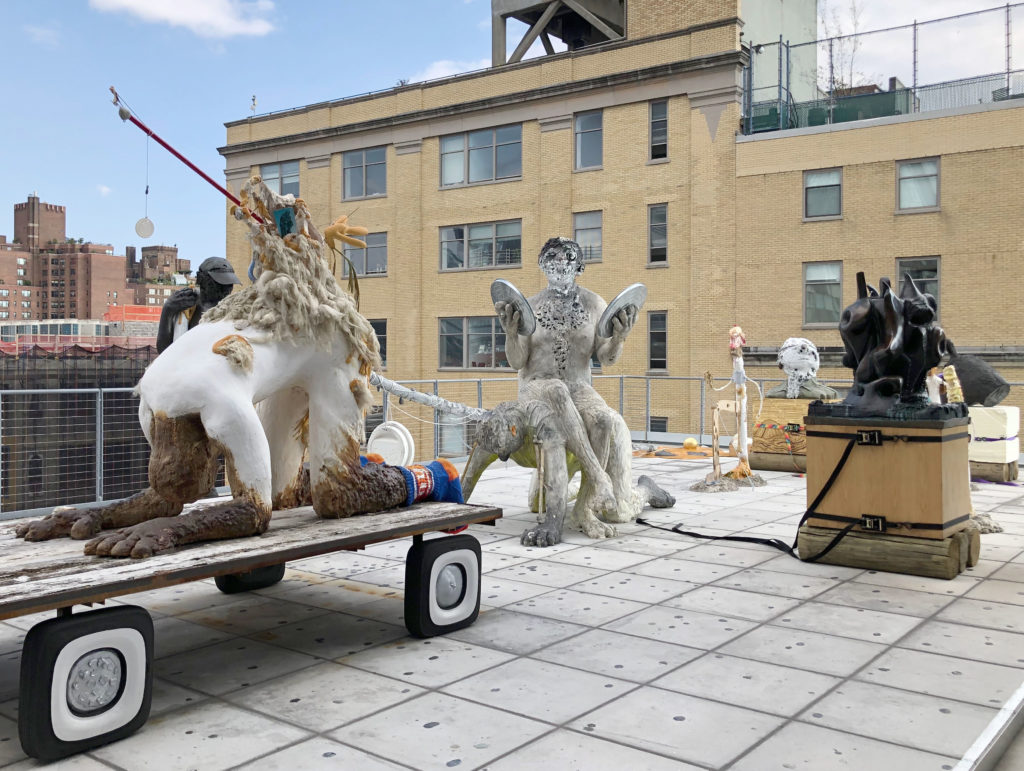
2019’s Whitney Biennial presents an interesting selection of work, by a mostly young and diverse group of artists. The works included in the show are consistently good, and often intriguing, but this time around nothing is particularly outrageous or polarizing- a contrast to many of the previous iterations.

Not that there wasn’t any drama surrounding the show. This time around, however, the controversy was not with an artwork but with former Whitney executive board member Warren B. Kanders and his ownership of Safariland, a tear-gas canister maker. He has since resigned after protests and threats of withdrawal from several of the artists included in the show. Artist collective Forensic Architecture’s film, Triple Chaser, on view in the exhibition, investigates Safariland and Kanders.

Below are a few highlights from the exhibition.

Janiva Ellis ” Uh Oh, Look Who Got Wet”, 2019

Daniel Lind-Ramos, “Centinelas (Sentinels)”, 2013

Section of Nicole Eisenman’s, “Procession”, 2019

This exhibition closes 9/22/19.


Mar 292019
 

The Whitney Museum’s exhibition, Andy Warhol – From A to B and Back Again is a great representation of the artist’s body of work. Despite the fact that so much of it has been seen before, the curation makes so much of it feel fresh.

Andy Warhol’s artistic legacy is vast. He created a prolific amount of work throughout his career and the exhibition covers a lot of it. From his early commercial illustrations to his more abstract pieces, his collaborations with Basquiat, his silk screen portraits, his videos, films, and books, there is a lot to see. Below are a few highlights.

Warhol’s fascination with death is seen in numerous works in the exhibition. In 129 Die In Jet, 1962 (pictured above), he recreated the newspaper cover by hand and even used a sponge-blotting technique to reproduce the look of the halftone image. It’s interesting to see how this work foreshadowed his move to the screen printing process. This technique combined with his interest in the subject of death can be seen in his car crash paintings made the following year.

There’s a room dedicated to reproducing Warhol’s Cow Wallpaper, which he used to fill a room in the Castelli Gallery as part of a 1966 installation where he “retired from painting”. He used it again in 1971 for a retrospective at the Whitney, where he directed that all the works be hung on it for the exhibition. It’s a creative way to tie in that history and to present the various colored flower paintings.

Some of Warhol’s portrait series, Ladies and Gentlemen, 1975, which focused on members of New York’s queer community, is included in the show. It’s a nice contrast to his portraits that more commonly feature socialites and Hollywood celebrities.

His giant portrait of Mao is impressive, and takes up a wall in one of the galleries. It’s a reproduction of a painting by Zhang Zhenshi, which was at the time thought to be the most widely reproduced artwork in the world. Warhol created the work in response to reading about then President Nixon’s trip to meet with the Chinese leader, while China was still considered an enemy of the United States.

On a separate floor are several monitors playing Warhol’s video work and work related to the artist. Included is one of him eating a Burger King burger, shot by Danish documentarian Jørgen Leth, that the fast food chain used as part of their ad in this year’s Superbowl.

Warhol was a constantly evolving artist who worked in many mediums, in effective ways. The exhibition is a testament to Warhol’s unique perspective and how his work continues to resonate in a time period where so much of what he was commenting on has even more relevance.

Andy Warhol – From A to B and Back Again, closes 3/31/19 and is free Friday from 7-10pm.

Feb 162019
 

Currently at Mitchell-Innes & Nash is Masses & Mainstream, an exhibition of Karl Haendel’s incredibly detailed drawings and his musings on life in current day America. The drawings can be humorous at times, including a comparison of himself to Jared Kushner through a checklist, and a record of his types of sneezes. They are balanced by others, where he expresses his anxiety when it comes to selling art, or a smaller piece that lists “wishful thinking” items that includes healthcare, education, housing, and equity for all.

From the press release-

While Karl Haendel’s newest work covers a wide range of subject matter from a stack of lawnmowers to a portrait of Barbara Walters, the common thread that links these disparate images is a dialogue between memory, both personal and collective, and national identity. Many of the works on view are drawn from overlooked sources in contemporary American life—cultural leftovers the artist combs through and resuscitates in order to represent an alternate picture of American reality. Other works, like the aforementioned stack of lawnmowers, come from the artist’s personal history and experiences—a once-submerged detail from his childhood home that has floated to the surface of recollection—that could also be read, more symbolically, as the paraphernalia of American comfort, excess and, perhaps even, of the endangered middle class.

This exhibition closes 2/16/19.
Feb 162019
 

This month there are a lot of excellent exhibitions on view in Chelsea.
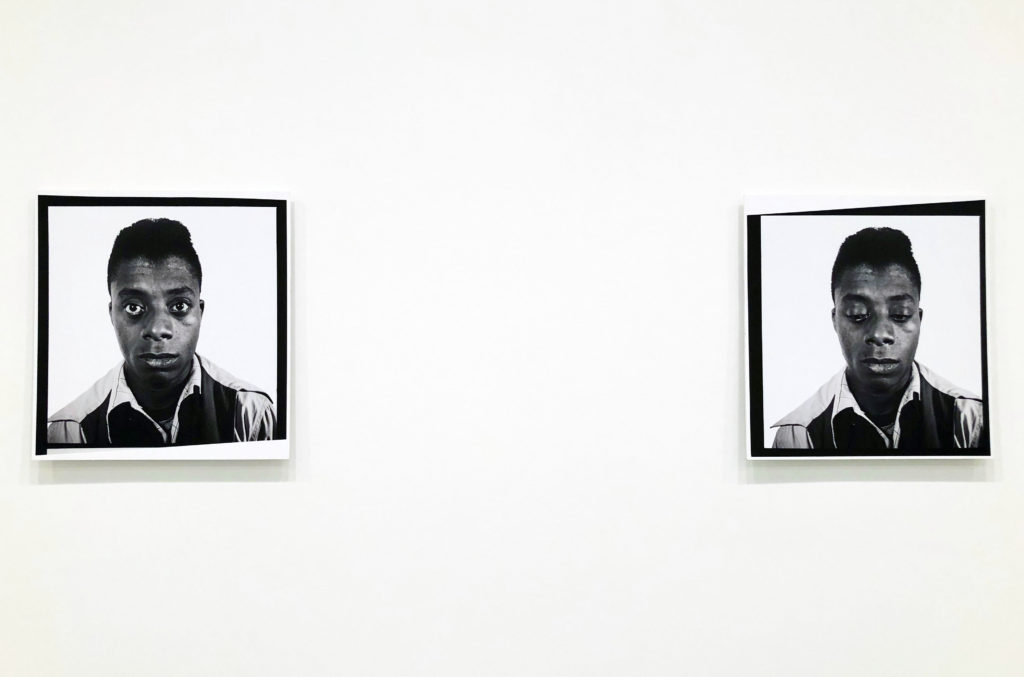
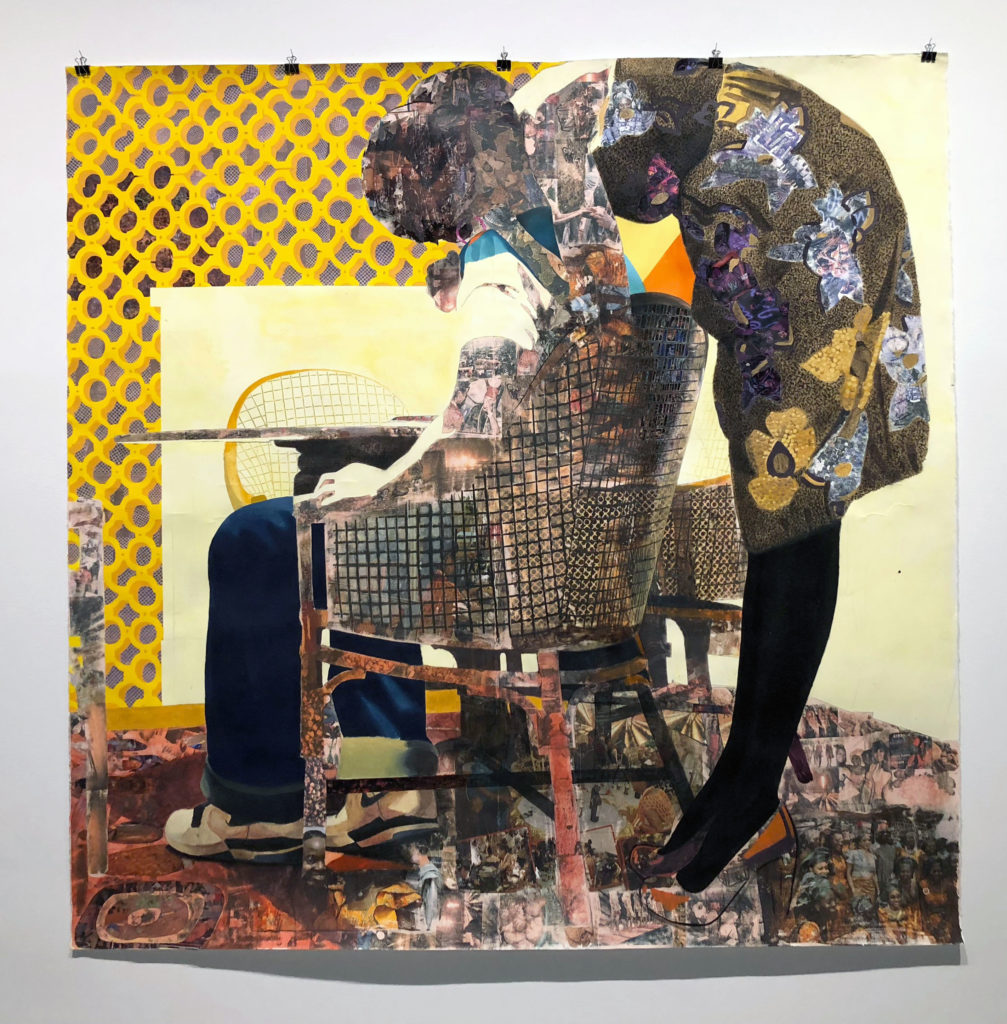
At David Zwirner is God Made My Face: A Collective Portrait of James Baldwin, a group show curated by writer Hilton Als. The works are varied and include portraits by Richard Avedon (shown above), a friend of Baldwin’s who also attended De Witt Clinton High School with him, as well work by Njideka Akunyili Crosby (seen below), Kara Walker, James Welling, Beuford Delaney, Glenn Ligon and many more.

Nyado: The Thing Around Her Neck, 2011 by Njideka Akunyili Crosby

At Marianne Boesky Gallery is Pure, Very, New, Paul Stephen Benjamin’s first solo exhibition in New York. The exhibition includes paintings, photographs, sculpture, and single and multi-channel video installations, as well as a new site-specific black light installation in the internal passageway between the two spaces.

From the press release–

Benjamin’s practice is rooted in a vigorous meditation on blackness, considering: “What is the color black?” “What does black sound like?” “Is it an adjective, a verb, an essence, or all of these components mixed to create a nuanced whole?” For his large-scale monochromatic paintings, Benjamin thickly coats the canvas in varying shades of black, producing a sensation of boundless depth. This is further accentuated by Benjamin’s application of the particular tonality’s name within the field of color—the words appearing to float and dissipate within the richness of the paint itself. The development of these paintings followed an ordinary visit to a hardware store, where Benjamin was confronted with the many permutations of commercial black paint. Shades of black came with emotive titles like “Totally Black,” “New Black,” and “Pure Black,” among numerous others. For Benjamin, this sparked a multi-layered investigation of the color and whether it could be distilled or understood differently within the context of a painting or the color itself.

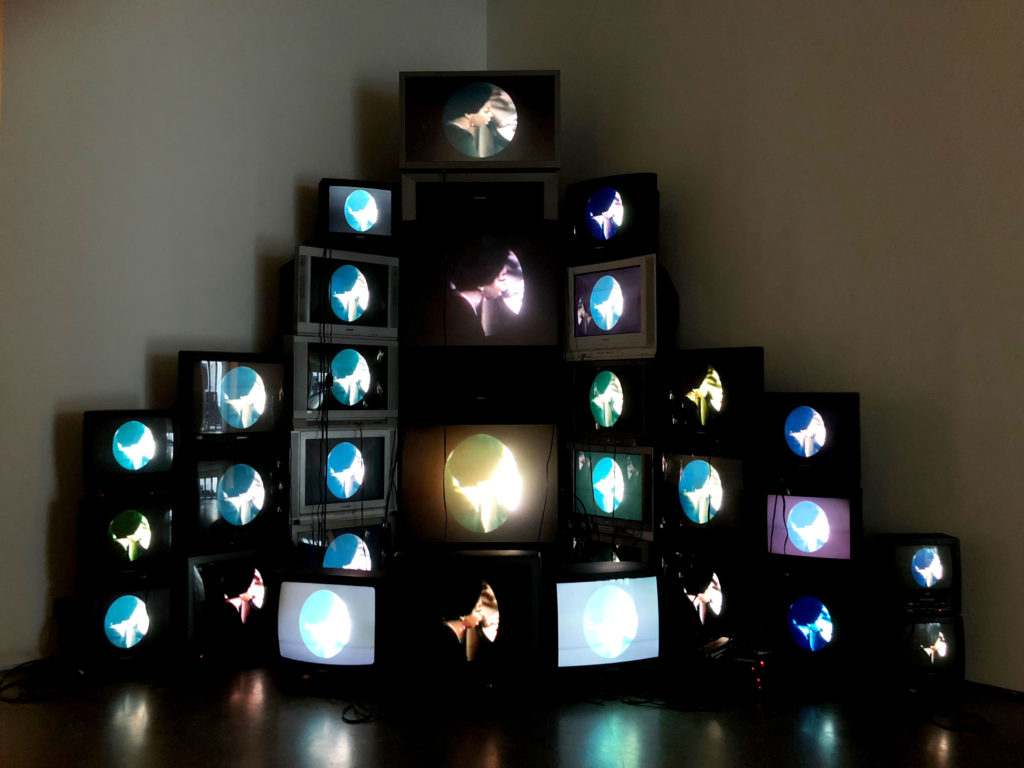
 … Benjamin’s practice also extends into a conceptual investigation of sound, and how “black” can be conveyed and experienced aurally. In these works, he often uses single and multi-channel video installations to loop portions of particular historic and cultural footage to isolate fragments of collective memories or internalized narratives. With Black is the Color (2015), which will be included in the exhibition, Benjamin arranges a towering cluster of antiquated televisions, forming a glowing grid that endlessly repeats a segment of Nina Simone’s 1959 performance of “Black is the Color of My True Love’s Hair.” Here, Benjamin appropriates only the words “Black is the Color,” creating an abstraction of the song that reveals the contradictions and parallels between the notion of black being the color and it being a color. Moving fluidly from sound installation to painting to photography and sculpture, Benjamin’s practice is driven by the idea that blackness, whether explored as a matter of conceptual inquiry or identity, cannot be captured in a single action, emotion, or language.

Black Is The Color 2015 by Paul Stephen Benjamin

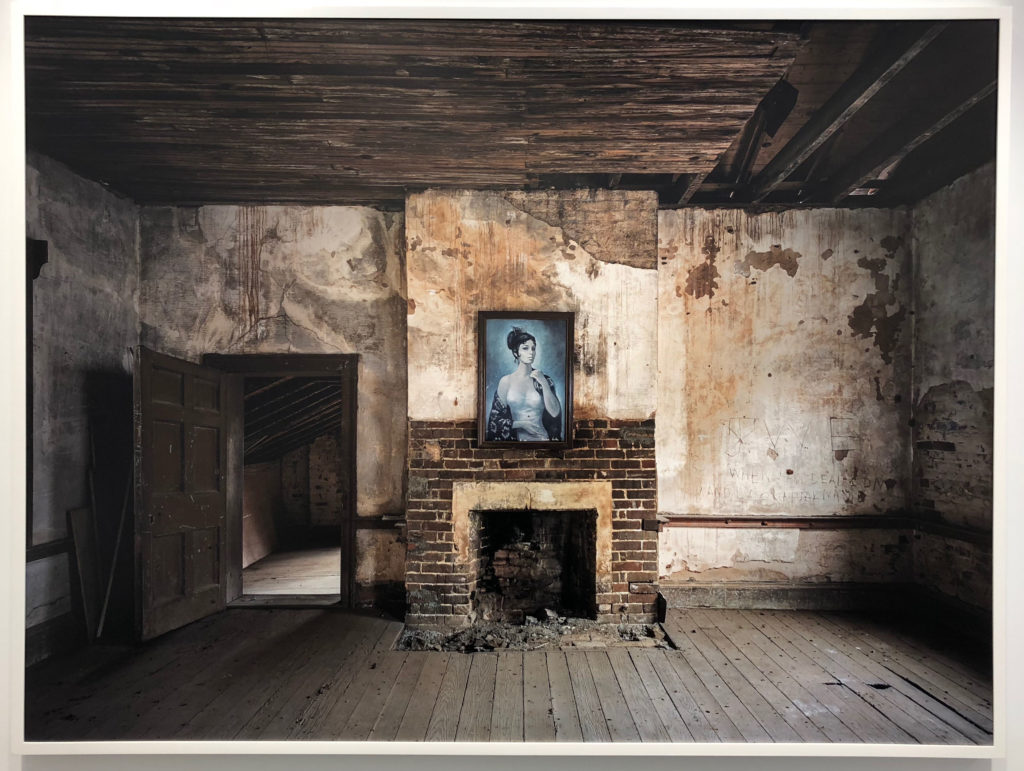
At Yancey Richardson is Blue Sweep, an exhibition of Andrew Moore’s beautiful photographs, taken in Alabama and Mississippi over the course of three years.

Carmen, Saunders Hall, AL 2015 by Andrew Moore

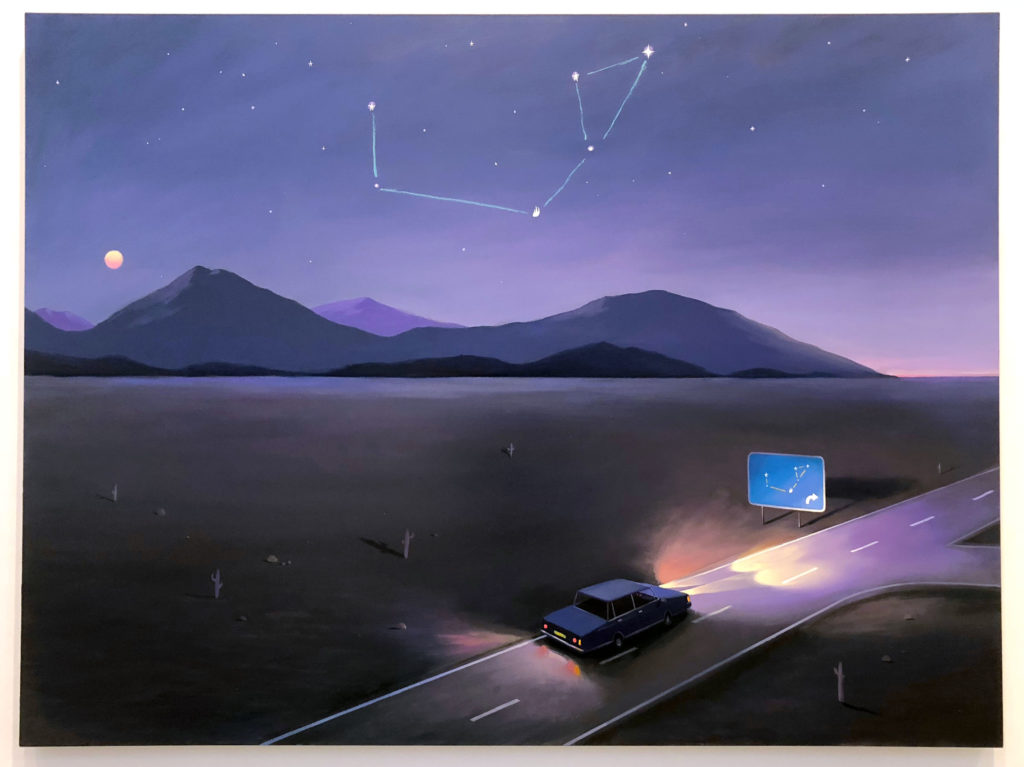
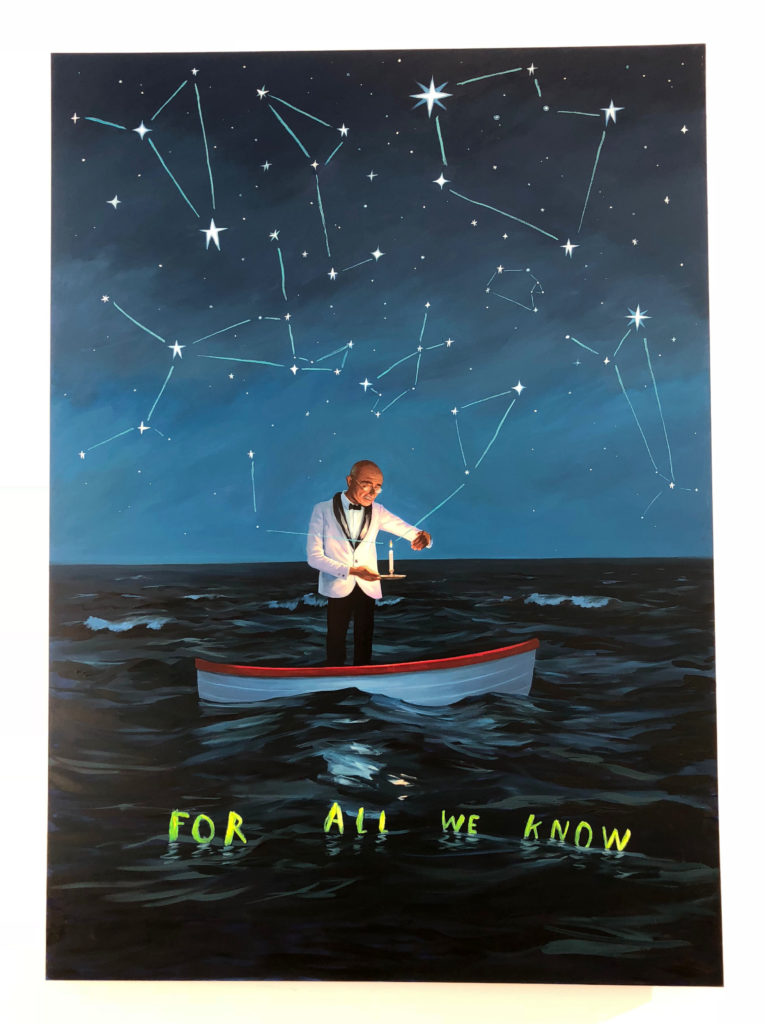
At Bryce Wolkowitz Gallery is Oliver Jeffers’ charming painting exhibition For All We Know. If his work looks familiar it may be because Jeffers is also the author of several critically acclaimed picture books.

From the press release–

This series of paintings illuminate a dream-like nocturnal world populated by astronauts, deep-sea divers, sinking ships, floating pianos, and burning matches. Omnipresent throughout are the night sky and the ocean – the two great and unknown frontiers – glittered with the imaginary lines that create constellations, serving in this case as a mysterious key to unlock our world.

Expanding on years of observation, from the history of his upbringing in Belfast, to contemporary New York City, Jeffers’ evokes the precarious state of our home and its inhabitants. Inspired by Buckminster Fuller’s seminal book Operating Manual for Spaceship Earth, he presents pianos as dubious flotation devices and our planet presented as a cumbersome motor vehicle, overheating as we argue over what to play on the radio. From researching astronaut’s descriptions of looking at Earth from the distance of the Moon, Jeffers noticed certain recognizable patterns to the way in which he discussed the politics of his hometown from a vantage point of across the Atlantic Ocean. In finding that few people outside of Northern Ireland knew or cared of the intricate conflict there, a great waste of time was revealed: a divided population identical to each other in every way save for the flags they flew and the stories they told. Tragically, each side’s identity are still firmly rooted to the existence of the other, and therefore locked into a spiral of repeated patterns.


At both of Jack Shainman’s locations are a series of impressive paintings by Lynette Yiadom-Boakye.

Black Allegiance to the Cunning, 2018 by Lynette Yiadom-Boakye


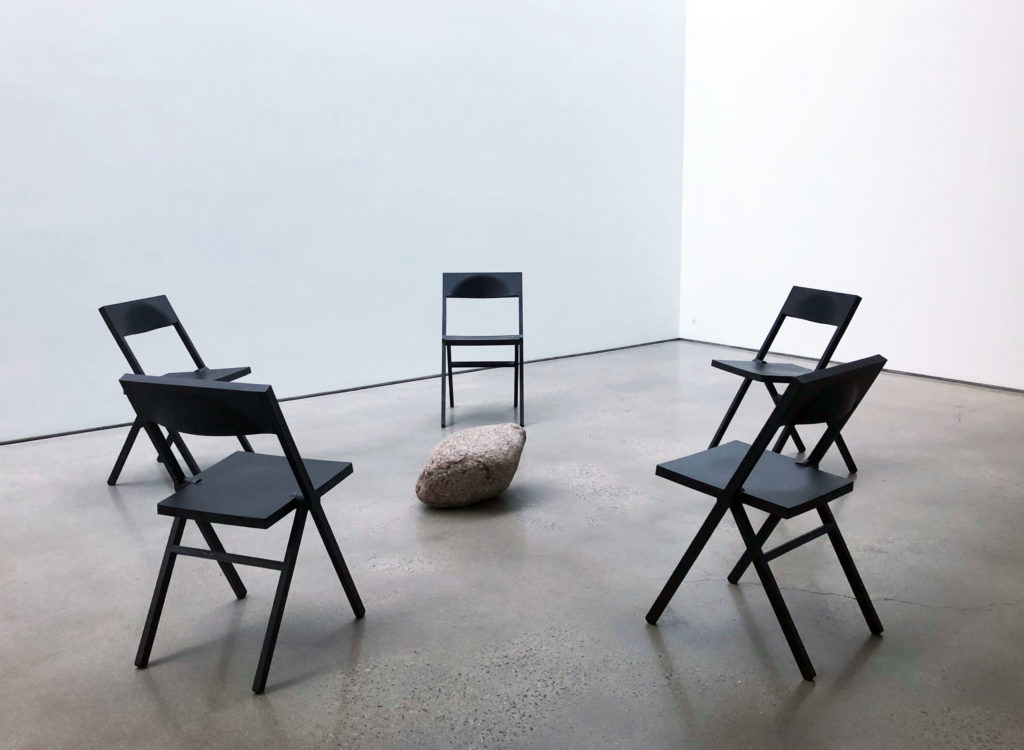
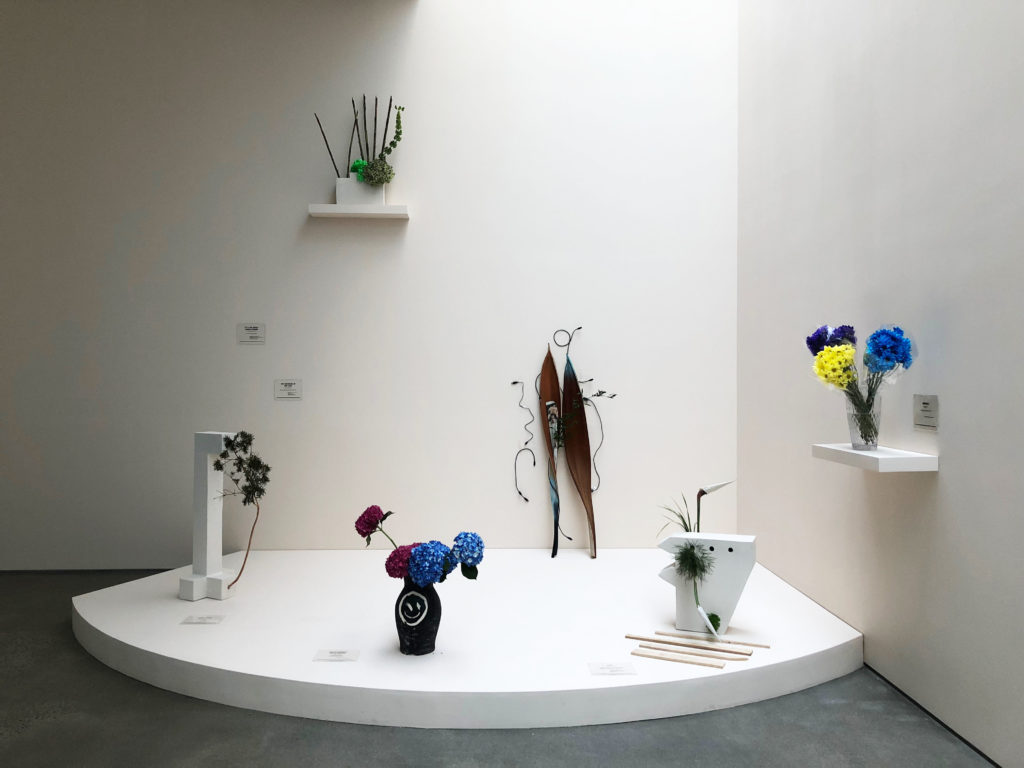
For a new kind of exhibition experience, Asad Raza has organized the group show Life to Come, at Metro Pictures which “brings together works that meditate on the creation of new worlds and new models for living.” There are no labels or listings for the works included in the show. Instead there is a guided tour by hosts who take you around the various works to help you draw connections between the objects. Adding to the uniqueness of the experience, at one point the host pauses while talking and partially in motion, recreating a work by artist Tino Sehgal, and at another they show you that they have changed their eye color, a work by Rirkrit Tiravanija.

From the press release–

Experiencing these works together incites intellectual, physical, and spiritual understandings of what it means to make an entirely new world, one in which reality is made from fiction. Raza asserts that “by re-immersing ourselves in the strangeness and fecundity of attempts to create worlds that have gone before, our imagination of a world beyond the present may be renewed.” The uncertainty about what new paradigm awaits us is unsettling in the wake of the modernist 20th century, but it links us to previous generations who experienced radical reinventions of biological and social life.

Philippe Parreno, La pierre qui parle (The Speaking Stone), 2018.


Selection of work by Camille Henrot (floral arrangements inspired by books)

All of these exhibitions close 2/16/19.