Jul 282021
 

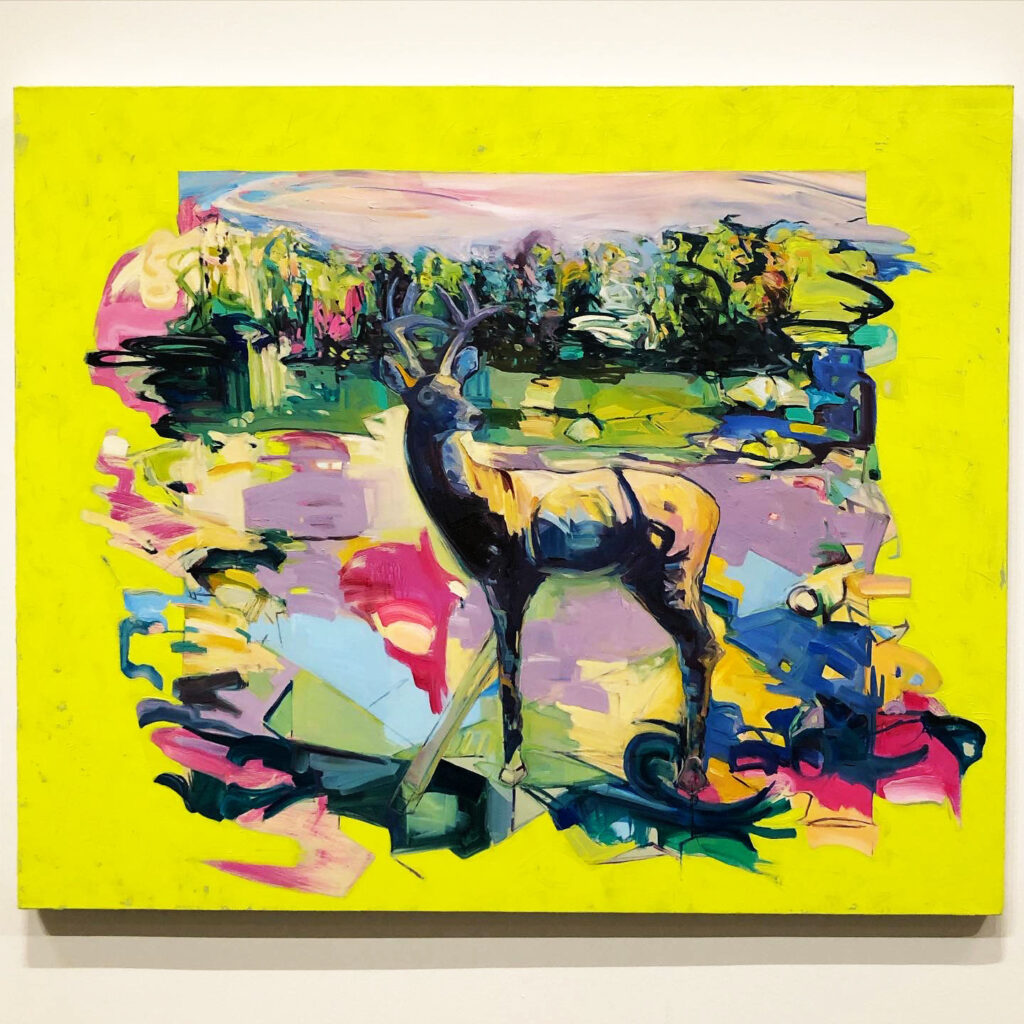
Texas Louise, 1971

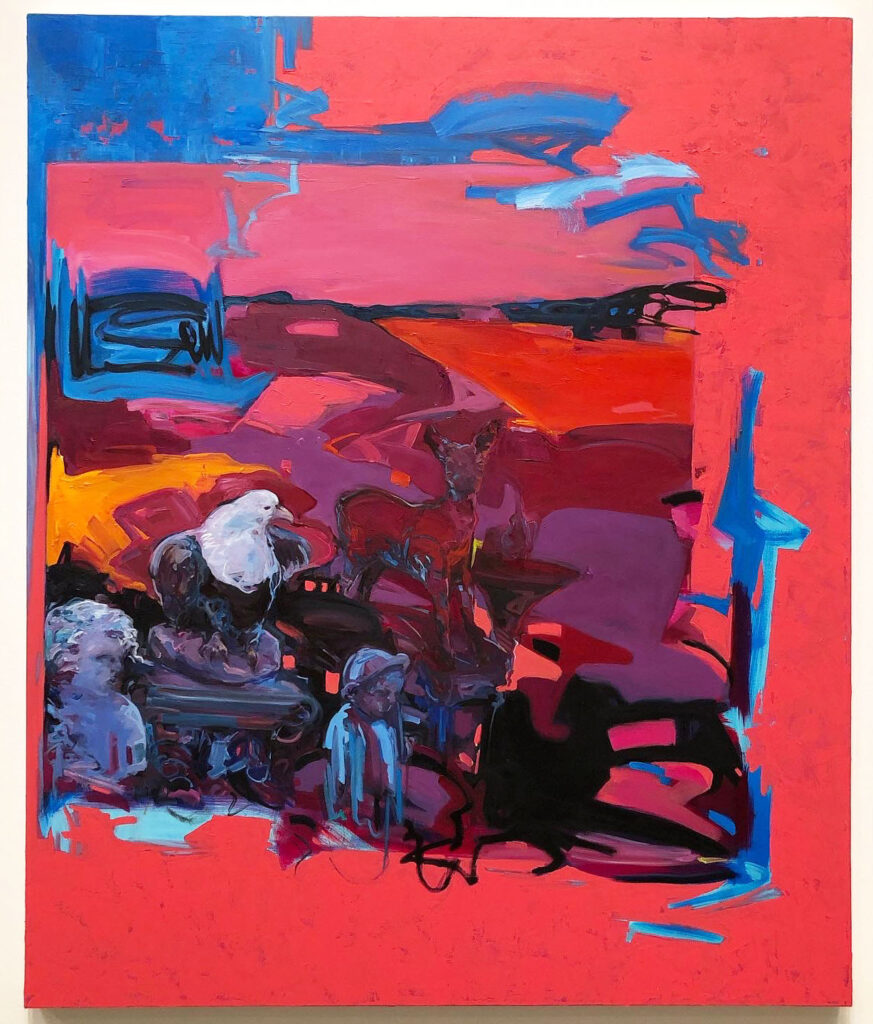
Where is Lucienne?, 1971


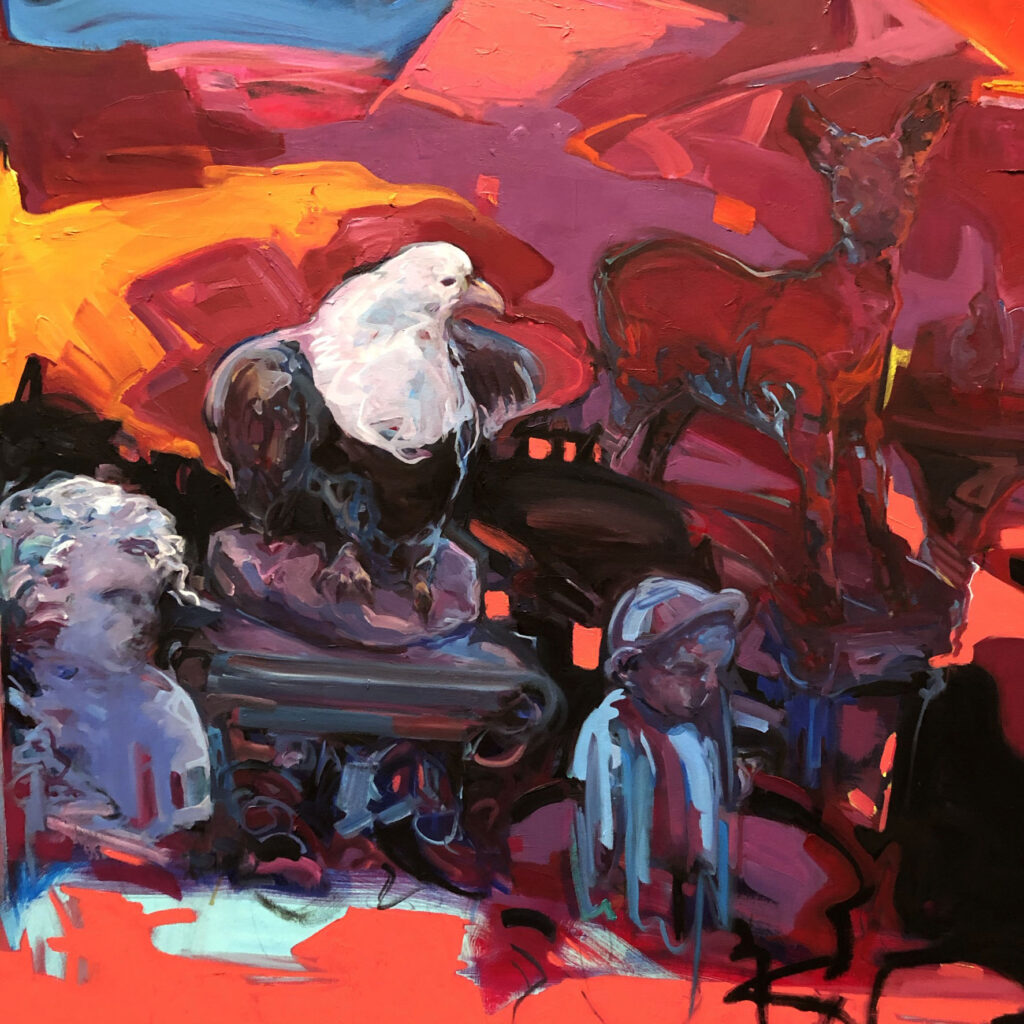
Where is Lucienne? (detail), 1971

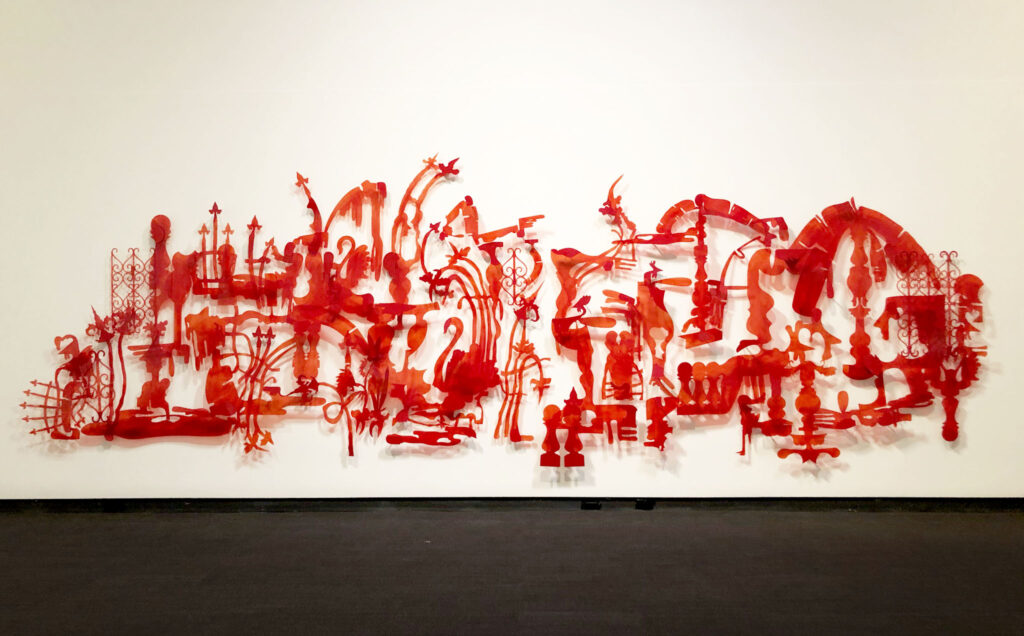
Where is Lucienne? (detail), 1971

Frank Bowling’s incredible paintings are currently on view at two of Hauser & Wirth’s locations, London and NYC, reflecting the artist’s time living in both cities. The paintings above are from the New York location.

From the press release-

The exhibition charts Bowling’s life and work between the UK and the United States. Born in Guyana (then British Guiana) in 1934, Bowling arrived in London in 1953, graduating from the Royal College of Art in 1962. He later divided his time between the art scenes in London and New York, maintaining studios in both cities. London is the city where Bowling trained as a painter and achieved early acclaim. New York is the city that drew him to itself at the height of the Civil Rights movement, where he became involved in discussions of Black Art – New York was a place of fresh energy and ideas for an artist in search of new ways to make paintings.

Bowling’s transatlantic orientation reveals itself in a shift from his early engagement with expressive figuration and pop art, to an immersion in a uniquely poetic abstraction that continues to evolve even today. Visible in his work are the legacies of both the English landscape tradition and American abstract expressionism. Developing in and between two cities over the course of decades, Bowling’s exploration of light, colour, and geometry can be understood as profoundly influenced by the two great rivers of his life: he has maintained studios close to The Thames in London and the East River in New York, absorbing the brilliance of the rivers’ light into his vision. Bowling would often begin a work in one city and finish it in the other, merging the atmospheres of both. In his own words, ‘I would just roll the lot up and move. And I knew that when I got to the other end, I could roll them out again and continue to work.’

Bowling’s restless innovation on the painted plane endures in his latest works. He continues to break ground through the use of thick impasto textures, acrylic gels, collage, stitched canvas, and metallic and pearlescent pigments. The complexities of his upbringing in Guyana and his constant journeying between London and New York have only served to activate the richness of the different influences of each location. His paintings are a celebration of life lived in varying lights and colours.

Jul 282021
 

Houses of the Holy, 2021

Houses of the Holy, 2021, detail

Rain Rereleases, 2021

Rain Rereleases, 2021, detail

Rain Rereleases, 2021, detail

Currently at Miles McEnery Gallery are Tom LaDuke’s incredible layered paintings. The more you look at them, the more the details emerge.

From the press release-

Tom LaDuke’s paintings are painstakingly constructed, offering multiple layers to absorb, with their own references and meanings. In his essay on the artist, Spaulding asserts, “hard-to-describe forms occupy a spatial netherworld that is neither entirely here nor there: neither entirely on the flat of the canvas, nor entirely in the spatial grid of post-Renaissance perspective.” LaDuke’s paintings situate the viewer in an illusory middle dimension, suspended between many levels of imagination.

Forms tend to be screened, stacked, and occluded among layers of fused, brightly colored impasto brushstrokes. “Art grows from the gallery like a tree from soil, in which strange tubes, tree-like structures, rock-like protuberances, proto-figures, or miasmatic nebulae of color precipitate from the atmosphere.” The complex abstract layers are set against the industrial lighting and airy architecture of the art gallery.

This exhibition closes on 8/13/21.

Jul 202021
 

Hartley, 1966.

The Metropolitan Museum of Art is currently showing Alice Neel: The People Come First, the first museum retrospective of the artist’s work in twenty years. It’s an impressive body of work covering a wide range of subjects, focused predominantly on her portraits.

From the museum’s website-

Alice Neel: People Come First presents Alice Neel (1900–1984) as one of the twentieth century’s most radical artists, a champion of social justice whose long-standing commitment to humanist principles inspired her life as well as her art. “For me, people come first,” Neel declared in 1950. “I have tried to assert the dignity and eternal importance of the human being.” In keeping with the ethical foundations of humanism, Neel dedicated herself to painting what she called “pictures of people.” The artist focused especially on individuals who had experienced injustice as a result of sexism, racism, and capitalism as well as those who combated it. Democratic and inclusive, Neel painted people from many different backgrounds and walks of life.

New York was Neel’s greatest muse and the stage for a human drama she began capturing in the early 1930s. Neel’s life and art were inflected by the tumultuous events of the twentieth century, including the Great Depression, the rise of Communism, and the feminist and civil rights movements. For this reason, she described her work as a kind of history painting. Mindful of the formal and sensuous possibilities of paint, Neel applied her incisive eye to all her subjects, whether people, urban landscapes, or still lifes. Her riveting portrayals of life in New York, whose gritty beauty persists even in precarious times, make Neel’s art even more relevant in 2021.

Below are a few selections from the exhibition, but it’s worth going to the museum’s website (even if you see the show), where all the paintings and their descriptions can be found.


Robert Smithson, 1962

This painting of artist Robert Smithson is worth noting for the detail Neel put into depicting Smithson’s skin condition, and her decision not to shy away from showing these aspects in her portraits.

The Black Boys, 1967

The New York Times has an interesting story about Jeff and Toby Neal, the boys from the picture above, and the search for the painting they sat for so many years ago.

Jackie Curtis and Ritta Red, 1970

Ginny, 1984

This moving portrait is one of her last paintings, and captures Neel’s daughter-in-law Ginny’s grief after her mother’s passing.

107th and Broadway, 1976

Black Bottles, 1977

This exhibition closes August 1st, 2021.

Jul 192021
 

End-To-End Encrypted (Lot’s Wife), 2020 by Elliot Reed, part of the group show Wish at Metro Pictures.

From the press release-

This exhibition closes 7/30/2021.

Jul 142021
 

For Marlene McCarty’s current exhibition Into The Weeds: Sex & Death at Sikkema Jenkins, she has combined her large scale drawings with an indoor and outdoor garden.

From the press release-

Using everyday materials such as graphite and ballpoint pen, McCarty’s work often focuses on representations of the female body, femininity, and its position within familial and biological systems. Her subjects are depicted engaging in unorthodox or transgressive social formations, breaking down the traditional, accepted interactions among humans and other species, as well as between humans and nature. For Into the Weeds, McCarty turns to plants, and their complex ecocultural role within society to explore issues of reproductive health, physical autonomy, public space, and the symbiosis of growth and decay.

Throughout history, certain plants and weeds have been foraged and cultivated for a wide range of purposes, both curative and toxic. The alkaloids of the deadly nightshade, for example, have also been used to treat fevers and inflammation, while mugwort has been used to regulate menstruation and induce abortion. Seedlings have been cultivated and installed alongside McCarty’s densely drawn compositions of plants, weeds, body parts, clothing, and abstract geometric forms. Meticulously shaded limbs and flowers interlace one another, mirroring each other’s shape with the curl of a finger or the droop of a petal. This interplay of human body and plant is disrupted by various symbols alluding to a hegemony of white western culture: a Civil War ball gown, cowboy hat, and fragments of Modernist architecture, including the honeycomb-esque Vessel at Hudson Yards. Within these chimerical gardens lies a contentious ecosystem, constantly negotiating the power dynamics across gender, race, health, and history.

This exhibition is on view until 7/30/21.
Jul 032021
 

This painting, Reverse Beach, 2019, is from Rob Thom’s exhibition at M+B Los Angeles, The Beast. Thom’s vision of American life takes on many forms, often focused on its more absurd qualities.

For more about his work, check out his interview at Interlocutor or his Instagram.

Jun 252021
 

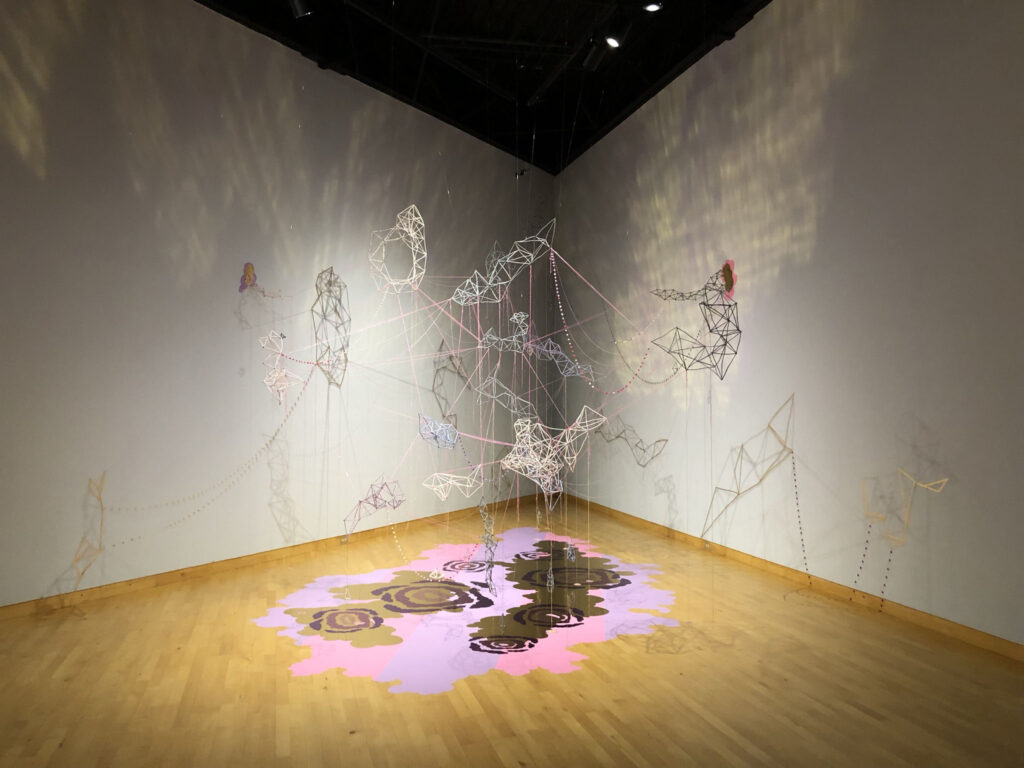
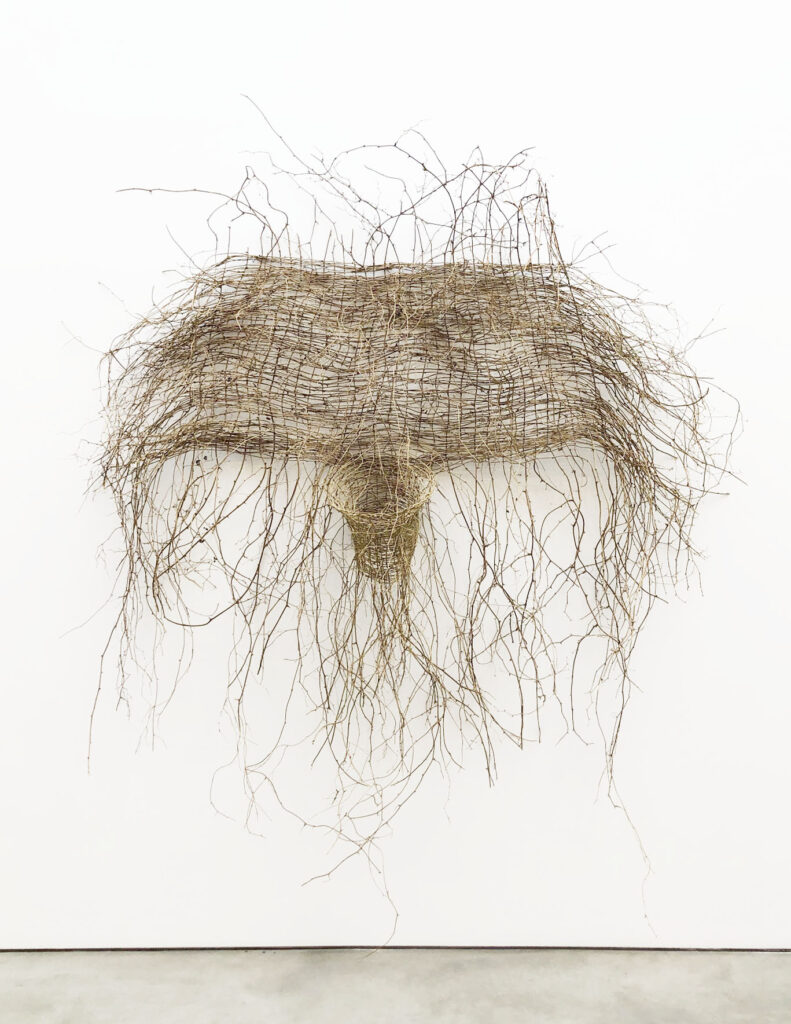
Currently at the Spartanburg Museum of Art in South Carolina is fiber filled, an exhibition consisting of two art installations. The one pictured above is by artist Samuelle Green, titled Manifestation 8: Permutation 1.

Her statement about the work-

There is structure and design inherent in the natural world, which we constantly draw from and take for granted. We generally fail to acknowledge the skill, time, and detail required to manifest the intricate structures found in objects we encounter regularly- such as those found in bird and wasps nests, beehives, spiderwebs, rock formations, anthills, feathers, etc.

My work, especially the large scale installations like this one, reference these natural forms as they merge with human-made objects, inspiring contemplation.

Also check out the museum’s site for a short video from the artist going into more detail on her process.

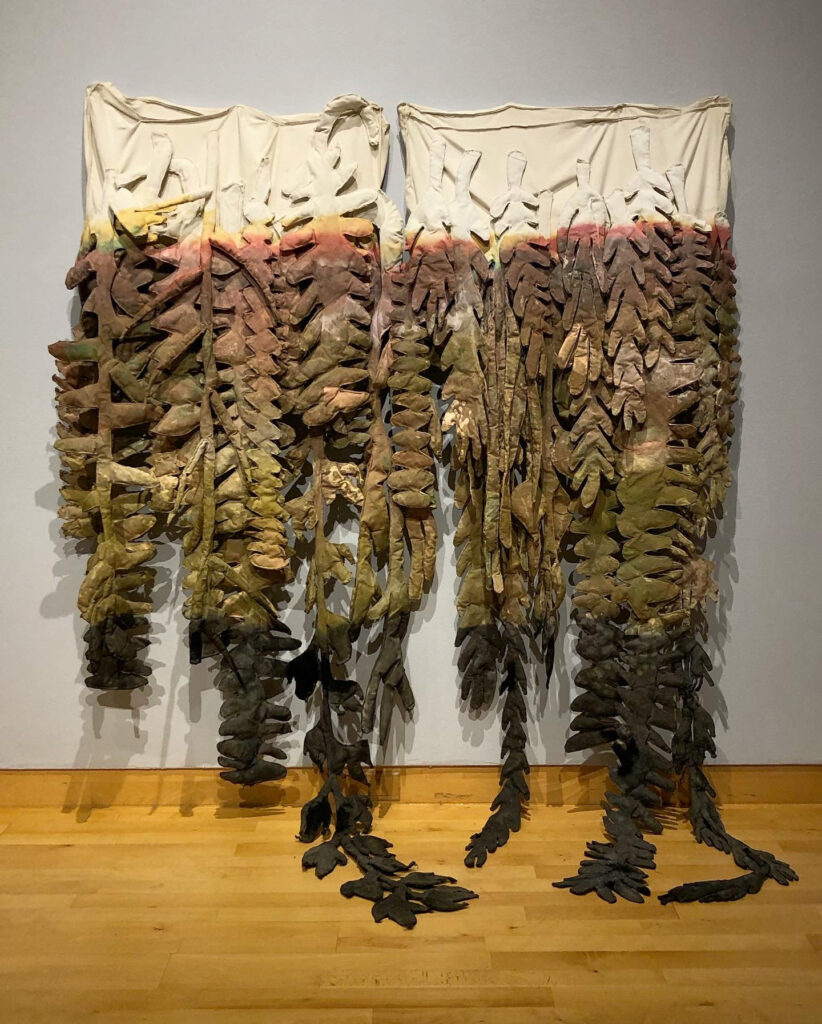
The other installation is by Liz Miller, titled Alchemical Conundrum, part of which is seen below.

Her statement about the work-

My work explores the fallibility of infrastructure and the precariousness of perceptions, as seen through a materially-intensive process-based lens. I create elaborate site specific installations that are equal parts absurd, menacing, and poetic. Pattern and tactility confuse and complicate identification, camouflaging recognizable forms and evoking recognition when applied to non-objective forms. The tensions between fact/fiction and dimensionality/flatness are endlessly fascinating to me, playing out my work as a dialogue between reality and illusion.

More recently I have become fascinated with rope and knotting as a byproduct of my large-scale installations, where I utilize rope to achieve tension that gives volume to otherwise flat materials. The varied use of rope and knotting across cultures and history ranges from utilitarian to decorative, and even deadly. I create interdependent knotted topographies that allude to both structure and malleability. The repeated act of tying by hand integrates an emphatic sense of strength, while the flexibility and nuance of the textile material ensures structural permutations. The resulting works are only quasi-architectural providing metaphorical insight laced with humor as related to a variety of structural and systemic behavior.

This exhibition closes 6/30/21.
Jun 242021


From The High Line’s information page on this work-

Simone Leigh presents Brick House, a 16-foot-tall bronze bust of a Black woman with a torso that combines the forms of a skirt and a clay house. The sculpture’s head is crowned with an afro framed by cornrow braids, each ending in a cowrie shell. Brick House is the inaugural commission for the High Line Plinth, a new landmark destination for major public artworks in New York City. This is the first monumental sculpture in Leigh’s Anatomy of Architecture series, an ongoing body of work in which the artist combines architectural forms from regions as varied as West Africa and the Southern United States with the human body. The title comes from the term for a strong Black woman who stands with the strength, endurance, and integrity of a house made of bricks.

Brick House references numerous architectural styles: Batammaliba architecture from Benin and Togo, the teleuk dwellings of the Mousgoum people of Cameroon and Chad, and the restaurant Mammy’s Cupboard in Natchez, Mississippi. The sculpture contrasts sharply against the landscape it inhabits, where glass-and-steel towers shoot up from among older industrial-era brick buildings, and where architectural and human scales are in constant negotiation. Resolutely facing down 10th Avenue, Leigh’s powerful Black female figure challenges us to consider the architecture around us, and how it reflects customs, values, priorities, and society as a whole.

Leigh works across sculpture, video, installation, and social practice, stitching together references from different historical periods and distant geographical locations. As a sculptor, Leigh works predominantly in ceramics—a medium that she mastered early in her career—continually pushing the boundaries of her chosen material by working in new methods and larger scales. In her intersectional practice, Leigh focuses on how the body, society, and architecture inform and reveal one another. She examines the construction of Black female subjectivity, both through specific historical figures such as Josephine Baker and Katherine Dunham, and more generally through overlapping historical lineages across Europe, Africa, the US, and the Caribbean.

The High Line’s website also has some excellent videos and additional information on the making of the sculpture well worth checking out.  This work was on view until May of 2021.
Jun 232021
 

Quarantine, 2018

This painting is from Julie Curtiss’ exhibition Altered States at VSF gallery in Los Angeles in 2018.
From the press release from that show-

Depicting mostly female subjects in her works, Curtiss creates an undulating dreamscape where the depths of a woman’s psyche are as important and palpable as her body. Rife with swirling curvatures and oscillating lines that convey both physical movement as well as cognitive dissonance, Curtiss’ subjects are secretive and faceless, inhabiting uncanny narratives driven by the logic of dreams. Teetering between dichotomies of seduction and repulsion, feral and domestic, their countenances are strategically concealed with thick mounds of serpentine hair, clawed hands and razor-sharp nails that conjure the anatomy of cold-blooded beasts. For Curtiss’ latest series of paintings and gouaches on paper, marine imagery permeates the narratives: koi, lotuses, fishtails in lieu of feet, a lobster claw clasping a glossy manicured finger … a nod to the 1980s science-fiction film “Altered States,” whose protagonist descends into a bottomless search for the self by way of floatation tanks – sensory deprivation chambers filled with body-temperature saltwater (water being the Jungian dream symbol for the unconscious). While Curtiss invites us to dive deeper into the layered, mercurial mind of her subjects, we are inevitably faced with a reflection of our own subconscious.

She is currently showing her newer work, which includes sculptures, at White Cube Mason’s Yard, in an exhibition titled Monads and Dyads, closing 6/26/21.