Jun 202022
 

Florida Roadside- Gatorland, 2020

Dusk Pines, 2020 (left) and Pinelands, 2020

Artists Sam McCoy (works above) and Sheherazade Thenard (work below) were both part of the recent exhibition Fresh Squeezed 6: Emerging Artists in Florida at Morean Arts Center in St. Petersburg, Florida.

Information on Sam McCoy from her website–

Sam McCoy was born and raised in Orlando, Florida in the 90s. She is a contemporary painter who focuses on the boundaries between natural and hyperreal landscapes of Florida. She pulls her inspirations from a place where spectacles and roadside attractions dominate America’s tourism capital. Between eco-tourism destinations and constructed gardens, McCoy explores the contradictions of her experiences in these places. By pulling back the metaphorical curtain on a carefully crafted image of Florida, McCoy’s ideas of disenchantment and re-enchantment are enacted in each painting. The viewer can still find meaning in the shadier discordant corners of the State.

Magnolia, 2020

From Sheherazade Thenard’s information page–

For me, a landscape painting is not merely a visual representation of the world. It is a metaphor for the human condition. I paint to try to make sense of the fragility of our world, the passing of time, and our shared experiences of light, color, and space. The incorporation of figures within my paintings are often swallowed or hidden by their constructed lush surroundings. Painting the land and its inhabitants continues to be a way of engaging with the strangeness of being here.

The undercurrent themes of mysticism, escapism and fantasy are reoccurring within my pieces. Through these works, I aim to create psychological spaces paired with hidden symbolism integral to the understanding of each painting.

Check out both of their websites to see more of their excellent work.

May 122022
 

Marcos Ramirez ERRE’s  Is All That it Proves, 2015, was created for Murals of La Jolla, in San Diego. Murals of La Jolla is a project started in 2010 by The Athenaeum and the La Jolla Community Foundation. It commissions artists to create work to be displayed on buildings around La Jolla. Information on his current mural for the project can be found here and a map of all the murals can be found here.

From the Murals of La Jolla website about the work-

Marcos Ramirez ERRE’s mural, All That it Proves, is a strongly stated, critical stance on what we perceive as the truth. He employs Thomas Paine’s famous quote as both a linguistic and visual exploration of the human condition and a challenge against long standing rhetoric. Paine’s quote is about understanding that our opinion is only that, our opinion. And our opinion is not necessarily the “truth”, while at the same time it may be. The piece deviates from its most obvious reference towards eyesight and becomes about another kind of vision, the kind of vision you perceive through common sense. True to his form as humanitarian artist, Is All That It Proves, exemplifies the notion that now, more than ever, we need to embrace tolerance and learn to respect individuals who chose to think in a way different than we do.

Marcos Ramirez ERRE has come to be defined by his clever visual arguments and masterfully crafted work that maintains a poetic sensibility, even when leveling biting political commentary. He was born in 1961 in Tijuana, Mexico. ERRE received his Law Degree from La Universidad Autónoma de Baja California. In 1983, he immigrated to the United States where he worked for seventeen years in the construction industry. His multi-disciplinary background has shaped his practice. He came to prominence in the 1990s with large public installations that dealt with migrants, immigration, and border control, specifically focusing on the Mexican-American border crossing. Much of ERRE’s work grapples with these issues.

Apr 152022
 

Lynette Yiadom-Boakye’s 2018 painting, The Ever Exacting, from her 2019 exhibition, In Lieu of a Louder Love at Jack Shainman Gallery in NYC.

This poem, written by the artist, was included with the press release for the show-

In Lieu Of A Louder Love

In the Shade of Hooded Cove,

In Debt to the Dead Oak.

In Range of a Twelve Gauge,

On Embers over Smoke.

At Pains to Hold the Wanton,

At Home to all who Knock.

At Prayer on Prickly Hearth Rug,

An Eye upon the Clock.

In the Parlance of the Pilgrim,

In Hallelujah Coat and Tie.

In Soul so Black Beguiling,

That the Ravens do Carp and Cry.

In Memory of A Cipher,

At Peace beside resting Dove.

In Light of Care and Kindness,

In Lieu of A Louder Love.

The information below is from the gallery’s artist biography, and gives some added insight on her paintings.

Lynette Yiadom-Boakye’s oil paintings focus on fictional figures that exist outside of specific times and places. In an interview with Nadine Rubin Nathan in the New York Times Magazine, Yiadom-Boakye described her compositions as “suggestions of people…They don’t share our concerns or anxieties. They are somewhere else altogether.” This lack of a fixed narrative leaves her work open to the projected imagination of the viewer.

Her paintings are rooted in traditional formal considerations such as line, color, and scale, and can be self-reflexive about the medium itself, but the subjects and the way in which the paint is handled is decidedly contemporary. Her predominantly black cast of characters often attracts attention. In an interview with Hans Ulrich Obrist in Kaleidoscope, she explained “People are tempted to politicize the fact that I paint black figures, and the complexity of this is an essential part of the work. But my starting point is always the language of painting itself and how that relates to the subject matter.”

The New Yorker published a wonderful portrait of Yiadom-Boakye by Zadie Smith in 2017, that is well worth a read as well.

Mar 152022
 

Artist Sophie Calle’s Here Lie The Secrets of the Visitors of the Green-Wood Cemetery, a 25 year long public artwork. The project debuted on April 29th and 30th, 2017.

From Creative Time’s website-

To inaugurate the project, the public was invited to Green-Wood Cemetery, a National Historic Landmark, in Sunset Park, Brooklyn, to privately unburden and inter their most intimate confessions.

During the two-day opening, in a setting nestled among the mausoleums and monuments of Green-Wood’s verdant rolling hills, visitors transcribed their secrets onto paper, and deposited them into the earth below, through a slot on a marble obelisk of Calle’s design. The artist was on hand during the two-day event to receive some visitors’ secrets.

The two-day performance was free and open to the public. Guests were invited to spend the day exploring the sculptures and monuments throughout Green-Wood, a tradition that dates back to the early 1800s. Free maps of the cemetery, specially designed to accompany Calle’s installation, were be available. Guided walking tours emphasizing the cemetery’s symbols and iconography were offered at no cost.

Visitors to the Cemetery can now see Calle’s installation during regular cemetery hours and independently deposit secrets into the marble obelisk. Calle has also pledged to return periodically over the next 25 years, each time the grave is filled, to exhume and cremate them in a ceremonial bonfire service and moment of remembrance.

Everyone has a secret to tell, now there’s a place to put one of yours.


Mar 102022
 

Sharon Norwood’s Polite Conversation, 2019, part of Spaces Between, the 2021 artist-in residence group show at McColl Center in Charlotte, North Carolina.

She currently has a solo show at Washington and Lee University Museums in Lexington, Virginia, running until May 28th, 2022.

Feb 242022
 

For more of Ya La’Ford’s artwork, check out her website and Instagram.

She was also one of the Tampa Bay artists featured in the recent exhibition Skyway 20/21.

Feb 172022
 

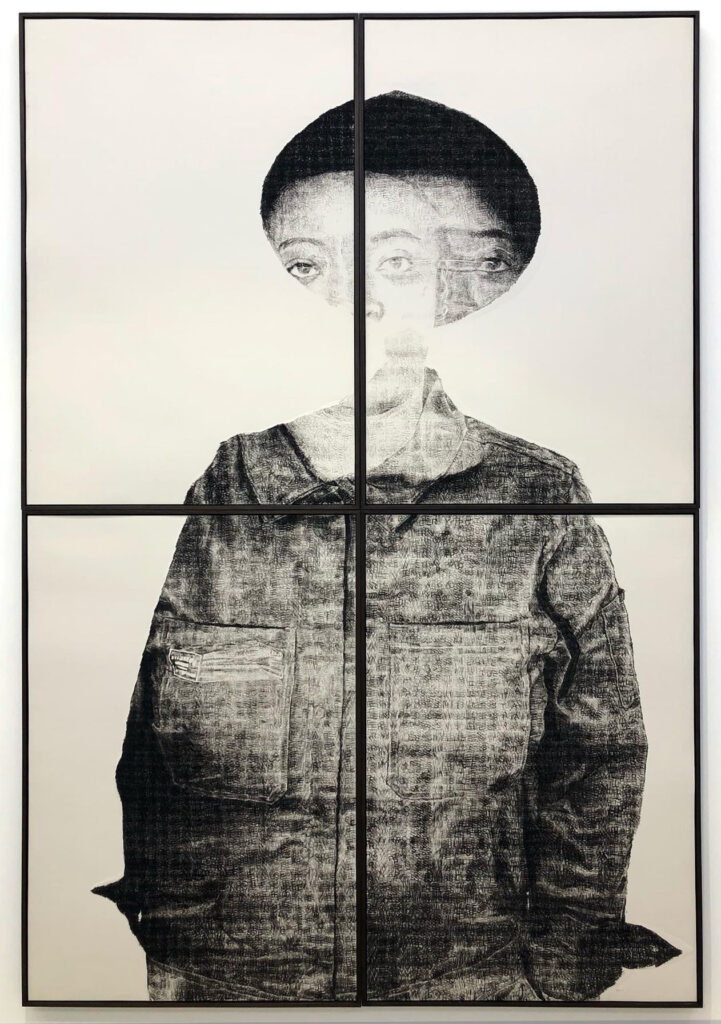
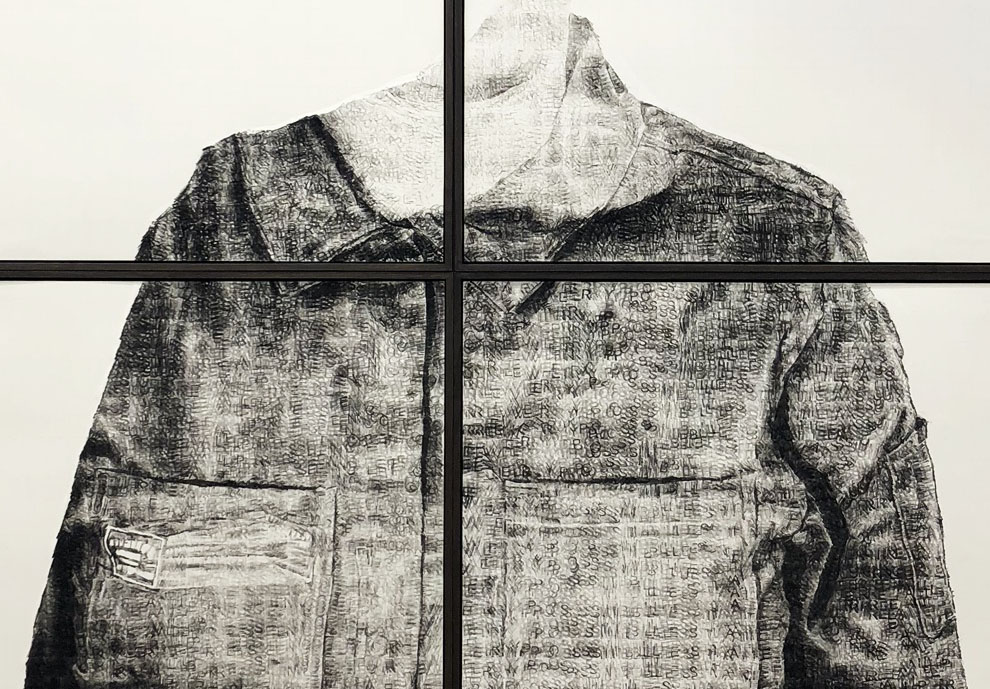
A Surreal Presence for Every Possible State, 2018 by Kenturah Davis from her 2019 exhibition, Blur in the Interest of Precision at Matthew Brown Los Angeles. The four panel work was created using oil paint applied with rubber stamp letters and graphite grid on embossed Mohachi paper.

From the press release-

Blur in the Interest of Precision is a search for parallel conditions between the poetics of our visual experience and the strangeness of our relationship to language. We often use language to carve out distinctions between one thing and another. Davis’ objective—to complicate ideas about meaning, representation and perception—have found refuge in blur and doubling. The new drawings are rendered with arrangements of text, but the words are virtually illegible. Many of the portraits pursue ideas the artist is working through via the writings of Fred Moten and Toni Morrison’s essay, Sites of Memory.

Davis’ work oscillates between various facets of portraiture and design. Using text as a point of departure, the artist explores the fundamental role that language has in shaping how we understand ourselves and the world around us. This manifests in a variety of forms including drawings, photographs and performances.

Recently Davis was commissioned by LA Metro to create work for the future Inglewood Station, slated to open in November of 2022. The work, Sonder, depicts community members photographed at gatherings at the artist’s Inglewood art studio and made into large porcelain enamel steel panels.

From Metro’s site–

The photographs were hand painted with stamps incorporating letters that form the words defining the term “sonder.”

Davis was drawn to the term which alludes to the realization that every person has a unique and significant story. She hopes that the portraits inspire connections between strangers, even if only for a passing moment while waiting for the train.

(images below via LA Metro’s site)

For more images, information about the station, and a video of the artist discussing the work, check out Metro’s website.


Oct 112021
 

Happy Indigenous People’s Day! The work above, Because You Enter My House, It Becomes Our House, is by Choctaw-Cherokee artist Jeffrey Gibson. The sculpture was commissioned for Socrates Sculpture Park in New York, but is currently located at deCordova Sculpture Park and Museum in Lincoln, Massachusetts.

The deCordova website gives the following information about Gibson and the work-

Jeffrey Gibson weaves together his Choctaw-Cherokee heritage and queer identity into vibrantly patterned painting, sculpture, video, performance, and installation. Drawing on Indigenous process and materials and queer camp aesthetics, his artistry aims to transcend binary thinking and corrects nostalgic views of indigeneity. Merging styles and historical references, Gibson states, “I have continued to think about my practice as encompassing the past and present while considering the future.” Gibson often integrates phrases and words into his artwork, with language drawn from pop songs to activist slogans, to offer open-ended declarations of love, community, and liberation.

Standing over 40 feet wide and 20 feet tall at the entrance to deCordova’s Sculpture Park, Gibson’s Because Once You Enter My House, It Becomes Our House commands attention to its stepped form and psychedelic facade. Originally commissioned by Socrates Sculpture Park in Long Island City, this installation expands Gibson’s signature artistry and collaborative process to a monumental scale. He took inspiration from North American Indigenous history, as well as queer nightlife to create this monument advocating for Indigenous space and culture. The tri-layered form references the earthen forms of the ancient Mississippian city of Cahokia which flourished in the seventh through the fourteenth centuries before European contact.

The title, Because Once You Enter My House, It Becomes Our House, comes from the song “Can You Feel It” by Mr. Fingers (Larry Heard). Gibson evokes 80s and 90s-era house music and night clubs as they provided welcoming spaces for queer communities and people of color. Mr. Finger’s lyrics embrace intimacy, generosity, acceptance, and community. This installation echoes this broad communal ethos as Gibson invited fellow Indigenous artists–Eric-Paul Riege (Diné), Luzene Hill (Eastern Band of Cherokee Indians), and Dana Claxton (Hunkpapa Lakota)–to co-create the wheat-pasted posters covering the façade of the installation and stage performances on and around the ziggurat.