May 062017
 

                                                                                             Drizzle (Wangechi Mutu) 2010

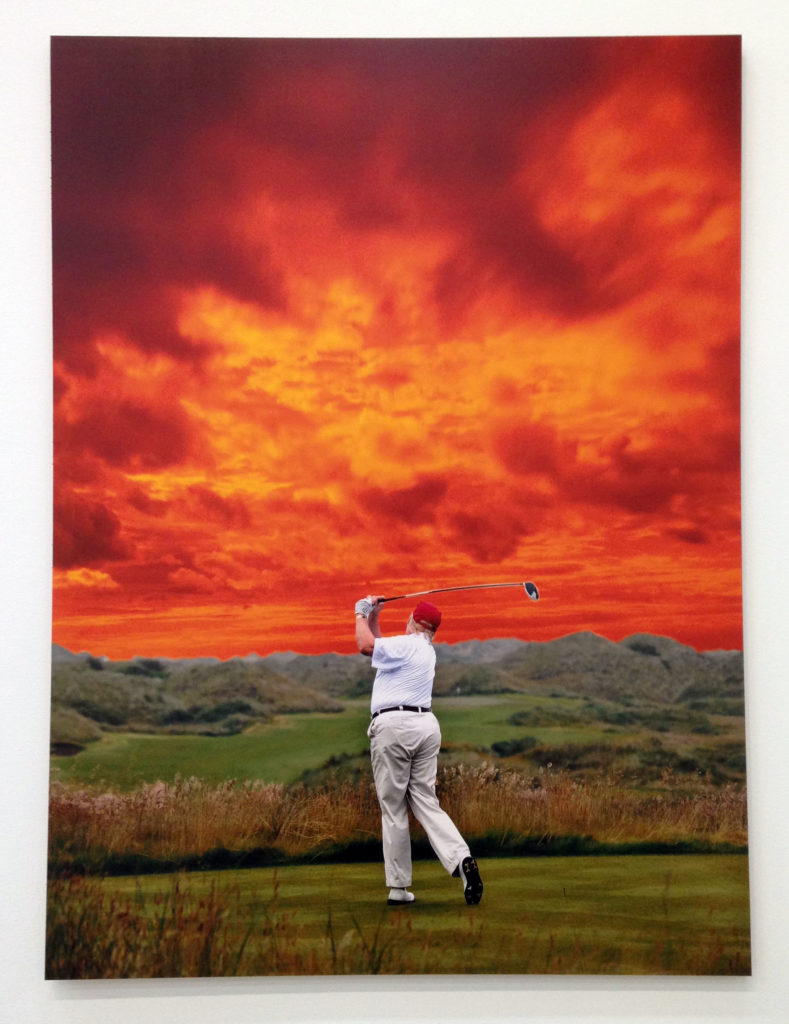
                                                                                                  Redhead, 2015

Marilyn Minter: Pretty/Dirty at Brooklyn Museum is absolutely stunning and a must see if you are in New York. The four decades of her work shown in the retrospective offer a chance to see the artist’s progression in style and technique, as well as content.

The exhibit starts with early black and white photos Minter took of her mother, smoking in bed, applying makeup or just staring into a mirror, with a hint of a former glamour that has now faded. It becomes immediately clear that Minter’s interest in exploring standards of beauty were present early on.  Moving through the exhibit you follow her evolution into her current work. From her early Photorealist paintings, to suggestive paintings of food, and then moving gradually to work that more explicitly uses sexual imagery, including a series of pubic hair paintings for Playboy that were mostly rejected. In that same section her slow motion videos of thick liquids being licked up and spit out on a glass pane by a red lipped mouth, walk the line between fascinating and repulsive.  Her large scale photo-realistic enamel on metal paintings that make up a large part of the retrospective are a particular standout with their lush colors.  The exhibition ends with the video, Smash, 2014, in which ominous music plays as a closeup of feet in high heeled silver sandals and red painted toenails breaks glass and splashes silvery liquid in slow motion. It is mesmerizing.

This interview with Minter is interesting and shows the work in the retrospective (from when it was shown at the Orange County Museum of Art)-

This exhibition closes 5/7/17.
 

Mar 102017
 

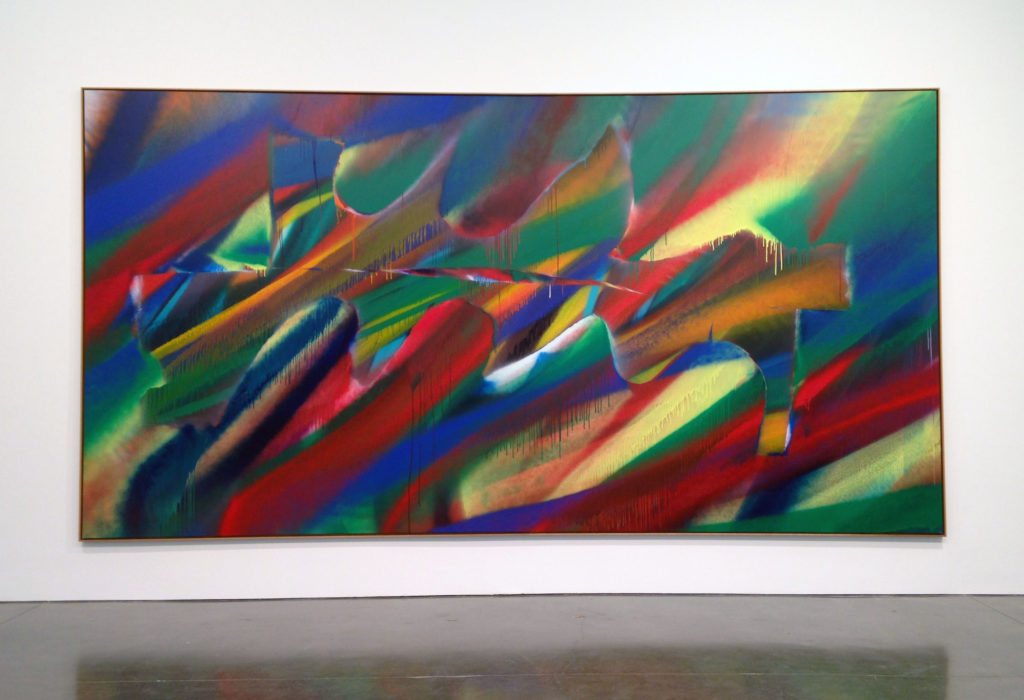
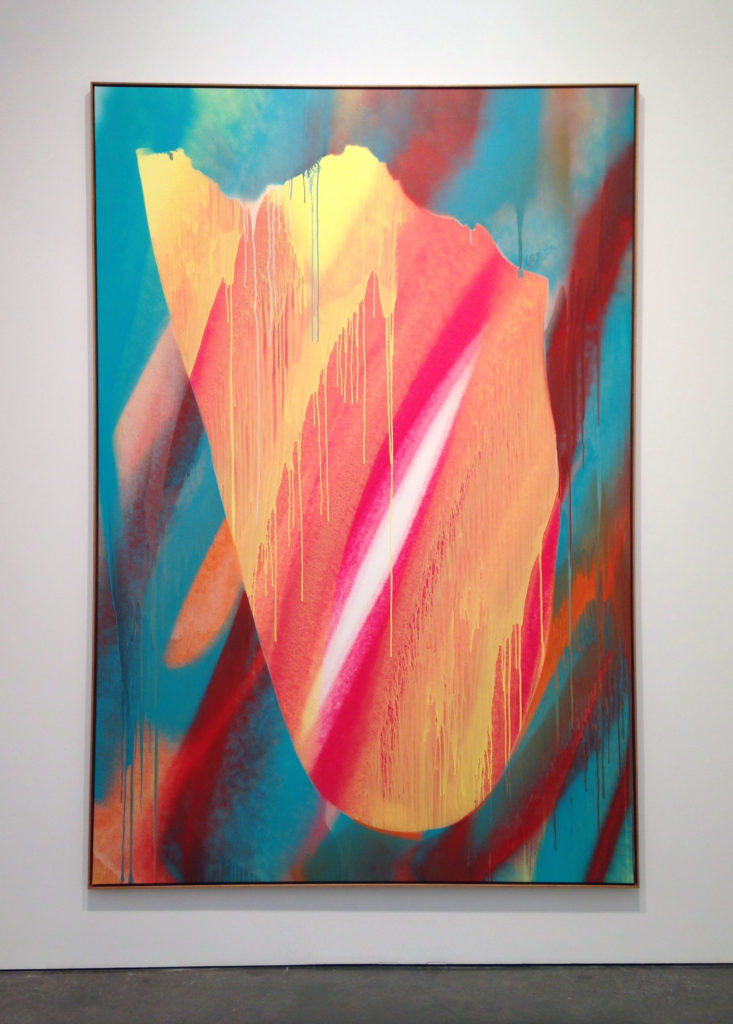
Katharina Grosse‘s current exhibition at Gagosian, consists of dynamic brightly colored canvases and one cast metal sculpture. Unlike traditional painting, these works are created using a spray gun which creates the unique effects.

Her process is described in the press release-

Embracing the events and incidents that arise as she paints, Grosse opens up surfaces and spaces to the countless perceptual possibilities of the medium. While she is widely known for her temporary and permanent in situ work, which she paints directly onto architecture, interiors, and landscapes, her approach begins in the studio. With calculated focus, she allows new patterns and procedures in her paintings to emerge from action, further multiplying this potential with stencils cut from cardboard and thick foam rubber—tools with which to develop further cuts, layers, and perspectival depths. Grosse’s gestures unfold all at the same time in unmixed acrylic colors, engulfing the viewer in a toxic sublime.

In this exhibition, selected works from several interconnected suites of untitled paintings produced during the last twelve months demonstrate this constant interaction of process and material. Base shapes migrate from one painting to another, appearing in new layers or fusing into clusters that advance and retreat. The paintings record Grosse’s ongoing choices about color, density, and velocity. In one group, monadic forms proclaim their specific hues within larger zones of color. A red shape takes its place amidst expressive jewel-toned streaks. A plane of cerulean blue opens, or perhaps closes, to a black and yellow void. In other more complex orchestrations, these coloristic moments become so compelling that the canvas, which supports it all, is easily forgotten.

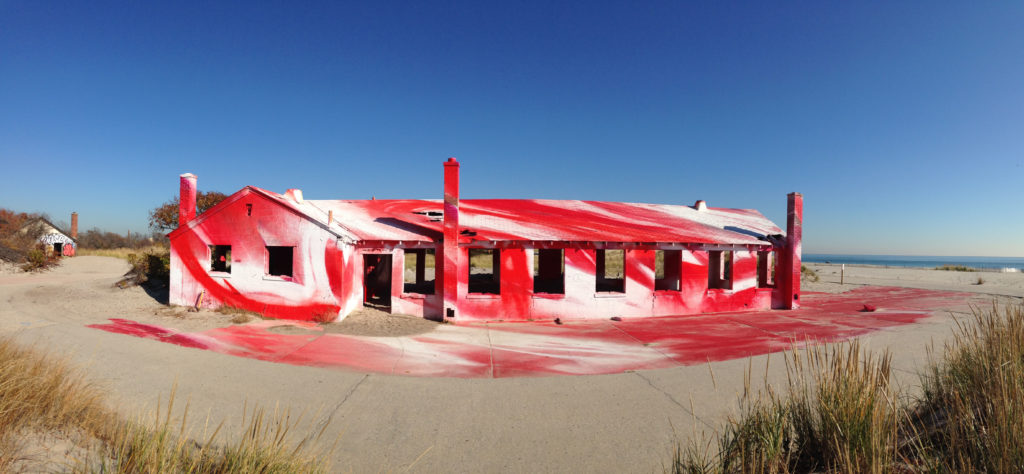
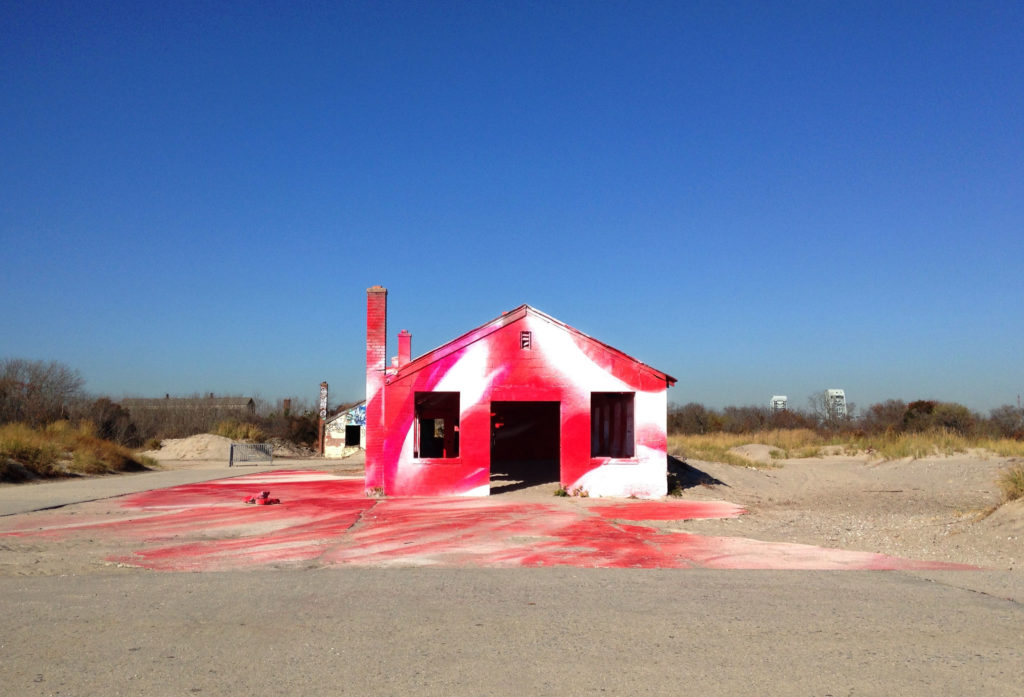
Grosse also made news this past summer with her installation for MOMA P.S. 1, titled Rockaway!. Located at Fort Tilden, she used a similar technique to paint an abandoned and soon to be demolished building (due to being structurally unsound after Hurricane Sandy).

 Grosse’s gallery exhibition closes this weekend, 3/11/17.
Mar 042017
 

                                                                         (above work by Sandra Low, Steve Seleska, and Amy Kaps)

Currently at Walter Maciel Gallery is With Liberty and Justice for Some, for which the gallery invited artists from across the country to do 8×8 inch portraits of individuals who came to the United States as immigrants- including historic subjects, personal friends, relatives, strangers, and sometimes self portraits. The gallery is also donating a portion of each sale to various non-profit groups including ACLU, Planned Parenthood, The Trevor Project, Center for Reproductive Rights, and the LA and SF LGBT Centers. Also showing at the gallery is I.D. Please!, with works by artists Hung Liu, John Bankston, Lezley Saar, John Jurayi, Maria E. Piñeres, Nike Schröder, Dana Weiser and Monica Lundy, who have all developed studio practices based around notions of identity.

This exhibition closes 3/4/17.

Also closing this weekend in Culver City-

Egan Frantz‘s The Oat Paintings at Roberts & Tilton

(image above via Roberts & Tilton)

And at Kopeikin Gallery are Ardeshir Tabrizi‘s Observations in Linear Time (palm tree), and Jason Engelund‘s Meta-Landscapes and Visual Ambient Drones (blue).

Ardeshir Tabrizi

Jason Engelund

(images via Kopeikin)

Feb 182017
 

                                                                                        Rest During The Flight Into Egypt, 2016

                                                                                           The Alpine Retreat, 2016
Many of Adrian Ghenie’s oil paintings take up their own wall in Pace Gallery and it is hard not to be drawn in by the bold colors and the blend of figuration and abstraction. The exhibition also includes some of his smaller collage pieces, which help to show Ghenie’s process for creating this work, and three of his self portraits.

From the press release-

Born in 1977 in Baia Mare, Romania, Adrian Ghenie was formally trained as a representational painter. He adopted conceptual tendencies from Dada that he synthesizes with his rigorous technical abilities, displaying both a Baroque mastery of chiaroscuro and a gestural handling of paint indebted to Abstract Expressionism. In 2008, Ghenie’s paintings began to explore themes of history, memory, and the former Communist regime of his native Romania, not through biographical reflection but rather through a direct address of the legacies of historical figures. The imagery in his paintings is largely derived from historical sources incorporated into dreamlike or cinematic vignettes in which figures appear in haunting interiors.

This show closes 2/18.

Feb 182017
 

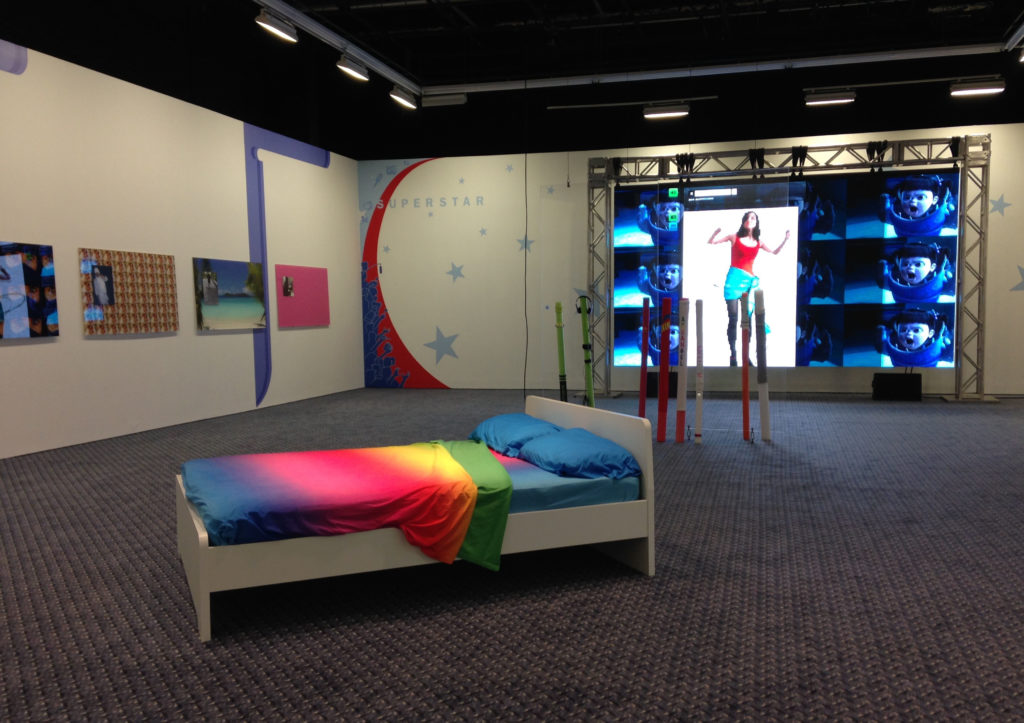
For Cory Arcangel and Olia Lialina’s exhibition at The Kitchen, Asymmetrical Response, the early days of the internet come to life in various artworks. The carpet is made of a diamond plate pattern that used to be a common background on 1990s websites and the wallpaper uses patterns from early Yahoo templates. One of the most interesting pieces is Lialina’s Give me time/This page is no more, a slide projection of former popular hosting site Geocities’ members home pages that promise a site they will create or come back to in the future. It’s hard not to look at these pages and wonder how soon what we are seeing now on the web will seem as antiquated as these images.

From the press release-

In military parlance, the terms asymmetrical and symmetrical are employed to refer to political provocations and diplomatic démarches, escalation and tension, and power dynamics of the highest order. Not specific to war, these terms also refer more generally to a set of relations that define our connections to power.

On the eve of Y2K, Russian­-born Olia Lialina—who is among the best-known participants in the 1990s net.art scene—first met American artist Cory Arcangel. Ever since, the artists have been deep in dialogue about the social and cultural impact of the Internet’s historical shift from a tool for military communication to an “information superhighway” promising open and equal exchange, and, finally, the increasingly asymmetric “content delivery system” we experience today.

This show closes 2/18/17.

Feb 122017
 

Jamie xx- Gosh

The Grammy Awards are tonight and the above video is one of the nominations for Best Music Video. It was directed by Romain Gavras, son of Costa-Gavras who has made numerous feature films, including Z and Missing, which won an Academy Award for Best Adapted Screenplay. Romain Gavras has received a lot of attention in the past for his more violent videos including Born Free for M.I.A., which depicts a military attack on red haired people, and Justice’s Stress, which focused on a Parisian youth gang. The video for Gosh takes place in the Chinese city of Tianducheng. The city was built to replicate Paris and to house 10,000 residents, but its current population of about 2,000 gives it a ghost town quality which adds to the eeriness of this video.

For a more on the making of Gosh– here is a behind the scenes look, which includes a scene of the children’s hair being bleached (and only for that day!)-

For even more information, Dazed has an interesting article on Gosh, the director’s previous work, and an interview with Gavras.

Feb 112017
 

                                                                            Rodeo 10, 2016 (Photo credit Jeff McLane)

                                                                       Hillary Clinton, 2016 (Photo credit Robert Wedemeyer)

Karl Haendel‘s solo exhibition BY AND BY at Susanne Vielmetter Los Angeles Projects, is a collection of  highly detailed drawings mixed with earlier work made in 2000, and a new video piece. Included in the earlier work is State Motto Map, a colorful map of the United States, with each state’s motto labeled on it. Washington State’s motto is Alki, or Al-ki, a Native American word meaning bye and bye, and is where the title of this exhibition is drawn from.

From the press release–

In this exhibition, Haendel uses the idea of the portrait to explore contemporary definitions of masculinity, power, and public identity. He undertakes the challenging task of drawing a portrait of what it is to be a man, or perhaps what is expected of men, in images that span a broad range of representations from the heroic to the abject, from the depiction of male achievement in the highest ranks of power to a raw and unsympathetic examination of a middle-aged convicted sex offender. An inquiry into what represents masculinity also requires a look at the conventions of gender representation, as masculinity and femininity have so long been defined, particularly in images, as a codependent set of complimentary traits. In “By and By” Haendel both reasserts and undermines these conventions in heroic portraits of teenage girls riding rodeo, reproductions of murals depicting black civil rights leaders, and a monumental portrait of Hillary Clinton. His drawings and his video work against a tradition of portraiture that collapses individuals into ciphers and symbols that read as shorthand for historical legacies and narrative tropes.

This show closes 2/11/17.


(images via Susanne Vielmetter Los Angeles Projects)

Feb 112017
 

                                         Jonathan Horowitz– Does she have a good body? No. Does she have a fat ass? Absolutely. 2016

For their current exhibition, Petzel Gallery decided to focus on the issues raised by the recent election by having a group show related to that theme. In addition they are encouraging visitors to “write down their reactions, thoughts, anxieties, hopes for the future.”

There is a lot of great work in the show by a long list of artists that includes Barbara Kruger, Robert Longo, Glenn Ligon, Jenny Holzer, Charles Gaines and Sam Durant.  Although it can be exhausting these days to follow politics, it is encouraging to see creative expression thriving in the midst of the chaos.

Jan 282017
 

This is the last weekend to see Kerry James Marshall:Mastery at Met Breuer in New York, definitely one of the best exhibitions I saw in 2016.

Here is Met Breuer’s overview of the exhibition-

This major monographic exhibition is the largest museum retrospective to date of the work of American artist Kerry James Marshall (born 1955). Encompassing nearly 80 works—including 72 paintings—that span the artist’s remarkable 35-year career, it reveals Marshall’s practice to be one that synthesizes a wide range of pictorial traditions to counter stereotypical representations of black people in society and reassert the place of the black figure within the canon of Western painting.

Born before the passage of the Civil Rights Act in Birmingham, Alabama, and witness to the Watts rebellion in 1965, Marshall has long been an inspired and imaginative chronicler of the African American experience. He is known for his large-scale narrative history paintings featuring black figures—defiant assertions of blackness in a medium in which African Americans have long been invisible—and his exploration of art history covers a broad temporal swath stretching from the Renaissance to 20th-century American abstraction. Marshall critically examines and reworks the Western canon through its most archetypal forms: the historical tableau, landscape and genre painting, and portraiture. His work also touches upon vernacular forms such as the muralist tradition and the comic book in order to address and correct, in his words, the “vacuum in the image bank” and to make the invisible visible.

The exhibition runs concurrently with Kerry James Marshall Selects, a room curated by Marshall, of work from the Met collection “ranging from the Northern Renaissance to French post-Impressionism, and from African masks to American photography of the 1950s and ‘60s, underscoring the global and historical nature of the influences that are predominant in his practice”. This is a wonderful addition that adds another layer of perspective to the work.

Taking up two floors of the building, and with work that is often filled with detailed imagery, make sure to leave enough time to take it all in.

For more information on the artist, this New York Times article discusses the retrospective, the artist’s history, and includes quotes from an interview the author had with Marshall in his studio.

This exhibition closes on 1/29/17. If you are in Los Angeles, or visiting, it will open at MOCA Grand Avenue on March 12, 2017.


(Image courtesy of Museum of Contemporary Art Chicago. Photo by Nathan Keay)

Dec 222016
 

terrywintersatmatthewmarks

terrywintersyellowmatthewmarks

To keep these posts a little shorter, I have split them up into two parts. The following continues the list of Chelsea exhibitions-

Terry Winters‘ vibrant paintings at Matthew Marks Gallery are made up of layers of marks in oil, resin, and wax.

From the press release-

“These recent paintings are a series of accumulations,” Winters says. “There’s a range of paint application in terms of both material and technique. Each color is a marker, a stage of development. I’m moving across the surface, modulating the material in different ways. That inflection produces an amplification of colors, both physical and chemical. But color is basically wild and full of surprises.”

padraigtimoneyatandrewkrepsgallery

Pádraig Timoney‘s work in The Deedle Eye, at Andrew Kreps Gallery, is a diverse combination of painting, photography, and installation.

From the press release-

Despite the visually distinct results, at the work’s core is a focused inquiry into the mechanics of images. Timoney conversely works in both directions – creating new images from abstractions (the captivating results of processes achieved in the studio), or rebuilding them part-by-part from photographs or observation. In each, he acknowledges the inherent flaws of these constructions, from the faultiness of recognition, the errors of translation, and further, the subjectivity of both viewers and the artist.

These in turn become generative openings in Timoney’s work as they are distanced from their original context. The images exist within thrilling, new visual constellations, allowing for the introduction of artifice and illusion, and the question of not only what they depict, but why? Each work records an index of decisions that determine its final state, materially and cognitively, displaying a history that is intentionally left open-ended. Figuration appears to hover only a hair away from abstraction, as if the movement of a line would cause one to collapse into the other. The narrowing of this gap suggests that the works’ initial disparate appearance may lead to an alternate understanding of their connections; a net that widens only to close anew, though what’s caught within it is left for the viewer to decide.

Also make sure to go to the space next door to see Klaus Weber’s sculpture Emergency Blanket.

klausweberatandrewkreps

Ai Weiwei has four shows up in NYC right now. Two of which are in Chelsea, at Mary Boone Gallery and Lisson Gallery, one is at the Mary Boone Gallery uptown, and one is at Deitch Projects in SoHo. Mary Boone Gallery and Lisson are both showing Weiwei’s Roots and Branches work, which includes large scale sections of dead trees, sometimes like the one seen below in cast iron at Lisson, and a 25 foot sculpture made up of tree parts bolted together. The uptown gallery includes a circle made up of 40,000 spouts broken off from Chinese teapots. Deitch Projects gallery has Laundromat, in which Weiwei has arranged items of clothing left behind by Syrian refugees (after they were forced to leave camps near the border of Greece) that he collected and laundered.

aiweiweilissongallery