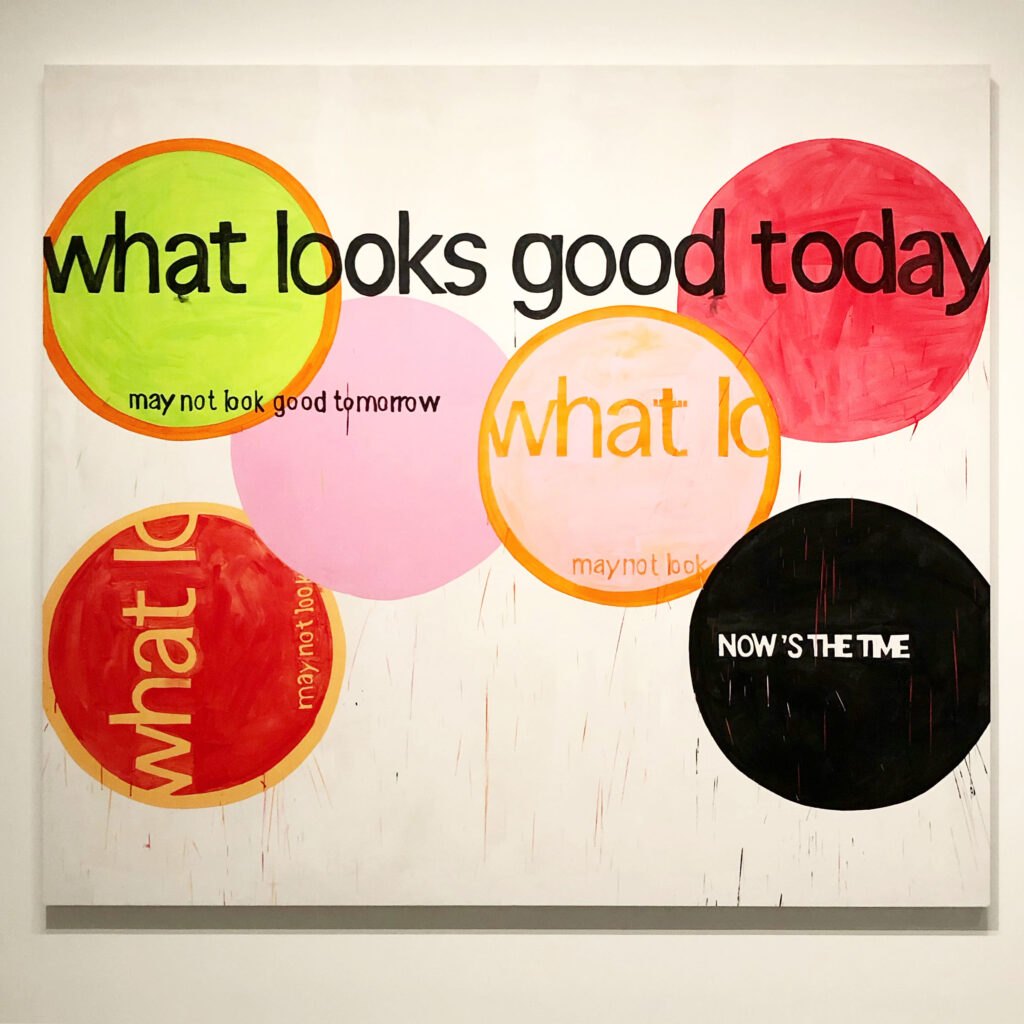
Michael Majerus‘ what looks good today may not look good tomorrow, 2000, currently on view at Museum of Modern Art in NYC.

Michael Majerus‘ what looks good today may not look good tomorrow, 2000, currently on view at Museum of Modern Art in NYC.
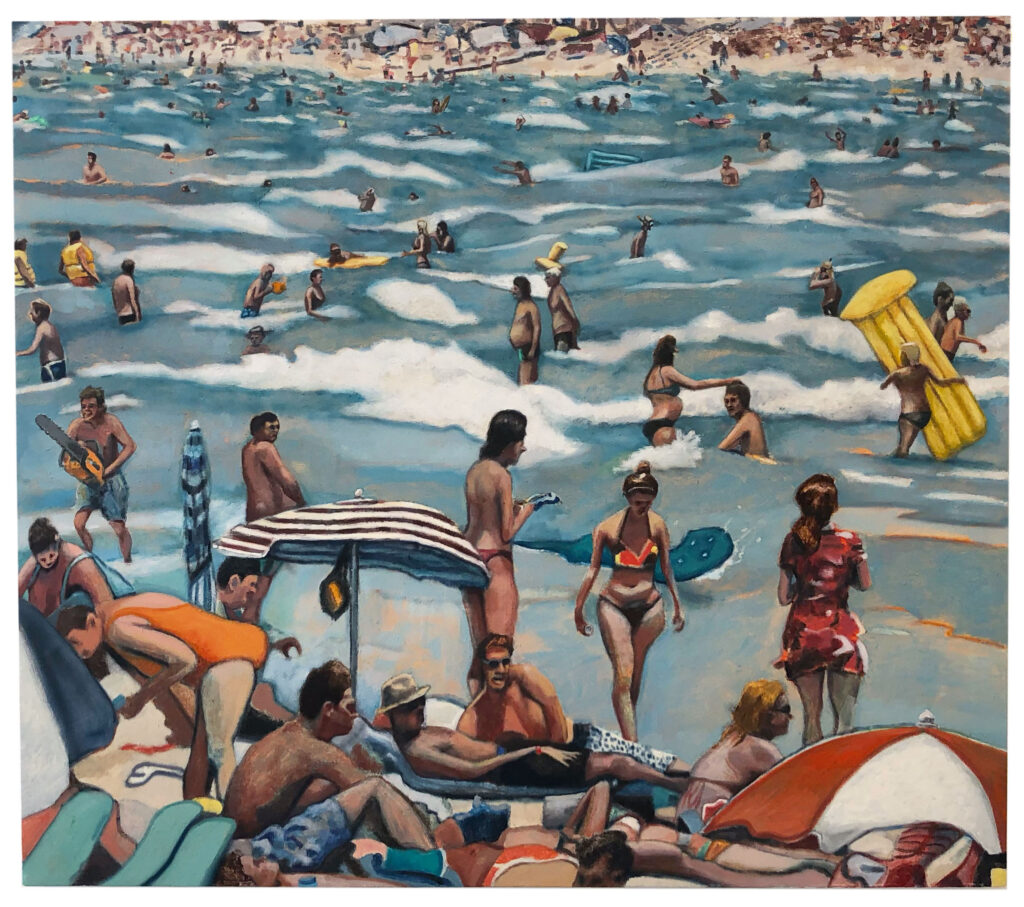
This painting, Reverse Beach, 2019, is from Rob Thom’s exhibition at M+B Los Angeles, The Beast. Thom’s vision of American life takes on many forms, often focused on its more absurd qualities.
For more about his work, check out his interview at Interlocutor or his Instagram.
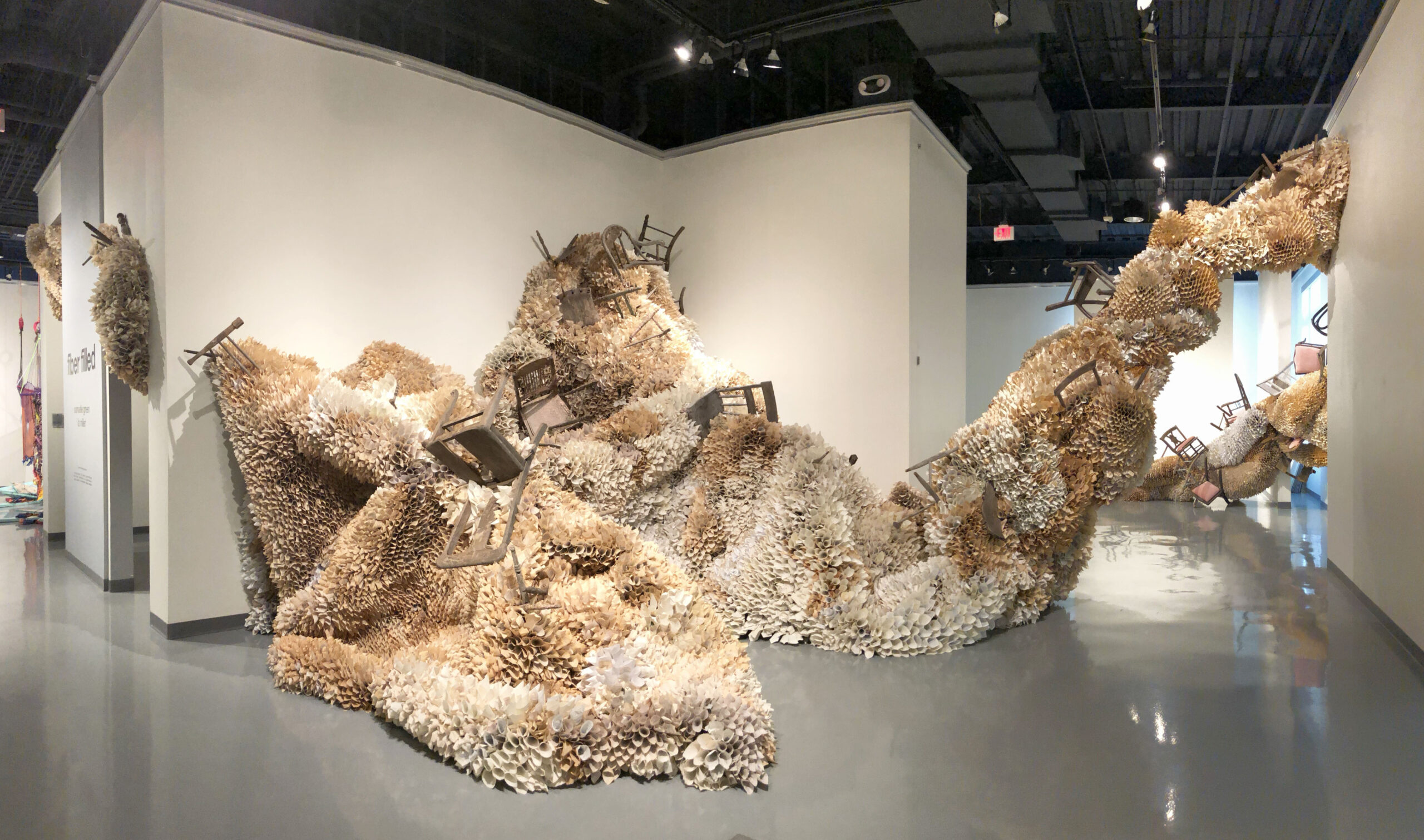


Currently at the Spartanburg Museum of Art in South Carolina is fiber filled, an exhibition consisting of two art installations. The one pictured above is by artist Samuelle Green, titled Manifestation 8: Permutation 1.
Her statement about the work-
There is structure and design inherent in the natural world, which we constantly draw from and take for granted. We generally fail to acknowledge the skill, time, and detail required to manifest the intricate structures found in objects we encounter regularly- such as those found in bird and wasps nests, beehives, spiderwebs, rock formations, anthills, feathers, etc.
My work, especially the large scale installations like this one, reference these natural forms as they merge with human-made objects, inspiring contemplation.
Also check out the museum’s site for a short video from the artist going into more detail on her process.
The other installation is by Liz Miller, titled Alchemical Conundrum, part of which is seen below.

Her statement about the work-
My work explores the fallibility of infrastructure and the precariousness of perceptions, as seen through a materially-intensive process-based lens. I create elaborate site specific installations that are equal parts absurd, menacing, and poetic. Pattern and tactility confuse and complicate identification, camouflaging recognizable forms and evoking recognition when applied to non-objective forms. The tensions between fact/fiction and dimensionality/flatness are endlessly fascinating to me, playing out my work as a dialogue between reality and illusion.
More recently I have become fascinated with rope and knotting as a byproduct of my large-scale installations, where I utilize rope to achieve tension that gives volume to otherwise flat materials. The varied use of rope and knotting across cultures and history ranges from utilitarian to decorative, and even deadly. I create interdependent knotted topographies that allude to both structure and malleability. The repeated act of tying by hand integrates an emphatic sense of strength, while the flexibility and nuance of the textile material ensures structural permutations. The resulting works are only quasi-architectural providing metaphorical insight laced with humor as related to a variety of structural and systemic behavior.
This exhibition closes 6/30/21.
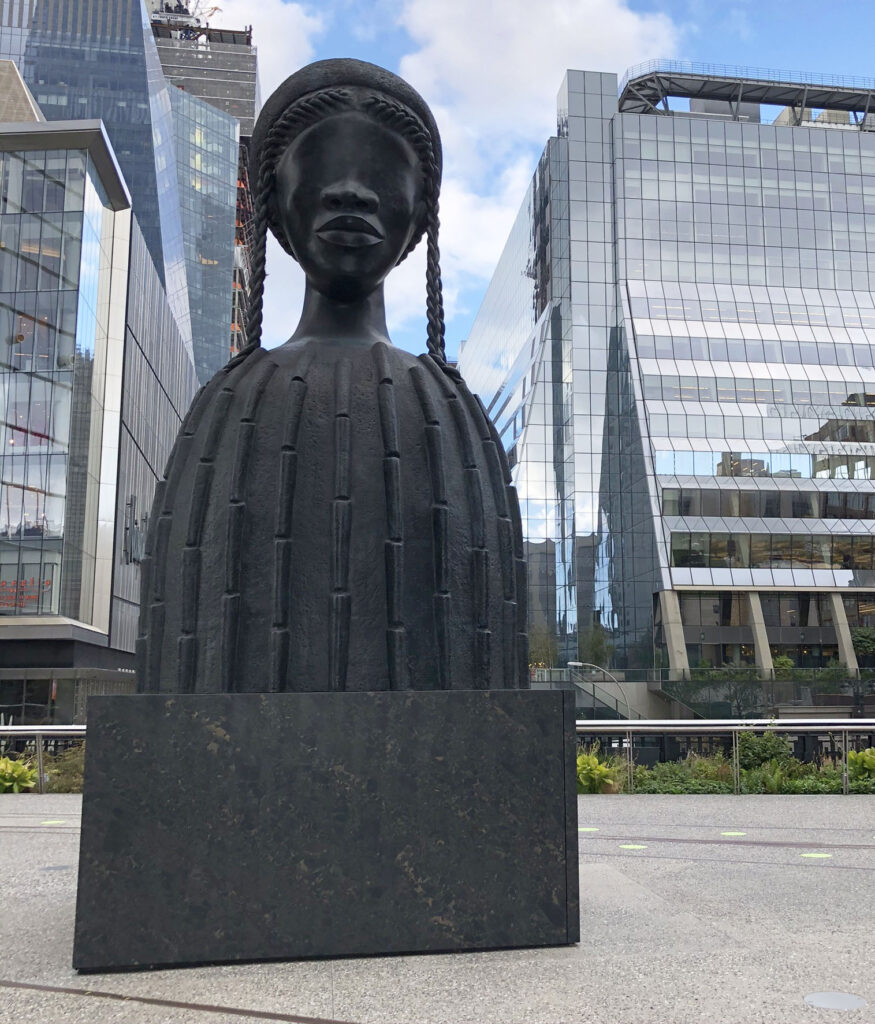
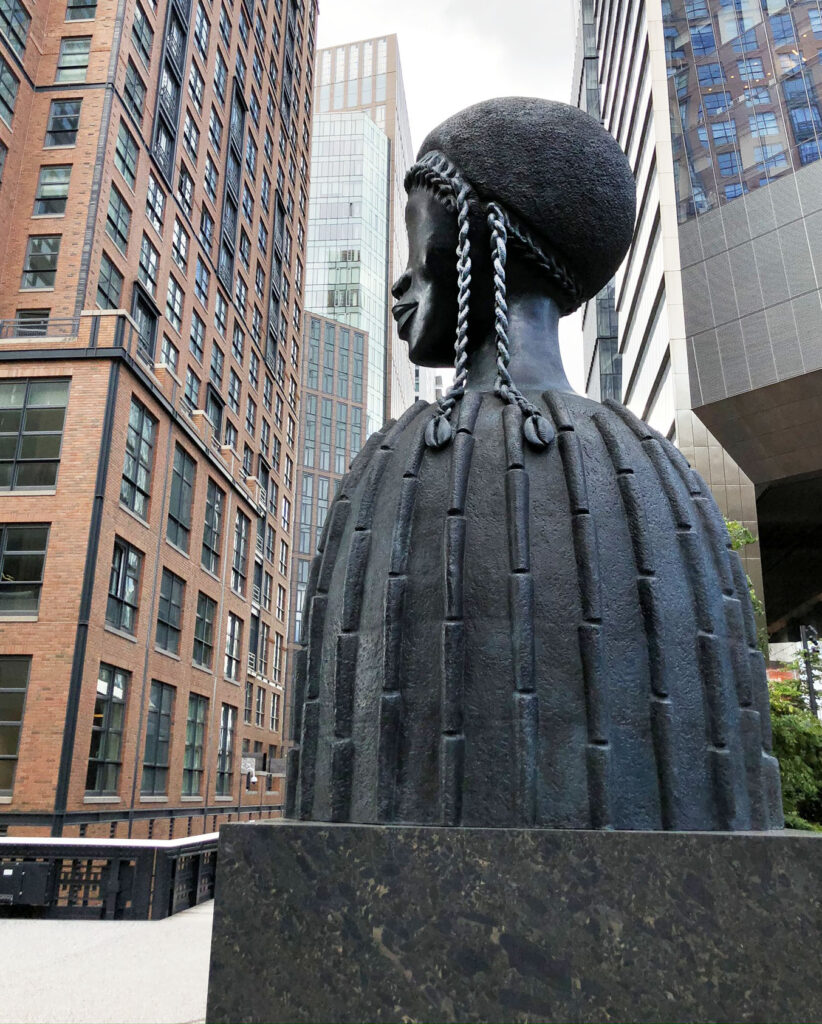
From The High Line’s information page on this work-
Simone Leigh presents Brick House, a 16-foot-tall bronze bust of a Black woman with a torso that combines the forms of a skirt and a clay house. The sculpture’s head is crowned with an afro framed by cornrow braids, each ending in a cowrie shell. Brick House is the inaugural commission for the High Line Plinth, a new landmark destination for major public artworks in New York City. This is the first monumental sculpture in Leigh’s Anatomy of Architecture series, an ongoing body of work in which the artist combines architectural forms from regions as varied as West Africa and the Southern United States with the human body. The title comes from the term for a strong Black woman who stands with the strength, endurance, and integrity of a house made of bricks.
Brick House references numerous architectural styles: Batammaliba architecture from Benin and Togo, the teleuk dwellings of the Mousgoum people of Cameroon and Chad, and the restaurant Mammy’s Cupboard in Natchez, Mississippi. The sculpture contrasts sharply against the landscape it inhabits, where glass-and-steel towers shoot up from among older industrial-era brick buildings, and where architectural and human scales are in constant negotiation. Resolutely facing down 10th Avenue, Leigh’s powerful Black female figure challenges us to consider the architecture around us, and how it reflects customs, values, priorities, and society as a whole.
Leigh works across sculpture, video, installation, and social practice, stitching together references from different historical periods and distant geographical locations. As a sculptor, Leigh works predominantly in ceramics—a medium that she mastered early in her career—continually pushing the boundaries of her chosen material by working in new methods and larger scales. In her intersectional practice, Leigh focuses on how the body, society, and architecture inform and reveal one another. She examines the construction of Black female subjectivity, both through specific historical figures such as Josephine Baker and Katherine Dunham, and more generally through overlapping historical lineages across Europe, Africa, the US, and the Caribbean.
The High Line’s website also has some excellent videos and additional information on the making of the sculpture well worth checking out. This work was on view until May of 2021.
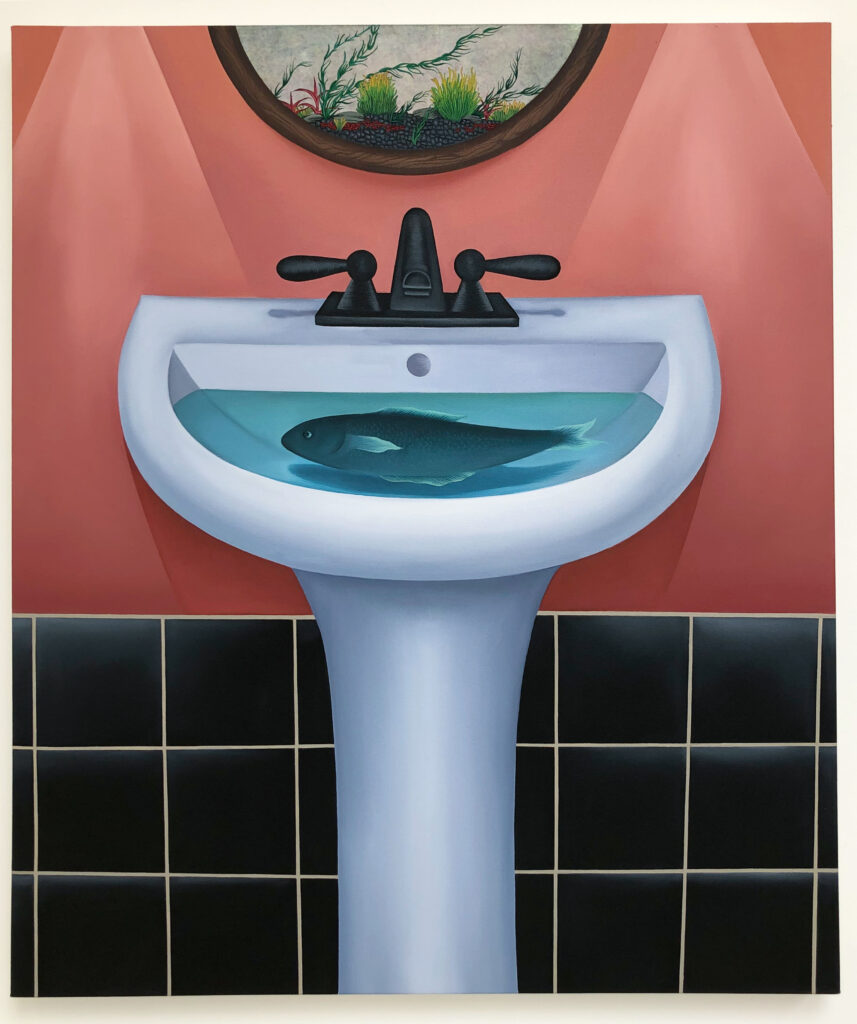
Quarantine, 2018
This painting is from Julie Curtiss’ exhibition Altered States at VSF gallery in Los Angeles in 2018.
From the press release from that show-
Depicting mostly female subjects in her works, Curtiss creates an undulating dreamscape where the depths of a woman’s psyche are as important and palpable as her body. Rife with swirling curvatures and oscillating lines that convey both physical movement as well as cognitive dissonance, Curtiss’ subjects are secretive and faceless, inhabiting uncanny narratives driven by the logic of dreams. Teetering between dichotomies of seduction and repulsion, feral and domestic, their countenances are strategically concealed with thick mounds of serpentine hair, clawed hands and razor-sharp nails that conjure the anatomy of cold-blooded beasts. For Curtiss’ latest series of paintings and gouaches on paper, marine imagery permeates the narratives: koi, lotuses, fishtails in lieu of feet, a lobster claw clasping a glossy manicured finger … a nod to the 1980s science-fiction film “Altered States,” whose protagonist descends into a bottomless search for the self by way of floatation tanks – sensory deprivation chambers filled with body-temperature saltwater (water being the Jungian dream symbol for the unconscious). While Curtiss invites us to dive deeper into the layered, mercurial mind of her subjects, we are inevitably faced with a reflection of our own subconscious.
She is currently showing her newer work, which includes sculptures, at White Cube Mason’s Yard, in an exhibition titled Monads and Dyads, closing 6/26/21.

This mural, Play Her Voice, is by one of Afghanistan’s first female street artists, Shamsia Hassani and is located in Eugene, Oregon.
She was also one of Hammer Museum’s resident artists in 2016. While in Los Angeles she met with local artists, painted the mural seen below (image via her website) and showed her work in an exhibition at Seyhoun Gallery in West Hollywood.

Make sure to check out her Instagram for updates on her current work.

Bluff, 2019
This painting is from Jarvis Boyland‘s 2019 solo exhibition, On Hold at Kohn Gallery in Los Angeles.
From the press release-
Born and raised in Memphis, TN, Boyland navigates intersections of black identity through portraiture. His paintings focus on queer men of color within intimate spaces. Boyland sees the domestic space as the foundation of social ideologies and an incubator that molds the facade of masculinity. Based on photographic images that the artist reconfigures to create specific compositions, Boyland’s paintings sensitively highlight the nuances of these complex interpersonal relationships, identities, and locales.
The idea of comfort is a recurring theme in Jarvis Boyland’s work. The complex intersections of blackness and queerness shape his delicate renderings of the black male body in repose. The figures in On Hold: dream big and beautifully, yet they are fully grounded and aware in their leisure. Boyland’s palette suggests stillness in the digital age of app culture that shapes modern interaction while evoking David Hockney’s 1970s California and the coolness of Barkley Hendricks. Black bodies are not welcomed in cyberspace but are privileged in Boyland’s paintings. Expectations, aspirations, and dreams that infuse queer experiences come into focus. Situated within domestic environments, Boyland’s paintings emphasize limpness through intimate gestures of distant closeness, overlapping satin garments, and a seemingly shared vanishing point. Coy yet cocky, pretty and promiscuous, commanding yet chaste––luxury is embodied by the three figures waiting on the phone with varied expressions in these slumber-party-themed works. There is tense correspondence, a deliberation about relationships within the group of artists pictured, all of whom grew up in the American South: D’Angelo Williams, Cameron Clayborn, and Jarvis Boyland. Skowhegan School of Painting and Sculpture brought these artists together and influenced the tone of this series. On Hold: expands Boyland’s oeuvre of queer relationships. Through his aperture, Boyland’s group and individual portraits collectively depict an idyllic sensibility towards reality.

Potatoes, Grapes, and a Lemon, 2019

Pear and Cherry Juice, 2019
These paintings are from Holly Coulis‘ 2019 exhibition Stilly at Philip Martin Gallery.
From the press release–
Holly Coulis’s paintings operate as stages where still life scenes unfold. A table, or tables, create an initial structure where simplified, geometric forms are arranged and interact. There is a sense of order in these scenes as though the fruits and dishes had been laid out by some external force. Through layers of paint, linear elements are created, giving the illusion of colorful stripes or energy fields around individual objects. These works feel familiar, but upend our sense of figure/ground, horizon-line, perspective, and scale. In these newest paintings, the still life begins to verge into abstraction.
Coulis works from a visual vocabulary built up over years of practice, and the sense of discovery and newness in her works occurs as she continues to explore her own paintings and their possibilities: “I rarely look at a scene. It’s more about shapes of things I know. Things like oranges, lemons, cherries: they’re all very easy shapes.” Standing in front of her works, we are immediately involved in a scene of pleasure and abundance, surprise and stimulation – a stimulation that is physical, intellectual and aesthetic.
Her new exhibition, Orbit, which also includes her sculptures, is currently on view at the same gallery in Culver City until 7/2/21.
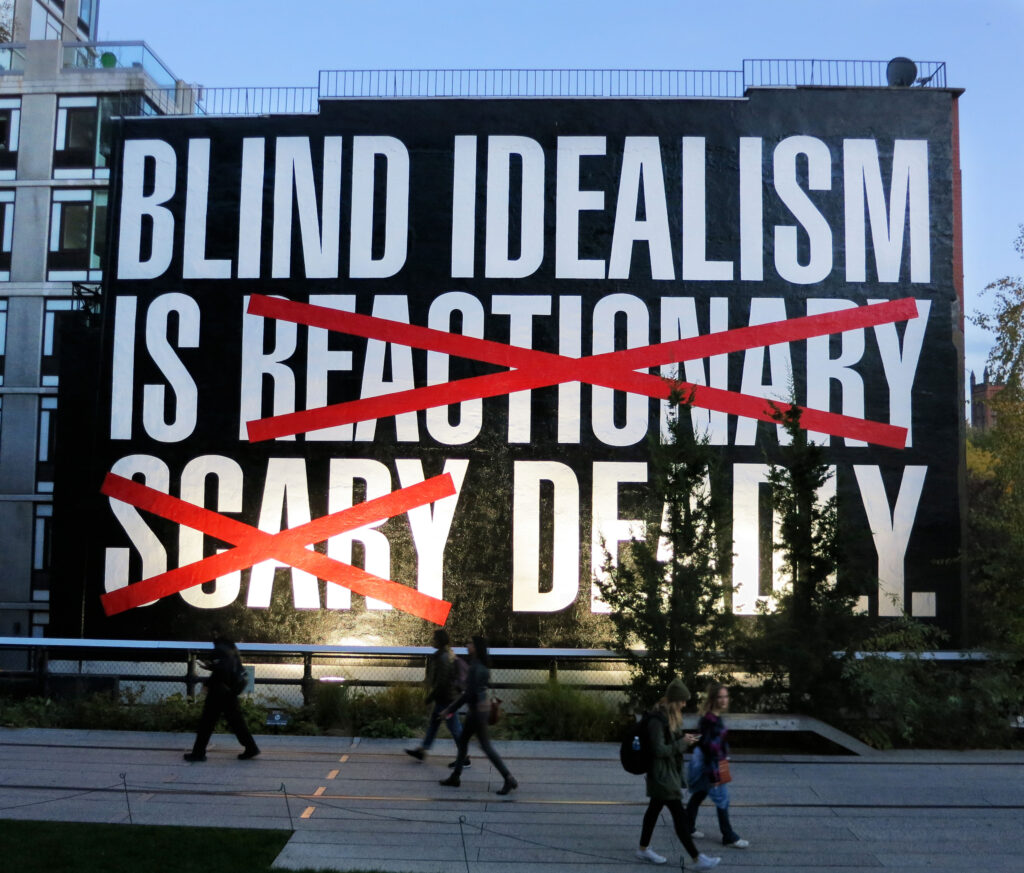
Barbara Kruger designed this mural, Untitled (Blind Idealism Is…) for the High Line in 2016. It is based on the quote “Blind idealism is reactionary” by Afro-Caribbean psychiatrist and political philosopher Frantz Fanon.
From the High Line website-
The original statement by Fanon, “Blind idealism is reactionary,” suggests that political and religious convictions stem from the situations from which they grow, not from the inherent nature of individual human beings. According to Kruger, the work reflects “how we are to one another” within “the days and nights that construct us.” These texts, along with Kruger’s own writings, resonate with particular potency in today’s political climate.
For more on this work at the time it was made, check out this interview with Kruger by The Intelligencer at New York Magazine.
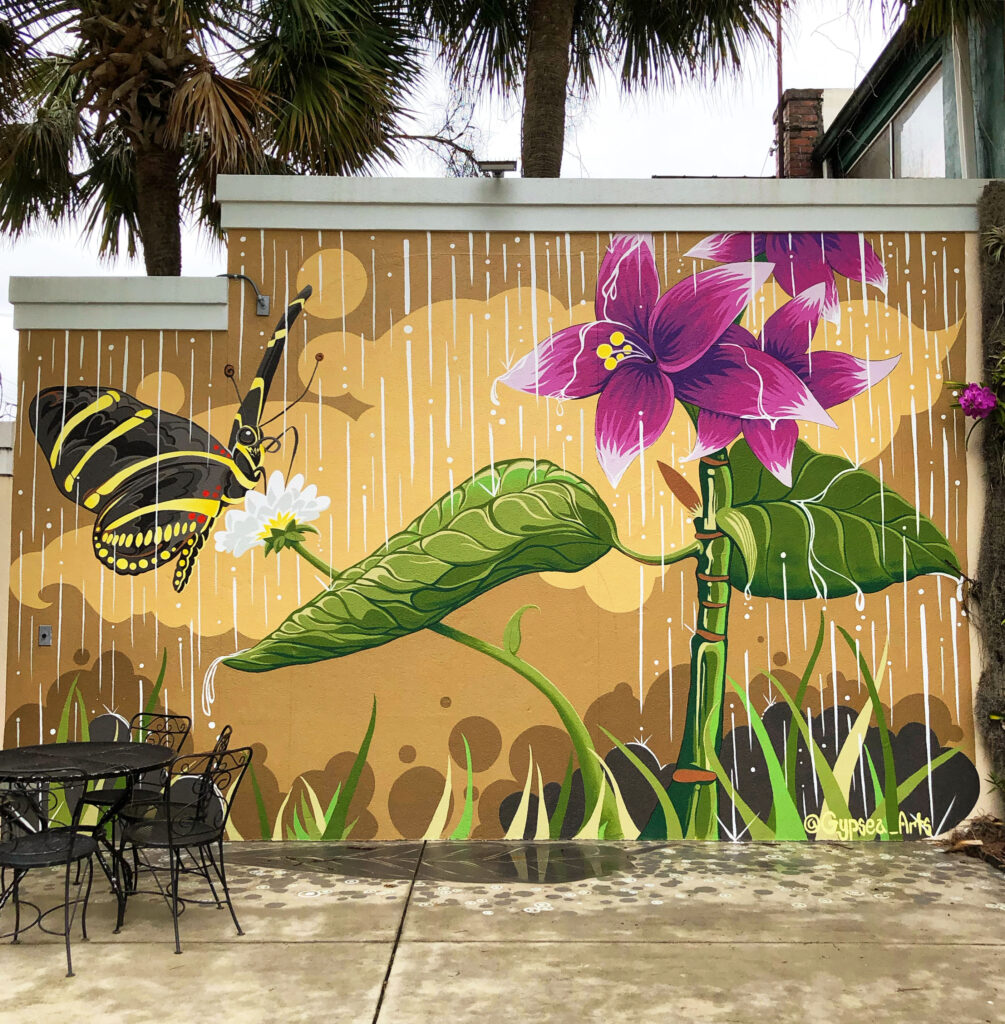
For more of Justin Alsedek’s work check out his website.
If you are looking for more information about the arts in Ocala/Marion County, check out Marion County Alliance and their gallery Brick City Center for the Arts.