Jul 062026
 

Mexican artist Frida Kahlo was born today, July 6th, in 1907. She painted many self-portraits, including the one pictured above, Me and My Parrots (Yo y mis pericos), from 1941. The painting was on view as part of the 2020 exhibition Vida Americana: Mexican Muralists Remake American Art, 1925–1945 at the Whitney Museum in New York.

Her work can currently be seen in the exhibitions Frida: The Making of an Icon at the Tate Modern in London and Frida and Diego: The Last Dream at the Museum of Modern Art in NYC.


Nov 272023
 

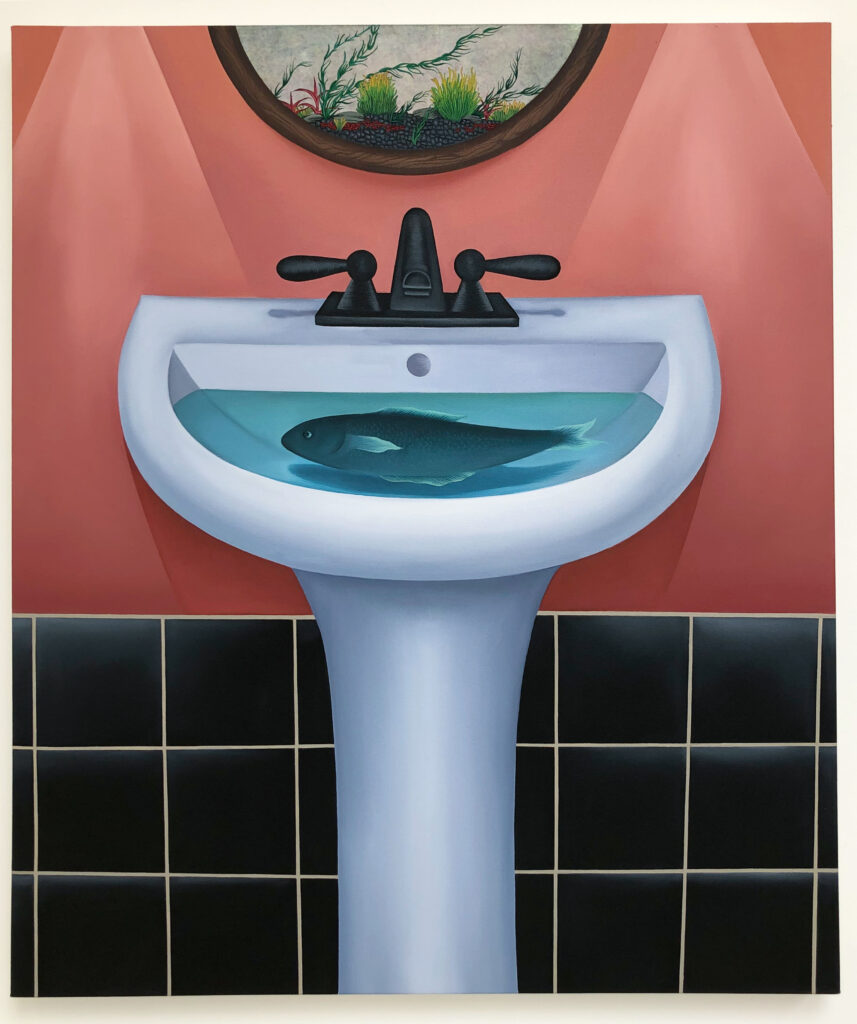
Tonight is the penultimate full moon of the year, so it seemed like a good moment to post this painting, The Real Realities 2, 2013, by Friedrich Kunath. It was on view in 2019 at the Marciano Art Foundation in Los Angeles which after abruptly closing due to a labor dispute, appears to have reopened.

The Art of Surviving November, Kunath’s inaugural solo exhibition at Galerie Max Hetzler’s London location, and consisting of a new body of paintings, is on view until 1/6/24.


Mar 262023
 

Kirsty Wither “Tumbling Crowd”

Yelena Lezhen “Clockwork Bird Song”

Esther Rosa “Goes around, comes around III”

This weekend is the Affordable Art Fair in NYC. It’s a chance to check out and buy art at reasonable prices.The fair goes to Hampstead, London next, and will return to New York in September of 2023.

For more on the artists pictured above and their galleries-

Kirsty Wither runs the London gallery Cameron Contemporary with her husband, Robin Cameron.

Yelena Lezhen’s work was shown by Barcelona gallery Manifest Destiny Art. Check out her Instagram for current work.

Esther Rosa’s sculpture was part of InSight Artspace’s booth. Her Instagram is also a good place to see her work.


Aug 112022
 

cave, 2019, from Billy Childish’s 2020 exhibition remember all the / high and exalted things / remember all the low / and broken things at Lehmann Maupin’s NYC gallery.

From the press release-

For his fifth exhibition with the gallery Childish has created a body of work emblematic of his “radical traditionalist” approach. Pulling from themes found throughout art history—the bather, a lone figure in a landscape, a sunset—Childish presents intensely personal vignettes that feel archetypical, vibrating with the kinetic energy of a moment lived…

While working in a state of flow is essential to the creative process of any artist, for Childish this state represents the entirety of artistic production. Working intuitively and quickly, most of his highly gestural paintings are created in a single session without any revision. Childish is also an adept woodblock printer and he produces satirical and activist imagery with his London art cooperative, L-13 Light Industrial Workshop. His material approach to printmaking extends to Childish’s painting practice where color and line are emphasized through a flattening of each composition. His style is often compared to the expressionist painters of the early 20th century, such as Vincent Van Gogh, Kurt Schwitters, or Edvard Munch, however, for Childish, it is the embodiment of these artists’ roles within society that is most compelling. An unabashed universalist, Childish considers artistry to be the inheritance of every human being, a method to capture the expressive impulse and visualize the powerful lure of beauty.

Utterly unironic and vividly familiar, a Childish painting can be interpreted the way one might interpret a dream. In one painting, a woman swimming underwater may represent the unconscious, while in another painting, a woman wading out to a cave could represent the dark entry into the unknown. For the artist, the conceptual should never replace the humanistic—Childish states “I make a picture in the same way a child does—something ‘out there’ interests me. Making a painting of that ‘something’ then joins me with the universal creator/creation in a more intent way than just being an observer.”

Childish is currently showing new work at Lehmann Maupin’s London location until 9/3/22.


Jul 282021
 

Texas Louise, 1971

Where is Lucienne?, 1971


Where is Lucienne? (detail), 1971

Where is Lucienne? (detail), 1971

Frank Bowling’s incredible paintings are currently on view at two of Hauser & Wirth’s locations, London and NYC, reflecting the artist’s time living in both cities. The paintings above are from the New York location.

From the press release-

The exhibition charts Bowling’s life and work between the UK and the United States. Born in Guyana (then British Guiana) in 1934, Bowling arrived in London in 1953, graduating from the Royal College of Art in 1962. He later divided his time between the art scenes in London and New York, maintaining studios in both cities. London is the city where Bowling trained as a painter and achieved early acclaim. New York is the city that drew him to itself at the height of the Civil Rights movement, where he became involved in discussions of Black Art – New York was a place of fresh energy and ideas for an artist in search of new ways to make paintings.

Bowling’s transatlantic orientation reveals itself in a shift from his early engagement with expressive figuration and pop art, to an immersion in a uniquely poetic abstraction that continues to evolve even today. Visible in his work are the legacies of both the English landscape tradition and American abstract expressionism. Developing in and between two cities over the course of decades, Bowling’s exploration of light, colour, and geometry can be understood as profoundly influenced by the two great rivers of his life: he has maintained studios close to The Thames in London and the East River in New York, absorbing the brilliance of the rivers’ light into his vision. Bowling would often begin a work in one city and finish it in the other, merging the atmospheres of both. In his own words, ‘I would just roll the lot up and move. And I knew that when I got to the other end, I could roll them out again and continue to work.’

Bowling’s restless innovation on the painted plane endures in his latest works. He continues to break ground through the use of thick impasto textures, acrylic gels, collage, stitched canvas, and metallic and pearlescent pigments. The complexities of his upbringing in Guyana and his constant journeying between London and New York have only served to activate the richness of the different influences of each location. His paintings are a celebration of life lived in varying lights and colours.

Jun 232021
 

Quarantine, 2018

This painting is from Julie Curtiss’ exhibition Altered States at VSF gallery in Los Angeles in 2018.

From the press release from that show-

Depicting mostly female subjects in her works, Curtiss creates an undulating dreamscape where the depths of a woman’s psyche are as important and palpable as her body. Rife with swirling curvatures and oscillating lines that convey both physical movement as well as cognitive dissonance, Curtiss’ subjects are secretive and faceless, inhabiting uncanny narratives driven by the logic of dreams. Teetering between dichotomies of seduction and repulsion, feral and domestic, their countenances are strategically concealed with thick mounds of serpentine hair, clawed hands and razor-sharp nails that conjure the anatomy of cold-blooded beasts. For Curtiss’ latest series of paintings and gouaches on paper, marine imagery permeates the narratives: koi, lotuses, fishtails in lieu of feet, a lobster claw clasping a glossy manicured finger … a nod to the 1980s science-fiction film “Altered States,” whose protagonist descends into a bottomless search for the self by way of floatation tanks – sensory deprivation chambers filled with body-temperature saltwater (water being the Jungian dream symbol for the unconscious). While Curtiss invites us to dive deeper into the layered, mercurial mind of her subjects, we are inevitably faced with a reflection of our own subconscious.

She is currently showing her newer work, which includes sculptures, at White Cube Mason’s Yard, in an exhibition titled Monads and Dyads, closing 6/26/21.